

Catherine of Braganza marries Charles II: Portsmouth, 21 May 1662
Portugal needed an ally against Spain and England's king needed money. The price was a princess, two million cruzados, Tangier and Bombay. Catherine spent thirty years in England and came home to govern her own country.
At a glance
- Catherine of Braganza, daughter of João IV and born at Vila Viçosa on 25 November 1638, married Charles II of England at Portsmouth on 21 May 1662 by the English calendar, 31 May in Portugal's.
- The marriage treaty of 23 June 1661 gave England Tangier, the island of Bombay and a dowry of two million cruzados; England promised troops and ships for Portugal's war against Spain.
- Half the dowry was due before she sailed. Portugal could not raise it in cash, and much of what went aboard was sugar and spices, to be sold in London.
- She drank tea at court and is linked to its fashion in England, but tea was on sale in London from 1658 and Samuel Pepys first tried it in 1660.
- Widowed in 1685, she returned to Lisbon in January 1693, built the Bemposta palace, governed Portugal as regent for her brother Pedro II in 1704 and 1705 and died on 31 December 1705.
Two weddings in one day
Charles II changed out of his travelling clothes before he went in to see his bride. He had driven down from London in a hurry, slept two hours on the way and reached Portsmouth at about two in the afternoon of 20 May 1662. Catherine of Braganza, 23, was in bed with a sore throat and a slight fever. They spoke in Spanish. At eight the next morning the king wrote to his Lord Chancellor that her face was “not so exact as to be called a beuty”, but that he thought himself very happy.
“If I have any skill in visiognimy, which I think I have, she must be as good a woman as ever was born.”
That morning, with almost nobody told, Catherine's almoner, Lord Aubigny, married the couple by the Catholic rite in her room. To a Catholic princess an Anglican service alone was no marriage, and the king's Protestant subjects were not to know that he had gone through a Catholic one. The only witnesses, according to the Duke of York, were her godfather, the Portuguese ambassador, three other Portuguese nobles and two or three of her women.
The public wedding followed in the main hall of the Governor's House, the king's lodging beside Portsmouth's medieval Domus Dei, now the Royal Garrison Church. The hall had been fitted out as a presence chamber. Gilbert Sheldon, Bishop of London, read the Church of England service. Both copies of the marriage contract were read aloud, Charles made his vows, and Catherine, who spoke no English, signed her consent.
She wore an English dress of rose pink trimmed with knots of blue ribbon. When it was over, Lady Suffolk cut the ribbons into scraps and handed them out to the court as keepsakes, until there were none left for the queen. In London that day Samuel Pepys heard that on the night of the bonfires for the queen's arrival there had been none at the door of Lady Castlemaine, the king's mistress, who was expecting his child, “which was much observed”.
A kingdom looking for a friend
Catherine was born at the ducal palace of Vila Viçosa, in the Alentejo, between eight and nine on the evening of 25 November 1638, the feast of St Catherine, which gave her her name. Her father was then only Duke of Braganza. Two years later, on 1 December 1640, a group of nobles in Lisbon threw off the Spanish Habsburg kings, who had ruled Portugal since 1580, and made him João IV.
Spain did not accept the loss. The war of the Restoration ran on until 1668, and when João died in 1656 his widow, Luísa de Gusmão, governed as regent for their son Afonso VI. In 1659 Spain and France made peace in the Treaty of the Pyrenees, and France could no longer openly help Portugal. The regent needed another friend.
England had just restored its own king. Charles II returned from exile in May 1660, with debts and a navy to pay for. In February 1661 the Portuguese envoy Francisco de Melo arrived in London with a generous offer. According to the Lord Chancellor, Clarendon, it was £500,000 in ready money, the North African port of Tangier, the island of Bombay and free trade with Brazil and the East Indies.
Spain's ambassador in London threatened war if Charles accepted, and the Dutch, rivals of both countries in Asia and Brazil, were hostile too. A secret assurance that Louis XIV of France favoured the match helped tip the balance, and Charles took the Portuguese offer. The two crowns had been allies since the Treaty of Windsor of 1386.
What the treaty gave away
The marriage treaty was concluded in London on 23 June 1661, and Portugal's ratification of that date is kept at the Torre do Tombo, the national archive in Lisbon. It was a military alliance as much as a marriage contract. It confirmed every Anglo-Portuguese treaty since 1641 and, in return for the dowry and two ports, committed England to fight for Portugal.
| Article | What it said |
|---|---|
| I | All treaties between Great Britain and Portugal since 1641 confirmed |
| II to IV | Tangier ceded to the English crown for ever; Catholic residents could stay or be shipped home |
| V | Dowry of 2,000,000 Portuguese cruzados: half aboard the fleet before Catherine sailed, half within a year of her arrival |
| VII | Free exercise of the Catholic religion for the queen and her household, with a chapel in every royal palace |
| VIII | A jointure of £30,000 a year and a residence for the queen |
| X | If widowed, she could return to Portugal with her jewels and goods, and still be paid her £30,000 |
| XI | The port and island of Bombay ceded, so that England could help defend the Portuguese in the East against the Dutch |
| XV to XVIII | English troops and warships for Portugal; no English peace with Spain to Portugal's harm |
| Secret article | England to defend all Portuguese colonies and to press the Dutch for peace or for the return of their conquests |
Article numbers and terms follow the English and Portuguese texts printed by Borges de Castro (1856), checked against the summary in the Marburg database of dynastic marriage contracts.
“The King of Portugal doth promise and oblige himself, by these presents, to give unto the King of Great Britain, for a portion or dowry with the said Lady Infanta his sister, two millions, i. e. 2,000,000 of crowns Portuguese.”
Paying for it was another matter. A country at war had little cash. On 10 November 1661 the regent ordered the sisa, a tax on sales, to be doubled to raise the dowry. The English took over Tangier first: the Earl of Peterborough's fleet anchored in the bay on 29 January 1662, and the next day he marched in and received the keys from the Portuguese governor.
From Lisbon to Portsmouth
When Lord Sandwich came with the English fleet to fetch the bride, the regent told him that the Spanish war had eaten into the money and she could pay only half of what was due. What came down to the ships was mostly sugar, spices and other goods. Sandwich refused jewels and would not take the goods at the Portuguese valuation. In the end he carried them as a cargo for merchants in London to sell, as the treaty allowed, and the regent gave a bond for the rest within a year. English envoys were still chasing the arrears years later.
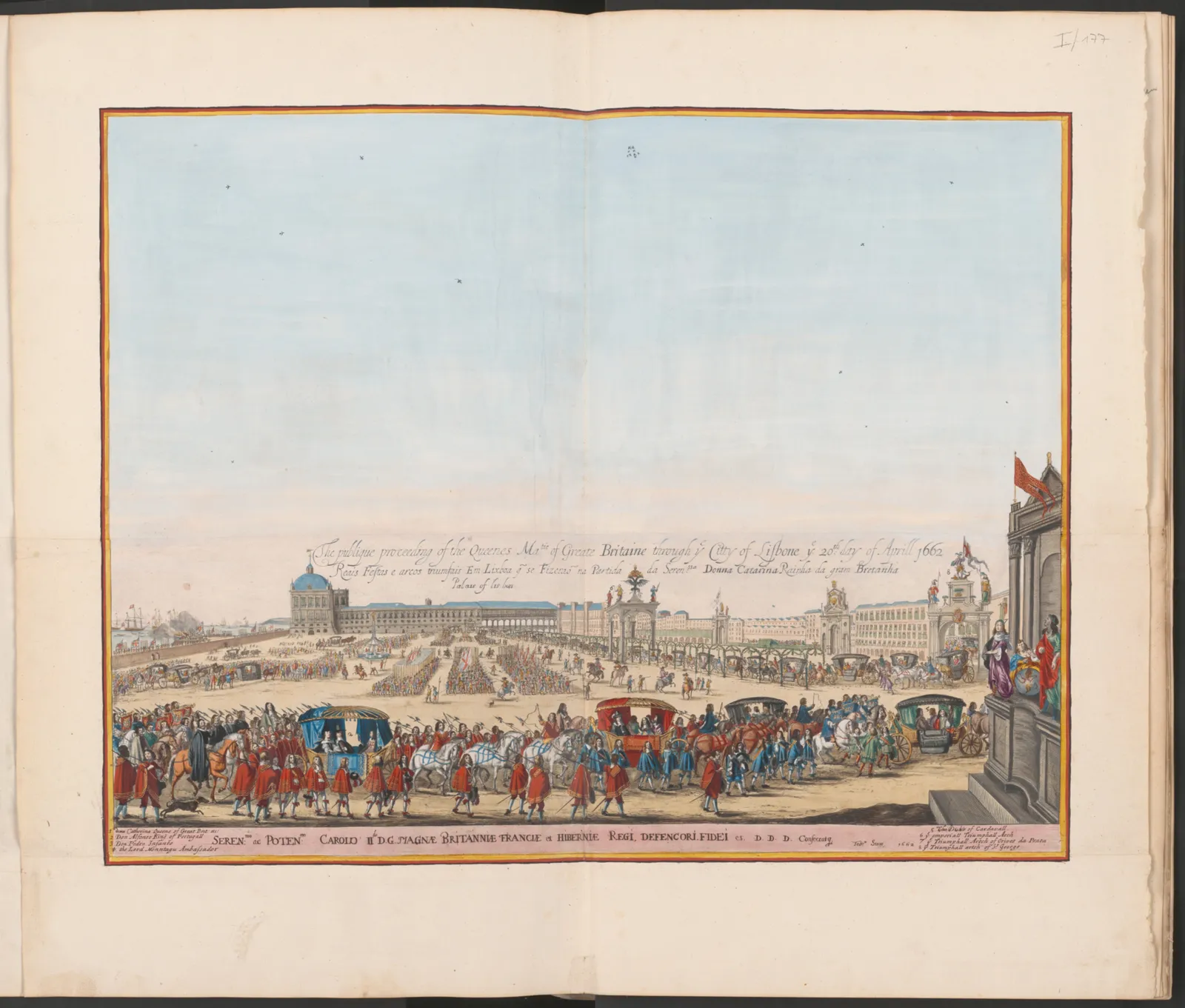
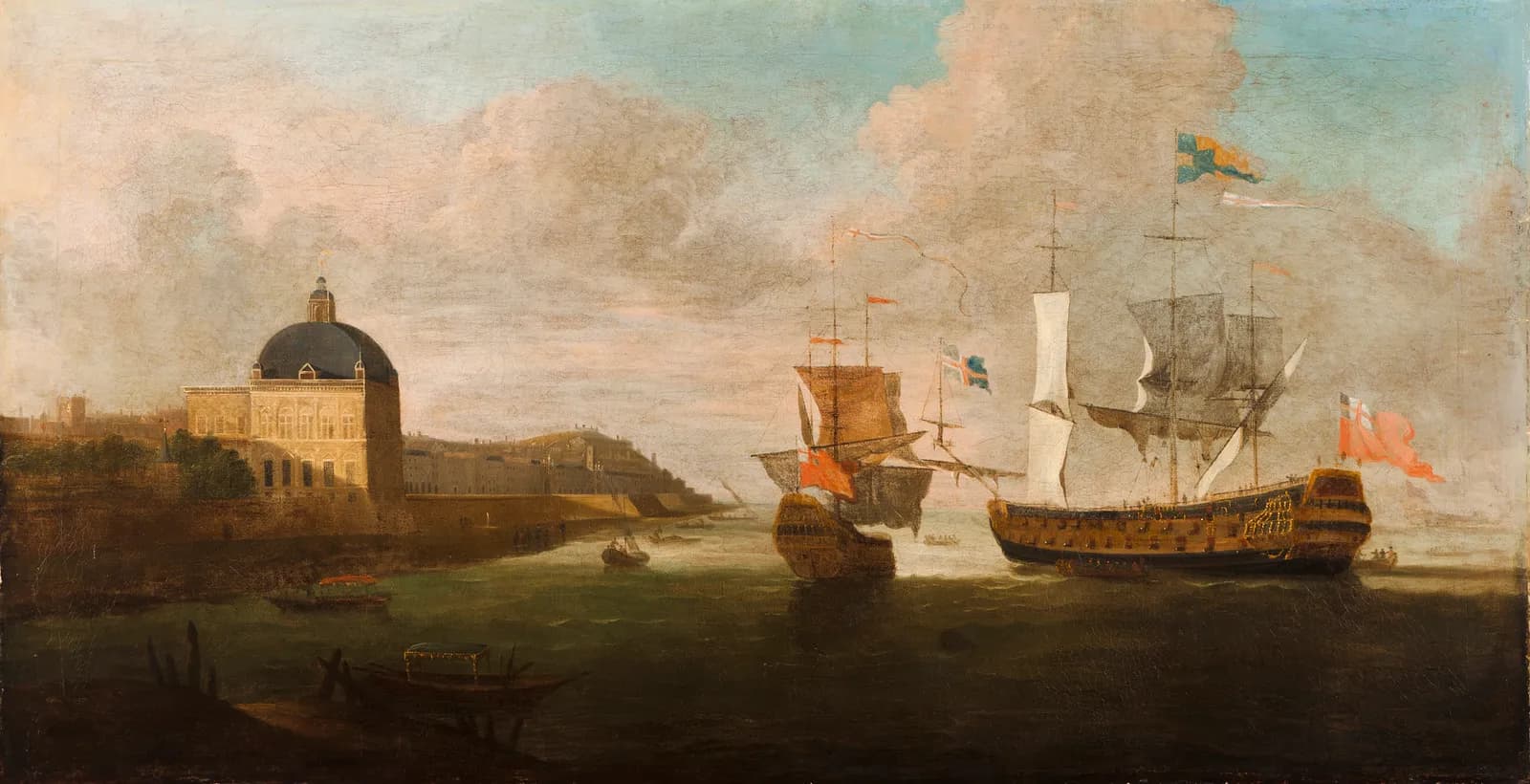
Dirk Stoop's print of her state procession through Lisbon is dated 20 April 1662. On the 23rd, St George's Day, she took leave of her mother at the palace and drove under arches of flowers to Mass at the cathedral and on to the quay. Her brothers took her by barge out to Sandwich's flagship, the Royal Charles. Contrary winds then held the fleet in the Tagus for two days, and the city lit up the river with fireworks.
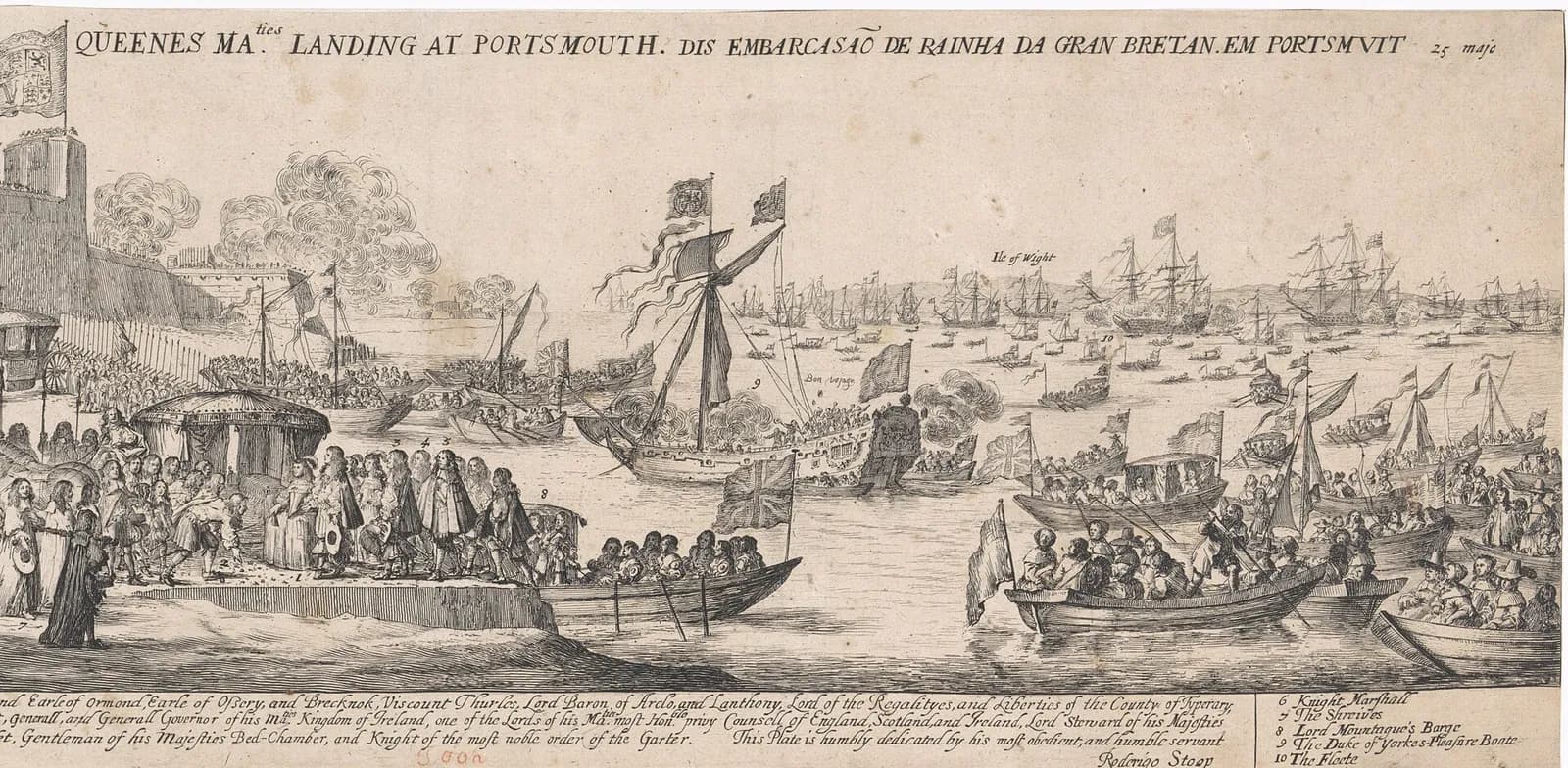
The crossing was long and stormy. Sandwich's secretary told Pepys that she never came on deck, but would send for Sandwich's musicians and listen from her cabin. On 14 May, the date in Sandwich's journal (some later writers give the 13th), the fleet came up the Solent. The Duke of York handed her ashore, and at her request her coach went through the main streets of Portsmouth so that the crowds could see her.
23 June 1661
Marriage treaty
Concluded in London; ratified by Portugal under the same date.
10 November 1661
Sisa doubled
The regent raises the sales tax to pay the dowry.
30 January 1662
Tangier
The Earl of Peterborough takes over the city.
20 April 1662
Procession
Catherine's state procession through Lisbon, as dated on Dirk Stoop's print.
23 April 1662
Embarkation
She boards the Royal Charles in the Tagus.
14 May 1662
Landing
She comes ashore at Portsmouth.
20 May 1662
The king arrives
Charles reaches Portsmouth in the afternoon.
21 May 1662
Wedding
A private Catholic rite, then the Anglican service.
29 May 1662
Hampton Court
The couple reach the palace for their honeymoon.
Thirty years in England
The court went to Hampton Court for the honeymoon. John Evelyn watched the queen arrive with her Portuguese ladies in their wide farthingales, which he called monstrous. He found her own face the handsomest of the party. Pepys, who saw some of the ladies in London, thought their farthingales “a strange dress”.
“Though low of stature, prettily shaped, languishing and excellent eyes, her teeth wronging her mouth by sticking a little too far out; for the rest, lovely enough.”
The first months were miserable. Charles insisted that Lady Castlemaine join the queen's household as a lady of the bedchamber. Catherine, “bred hugely retired” as Thomas Maynard, the English consul in Lisbon, had put it, refused. Clarendon was sent to wear her down, and after weeks of being shunned by the court she gave in. Most of her Portuguese household was sent home. Pepys, who first saw her in September, thought that “though she be not very charming, yet she hath a good, modest, and innocent look”.
There were no children. Catherine miscarried more than once, and the king's letters to his sister record losses in May 1668 and June 1669. Charles had children by several mistresses but refused to put his wife aside, whatever some of his courtiers hoped.
Her religion made her a target. In 1678 the informers Titus Oates and William Bedloe claimed that Catholics were plotting to kill the king, and they named the queen. On 28 November the House of Commons asked Charles to remove “the Queen, and all her Family, and all Papists” from Whitehall. He stood by her, and the regent in Lisbon, her brother Pedro, sent the Marquis of Arronches to London to support her.
Charles died in February 1685 after being received into the Catholic Church on his deathbed, which Portuguese chroniclers credited to her persuasion. She stayed on at Somerset House through the reign of his brother James II and the revolution of 1688 that replaced him with William and Mary.
Did she bring tea to England?
Much of the story goes back to a ten-line poem by Edmund Waller, “Of Tea, Commended by Her Majesty”, written for one of her birthdays. It is often dated to 1663, but the 1893 edition of Waller prints it among his poems to the queen of the 1680s. Its editor called it the first poem in English in praise of tea and said the drink became fashionable at court through the example of the queen, who was used to it in Portugal.
“The best of queens, and best of herbs, we owe / To that bold nation which the way did show / To the fair region where the sun does rise.”
Tea stayed a luxury, and partly a medicine, for years. In June 1667 Pepys came home to find his wife making tea, which the apothecary had told her was good for her cold. Portugal's national archive puts the claim cautiously: Catherine “terá introduzido”, may have introduced, the habit of tea-drinking in England.
What became of Tangier and Bombay
Neither port turned out as the English hoped. Tangier had to be held against Moroccan armies, and year after year the crown struggled to pay its garrison and the great harbour mole it was building. In 1683 Charles sent Lord Dartmouth to give it up. His engineers blew up the castle, forts and walls, and on 5 February 1684 the last mines were sprung and the garrison withdrew.
Bombay was a slower story. The Portuguese in India refused at first to hand the island over, and Humphrey Cooke took possession only on 18 February 1665. By a charter of 27 March 1668 Charles passed it to the East India Company for £10 a year. From that grew the city of Mumbai.
- Tangier
- English from 30 January 1662 to February 1684
- Bombay
- Handed over 18 February 1665; to the East India Company in 1668
- Dowry
- 2,000,000 cruzados promised; paid partly in goods, and late
- Jointure
- £30,000 a year, payable even if she left England
Home to Lisbon, and a regency
Catherine left London in the spring of 1692, crossed to Dieppe and travelled through France and Spain. She fell ill with erysipelas at Matapozuelos, in Castile, and wrote to her brother from Almeida, the Portuguese border fortress, on 30 December. On 20 January 1693 she entered Lisbon. Her brother, now King Pedro II, drove out to meet her on the road at Lumiar.
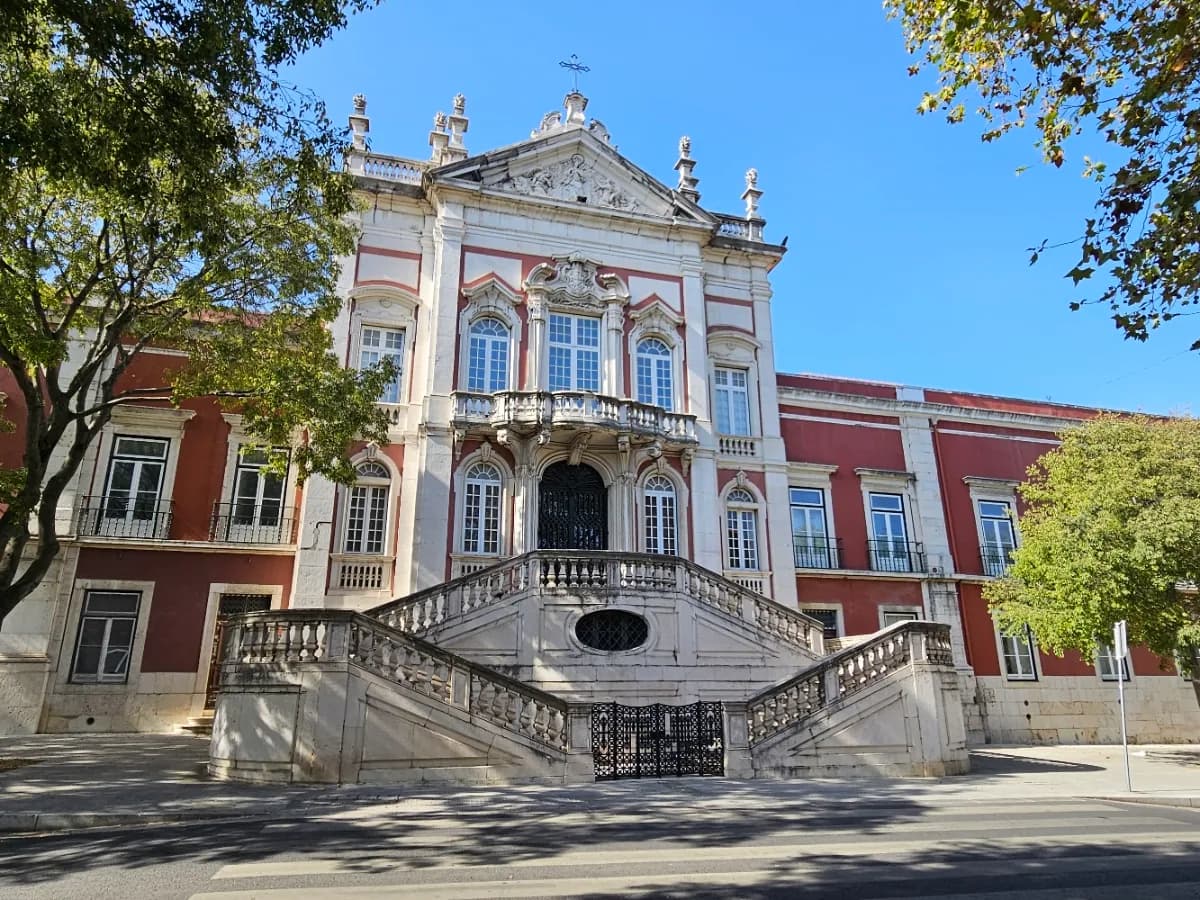
She moved from one borrowed house to another, at Alcântara, Santa Marta, the Bairro Alto and Belém, before building her own. In 1694 she began a palace, chapel and gardens on land she had bought in the fields of the Bemposta, then on the edge of the city. She was living there by 1702, and the Portuguese called it the Paço da Rainha, the Queen's Palace.
Portugal was at war again, this time in the War of the Spanish Succession, on the side of England and the Dutch against France and Philip V of Spain. In 1704, when Pedro II left for the front in Beira, he made his sister regent, with decrees to every court of law and a council of state to advise her. In 1705, when he fell dangerously ill, she governed a second time.
The campaign of 1705 went well for the allies. Portuguese and allied troops took four towns across the Spanish border, which the chronicler António Caetano de Sousa lists as Valença de Alcântara, Albuquerque, Salvaterra and Çarça. Sousa gave her regency the credit for pushing the war with energy. She did not long enjoy it. On the night of Thursday 31 December 1705, at ten o'clock, she died at the Bemposta of a colic, aged 67.
February 1685
Widowed
Charles II dies in London.
Spring 1692
Leaves London
She travels through France and Spain.
20 January 1693
Enters Lisbon
Pedro II meets her on the road at Lumiar.
1694
Bemposta
Building of her palace begins; she lives there by 1702.
1704
First regency
While Pedro II is with the army in Beira.
1705
Second regency
During the king's dangerous illness.
31 December 1705
Death
At the Bemposta; buried at Belém.
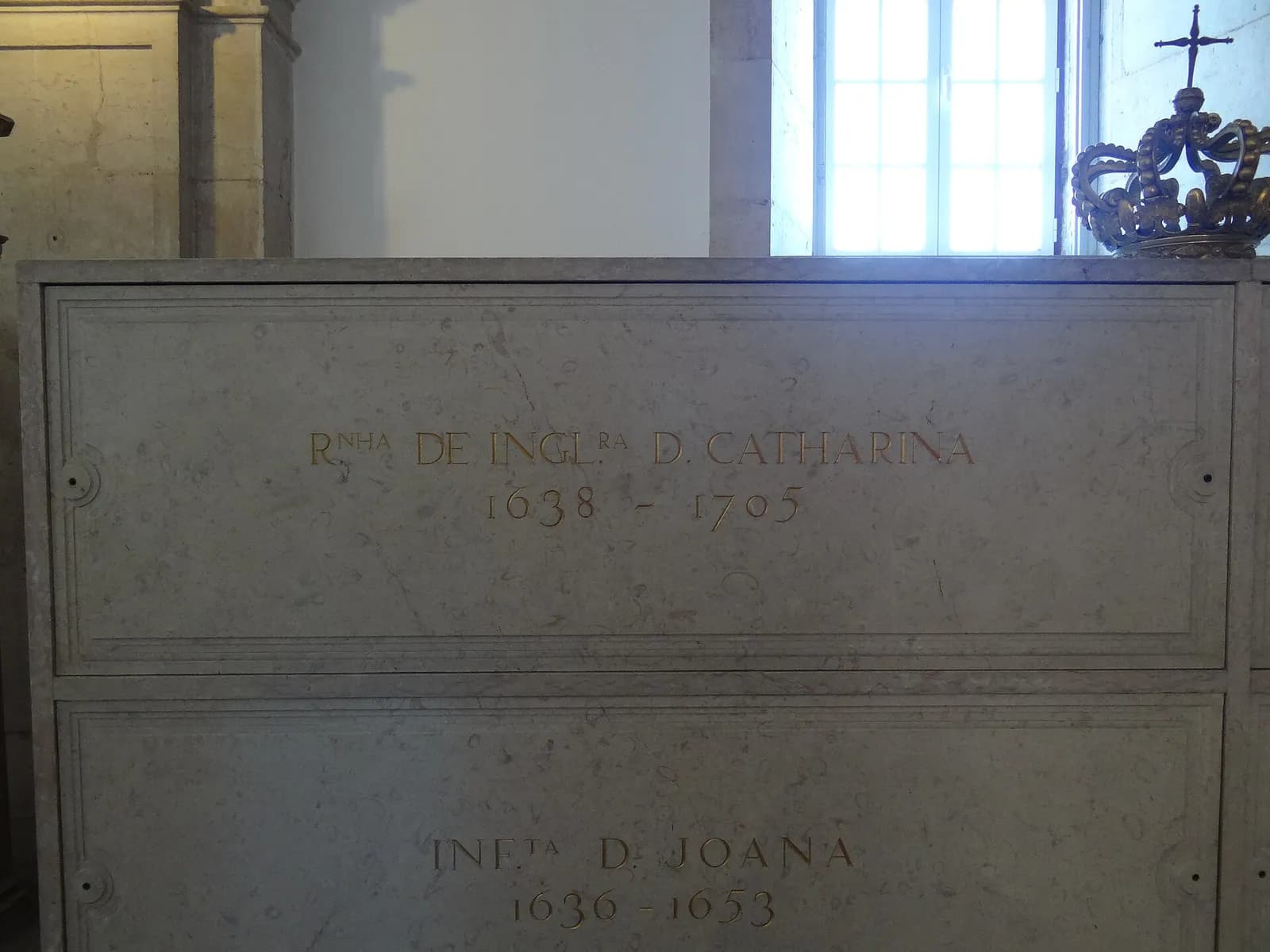
Her will, drawn up in 1699, made Pedro her heir; the palace passed to the crown, and in 1707 João V gave it to his brother, the Infante Francisco. She was buried at the Jerónimos monastery in Belém, beside her brother Teodósio. Her remains now lie with her mother's in the Bragança pantheon at São Vicente de Fora.
Why it still matters
The secret article of her marriage treaty, England's promise to defend Portugal's colonies, was still in force more than two centuries later. In a secret declaration signed in London on 14 October 1899, during the Boer War, Britain and Portugal quoted its first part word for word and confirmed it.
Her reputation has moved too. English writers long treated her as a dull, plain wife at a brilliant court, and a sympathetic biography of 1908 swung to the other extreme. Recent historians, Portuguese and English, read her as a political figure in her own right: a queen who kept her faith through the Popish Plot and ended her life running a country at war.
FAQs
When and where did Catherine of Braganza marry Charles II?
At Portsmouth on 21 May 1662 by the English (Julian) calendar, which was 31 May in Portugal. There were two ceremonies that day: a private Catholic rite in her room, then a Church of England service in the Governor's House led by Gilbert Sheldon, Bishop of London.
What was in Catherine of Braganza's dowry?
The treaty of 23 June 1661 promised two million Portuguese cruzados and ceded the city of Tangier and the island of Bombay to the English crown. It also opened trade in Brazil and the East Indies to English merchants. Much of the first half was delivered as sugar and spices to be sold in London, and the rest was paid late.
Did Catherine of Braganza introduce tea to England?
No. Tea was advertised in London in 1658 and Samuel Pepys first drank it in 1660. Catherine was a known tea drinker, Edmund Waller wrote a poem on tea for her birthday, and her example is credited with making it fashionable at court.
Why did Catherine of Braganza go back to Portugal?
Her marriage treaty let her return if widowed and still be paid her English jointure. After Charles II died in 1685 she stayed in London for seven years, then left in 1692 and entered Lisbon on 20 January 1693.
Was Catherine of Braganza ever regent of Portugal?
Yes, twice, for her brother Pedro II: in 1704, while he was with the army in Beira, and in 1705, during a dangerous illness. She died at her Bemposta palace in Lisbon on 31 December 1705.
On the timeline
Open the timelineNearby moments from restoration and the gold of brazil (1640–1750).
During the Portuguese Restoration War, a Spanish army under the Marquis of Viana defeats Portuguese forces led by the Count of Castelo Melhor at the Battle of Vilanova, near the River Minho, going on to capture Monção and other Portuguese strongholds in the months that followed.
Battle of the Lines of Elvas — Portuguese forces under António Luís de Meneses, Count of Cantanhede (later Marquis of Marialva), defeat the Spanish army besieging Elvas, a decisive victory in the Restoration War.
Portugal and the Dutch Republic sign the Treaty of The Hague, under which the Netherlands recognises Portuguese sovereignty over Brazil (formerly Dutch-held New Holland) in exchange for a substantial indemnity, ending decades of colonial conflict.
Catherine of Braganza's wedding
Catherine of Braganza, daughter of King João IV, marries Charles II of England at Portsmouth. Her dowry includes Bombay and Tangier, and as queen she is credited with making tea-drinking fashionable at the English court.
The Portuguese army achieves a decisive victory at the Battle of Ameixial, in the Alentejo. Commanded by Sancho Manuel de Vilhena, Count of Vila Flor, with an English contingent under Frederick Schomberg, the Portuguese rout the much larger Spanish force of Don Juan José of Austria. Évora, captured by the Spanish weeks earlier, is retaken within days, and the victory turns the Restoration War decisively in Portugal's favour.
At the Battle of Castelo Rodrigo (also known as the Battle of Salgadela), a Portuguese force under Pedro Jacques de Magalhães falls on the Spanish army of the Duke of Osuna, which had been besieging the fortress and its garrison of just 150 men. The Spanish are routed and lose their artillery — Osuna is said to have fled disguised as a monk — ending the invasion of the Beira frontier.
Portugal wins the decisive Battle of Montes Claros, near Borba in the Alentejo, under the command of António Luís de Meneses, Marquis of Marialva. An invading Spanish army under the Marquis of Caracena is destroyed, ending Madrid's hopes of reconquering Portugal and effectively closing the Restoration War.
Coming up in history
All long reads 23 May 1536Cum ad nihil magis: the papal bull that founded the Portuguese Inquisition
 24 May 1898Ferreira de Castro, the boy from Ossela who wrote the Amazon
 25 May 1942José Mário Branco, the Porto singer who fled a war and came back to sing
 26 May 1834The Convention of Evoramonte: how Portugal's war of two brothers ended
28 sources
Archives, scholarship and reporting this article was checked against.
- 1
Collecção dos tratados, convenções, contratos e actos publicos celebrados entre a coroa de Portugal e as mais potencias desde 1640, vol. I, ed. José Ferreira Borges de CastroImprensa Nacional, Lisbon, 1856 (Internet Archive scan)
- 2
Casamento de D. Catarina de Bragança com Carlos II de InglaterraArquivo Nacional Torre do Tombo
- 3
- 4
- 5
The Diary of John Evelyn, vol. I (ed. William Bray)Project Gutenberg
- 6
- 7
- 8
History of the Royal Garrison Church, PortsmouthEnglish Heritage
- 9
The Diary of Samuel Pepys, 21 May 1662The Diary of Samuel Pepys (pepysdiary.com)
- 10
Dating documents: Julian and Gregorian calendarsManuscripts and Special Collections, University of Nottingham
- 11
Las reinas ibéricas y la diplomacia barroca: un estudio comparativo de las regencias de Luísa de Gusmão y Mariana de Austria (Ezequiel Borgognoni)Intus-Legere Historia, vol. 15, no. 1 (2021), pp. 237-255, Universidad Adolfo Ibáñez
- 12
- 13
Catherine of Braganza: the foreign princessUK Tea and Infusions Association
- 14
History's unparalleled alliance: the Anglo-Portuguese Treaty of Windsor, 9th May 1386The National Archives (UK), History blog
- 15
Marriage contract of Charles II of Great Britain and Catherine of Portugal, London, 23 June 1661Dynastic Marriage Contracts in the Early Modern Period, Philipps-Universität Marburg
- 16
- 17
- 18
House of Commons Journal, vol. 9: 28 November 1678British History Online
- 19
- 20
- 21
- 22
Inventário de Lisboa, fascículo 3 (Norberto de Araújo): Paço da BempostaCâmara Municipal de Lisboa (Hemeroteca Digital)
- 23
Palácio da Bemposta: Academia MilitarOpen House Lisboa, Trienal de Arquitectura de Lisboa
- 24
Treaty of alliance between Great Britain, Portugal and the States General, 1703 May 5 OS / 16 NS (SP 108/340)The National Archives (UK), State Papers Foreign, Treaties
- 25
D. Maria Ana de Áustria: a rainha desaparecida (Eduardo Sucena)Arqueologia & História, no. 58/59 (2006/2007), Associação dos Arqueólogos Portugueses
- 26
- 27
Review of Sophie Shorland, The Lost Queen: The Surprising Life of Catherine of Braganza (Maria da Conceição Emiliano Castel-Branco)Revista de Estudos Anglo-Portugueses / JAPS 33, CETAPS, NOVA FCSH
- 28
History and heritageAcademia Militar (Portuguese Military Academy)
Image credits
- The embarkation of Catherine of Braganza at Lisbon in April 1662, in an early eighteenth-century copy of a lost painting by the Dutch artist Dirk Stoop. The domed building on the left is probably the tower of the royal palace on the Terreiro do Paço; English warships wait in the Tagus. Unknown author, Public domain, via Wikimedia Commons.
- Dirk Stoop's print of the queen's state procession through Lisbon on 20 April 1662, dedicated to Charles II. The coaches cross the Terreiro do Paço under triumphal arches, with the royal palace and its domed tower behind. Austrian National Library copy, coloured by hand. Dirk Stoop, Public domain, via Wikimedia Commons.
- The queen's landing at Portsmouth in May 1662, in a print by Dirk Stoop with a title in English and Portuguese. The fleet lies at anchor towards the Isle of Wight, named in the distance. Rijksmuseum, Amsterdam. Dirk Stoop (photograph by Aleobt), CC BY-SA 4.0, via Wikimedia Commons.
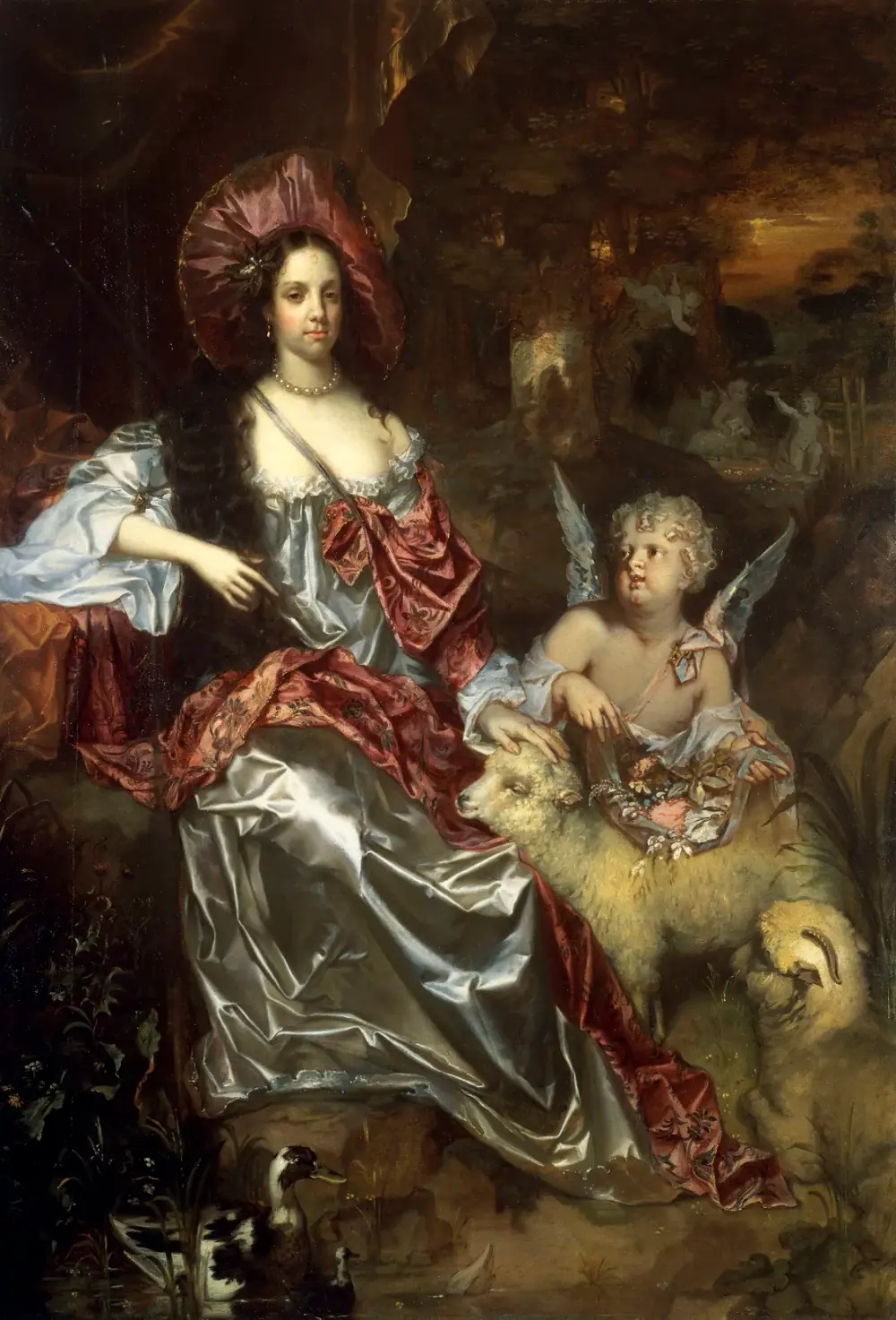
- Catherine painted as a shepherdess, with a lamb and a cupid, by Jacob Huysmans in about 1662 to 1664, soon after her marriage. Royal Collection. Jacob Huysmans, Public domain, via Wikimedia Commons.
- The Bemposta palace in Lisbon, which Catherine began building in 1694, photographed in 2023. Its front owes much to the rebuilding after the 1755 earthquake; the building is now the Military Academy. GualdimG, CC BY-SA 4.0, via Wikimedia Commons.
- Catherine's tomb in the Bragança pantheon at São Vicente de Fora, Lisbon, inscribed as Queen of England, 1638-1705. Below it lies her elder sister, the Infanta Joana. Photographed in 2024. Antoine Rex, CC0, via Wikimedia Commons.