

Vasco da Gama reaches Calicut: the first fleet from Europe to India
After 23 days without sight of land, a pilot from Malindi recognised the mountains above Calicut. The Portuguese had reached the pepper coast of India by sea, and spent the next hundred days learning how little they understood it.
At a glance
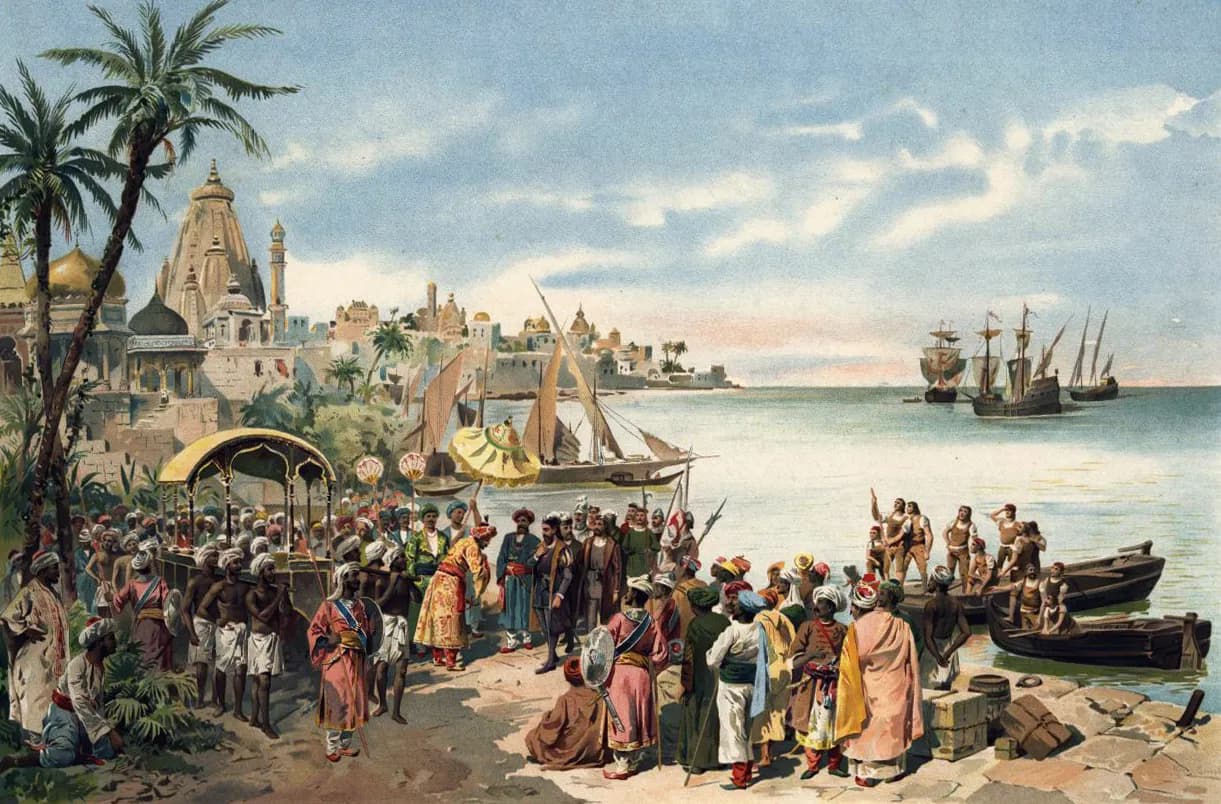
- On Sunday 20 May 1498 Vasco da Gama's three ships anchored about two leagues from Calicut (Kozhikode), off a place the chroniclers called Capocate, today Kappad, after crossing the Arabian Sea with a pilot from Malindi.
- Calicut was the main pepper and spice port of the Malabar coast in south-west India, ruled by a Hindu king the Portuguese called the Samorim, or Zamorin, and its sea trade was run by Muslim merchants.
- Gama went ashore on 28 May and was received by the Zamorin. The next day the king's officials laughed at the presents he had brought and refused to pass them on.
- Trade went badly. In August the Zamorin demanded customs dues and held Portuguese men and goods ashore. Gama seized 18 local men as hostages and sailed on 29 August; five of them were taken to Lisbon.
- The return crossing took almost three months and scurvy killed 30 men. Depending on the source, between about half and two-thirds of the crews died, but the sea route from Portugal to India was open.
Mountains in the rain
On Friday 18 May 1498, after 23 days without seeing land, the lookouts sighted high mountains. The three Portuguese ships had sailed before the wind from Malindi, in today's Kenya, and reckoned they had covered at least 600 leagues. The next day heavy rain and a thunderstorm hid the coast, and the pilot could not tell where they were.
On Sunday 20 May they came close enough for him to know the mountains. They stood, he said, above Calicut, the country they had come for. The chronicler Fernão Lopes de Castanheda says he asked Vasco da Gama for the customary reward for good news, and that Gama paid it and had the Salve Regina said.
“Said the pilot from Malindi, full of joy: “This is the land of Calicut, unless I am mistaken.””
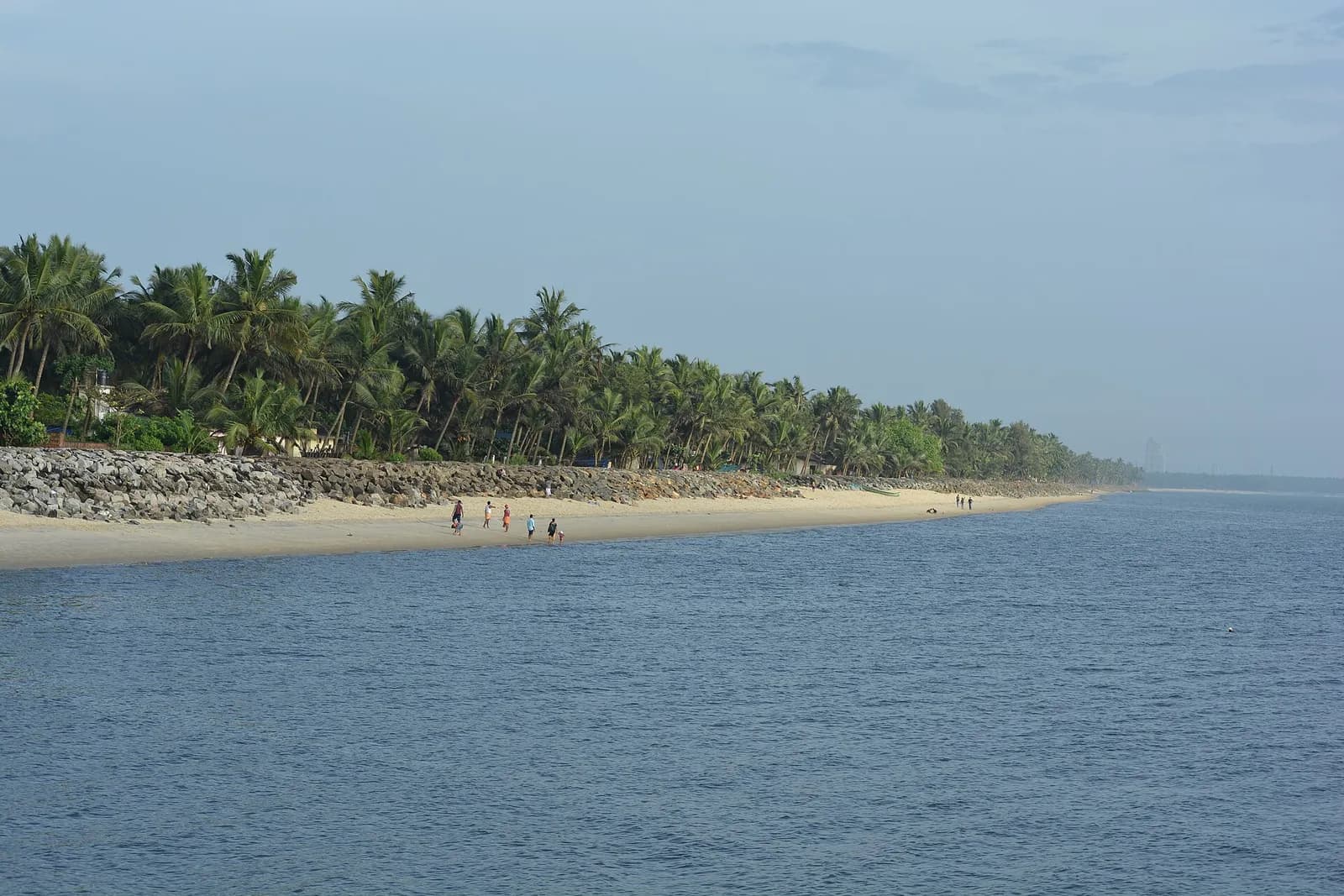
That evening they anchored about a league and a half offshore and two leagues from the city, off a town the journal calls Capua and Castanheda Capocate, today Kappad. The pilot had mistaken it for Calicut. Four dugout boats came out to ask what nation they were, then pointed the way to the city.
The next day Gama sent ashore one of the convicts he had brought to spy out unknown coasts. In the city he was taken to two Muslims from Tunis who spoke Castilian and Genoese, and one came back with him to the ships with a greeting that astonished the crew.
“A lucky venture, a lucky venture! Plenty of rubies, plenty of emeralds! You owe great thanks to God, for having brought you to a country holding such riches!”
The pepper port at the wrong time of year
Calicut, now Kozhikode in the Indian state of Kerala, lay on the Malabar coast, a strip of low, wet land between the Arabian Sea and the mountains of the Western Ghats. It had risen in the fourteenth and fifteenth centuries to become the region's main trading port. Pepper and ginger grew locally, cinnamon came from Ceylon and cloves from much further east, and Arab and Persian merchants came to buy them.
Its king was a Hindu ruler whose title the Portuguese wrote as Samorim and the English as Zamorin. He did not trade himself; he taxed the trade. Overseas commerce was in the hands of Muslim merchants: the Pardesis, foreign merchants from Egypt, Arabia and Persia who controlled the spice trade to the Red Sea, and the Mappilas, local Muslims who handled shorter routes. The Pardesis had most to lose from a new route round Africa.
- The city
- Calicut (Kozhikode), Malabar coast, south-west India
- Ruler
- The Zamorin, a Hindu king, then at Ponnani, south of the city
- The trade
- Pepper, ginger, cinnamon, cloves and precious stones, shipped by Muslim merchants to Jidda, the Red Sea and Alexandria
- First anchorage
- Off Capocate (Kappad), two leagues from the city, 20 May 1498
- Safe anchorage
- Pandarani (Pantalayini Kollam), further north, from 27 May
The Portuguese had come at the worst moment. The south-west monsoon was breaking, and on that open coast ships did not sail in the rains. João de Barros, the royal historian, wrote that when Gama arrived there was none of the usual crowd of shipping: the foreign vessels had gone home and the local ones were laid up in the rivers under palm-leaf roofs. Castanheda says the fishermen had never seen ships of that shape, nor any ship arriving at that season.
Portugal knew something of Calicut already. Pêro da Covilhã, sent overland by King João II in 1487, had visited it about ten years earlier. Gama carried two letters from King Manuel I for its ruler.
The pilot from Malindi
At Malindi, where the fleet anchored on 14 April, the ruler welcomed them as allies against his rival Mombasa but was slow to produce the pilot he had promised. On 22 April Gama seized one of his trusted servants and sent word that he wanted the pilot. The pilot came that day, and they sailed on Tuesday 24 April.
The journal calls him a Christian, as the Portuguese then called every Indian who was not a Muslim. Barros describes a Muslim from Gujarat named Malemo Cana, and Castanheda a Gujarati pilot called Canaqua; malemo comes from the Arabic for a ship's master. The Kerala historian K. V. Krishna Ayyar called him a Konkani. The popular story that he was the Arab navigator Ahmad ibn Mājid goes back to a French scholar in the 1920s, and the Portuguese National Library's dictionary of historians rejects it.
Barros tells how the two navigators compared methods. The pilot showed Gama a chart of the whole Indian coast, drawn in close-set meridians and parallels. Gama showed him his large wooden astrolabe. The pilot was not surprised: some Red Sea pilots used triangular brass instruments and quadrants, he said, and the seamen of Cambay steered by the stars with an instrument of three wooden boards.
How long each stage at the Indian end of the voyage took
days
Elapsed days between dates in the anonymous journal, as dated by Ravenstein: 24 April to 18 May 1498; 20 May to 29 August; 20 September to 5 October; 5 October 1498 to 2 January 1499, which the journal calls three months less three days. The manuscript and Castanheda date the first sight of India to the 17th, but that Friday was the 18th. Castanheda gives 23 days without sight of land on the way out, Barros 22.
Show the data
| Days, from the dates in the Roteiro | |
|---|---|
| Malindi to first sight of India | 24 |
| Off Calicut and Pandarani | 101 |
| Refitting at Anjediva | 15 |
| Anjediva to first sight of Africa | 89 |
A temple taken for a church, and a king on a couch
The Zamorin was at Ponnani, some fifteen leagues away, when Gama's messengers reached him. He gave them fine cloth, sent word that he was coming to Calicut, and sent a pilot to move the ships to Pandarani, further north, where a mud bank gave shelter from the monsoon. They moved on 27 May. Gama, nervous, would not anchor as close inshore as the pilot wanted.
On Monday 28 May he went ashore with thirteen men, among them the anonymous author of the journal, probably the soldier Álvaro Velho. His brother Paulo and Nicolau Coelho were told to sail straight for Portugal if anything happened to him. The king's governor met them with armed men and a palanquin, and they travelled by land and river towards the city through crowds the writer could not count.
On the way they were taken into a great stone temple. Believing that all Indians except the Muslims were Christians, the Portuguese took it for a church. Priests wearing a thread over one shoulder sprinkled them with holy water and gave them white earth for their foreheads. Inside the sanctuary was an image they understood to be Our Lady, and Gama said his prayers.
Not everyone was sure: the saints painted on the walls had protruding teeth and four or five arms. According to Castanheda, the clerk João de Sá muttered as he knelt, “If these be devils, I worship the true God,” and Gama smiled. The temple was Hindu. Ravenstein's notes to the journal pass on guesses that the image was the goddess Gauri, or Mari, a local smallpox goddess much venerated in Malabar.
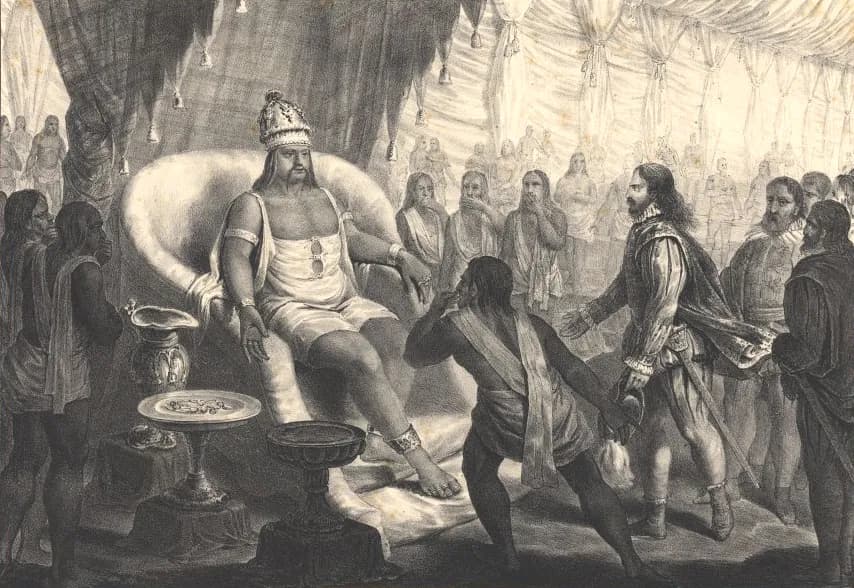
They reached the palace an hour before sunset. The Zamorin lay on a couch covered in green velvet, chewing betel and spitting the husks into a great golden cup. Gama greeted him with joined hands, in the local way, and the king had fruit brought for his men, watched them eat, and smiled.
In a private chamber Gama made his speech. For sixty years, he said, the kings of Portugal had sent ships to find the Christian kings of India, not for gold or silver, which they had in plenty, and he had orders not to come home without finding this king, on pain of losing his head. The Zamorin replied that he was welcome and that he would send ambassadors to Portugal. It was about ten at night when they left, in pouring rain.
Hoods, hats and honey
On Tuesday 29 May Gama laid out his present for the king. Custom required that the king's Muslim factor and the governor see it first. When they did, they laughed.
| Item | Quantity |
|---|---|
| Pieces of lambel, a striped cloth sold in the West African trade | 12 |
| Scarlet hoods | 4 |
| Hats | 6 |
| Strings of coral | 4 |
| Wash-hand basins, in a case | 6 |
| Case of sugar | 1 |
| Casks of oil | 2 |
| Casks of honey | 2 |
As listed in the anonymous journal. Castanheda's list is almost the same, except that the basins come as a bundle of seven brass pieces. He too says the king's factor and governor laughed at it.
It was not a thing to offer a king, they said. The poorest merchant from Mecca gave more, and a present should be in gold. Gama answered that he was an ambassador, not a merchant, that this was his own gift and not his king's, and that richer presents would come later. They refused to forward it or to let him take it himself.
On Wednesday 30 May Gama was kept waiting four hours outside the king's door, then admitted with only two companions. Had he come to discover stones or men, the Zamorin asked; if men, why had he brought nothing? He had heard that Gama carried a golden image of Santa Maria. Gama replied that it was not gold, and that he would not part with it anyway, because she had guided him across the ocean.
Then the letters. One was in Portuguese, the other in Arabic, which Gama could not read and did not trust Muslim interpreters to translate honestly. The young Christian the king sent for could not read it either, so four Muslims read it between them and translated it for the king, who was satisfied. He told Gama to land his goods and sell them as best he could.
Shirts for thirty reis
Going back to the ships on 31 May, Gama was held at Pandarani. The governor's men would give him no boats unless he brought his ships closer inshore, and asked for their sails and rudders. He refused, and was let go on 2 June after agreeing to land some merchandise. Krishna Ayyar, writing from Calicut's side, read the episode differently: squalls kept the boatmen ashore, and the guards were there to protect the strangers from angry merchants.
The goods did not sell. Merchants sent by the king ran them down for eight days, and Muslims spat on the ground when a Portuguese passed, saying “Portugal, Portugal”. On 24 June the Zamorin had the merchandise carried to Calicut at his own expense, and Gama let his men go ashore in turns. Local people fed and lodged them, and crowds came out to the ships to sell fish.
A fine shirt worth 300 reis in Portugal fetched two fanams in Calicut, which the writer reckoned at 30 reis. The men bought cloves, cinnamon and precious stones as samples.
Hostages and a palm-leaf letter
About 10 August Gama sent his clerk Diogo Dias, who was acting as factor ashore, with a second present of amber and coral, asking for a bahar (a heavy local measure) each of cinnamon and cloves. After four days' wait the king received him with a “bad face” and said that Gama must first pay 600 xerafins, as was the custom of the country. When Dias returned to the warehouse, guards were posted on him and the goods, and boats were forbidden to approach the ships.
The journal blamed the Muslim merchants, who it said had told the king that the Portuguese were thieves. On Sunday 19 August, when about 25 visitors came aboard, Gama seized 18 of them, six of them men of rank, and sent word that he would free them when his own men were returned. Krishna Ayyar counts six Nairs, of the warrior caste, and sixteen fishermen. Gama sailed a little way off on 23 August, saying he was going home.
The Zamorin sent for Dias, treated him kindly, blamed his factor for the demand and sent him back on 27 August with a letter for King Manuel, which Dias had written for him with an iron pen on a palm leaf. Gama released six hostages but kept the rest, and refused to exchange them for the goods still ashore. He also took aboard the merchant from Tunis, Monçaide, whose property had been seized because people accused him of being a Christian sent by the King of Portugal.
“Vasco da Gama, a gentleman of your household, came to my country, whereat I was pleased. My country is rich in cinnamon, cloves, ginger, pepper, and precious stones. That which I ask of you in exchange is gold, silver, corals and scarlet cloth.”
On 29 August the captains agreed that they had found what they came for, spices and precious stones, and that friendly relations seemed impossible. They sailed for Portugal with their captives, meaning to use them as witnesses and go-betweens on a later voyage. The next day, while they lay becalmed a league north of Calicut, about seventy boats full of armed men came out. The Portuguese fired on them, and the boats followed for an hour and a half until a thunderstorm carried the ships out to sea.
18 May
Land sighted after 23 days out of sight of land
20 May
Anchored off Capocate (Kappad), two leagues from Calicut
21 May
A convict goes ashore and meets two merchants from Tunis
27 May
Ships move to Pandarani on the Zamorin's advice
28 May
Gama lands with thirteen men; first audience at sunset
29 May
The king's officials laugh at the present
30 May
Second audience: “stones or men?”
31 May to 2 June
Gama held at Pandarani until goods are landed
24 June
Goods carried to Calicut at the Zamorin's expense
About 10 August
Diogo Dias takes a second present; he is told to pay 600 xerafins and is detained
19 August
Gama seizes 18 men as hostages
27 August
Dias returned with the Zamorin's palm-leaf letter
29 August
The fleet sails for Portugal
30 August
About seventy armed boats driven off
“Throughout the whole stay of the Portuguese the Samuri showed no signs of treachery … On the other hand, Da Gama's conduct in carrying off the 5 men he had entrapped on board his ships is indefensible.”
The way home and what it cost
The fleet worked north along the coast. On 10 September Gama put one captive ashore with a letter of apology for the Zamorin, written in Arabic by Monçaide. At the Anjediva islands, south of Goa, where they refitted from 20 September to 5 October, they seized a Jewish merchant who spoke Venetian and served the ruler of Goa; baptised in Portugal, he became Gaspar da Gama.
On the way back they met calms and contrary winds, and the crossing that had taken 24 days outward took 89. Scurvy swelled the men's gums over their teeth and their legs, and 30 died, as many again having died earlier. Only seven or eight men in each ship could still work, and the captains agreed to turn back to India if the wind allowed. On 2 January 1499 they sighted Africa near Mogadishu.
With too few men for three ships, they burned the São Rafael on 13 January at the shoals the Portuguese named after her, near Mombasa. The other two rounded the Cape of Good Hope on 20 March. Coelho's Berrio reached Lisbon on 10 July 1499; Gama, delayed by his brother Paulo's fatal illness in the Azores, arrived some weeks later. The sources disagree on how many sailed, so no one knows how many died: Sernigi has 63 coming home of 118, Castanheda 55 of 148, and Whiteway 55 of the 170 that Barros gives.
From embassy to war
In July 1499, soon after Coelho arrived, King Manuel wrote to Ferdinand and Isabella of Castile that his captains had reached India, where the spices bound for Mecca and Cairo were traded, and that he hoped to divert that trade to his own ships. They had not brought as much as they could have, the king admitted, because they had taken no merchandise. By 28 August he was styling himself lord of the conquest, navigation and commerce of Ethiopia, Arabia, Persia and India.
The next fleet, under Pedro Álvares Cabral, brought back the men Gama had taken and set up a trading post at Calicut in 1500. The post was soon stormed and most of its defenders killed; Cabral bombarded the city and moved his trade to Cochin, whose ruler was the Zamorin's rival. Gama himself came back in 1502 and bombarded Calicut again. A peace in 1513 allowed a Portuguese fortress in the city, but it was besieged and destroyed in 1525.
Zainuddin, a Muslim scholar of Malabar, finished his history of the wars against the Portuguese in the late 1570s as a call to holy war. Yet his account of 1498 is plain. The Franks, as he called Europeans, stayed some months gathering information about Malabar, did no trade and went home; by their own account, they had come for pepper.
“Now, the year in which the Franks first visited Malabar was the 904th of the Hejira, when three of their vessels having, towards the close of the Indian season, anchored off Fundreeah, a party from on board left the ships, and proceeded by land to Calicut.”
Why it still matters
Gama's ships proved that a fleet could sail from Lisbon round Africa to the pepper ports of India and come back. Fleets followed in 1500, 1501 and 1502, and the route became known as the Carreira da Índia. Gama himself died in Cochin in 1524, as viceroy.
The Portuguese Navy holds its Navy Day, the Dia da Marinha, on 20 May in honour of the arrival at Calicut, in a different coastal town each year. Until 1998, the five-hundredth anniversary, it was held on 8 July, the date the fleet left Lisbon.
FAQs
When did Vasco da Gama reach India?
His fleet sighted the Indian coast on Friday 18 May 1498 and anchored about two leagues from Calicut on the evening of Sunday 20 May. Gama himself went ashore at Pandarani on 28 May. The journal's manuscript and Castanheda put the first sighting on the 17th, which was a Thursday, and Whiteway (1899) has the ships anchoring on the 17th.
Who guided Vasco da Gama from Africa to India?
A pilot provided by the ruler of Malindi, in today's Kenya. Barros calls him Malemo Cana, a Muslim from Gujarat; Castanheda calls him Canaqua. The claim that he was the Arab navigator Ahmad ibn Mājid is rejected by the Portuguese National Library's dictionary of historians.
Why did the Zamorin's officials laugh at Vasco da Gama's gifts?
Gama offered striped cloth, hoods, hats, coral, basins, sugar, oil and honey. The king's factor and governor said the poorest merchant from Mecca gave more and that a present for the king should be in gold, and they refused to pass it on.
Is Calicut the same as Kozhikode?
Yes. Calicut is the European name for Kozhikode, a city on the Malabar coast of Kerala, in south-west India. Gama's ships first anchored off Kappad, north of the city.
Why is Portugal's Navy Day on 20 May?
The Portuguese Navy celebrates Navy Day on 20 May in honour of Vasco da Gama's arrival at Calicut in 1498. Until 1998 it was held on 8 July, the anniversary of the fleet's departure from Lisbon.
On the timeline
Open the timelineNearby moments from the age of discoveries (1415–1580).
Vasco da Gama's four ships round the Cape of Good Hope after days of contrary winds and enter the Indian Ocean, on the voyage that would reach India the following May and open the first sea route from Europe to Asia.
Vasco da Gama's fleet arrives at Mozambique Island during his first voyage to India, encountering a prosperous Swahili trading town, the first Muslim port the expedition had reached on the East African coast.
At sunset Vasco da Gama's fleet anchors off Malindi, on the coast of today's Kenya, after a tense week at hostile Mombasa. Malindi's ruler, a rival of Mombasa's, welcomes the Portuguese and supplies a Gujarati pilot who guides them across the Indian Ocean to Calicut — not, as legend long had it, the famous Arab navigator Ibn Majid.
Vasco da Gama reaches Calicut
Vasco da Gama's fleet anchors off Calicut, India, after the first voyage from Europe to India by sea. Eight days later the Zamorin (ruler) receives him; the next day the king's officials laugh at his gifts of striped cloth, hats, coral, sugar, oil and honey and refuse to pass them on.
Queen Isabel of Portugal, wife of Manuel I and eldest daughter of Spain's Catholic Monarchs, dies in Zaragoza within an hour of giving birth to a son, Miguel da Paz. Sworn heir to Portugal, Castile and Aragon, the boy might have united the whole Iberian Peninsula under one crown, but he died before his second birthday.
Pedro Álvares Cabral's fleet of 13 ships sails from Lisbon for India, carrying about 1,500 men. Swinging far west into the Atlantic, it sighted Brazil on 22 April; historians still debate whether that landfall was chance or design.
Pedro Álvares Cabral's India fleet, swinging far west across the Atlantic, sights a high, round mountain that Cabral names Monte Pascoal: its first sight of Brazil. The clerk Pero Vaz de Caminha's letter on the next ten days has been called the account of Brazil's birth.
Coming up in history
All long reads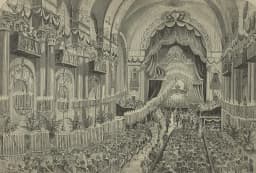 22 May 1886Carlos and Amélie: the royal wedding of 22 May 1886 in Lisbon
 23 May 1536Cum ad nihil magis: the papal bull that founded the Portuguese Inquisition
 24 May 1898Ferreira de Castro, the boy from Ossela who wrote the Amazon
 25 May 1942José Mário Branco, the Porto singer who fled a war and came back to sing
16 sources
Archives, scholarship and reporting this article was checked against.
- 1
A Journal of the First Voyage of Vasco da Gama, 1497-1499E. G. Ravenstein (trans. and ed.), Hakluyt Society, London, 1898 (digitised by the Internet Archive)
- 2
- 3
- 4
- 5
Calicute (José Luís Ferreira)Encyclopaedia of Portuguese Expansion (EVE), CHAM, NOVA FCSH
- 6
- 7
- 8
- 9
Os Lusíadas (Luís de Camões, 1572)Project Gutenberg
- 10
- 11
- 12
David Lopes (1867-1942)Dicionário de Historiadores Portugueses, Biblioteca Nacional de Portugal
- 13
Arcanjo de São RafaelMuseu de Marinha, Direção-Geral do Património Cultural da Marinha
- 14
- 15
VRSA celebra Dia da Marinha com batismos de marBarlavento
- 16
Kappad BeachKerala Tourism, Government of Kerala
Image credits
- The arrival of Vasco da Gama at Calicut as Alfredo Roque Gameiro imagined it around 1900. The quay and domed city are invented: Gama's ships anchored well off an open beach, and he went ashore at Pandarani, north of the city. Roque Gameiro, Public domain, via Wikimedia Commons.
- Vasco da Gama gives his embassy to the Zamorin in Calicut, a lithograph by Maurício José do Carmo Sendim, about 1839. The courtiers holding their hands before their mouths and the basin by the couch follow the journal's description of the audience. Maurício José do Carmo Sendim (1786-1870), Public domain, via Wikimedia Commons.
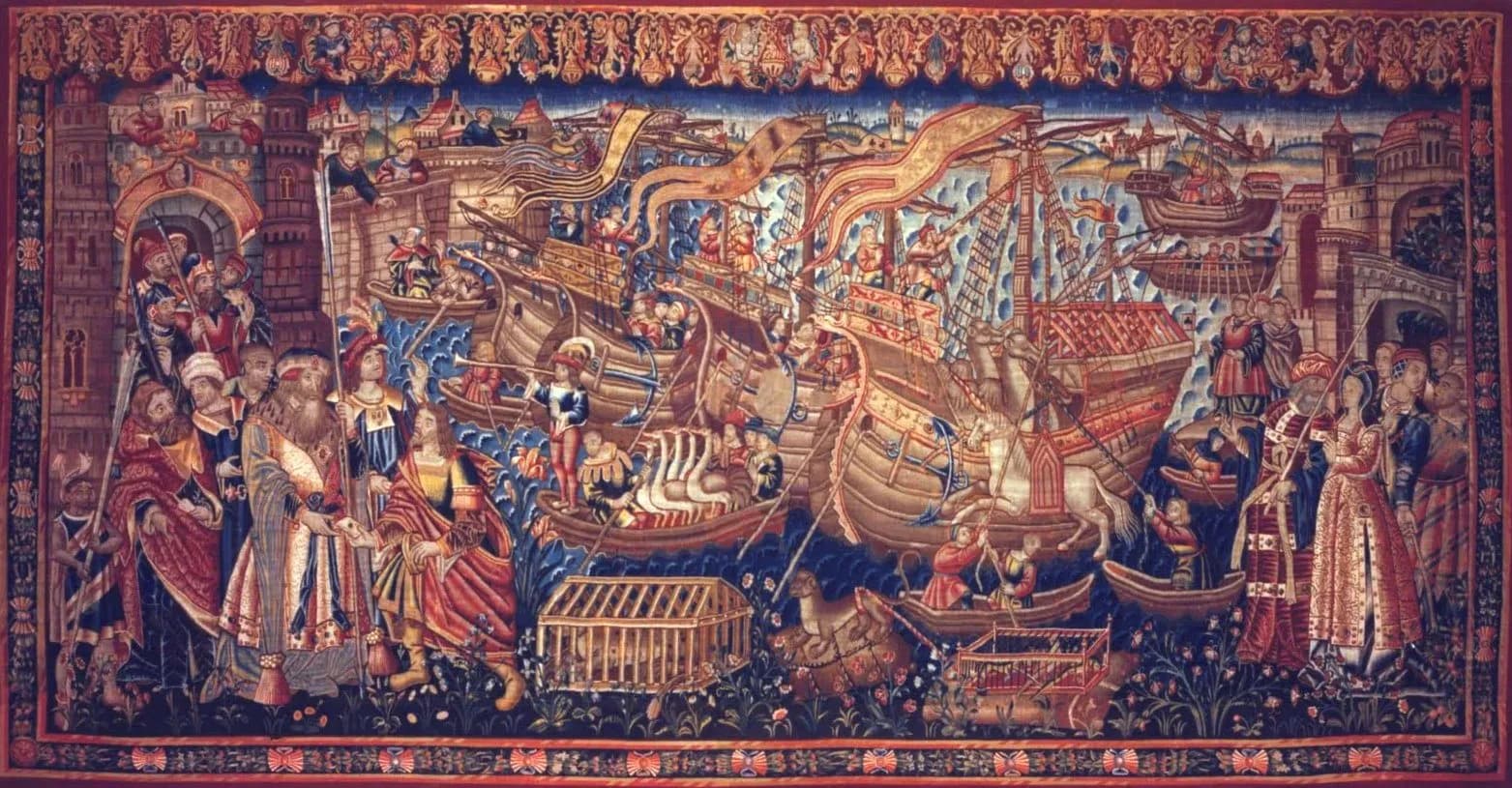
- A sixteenth-century wall hanging woven at Tournai “in the manner of Portugal and India”, now in the collection of the Caixa Geral de Depósitos in Lisbon and titled the arrival of Vasco da Gama at Calicut or Cochin. The ships, town and dress are all European in style. Unknown weavers, Tournai, Public domain, via Wikimedia Commons.
- Kappad beach, north of Kozhikode, in 2017. Gama's three ships anchored off this stretch of coast on the night of 20 May 1498. SidhardhRamesh, CC BY-SA 4.0, via Wikimedia Commons.