

Through the fog to Horta: the NC-4 and the first flight across the Atlantic
Three American flying boats left Newfoundland for the Azores on the evening of 16 May 1919. Fog brought two of them down on the sea. The third found a gap over Flores, landed at Horta and, ten days later, flew into Lisbon to a 21-gun salute.
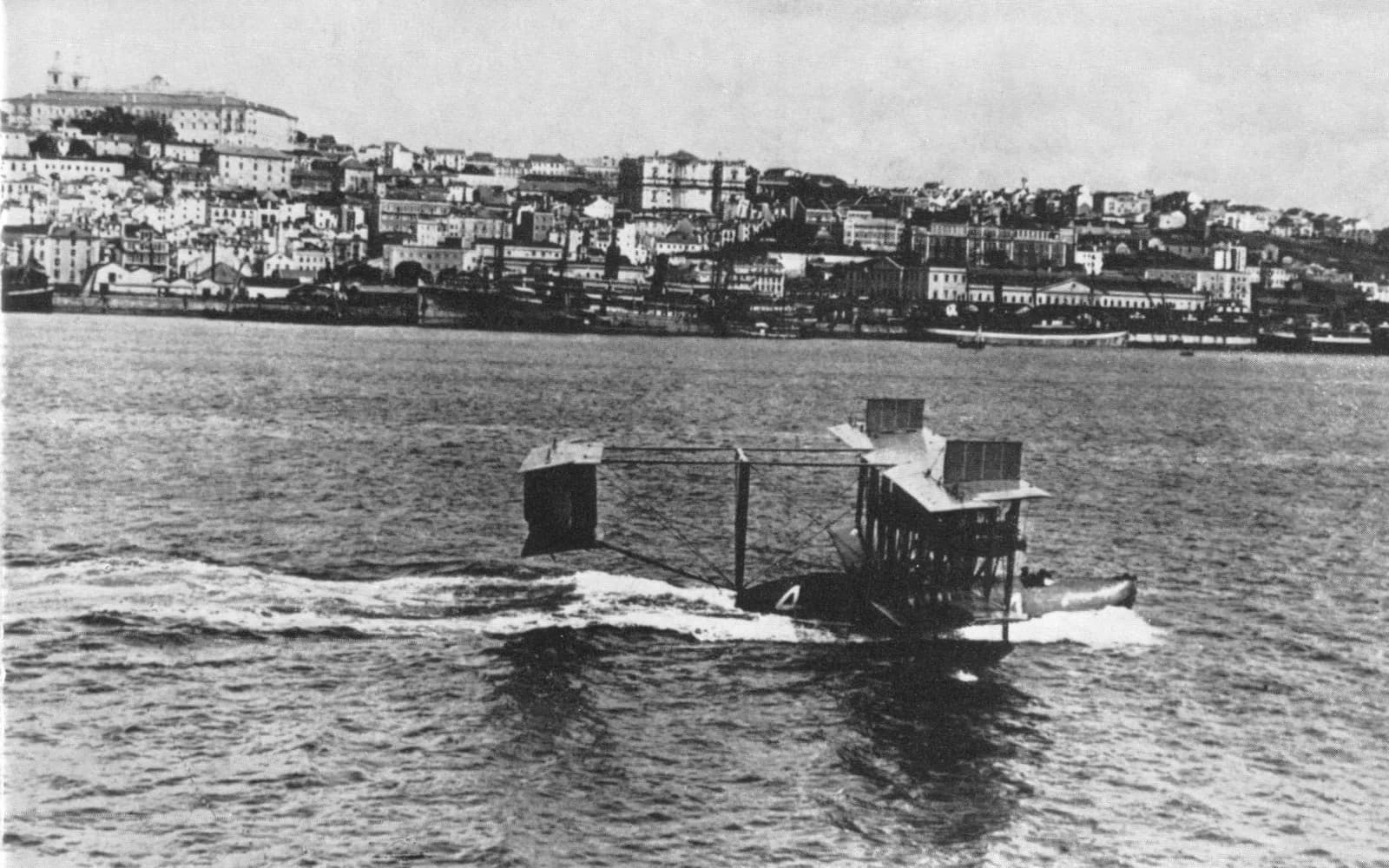
At a glance
- On the evening of 16 May 1919 three US Navy flying boats, the NC-1, NC-3 and NC-4, took off from Trepassey Bay, Newfoundland, for the Azores, following a line of destroyers stationed about 50 miles apart.
- Fog hid the sea near the islands. The NC-1 and NC-3 came down on the water and could not fly again; the NC-4, commanded by Lieutenant Commander Albert C. Read, sighted Flores through a gap and landed at Horta, on Faial, at 13.23 Greenwich time on 17 May.
- That leg, about 1,200 nautical miles in 15 hours and 18 minutes, was the longest of the trip. Weather held the NC-4 at Horta until 20 May. At Ponta Delgada, on São Miguel, an engine fault and then rough seas kept it until 27 May.
- On 27 May the NC-4 flew 800 nautical miles to Lisbon and landed on the Tagus at about 9 in the evening, the first aircraft to fly across the Atlantic. The Navy Minister gave the crew the insignia of the Order of the Tower and Sword that night.
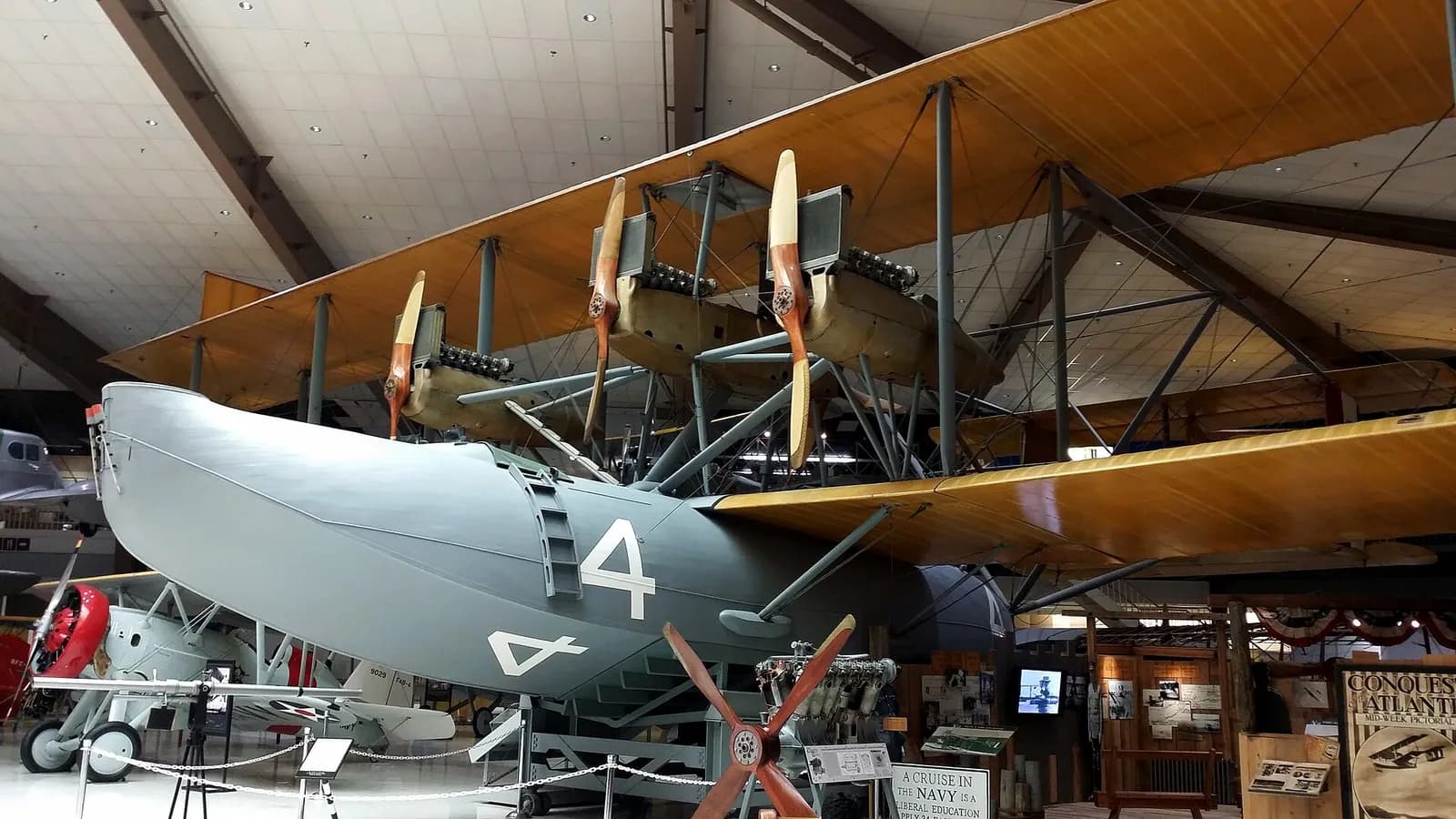
- The flight ended at Plymouth on 31 May, 3,936 nautical miles from New York; its builder, Curtiss, counted 52 hours and 31 minutes in the air. The NC-4 belongs to the Smithsonian and has been on loan to the naval aviation museum in Pensacola, Florida, since 1974.
A farmhouse on Flores
On the morning of Saturday 17 May 1919 Albert Read had not seen a ship for nearly three hours. He sat in the open navigator's cockpit of the NC-4, a four-engined American flying boat, about 3,400 feet above a white sheet of fog. Somewhere under it were the Azores.
Less than two hours earlier the fog had swallowed the aircraft whole. The pilot, flying blind, let one wing drop, the compass spun and the boat went into a sharp turn before it shot up out of the fog into clear air. Since then Read had steered by dead reckoning and by radio messages from the destroyers ahead. Number 19 reported thick fog, number 20 heavy mist. Number 21 reported ten miles of visibility.
At 11.27 Greenwich time he saw, through a rift, a white line on the water that he took for a tide rip. Then a rock appeared at the end of it. It was surf, and the dark ground beyond was the southern end of Flores, in the western Azores. He signalled the pilots down. Under the fog, as they rounded the point, a farmhouse came into view among fields on a hillside.
“That scene appeared far more beautiful to us than any other ever will. If the worst happened now we could land in a lee somewhere, and get ashore, somehow.”
Just under two hours later the NC-4 landed beside the American warship Columbia in the harbour of Horta, on Faial. It had left Newfoundland 15 hours and 18 minutes earlier. Of the three flying boats that set out, it was the only one to reach the islands in the air, and ten days later it carried on to Lisbon.
What you need to know first
In 1913 the London Daily Mail offered £10,000 for the first flight across the Atlantic. The First World War stopped the race before anyone could try, and the paper offered the prize again after the Armistice of November 1918. By May 1919 British crews were waiting in Newfoundland to attempt the shortest route, straight to Ireland.
The US Navy took another approach. During the war it had ordered from Curtiss a class of large flying boats, nicknamed “Nancy boats”, to hunt German submarines. They were meant to be able to fly to the war zone in Europe on their own, because shipping space was scarce. The war ended before they could be used, and in 1919 the Navy decided to show what they could do.
Its plan was to fly in stages rather than straight across: from New York to Newfoundland, then about 1,200 nautical miles to the Azores, then to Lisbon and on to Plymouth, in England. Three boats would fly together, each with six men and four Liberty engines. Destroyers would mark the way across the open ocean, and their crews would pick up anyone who came down.
- Aircraft
- Curtiss NC-4, a four-engined biplane flying boat of the US Navy
- Wingspan
- 38.4 metres
- Length
- 20.8 metres
- Weight
- 6,396 kg as preserved (14,100 lb)
- Engines
- Four Liberty engines
- Crew
- Six: commander and navigator, two pilots, two engineers, radio operator
- Commander
- Lieutenant Commander Albert Cushing Read (1887–1967)
The NC-4 almost missed the start. On the first day out of Rockaway, New York, on 8 May, it lost two engines and came down on the sea off Cape Cod. Read's crew taxied it through the night to the naval air station at Chatham, Massachusetts, where the station's crew fitted a replacement engine, and gales then held them there until 14 May. Read later called his account of the flight “The ‘lame duck’ wins”. It reached Trepassey Bay, in Newfoundland, on 15 May, the day before the others left.
The big hop, 16 and 17 May
The three boats left Trepassey Bay in the early evening of Friday 16 May, between 22.06 and 22.09 Greenwich time, after false starts and a struggle to get a newly fitted engine going. The NC-3 carried the squadron commander, John H. Towers. The NC-1 was commanded by P. N. L. Bellinger, with M. A. Mitscher among its pilots.
Read's crew were the pilots Walter Hinton of the Navy and Elmer Stone of the Coast Guard, the engineers James Breese and Eugene Rhoads, and the radio officer Herbert Rodd. Before midnight Greenwich time they had lost sight of the other two boats in the dark, and they flew on alone, mostly at 800 to 1,000 feet.
At night the destroyers were the signposts. Each one fired star shells as the planes approached, shone a searchlight into the wind and displayed its station number in lights on deck. Read ticked them off “with clocklike regularity”, as he put it, while Rodd picked up messages from as far away as Bar Harbor, in Maine, and talked to Cape Race, in Newfoundland. Read's breakfast was coffee, one sandwich and a piece of chocolate.
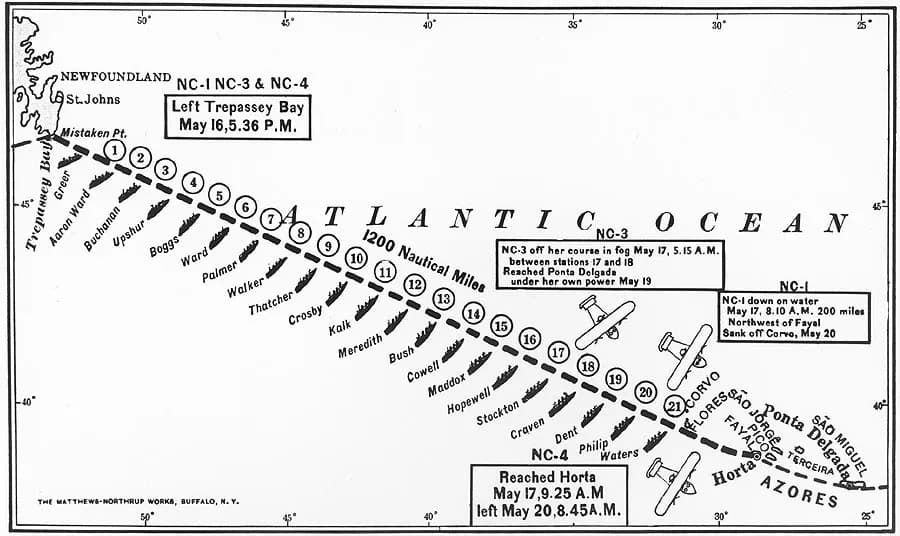
The weather broke near the islands. After destroyer 16, at about 08.30 Greenwich time, the NC-4 saw no ship for nearly three hours. The NC-1 and NC-3 also lost their way in the fog. Both crews decided to land on the sea to get their bearings, and both found the waves far bigger than they looked from the air.
The NC-1 came down about 100 miles west of Flores and was too damaged to take off. A passing steamer, the Ionia, took its crew off after about five hours; the hull sank later.
The NC-3, with Towers aboard, landed in heavy seas short of Faial. With a damaged hull and no way to fly, its crew sailed it backwards before the wind for about 205 miles and 52 hours (Read put it at sixty), and on 19 May taxied into Ponta Delgada under its own power, waving away a destroyer that came to tow it.
Read's luck held. After Flores the NC-4 picked up destroyer 22, and the engineer said there was enough fuel to go straight on to Ponta Delgada. Fog closed in again before number 23. Read gave up on São Miguel, sighted the north end of Faial through clearer air and turned for Horta, landing first in the wrong bay. The crew took off again, rounded the next point and set down beside the Columbia at 13.23 Greenwich time.
8 May
NC-1, NC-3 and NC-4 leave Rockaway, New York
The NC-4 comes down off Cape Cod with engine failure and taxies to Chatham.
14–15 May
NC-4 flies Chatham to Halifax to Trepassey
It joins the other two boats in Newfoundland.
16 May, 22.07 GMT
Take-off from Trepassey Bay for the Azores
17 May, 11.27 GMT
Flores sighted through the fog
17 May, 13.23 GMT
NC-4 lands at Horta, Faial
The NC-1 and NC-3 are down on the sea.
19 May
NC-3 reaches Ponta Delgada on the water
20 May
NC-4 flies Horta to Ponta Delgada in 1 hour 44 minutes
21–26 May
Held at Ponta Delgada by an engine fault and rough seas
27 May, 20.01 GMT
NC-4 lands on the Tagus at Lisbon
29 May
Lisbon's gold medal for Read; ball at Bom Sucesso
30 May
Leaves Lisbon; stops in the Mondego at Figueira da Foz and at Ferrol
31 May
Lands at Plymouth, England
Ten days in the Azores
On the Columbia's gangway the crew were cheered, and Read realised for the first time that people thought the flight a great feat. Bands from Horta came out to serenade them and the town sent bouquets of flowers. The boat needed only a few small repairs, finished the same day.
Rain squalls kept the NC-4 at Horta for three days. It took off at 12.39 Greenwich time on 20 May and covered the 150 nautical miles along the south side of Pico, past São Jorge and Terceira, to Ponta Delgada in 1 hour and 44 minutes.
Ponta Delgada was ready. American warships waiting for the flying boats filled its harbour; the Lisbon weekly Ilustração Portuguesa photographed the repair ship Buffalo, the Melville and the cruiser Rochester there. Ships' whistles blew, the quays and seawall were lined with people, and Read was taken to meet the island's governor, who gave a reception with speeches in Portuguese that the Americans could not follow.
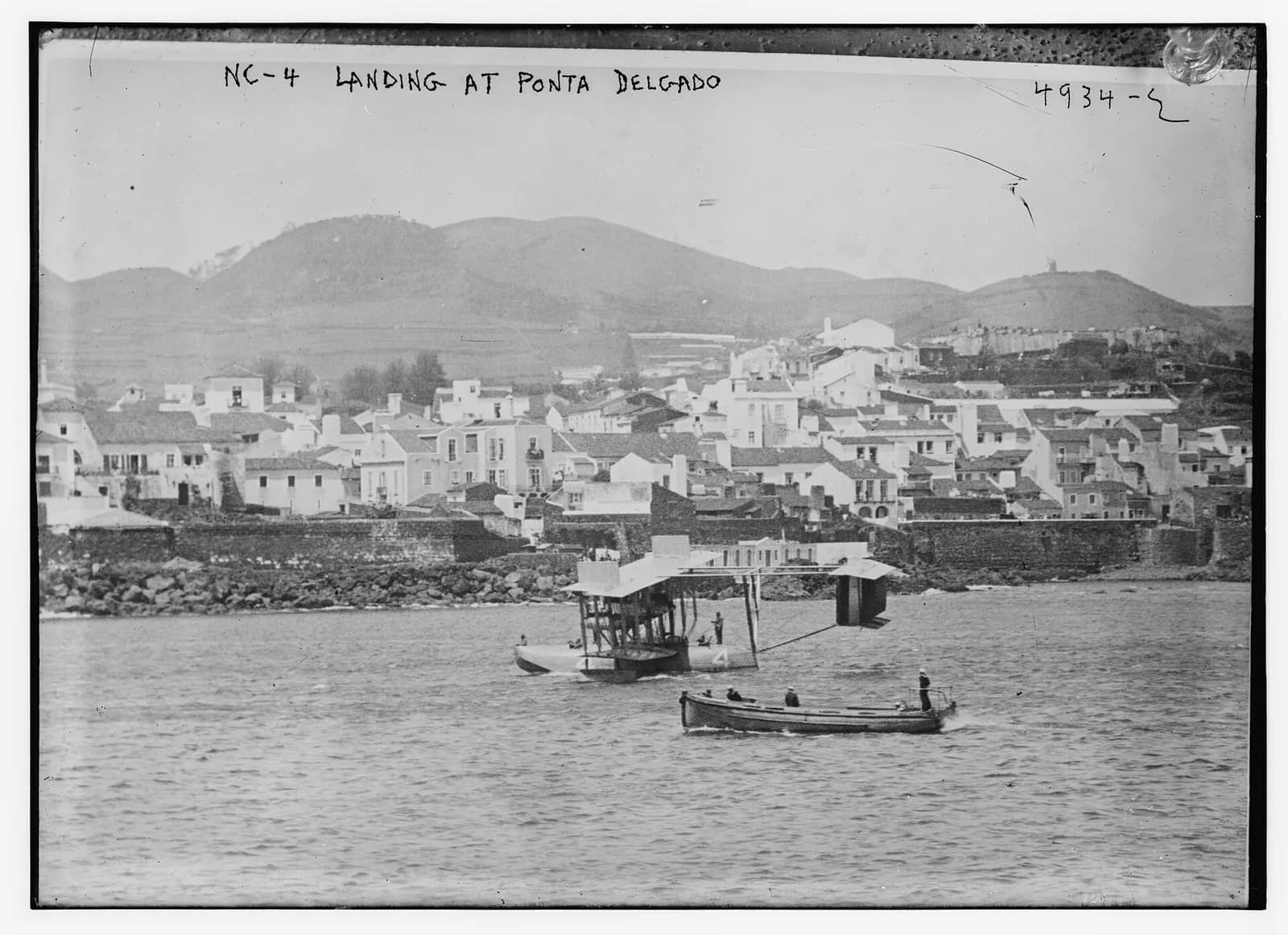
The next morning one engine faltered as the NC-4 tried to take off. To reach Lisbon in daylight it had to leave early, so the fault cost a day. Then the sea got up. For five days Read kept the boat at its mooring, more afraid of a small boat running into it than of the flight ahead.
Into Lisbon, 27 May
The NC-4 left Ponta Delgada at 10.18 Greenwich time on Tuesday 27 May, after dirt in the fuel delayed the start. It was 2,000 pounds lighter than at Trepassey and lifted off the swell with a few jolts. A second line of destroyers, numbered 1 to 14, marked the 800 nautical miles to Portugal.
The bumpy take-off had probably knocked the compass out of true, and the boat strayed seven or eight degrees south of its course. It missed destroyer 3 altogether. Read found his way back with the radio direction-finder, which gave him bearings on destroyer 4. He reckoned that if he missed Portugal he could still reach Africa.
Past the last destroyer, number 14, the coast came into view. On the way Read had written his report to the Navy, and one of the engineers had shaved for the reception they had heard was waiting.
“Perhaps the biggest thrill of the whole trip was experienced as we passed over the beach line of Portugal and realized that no matter what happened … the transatlantic flight, the first one in the history of the world, was an accomplished fact.”
At 19.50 Greenwich time the NC-4 was off the mouth of the Tagus. It circled and landed astern of the American ship Shawmut at 20.01, by Lisbon's clocks about nine in the evening. The flight from Ponta Delgada had taken 9 hours and 43 minutes. Ships' sirens sounded, and the warships anchored off the city fired a 21-gun salute, which Read noted was normally given only to a president or a foreign flag.
“The 27th of May will remain historic and unforgettable in the annals of the Portuguese capital. It was nine o'clock; the sun had barely crossed the line of the horizon … when, before many thousands of people who filled the banks of the Tagus and the high points of the city, the N.C.4 appeared, anxiously awaited for days.”
A boat took the crew to the Rochester, where Towers, Rear Admiral Plunkett and the American minister, Birch, were waiting with Portuguese officials. On board, the Navy Minister presented the airmen with the insignia of the Order of the Tower and Sword. The formal awards were dated 2 and 3 June: Read and Towers were made commanders of the order, and the other five crew knights.
Birch spoke of the Americans having written a page of glory like the one the Portuguese wrote centuries earlier when they crossed unknown seas. Read told the people crowding round him that they had averaged about 85 miles an hour, had felt the cold and had eaten on board. That night some of the crew went ashore to see the town.
Three days in Lisbon
For the next two days the NC-4 lay moored by the Shawmut, refuelling while its mechanics worked on the engines. Launches and small boats full of sightseers circled it the whole time. A cable came from President Woodrow Wilson, in Paris, saying he was proud of what they had done.
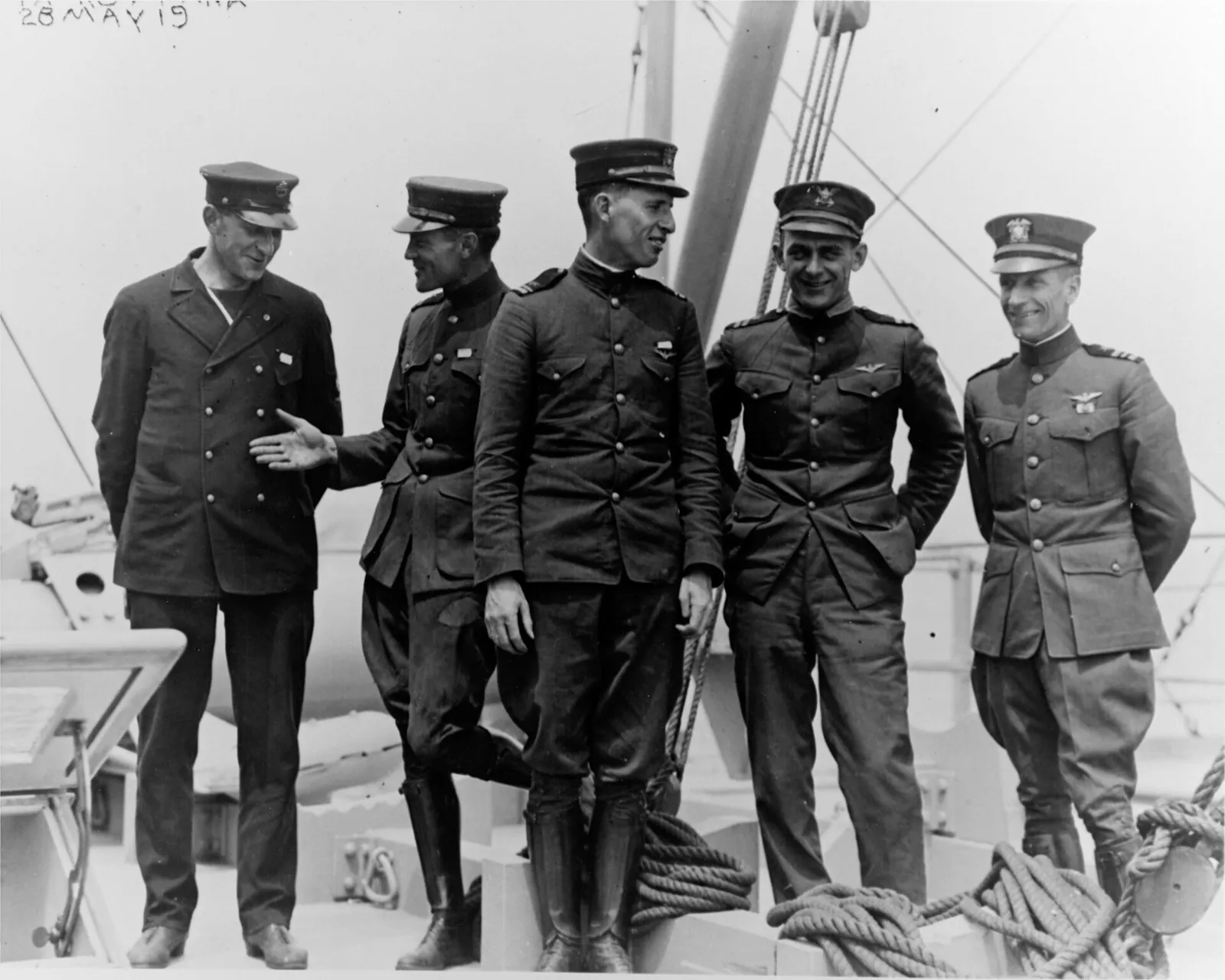
On 29 May the president of Lisbon's municipal senate, Alberto Ferreira Vidal, went aboard the Shawmut to give Read a gold medal from the city. Portuguese naval airmen were in the group photographed with the crew that day, among them a Lieutenant Commander Cabral. Pesquisa FAPESP, the Brazilian science magazine, says Sacadura Cabral was among those who welcomed Read in Lisbon.
The same day the Portuguese naval air station at Bom Sucesso, in Lisbon, gave a ball in the crew's honour. The War Minister wrapped Read in a Portuguese flag, a gift from the government, and the Ilustração Portuguesa photographed Read and Breese dancing.
The Portuguese had more planned, but the crew wanted to finish. They left at about 05.25 Greenwich time on 30 May and cancelled several official engagements to do it. Before heading out of the Tagus, Read circled over the city as a farewell.
The flight did not leave Portugal at once. A water leak in the port engine put the NC-4 down in the Mondego river at Figueira da Foz, where it ran aground on a sandbank and the port captain lent boats. The leak was stopped with a radiator compound, and the boat flew on to Ferrol, in Spain, that afternoon and to Plymouth on 31 May.
| Date | Leg | Nautical miles | Time in the air | Average speed (knots), worked out |
|---|---|---|---|---|
| 8 May | Rockaway to Chatham, Massachusetts | 190 | 3 h 43 min | 51 |
| 14 May | Chatham to Halifax, Nova Scotia | 340 | 4 h 10 min | 82 |
| 15 May | Halifax to Trepassey, Newfoundland | 461 | 6 h 20 min | 73 |
| 16–17 May | Trepassey to Horta, Faial | 1,200 | 15 h 18 min | 78 |
| 20 May | Horta to Ponta Delgada, São Miguel | 150 | 1 h 44 min | 87 |
| 27 May | Ponta Delgada to Lisbon | 800 | 9 h 43 min | 82 |
| 30 May | Lisbon to the Mondego river | 100 | 1 h 20 min | 75 |
| 30 May | Mondego river to Ferrol, Spain | 220 | 3 h 7 min | 71 |
| 31 May | Ferrol to Plymouth, England | 475 | 6 h 59 min | 68 |
From the “Record made by NC-4 from Rockaway to Plymouth” in the Curtiss company's 1919 book, which totals 3,936 nautical miles and 52 hours 31 minutes in the air. The leg times as printed add up to 52 hours 24 minutes, and another chapter of the same book gives 2 days, 7 hours and 33 minutes. The 15 h 18 min for the Horta leg is the time from take-off to landing; Read counted 15 h 13 min of flying, leaving out the minutes on the water in the wrong bay. The book also prints a speed for each leg, but those figures do not agree with its own distances and times (58 knots for the 461 nautical miles from Halifax to Trepassey, flown in 6 h 20 min), so the speeds here are each distance divided by its time in the air. Read gave about 86 knots to Halifax, about 79 to Horta and about 80 to Lisbon.
Length of each leg of the NC-4's flight, May 1919
nautical miles
Air-line distances from the Curtiss company's 1919 record of the flight. The two legs that ended in Portugal, to Horta and to Lisbon, were the longest.
Show the data
| Distance | |
|---|---|
| Rockaway–Chatham | 190 |
| Chatham–Halifax | 340 |
| Halifax–Trepassey | 461 |
| Trepassey–Horta | 1,200 |
| Horta–Ponta Delgada | 150 |
| Ponta Delgada–Lisbon | 800 |
| Lisbon–Mondego | 100 |
| Mondego–Ferrol | 220 |
| Ferrol–Plymouth | 475 |
After the NC-4
The NC-4 crossed the ocean in stages, with stops on the sea and a fleet beneath it. Two weeks later, setting out on 14 June 1919, the British airmen John Alcock and Arthur Whitten Brown flew a twin-engined Vickers Vimy non-stop from Newfoundland to Ireland. Charles Lindbergh made the first solo non-stop crossing in May 1927.
Totals for the support fleet vary with the source. The Curtiss company's 1919 account speaks of a line of sixty destroyers; Pesquisa FAPESP gives 68 ships posted every 50 to 75 miles. In Read's account the stations are numbered up to 25 between Newfoundland and São Miguel, and 1 to 14 from there to Portugal, where number 10 was missing on the day.
Among the Portuguese naval airmen who welcomed the crew in Lisbon was Sacadura Cabral. In June 1919, a few weeks after the NC-4 left, he conceived a flight from Lisbon to Rio de Janeiro for the centenary of Brazil's independence, after a visit to Lisbon by Brazil's president-elect, Epitácio Pessoa. When he and the navigator Gago Coutinho made that flight in 1922, the first across the South Atlantic, they had no chain of ships and no radio, and found their way with Coutinho's sextant.
Back in the United States the NC-4 was shown in Central Park in New York, in Philadelphia and in Washington. Its hull went on display at the Smithsonian in 1920. The Smithsonian took the whole aircraft over in stages, in 1927 and 1961, restored it for the 50th anniversary in 1969 and showed it on the National Mall in Washington.
In an essay for the Curtiss company's book that year, Read had a warning for sceptics.
“As for the future, this is certain: any one who to-day declares anything impossible is apt to bark his knuckles.”
FAQs
What was the first aircraft to fly across the Atlantic?
The US Navy flying boat NC-4, commanded by Lieutenant Commander Albert C. Read. It left New York on 8 May 1919, flew from Newfoundland to Horta in the Azores on 16 and 17 May, and landed at Lisbon on 27 May, the first aircraft to fly across the Atlantic. It went on to Plymouth, England, on 31 May.
Why did the NC-4 stop in the Azores?
The Navy chose a route in stages rather than a non-stop flight. The Azores were the only land between Newfoundland and Europe on that route, about 1,200 nautical miles from Trepassey Bay, and the US Navy had ships and a base there. The NC-4 landed at Horta on 17 May and flew to Ponta Delgada on 20 May, where an engine fault and then rough seas kept it until 27 May.
What happened to the NC-1 and NC-3?
Both came down on the sea in fog near the Azores on 17 May 1919 and were too damaged to fly again. The NC-1's crew were rescued by the steamer Ionia and the boat sank. The NC-3 sailed on the surface for about 52 hours and reached Ponta Delgada on 19 May.
How was the NC-4 received in Lisbon?
Thousands of people lined the Tagus when it landed at about 9 pm on 27 May 1919. Warships fired a 21-gun salute, and the Navy Minister presented the crew with the insignia of the Order of the Tower and Sword. On 29 May the city gave Read a gold medal, and the Bom Sucesso naval air station held a ball for the crew.
Was the NC-4 the first non-stop transatlantic flight?
No. The NC-4 crossed in stages, landing in the Azores and at Lisbon. The first non-stop crossing was made by John Alcock and Arthur Whitten Brown, from Newfoundland to Ireland, in June 1919.
On the timeline
Open the timelineNearby moments from the first republic (1910–1926).
President Sidónio Pais is assassinated at Lisbon's Rossio station as he arrives to catch the night train to Porto. José Júlio da Costa, a 25-year-old left-wing former army sergeant who has been waiting for him, shoots him in the chest. The charismatic 'President-King', who had seized power a year earlier, dies within minutes; four bystanders are killed in the shooting and panic that follow.
Monarchist troops under Henrique de Paiva Couceiro proclaim the restoration of the monarchy in Porto, the so-called Monarchy of the North, and a Junta Governativa do Reino takes power across much of northern Portugal. Never sanctioned by the exiled D. Manuel II, the rising collapses on 13 February, when a republican counter-coup inside Porto restores the Republic.
Death of Francisco Marto at age 10 in Aljustrel, one of the three shepherd children who reported the apparitions of Our Lady of Fátima in 1917. He died of the Spanish Flu and was canonised by Pope Francis in 2017.
The NC-4 reaches the Azores
The US Navy flying boat NC-4 takes off from Trepassey, Newfoundland, on the longest leg of the first transatlantic flight, reaching Horta in the Azores some 15 hours later. After a week's wait at Ponta Delgada, it lands on the Tagus at Lisbon on 27 May, the first aircraft to fly across the Atlantic.
Jorge de Sena is born in Lisbon. Poet, novelist, dramatist and essayist, he trained as a civil engineer, went into exile in Brazil in 1959 and from 1965 taught in the United States, at the universities of Wisconsin and California, leaving one of the most wide-ranging bodies of work in twentieth-century Portuguese letters.
Sophia de Mello Breyner Andresen is born in Porto. One of the most important Portuguese poets of the twentieth century, she published fourteen books of poetry between 1944 and 1997 and in 1999 became the first Portuguese woman to win the Camões Prize.
Jacinta Marto, the youngest of the three shepherd children who reported visions of the Virgin at Fátima in 1917, dies aged nine in Lisbon's Dona Estefânia hospital, weakened by the Spanish flu. Canonised in 2017, she is the youngest saint in Catholic history who did not die a martyr.
Coming up in history
All long reads 18 May 1881Carvalho Araújo: the deputy who took a trawler against a U-boat
 19 May 1954Catarina Eufémia, the harvest worker shot at Baleizão in 1954
 20 May 1498Vasco da Gama reaches Calicut: the first fleet from Europe to India
 21 May 1662Catherine of Braganza marries Charles II: Portsmouth, 21 May 1662
14 sources
Archives, scholarship and reporting this article was checked against.
- 1
The Triumph of the N.C.'s, by G. C. Westervelt, A. C. Read and H. C. Richardson; part 2, “The ‘lame duck’ wins: the story of the transatlantic flight of the N.C.4”, by A. C. ReadDoubleday, Page & Company, Garden City, New York, [1920] (Internet Archive)
- 2
- 3
“A travessia aérea do Atlântico”, Ilustração Portuguesa, 2.ª série, n.º 694, 9 June 1919, pp. 453–457Hemeroteca Digital, Câmara Municipal de Lisboa
- 4
- 5
Curtiss NC-4 (inventory number A19270032000)Smithsonian National Air and Space Museum
- 6
- 7
Um voo de 67 dias entre Lisboa e Recife (Carlos Fioravanti)Revista Pesquisa FAPESP, no. 312, 2022
- 8
The Portuguese Expeditionary Corps in World War I: From Inception to Destruction, 1914-1918 (Jesse Pyles, MA thesis)University of North Texas, 2012 (UNT Digital Library)
- 9
1919: da Traulitânia e Monsanto ao regresso da República Velha, by José Adelino MaltezRespublica, anuário político (José Adelino Maltez, ISCSP, Universidade de Lisboa)
- 10
Entidades estrangeiras agraciadas com ordens portuguesas (search: Read, Towers, Hinton, Stone, Breese, Rodd, Rhoades)Presidência da República, Ordens Honoríficas Portuguesas
- 11
Centenary of the First Air Crossing of the South Atlantic (online exhibition)Museu de Marinha
- 12
Sacadura Cabral, by Vice-Admiral Abílio Cruz Júnior (second part), p. 7: the Lisbon–Funchal flight and the preparation of the crossingRevista da Armada, no. 331, May 2000
- 13
Coutinho, Carlos Viegas Gago (Lisboa, 1869 – Lisboa, 1959)Dicionário de Historiadores Portugueses, Biblioteca Nacional de Portugal
- 14
Image credits
- The NC-4 on the Tagus in front of Lisbon in May 1919. It landed there on the evening of 27 May, the end of the first flight across the Atlantic, and left for Plymouth on 30 May. The photographer is not recorded. Unknown author, Public domain, via Wikimedia Commons.
- The Trepassey to Azores leg as published by the Curtiss company in 1919. The numbered circles are the destroyers stationed along the line; the boxes give each boat's fate in New York time. In Read's account the stations run up to number 25, short of São Miguel. Unknown author, Public domain, via Wikimedia Commons.
- The NC-4 on the water with a launch alongside, in a 1919 photograph that the Bain News Service labelled as Ponta Delgada, on São Miguel. It arrived there from Horta on 20 May and waited a week to leave for Lisbon. Bain News Service, publisher, Public domain, via Wikimedia Commons.
- The NC-4's crew in Lisbon on 28 May 1919. From left: Chief Machinist's Mate Eugene Rhoads, Lieutenant James Breese, Lieutenant (junior grade) Walter Hinton, Lieutenant Elmer Stone of the Coast Guard and Lieutenant Commander Albert Read. The radio officer, Ensign Herbert Rodd, is not in the picture. U.S. Navy, Public domain, via Wikimedia Commons.
- The NC-4 at the National Naval Aviation Museum in Pensacola, Florida, in June 2015. The Smithsonian, which owns it, lent it to the museum in 1974. Eric Friedebach, CC BY 2.0, via Wikimedia Commons.