

Pêro da Covilhã's secret journey to India and Ethiopia, 1487
Disguised as merchants, two of João II's squires set out to learn what Portugal's ships were looking for. One died before they could meet again. The other saw Calicut a decade before Vasco da Gama and spent more than thirty years in Ethiopia, whose emperors would not let him leave.
At a glance
- On 7 May 1487, at Santarém, King João II sent his squires Pêro da Covilhã and Afonso de Paiva overland to find Prester John, the Christian king Europeans placed beyond Egypt, and the source of the spices that reached Europe through Venice.
- Posing as merchants, they went by Barcelona, Naples, Rhodes, Alexandria, Cairo and the Red Sea to Aden, where they split up: Paiva for Ethiopia, Covilhã for India.
- Covilhã saw Cannanore, Calicut and Goa, probably in 1488 and 1489, then Hormuz and the East African coast as far as Sofala. Back in Cairo he learned that Paiva had died.
- From Cairo he sent the king a report that India could be reached by sea by way of Guinea and Sofala. No document records its arrival in Lisbon.
- He reached Ethiopia around 1493 and was never allowed to leave. The chaplain Francisco Álvares met him there in 1520, and his account of Covilhã's story was printed in 1540.
An audience at Santarém
On 7 May 1487, at Santarém on the Tagus, King João II gave two of his squires their final orders. Pêro da Covilhã and Afonso de Paiva were to travel east through the lands of Islam and find out two things: where Prester John lived, and where cinnamon and the other spices came from before Muslim traders carried them to Venice.
Manuel, Duke of Beja, who would succeed João as king, was present. The two men were given a sailing chart copied from a map of the world, the work of the Licentiate Calçadilha (Diogo Ortiz de Vilhegas, later Bishop of Viseu), of mestre Rodrigo, the king's physician, and of mestre Moisés, then a Jew. It had been drawn up in the house of Pêro de Alcáçova.
The king paid out 400 cruzados for their expenses from the chest that funded his garden at Almeirim. He gave Covilhã a letter of credence “for all the countries and provinces in the world”, to be shown if he was ever in danger, and blessed them both.
Neither man saw Portugal again. Paiva died before the two could meet as planned. Covilhã reached India, the Persian Gulf and the gold port of Sofala, then lived out his life in Ethiopia. In 1520 a Portuguese priest found him there, more than thirty years after the audience at Santarém, and wrote down what he said. Almost everything known about the journey comes from that conversation.
Ships to the south, spies to the east
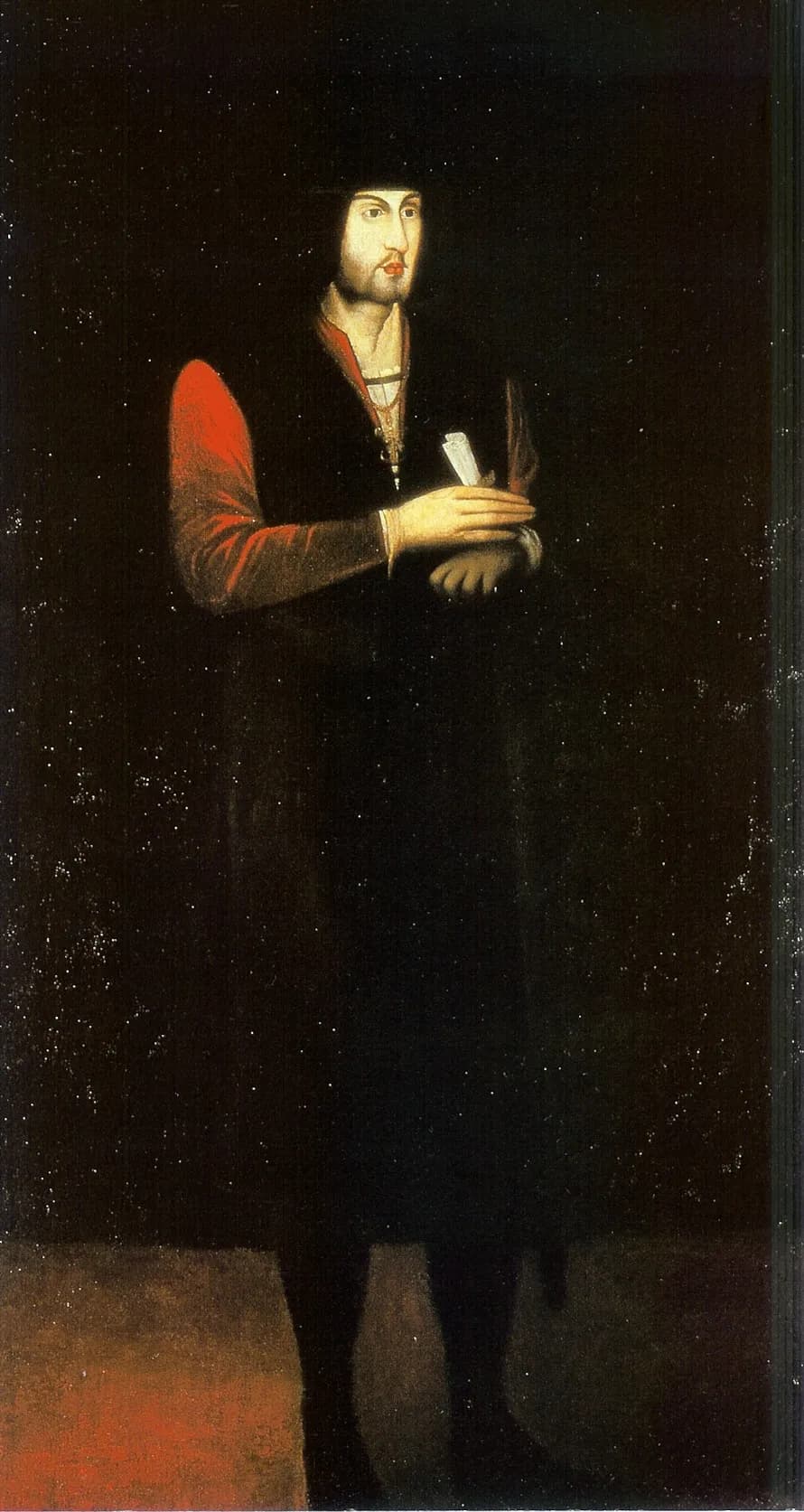
João II became king in 1481 and pushed his captains further down the African coast than anyone before. Diogo Cão made two voyages south past the mouth of the Congo in the 1480s. Then Bartolomeu Dias was sent with three ships to go further still, and early in 1488 he rounded the southern tip of Africa.
The spices Europe paid most for, pepper, cinnamon and cloves, came from India and further east, and reached the Mediterranean through Arab traders, the ports of Mamluk Egypt and the merchants of Venice. João wanted to know where the trade began and how it ran.
A report from Benin sharpened the king's interest. João de Barros, the great chronicler of the Portuguese in Asia, says an envoy of the king of Benin, brought to Lisbon by João Afonso de Aveiro, spoke of a ruler called Ogané, twenty moons' journey to the east. Ogané confirmed each new king of Benin with a brass staff, a cap like a helmet and a brass cross, and showed only his foot from behind silk curtains.
The king's cosmographers measured the distance on Ptolemy's map of Africa and decided that Ogané must be Prester John. In that year of 1486, Barros writes, João resolved to send ships by sea and men by land.
He had already tried the land route once. Frei António de Lisboa and Pêro de Montarroio got as far as Jerusalem, but neither knew Arabic, and they did not dare go on with the Ethiopian monks they met there. Both came home. The next envoy, João decided, had to speak the language.
The king's squire
Covilhã took his name from his birthplace, the town of Covilhã. His date of birth is unknown; the Count of Ficalho, who wrote a book-length study of his journey in 1898, put it around 1450. As a young man he went to Castile to serve Don Alfonso, “Duke of Seville” as Álvares calls him, and came back to Portugal with the duke's brother, Juan de Guzmán, at the start of the war between the two kingdoms.
He entered the service of King Afonso V, first as a groom and then as a squire, fought in that war and went with the king to France. Under Afonso's son João II he was a squire of the guard. After what Álvares calls “the treasons”, the plots against João II, the king sent him round Castile, because he spoke Castilian well, to find out which Portuguese gentlemen had fled there.
Then came two missions to North Africa: one to buy cloth and make peace with the king of Tlemcen, the other to Muley Belagegi, the lord in Barbary who had sent home the remains of the Infante Fernando, the “Constant Prince”. Barros calls him a knight of the king's household who knew Arabic very well.
His companion is a shadow. Álvares says only that Afonso de Paiva came from Castelo Branco and was waiting at court when Covilhã returned from Barbary. The king then called Covilhã in, spoke to him in great secrecy and told him he expected a great service of him.
- Dispatched
- 7 May 1487, at Santarém, in the presence of Manuel, Duke of Beja
- Envoys
- Pêro da Covilhã, squire of the guard; Afonso de Paiva, of Castelo Branco
- Orders
- Find Prester John and learn where cinnamon and the other spices came from
- Funds
- 400 cruzados, partly banked with a Florentine for collection in Valencia
- Equipment
- A sailing chart taken from a map of the world, and a royal letter of credence
- Cover
- Merchants, with a cargo of honey for Alexandria
Honey merchants on the road to Aden
Part of the money went with them; the rest they left with Bartolomeu, a Florentine, to be paid out in Valencia. They reached Barcelona on the feast of Corpus Christi, which fell on 14 June that year, and Naples on St John's Day, 24 June. There, Álvares says, the sons of Cosimo de' Medici provided for their journey; Ficalho took this to mean that a Medici bank paid out money sent on from Barcelona.
At Rhodes, held by the Knights of St John, they lodged with the only two Portuguese there, Frei Gonçalo and Frei Fernando, knights of the order. They crossed to Alexandria in a ship of Bartolomeu de Paredes, having bought a great deal of honey so that they would pass as merchants. There both men fell ill with fever. The Naib, the city's governor, seized the honey, thinking they would die; when they recovered he paid them what he chose.
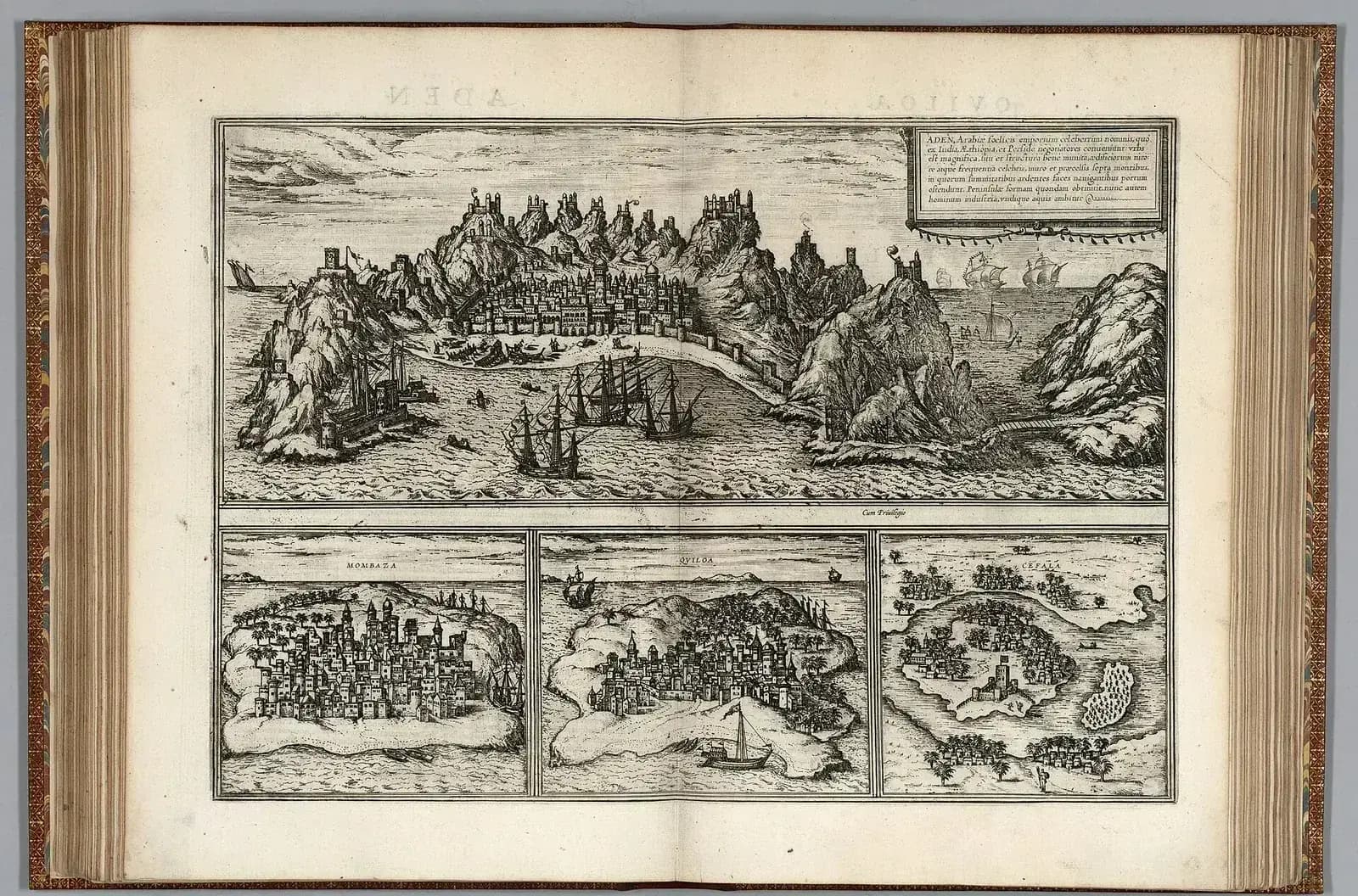
They bought new goods and went on to Cairo, the city of the Mamluk sultan. There they joined a party of North African Muslims from Fez and Tlemcen bound for Aden, crossed to Tor on the Sinai shore of the Red Sea and sailed down it, by way of Suakin on the African coast, to Aden at its mouth.
It was the season of the monsoon winds that carried ships across the Indian Ocean, and the two men parted. Paiva was to go to Ethiopia, Covilhã to India. They agreed to meet in Cairo at a fixed time and go home together to report.
Calicut, Goa and Sofala
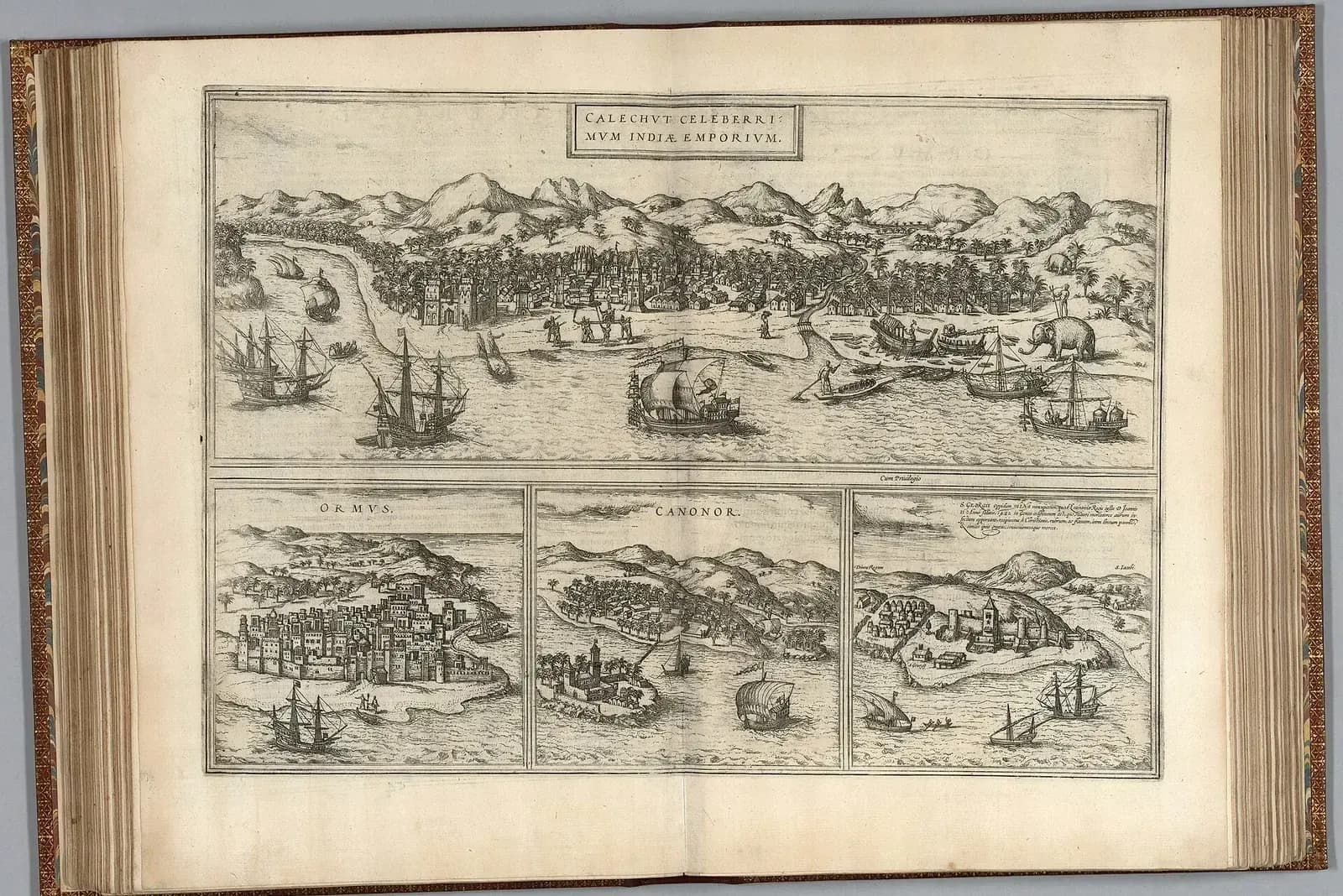
Covilhã took ship at Aden for Cannanore, on the Malabar coast of south-west India. From there he went to Calicut, the great pepper port ruled by a Hindu prince the Portuguese called the Samorim, and then north to Goa, then a Muslim-ruled port. Ficalho reckoned he was in Calicut by the end of 1488 and sailed for Goa early in 1489, almost ten years before Vasco da Gama's ships reached Calicut in May 1498.
From Goa the two main accounts part company. Álvares has him sail to Hormuz, the island market at the mouth of the Persian Gulf, and then back to the Red Sea. Barros sends him from Goa down the African coast to Sofala, the port in today's Mozambique through which the gold of the interior was sold, and then back to Aden. Covilhã's own letter, as Álvares reports it, says he had been to Sofala too.
Ficalho combined the two: Hormuz first, then the long run down the African coast with the north-east monsoon, between October 1489 and March 1490 at the earliest. He thought Covilhã went to Sofala on purpose, to find out from Arab pilots whether the sea ran on round Africa towards the west, the question on which a sea route to India depended.
| Stage | Francisco Álvares (1540) | João de Barros (1552) |
|---|---|---|
| Departure | Santarém, 7 May 1487, Duke Manuel present | Santarém, 7 May 1487, Duke Manuel present |
| To the Levant | Barcelona, Naples, Rhodes, Alexandria; money to collect in Valencia | Naples, Rhodes, Alexandria |
| To Aden | Cairo, Tor, Suakin, Aden | Cairo, Tor, Aden |
| India | Cannanore, Calicut, Goa | Cannanore, Calicut, Goa |
| After Goa | Hormuz, then Tor and Cairo; Sofala mentioned in his letter | Sofala, then Aden and Cairo |
| Second journey | Aden, Hormuz, Jiddah, Mecca, Medina, Mount Sinai, Tor, Zeila, overland to the court | Aden, Hormuz, the Red Sea, the court |
| Emperors met | Alexander, then his brother Nahum, then David | Alexander, then his brother Naut, then Naut's son David |
Álvares heard the story from Covilhã himself in Ethiopia in the early 1520s. Barros, writing later, says he learned it from Álvares and from Álvares's book. Alexander, Nahum or Naut, and David are the emperors Eskender, Na'od and Lebna Dengel.
Letters in Cairo
Back in Cairo, early in 1491 or 1492 by Ficalho's reckoning, Covilhã looked for his companion and learned that he was dead. Barros says Paiva had died of illness in Cairo not long before. Nobody knows whether he ever entered Ethiopia; Ficalho, finding no evidence that he did, thought he probably died early, while trying to get in.
As Covilhã was about to leave for Portugal, he heard that two Portuguese Jews were in the city looking for him. They were Rabbi Abraham of Beja and Joseph, a shoemaker of Lamego, who had travelled to Baghdad and told the king about Hormuz. They carried letters from João: if the envoys had found everything, they should come home to great rewards; if not, they should send word of what they had learned and keep going, above all to Prester John, and show Hormuz to the rabbi.
Covilhã wrote back at once and gave the letter to Joseph to take to Lisbon. Its contents are known mainly from what Covilhã remembered of it many years later, as Álvares wrote it down.
“Here he at once wrote by the shoemaker of Lamego, how he had discovered cinnamon and pepper in the city of Calicut, and that cloves came from beyond, but that all could be had there; and that he had been in the cities of Cananor, Calicut, and Goa, all on the coast, and to this they could navigate by their coast and the seas of Guinea, coming to make the coast of Sofala, to which he had also gone.”
From Sofala, the letter went on, or from a great island the Moors called the island of the Moon, with 300 leagues of coast, ships could cross to Calicut. The island was Madagascar. Ficalho noted that the information was accurate: fine cinnamon came to Calicut from nearby Ceylon, and cloves from much further east.
Mecca, Sinai and the road to the emperor
With Rabbi Abraham, Covilhã went back down the Red Sea to Aden and across to Hormuz, and left him there to go home by the caravan road through Aleppo. Instead of heading straight for Ethiopia, he then sailed to Jiddah and went on to Mecca and Medina, cities closed to Christians, where Ficalho thought he must have passed as a Muslim, and from there to Mount Sinai.
At Tor he took ship once more, out through the straits to Zeila, a Muslim trading town on the African coast in what is now Somaliland, and from there went overland into the Ethiopian highlands. The date is often given as 1490. Ficalho argued that the journeys could not fit into so short a time: Covilhã reached Zeila in 1492, or more probably in 1493, and the court probably late in 1493.
7 May 1487
Final audience with João II at Santarém
14 June 1487
Barcelona, on the feast of Corpus Christi
24 June 1487
Naples, on St John's Day
Then Rhodes, Alexandria, Cairo, Tor, Suakin and Aden, where the two envoys part.
Late 1488
Covilhã in Cannanore and Calicut
Early 1489
Goa
1489 to 1490
Hormuz, then the East African coast to Sofala
Ficalho puts the voyage south between October 1489 and March 1490 at the earliest.
1491 or 1492
Cairo: news of Paiva's death, and the letter to the king
1491 to 1493
Hormuz, Jiddah, Mecca, Medina, Mount Sinai and Zeila
Late 1493
Reaches the court of the emperor Eskender
7 May 1494
Eskender is killed; his successors refuse Covilhã leave to go
27 April 1520
A Portuguese embassy lands at Massawa
1524
Last news of Covilhã, at Dara
28 April 1526
The embassy sails home without him
Kept by the emperors
Covilhã gave his letters to the emperor Eskender, the “King Alexander” of the Portuguese accounts, who received them gladly and said he would send him home with great honour. A few months later, on 7 May 1494, Eskender was killed in a night attack while putting down a revolt, according to the Ethiopian chronicle Ficalho used. His small son reigned for seven months and died.
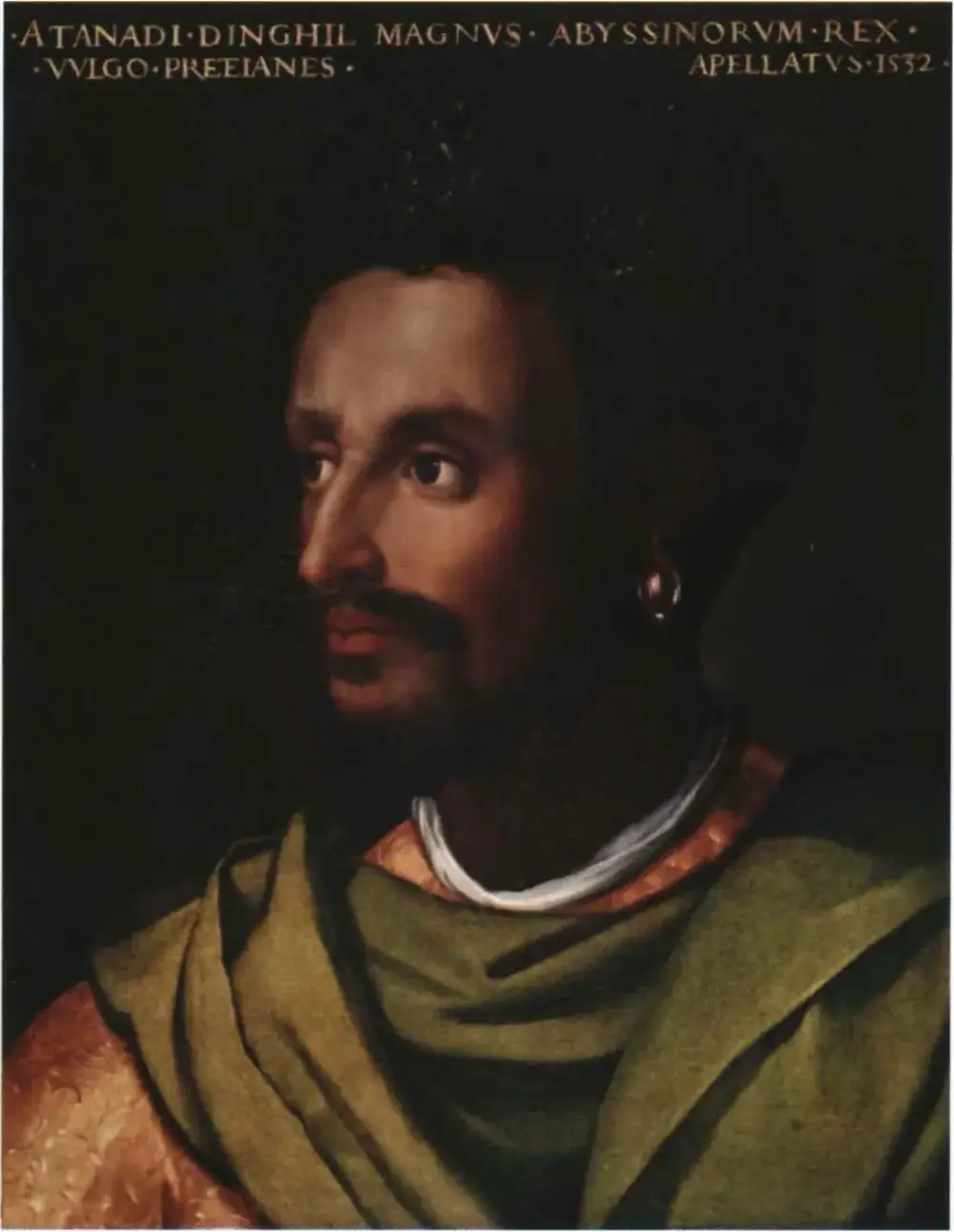
The next emperor, Eskender's brother Na'od, would not let him go. Álvares says Na'od treated him with favour; Barros says he made little of him. Nor would Na'od's son Lebna Dengel, who came to the throne in 1508. Covilhã had not come in his time, he said, and his predecessors had given Covilhã lands and lordships to rule and enjoy.
Ethiopian rulers did not as a rule let foreigners leave. The Portuguese of the 1520 embassy were told that it had always been the custom of the kingdom not to let foreigners who came to it go away again. Álvares met a Venetian painter, Nicolò Brancaleone, who had been there for thirty-three years. Two envoys landed by the fleet of the Portuguese commander Tristão da Cunha, João Gomes and a priest, who reached the court in 1508, were not allowed to go either.
He married, and Barros says the emperor's refusal rested partly on the lands he had been given to enjoy with his wife and children. Queen Eleni, widow of the emperor Ba'eda Maryam and one of the regents for the young Lebna Dengel, sent him to Gojjam to show how the altar should be made in a church she was building there. It was of wood covered all over in gold, and she was later buried in that church.
When he first arrived he kept the local customs, keeping Saturday as a holy day and eating as the Ethiopians did, and some clergy used his example to argue against the Abuna, the bishop sent from Alexandria, who had persuaded the emperor to drop such customs. He lived a league from a cave where the emperors stored their gold, and told Álvares that the gold in it was enough to buy the world.
The chaplain's account
Meanwhile Eleni had sent an envoy of her own to King Manuel, an Armenian merchant called Matewos, with gifts and a promise of soldiers and supplies against Portugal's enemies. Manuel sent an embassy to the emperor. Its first leader, Duarte Galvão, died on the way; under Rodrigo de Lima it landed at Massawa, on the Red Sea, on 27 April 1520. Its chaplain was the priest Francisco Álvares.
Covilhã joined the embassy at the emperor's camp by Christmas 1520 and became its interpreter, guide and adviser. When Lebna Dengel's letters to King Manuel were prepared early in 1521, in Ethiopic, Arabic and Portuguese, it was Covilhã who put them into Portuguese. He interpreted when the ambassador and Álvares visited the head of the Ethiopian church, the Abuna Marcos, who told them he had often urged Covilhã not to lose heart.
“Cide Petrus do not be vexed, for in your days the people of your country will come to this country and to these kingdoms.”
Álvares became his confessor. Covilhã told him he had not confessed for thirty-three years, because in that country the secret of confession was not kept, and he had confessed his sins to God alone in church. Then he told the priest the story of his life.
“This Pero de Covilham is a man who knows all the languages that can be spoken, both of Christians, Moors, and Gentiles, and who knows all the things for which he was sent.”
When the Portuguese left the court in 1521 he travelled with them, with his wife and some of his sons. Much of what Álvares wrote about Ethiopian lakes, mountains, churches and treasure he credits to him. The last sighting is at Dara in 1524, still vigorous enough to keep up with the embassy.
The embassy sailed from Massawa on 28 April 1526 and entered the Tagus on 24 July 1527. Covilhã stayed behind. Nobody knows when he died. Ficalho, who thought him born around 1450, liked to imagine him dying in battle at about eighty in the war with the sultanate of Adal, whose imam Ahmad ibn Ibrahim routed the emperor's army in 1529, though he admitted there was no evidence at all. That war brought Cristóvão da Gama and 400 Portuguese to fight for Ethiopia in 1541.
What the journey left behind
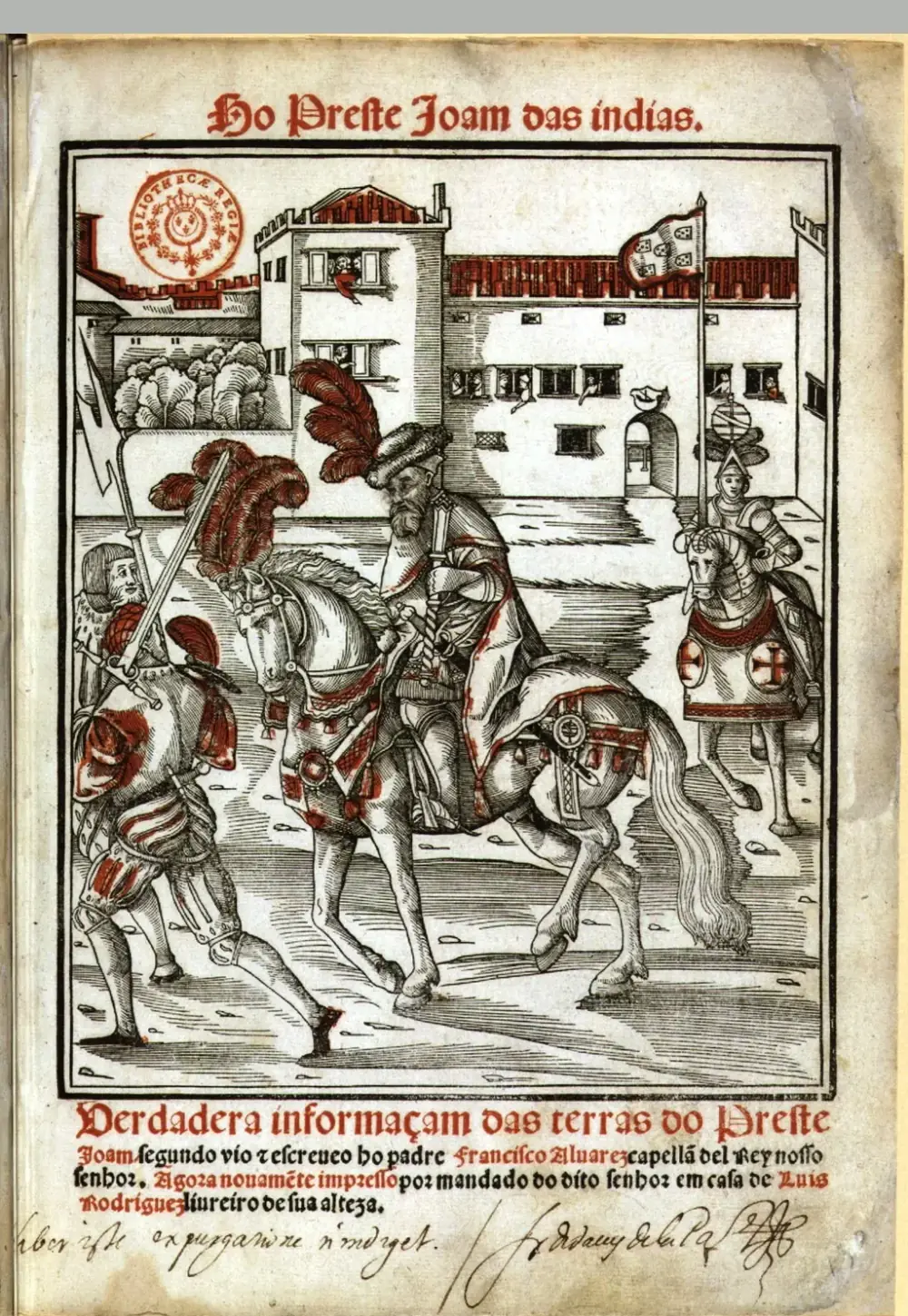
Covilhã wrote no book. His story survives because Álvares put it in his own, the Verdadeira informaçam das terras do Preste Joam, printed by the king's bookseller Luís Rodrigues on 22 October 1540. Its English translator in 1881 called it the earliest surviving work on Ethiopia, and Barros drew on it for his chronicle of 1552.
In the fourth canto of Os Lusíadas, published in 1572, Luís de Camões follows João II's messengers through Naples, Rhodes and Egypt, up to Ethiopia, across the Red Sea and past Arabia to the Persian Gulf and the Indus. Then he lets them die abroad.
“There in the end they died, and there they stayed, and never came back to the homeland they longed for.”
Camões compressed the story. Both men did die abroad, but Covilhã first lived for more than thirty years as a landholder of the Ethiopian emperors, with an Ethiopian family, and the poem's route to the Indus is not the one Álvares records. Ficalho put the errors down to incomplete news and poetic licence, and noted that this journey is the only event of João II's reign the canto tells.
The journey also left a long thread between Portugal and Ethiopia. The embassy that found Covilhã was followed by Portuguese soldiers, who fought for the emperors in the 1540s, and by Jesuit missionaries, who worked in Ethiopia from 1557 into the 1630s.
FAQs
Who was Pêro da Covilhã?
A squire of King João II from the town of Covilhã who spoke Arabic and Castilian. On 7 May 1487 the king sent him and Afonso de Paiva overland to find Prester John and the sources of the spice trade. He reached India, Hormuz and Sofala, then settled in Ethiopia, where he spent the rest of his life.
Did Pêro da Covilhã reach India before Vasco da Gama?
Yes. He sailed from Aden to Cannanore and visited Calicut and Goa, by Ficalho's estimate in late 1488 and early 1489. Vasco da Gama reached Calicut by sea in 1498.
What happened to Afonso de Paiva?
The two men parted at Aden, Paiva heading for Ethiopia. When Covilhã returned to Cairo to meet him, he learned that Paiva had died, of illness in Cairo according to Barros. There is no evidence that he ever reached the Ethiopian court.
Why did Covilhã never come home?
The emperor Eskender promised to send him back but was killed in 1494. His brother and successor Na'od refused him leave, and so did Na'od's son Lebna Dengel, who said his predecessors had given Covilhã lands. Ethiopian rulers commonly kept foreigners who reached their court, and Covilhã had married and had children there.
How do we know about his journey?
Mainly from Francisco Álvares, chaplain of the Portuguese embassy that reached Ethiopia in 1520. Covilhã told him his story, and Álvares's book, printed in 1540, recorded it. João de Barros retold it in 1552, with some differences in the route.
On the timeline
Open the timelineNearby moments from the age of discoveries (1415–1580).
Portugal and Castile sign the Treaty of Alcáçovas, ending the War of the Castilian Succession; Castile keeps the Canaries while Portugal's possession of Madeira, the Azores, Cape Verde and Guinea is recognised — the first treaty to divide the Atlantic world between European powers.
King Afonso V of Portugal, known as 'the African' for his conquests in Morocco, dies at Sintra and is succeeded by his son João II, under whom Portuguese exploration would flourish.
King João II grants an annuity 'in consideration of his services' to Diogo Cão, back in Lisbon from the voyage on which he became the first European to reach the mouth of the Congo. Days later he was given a coat of arms bearing the two padrões — carved stone pillars — he had planted on the African coast.
Pêro da Covilhã's journey east
Pêro da Covilhã and Afonso de Paiva set out from Santarém on João II's secret overland mission to find the spice route to India and the court of Prester John. Travelling disguised as merchants via Cairo and Aden, Covilhã would reach India years before Vasco da Gama.
Bartolomeu Dias lands at Mossel Bay, South Africa, on the day usually reckoned from its old name, São Brás (St Blaise's day). He had passed the Cape of Good Hope unseen, the first known European to sail beyond Africa's southern tip.
Nzinga a Nkuwu, ruler of the Kingdom of Kongo, is baptised by Portuguese missionaries and takes the Christian name João, after Portugal's king. The alliance brings priests and masons, but within a generation his son Afonso I is writing to João III to protest that Portuguese slave traders are depopulating his kingdom.
Death at age 16 of Prince Afonso, only legitimate son and heir of King João II and Queen Eleanor, after a fall from a horse on the banks of the Tagus near Santarém. The tragedy ends the direct Avis succession and sets in motion the dynastic chain that, three generations later, will deliver Portugal into the hands of the Habsburgs.
Coming up in history
All long reads 9 May 1386The Treaty of Windsor, 1386: Portugal and England's perpetual league
 10 May 1984Joaquim Agostinho: the farm boy who climbed Alpe d'Huez
 11 May 1937Afonso Costa dies in Paris: the First Republic's strongman in exile, 1937
 12 May 1982A blade on the basilica steps: John Paul II at Fátima, 12 May 1982
10 sources
Archives, scholarship and reporting this article was checked against.
- 1
Narrative of the Portuguese Embassy to Abyssinia during the years 1520-1527, by Father Francisco Alvarez (Lord Stanley of Alderley, trans. and ed.)Hakluyt Society, London, 1881 (digitised by the Internet Archive)
- 2
- 3
- 4
- 5
- 6
Eléni (Merid Wolde Aregay)Dictionary of African Christian Biography
- 7
- 8
Os Lusíadas (Luís de Camões, 1572)Project Gutenberg
- 9
Review of V. M. Fernández, J. de Torres, A. Martínez d'Alòs-Moner and C. Cañete, The Archaeology of the Jesuit Missions in Ethiopia (1557–1632) (David W. Phillipson)Aethiopica 21 (2018), Universität Hamburg
- 10
Image credits
- Calicut, with Hormuz, Cannanore and the Portuguese fort of São Jorge da Mina below, in Braun and Hogenberg's atlas of the world's cities, first published in 1572; this copy is from the edition of 1640. Covilhã visited the first three about eighty years before it was engraved. Georg Braun, Franz Hogenberg, Simon Novellanus and Joris Hoefnagel, Public domain, via Wikimedia Commons.
- João II, king from 1481 to 1495, who sent Covilhã and Paiva east. An eighteenth-century portrait based on an earlier sixteenth-century painting. Unknown author, Public domain, via Wikimedia Commons.
- Aden, where the two envoys parted, above Mombasa, Kilwa and Sofala on the East African coast, in Braun and Hogenberg's city atlas (first published 1572; this copy 1640). Barros and Covilhã's own letter put Sofala on his route. Georg Braun, Franz Hogenberg, Simon Novellanus and Joris Hoefnagel, Public domain, via Wikimedia Commons.
- Lebna Dengel, the “King David” of the Portuguese accounts, emperor from 1508 to 1540, who kept Covilhã in Ethiopia. Painted by Cristofano dell'Altissimo between about 1552 and 1568, long after his death, and now in the Uffizi in Florence; the inscription calls him great king of the Abyssinians, commonly called Prester John. Cristofano dell'Altissimo, Public domain, via Wikimedia Commons.
- Title page of Francisco Álvares's Verdadeira informaçam das terras do Preste Joam, printed by the king's bookseller Luís Rodrigues in 1540, with the woodcut king under the heading “Prester John of the Indies”. This copy is in the Bibliothèque nationale de France. Unknown author, Public domain, via Wikimedia Commons.