

Afonso Costa dies in Paris: the First Republic's strongman in exile, 1937
He wrote the Republic's laws against the Church, balanced its budget, took it into the First World War and was driven out by a coup. When he died in Paris, a censored Lisbon paper put him on its front page.
At a glance
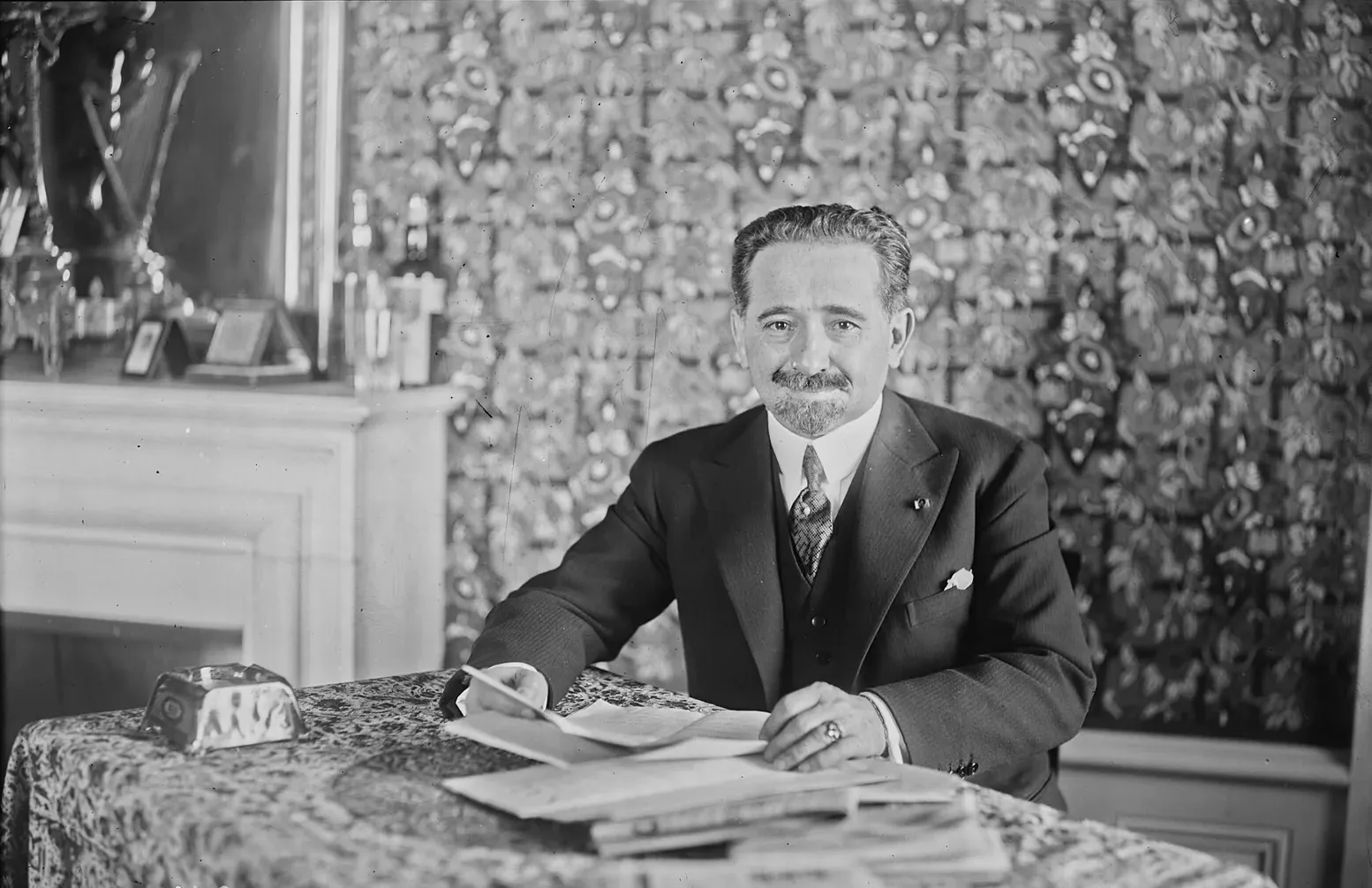
- Afonso Costa, born in Seia on 6 March 1871, died in exile in Paris on 11 May 1937, aged 66. The censored Lisbon evening paper Diário de Lisboa ran a tribute in the centre of its front page that day.
- A Coimbra law professor and republican deputy, he was Minister of Justice in the Provisional Government of 1910-11 and wrote the Law of Separation of Church and State.
- He led the Democratic Party, the strongest of the Republic's parties, and headed three governments: 1913-14, 1915-16 and 1917. As finance minister he closed the 1912-13 and 1913-14 accounts in surplus.
- His third government, which had taken Portugal to war in Europe, was overthrown by Sidónio Pais in December 1917. Costa was imprisoned, then based himself in Paris, where he signed the Treaty of Versailles for Portugal in 1919.
- Calls to govern again, in 1922 and four times in 1923-1925, came to nothing. After the military coup of 28 May 1926 he belonged to the Paris League, the exiled republicans who opposed the dictatorship.
A front page in a censored paper
On the afternoon of Tuesday 11 May 1937, the Lisbon evening paper Diário de Lisboa went on sale with a line under its masthead: “This issue was seen by the Censorship Commission.” The left-hand column belonged to London, where crowds were filling the streets for the coronation of George VI. In the middle, under a headline in heavy type, was a dead man: “Dr. Afonso Costa”.
The unsigned text said only that he had died in Paris. It printed what it called one of the last portraits of him, taken recently in Paris, and spoke of “the pain of absence in a foreign land”. It did not explain why a former head of government, aged 66, had been living abroad, or who now ruled the country he had left.
“Dr. Afonso Costa has died in Paris, a man who, to friends and enemies alike, was a Portuguese, a republican, a patriot, who would rather break than bend. Before his body, all who know how to put justice above passions bow their heads.”
The next day's front page showed the man who did rule it. António de Oliveira Salazar, head of the government since 1932, was photographed leaving Lisbon's Anglican church after a service for the coronation, followed by the British ambassador. Costa had led the parliamentary republic that the dictatorship replaced in 1926, and he had spent his last eleven years opposing it from Paris.
A law professor from Seia
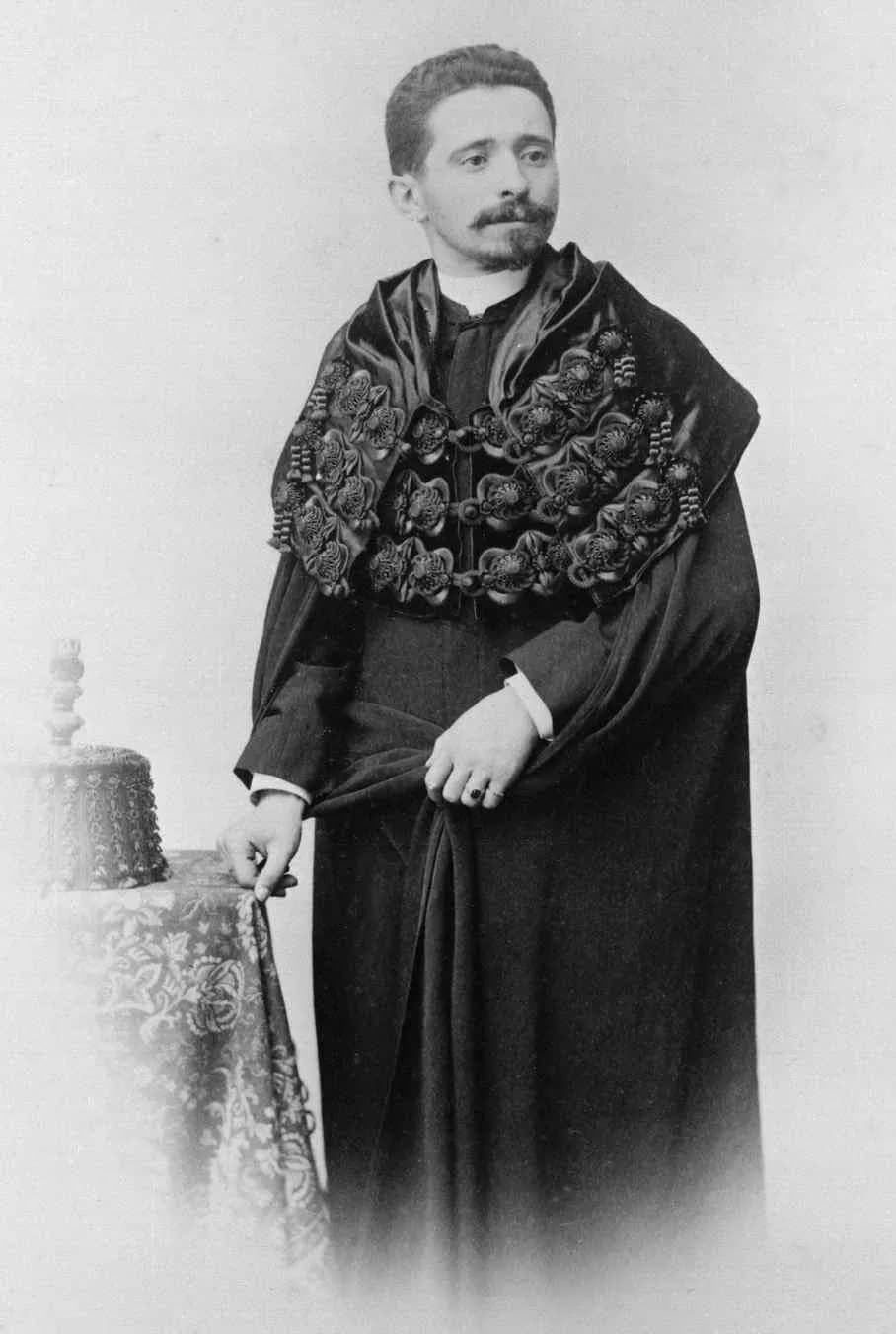
Afonso Augusto da Costa was born on 6 March 1871 in the parish of Santiago in Seia, a small town in the district of Guarda, in central Portugal. He studied law at Coimbra and stayed to teach it, rising to a full professorship there before moving to the law faculty in Lisbon. Even a hostile modern critic, the legal historian António Menezes Cordeiro, calls him an excellent jurist.
He made his name as a republican in parliament. In 1906 he was elected deputy for eastern Lisbon alongside António José de Almeida, and joined the directorate of the Portuguese Republican Party. On 20 November that year he told the Chamber that Louis XVI had gone to the scaffold for fewer crimes than King Carlos had committed, and was expelled from the chamber for it.
In January 1908 he was among the republican leaders arrested over a failed rising, the story told in our article on the Elevador da Biblioteca coup. In August 1910 eastern Lisbon elected him again, with Almeida and Bernardino Machado. Two months later the monarchy fell, and Costa became Minister of Justice in the Provisional Government.
He set the pace on religion. Between October 1910 and April 1911 the government expelled the religious orders, legalised divorce, made civil marriage the only legal one and, on 20 April 1911, separated church and state by a 196-article law that Costa drafted. Our articles on the divorce law and the Law of Separation tell those stories.
- Born
- 6 March 1871, parish of Santiago, Seia
- Died
- 11 May 1937, Paris, aged 66
- Profession
- Lawyer and professor of law at Coimbra, later Lisbon
- Party
- Portuguese Republican Party, known from 1911-12 as the Democratic Party
- Head of government
- 1913-14, 1915-16 and 1917
- Signed for Portugal
- Treaty of Versailles, 28 June 1919
Leader of the Democrats
The republicans split almost at once. In February 1912 António José de Almeida founded the Evolutionist Party because he rejected the line Costa was taking, and days later Manuel de Brito Camacho announced his Republican Union. What remained of the old party, under Costa, became known as the Democrats.
Republicans had long promised the vote to all adult men, and the Democrats' programme still did. In power they drew back. In 1913, when an elected parliament wrote an electoral law for the first time, the result was narrower than the rules of 1911. Illiterate heads of family, who had been allowed to vote, lost the right, and the law now said in so many words that women could not vote. Only a minority of deputies argued for votes for all men.
| Measure | Under the 1911 rules | After the 1913 law | Study cited |
|---|---|---|---|
| Electorate as a share of men over 21 | 57.4% | 26.5% | Maria Antonieta Cruz (2011) |
| Overall registration rate | 57% | 32% | Maria Ana Bernardo (2002) |
Both figures as reported by Miriam Halpern Pereira (2014). Bernardo compared the registers of 1910, 1911 and 1915, so her later figure comes from the 1915 register. Rural voters lost most: the more literate northern districts held up better, and Lisbon and Porto held steady.
The historian Miriam Halpern Pereira links the retreat to fear of a monarchist and Catholic comeback, and of socialists and anarchists, among a population most of whom could not read. A restricted vote could also, she argues, protect the Democrats' hold on power. A party study of the municipal elections of 1913 showed that the less literate regions had voted more for the Evolutionists and Unionists.
Balancing the books, 1913-1914
On 9 January 1913 President Manuel de Arriaga swore in the first government drawn from a single party, with Costa as head of government and minister of finance. Supported in parliament by the Unionists and independents, it made a balanced budget its first priority.
It cut spending with the so-called brake law of 15 March 1913 and a law of 14 June on officials kept on the payroll without posts, and it raised revenue by reforming the industrial and property taxes and the tax on transfers of property. The state accounts for 1912-13 and 1913-14 closed in surplus, the Democratic ministry's first victory.
“It is worth remembering that Afonso Costa, the first time he headed the government while also holding the finance portfolio, had managed to achieve two surpluses, in 1913 and 1914. A feat without precedent in the history of Portuguese public finance.”
The sums were modest. Economists working from Nuno Valério's historical statistics put the 1914 surplus at about 7,000 contos (a conto was 1,000 escudos), roughly 1 per cent of national output. War spending turned it into a deficit of 4.2 per cent by 1916, and every later year in their tables, up to 1926, shows a deficit.
Portugal's state budget balance, selected years 1914-1926
% of GDP
Figures from Martins and Duarte (2014), tables 5 and 6, calculated from Nuno Valério's historical statistics. The paper gives no figures for 1915, 1917-1919 or 1921.
Show the data
| Budget balance | |
|---|---|
| 1914 | 1 |
| 1916 | -4.2 |
| 1920 | -4.8 |
| 1922 | -2.9 |
| 1923 | -5 |
| 1924 | -2.4 |
| 1925 | -1.6 |
| 1926 | -2.4 |
Costa was no friend of the trade unions, and his policy earned him the nickname “racha-sindicalistas”, the union-breaker. Strikes nonetheless fell, from 35 in 1912 to 19 in 1913 and 10 in 1914. His enemies were busy elsewhere: the revolutionary veteran Machado Santos inspired a civilian and military protest on 27 April 1913, and monarchists attempted risings in Lisbon in July and October.
As pressure grew, Arriaga sounded out the three party leaders about a government above party. Costa asked to be relieved on 26 January 1914, and on 9 February Bernardino Machado took over.
War, hunger and a coup, 1915-1917
Out of office, Costa still steered his party. In January 1915 Arriaga put General Pimenta de Castro at the head of a government that ruled without parliament. On 14 May the navy, part of the army and large numbers of civilians, organised by the Freemasons, rose in Lisbon and overthrew him. Costa, the Museu da Presidência writes, played a prominent part behind the scenes. Warehouses and bakeries were looted for food.
Costa returned as head of government on 29 November 1915. Within months Portugal seized the German ships in its ports at Britain's request, and Germany declared war on 9 March 1916, a story told in our article on the declaration. Costa handed the premiership to a coalition, the Sacred Union, under Almeida, and kept the finance ministry. In the summer of 1916 he led the mission to London that settled the charter of the seized ships and the loans Portugal needed to fight.
Costa's Democrats wanted troops in France, not only in Africa, because only full commitment to the Allies would secure grain and raw materials and a voice at the peace conference. His biographer, Filipe Ribeiro de Meneses, argues that the policy failed at home. Outside Lisbon and Porto the enthusiasm of Costa's followers did not catch on, indifference soon turned to hostility, and the government made little effort to win people over.
| Office | From | To |
|---|---|---|
| Minister of Justice, Provisional Government | 5 October 1910 | 3 September 1911 |
| Head of government and minister of finance (1st) | 9 January 1913 | 9 February 1914 |
| Head of government and minister of finance (2nd) | 29 November 1915 | 15 March 1916 |
| Minister of finance, Sacred Union government | 15 March 1916 | 25 April 1917 |
| Head of government and minister of finance (3rd) | 25 April 1917 | 8 December 1917 |
Dates from the government's list of heads of government and the Presidency's page on Bernardino Machado. The government's list dates the second government from 29 December 1915; the Presidency gives 29 November.
His third government took office on 25 April 1917, as wartime prices soared. From 19 to 21 May, strikes and the looting of grocers in and around Lisbon, remembered as the potato revolt, were put down with dozens killed or badly wounded, and more than twenty people died in unrest in Porto. Further clashes in July brought a state of siege in the capital.
When postal and telegraph workers struck for higher pay in September, the government called them up into the army, and hundreds were held on prison ships in the Tagus. From then on, Meneses writes, Lisbon, once the bastion of the republican cause, was hostile to Costa's government.
The Museu da Presidência sums up where that left him: the unions opposed the war and the repression, employers feared disorder, and Catholics, re-energised by the apparitions at Fátima that year, feared Bolshevism. Even inside his own party he was accused of authoritarianism.
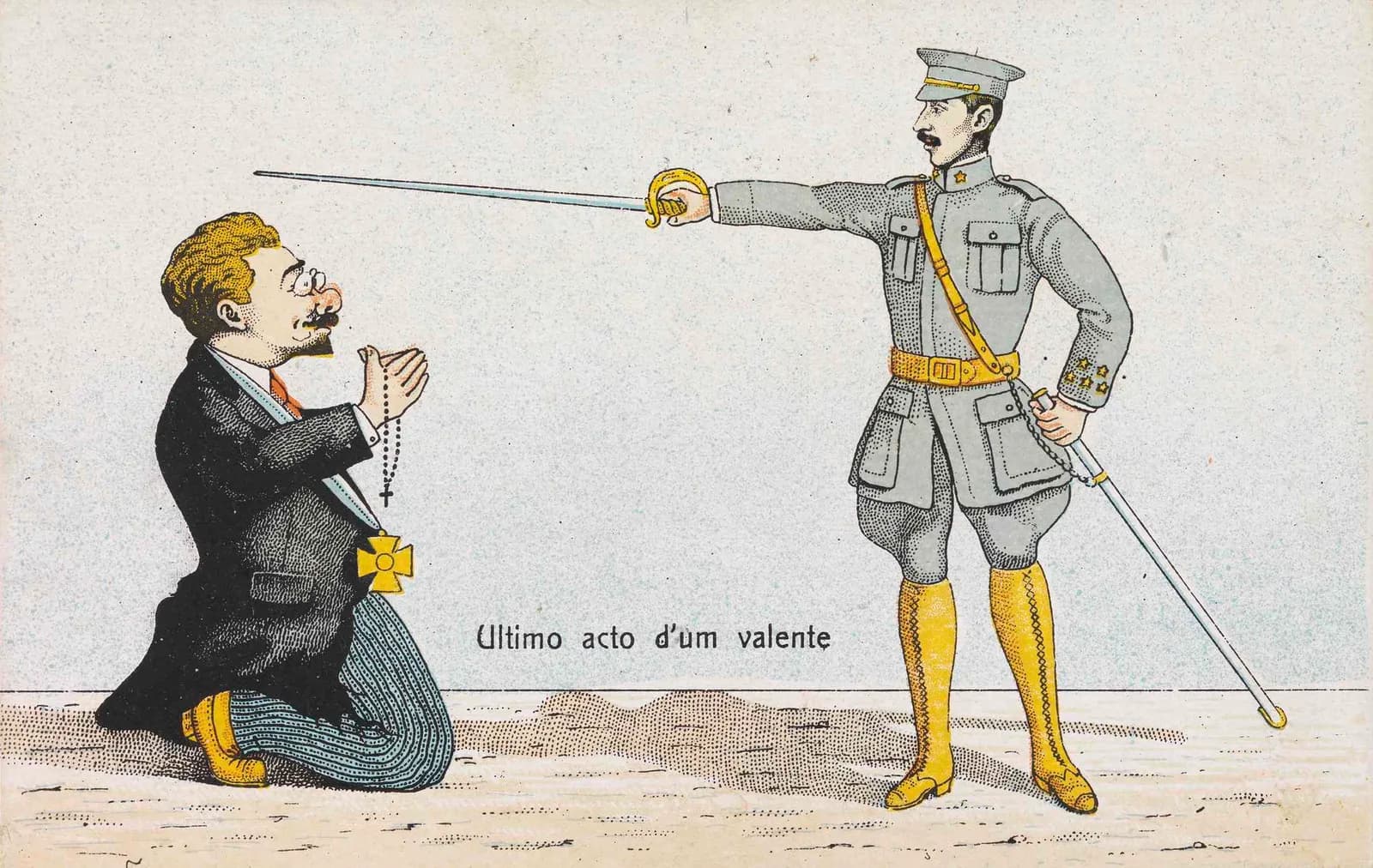
On 19 November 1917 Costa left for an Allied conference in Paris. He came back on 6 December to find Sidónio Pais's revolt under way in Lisbon. When the fighting ended on 8 December, with about 100 dead by Rui Ramos's count, his government had fallen. Crowds sacked the houses of his ministers, his own among them, and he was arrested.
In his autobiography, Seia's council says, he dated his imprisonment in the Forte da Graça, a fortress at Elvas near the Spanish border, to 25 March 1918. Our article on Sidónio's assassination tells the story of that year.
Versailles, Geneva and the calls to come home
After his release Costa went to Paris, which became his base. Sidónio was shot dead in Lisbon in December 1918. On 16 March 1919 Costa replaced Egas Moniz at the head of Portugal's delegation to the peace conference, and on 28 June he and the former foreign minister Augusto Soares signed the Treaty of Versailles for Portugal. In 1920 he represented Portugal at the new League of Nations, and Pais de Sousa counts him among its founders.
He never returned to the premiership. In early 1922 his old rival Almeida, now president, invited him to lead a “government of national salvation”, and Costa, in Paris, declined. Almeida's successor, Manuel Teixeira Gomes, had become Costa's friend in London in 1916, and took office in 1923 meaning to build a national government around him. He asked him again and again.
| When | Who asked | What happened instead |
|---|---|---|
| Early 1922 | President António José de Almeida | Costa declined; the Democrats governed under António Maria da Silva |
| November 1923 | President Teixeira Gomes | The Nationalist Party resisted a Costa government; Ginestal Machado formed one on 15 November |
| December 1923 | President Teixeira Gomes | In vain; Álvaro de Castro took office on 18 December |
| June 1924 | President Teixeira Gomes | In vain; Rodrigues Gaspar took office on 6 July |
| July 1925 | President Teixeira Gomes | The last attempt; Domingos Pereira took office on 1 August |
He was still a figure at Geneva. When the League of Nations met in a special session in Geneva in March 1926 to admit Germany, Time reported that the “onetime Premier of Portugal” took the presidential chair to open it. The session broke up without admitting Germany, which joined that September.
Exile under the dictatorship, 1926-1937
Two months later the army overthrew the Republic. The coup of 28 May 1926 removed a Democratic government led by António Maria da Silva, and among the generals who took over, the most conservative faction soon won. A revolt against the dictatorship in Porto and Lisbon in February 1927 was crushed, and many of its leaders fled.
In Paris the exiles formed the League for the Defence of the Republic, known as the Paris League. Its leaders included Costa, António Sérgio, José Domingues dos Santos, Álvaro de Castro and Jaime Cortesão. Its founding manifesto, Ao País (To the Country), written by Sérgio and published in July 1927, called for reform of parliamentary institutions, the economy and education.
The League also campaigned against a large loan the dictatorship sought through the League of Nations. Costa signed its protest to the League's Council in late 1927, and in 1928 Lisbon turned down the loan because of the conditions attached.
Bernardino Machado, the president the coup had deposed, worked with Costa from exile to unite the opposition inside and outside the country. Meanwhile, in April 1928, a Coimbra professor, António de Oliveira Salazar, became finance minister on conditions that made him responsible for the conduct of every other ministry. His first aim was a balanced budget, the achievement Costa had claimed in 1913.
How much Costa himself did in these years is still debated. Reviewing Meneses's study of Costa's war years, the historian David Castaño notes that the book sets out to explain, among other puzzles, “his silence during exile”.
6 March 1871
Born in Seia
20 November 1906
Expelled from the Chamber of Deputies after attacking the king
October 1910
Minister of Justice in the Provisional Government
20 April 1911
Law of Separation of Church and State
9 January 1913
First government; surpluses in 1912-13 and 1913-14
29 November 1915
Second government; war with Germany follows in March 1916
25 April 1917
Third government
December 1917
Overthrown by Sidónio Pais and imprisoned
28 June 1919
Signs the Treaty of Versailles for Portugal
March 1926
Opens the special session of the League of Nations Assembly
July 1927
Paris League publishes its manifesto
11 May 1937
Dies in Paris
He died in Paris on 11 May 1937. The Diário de Lisboa wrote that he had never tired of working and studying, and that since settling in Paris his interests had widened from politics to philosophy, art and literature. Death, it said, had struck him down unexpectedly.
How he is remembered
Even the censored tribute admitted the anger he had drawn. Crowds had cheered him in the first years of the Republic, it wrote; then came disillusion, and his fellow republicans, split into parties, turned on him “all the gall of their curses”. It ended by predicting that history, judging calmly, would rank him among the illustrious men of the age.
Historians still divide. Menezes Cordeiro sees calculation in the most provocative clauses of the separation law: by picking a fight with a weakened Church, he argues, Costa isolated his republican rivals and kept his Democrats almost unbeatable. Jorge Pais de Sousa stresses instead the grasp of public finance that produced the surpluses and, in his reading, sent Costa to the peace conference.
The harshest verdicts concern how he held power. Writing in Observador in 2017, the historian Rui Ramos called Costa's rule a violent autocracy: parliaments came out of rigged elections, the press was censored before publication, and opponents risked prison or exile. In his account Costa answered the wartime protests with killings and arrests, and the party used bands of armed volunteers to intimidate its critics.
His name kept a charge under the dictatorship. In January 1973 the new weekly Expresso, launched while censorship still applied, told readers on page 2 that it lived in a house once lived in by Afonso Costa, who had been thrown out of it by force.
In 2025 his home town gave him a museum. On 25 March, the anniversary of his imprisonment at Elvas, Seia opened the Centro de Interpretação da República Afonso Costa in a former primary school he had had built. His eldest living granddaughter, then 92, told the Lusa news agency that it was the first time she had heard her grandfather praised.
FAQs
Who was Afonso Costa?
A law professor from Seia and the dominant politician of Portugal's First Republic. As Minister of Justice in 1910-11 he drafted the Law of Separation of Church and State, and as leader of the Democratic Party he headed three governments between 1913 and 1917.
When and where did Afonso Costa die?
In Paris, on 11 May 1937, aged 66. The Diário de Lisboa reported his death on its front page that afternoon, in an issue passed by the censors.
Did Afonso Costa really balance Portugal's budget?
Yes, briefly. As head of government and finance minister in 1913-14 he closed the 1912-13 and 1913-14 accounts in surplus, through spending curbs and tax reforms. Reconstructed figures put the 1914 surplus at about 1 per cent of GDP. War spending brought deficits back from 1916.
Why did Afonso Costa live in exile?
Sidónio Pais's coup of December 1917 overthrew his government and he was imprisoned, then based himself in Paris. Repeated calls for him to govern again in 1922-1925 came to nothing, and after the military coup of 28 May 1926 he stayed abroad in opposition, as a member of the Paris League.
Where can you learn about Afonso Costa in Portugal today?
In Seia, his birthplace, where the Centro de Interpretação da República Afonso Costa opened in March 2025 in a former school he had had built. A statue unveiled in 1981 stands nearby.
On the timeline
Open the timelineNearby moments from dictatorship and the estado novo (1926–1974).
Otelo Saraiva de Carvalho is born in Lourenço Marques (now Maputo), Mozambique. As chief strategist of the Armed Forces Movement he directed the 25 April 1974 coup from a command post at Pontinha; he later ran second in the 1976 presidential election and was tried over alleged links to the FP-25 armed group before a 1996 amnesty.
Sailors of the Organização Revolucionária da Armada, linked to the clandestine Communist Party, seize the warships Afonso de Albuquerque and Dão in the Tagus, hoping to sail them to Spain to fight for the Republic. Shelled by the shore batteries, both ships run aground; around a dozen sailors die, and many mutineers become the first inmates of the new Tarrafal prison camp.
The steamer Luanda lands the first 152 political prisoners at the Tarrafal concentration camp on Santiago island in Cape Verde, among them Marinha Grande strikers and sailors from the September mutiny. The 'camp of slow death' operated until 1954 and again from 1961 to 1974.
The death of Afonso Costa, 1937
Afonso Costa dies in exile in Paris, aged 66. Leader of the Democratic Party and three times head of government of the First Republic, he wrote the 1911 Law of Separation of Church and State and, as finance minister, closed two budgets in surplus. After the 1926 coup he opposed the dictatorship from Paris.
Anarchists including Emídio Santana detonate a bomb hidden in a sewer on Avenida Barbosa du Bocage in Lisbon as António de Oliveira Salazar steps out of his car to attend Sunday Mass at a friend's private chapel. The blast goes off only a few metres away but the dictator is unhurt; thanksgiving Masses are said across the country and the failed attack burnishes his providential image.
Jorge Nuno Pinto da Costa is born in Porto. President of FC Porto for 42 years, from 1982 to 2024, he oversaw two European Cups (1987 and 2004), two UEFA Cup/Europa League titles and more than 20 league championships, and turned the club into the dominant force in Portuguese football. He died in February 2025.
Film-maker João César Monteiro is born in Figueira da Foz. The great provocateur of Portuguese cinema, he won a Silver Lion at Venice for 'Recordações da Casa Amarela' (1989), playing his own lecherous alter ego, João de Deus, and later scandalised audiences with 'Branca de Neve', a film that is largely a black screen.
Coming up in history
All long reads 13 May 1798Porto's Real Teatro de São João opens on a prince's birthday, 1798
 14 May 191514 May 1915: the navy rising that brought down Pimenta de Castro
 15 May 1964Morais's corner: how Sporting won the Cup Winners' Cup in 1964
 16 May 1919Through the fog to Horta: the NC-4 and the first flight across the Atlantic
32 sources
Archives, scholarship and reporting this article was checked against.
- 1
Diário de Lisboa, n.º 5198, 11 May 1937: “Dr. Afonso Costa” (front page)Casa Comum, Fundação Mário Soares e Maria Barroso (Ruella Ramos archive)
- 2
Manuel de Arriaga (biography)Museu da Presidência da República
- 3
- 4
- 5
Afonso Costa e Manuel Teixeira Gomes na missão que negociou em Londres, no verão de 1916, as condições financeiras para a participação de Portugal na I Guerra Mundial (Jorge Pais de Sousa)Revista Universitaria de Historia Militar 3 (5), 2014
- 6
The Public Finance and the Economic Growth in the First Portuguese Republic (Nuno Ferraz Martins and António Portugal Duarte)Economic Analysis, vol. 47, no. 1-2 (2014), pp. 59-75
- 7
- 8
Paris LeagueMuseu do Aljube – Resistência e Liberdade, 11 February 2025
- 9
Neta de Afonso Costa “de queixo caído” com homenagem em Seia ao avô (Lusa)Notícias ao Minuto, 25 March 2025
- 10
- 11
Chefes do Governo desde 1821República Portuguesa, Governo de Portugal
- 12
Divórcio e casamento na I República: questões fraturantes como arma de conquista e de manutenção do poder pessoal?, by António Menezes CordeiroOrdem dos Advogados
- 13
Bernardino Machado [1915-1917]Presidency of the Portuguese Republic
- 14
- 15
A tragédia do Terreiro do Paço na imprensa rio-grandina (fevereiro de 1908), by Reto MonicoHistoriæ (Universidade Federal do Rio Grande), vol. 7, no. 1 (2016), pp. 175–202
- 16
Separação do Estado das Igrejas (1911)Assembleia da República
- 17
A aplicação da Lei de Separação do Estado das Igrejas (1911) na diocese do Algarve, by João Romero Chagas AleixoRevista Portuguesa de História, t. LVII (2026), pp. 339–366, Imprensa da Universidade de Coimbra
- 18
Diário do Governo n.º 92, 21 April 1911: decreto com força de lei de 20 de abril, separando o Estado das igrejasDiário do Governo (Diário da República Eletrónico)
- 19
Treaty of Peace with Germany (Treaty of Versailles), 28 June 1919, in Treaties and Other International Agreements of the United States of America 1776–1949, vol. 2 (Bevans)Library of Congress
- 20
Review of Filipe Ribeiro de Meneses, A Grande Guerra de Afonso Costa (David Castaño)e-Journal of Portuguese History, vol. 14, no. 2 (2016), pp. 111-114 (Maynooth University repository)
- 21
A Primeira República e a importância da mobilização política em tempo de guerra (Filipe Ribeiro de Menezes)Instituto de Estudos Estratégicos e Internacionais, Estratégia
- 22
- 23Sidónio, 100 anos depois do Presidente-Rei, by Rui RamosObservador, 8 December 2017
- 24
- 25
Cronologia (Egas Moniz chronology)Casa-Museu Egas Moniz, Câmara Municipal de Estarreja
- 26
The League of Nations: Travel, TroubleTime, 15 March 1926
- 27
- 28
Chronology of the League of NationsUnited Nations Office at Geneva
- 29
Recordando a Revolta de Fevereiro de 1927 no Porto contra a Ditadura Militar (António Ventura)Seara Nova, no. 1741, 2017-18 (online 18 February 2019)
- 30
A resistência republicana à Ditadura (1926-1938): as redes conspiratórias do Norte (Daniel Filipe Soares da Silva, MA dissertation)Faculdade de Letras da Universidade do Porto, 2025
- 31
À procura de António Sérgio: ensaio cronológico através de documentação bibliográfica e arquivística (Sónia Queiroga)Casa António Sérgio, CASES, January 2019
- 32
Expresso: um projeto de renovação no fim do Marcelismo (Joana Catarina Vieira da Rosa, MA dissertation)Escola Superior de Comunicação Social, Instituto Politécnico de Lisboa, 2014
Image credits
- Afonso Costa in Geneva on 9 March 1926, during the special session of the League of Nations Assembly. Photograph by the Paris agency Rol. Agence Rol, Public domain, via Wikimedia Commons.
- Afonso Costa in the doctoral insignia of the University of Coimbra, about 1895. Photograph by the Centro Photographico Academico. Centro Photographico Academico, Public domain, via Wikimedia Commons.
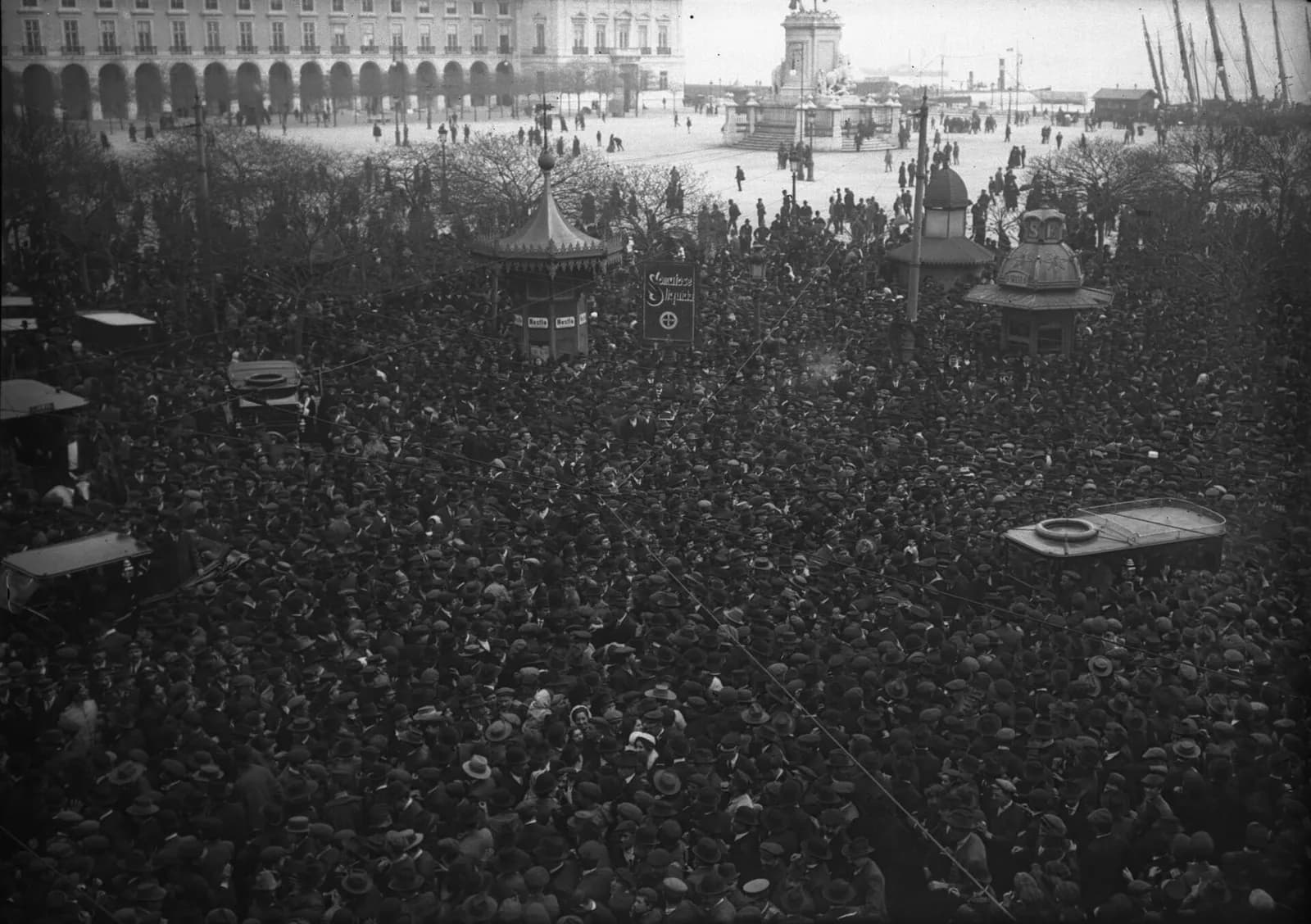
- A crowd surrounds Afonso Costa's car in the Terreiro do Paço, Lisbon, on his return from Paris, photographed by Joshua Benoliel for Ilustração Portuguesa, published on 25 March 1912. Joshua Benoliel, Public domain, via Wikimedia Commons.
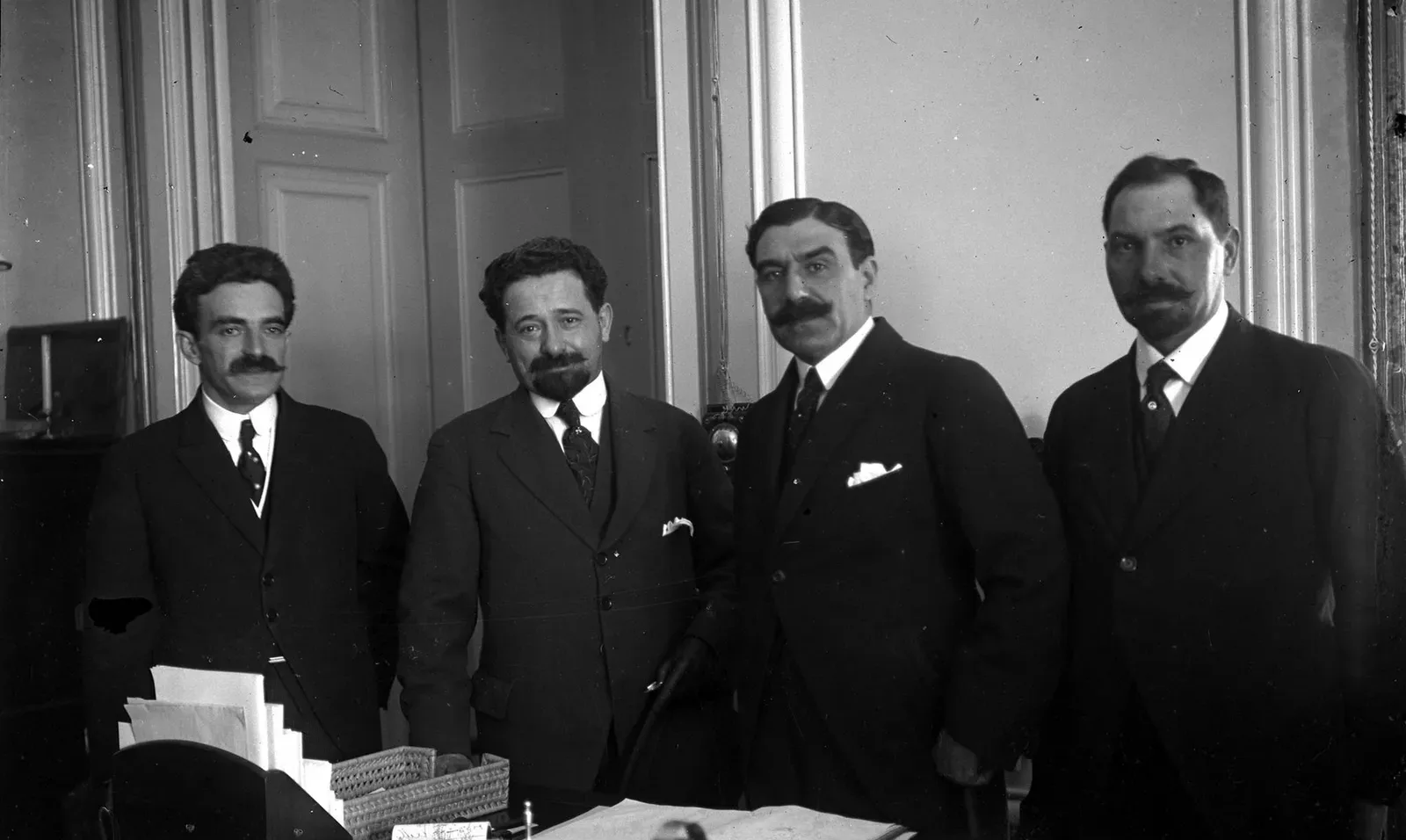
- Afonso Costa, second from left, in 1913, during his first government. The archive's caption names the others as the foreign minister António Macieira, Germano Martins and Simão José, secretary of Costa's cabinet. Joshua Benoliel, Public domain, via Wikimedia Commons.
- “Last act of a brave man”: a postcard of 1918 mocking Costa, on his knees with a rosary, as Sidónio Pais points his sword at him. Unknown author, Public domain, via Wikimedia Commons.