

Benfica 5, Real Madrid 3: the night Eusébio won Amsterdam
Real Madrid had won the first five European Cups and led 3–2 at half-time through a Ferenc Puskás hat-trick. Then a 20-year-old from Mozambique scored twice, and Benfica were champions of Europe again.
At a glance
- On 2 May 1962 Benfica, the holders, beat Real Madrid 5–3 in the European Cup final at the Olympisch Stadion in Amsterdam, before a crowd given as 61,257 or 65,000.
- Ferenc Puskás scored a hat-trick in the first half and Real led 3–2 at the interval; Águas, Cavém, Coluna and Eusébio, twice, scored for Benfica.
- Eusébio, aged 20, scored the fourth goal from a penalty and the fifth five minutes later, and left the pitch with Alfredo Di Stéfano's shirt.
- The coach, the Hungarian Béla Guttmann, left Benfica that summer after a quarrel over money; the 'curse' he is said to have put on the club is a legend, quoted in several versions.
- Benfica lost its next eight European finals, from 1963 to 2014; before the 1990 final Eusébio went to Guttmann's grave in Vienna to ask for the curse to be lifted.
Shoulder-high in Amsterdam
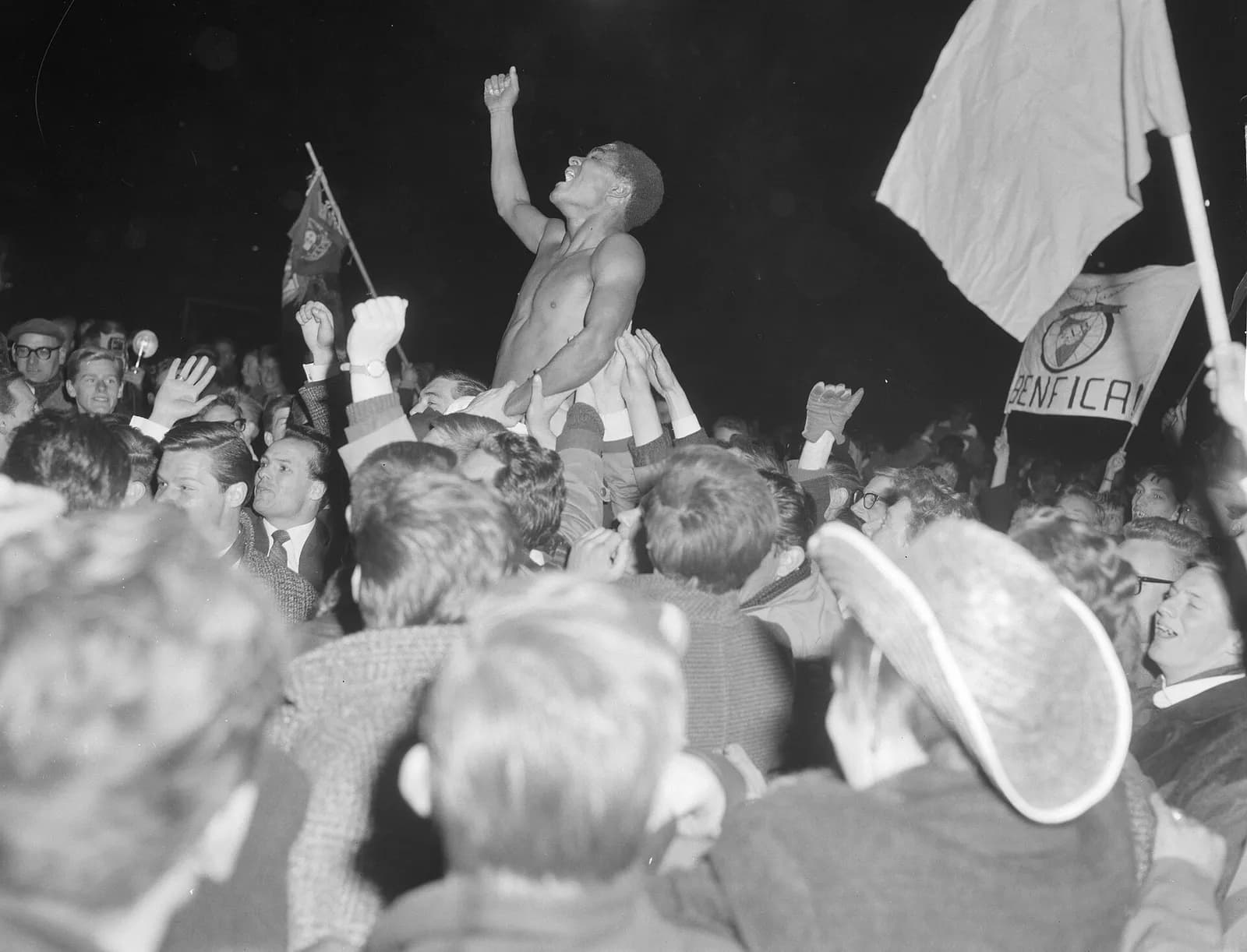
When the Dutch referee Leo Horn blew the final whistle at the Olympisch Stadion in Amsterdam on 2 May 1962, supporters swarmed around the Benfica players. A press photographer caught Eusébio da Silva Ferreira held above the crowd, bare-chested, one fist in the air, with a Benfica banner behind him. He was 20 years old and had just scored twice in a European Cup final.
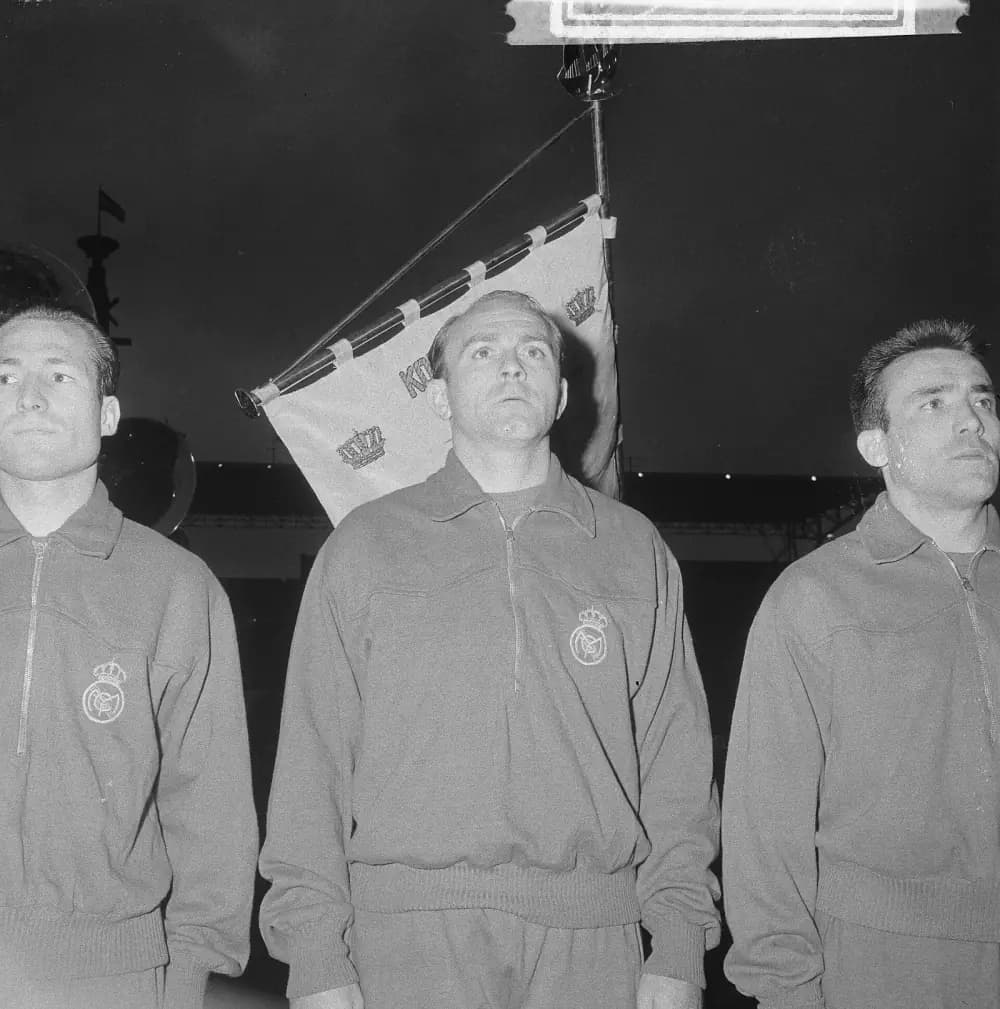
Alfredo Di Stéfano, the Argentine-born Real Madrid forward who had been Eusébio's idol, had faced him for the first time that night. Di Stéfano's shirt went home with the new European champion.
Benfica had beaten Real Madrid 5–3 after trailing 3–2 at half-time. Real had won the first five European Cups, from 1956 to 1960. Benfica had won the trophy for the first time a year earlier, beating Barcelona in Bern, and now it had kept it.
That first title had been a tight 3–2 win over Barcelona in Bern, with goals from José Águas and Mário Coluna and an own goal by the Barcelona goalkeeper, Antoni Ramallets. In Amsterdam the champions faced the side they had replaced.
A small dictatorship and a big club
Portugal in 1962 was a dictatorship, the Estado Novo (New State) of António de Oliveira Salazar, and it was at war. Fighting had broken out in Angola in 1961 and would spread to Guinea in 1963 and Mozambique the year after. The regime tried to use its African footballers for propaganda, as the historian Nuno Domingos has shown in the case of Eusébio.
The spring of 1962 was tense at home too. On May Day in Lisbon a 25-year-old, Estêvão Giro, was killed by the police near the Largo do Caldas, and a week after the final students at the Cidade Universitária began a hunger strike in their long fight with the government.
Since the late 1940s the regime had let gifted players from the African colonies move to clubs in Portugal itself. Eusébio, born in Lourenço Marques (now Maputo) in Mozambique, was the most famous. Benfica brought him to Lisbon in December 1960 and won a months-long fight with its Lisbon rival, Sporting, to keep him, a story told in our article on his life and death.
The man who built the team was Béla Guttmann, a Hungarian born in Budapest in 1899. He had played for Hungary at the 1924 Olympics and coached, by Olympedia's count, 25 teams in 12 countries without staying long at any of them. He came to Benfica in 1959 after winning the league with its northern rival, FC Porto.
His life had already been a long journey. He starred for MTK in Budapest, moved to the Jewish club Hakoah in Vienna, and in the 1920s went to the United States, where he played for New York clubs, ran a bar during Prohibition and lost his savings in the Wall Street crash of 1929. Back in Europe he won the Hungarian league and the Mitropa Cup with Újpest in 1939, and he later coached Honvéd, the club of Puskás himself.
Simões remembered him as extremely demanding and a man of few words, who lectured his players on life as much as football: put your money in the bank, think of your children's future, go to bed early, stay away from the night life, respect your wife.
Real Madrid were the team everyone measured themselves against. Di Stéfano was three months short of his 36th birthday. Ferenc Puskás, the star of Hungary's great side of the 1950s, had refused to go home after the Soviet army crushed the Hungarian uprising in 1956, served a two-year ban and joined Madrid. In the 1960 final at Hampden Park in Glasgow he had scored four goals in a 7–3 win over Eintracht Frankfurt.
The road to Amsterdam
Guttmann's second European side was stronger than his first. Eusébio and an 18-year-old winger, António Simões, had come into the team, and Simões's arrival moved Domiciano Cavém back into midfield alongside Mário Coluna. According to Maisfutebol, Simões is still the youngest player to have become a European champion.
| Round | Date | Match | Score |
|---|---|---|---|
| First round | 1961 | Bye as holders | – |
| Second round, first leg | 31 Oct 1961 | Austria Vienna v Benfica | 1–1 |
| Second round, second leg | 8 Nov 1961 | Benfica v Austria Vienna | 5–1 |
| Quarter-final, first leg | 1 Feb 1962 | 1. FC Nürnberg v Benfica | 3–1 |
| Quarter-final, second leg | 22 Feb 1962 | Benfica v 1. FC Nürnberg | 6–0 |
| Semi-final, first leg | 21 Mar 1962 | Benfica v Tottenham Hotspur | 3–1 |
| Semi-final, second leg | 5 Apr 1962 | Tottenham Hotspur v Benfica | 2–1 |
| Final | 2 May 1962 | Benfica v Real Madrid (Amsterdam) | 5–3 |
Home team named first. RSSSF's season summary calls the first round the preliminary round and the second round the first.
The campaign began in Vienna on 31 October 1961 with a 1–1 draw against Austria, Águas scoring Benfica's goal. The return in Lisbon a week later was easy: 5–1, with two goals each for Joaquim Santana and Águas and one for Eusébio, his first in the competition.
The quarter-final was the scare. Benfica lost 3–1 in Nuremberg and then won the return in Lisbon 6–0. Águas scored in the first minute and Eusébio in the fourth; Coluna, Eusébio again and José Augusto, twice, did the rest. In the semi-final they met the English champions, Tottenham Hotspur. Benfica won 3–1 at home and held on at White Hart Lane, where they lost 2–1 on a heavy pitch and their goalkeeper, Alberto da Costa Pereira, kept them in the tie.
Real Madrid had their own scare. They beat Vasas of Budapest and then Odense of Denmark 12–0 on aggregate, with 9–0 at home. Juventus beat them in Madrid in the quarter-final, which went to a play-off in Paris that Real won 3–1. Standard Liège were brushed aside 6–0 over two legs in the semi-final.
Benfica's goals in the 1961–62 European Cup, by tie
goals
- Scored by Benfica
- Conceded
Aggregate scores over two legs, and the single-match final. Benfica scored 22 goals and conceded 11 in seven matches.
Show the data
| Scored by Benfica | Conceded | |
|---|---|---|
| Austria Vienna | 6 | 2 |
| Nürnberg | 7 | 3 |
| Tottenham | 4 | 3 |
| Real Madrid (final) | 5 | 3 |
Puskás's half
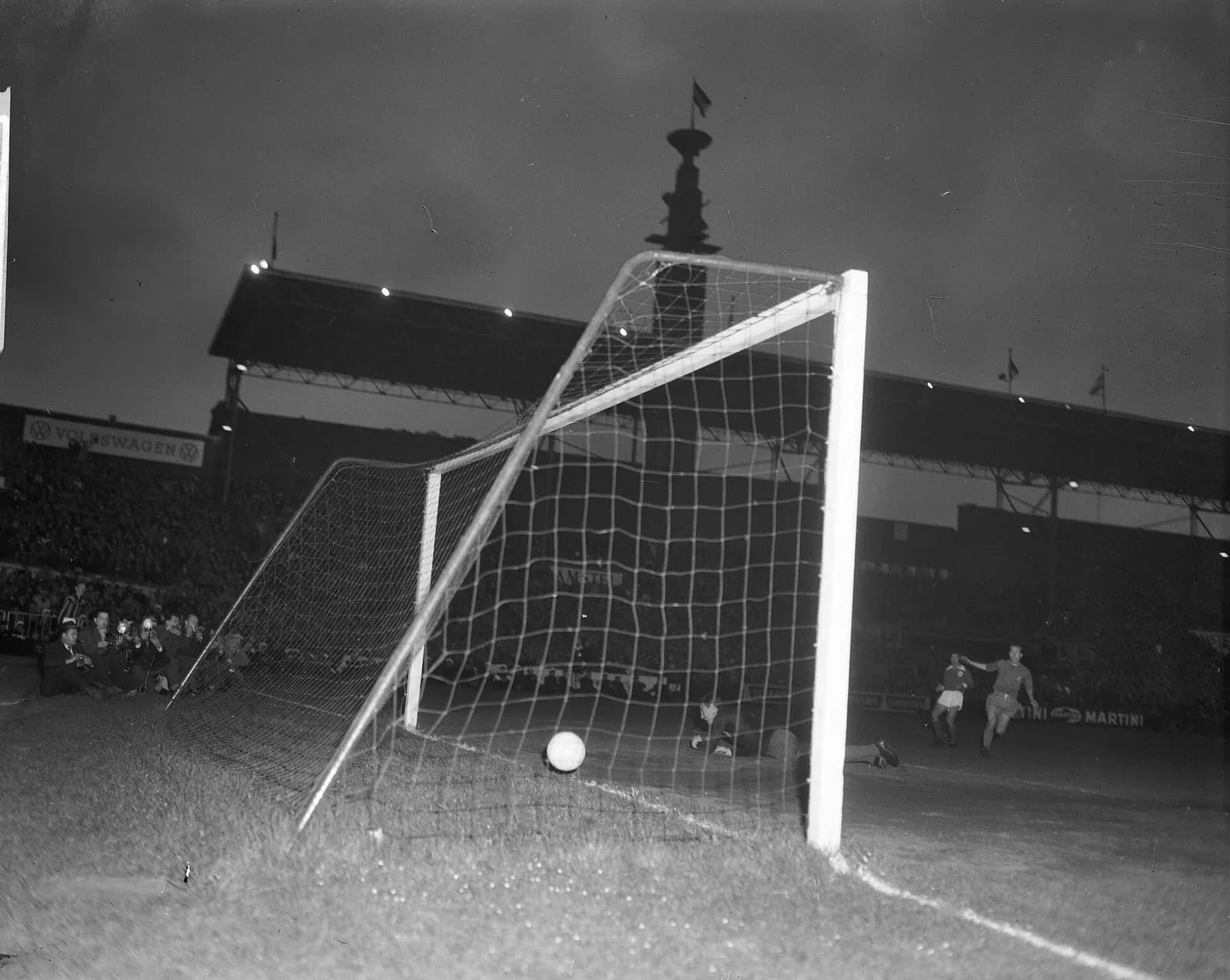
Real started fast. Puskás scored in the 17th minute and again in the 23rd.
Benfica answered at once. José Águas, Benfica's captain, scored two minutes after the second goal, and Cavém equalised in the 34th minute. Four minutes later Puskás had his hat-trick, and Real went in 3–2 ahead.
Eusébio's half
The second half belonged to the younger, fitter team. Coluna equalised six minutes after the restart; RTP's archive account says the goal came from a free kick after Eusébio had been fouled.
In the 63rd minute Benfica got a penalty, and Eusébio scored it. Five minutes later he struck again for 5–3. Real Madrid, with Di Stéfano covering the whole pitch, could not get back into it. Record later called the final Eusébio's first great appearance and Di Stéfano's last.
The match went out live on television. The Olympisch Stadion's own history puts the audience at about a hundred million people, a figure impossible to check, and says some consider it one of the best football matches ever played.
17'
Puskás
Benfica 0, Real Madrid 1
23'
Puskás
0–2
25'
José Águas
1–2
34'
Domiciano Cavém
2–2
38'
Puskás completes his hat-trick
2–3 at half-time
51'
Mário Coluna
3–3
63'
Eusébio, penalty
4–3
68'
Eusébio
5–3, the final score
- Match
- European Champion Clubs' Cup final, 1961–62
- Date and place
- Wednesday 2 May 1962, Olympisch Stadion, Amsterdam
- Score
- Benfica 5, Real Madrid 3 (2–3 at half-time)
- Referee
- Leo Horn (Netherlands)
- Crowd
- 61,257 in RSSSF's match details; 65,000 in its season summary and about 65,000 by the stadium's count
- Coaches
- Béla Guttmann (Benfica), Miguel Muñoz (Real Madrid)
- Benfica
- Costa Pereira; Mário João, Germano, Ângelo; Cavém, Cruz; José Augusto, Eusébio, Águas (captain), Coluna, Simões
Sources differ by a minute or two on most of the goals. The minutes above come from RSSSF's match details. UEFA's own record has Puskás at 18, 23 and 39, Cavém at 33, Coluna at 50 and Eusébio at 64 and 69, and RSSSF's season summary puts the penalty at 65.
Home to Lisbon
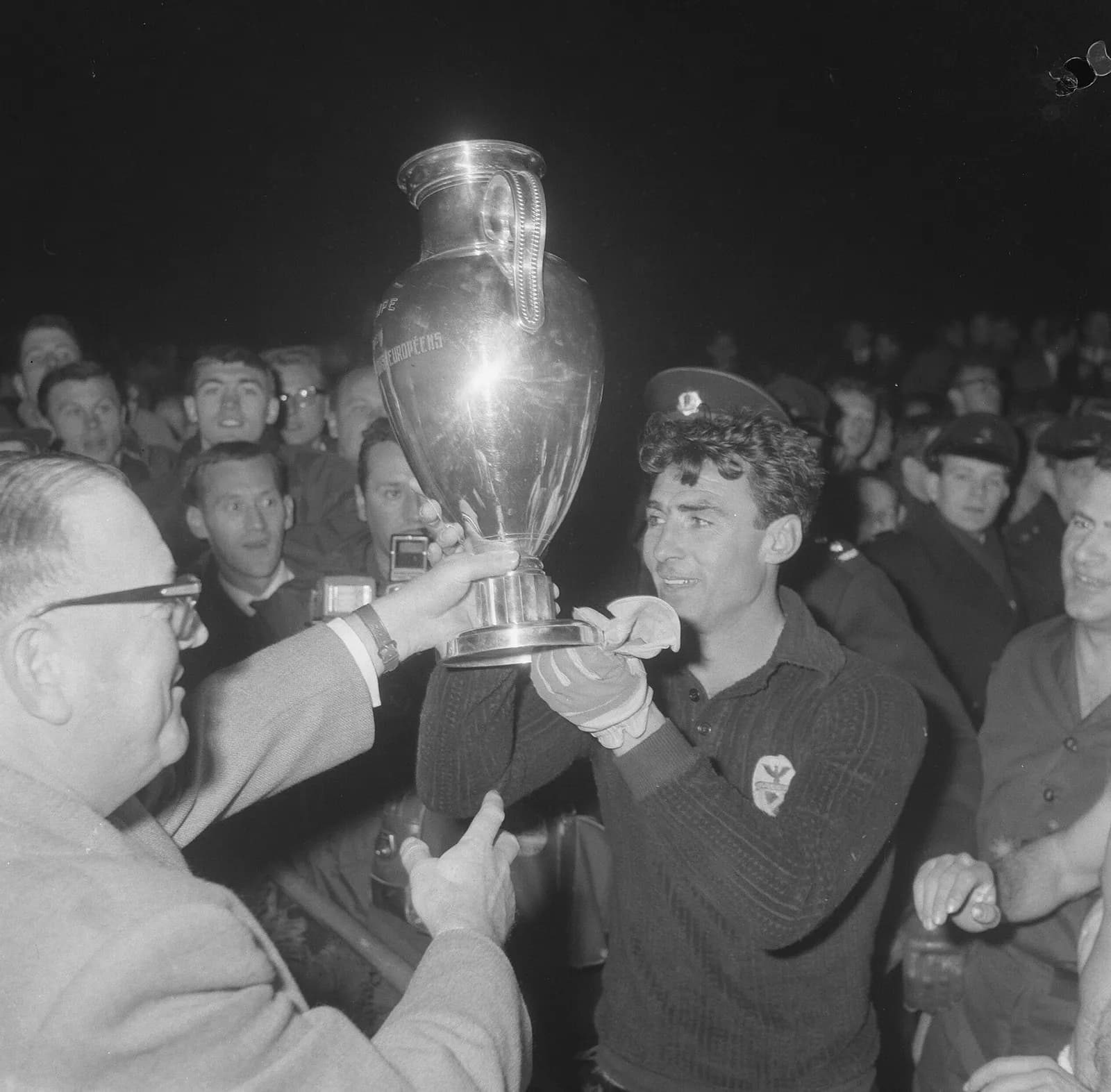
A euphoric crowd met the team at Lisbon's airport. José Águas was first through the aircraft door and held the cup above his head. The Minister of Education and the Mayor of Lisbon were there to greet the captain, but the fans' eyes were on Eusébio.
The regime wanted its share. According to Record, the players and their coach were received by the President of the Republic, Américo Tomás, and by Salazar, who gave them decorations. Leaving the reception at São Bento, Guttmann is said to have whispered to the club's new president, Fezas Vital, that he would resign because he could not coach fourteen commendatori. They thought he was bluffing.
The win was expensive for the club. RTP's archive notes say Benfica paid 500 contos to the coach and 40 contos to each player for the Amsterdam title. A conto was 1,000 escudos; RTP converts the coach's bonus to about €209,000 in today's money.
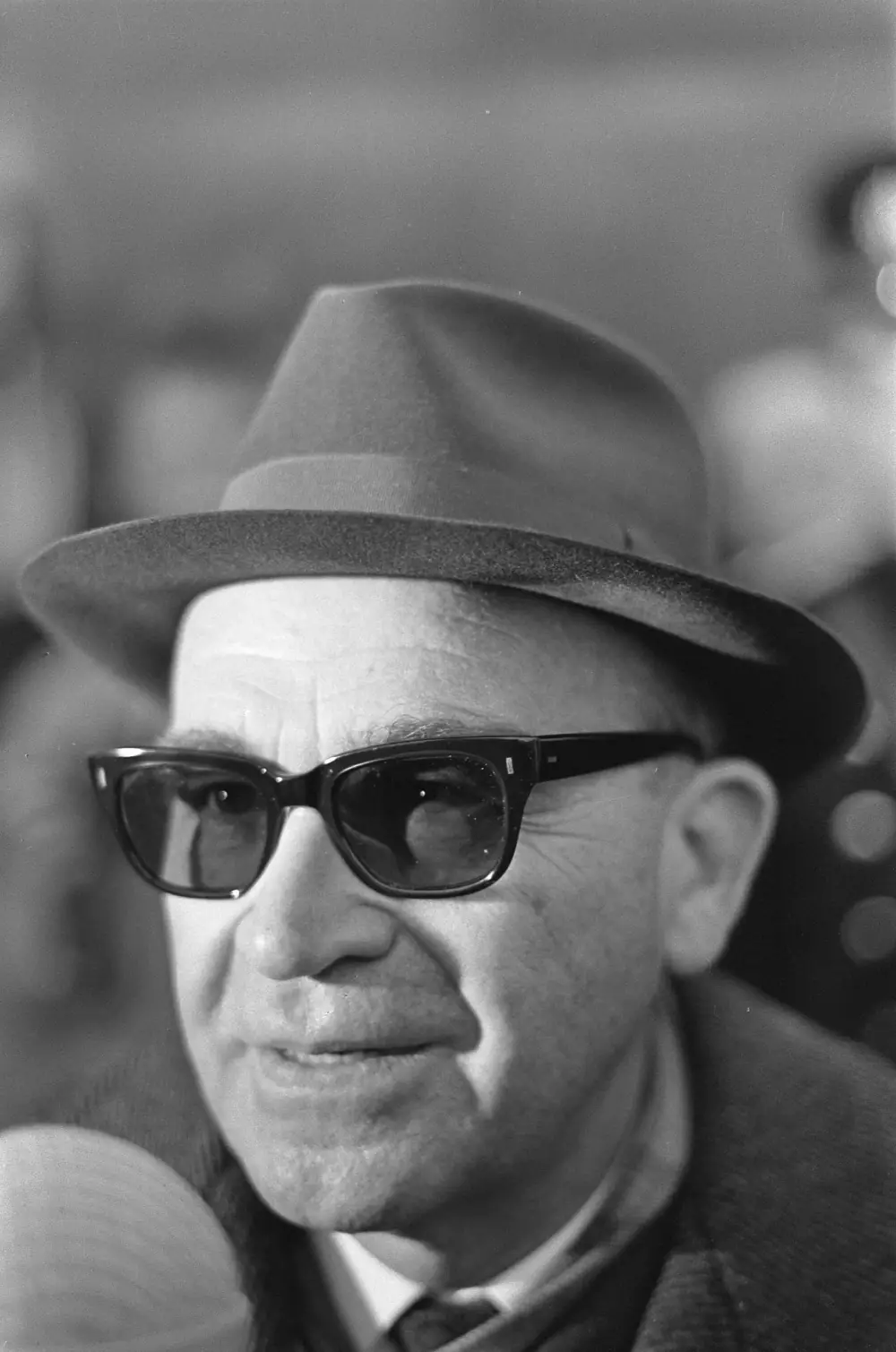
Guttmann goes, and a legend begins
Guttmann did not stay for a fourth season. “The third year is almost always fatal for a coach,” he said, by Record's account (translated from Portuguese). He left that summer and was succeeded by Fernando Riera. His later clubs included Peñarol in Uruguay and, in 1973–74, his last, FC Porto again.
What the quarrel was about depends on who tells it. Some accounts speak of a bonus the board would not pay, others of a pay rise refused, others of a coach who simply knew when to leave. Even the money he was owed is told differently.
| Source | What it says |
|---|---|
| Record | In 1959 he asked for 400 contos a year net, plus bonuses of 150 for the league, 50 for the cup and 200 for the European Cup. A director told him to add another 100. He collected 600 contos for the two finals. |
| RTP Memória | Benfica paid him 500 contos for the 1962 title, and each player 40 contos. |
| António Simões, to Maisfutebol | He asked for 200 contos if Benfica became European champions; the director in charge of football agreed, thinking it would never happen, and the club had to borrow from the bank. |
| Olympedia | After the 1962 final he demanded a bonus; the president replied that it was not in his contract, and he quit. |
| Wien Geschichte Wiki | He left Lisbon because he was refused a pay rise. |
1 conto = 1,000 escudos.
Then there are the words. The best-known version, repeated by RTP and Record, has Guttmann promising that no Portuguese team would be European champions twice in a row for a hundred years, and that Benfica would never win the cup without him. Olympedia notes that some sources have “never” and others a hundred years.
“Not in a hundred years from now will a Portuguese team be European champions twice in a row, and Benfica will never win a Champions' Cup without me.”
Guttmann's own story was darker than the legend. He was Jewish, and in 1944, during the Nazi occupation of Hungary, his brother-in-law hid him in an attic in Újpest, north of Budapest. He later gave himself up, was sent to a forced-labour camp and escaped by jumping from a first-floor window. His father and sister were murdered. He never talked to his players about it, Simões said; they found out much later.
For decades it was believed that he had sat out the war in exile, in Switzerland by some accounts. The English writer David Bolchover, whose biography of Guttmann traced his hiding place, found otherwise. “Much of Europe wanted him dead and, 16 years later, he won Europe's biggest sporting competition,” Bolchover told Maisfutebol (translated from Portuguese).
Eight finals lost
The curse's reputation rests on what followed. Benfica reached the European Cup final again in 1963, 1965 and 1968, with Eusébio, and lost all three. It lost a UEFA Cup final in 1983 and two more European Cup finals in 1988 and 1990.
| Year | Competition | Opponent | Result | Venue |
|---|---|---|---|---|
| 1963 | European Cup | AC Milan | Lost 2–1 | Wembley, London |
| 1965 | European Cup | Inter | Lost 1–0 | San Siro, Milan |
| 1968 | European Cup | Manchester United | Lost 4–1 after extra time | Wembley, London |
| 1983 | UEFA Cup | Anderlecht | Lost 2–1 on aggregate | Two legs; 1–1 at the Luz |
| 1988 | European Cup | PSV Eindhoven | 0–0, lost 6–5 on penalties | Stuttgart |
| 1990 | European Cup | AC Milan | Lost 1–0 | Vienna |
| 2013 | Europa League | Chelsea | Lost 2–1 | Amsterdam |
| 2014 | Europa League | Sevilla | 0–0, lost 4–2 on penalties | Turin |
Before the 1990 final against AC Milan in Vienna, Eusébio went to Guttmann's grave in the Jewish section of the city's Central Cemetery and asked for the curse to be lifted. Frank Rijkaard scored the only goal of the final.
In 2013 Benfica lost the Europa League final to Chelsea in Amsterdam, the city of its last triumph, to a header by Branislav Ivanović in stoppage time. A year later Sevilla beat it on penalties in Turin. UEFA's report of that match counted a 52-year wait for a third European title, with eight losing finals along the way.
Why it still matters
Amsterdam made Eusébio famous across Europe, and he finished second in the voting for the Ballon d'Or that year. It also gave the Estado Novo a star from Mozambique whose life story it could fold into its account of one Portuguese nation, just as the colonial wars began. Eusébio stayed out of politics in public; football, he liked to say, was his politics.
Fame also made him harder to sell. When Italian clubs came for him later in the decade, Salazar is said to have declared Eusébio a national treasure who could not leave; Domingos calls the remark alleged, and no written order has been found. He stayed at Benfica until after the 1974 revolution and reached three more European Cup finals with the club, losing them all.
For Benfica, the two European Cups of 1961 and 1962 are still the high point of its history, and the club marked the 60th anniversary of the second with an exhibition in 2022. Many supporters have laid each lost final since at Guttmann's door.
FAQs
What was the score of the 1962 European Cup final?
Benfica beat Real Madrid 5–3 at the Olympisch Stadion in Amsterdam on 2 May 1962, after trailing 3–2 at half-time.
Who scored in the 1962 European Cup final?
Ferenc Puskás scored all three of Real Madrid's goals. Benfica's came from José Águas, Domiciano Cavém, Mário Coluna and Eusébio, who scored twice, the first from a penalty.
What is the curse of Béla Guttmann?
A legend that Benfica's coach, leaving the club in 1962 after a quarrel over money, said it would never win a European Cup without him, or not for a hundred years. The wording varies between sources, and António Simões, who played under him, has said he never put it exactly that way. Benfica lost its next eight European finals.
How many European Cups have Benfica won?
Two, in 1961 against Barcelona in Bern and in 1962 against Real Madrid in Amsterdam, both under Béla Guttmann. By UEFA's count in 2014, the club had lost eight European finals since.
How old was Eusébio in the 1962 final?
He was 20. His team-mate António Simões was 18 and, according to Maisfutebol, remains the youngest player to have won the European Cup. Alfredo Di Stéfano, on the other side, was 35.
On the timeline
Open the timelineNearby moments from dictatorship and the estado novo (1926–1974).
Governor-General Manuel Vassalo e Silva surrenders Goa, Daman and Diu to the Indian army, which had crossed the borders on 17 and 18 December, ending 451 years of Portuguese rule in Goa. Salazar had ordered his roughly 3,500 soldiers to fight to the death against an Indian force put at 30,000 to 45,000 or more; Vassalo e Silva chose to save lives and was later expelled from the army.
In the early hours of New Year's Day, several dozen civilian and military rebels led by Captain João Varela Gomes and Manuel Serra storm the 3rd Infantry Regiment barracks in Beja, hoping to spark a rising against Salazar. General Humberto Delgado had slipped secretly into Portugal to lead it, but the assault fails and Varela Gomes is gravely wounded.
The Salazar regime bans the 'Dia do Estudante' (Students' Day) celebrations in Lisbon, setting off the 1962 academic crisis — months of strikes, protests and police charges that shaped a generation of opponents of the dictatorship. Portugal still marks 24 March as National Student Day.
Benfica's second European Cup
Benfica retain the European Cup, beating Real Madrid 5–3 in the final at Amsterdam's Olympic Stadium. Despite a Puskás hat-trick for the five-time champions, two goals from the 20-year-old Eusébio seal Benfica's second consecutive title.
Before dawn, PAIGC guerrillas fire on the Portuguese barracks at Tite, in Portuguese Guinea. The PAIGC and Portuguese military historians date the war from that night, though there had been smaller clashes in 1961 and 1962.
Birth in Beira, Mozambique, of José Rodrigues dos Santos, who became one of Portugal's best-known television journalists as an RTP news anchor and, alongside it, one of the country's best-selling novelists.
Sporting CP win the European Cup Winners' Cup, beating MTK Budapest 1–0 in a replay in Antwerp after a 3–3 draw in Brussels two days earlier. The winner is João Morais's celebrated goal scored direct from a corner.
Coming up in history
All long reads 4 May 1493Inter caetera, 1493: the pope's line that led to Tordesillas
 5 May 1210Afonso III, born 5 May 1210: from count of Boulogne to king of the Algarve
 6 May 1908Manuel II swears his oath: the acclamation of Portugal's last king, 1908
 7 May 1487Pêro da Covilhã's secret journey to India and Ethiopia, 1487
23 sources
Archives, scholarship and reporting this article was checked against.
- 1
European Champions' Cup 1961–62: full detailsRSSSF
- 2
1961/62: Eusébio strikes gold for BenficaUEFA
- 3
Eusébio nunca esqueceu o dia em que a Europa se rendeu ao BenficaRecord, 5 January 2014
- 4Chegaram os campeões (Rui Alves)RTP Memória, Replay
- 5
- 6
Béla Guttmann: do esconderijo onde sobreviveu ao Holocausto à glória no BenficaMaisfutebol
- 7
- 8
Europacupfinalspiele in Wien (Fußball)Wien Geschichte Wiki, City of Vienna
- 9E tudo Eusébio levou! (Rui Alves)RTP Memória, Replay
- 10
The death of a football player. Eusébio and the struggle for Portuguese HistoryNuno Domingos, Práticas da História, n.º 8 (2019), 163–197
- 11
Beer, cheese and Eusébio (Todd Cleveland)Honors College blog, University of Arkansas
- 12
Manifestação de apoio a Eurico FigueiredoMuseu do Aljube Resistência e Liberdade
- 13
Guttmann: Der Fluch des Trainers, der alles gewonnen hatFIFA
- 14
- 15
Béla GuttmannOlympedia
- 16Os 57 treinadores do BenficaDiário de Notícias
- 17
- 18
- 19
Geschiedenis (history)Olympisch Stadion Amsterdam
- 20
- 21
- 22
- 23
Museu Benfica – Cosme Damião comemora 60 anos do bicampeonato europeu com exposição temporáriaEcho Boomer, 2022
Image credits
- Eusébio, stripped to the waist, is carried shoulder-high by supporters at the Olympisch Stadion after Benfica beat Real Madrid, Amsterdam, 2 May 1962. Joop van Bilsen for Anefo, CC0, via Wikimedia Commons.
- Alfredo Di Stéfano (centre) lines up with Real Madrid teammates in Amsterdam on the night of the final, 2 May 1962. He was three months short of his 36th birthday. Jack de Nijs for Anefo, CC0, via Wikimedia Commons.
- The Dutch photo agency Anefo filed this frame as Puskás's second goal, which put Real Madrid 2–0 up after 23 minutes. Benfica's goalkeeper, Costa Pereira, is on the ground. Joop van Bilsen for Anefo, CC0, via Wikimedia Commons.
- Benfica's goalkeeper, Alberto da Costa Pereira, still in his gloves, takes hold of the European Cup amid the crowd after the final. Jack de Nijs for Anefo, CC0, via Wikimedia Commons.
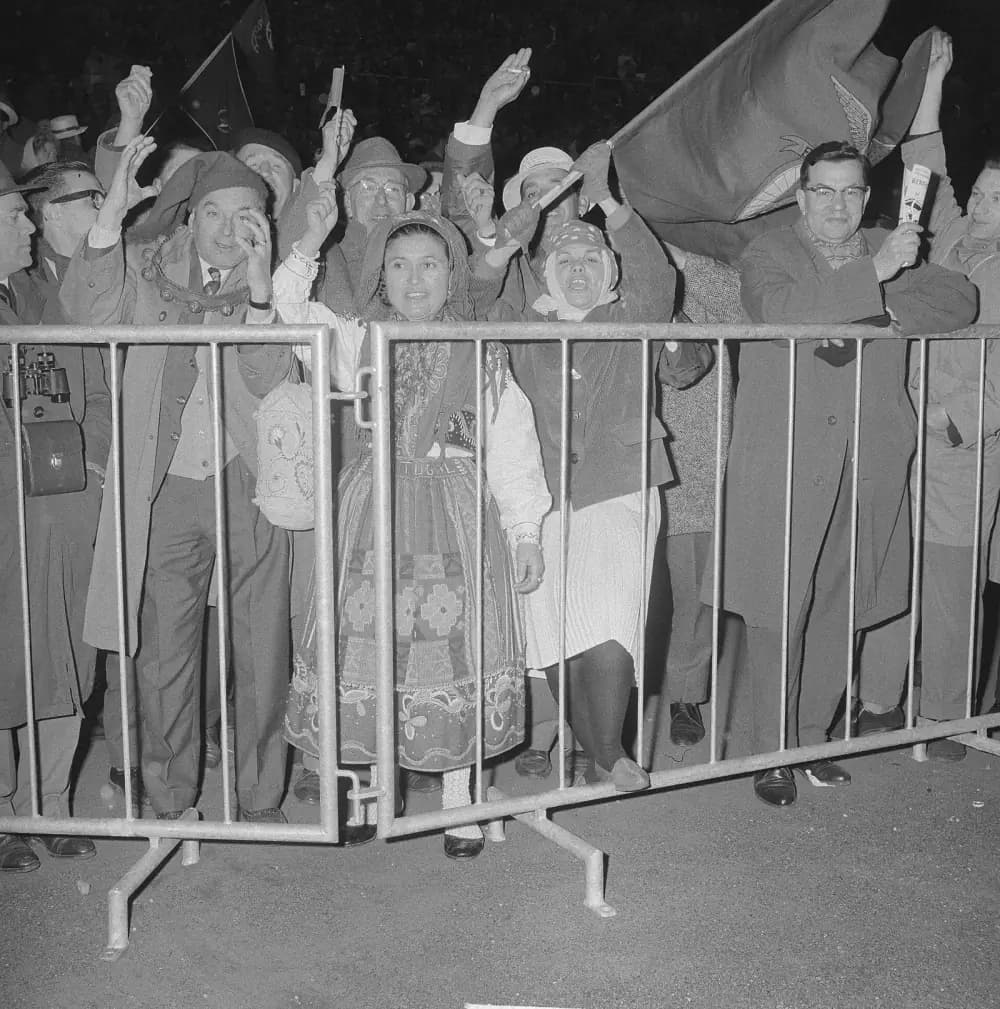
- Portuguese supporters at the barriers in Amsterdam, 2 May 1962. The woman in front wears a regional costume with Portugal embroidered on her apron. Jack de Nijs for Anefo, CC0, via Wikimedia Commons.
- Béla Guttmann at Schiphol airport on 15 November 1966, arriving with the Swiss club Servette, which he was then coaching. Anefo, CC0, via Wikimedia Commons.