

Santa Apolónia station opens on the Lisbon waterfront: 1 May 1865
For more than eight years Lisbon's trains had left from a converted convent. Then a Spanish financier's builders filled in a beach on the Tagus and put up a long, plain station meant to link the capital with Europe.
At a glance
- Santa Apolónia, the Lisbon terminus of the Leste and Norte railway lines, was officially opened on 1 May 1865, eight and a half years after Portugal's first train left from a temporary station in the old convent of Santa Apolónia nearby.
- The station was built from 1862 for the Companhia Real dos Caminhos de Ferro Portugueses, the company of the Spanish financier José de Salamanca, on the site of an artillery barracks called the Cais dos Soldados and on land reclaimed from the Tagus.
- Its iron and glass train shed, by James Blair of Glasgow, was 117 metres long and 24.6 metres wide, and the whole building cost 255,164,000 réis.
- Rossio station took most long-distance and international trains from 1890–91, but they came back to Santa Apolónia after the electrification of 1957.
- Santa Apolónia is still kilometre zero of the Linha do Norte. It handled about 3.7 million passengers in 2022, and part of the building became a hotel that year.
A gateway to Europe on a filled-in beach
On 11 February 1865 Angel Arribas Ugarte, the engineer who directed the firm building the Leste and Norte lines, wrote to the president of Lisbon's city council. The Praia dos Algarves, a strip of beach on the Tagus where, according to the Lisbon historian Norberto de Araújo, boats from the Algarve used to land, was almost filled in. Next to it stood the new main station of the Leste and Norte lines, and Arribas wanted to know what paving the council planned for the square in front.
“a place intended to give access to the main station of the railway that is to link this capital with Europe, and which for that very reason must be visited by a great number of foreigners.”
He also asked permission to knock down the latrines and the parapet that still stood on the beach. The council replied on 17 March that they had already been demolished. Six weeks later, on 1 May 1865, the station was officially opened.
The accounts used for this article record the date but not the ceremony. What they do describe is the building: a long, plain, two-storey block on the waterfront, wrapped around an iron and glass train shed, on a narrow strip between the houses of eastern Lisbon and the river. With changes, it is the same building Lisbon uses today.
Eight years in a convent
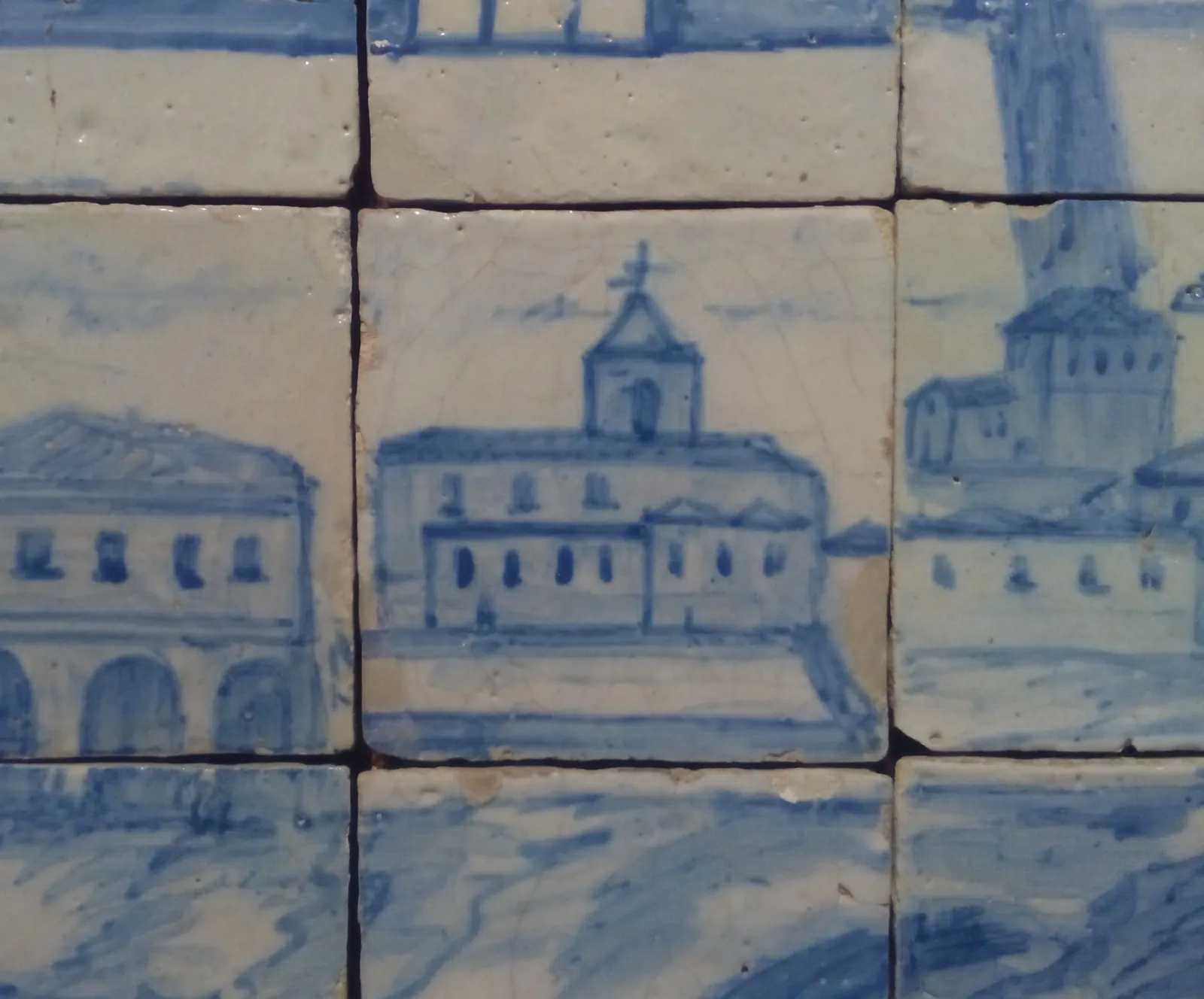
Portugal's first railway, from Lisbon to Carregado, opened on 28 October 1856 (that story is told in its own article). Its Lisbon end was a stopgap. The trains left from the former convent of Santa Apolónia, at the corner of the street of that name, opposite the Calçada dos Barbadinhos, some way east of today's station.
The convent had housed women in religious retreat until 1833; from 1834 it took in the boys of the Casa Pia, Lisbon's charity school. The railway took it over and made do with it, adding sheds and offices. Goods went to a separate yard further east, in old fish-oil warehouses that the first railway company bought from the Misericórdia of Lisbon in December 1856 for 16,200,000 réis.
Salamanca's builders worked fast. The Leste reached the Spanish border beyond Elvas in September 1863, and in July 1864 the Norte was finished as far as Vila Nova de Gaia, across the Douro from Porto. By the end of 1864 the two lines that ran out of Lisbon added up to about 500 kilometres. The convent at the Lisbon end had only ever been a temporary station.
Length of the Leste and Norte lines open at the end of each year, 1856 to 1864
km
Kilometres of the two lines out of Lisbon, added up from the dates and lengths in the Gazeta dos Caminhos de Ferro's 1956 table of sections opened since 1856. The Estarreja–Gaia section, opened provisionally in 1862 and definitively in 1863, is counted once. Work on the new station began in 1862, the year Salamanca's company opened its first long stretches.
Show the data
| Leste and Norte lines open | |
|---|---|
| 1856 | 36.5 |
| 1857 | 50.3 |
| 1858 | 67.8 |
| 1859 | 67.8 |
| 1860 | 67.8 |
| 1861 | 74.4 |
| 1862 | 179.4 |
| 1863 | 320.4 |
| 1864 | 501.5 |
A cramped site between the hill and the river
Where to put the terminus had been argued over since the early 1850s. Engineers proposed Intendente, Arroios, Beato and Xabregas, all inland or further east. João Crisóstomo de Abreu e Sousa and Carlos Lobo d'Ávila insisted that the line should start by the Tagus, where goods could pass between trains and ships, and in an official letter of 8 March 1855 the government fixed the starting point at the Cais dos Soldados.
The Cais dos Soldados was an old artillery barracks on the waterfront, near the Army Arsenal, a big irregular building with a yard closed by iron railings. A contractor, António Ferreira de Almeida, agreed in 1860 to pull it down for 2,900,000 réis. To win more ground, the company filled in the caldeiras, the little anchorages along the shore, from May 1860, using its own locomotives and wagons to bring the earth.
The government's Council of Public Works blew hot and cold about the space. In December 1861 it found the planned station rather narrow. On 1 May 1862 it approved the façades and judged that four tracks would do even if traffic grew a great deal.
Then, in a second opinion on 19 July signed by almost the same members, it found the whole site too narrow and irregular for the passenger and goods sheds, the workshops and the engine house. Four tracks were now enough for ordinary trains but not for specials once traffic grew. Abragão could not explain the change of mind.
The council asked for a wider street on the north side, an entrance facing a square to the west and a quay along the river. The government's inspecting engineer went further and suggested demolishing the Army Arsenal next door to make room. That never happened, and the station was squeezed into the strip between the houses and the water.
Building it, 1862 to 1865
The first stone was laid on 4 September 1862, on the ground of the demolished barracks. The record of the ceremony names the director engineer of Salamanca's construction firm, Eusébio Page, and the chief engineer of its first section, Nicolas Le Crenier, and calls the building the future main station of the railways from Lisbon to Badajoz and to the city of Porto.
The plans bore the names of Angel Arribas Ugarte, the firm's chief engineer João Evangelista de Abreu and Le Crenier. The French firm C.A. Oppermann did the building, under an engineer named Agnés. The south front was founded on rock, laid dry at the low water of spring tides.
The iron roof of the train shed came from James Blair of Glasgow, who travelled to Lisbon to oversee its assembly. It did not go smoothly. Some of the first trusses collapsed after they had been put up, and the design had to be changed; Abragão, writing in 1956, could find no record of why.
The square in front caused a quarrel. In August 1863 the government ordered the company to build a square at least 20 metres wide before the main façade and to fill in the Praia dos Algarves. The company asked to be let off, saying its contract did not oblige it to do such work. On 30 October 1863, in an order signed by the Duke of Loulé, then head of the government, the government answered that it was not asking for public squares, only a station people could enter and leave without danger. A station was more than its walls, it said, and it would not accept the building until the work was done.
8 March 1855
Government fixes the terminus at the Cais dos Soldados
28 October 1856
First train leaves the temporary station in the Santa Apolónia convent
30 July 1859
Contract with José de Salamanca for the Leste and Norte lines
May 1860
Filling of the riverside caldeiras begins; the barracks are demolished
1 May 1862
Council of Public Works approves the façades
4 September 1862
First stone laid
30 October 1863
Government refuses to accept the station without a square in front
19 August 1864
Contract to fill the Praia dos Algarves
11 February 1865
Arribas Ugarte asks the city how it will pave the square
1 May 1865
Station officially opened
25 June 1865
The Companhia Real takes over running the lines from the builders
29 July 1865
Government inspector formally receives the building, which passes to the Companhia Real
The filling was contracted on 19 August 1864 with Francisco Goullard and was due to finish by 8 October. In January 1865 it was still not done, and the firm told its chief engineer to put men and carts to work at the contractor's expense unless Goullard speeded up and finished by 15 February. A few days before that deadline Arribas wrote his letter about the paving.
After the opening, the paperwork followed. On 29 July 1865 the chief engineer of the government's inspectorate formally received the building, and Arribas handed it to the Companhia Real, represented by its director-general, Eduardo Goudchaux. The total cost was 255,164,000 réis.
What the new station held
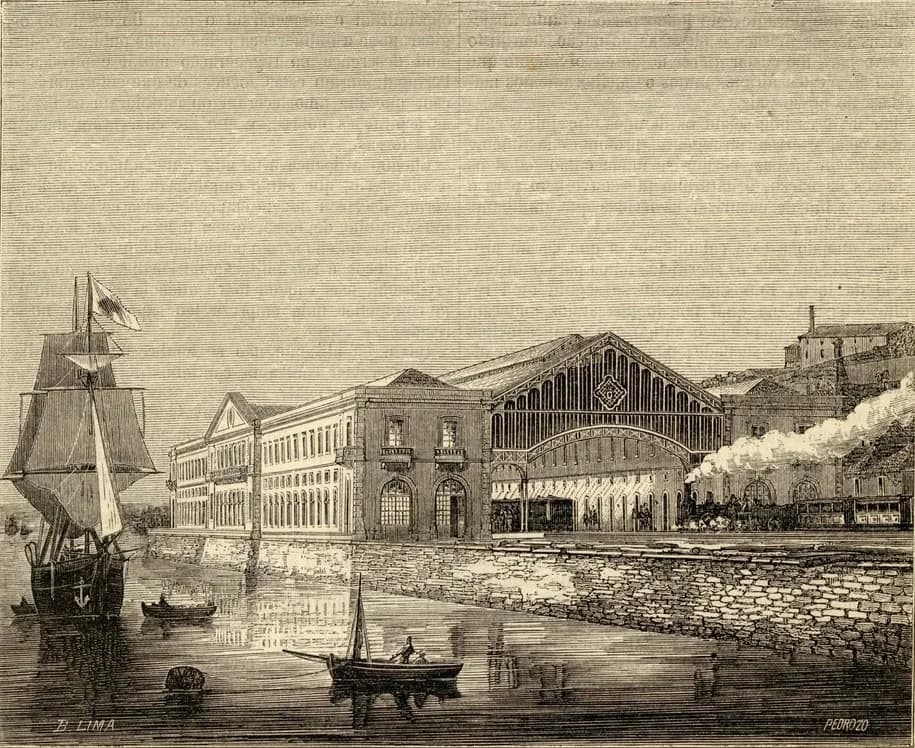
The writer Vilhena Barbosa described the new station for the magazine Archivo Pittoresco, which printed the engraving at the top of this page. The building was 135 metres long, 50.40 metres wide and 13 metres high. Its long sides faced north, to the street of the Cais dos Soldados, and south, to the Tagus; trains came in through the open east end. Passengers entered from the north and left by the west front, so that the cabs and omnibuses had a square on each side.
On the ground floor were a royal waiting room, a shed for 22 carriages, waiting rooms for first, second and third class, baggage offices, the municipal customs post, the government's inspectors, a health office, the telegraph, the station master and cafés and eating houses. Upstairs were the boardroom and the offices of every department of the Companhia Real, from traffic to accounts.
“The roof, all of iron, with glazing in the centre, is of very solid and graceful construction despite its great width; and this vast space is bright and cheerful by day, from the abundant light given it by the glazing of the roof and by the east front of the building, which is open across the whole width of the shed; and at night from the 30 gas lamps that light it.”
| 1865–1866 | Today | |
|---|---|---|
| Main building | 135 m long, 50.40 m wide, 13 m high | U-shaped neoclassical building around the train shed |
| Train shed | 117 m long, 24.60 m wide, 13 m high | Nearly 120 m long and 25 m wide |
| Storeys | Two | Three, after a storey was added in the early twentieth century |
| Lighting | 143 gas lamps, 30 of them in the train shed | Electric |
| Traffic | 1,894 passengers a day on the whole Companhia Real network (average, 1866–1870) | About 3,706,600 passengers a year at the station (2022) |
| Run by | Companhia Real dos Caminhos de Ferro Portugueses | Infraestruturas de Portugal, through IP Património |
1865–1866 figures from Vilhena Barbosa's description and the Companhia Real's statistics, both as printed by Abragão in 1956. Present-day figures from Infraestruturas de Portugal (2024 and 2025). The two eras' traffic figures measure different things and are not directly comparable.
Not everyone was impressed. Abragão, an engineer writing for the centenary of Portugal's railways, judged the station architecturally modest and short of room to grow.
“If it was not monumental, and was rather architecturally quite modest, and if it lacked space and, above all, any great scope for adapting to the growth in traffic that was to be expected (and that will have been the greatest mistake), it was nonetheless, in its simplicity, the indispensable crowning of our first two great lines, the Leste and the Norte.”
Twelve hours to Gaia
Until the summer of 1865 Salamanca's construction firm had run the trains itself. On 25 June 1865 it handed the Leste and Norte lines to the Companhia Real, which set up its own operating departments under Goudchaux.
From 6 August 1865 three trains a day left Santa Apolónia for Gaia, two ran between Entroncamento and Badajoz and one between Lisbon and Entroncamento. All carried the three classes and took about 12 hours by day. The Porto and Badajoz trains travelled together as far as Entroncamento, where they split. Night mail trains reached Gaia in 10 hours and the border in 11.
For the International Exhibition held in Porto that year, the company started a fast train on 17 September 1865, first and second class only, that ran from Lisbon to Gaia in 8 hours. It was withdrawn on 4 February 1866, after the exhibition closed, and brought back for good on 7 April. On a trial run the company said it had touched 82 kilometres an hour.
- Official opening
- 1 May 1865
- Designers
- Angel Arribas Ugarte, João Evangelista de Abreu and Nicolas Le Crenier
- Builder
- C.A. Oppermann, for Salamanca's construction firm
- Train shed roof
- James Blair of Glasgow
- Cost
- 255,164,000 réis
- Fastest train in 1865
- Lisbon to Gaia in 8 hours
Passengers carried by the Companhia Real, 1866 to 1870
passengers
Total passengers on the Companhia Real's Leste and Norte lines, from the company's statistics as printed by Abragão in the Gazeta dos Caminhos de Ferro in 1956. About 70 per cent travelled third class. Over the same years goods sent at ordinary speed rose from 110,084 to 183,968 tonnes.
Show the data
| Passengers, all classes | |
|---|---|
| 1866 | 729,272 |
| 1867 | 729,100 |
| 1868 | 650,354 |
| 1869 | 685,739 |
| 1870 | 667,017 |
Royal arrivals, a rival station and a comeback
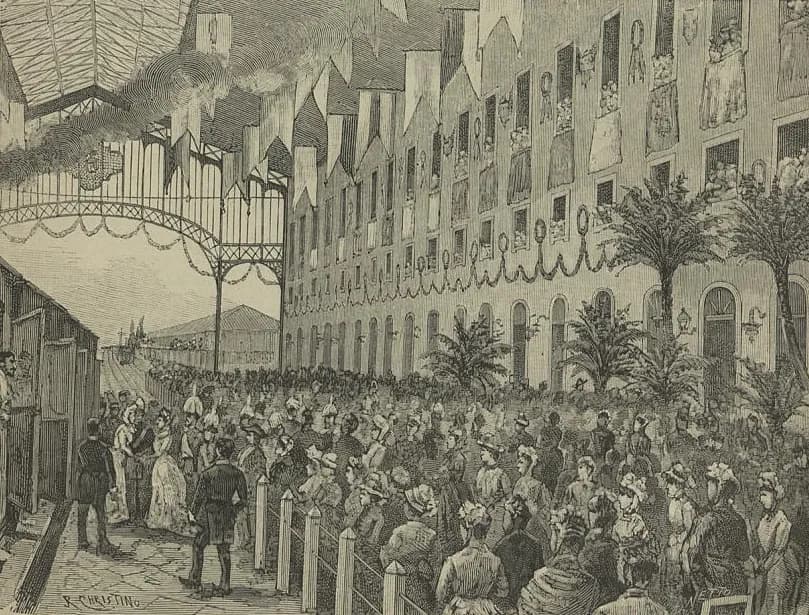
For a quarter of a century Santa Apolónia was where Lisbon met the trains from Porto and Spain. On 19 May 1886 Princess Amélie of Orléans arrived there with her parents, the Count and Countess of Paris, three days before her wedding to Crown Prince Carlos. The magazine O Occidente reported that the station was hung with flags, coats of arms and garlands of flowers, and that the crowd filling the train shed was enormous.
In 1887 the Wagons-Lits company launched the Sud-Express, which linked Lisbon with Madrid, Paris and Calais. At first it ran over the Leste line and entered Spain at Valencia de Alcántara; from 1895 it took the Beira Alta line instead.
Santa Apolónia lay off-centre, east of the Baixa, Lisbon's commercial district. To fix that, the Companhia Real dug a tunnel under the city and built Rossio station, in the heart of town, and a ring line linked it with the Norte. CP dates Rossio to 1890; the Gazeta's table of openings and IP give 1891. The international trains, the Sud-Express among them, and the long-distance trains to Porto moved there.
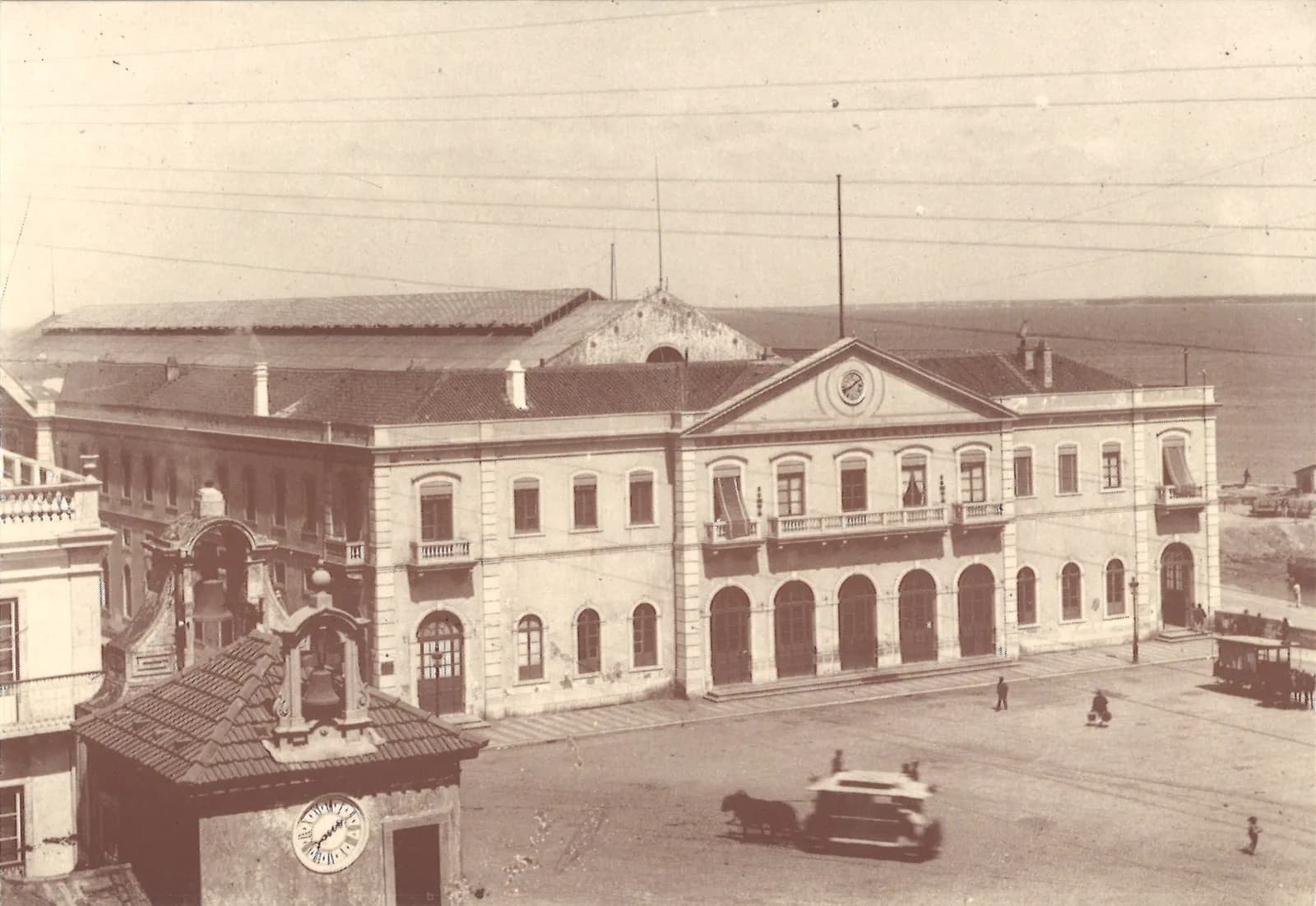
Santa Apolónia did not stand still. Early in the twentieth century a third storey was added, and the two upper floors became offices of the railway companies, with passengers kept to the ground floor. On 28 April 1957 the Sintra line out of Rossio and the first stretch of the Norte were electrified, as part of the railway centenary. Rossio became a suburban station, and the long-distance and international trains came back to Santa Apolónia, whose platforms were lengthened for them.
The station was also a stage for politics. In May 1958, during the presidential campaign of the opposition candidate Humberto Delgado, there were clashes with the police at Santa Apolónia when he returned to Lisbon from his rally in Porto.
In 1998 Santa Apolónia lost ground again, to the new Gare do Oriente built for Expo '98. In December 2007 the Metro's Blue Line reached it, with a stop of its own beside the station, which brought it closer to the rest of the city.
Santa Apolónia today
The station is still kilometre 0.000 of the Linha do Norte, Portugal's main line. It is the terminus for long-distance trains to Porto and the north and for regional and suburban trains to Azambuja. In 2022 about 3,706,600 passengers passed through it.
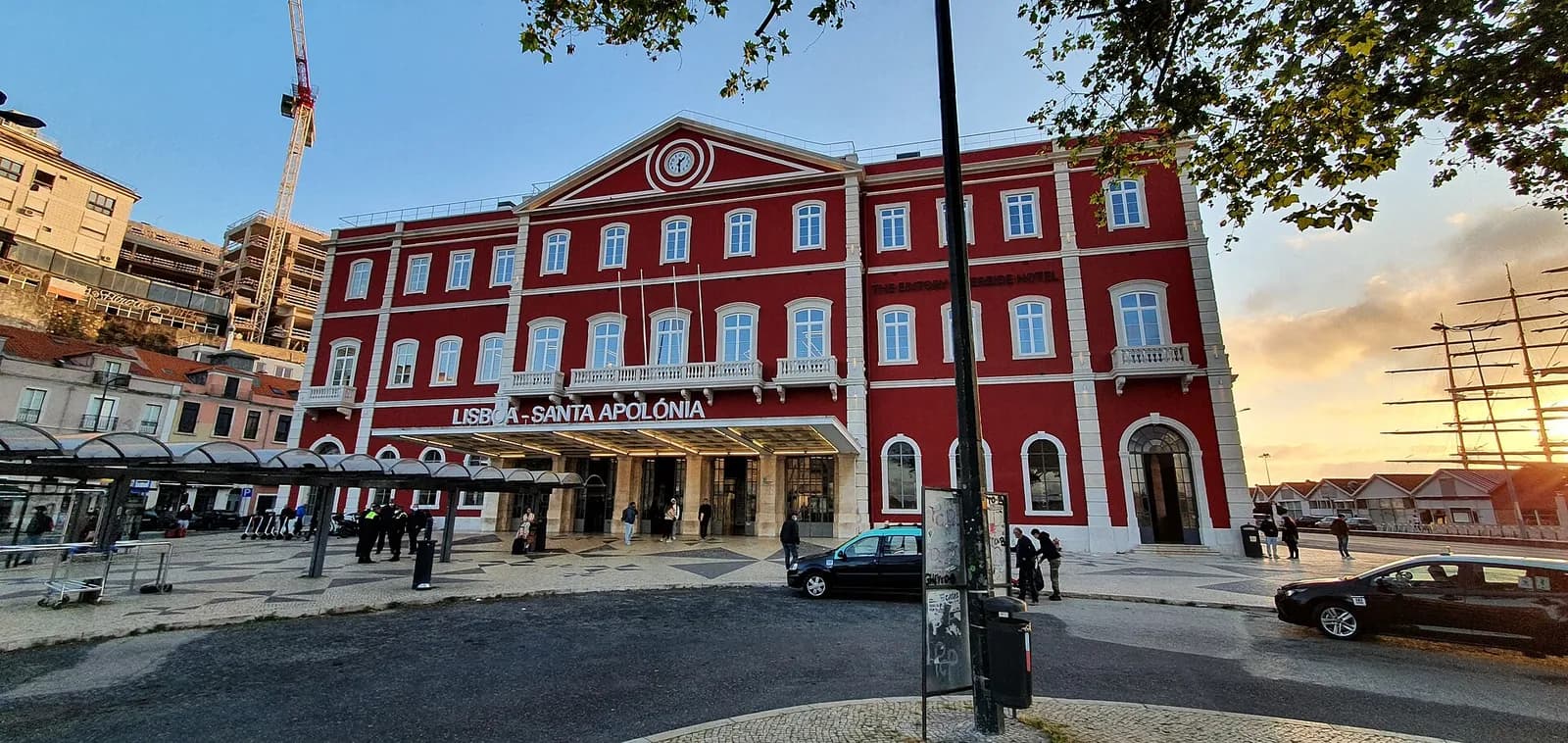
In 2019 Infraestruturas de Portugal (IP), the state company that manages the building, awarded a 35-year sub-concession for a hotel of at least 120 rooms inside it. The Editory Riverside Santa Apolónia Hotel opened in February 2022 after a €12 million conversion, with 126 rooms in the east wing and the upper floors of the central block, according to the Diário de Notícias; IP calls the hotel wing the south wing, facing the Tagus. Its Sala Nobre, the main reception room, kept a nineteenth-century stucco ceiling, restored to its original design.
A third and last phase of repairs to the walls, canopies and stonework, costing about €190,000, was completed by early 2024. It replastered and repainted them in the building's original colour, a deep red the Portuguese call sangue-de-boi, ox blood.
The trains that once made it a gateway to Europe are gone. The Sud Express and the Lusitânia night train to Madrid, which ran coupled together from Lisboa-Apolónia as far as Medina del Campo, were halted by CP and Renfe, the Spanish railway, in March 2020, during the Covid-19 pandemic. CP promised in June 2020 to restart them once the border reopened, but in December 2025 campaigners were still gathering at Santa Apolónia to ask for them back.
FAQs
When did Santa Apolónia station open?
The present station building was officially opened on 1 May 1865. Trains had run from the same neighbourhood since Portugal's first railway opened on 28 October 1856, but at first they left from a temporary station in the old convent of Santa Apolónia.
Is Santa Apolónia the oldest railway station in Portugal?
Infraestruturas de Portugal calls it the first railway station in Portugal, because Lisbon's first line started there in 1856. The building now in use dates from 1862 to 1865, with a third storey added in the early twentieth century.
Who designed Santa Apolónia station?
The project, approved in 1862, was signed by the engineers Angel Arribas Ugarte, João Evangelista de Abreu and Nicolas Le Crenier. The French firm C.A. Oppermann built it, and James Blair of Glasgow supplied the iron roof of the train shed.
Which trains leave from Santa Apolónia today?
Long-distance trains on the Linha do Norte to Porto and the north, and regional and suburban trains to Azambuja. The international night trains to Madrid and Hendaye stopped in March 2020 and had still not returned at the end of 2025.
On the timeline
Open the timelineNearby moments from regeneration and the last kings (1851–1910).
Portugal and Spain sign the Treaty of Lisbon, fixing their frontier from the mouth of the Minho to the confluence of the Caia and Guadiana rivers and abolishing the Couto Misto, a tiny self-governing territory that had eluded both crowns for centuries.
The 'Diário de Notícias' appears in Lisbon for the first time, with a specimen issue. Founded by the journalist Eduardo Coelho and the printer Tomás Quintino Antunes, it grew into one of the country's leading newspapers and is still published today.
The army doctor José António Marques founds the Portuguese Commission for Relief of Wounded and Sick Soldiers in Time of War, the body that became the Portuguese Red Cross, months after representing Portugal at the 1864 Geneva conference.
Santa Apolónia station opens
Lisbon's Santa Apolónia station is inaugurated on the riverfront below the Alfama. Its neoclassical building and 117-metre train shed replaced the makeshift terminus in the old convent of Santa Apolónia that had served since Portugal's first railway opened in 1856, and it remains the capital's oldest railway terminus.
Birth at Seixas, near Caminha, of Miguel Ventura Terra, the Paris-trained architect who shaped belle-époque Lisbon. He redesigned the debating chamber of the parliament at São Bento, built the Shaaré Tikvá synagogue, the Liceu Camões and the Teatro Politeama, and won the city's Valmor architecture prize four times.
A landmark royal decree abolishes the death penalty for civil crimes in Portugal — one of the earliest abolitions in the world — and promulgates the new Civil Code drafted by Visconde de Seabra, a foundational text of modern Portuguese law.
António Nobre, whose only book 'Só' became a landmark of Portuguese symbolist and saudosista poetry, is born in Porto.
Coming up in history
All long reads

14 sources
Archives, scholarship and reporting this article was checked against.
- 1
Gazeta dos Caminhos de Ferro, n.º 1652 (16 October 1956): centenary issue of the Portuguese railwaysGazeta dos Caminhos de Ferro, digitised by the Hemeroteca Municipal de Lisboa
- 2
Estação ferroviária de Santa Apolónia celebra 160 anosInfraestruturas de Portugal, 30 April 2025
- 3
Estação de Santa Apolónia: 161 anos do berço da ferrovia em PortugalInfraestruturas de Portugal, 4 May 2026
- 4
Investimentos estrangeiros, política financeira e caminhos-de-ferro em Portugal na segunda metade do século XIX (Magda de Avelar Pinheiro)Análise Social, vol. 15, n.º 58 (1979), pp. 265–286
- 5
- 6
- 7
A Linha de SintraCP – Comboios de Portugal
- 8
Humberto Delgado's candidacy: a journey of resistanceMuseu do Aljube Resistência e Liberdade, 15 May 2026
- 9
A brief historyMetropolitano de Lisboa
- 10
- 11Está quase a nascer um hotel de 5 estrelas na Estação de Santa ApolóniaDiário de Notícias, 3 February 2022
- 12
Sem comboios internacionais, Lisboa fica isolada do resto da Europa (Mário Rui André)Lisboa Para Pessoas, 22 March 2021
- 13CP retoma comboio para Espanha e França assim que fronteira reabrirDiário de Notícias, 3 June 2020
- 14
Cidadãos vão manifestar-se de pijama em Santa Apolónia pelo regresso do Sud Express e do LusitâniaTime Out Lisboa, 10 December 2025
Image credits
- Santa Apolónia seen from the Tagus, in an engraving published in the Lisbon magazine Archivo Pittoresco in 1866, the year after the station opened. The south front faces the river and the train shed opens to the east. João Barbosa Lima (1839-1867) e João Pedrozo (1823–1890), Public domain, via Wikimedia Commons.
- The convent of Santa Apolónia as painted in the Grande Panorama de Lisboa, a tile panel of the early eighteenth century now in the Museu Nacional do Azulejo. Lisbon's first trains left from this building from 1856 until the new station opened. RickMorais, CC BY-SA 4.0, via Wikimedia Commons.
- The arrival of Princess Amélie of Orléans at the station of the Norte and Leste railway on 19 May 1886, engraved for the front page of O Occidente of 1 June 1886. J. Christino, Public domain, via Wikimedia Commons.
- The west front of Santa Apolónia in 1891, still with two storeys, in a photograph reproduced on a CP postcard. A horse-drawn vehicle crosses the square that the government had insisted on. Unknown author, Public domain, via Wikimedia Commons.
- The west front of Santa Apolónia in April 2022, painted ox-blood red, with the third storey added in the early twentieth century. The hotel had opened inside the building two months earlier. Yair Haklai, CC BY-SA 4.0, via Wikimedia Commons.