

The Constitutional Charter of 1826: Portugal's constitution made in Rio
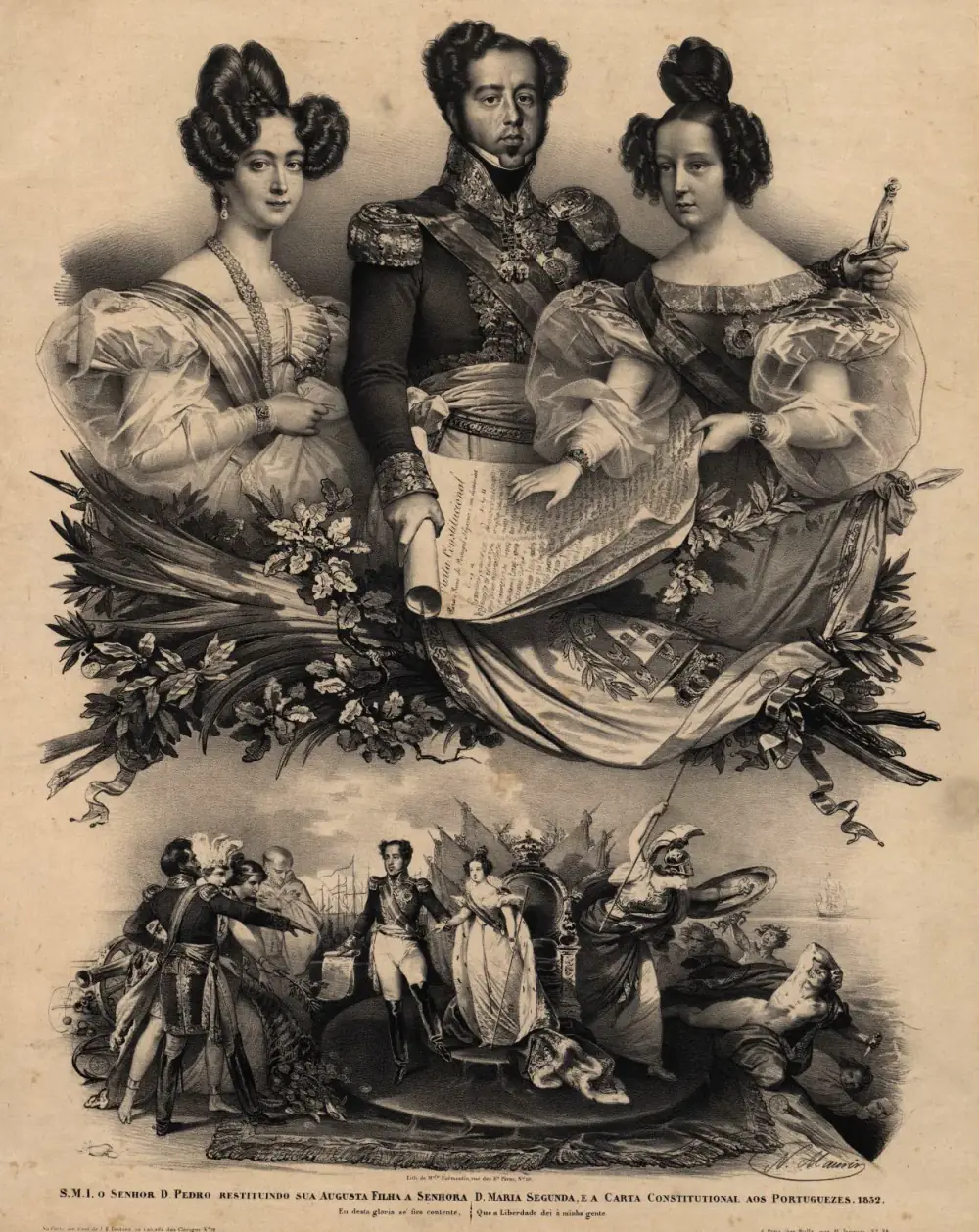
Emperor of Brazil and, briefly, King of Portugal, Pedro gave the Portuguese a constitution before giving up their crown. Torn up within two years, the Charter came back to govern the kingdom until the monarchy fell.
At a glance
- On 29 April 1826, in Rio de Janeiro, Pedro IV of Portugal, who was also Emperor Pedro I of Brazil, signed a Constitutional Charter for Portugal, five days after hearing of his father's death.
- The Charter was granted by the king, not voted by an assembly, and was closely copied from the constitution Pedro had given Brazil in 1824.
- It added a fourth, “moderating” power held by the king alone, an absolute royal veto, an appointed hereditary Chamber of Peers and indirect elections limited by income.
- It was sworn in Lisbon on 31 July 1826, annulled when Miguel made himself absolute king in 1828, restored in 1834, overthrown in 1836 and restored again in 1842.
- Amended by four Additional Acts (1852, 1885, 1895-1896 and 1907), it lasted until the Republic of 5 October 1910: 72 years in force, longer than any other Portuguese constitution.
Five days in Rio de Janeiro
The news reached Rio de Janeiro on 24 April 1826, on merchant ships that had crossed the Atlantic ahead of the official deputation from Lisbon. King João VI of Portugal had died on 10 March. His heir was his elder son Pedro, who had declared Brazil independent in 1822 and reigned there as its emperor.
Pedro could not wear both crowns. Brazil, jealous of its new independence, would not accept a king of Portugal as its emperor, and many in Portugal saw him as a foreign prince who had betrayed them. He chose Brazil. Before letting Portugal go, he decided to give it two things: a constitution and a queen.
The constitution took five days. According to the nineteenth-century jurist José Joaquim Lopes Praça, followed by the historian José Miguel Sardica, a first draft was written by José Joaquim Carneiro de Campos, Brazil's minister of justice. Pedro and his private secretary, Francisco Gomes da Silva, finished it, and the British envoy Sir Charles Stuart probably read it. The work went fast because the text was almost a copy of the constitution Pedro had given Brazil two years earlier.
The finished Charter closed in the old chancery style: given at the Palace of Rio de Janeiro on the twenty-ninth day of the month of April 1826. Under the royal signature came a second line, “Francisco Gomes da Silva a fez”, Francisco Gomes da Silva made it. He registered it the next day, signing as chief officer of the imperial cabinet.
“Dom Pedro, by the grace of God, King of Portugal and the Algarves, etc. I make known to all My Portuguese subjects that I am pleased to decree, give and order to be sworn immediately by the Three Orders of the State the Constitutional Charter transcribed below, which shall henceforth govern these My Kingdoms and Dominions.”
On 30 April Pedro named the members of the new upper house, the Chamber of Peers. On 2 May he abdicated the Portuguese crown in favour of his seven-year-old daughter, Maria da Glória, on two conditions: that the Charter be sworn, and that his brother Miguel marry her. The story of that abdication belongs to the articles on João VI's death and on Maria II. Stuart sailed for Lisbon with the papers.
The charter João VI never gave
Portugal already knew written constitutions. A liberal revolution in Porto in August 1820 led to elected Cortes, which wrote the Constitution of 1822. It placed sovereignty in the nation and almost all power in a single elected chamber. The king had only a suspensive veto, sending a law back once, and could not dissolve parliament.
That constitution fell in mid-1823, after the Vilafrancada, a military rising led by Miguel. João VI then promised a text of his own. A decree of 18 June 1823 set up a junta under his foreign minister, Palmela, to draft a fundamental law. It met from 7 July and took as its basis a draft by the Coimbra jurist Ricardo Raimundo Nogueira, with an absolute royal veto, two chambers and an income qualification for voters. Absolutists on the junta blocked it, and the draft was shelved.
After Miguel's second coup, the Abrilada of April 1824, which has its own article, a law of 4 June 1824 restored the traditional laws of the kingdom. João VI died without granting a charter, although a draft constitution in his own hand was reportedly found among his papers. When it came in 1826 from his son, Sardica concludes, the Charter was not a rupture but the model the old king and Palmela had pursued in vain.
What the Charter said
The Charter had 145 articles in eight titles, against 179 in the Brazilian constitution and 240 in the Portuguese one of 1822. Its main source was the Brazilian text of 1824, and through it the French Charter of 1814. Behind both stood Benjamin Constant, a moderate French liberal, whose sketch of a constitution of 1814 lent the Brazilian and Portuguese texts their guiding ideas and many sentences translated word for word.
Article 11 named four political powers instead of the usual three: legislative, moderating, executive and judicial. The new one was Constant's “royal power”, which Pedro called the moderating power, and it belonged to the king alone.
“The Moderating Power is the key to the whole political organisation, and belongs exclusively to the King, as Supreme Head of the Nation, so that he may constantly watch over the maintenance of the independence, balance and harmony of the other Political Powers.”
Article 74 spelled out what that meant. The king appointed peers without limit of number, called the Cortes to extraordinary sessions, sanctioned their decrees, adjourned them and dissolved the Chamber of Deputies, appointed and dismissed ministers freely, suspended judges, and granted pardons and amnesties. His veto was absolute. Ministers answered to him, not to parliament.
Parliament, the Cortes Gerais, had two chambers for the first time. Members of the Chamber of Peers were appointed by the king for life and by inheritance, with no fixed number; the Prince Royal and the infantes sat by right from the age of 25. The Chamber of Deputies was elective and temporary, and only it could begin laws on taxes and military recruitment.
Deputies were chosen in two stages. Men with a net income of at least 100,000 réis a year voted in parish assemblies for provincial electors, who needed 200,000 réis; the electors chose the deputies, who needed 400,000. The voting age was 25, or 21 for married men and army officers, and graduates and priests in holy orders were exempt from the age rule. Servants, monks, sons living with their parents and anyone below the income line were excluded, and freed slaves could vote but not be electors.
Rights came last, in article 145, the longest in the text, with 34 paragraphs. Most of the liberties of 1822 survived: equality before the law, a press free of prior censorship, and freedom from persecution for religion so long as the state religion was respected. The same article abolished flogging, torture and branding, and promised free primary education.
Unlike the 1822 text, it also guaranteed the hereditary nobility and its privileges. Roman Catholicism remained the religion of the kingdom; foreigners could practise other faiths only in private, in buildings without the outward form of a church.
| Constitution of 1822 | Constitutional Charter of 1826 | |
|---|---|---|
| Made by | Elected Constituent Cortes | Granted by the king |
| Sovereignty | Resides in the nation | Representatives of the nation are the king and the Cortes (article 12) |
| Powers | Three: legislative, executive, judicial | Four, adding the king's moderating power |
| Parliament | One elected chamber | Chamber of Peers (appointed, life and hereditary) and Chamber of Deputies |
| Elections | Direct | Indirect, with income thresholds of 100,000, 200,000 and 400,000 réis |
| Royal veto | Suspensive | Absolute |
| Dissolution | King could not dissolve the Cortes | King could dissolve the Chamber of Deputies |
| Legislature | Two years | Four years |
| Citizens' rights | Title I, at the start | Article 145, at the end |
The 1822 Constitution excluded some groups, such as servants and men under 25, but set no specific income threshold for voters.
- Signed
- 29 April 1826, Palace of Rio de Janeiro
- Length
- 145 articles in 8 titles
- Political powers
- 4: legislative, moderating, executive, judicial
- Legislature
- 4 years; annual session of 3 months, opened on 2 January
- First peers
- 91 named on 30 April 1826: 19 prelates and 72 titled nobles
- Earliest amendment
- Not before 4 years after the oath (article 140)
Sworn in 1826, annulled in 1828
The first copies reached Lisbon before the envoy. On 2 July 1826 the corvette Lealdade entered the Tagus, 53 days out of Rio, with copies of the Rio newspaper Diário Fluminense that printed Pedro's decrees. Stuart himself arrived on the frigate Diamond on 7 July, although Sardica dates his arrival to 2 July. The regent, Pedro's sister the Infanta Isabel Maria, was staying at the spa town of Caldas da Rainha, and her government hesitated and held the Charter back.
“Nobody wanted it, nobody had asked for it.”
The left, heirs of 1820, saw in the Charter a king's power placed above the nation's. To absolutists, who had hoped Pedro would abdicate in Miguel's favour, any constitution was a surrender to the revolution. The regency announced publication on 12 July, and the Gazeta de Lisboa printed the text in instalments from 15 to 26 July.
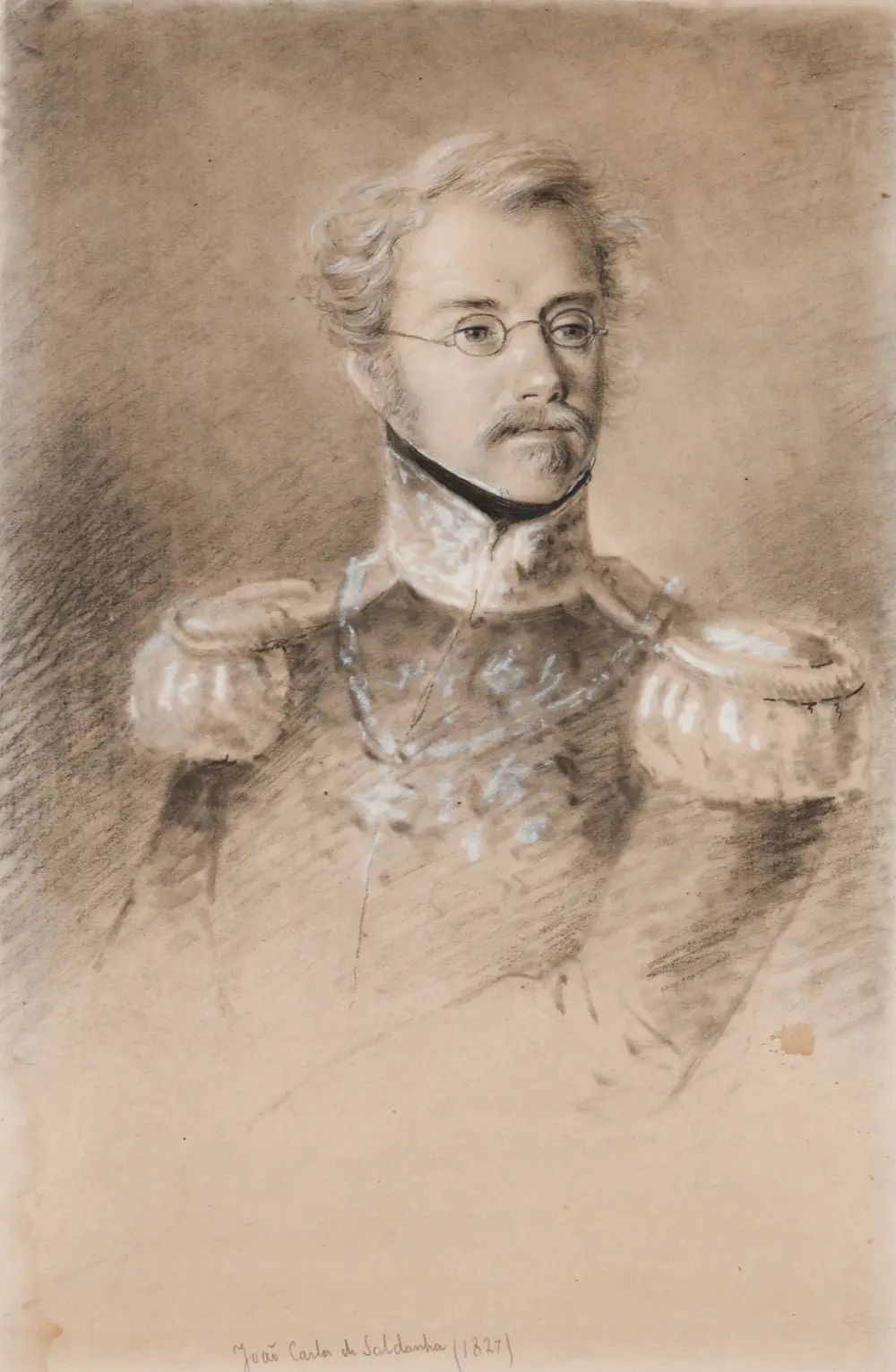
Nobody set a date for the oath until General João Carlos de Saldanha, military governor of Porto, sent Rodrigo Pinto Pizarro to Caldas at the head of a column of troops, a sign that no more delay would be tolerated. A decree of 19 July fixed the oath for 31 July, and the Charter came into force that day. Lisbon was lit up for three nights, with military bands in the streets and poems recited at the illuminations.
The new institutions took shape. Pedro's peers were the old court: by one decree the Patriarch of Lisbon and all the archbishops and bishops, 19 in all; by royal letters 72 titled nobles, every duke and marquis, almost every count and the two viscounts who ranked as grandees. Nine were under age. Elections followed, and the Cortes opened on 30 October 1826.
Resistance began at once. The 24th Infantry rose for Miguel at Bragança and the 17th in the Alentejo, and rebels who fled to Spain raided across the border between October 1826 and January 1827. In December 1826 Britain sent a division under General Clinton to defend Portugal. According to Oliveira Martins, the British foreign secretary, George Canning, remarked that everything Stuart brought from Brazil was excellent, except the Charter.
Miguel, in exile in Vienna, swore the Charter on 4 October 1826, and his betrothal to his niece followed on 29 October. In July 1827 Pedro named him lieutenant and regent. Miguel landed in Lisbon on 22 February 1828 and swore loyalty to Maria and the Charter four days later. On 13 March he dissolved the Chamber of Deputies. In May he summoned the old Cortes of the Three Estates, which proclaimed him king, and in July he took the crown as an absolute monarch and annulled the Charter.
24 April 1826
News reaches Rio
Pedro learns of João VI's death.
29 April 1826
Charter signed
Given at the Palace of Rio de Janeiro.
30 April 1826
Peers named
19 prelates by decree and 72 titled nobles by royal letter.
2 May 1826
Conditional abdication
In favour of Maria da Glória, aged seven.
2 July 1826
Rio newspapers reach Lisbon
The corvette Lealdade brings the decrees in print.
7 July 1826
Stuart lands in Lisbon
With the official texts.
31 July 1826
Charter sworn
After Saldanha's pressure on the regency.
4 October 1826
Miguel's oath
Sworn in Vienna.
30 October 1826
Cortes open
The first Chamber of Peers and Chamber of Deputies meet.
22 February 1828
Miguel lands
He swears to the Charter on 26 February.
13 March 1828
Chamber dissolved
July 1828
Absolute king
Miguel takes the crown and annuls the Charter.
Banner of the exiles, then a battleground
Persecution made the Charter popular. Liberals fled to Galicia, France and England, and the cause of Maria II and the cause of the Charter became one. Pedro gave up the throne of Brazil in 1831 to lead it in person, and the civil war that followed ended with Miguel's surrender at Evoramonte in May 1834, the subject of its own article.
“The Charter, precisely because it was persecuted, began more and more to be the banner of the persecuted.”
When the Cortes reopened on 15 August 1834, Pedro's Chamber of Peers had almost vanished. Of the 60 peers who had taken their seats in 1826-1828, 37 were still alive, and 24 of those were excluded, or excluded themselves, for having sided with Miguel.
A decree of 28 May 1834 ruled that nobles who had signed the 1828 petition asking Miguel to abolish the Charter had renounced their peerage. Only 13 of Pedro's peers were left when the chamber reopened, and the crown refilled it with new peers: 20 appointed by royal letter in 1834 and 18 more in 1835.
Pedro died in September 1834, remembered by his supporters as o Dador, the Giver. Victory then split the liberals. The left disliked a constitution that came as a royal gift and gave the crown so much power. On 9 September 1836 a revolution in Lisbon restored the Constitution of 1822, and new Cortes wrote the compromise Constitution of 1838. Passos Manuel, whom the September Revolution brought to power, later explained the Charter's second fall.
“The Charter was destroyed twice. In 1828 by tyranny; in 1836 by liberty, which already wanted greater perfection in the institutions, a larger share in power, a wider constitutional circle, and above all the solemn recognition of that great principle, national sovereignty.”
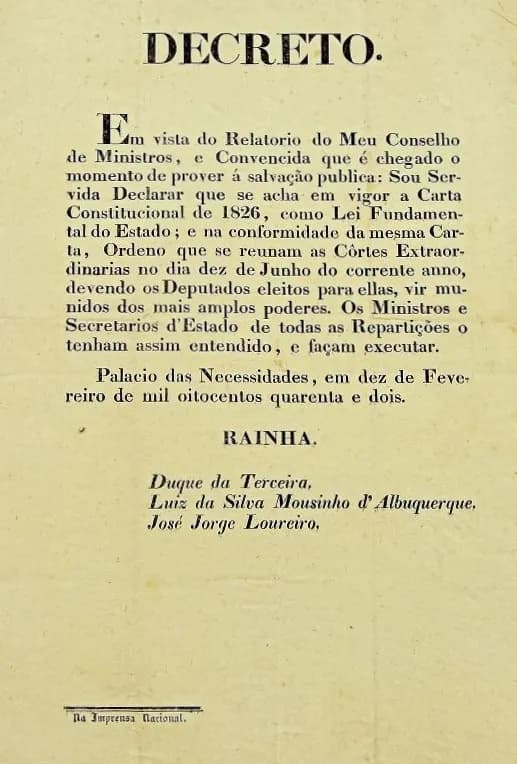
The Charter's hardliners struck back. On 27 January 1842 António Bernardo da Costa Cabral led a coup with the army behind him, and a decree of 10 February declared the Charter of 1826 in force again as the fundamental law of the state. The same decree held out the promise of a revision, which the left took up. The Constitution of 1838 had lasted less than four years. This time the Charter would last 68.
Four Additional Acts
The left now asked for reform instead of repeal: direct elections, parliamentary control of treaties and taxes, and limits on the moderating power and on hereditary peers. The Charter's own procedure was slow. A proposal had to come from the Chamber of Deputies with the support of a third of its members, be read three times, pass as a law, and then be voted by the next Cortes, whose electors had given them special powers.
The Regeneration, the movement that brought Saldanha to power in 1851 and ended Costa Cabral's era, took a shortcut. A dictatorial decree of 25 May 1851 gave the next Chamber of Deputies the power to amend the articles that experience had shown needed correcting. The result, the first Additional Act, was sanctioned by Maria II on 5 July 1852. Three more followed, and Sardica notes that only the Act of 1885 was passed by the procedure the Charter laid down.
| Act | Main changes | How it was passed |
|---|---|---|
| 5 July 1852 | Direct election of deputies; one income threshold of 100,000 réis for all voters, with no proof of income required from men with educational qualifications; treaties approved by the Cortes before ratification; taxes voted every year; parliamentary inquiries; no death penalty for political crimes | By a Chamber given amending powers by decree, outside the Charter's procedure |
| 24 July 1885 | End of hereditary peers and of unlimited appointments: 100 life peers named by the king and 50 elected for six years; legislatures cut from four years to three; some acts of the moderating power made the responsibility of ministers | Agreed between the two governing parties, by the Charter's own procedure |
| Decree of 25 September 1895 and law of 3 April 1896 | Elected peers abolished; up to 90 life peers named by the king, besides peers by right of birth or office | Decreed by the government while the Cortes were dissolved |
| 23 December 1907 | No fixed number of life peers named by the king | Decreed by João Franco's government with parliament closed; never applied after the regicide of 1 February 1908 |
Under the Act of 1885, 45 elected peers were chosen in the administrative districts and 5 by scientific institutions. The Act of 1852 kept the 400,000 réis income required to be elected a deputy.
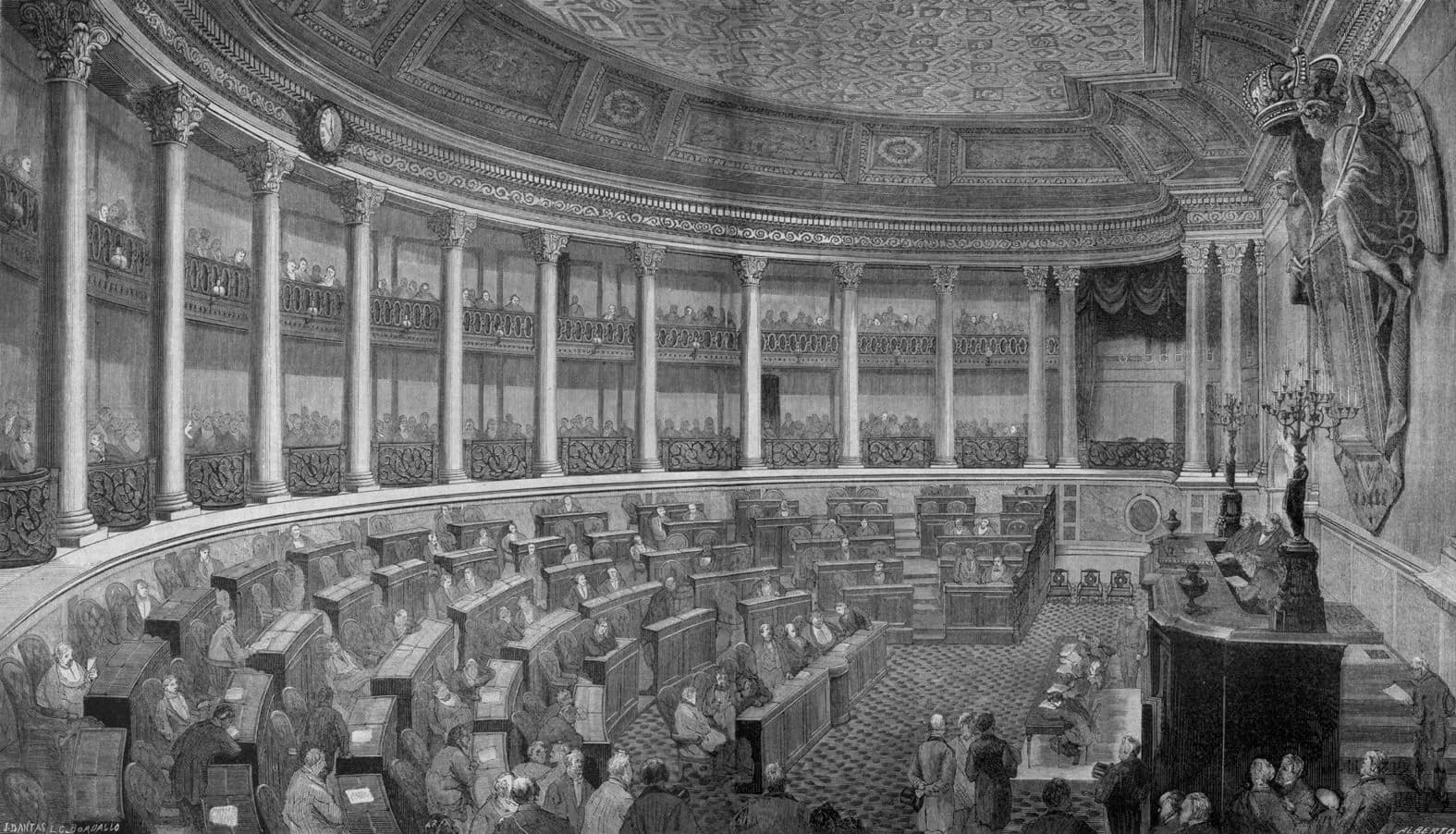
The Chamber of Peers was the running quarrel. A government short of a majority there could ask the king for a batch of new peers, a fornada, literally an ovenful. Over the decades the house filled with men who owed their seats to service rather than birth: every peer appointed by royal letter in 1826 and 1827 was a titled noble, but fewer than one in five of those appointed between 1890 and 1906.
Peers appointed by royal letter, 1826-1906
peers appointed
- All peers appointed
- Of whom titled nobles
Periods are of unequal length and follow the governments of the day. The figures exclude the prelates who sat by virtue of their office, Maria II's first husband and five clergymen appointed by royal letter; they include men appointed who never took their seats. A peer counts as titled if he held a title when appointed or received one later. Source: Luís Espinha da Silveira (1992), quadro 6, from the official statistics of the peerage of 1899 and 1910.
Show the data
| All peers appointed | Of whom titled nobles | |
|---|---|---|
| 1826-27 | 73 | 73 |
| 1834-35 | 36 | 23 |
| 1842-51 | 54 | 41 |
| 1851-54 | 30 | 18 |
| 1861-66 | 50 | 19 |
| 1870-78 | 41 | 16 |
| 1880-89 | 67 | 16 |
| 1890-1906 | 95 | 18 |
Elections worked backwards. Because the king appointed governments, a new ministry asked him to dissolve the Chamber of Deputies and then won the election it ran. Between 1834 and 1910 Portugal held 42 general elections and saw 31 dissolutions. Augusto Fuschini summed up the system in 1899: “governments choose and make the deputies; these in turn support the government”.
The electorate grew by ordinary law rather than by amendment. A law of 8 May 1878 counted every head of family and every man who could read and write as having the minimum income. Eligibility stayed narrow: in the middle of the century a little over 36,000 men, under 1 per cent of a population of about 3.8 million, could stand for the Chamber of Deputies.
Why it still matters
The Charter was in force for 72 years in all, 68 of them without a break, from 1842 to 1910. By Sardica's count, the Constitution of 1822 lasted about three years in two spells, that of 1838 under four, the republican Constitution of 1911 about 15 in practice and Salazar's Constitution of 1933 for 41.
The present Constitution came into force on 25 April 1976. It will reach 72 years in April 2048; counted day by day, the Charter's three spells add up to almost 73 years, a total it would pass only at the end of 2048 or early in 2049.
It fell with the monarchy on 5 October 1910. Sardica argues that the republicans did not rise chiefly against the Charter, which had bent to accommodate new groups and ideas, and that it should be judged by the world it came from, one just emerging from the divine right of kings. Paulo Jorge Fernandes is more critical: the reform of 1885 closed the system to newcomers, monarchist and republican alike, and the political elites never agreed on the form of the constitution.
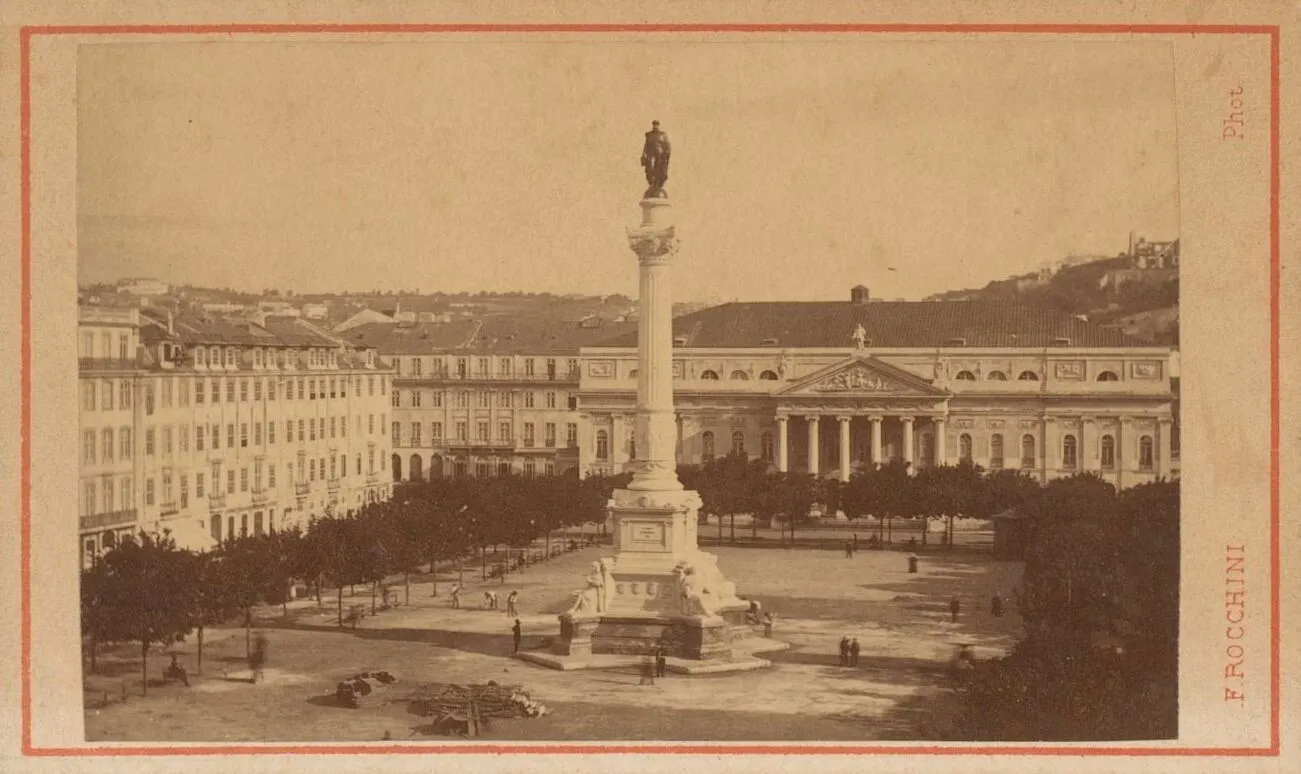
Its institutions framed Portuguese politics for most of the nineteenth century: a parliament of two chambers at São Bento, a monarch who chose and dismissed governments, and parties that took turns in power through managed elections. Through its Additional Acts it was also the first Portuguese constitution to be amended rather than replaced: the texts of 1822 and 1838 were swept away by revolution and coup.
FAQs
What was the Constitutional Charter of 1826?
It was the constitution that Pedro IV, also Emperor Pedro I of Brazil, granted to Portugal from Rio de Janeiro on 29 April 1826. It created a constitutional monarchy with a strong king, an appointed Chamber of Peers and an elected Chamber of Deputies, and with interruptions it governed Portugal until 1910.
Why was it called a charter and not a constitution?
Because it was granted by the king, not voted by an elected assembly. The name and the idea came from Louis XVIII's French Charter of 1814. Of Portugal's constitutions since 1822, it is the only one given by a monarch.
What was the moderating power?
A fourth power, taken from Benjamin Constant's “royal power”, that the Charter gave to the king alone to keep the other three in balance. With it he appointed peers, sanctioned or refused laws, dissolved the Chamber of Deputies, appointed and dismissed ministers, suspended judges and granted pardons.
How long was the Charter in force?
Seventy-two years in three spells: from 31 July 1826 to 1828, from 1834 to September 1836, and from 1842 until the Republic was proclaimed on 5 October 1910. No other Portuguese constitution has lasted as long.
What were the Additional Acts?
The four amendments to the Charter, of 1852, 1885, 1895-1896 and 1907. The first brought direct elections and parliamentary control of taxes and treaties; the later ones changed the make-up of the Chamber of Peers.
On the timeline
Open the timelineNearby moments from invasions, brazil and the liberal wars (1807–1851).
The Abrilada (April Revolt): Infante Miguel, commander-in-chief of the army, turns the Lisbon garrison against his father's moderate ministers and holds King João VI in the Bemposta palace. Backed by the diplomatic corps, the king takes refuge on a British warship, strips Miguel of his command and sends him into exile.
By the Treaty of Rio de Janeiro, mediated by Britain, Portugal formally recognises the independence of Brazil, ending the Brazilian war of independence.
King João VI dies in Lisbon under suspicious circumstances (possible arsenic poisoning), triggering a succession crisis between his sons Pedro (Emperor of Brazil) and Miguel, which would lead to the Portuguese Civil War.
The Constitutional Charter of 1826
In Rio de Janeiro, Pedro IV — also Emperor Pedro I of Brazil — grants Portugal the Constitutional Charter, a more conservative liberal constitution with a hereditary Chamber of Peers. With interruptions, it would remain in force until the fall of the monarchy in 1910.
Death in Rio de Janeiro of Leopoldina of Austria, wife of Pedro I and Empress of Brazil, aged 29. A Habsburg archduchess with a passion for natural science, she played an important part in Brazil's independence, chairing the council that sent urgent letters to Pedro days before he declared it in September 1822; she was the mother of Portugal's Queen Maria II and of Brazil's last emperor, Pedro II.
The 'Belfastada': the steamer 'Belfast' lands a party of 29 exiled liberals led by the Marquis of Palmela at Matosinhos, near Porto, to take charge of the city's revolt against the absolutist Miguel I. With Miguelist troops closing in, they soon abandon the rebellion and flee aboard the same ship — a fiasco that gives the episode its mocking name and begins years of Liberal exile.
The Cortes of the Three Estates, summoned by Miguel of Braganza, close with a formal act ('assento') declaring him the rightful King Miguel I, in defiance of the Constitutional Charter granted by his brother Pedro IV and of the claim of Pedro's daughter Maria. The usurpation leads to the Liberal Wars, which pit absolutists against constitutionalists until 1834.
Coming up in history
All long reads
22 sources
Archives, scholarship and reporting this article was checked against.
- 1
Carta constitucional da monarchia portugueza (Lisbon: Impressão Régia, 1826)John Carter Brown Library, via the Internet Archive
- 2
A Carta Constitucional portuguesa de 1826 (José Miguel Sardica)Historia Constitucional, no. 13 (2012), pp. 527-561, Universidad de Oviedo
- 3
- 4
Revolução liberal e pariato (1834-1842) (Luís Espinha da Silveira)Análise Social, vol. XXVII (116-117), 1992, pp. 329-353
- 5
- 6
A Monarquia Constitucional (1820-1910)Assembleia da República
- 7
Pedro signs into effect a Constitutional Charter for the Portuguese monarchy (29 April 1826)Parques de Sintra, D. Pedro IV chronology (Palácio Nacional de Queluz)
- 8
- 9
- 10
- 11
- 12
- 13
- 14
- 15
- 16
- 17
- 18
A Constituição de 1838 (Júlio Rodrigues da Silva)Historia Constitucional, no. 13 (2012), Universidad de Oviedo
- 19
- 20
O mosteiro que se tornou ParlamentoVisit Lisboa (Turismo de Lisboa)
- 21
O pátio das antigas: a estátua de D. Pedro IV em construçãoTime Out Lisboa
- 22
Image credits
- Pedro holding the Constitutional Charter between his second wife, Amélia, and his daughter Maria II, in a lithograph by Nicolas-Eustache Maurin dated 1832 and titled “His Imperial Majesty Dom Pedro restoring his august daughter Dona Maria II and the Constitutional Charter to the Portuguese”. Nicolas-Eustache Maurin (1799-1850), Public domain, via Wikimedia Commons.
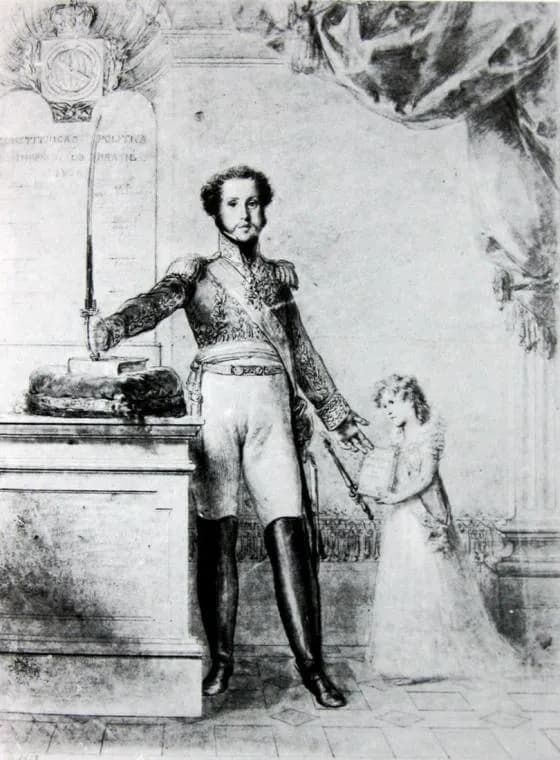
- Domingos Sequeira's allegory of the Constitutional Charter, drawn in 1826: Pedro, with a constitution tablet behind him, points to a small girl, presumably his daughter Maria da Glória, in whose favour he abdicated. Museu Nacional de Arte Antiga, Lisbon. Domingos Sequeira, Public domain, via Wikimedia Commons.
- General João Carlos de Saldanha, who forced the regency to swear the Charter in July 1826, in a drawing inscribed 1827 and sold at auction as the work of Domingos Sequeira. Private collection. Domingos Sequeira, Public domain, via Wikimedia Commons.
- The decree of 10 February 1842, issued at the Necessidades palace, declaring the Constitutional Charter of 1826 in force again and calling extraordinary Cortes. It is signed by the queen and countersigned by the Duke of Terceira and two other ministers. Reino de Portugal, Public domain, via Wikimedia Commons.
- The new hall of the Chamber of Peers at the São Bento palace in Lisbon, engraved by Caetano Alberto from a photograph by Francisco Rocchini, 1867. Caetano Alberto da Silva, Public domain, via Wikimedia Commons.
- The column of Pedro IV in the Rossio, with the Teatro Nacional D. Maria II behind it, in a small albumen print by the Lisbon photographer Francisco Rocchini, taken between the monument's inauguration in 1870 and about 1890. Rijksmuseum, CC0, via Wikimedia Commons.