

Magalhães killed at Mactan: 27 April 1521
A Portuguese captain in Spain's service waded ashore on a small Philippine island to make its chiefs submit to a newly baptised ally. He died in the shallows, and the island's chief became a Philippine national hero.
At a glance
- Fernão de Magalhães (Ferdinand Magellan), the Portuguese commander of a Spanish fleet, was killed on the island of Mactan, in the central Philippines, on Saturday 27 April 1521.
- He attacked Mactan to make its chiefs obey Humabon, the ruler of neighbouring Cebu, who had been baptised a Christian on 14 April, and the king of Spain.
- Antonio Pigafetta, who was there, says 49 men waded ashore against more than 1,500 defenders. Other accounts give 40 men against up to 4,000, and between six and eleven dead besides Magalhães.
- The people of Mactan refused to give up his body. On 1 May Humabon's men killed more of the visitors at a feast in Cebu; only the Victoria, under Juan Sebastián Elcano, got back to Spain, in September 1522.
- The Philippines honours the Mactan chief Lapulapu as the victor: 27 April has been Lapu-Lapu Day by law since 2018, and the traditional battle site is a national shrine in Lapu-Lapu City.
Before dawn off Mactan
Three hours before dawn on Saturday 27 April 1521, three ships' boats lay off the island of Mactan, in the central Philippines. In them were sixty men in corselets and helmets. Behind them, in twenty or thirty boats of his own, waited Humabon, the ruler of Cebu across the channel, who had been baptised a Christian thirteen days before.
Their commander was Fernão de Magalhães, a Portuguese nobleman sailing for the king of Castile, known in English as Ferdinand Magellan. He sent a message ashore by a Muslim trader from Siam who had been baptised in Cebu: if the people of Mactan obeyed the king of Spain, accepted Humabon as their lord and paid tribute, he would be their friend. If not, they would see how his lances wounded. The answer came back that they had lances too, of bamboo, and stakes hardened in fire.
When it was light, forty-nine men climbed out of the boats. Rocks kept the boats from coming closer, so they waded more than two crossbow shots through water up to their thighs, while eleven stayed behind on guard. Antonio Pigafetta, an Italian gentleman who kept a journal of the voyage, put the islanders waiting on the beach at more than 1,500, drawn up in three groups.
By the end of the morning Magalhães was dead in the shallows, and the people of Mactan would not give up his body.
- Date
- Saturday 27 April 1521 (28 April in one copy of the Genoese pilot's log)
- Place
- Mactan, the island opposite Cebu in the central Philippines; today Lapu-Lapu City
- Attackers
- Magalhães with about 60 men, 49 of whom landed; Humabon of Cebu and his warriors watched from their boats
- Defenders
- The men of Mactan under the chief Pigafetta called Cilapulapu, known today as Lapulapu
- Dead
- Magalhães and 6 to 11 of his men, depending on the account; Pigafetta counted 15 islanders killed
- Eyewitness
- Antonio Pigafetta, wounded in the face by an arrow
A Portuguese captain in Castile's service
Magalhães was born around 1480 in the north of Portugal, perhaps in Porto, and spent eight years fighting for Portugal in the East, including Afonso de Albuquerque's capture of Malacca in 1511. After King Manuel I turned down his petitions for advancement, he renounced his allegiance and reached Seville on 20 October 1517. Lisboeta's article on the strait that bears his name tells the story of that break and of the voyage to the bottom of South America.
Charles I of Spain backed his plan to reach the Moluccas, the clove islands of what is now eastern Indonesia, by sailing west. Five ships left Sanlúcar de Barrameda on 20 September 1519. Three came out of the strait into the Pacific in late November 1520, and on 6 March 1521, after a crossing of more than three months without fresh food, they reached the Marianas.
On 16 March they sighted Samar, in the islands later named the Philippines. At an island Pigafetta calls Mazaua, usually identified with Limasawa, the fleet's priest said Mass on Easter Sunday, 31 March, and Magalhães had a cross set up on the highest hill so that later ships would know they had been there.
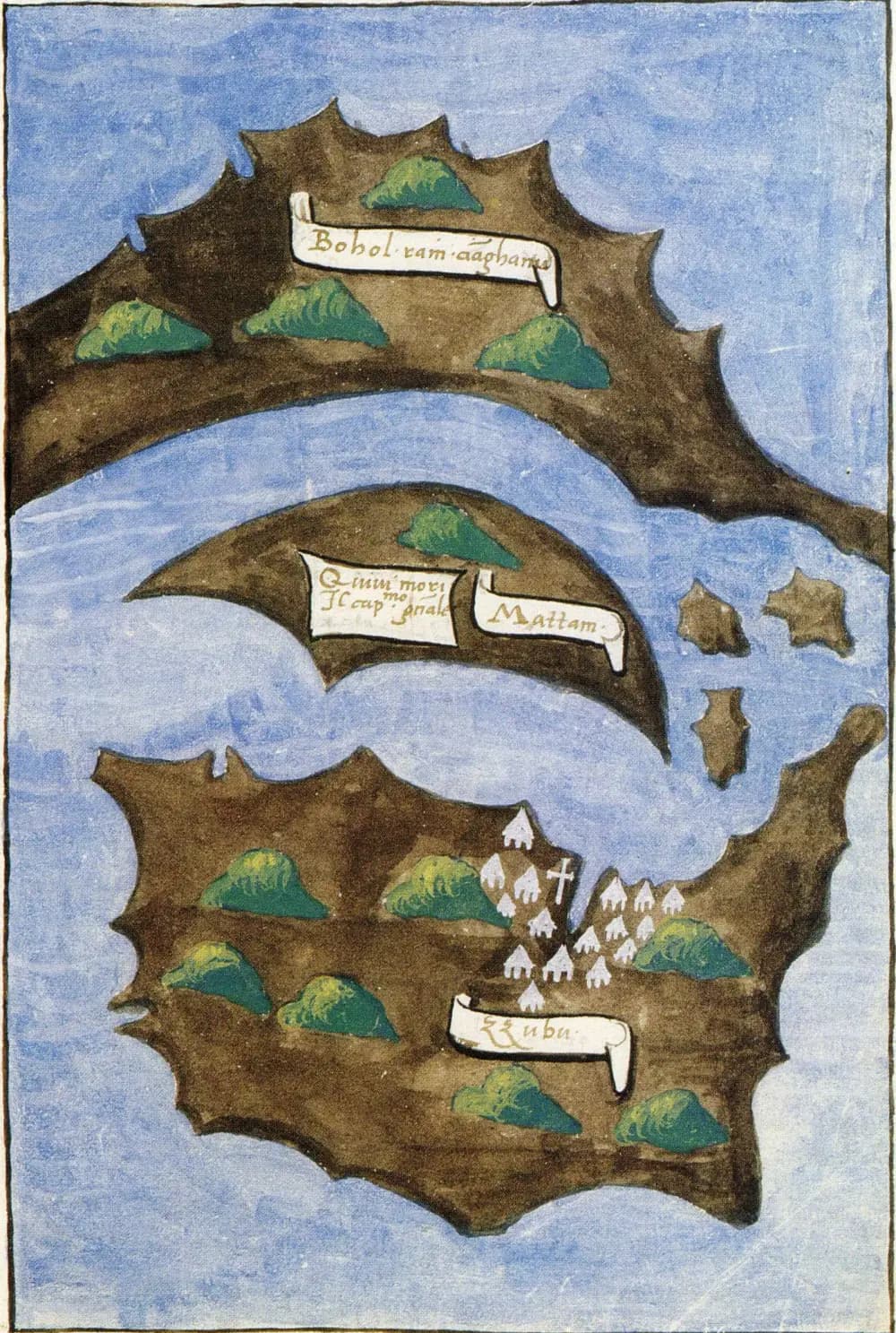
The ruler of Mazaua guided them on to Cebu, a large and well-supplied island. They entered it at noon on Sunday 7 April with flags flying and every gun firing, which terrified the town. Humabon's first answer was that ships entering his port paid tribute: a junk from Siam had paid four days earlier.
A Muslim merchant from Siam who was trading in the town told Humabon to be careful. These, he said, were the men who had conquered Calicut, Malacca and all of India. The Castilians had done no such thing, but their captain had fought at Malacca for Portugal ten years before. The interpreter replied that his master's king was more powerful than the king of Portugal, and that Humabon could have peace or war.
Baptisms, tribute and a burned village
Humabon chose peace. He asked for a drop of blood from Magalhães's right arm as a sign of friendship and offered his own. On Sunday 14 April he was baptised Carlos, after the emperor, on a platform hung with palm branches in the town square. Pigafetta counted 800 baptisms that day; Maximilianus Transylvanus, a student at Valladolid who wrote up the survivors' stories in 1522, put the total at more than 2,200.
The new faith came with conditions. Magalhães told the chiefs who would not obey Humabon that he would have them killed and give their goods to the king, and promised Humabon he would come back from Spain with forces enough to make him the greatest king in those islands.
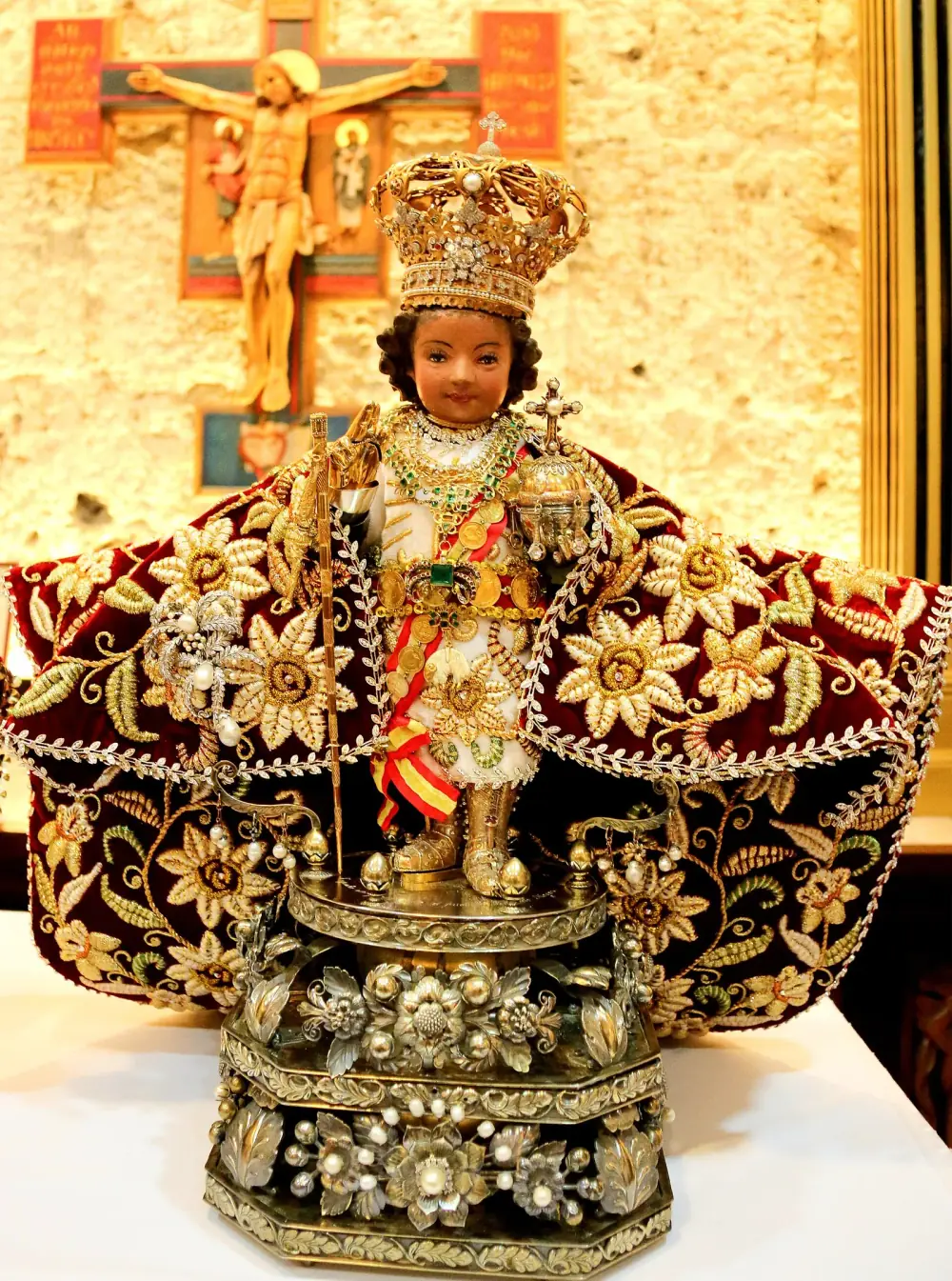
That afternoon the queen was baptised Johanna, after the emperor's mother. Shown an image of the Virgin, a wooden figure of the Child Jesus and a cross, she asked to keep the child in place of her idols. In 1565 a soldier of Miguel López de Legazpi's Spanish expedition found a carved Child Jesus in Cebu, and it was taken to be the same figure.
Not every chief came over. Before the week was out the visitors burned a village called Bulaia on Mactan, the smaller island that sheltered their anchorage, “because it refused to obey the king or us”, in Pigafetta's words. Mactan had two chiefs, Zula and the man Pigafetta calls Cilapulapu, known in the Philippines today as Lapulapu.
The accounts give different reasons for what came next. The log of a Genoese pilot in the fleet says Magalhães ordered a village on Mactan to send three goats, three pigs, three loads of rice and three of millet, and was offered two of each. Transylvanus says the king of Mactan was stronger than the other chiefs and would not do homage to Humabon, whom he had long been used to command. Ginés de Mafra, a sailor in the fleet, adds that the two rulers were brothers-in-law.
On Friday 26 April Zula sent one of his sons with two goats and a request. He could not deliver all he had promised, he said, because Cilapulapu refused to obey the king of Spain; if Magalhães sent one boatload of men the next night, they could fight him together. Magalhães decided to go with three.
The fight in the shallows
His men begged him not to go. The royal instructions for the voyage told him to avoid putting himself in danger, and Humabon offered warriors of his own. Magalhães told Humabon to stay in his boat and watch. In Mafra's account he turned down the offer of help in so many words.
“He wanted him to see how the lions of Spain fought.”
The landing went wrong from the start. Pigafetta says the islanders had dug pits between their houses and had asked the visitors to wait until morning so that more men could gather. The guns in the boats were too far off to help. For half an hour the musketeers and crossbowmen fired from long range; the shots went through the thin wooden shields without stopping anyone, and Magalhães shouted to them to cease firing.
He sent men to burn the houses, hoping to frighten the defenders. Twenty or thirty houses went up, two of his men were killed beside them, and the attack grew fiercer. A poisoned arrow struck Magalhães in the right leg. He ordered a slow retreat, but most of his men ran for the boats, leaving six or eight with him.
The islanders aimed at the visitors' bare legs and twice knocked the helmet from Magalhães's head. For more than an hour the small group fought knee-deep in the water. He killed one man with his lance, but a bamboo spear in the arm stopped him drawing his sword, and a cutlass blow to his left leg brought him down face first. The defenders closed in with iron and bamboo spears.
Friday 26 April
Zula asks for help
His son brings two goats and asks for men to fight Cilapulapu.
Midnight
The boats leave Cebu
Sixty armed men in three boats, with Humabon and twenty or thirty boats of his people.
Three hours before dawn
Off Mactan
Magalhães sends his terms ashore by a baptised trader and waits for daylight.
Morning, Saturday 27 April
The landing
Forty-nine men wade ashore; more than 1,500 defenders wait in three groups.
About half an hour
Firing to no effect
Muskets and crossbows shoot from too far away; houses are set alight.
More than an hour
Retreat and death
Wounded in the leg, Magalhães covers the retreat in the water and is killed.
Afternoon
No ransom
Humabon offers goods for the bodies; Mactan refuses.
Wednesday 1 May
The feast in Cebu
Humabon's men kill the visitors who come ashore to dine.
Pigafetta says eight of his men died with him, and four Christian islanders who had come to help were killed by the guns in the boats. Fifteen of Mactan's defenders were killed. That afternoon Humabon, with the visitors' consent, offered the people of Mactan as much merchandise as they wanted for the bodies.
“They would not give him for all the riches in the world, but … they intended to keep him as a memorial.”
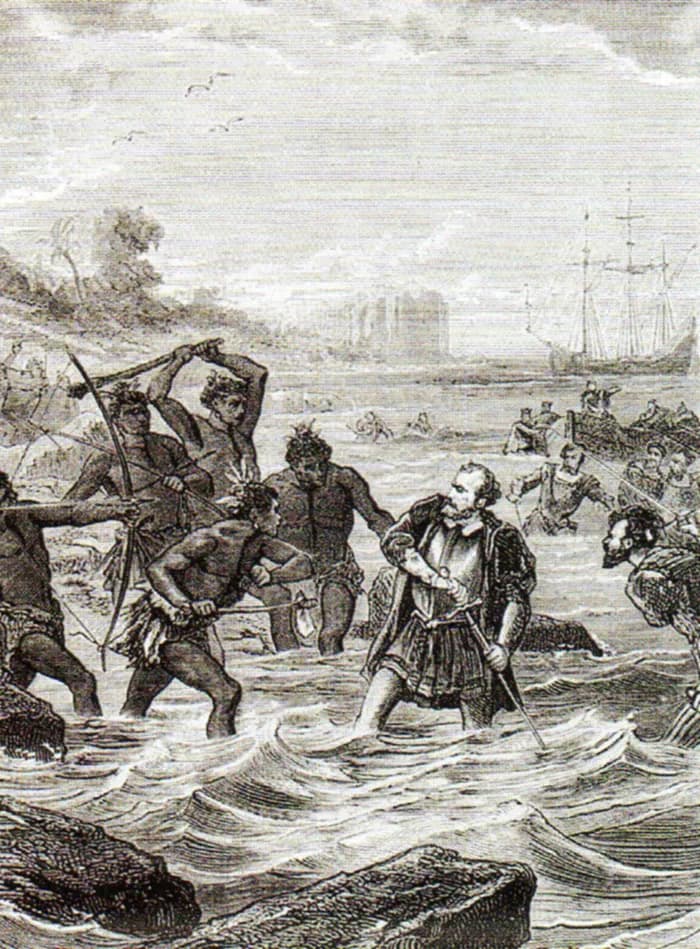
Pigafetta, wounded in the face by a poisoned arrow, wrote a eulogy into his account of the battle. No man in the world, he wrote, understood sea charts and navigation better, and Magalhães had almost sailed round the world.
Six accounts of one morning
Pigafetta's is the fullest account, and he wrote it as an admirer of his commander. Of the twenty-five early accounts of the voyage that survive, eleven were written by men who sailed on it. The rest were written by people who were not there. They agree on the outcome and differ on most of the details.
| Account | Who and when | Magalhães's force | Mactan's force | Killed with him |
|---|---|---|---|---|
| Antonio Pigafetta | Fought at Mactan; journal printed in Paris around 1525 | 60 set out, 49 landed | More than 1,500, in three groups | 8, plus 4 Christian islanders |
| Genoese pilot | Anonymous pilot in the fleet; log of the voyage | 50 or 60 men in three boats | 3,000 or 4,000 | 6 |
| Maximilianus Transylvanus | Wrote in October 1522 from survivors' testimony | 40 picked men | About 3,000 | 7 |
| António de Brito | Portuguese captain of Ternate, in the Moluccas; letter of 1523, drawing on the Trinidad's captured crew | Not given | Not given | His servant and 5 Castilians |
| Ginés de Mafra | Sailor in the fleet; account copied around 1542 | 40 men in two boats, 34 landed | About 50 at first, then a party in ambush | 11 (12 dead including Magalhães) |
| Gaspar Correa | Portuguese chronicler in India, Lendas da Índia | Not given | Not given | Says Magalhães won and was killed later, at the feast in Cebu |
Brito and the Genoese pilot are quoted from Robertson's notes to Pigafetta and from Stanley's edition. The list of the dead published by the Spanish historian Martín Fernández de Navarrete names seven men killed at Mactan, one of whom died of his wounds on 29 April.
Men of the fleet killed with Magalhães at Mactan, by account
men
Men killed besides Magalhães himself. Genoese pilot: “with six of his men”. Brito: “he, his servant, and five Castilians”. Transylvanus: “seven of their comrades”. Navarrete's list: the seven names he published. Pigafetta: “eight of our men”. Mafra: twelve dead left ashore, Magalhães among them.
Show the data
| Killed | |
|---|---|
| Genoese pilot | 6 |
| Brito, 1523 | 6 |
| Transylvanus, 1522 | 7 |
| Navarrete's list | 7 |
| Pigafetta | 8 |
| Mafra | 11 |
Mafra tells a different battle. In his version Magalhães landed with 34 men, found a large village among palm trees with nobody in sight, and ordered a house burned. About fifty men burst out of it with cutlasses and shields, a second party came at the landing party's backs from a side street, and Magalhães, wounded in the face and legs, bled until he fell. Only then did Humabon's men charge and help carry the wounded to the boats.
Even the date varies. Pigafetta gives Saturday 27 April and says Magalhães chose a Saturday because it was a day especially holy to him. One copy of the Genoese pilot's log gives 28 April and another 27 April; the Lisbon Academy's editors noted that 27 April 1521 was indeed a Saturday. A wooden tablet a parish priest set up on Mactan in 1843 gave 26 April. It stood beside a cross until a stone monument was raised on the site later in the century.
Some witnesses left the battle out. The log of the pilot Francisco Albo records only that the fleet stayed many days at Cebu, and that the king and queen, with many people, “became Christians of their free will”.
The chief Pigafetta called Cilapulapu
Almost nothing is known about the man the Philippines honours as the victor of Mactan. Pigafetta names Cilapulapu twice, as one of the island's two chiefs and as the one who refused to obey the king of Spain. No account describes him or says what became of him.
The gap has been filled with competing stories. At the 500th anniversary in Lapu-Lapu City on 27 April 2021, Senator Christopher “Bong” Go said Lapulapu had been a Tausug warrior from Sulu, in the far south of the country, a claim President Rodrigo Duterte had made in speeches since 2017. Go apologised after historians objected.
The National Historical Commission of the Philippines (NHCP), which the law charges with resolving historical controversies, said on 30 April 2021 that Lapulapu's origins, his ethnicity included, are unknown. Everything known about him, it said, comes from survivors of the expedition such as Pigafetta. The archaeologist Jose Eleazar Bersales, director of the University of San Carlos Museum in Cebu, said the records show that Lapulapu was chief of Mactan.
“[The NHCP] considers all popular accounts and stories outside of these historical sources as speculative and folkloric and should not be regarded as established facts of history.”
What the battle means is argued over too. Writing in the journal südostasien in 2021, Luis Zuriel P. Domingo noted that some historians call Mactan the first Philippine revolt against colonial rule, although the word Filipino came into use only in the late nineteenth century. For Catholics, he wrote, Magalhães's arrival laid the foundations of Christianity in the islands; for others it began centuries of colonisation.
After Mactan
The alliance with Cebu lasted four more days. On 1 May Humabon invited the two men the crews had chosen to replace Magalhães, Duarte Barbosa and João Serrão, to a feast. Pigafetta says twenty-four men went ashore. Two turned back, suspecting a trap. Soon afterwards Serrão was brought to the beach bound and wounded, shouting that all the others were dead except the interpreter, and the ships sailed without him.
Pigafetta and Transylvanus both blame Enrique, the interpreter Magalhães had held as a slave since buying him in Malacca, as Transylvanus tells it. After the battle one of the new commanders told Enrique that his master's death had not freed him, and he went to Humabon. Transylvanus and the Genoese pilot put the party that went ashore at twenty-eight, and Brito at thirty-five or thirty-six.
With too few men to sail three ships, the survivors burned the Concepción and reached Tidore, in the Moluccas, on 8 November 1521. The Victoria, under the Basque Juan Sebastián Elcano, sailed home round Africa and reached Sanlúcar on 6 September 1522 with eighteen men, the first ship to sail round the world.
Spain came back. The voyage opened the way for Spanish colonisation of the Philippines, and Legazpi's expedition was in Cebu by 1565. From 1571 Manila was the seat of power in the islands.
In Portugal his memory stayed double-edged. Luís de Camões, in Os Lusíadas, the national epic printed in 1572, included him in the passage where a goddess shows Vasco da Gama the future deeds of the Portuguese: a Lusitanian “aggrieved with his king” who would open a way no one had imagined. Then he drew the line plainly.
“Magalhães, in the deed truly Portuguese, but not in loyalty.”
Why it still matters
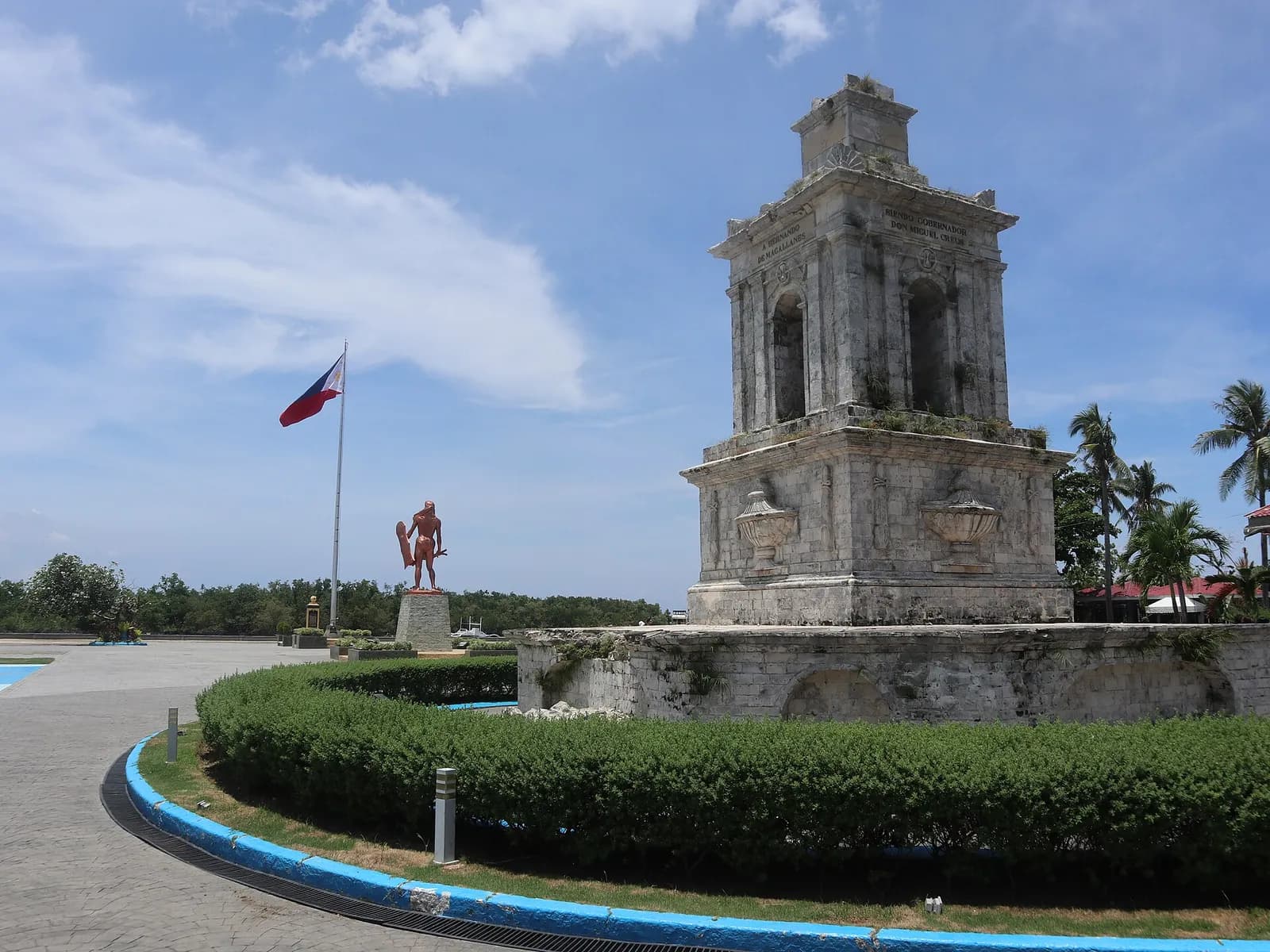
In the Philippines, 27 April is a public occasion. A 1961 law turned the town of Opon, on Mactan, into the City of Lapu-Lapu. In 1969 Congress made the site of the old Magellan Monument, “the approximate place” of the battle, a national shrine called the Liberty Shrine, and ordered a monument to Lapulapu built beside it.
Under a law of 2018, 27 April is Lapu-Lapu Day, a special working holiday across the country and a day off in Lapu-Lapu City, “to commemorate the victory of Lapu-Lapu and his men over the Spaniards”. The same year the government set up a National Quincentennial Committee for the 500th anniversary in 2021, with the NHCP as its vice-chair and secretariat. An order of 2020 set out its view: it was to stress both the humanity of the islanders who helped the starving crew after the Pacific crossing and the courage of the warriors at Mactan.
“The Committee espouses a Filipino-centric point of view of the first circumnavigation of the world.”
Lapu-Lapu City marks the day with a wreath-laying and a re-enactment of the battle at the shrine, which the city believes is the site of the fighting. At the 505th commemoration, on 27 April 2026, the police estimated the crowd at 2,500, and the mayor, Cynthia King-Chan, told it that Lapulapu had united his people against a common enemy.
Portugal and Spain now present the voyage as shared heritage. In 2023 UNESCO added fifteen manuscripts about the first circumnavigation to its Memory of the World register, on a nomination by the two governments. Some of them are in the Torre do Tombo, Portugal's national archive.
FAQs
Who killed Ferdinand Magellan?
The warriors of Mactan, an island off Cebu in the Philippines, on 27 April 1521. They followed the chief Pigafetta called Cilapulapu, honoured today as Lapulapu. No early account says who struck the fatal blow: Pigafetta describes many attackers with spears and cutlasses closing on Magalhães after he fell.
Why did Magellan attack Mactan?
To force its chiefs to obey Humabon, the newly baptised ruler of Cebu, and the king of Spain, and to pay tribute. One Mactan chief, Zula, had asked for help against his rival. The Genoese pilot's log adds that Mactan had offered only two of every three goats, pigs and loads of rice and millet that Magalhães demanded.
Where exactly did Magellan die, and can you visit?
On the shore of Mactan, now Lapu-Lapu City in Cebu province. A 1969 law made the site of the old Magellan Monument, the approximate place of the battle, a national shrine. The Mactan Shrine there holds that monument and a statue of Lapulapu, and the city stages a re-enactment of the battle on 27 April.
Was Lapulapu a Muslim or a Tausug?
There is no evidence either way. In April 2021 the National Historical Commission of the Philippines said his origins, including his ethnicity, are unknown, because everything known about him comes from survivors of the expedition such as Pigafetta, and it treats other stories as folklore.
On the timeline
Open the timelineNearby moments from the age of discoveries (1415–1580).
Fernão de Magalhães's three remaining ships emerge from the strait that now bears his name into the ocean he called the 'Mar Pacífico', after weeks threading the channel at the southern tip of South America.
Portuguese navigator Ferdinand Magellan (Fernão de Magalhães), sailing in the service of Spain, reaches the island of Guam in the Mariana Islands after a gruelling crossing of the Pacific Ocean.
Portuguese navigator Ferdinand Magellan sights the island of Samar in the Philippines, becoming the first European to reach the Philippine archipelago during his circumnavigation voyage.
Magalhães's death at Mactan
Death of Ferdinand Magellan (Fernão de Magalhães), the Portuguese navigator sailing in Spain's service, at the Battle of Mactan in the Philippines, killed while leading an assault on the local chief Lapu-Lapu. One of his ships, the 'Victoria', under Juan Sebastián Elcano, went on to complete the first circumnavigation of the globe.
The Trinidad and the Victoria, the surviving ships of the Spanish expedition led by the Portuguese navigator Fernão de Magalhães until his death in the Philippines, drop anchor at Tidore in the Moluccas — the Spice Islands that had been the voyage's goal, where Portuguese traders were already active.
Death of King Manuel I, 'o Venturoso' (the Fortunate), in Lisbon, aged 52. His 26-year reign saw Vasco da Gama reach India and Cabral land in Brazil, and a share of the trade with Africa and the East, above all in spices, paid for the Jerónimos Monastery, a showpiece of the exuberant Manueline style. He is buried there.
The Victoria, sole surviving ship of the expedition led by the Portuguese navigator Fernão de Magalhães (Ferdinand Magellan), reaches Sanlúcar de Barrameda in Spain, completing the first circumnavigation of the globe three years after setting out.
Coming up in history
All long reads 29 April 1826The Constitutional Charter of 1826: Portugal's constitution made in Rio
 30 April 1824The Abrilada: how Prince Miguel held his father captive in April 1824
 1 May 1865Santa Apolónia station opens on the Lisbon waterfront: 1 May 1865
 2 May 1962Benfica 5, Real Madrid 3: the night Eusébio won Amsterdam
19 sources
Archives, scholarship and reporting this article was checked against.
- 1
Antonio Pigafetta, Primo viaggio intorno al mondo, part 1 (Italian text with English translation by James Alexander Robertson), in The Philippine Islands, 1493–1898, vol. XXXIIIArthur H. Clark, Cleveland, 1906; Project Gutenberg edition
- 2
- 3
Lord Stanley of Alderley (trans. and ed.), The First Voyage Round the World by Magellan, translated from the accounts of Pigafetta and other contemporary writersHakluyt Society, London, 1874; Internet Archive
- 4
- 5
VERA Files Fact Check: Even after NHCP clarification that Lapulapu’s origin remains unknown, Duterte insists the hero is a Tausug warrior (14 May 2021)VERA Files, Quezon City
- 6
Republic Act No. 5695: establishing a national shrine in the City of Lapu-Lapu, to be known as the Liberty Shrine (approved 21 June 1969)Congress of the Philippines; text from the Lawphil Project, Arellano Law Foundation
- 7
- 8
O conjunto escultóricoPadrão dos Descobrimentos, EGEAC, Lisbon
- 9
José Manuel Garcia, “Documentos existentes em Portugal sobre Fernão de Magalhães e as suas viagens”, Abriu 8 (2019), 15–33Universitat de Barcelona
- 10
- 11
Luis Zuriel P. Domingo, “Duterte und seine Geschichtspolitik”, südostasien 3/2021 (2 August 2021)südostasien, Stiftung Asienhaus, Cologne
- 12
- 13
- 14
- 15
- 16
- 17
Denise Mae P. Codis, “‘Kadaugan sa Mactan’ celebrates 505th year” (27 April 2026)SunStar Cebu
- 18
UNESCO recognizes manuscripts First Voyage around the Globe and Hikayat Aceh as World Heritage (18 May 2023)Leiden University
- 19
A viagem de circum-navegação de Fernão de Magalhães (virtual exhibition)Arquivo Nacional Torre do Tombo
Image credits
- The Mactan Shrine in Lapu-Lapu City, Philippines, in 2022: the stone monument to Magalhães raised under Spanish rule in the nineteenth century, with the statue of Lapulapu and the Philippine flag beyond it. Patrickroque01, CC BY-SA 4.0, via Wikimedia Commons.
- Pigafetta's chart of Cebu (Zubu, with its houses and a cross), Mactan (Mattam) and Bohol, from a sixteenth-century manuscript of his account. The label beside Mattam reads, in Italian, “here died the captain-general”. unknown, about the year 1530, Public domain, via Wikimedia Commons.
- The Santo Niño de Cebú, the figure of the Child Jesus that Cebu's Catholics hold to be the one given to Humabon's queen in 1521, photographed in 2014. Cofradiabsn, CC BY 4.0, via Wikimedia Commons.
- The death of Magalhães as a nineteenth-century illustrator imagined it, about 1860. Unknown author, Public domain, via Wikimedia Commons.