

Portugal's Law of Separation: how the Republic broke with the Church in 1911
Six months after the revolution, the Provisional Government ended Catholicism's status as the state religion, took over church property and tried to put lay committees in charge of worship. The fight it started lasted three decades.
At a glance
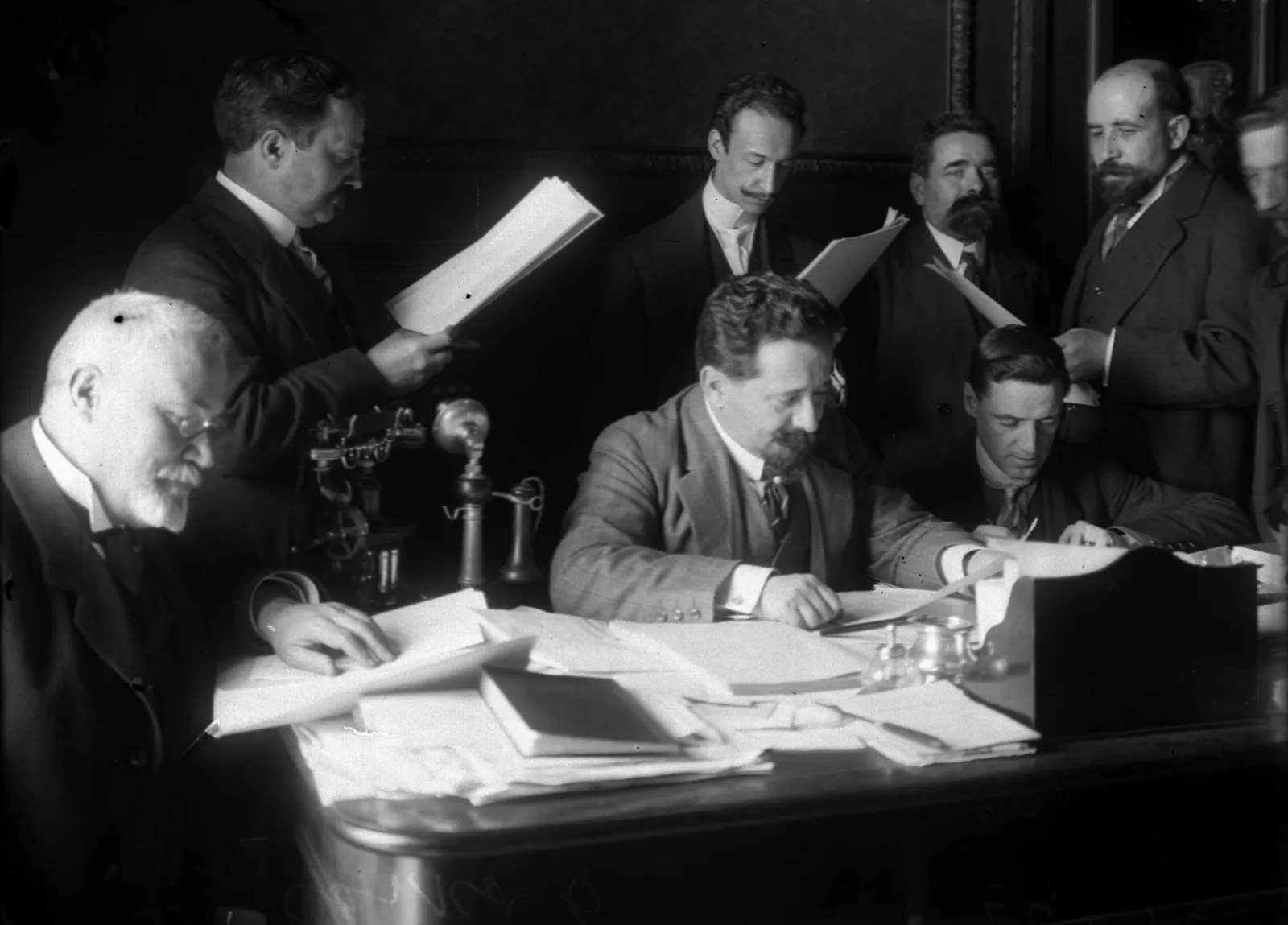
- The Law of Separation of the State from the Churches was decreed on 20 April 1911 by Portugal's Provisional Government and published in the Diário do Governo the next day. Its author was the Minister of Justice, Afonso Costa.
- Its 196 articles ended Catholicism's status as the state religion, stopped all public funding of worship from 1 July 1911 and declared church buildings and property to belong to the state and local councils.
- Worship was to be run by lay associations from which priests were barred. Priests were offered state pensions, processions and cassocks in the street were restricted, and church documents needed government approval.
- Pope Pius X condemned the law in the encyclical Iamdudum of 24 May 1911. Bishops who resisted were banished from their dioceses, and relations with the Holy See were broken in 1913.
- Sidónio Pais's government softened the law by a decree of 22 February 1918. The Concordat of 7 May 1940 recognised the Church's legal personality and returned much of its property, but Portugal never restored a state religion.
Issue 92 of the Diário do Governo
On Friday 21 April 1911, readers of the Diário do Governo, the official gazette of the six-month-old Portuguese Republic, found a long decree starting on page 1619. Earlier in the issue, the Ministry of the Interior divided the country into constituencies for the coming election of a Constituent Assembly. Then came the Ministry of Justice, under the heading “Law of separation of the State from the churches”.
Article 1 guaranteed full freedom of conscience to every citizen and to foreigners living in Portugal. Article 2 ended the status that the constitutions of the monarchy, from 1822 on, had given the Catholic Church.
“From the publication of this decree with force of law, the Roman Catholic Apostolic religion ceases to be the religion of the State, and all churches or religious confessions are equally authorised, as legitimate private associations, provided they do not offend public morals or the principles of Portuguese political law.”
The text ran to 196 articles over six pages. It was dated “in the Palace of the Republic, 20 April 1911” and signed by the eight members of the Provisional Government: Teófilo Braga, António José de Almeida, Afonso Costa, José Relvas, António Xavier Correia Barreto, Amaro de Azevedo Gomes, Bernardino Machado and Manuel de Brito Camacho. Article 195 said the decree would be put to the Constituent Assembly.
The very next decree in the same issue showed the law's spirit. Signed by Afonso Costa and Brito Camacho, it moved the industrial school of Covilhã into the former residence of the Jesuits, and gave the school's old building to a textile workers' association. The Jesuits had been expelled six months earlier.
A Catholic country and a hurried republic
Under the monarchy's Constitutional Charter of 1826, Catholicism was the religion of the kingdom. In the census of 1900, 99.8 per cent of the population declared themselves Catholic. Priests also did the state's paperwork: until February 1911 it was the parish clergy who recorded births through baptism, married couples and buried the dead.
Portuguese republicans wanted that world gone. They argued for a state neutral in religion, for compulsory civil registration and for schools free of the Church, and saw the clergy as allies of the monarchy. By 1909 anticlericalism had a mass following in Lisbon, shown by a large demonstration on 2 August.
When the Republic was proclaimed on 5 October 1910, the Provisional Government governed by decree, without a parliament. Afonso Costa, its Minister of Justice and Worship, set the pace on religion, and the separation law is credited to him.
8 October 1910
Jesuits and religious orders expelled
Old laws against the Jesuits and the 1834 abolition of the religious orders are put back in force.
12 October 1910
Religious holidays abolished
They become working days.
18 October 1910
Religious oaths replaced
Civil formulas take their place.
22 October 1910
Christian doctrine dropped
No more catechism in primary and teacher-training schools.
3 November 1910
Divorce made legal
25 December 1910
Civil marriage only
A church wedding no longer has legal effect.
18 February 1911
Compulsory civil registration
Birth, marriage and death must be registered with the state before any religious act.
The historian Fernando Catroga noted that French republicans took almost 25 years to pass measures their Portuguese counterparts decreed in about seven months. They did so in a country where about 70 per cent of people could not read and about four in five lived in the countryside.
What 196 articles said
The law was long by any standard, and it regulated almost everything, from the ringing of church bells to what priests could wear in the street. It drew on the French separation law of December 1905 and, in places, on the French Revolution's Civil Constitution of the Clergy of 1790.
| Chapter | Subject | Articles |
|---|---|---|
| I | Freedom of conscience and of worship | 1–15 |
| II | Bodies in charge of worship | 16–42 |
| III | State supervision of public worship | 43–61 |
| IV | Ownership of buildings and property, and charges on them | 62–88 |
| V | What happens to the buildings and property | 89–112 |
| VI | Pensions for Catholic clergy | 113–155 |
| VII | General and transitional provisions | 156–196 |
Chapter titles translated from the decree.
Money came first. From 1 July 1911 the state, local councils and public bodies stopped paying for any form of worship (article 4). Every cathedral, church and chapel, with the property used for worship and to support the clergy, was declared to belong to the state or to local councils, to be listed and inventoried parish by parish (articles 62 and 63). Churches still needed for worship would be lent free of charge, on a revocable basis (article 89). Churches built by the Jesuits could never again be used for worship (article 92).
Worship itself was handed to lay bodies. The faithful could pay for it collectively only through Portuguese charitable bodies, such as the misericórdias and lay brotherhoods, or new ones authorised by the Ministry of Justice (article 17), and priests could not sit on their boards (article 26). At least a third of what they received for worship had to go to charity (article 32). Any church they built in future would pass to the state, without compensation, after 99 years (article 30).
- Public worship
- No permission needed in the usual places of worship between sunrise and sunset (art. 43); any gathering of more than 20 people elsewhere counted as public worship (art. 9)
- Processions
- Allowed only where they were an “inveterate custom”, and banned wherever they led to disorder (art. 57)
- Bells and symbols
- Bell-ringing regulated by the municipality (art. 59); no religious emblems on public monuments or house fronts (art. 60)
- Dress
- Cassocks and religious habits banned outside churches and services from 1 July 1911 (art. 176)
- Church documents
- Bulls and pastoral letters could be published only if the government did not veto them within ten days (art. 181)
- Training
- Priests with degrees from pontifical universities could not minister in Portugal (art. 177)
The pension chapter was the most provocative. Priests serving cathedrals and parish churches when the Republic was proclaimed could receive a lifetime state pension, set by district commissions according to twelve criteria, from age to the size of the parish (article 113). A priest suspended by his bishop for marrying would keep it (article 150), and on his death a share would pass to his parents, widow or children, legitimate or not (article 152).
The historian Sérgio Ribeiro Pinto calls the result a “quasi-separation”: it separated the churches from the state but did not separate the state from the churches, because it set out to shape and control their internal life. Republicans called it “the Intangible”, a name coined by António França Borges, editor of the Lisbon daily O Mundo, for a law that could not be touched without betraying the Republic.
“The law is stupid, it dignifies the priest, and it will wound the religious feeling of the Portuguese people. Result: civil war. If they don't change it, we'll have one before long. The people hated the Jesuit; the people didn't care about the priest.”
The bishops and the Pope say no
The hierarchy was already at war with the government. Before the law appeared, the Bishops of Porto and Beja had been driven from their dioceses. Within five weeks of its publication the bishops had jointly rejected it, declaring, as the Pope summed up, that they would rather lose all their property than accept servitude “for the sake of paltry pensions”.
On 24 May 1911 Pius X answered with an encyclical, Iamdudum. It called the law a decree that bore the name of separation but in fact reduced the Church to poverty and servitude, and listed its grievances: confiscated property, lay committees running worship, the ban on cassocks and processions, state control of seminaries, and pensions for priests who married.
“We by our Apostolic authority denounce, condemn, and reject the Law for the Separation of Church and State in the Portuguese Republic. This law despises God and repudiates the Catholic faith.”
The bishops told their priests to refuse the pensions and to keep away from the lay associations. In the Algarve, Bishop António Barbosa Leão called the law “despoiling, oppressive, insulting” and one that could “almost be called extinctive of the Catholic religion in Portugal”. In a circular of 24 December 1911 he ruled that anyone who joined a worship association would be refused the sacraments and a church burial.
“We cannot accept the so-called law of separation because it is incompatible with our conscience; and we firmly renounce the pensions offered, because we prefer to live poor but with honour.”
The government replied with banishment. The Attorney General ruled that the bishop's circular had been printed without the state's approval, against article 181, and in January 1912 the Minister of Justice, António Caetano Macieira, barred him from his district for two years. He spent them in Lisbon, until January 1914.
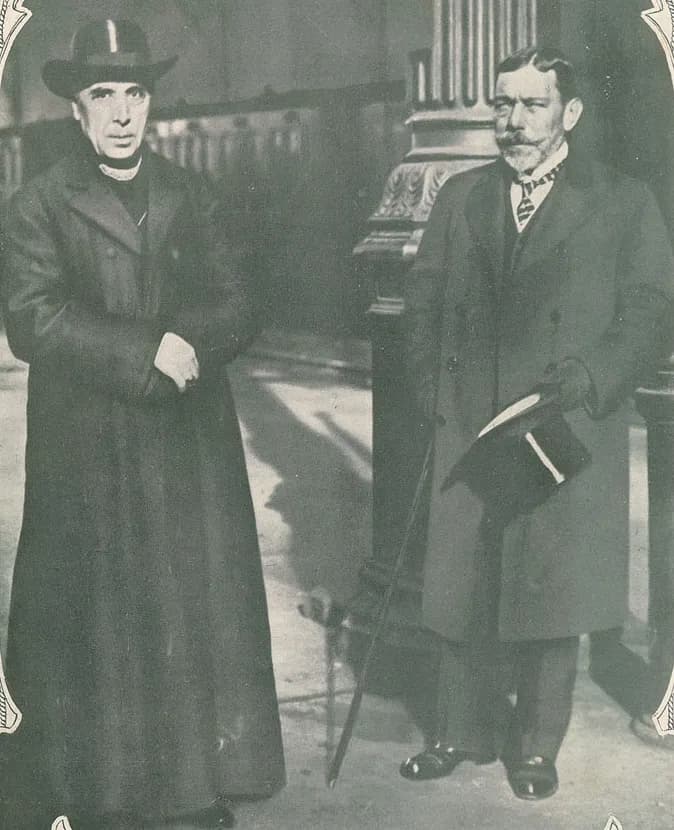
The Patriarch of Lisbon, António Mendes Belo, was expelled from Lisbon for two years for breaking the law, and lived in his home town of Gouveia; a biographical dictionary of the cardinals dates the exile to 1911 to 1913. On 27 November 1911 Pius X made him a cardinal in secret, in pectore, because the turmoil in Portugal made a public announcement unwise. It was published only in May 1914.
The Constituent Assembly approved the Republic's first constitution on 21 August 1911, with freedom of conscience, equality between faiths and neutral state schooling. In 1913 Portugal broke off diplomatic relations with the Vatican.
What happened in the parishes
The law expected each of Portugal's 3,814 parishes to hand its worship to a lay association, which would be lent the church. In practice Catholics stayed away. At the end of July 1911 there was one association with approved statutes in the whole country, at Alte in the Algarve, probably set up by its own parish priest, a pensioner who wrote for O Mundo. By 1918, by one count, 411 had been formed, about one parish in nine.
| District | Associations | Parishes | Share |
|---|---|---|---|
| Lisboa | 65 | 195 | 33.3% |
| Beja | 19 | 88 | 21.6% |
| Faro (Algarve) | 11 | 67 | 16.4% |
| Coimbra | 22 | 186 | 11.8% |
| Porto | 24 | 369 | 6.5% |
| Braga | 4 | 505 | 0.8% |
| Funchal, Ponta Delgada, Horta | 0 | 133 | 0% |
| Portugal | 241 | 3,814 | 6.3% |
Associations formed from July 1911 to June 1914, from the reports of the Central Commission for the Execution of the Law of Separation as compiled by Maria Lúcia de Brito Moura and republished by João Romero Chagas Aleixo. The national row is the sum of the district figures; Aleixo's table prints 411 there, the total his text gives for 1911 to 1918.
The pensions split the clergy along the country's religious map. Priests appointed to a parish for life received the pension unless they wrote to refuse it; others had to apply by 30 June 1911. Takers clustered in poor rural parishes. In the archdiocese of Évora, in the Alentejo, four in five eligible priests took it. In the archdiocese of Braga, in the north, where Catholicism was most deeply rooted, four did, out of 993.
Priests who took the state pension, by diocese
% of eligible priests
Évora 176 of 218, Beja 115 of 177, Algarve 10 of 76, Porto 17 of 458, Braga 4 of 993. Figures compiled by Aleixo from the Faro district pensions commission and the studies of José Cutileiro, Vítor Neto, Paulo Pires and Vasco Pulido Valente; national totals are not given.
Show the data
| Pensioned priests | |
|---|---|
| Évora | 80.6 |
| Beja | 65 |
| Algarve | 13.2 |
| Porto | 3.7 |
| Braga | 0.4 |
Bishops punished the pensioners. All ten in the Algarve were suspended at once, and two were later excommunicated. Priests were also prosecuted for wearing cassocks in public: in Loulé one was fined ten days at 500 réis a day.
Processions were the flashpoint, because the law allowed them only where they caused no trouble. Radicals learned to provoke trouble by watching with their hats on, and the faithful hit back. On Maundy Thursday, 4 April 1912, a clash at the torchlight procession in Chamusca, on the Tagus, left one dead and several wounded. Faro's Good Friday procession was banned from 1911 to 1914, and the Easter procession in Lagos from 1911 until 1940.
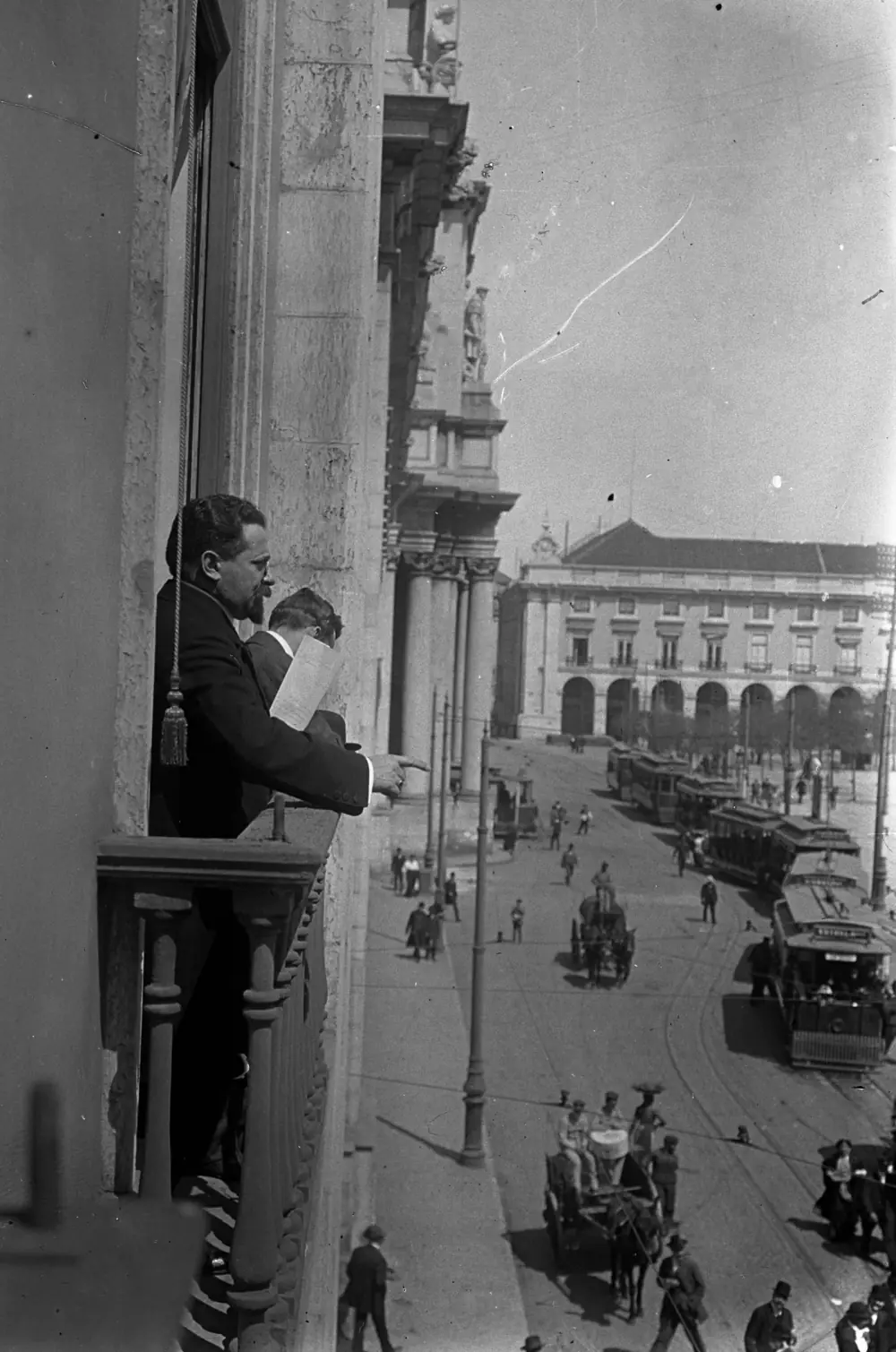
Parliament debated revising the law in March 1914, prompted by the programme of Bernardino Machado's government. Afonso Costa opened the debate by accusing opponents of inventing “a law of intolerance and persecution” in order to attack it. The republican deputy Rodrigo Fontinha replied that some of its articles set out “to vex the Catholic Church and its faithful”. The debate dragged on into the following months, but the law stayed as it was until 1918.
Sidónio Pais softens the law
The change came with a coup. Sidónio Pais seized power in Lisbon in December 1917, and on 10 December a decree cancelled every penalty imposed on bishops for breaking the separation law. In January 1918 the commission that enforced it was reorganised and its members replaced.
Decree 3,856 of 22 February 1918, published the next day and known after the Minister of Justice as the Moura Pinto law, rewrote the core. Priests could now sit on the boards of the bodies that ran worship, which only had to notify the authorities of their members. Worship in suitable places needed no permission and had no time limit. Church documents no longer needed state approval, and the charity share fell to ten per cent. The cassock ban and the pensions for priests' widows and children went.
“Power must allow and ensure respect for the religious activity of its citizens, limiting itself to regulating it, as it is, and never seeking to modify or adapt it.”
On 15 May 1918 Sidónio became the first republican head of state to attend Mass, and on 10 July Portugal restored diplomatic relations with the Holy See. The bishops never publicly accepted the decree: in December 1918 the Patriarch wrote to the president asking for the return of everything the state had taken in 1911.
The Moura Pinto law outlived Sidónio, who was murdered in December 1918. An informal truce followed: in May 1919 the Holy See promised in writing not to appoint bishops the government objected to for political reasons. In June 1924 the Minister of Justice, José Domingues dos Santos, proposed restoring the 1911 law in full, but religion stayed a live issue in parliament until the military coup of 28 May 1926 ended the Republic.
The Concordat of 1940
The dictatorship that followed, shaped by António de Oliveira Salazar into the Estado Novo (New State), was friendly to the Church but did not undo the separation. Its constitution of 1933 guaranteed freedom of worship for all religions (article 45) and said the state “maintains the regime of separation” from the Catholic Church and any other religion (article 46).
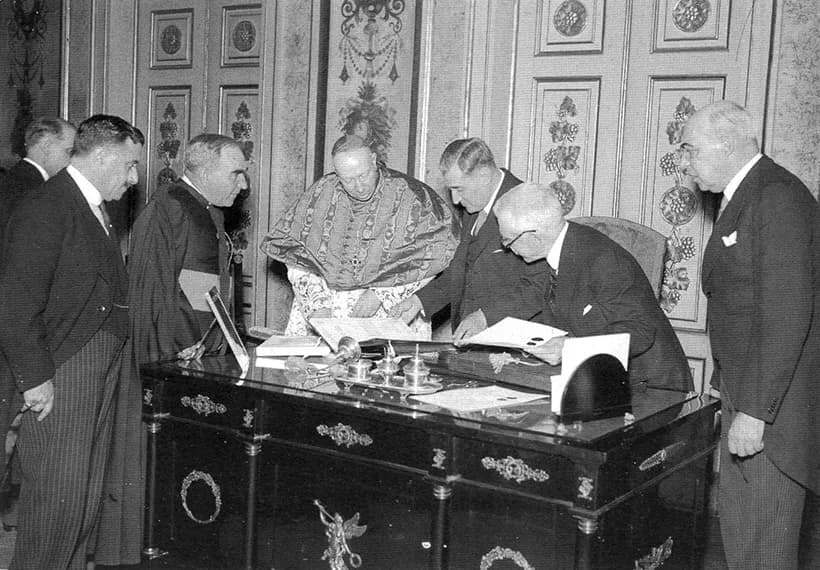
On 7 May 1940 Portugal and the Holy See signed a Concordat in Vatican City, with a separate Missionary Agreement for the colonies. Article I recognised the legal personality of the Catholic Church and provided for a nuncio in Lisbon and an ambassador at the Vatican. Article II let the Church publish its documents without state approval.
Article VI dealt with what 1911 had taken. The Church regained ownership of churches, bishops' palaces, parish houses, seminaries and objects of worship still held by the state, except those in public use or classified as national monuments or buildings of public interest. Those stayed state property, permanently assigned to the Church and maintained by the state.
The Concordat also reached into private life. Under article XXIV, couples married in church gave up the right to a civil divorce, a rule that lasted until 1975 and is told in the story of the 1910 divorce law.
20 April 1911
Law of Separation decreed
Published in the Diário do Governo on 21 April.
24 May 1911
Pius X condemns it
Encyclical Iamdudum.
1 July 1911
Public funding of worship ends
21 August 1911
First republican constitution
January 1912
Bishop of the Algarve banished for two years
1913
Relations with the Vatican broken
22 February 1918
Moura Pinto decree softens the law
10 July 1918
Relations with the Holy See restored
28 May 1926
Military coup ends the First Republic
1933
New constitution keeps the separation
7 May 1940
Concordat and Missionary Agreement signed
Why it still matters
The memory lasted inside the Church. In a study of Portugal's bishops, Luís Salgado de Matos found that the experience of the separation law marked almost all Portuguese bishops until the revolution of 1974, because they had been trained while its wounds were still open.
Its central principle survived. The Constitution of 1976 says that churches and other religious communities “are separated from the State” and free to organise themselves. Article 3 of the 1911 law said no one could be questioned by any authority about their religion; article 41 of today's constitution says the same, with an exception for anonymous statistics.
Relations with the Catholic Church are still set by treaty. On 18 May 2004 Prime Minister José Manuel Durão Barroso signed a new Concordat in the Vatican, and John Paul II said it confirmed the mutual respect between the Holy See and Portugal.
FAQs
What was the Portuguese Law of Separation of 1911?
A decree of 20 April 1911 by the Provisional Government of the First Republic, drafted by the Minister of Justice, Afonso Costa. Its 196 articles ended Catholicism's status as the state religion, stopped public funding of worship, declared church property to belong to the state and local councils, and put worship under lay associations and state supervision.
Did the 1911 law nationalise church property?
Yes. Article 62 declared cathedrals, churches, chapels and the property used for worship and to support the clergy to be owned by the state and local councils. Churches still needed for worship were lent back free of charge on a revocable basis. The Concordat of 1940 returned much of this property, except buildings in public use or classified as monuments.
How did the Catholic Church respond?
The bishops rejected the law and told priests to refuse its pensions and stay out of the lay worship associations. Pope Pius X condemned it in the encyclical Iamdudum of 24 May 1911. Several bishops were driven from their dioceses, the Bishop of the Algarve and the Patriarch of Lisbon for two years each, and Portugal broke off relations with the Vatican in 1913.
When was the Law of Separation changed?
Sidónio Pais's government softened it by Decree 3,856 of 22 February 1918, which let priests run the bodies in charge of worship and dropped the cassock ban and the state's veto on church documents. Relations with the Holy See were restored on 10 July 1918. The Concordat of 7 May 1940 settled the Church's legal status and property.
Is Portugal a secular state today?
Yes. Article 41 of the Constitution of 1976 guarantees freedom of conscience, religion and worship and says that churches and religious communities are separated from the state. Relations with the Catholic Church are governed by a Concordat signed in 2004.
On the timeline
Open the timelineNearby moments from the first republic (1910–1926).
Less than a month after the proclamation of the Republic, a decree of the Provisional Government legalises divorce in Portugal, including by mutual consent — one of the first secularising reforms driven by the Minister of Justice, Afonso Costa.
Two months after the fall of the monarchy, the Republic presents its new green-and-red flag to the nation on the 270th anniversary of the Restoration, declared 'Flag Day'. In Lisbon, despite torrential rain, army cadets mount a guard of honour over it at City Hall and a long procession files down the Avenida da Liberdade and around the Restauradores monument, where the new flag has been raised, amid fierce debate from those who wanted to keep the old blue and white.
The young Republic founds the University of Porto, built on the city's Polytechnic Academy and Medical-Surgical School, with the mathematician Francisco Gomes Teixeira as first rector. It has grown into one of the country's largest universities.
The Law of Separation, 1911
The Provisional Government of the Portuguese Republic decrees the Law of Separation of Church and State, drafted by Afonso Costa — one of the most sweeping anticlerical measures in Europe, nationalising church property and ending the state religion.
A decree of the Provisional Government creates the escudo as Portugal's new currency, replacing the real at a rate of one escudo to 1,000 réis in the wake of the Republican Revolution.
The Constituent Assembly of the young Republic formally adopts the green-and-red flag bearing the armillary sphere and the shield of Portugal, and confirms 'A Portuguesa', the march written against the 1890 British Ultimatum, as the national anthem. Both remain the symbols of Portugal today.
The Constituent Assembly elects Manuel de Arriaga as the first President of the Portuguese Republic, days after approving the new republican Constitution.
Coming up in history
All long reads 22 April 1500Monte Pascoal on the horizon: Cabral's fleet reaches Brazil, 22 April 1500
 23 April 1909The Benavente earthquake: when the Tagus valley shook in 1909
 24 April 1970Cassiano Branco, Lisbon’s Art Deco dissenter, dies: 24 April 1970
 25 April 1974The Carnation Revolution of 25 April 1974: a dictatorship falls in a day
13 sources
Archives, scholarship and reporting this article was checked against.
- 1
Diário do Governo n.º 92, 21 April 1911: decreto com força de lei de 20 de abril, separando o Estado das igrejasDiário do Governo (Diário da República Eletrónico)
- 2
A aplicação da Lei de Separação do Estado das Igrejas (1911) na diocese do Algarve, by João Romero Chagas AleixoRevista Portuguesa de História, t. LVII (2026), pp. 339–366, Imprensa da Universidade de Coimbra
- 3
Iamdudum: encyclical of Pope Pius X on the Law of Separation in Portugal, 24 May 1911Holy See
- 4
O Centro Católico Português e a revisão da Lei Moura Pinto (1919-1926): o debate interno na Igreja Católica, by João Miguel AlmeidaLusitania Sacra 24 (2011), pp. 111–122, Centro de Estudos de História Religiosa, Universidade Católica Portuguesa
- 5
Separação do Estado das Igrejas (1911)Assembleia da República
- 6
- 7
Bello, António Mendes (1842-1929), in The Cardinals of the Holy Roman Church: consistory of 27 November 1911Salvador Miranda, Florida International University Libraries
- 8Sidónio, 100 anos depois do Presidente-Rei, by Rui RamosObservador, 8 December 2017
- 9
- 10
Os bispos portugueses: da Concordata ao 25 de Abril, alguns aspectos, by Luís Salgado de MatosAnálise Social, vol. XXIX (125-126), 1994, pp. 319–383
- 11
- 12
Constituição da República Portuguesa (current text), articles 80 and 82Tribunal Constitucional
- 13
Image credits
- Afonso Costa, seated at the centre, signs the Law of Separation on 20 April 1911, according to the Lisbon Municipal Archive's description of the photograph. Anselmo Franco, Public domain, via Wikimedia Commons.
- The Patriarch of Lisbon, António Mendes Belo (left), with the Count of Caria, photographed for Ilustração Portuguesa, which published the picture on 15 January 1912. Unknown author, Public domain, via Wikimedia Commons.
- Afonso Costa, by then head of the government, speaks from a window above the Praça do Comércio in Lisbon at the celebrations of the law's second anniversary, 1913. Joshua Benoliel, Public domain, via Wikimedia Commons.
- The exchange of ratifications of the Concordat at the Necessidades Palace in Lisbon, 1 June 1940. Salazar and the papal nuncio, Archbishop Pietro Ciriaci (in the cape), were among those present. Unknown author, Public domain, via Wikimedia Commons.