

The Lisbon Massacre: three days of killing in April 1506
In a city emptied by plague, a doubting remark in a Dominican church set off three days in which Lisbon crowds hunted down and burned the converted Jews they still called Jews. Nobody agrees how many died.
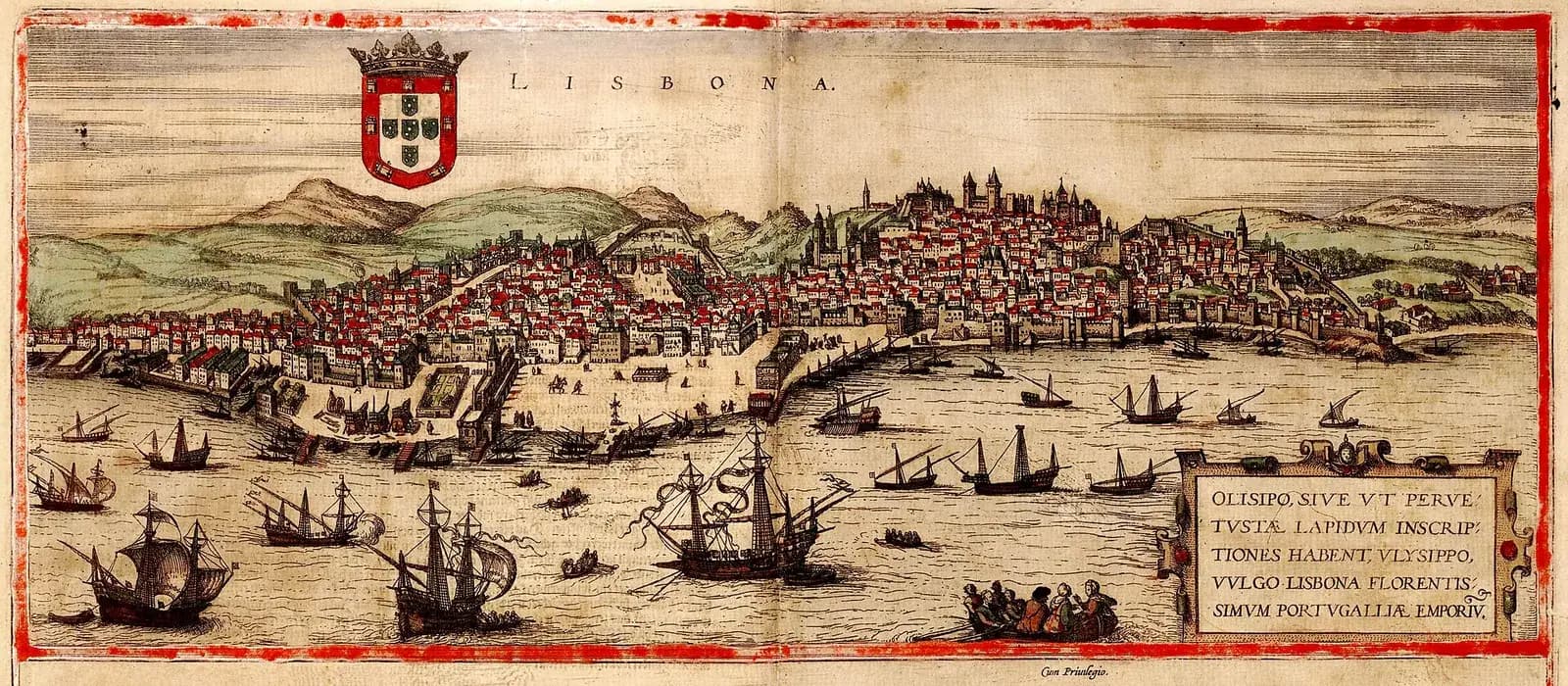
At a glance
- On Sunday 19 April 1506, in the Dominican church of São Domingos beside Lisbon's Rossio, worshippers killed a New Christian who had doubted a “miracle” on a crucifix, and his body was burned in the Rossio.
- Urged on by Dominican friars carrying a crucifix and joined by foreign sailors, crowds hunted down New Christians (Jews forcibly baptised in 1497 and their families) until Tuesday 21 April, and in nearby villages for days after.
- Estimates of the dead run from about 1,000 to 4,000. Damião de Góis counted more than 1,900; most historians since Alexandre Herculano have accepted about 2,000.
- King Manuel I, away from the plague-stricken city, had dozens of rioters hanged and the two ringleading friars condemned, and on 22 May 1506 confiscated the goods of the guilty and a fifth of the goods of bystanders.
- In 1507 the king let New Christians leave Portugal freely. Since April 2008 a memorial in the Largo de São Domingos has marked the place where the killing began.
A light on the crucifix
On the afternoon of Sunday 19 April 1506, the first Sunday after Easter, the church of the Dominican convent of São Domingos was full. Lisbon was in the grip of plague, and for days people had crowded into a side chapel, the Chapel of Jesus, where they said the crucifix above the altar gave off a strange light.
A German then in the city went to look. He saw nothing, but about 200 people, many of them friends he trusted, told him they had seen lights and gilded stars shining around the crucifix. He asked them whether it might be a trick by the friars, which would be easy to set up. All of them said it was a true sign from God.
Some New Christians were in the church that Sunday, among them a man who said aloud what many suspected, that the miracle was a fraud. Damião de Góis, the royal chronicler, wrote that he thought the glow was a candle placed beside the image. The German heard a blunter version.
“How can a piece of dry wood work a miracle? Take water and throw it on, and it will soon go out.”
In the German's account, women in the crowd fell on him and dragged him out of the door, and men and boys helped them kill him; Góis says men of low condition dragged him out by the hair. When a second New Christian asked why they had killed him, he was beaten to death too. The first man's body was burned in the Rossio, Lisbon's great square next to the convent.
A friar then preached to the gathering crowd. Two others came out of the convent, one with a cross and one with a crucifix, shouting “Heresy, heresy!” By nightfall hundreds of people were dead.
A city of plague, hunger and resentment
On paper they were Christians like any other. In the street they were still “the Jews”. Many were merchants, doctors, tax farmers and skilled craftsmen, and Old Christians resented their success and doubted their faith. On Whit Sunday 1504 a gang of youths had surrounded New Christians talking in the Rua Nova, the merchants' street, and a fight broke out. Forty rioters were sentenced to flogging and exile, then pardoned when the queen intervened.
Then the plague came. Its first signs appeared in Lisbon in the autumn of 1505, after two years of unseasonable weather had brought hunger. The court left for Almeirim, Santarém and then Abrantes. By early April 1506 the epidemic was killing as many as 130 people on some days. On 15 April a penitential procession wound from the church of São Estêvão to São Domingos, and it was during the prayers that followed that people first spoke of the miracle.
Preachers had a ready explanation for the city's suffering. Samuel Usque, a Portuguese Jew whose history of his people's tribulations was printed at Ferrara in 1553, recalled priests saying from the pulpit, and townsmen repeating in the squares, that “any famine, plague or earthquake” that struck the land came because the New Christians “were not good Christians” and secretly practised Judaism.
Two days before the killing began, on the night of 17 April, someone denounced a group of New Christians who had baked Passover bread and killed lambs and hens to eat in the Jewish manner. A city judge raided the house and arrested 17 men and women; the rest escaped over the rooftops. Some were released two days later, and the German heard people grumbling that money or friends had bought their freedom and that they all deserved to burn.
The king was far away. Manuel I had gone from Abrantes towards Beja, where his mother, the Infanta Beatriz, lived, and many of Lisbon's leading men had also left to escape the plague.
Three days in April
On the Sunday afternoon the friars walked through the streets with their crucifix, calling on everyone who wanted to help the Christian faith to follow them. Sailors from ships anchored in the Tagus, from Holland, Zeeland, Germany and France, joined local men. Góis put the first band at more than 500. They killed every New Christian they found in the streets and threw the dead and the living together onto bonfires in the Rossio and on the riverside, the Ribeira. Slaves and boys fetched the firewood.
A city judge who came with his men to arrest the killers was driven back by a crowd shouting that if the king would not punish the Jews, God would. He escaped over the roof of his own house, and the crowd wanted to burn it. A contemporary memoir quoted by Herculano says 300 people were burned in the Rossio that afternoon, sometimes 15 or 20 at a time. Góis counted more than 500 dead by nightfall.
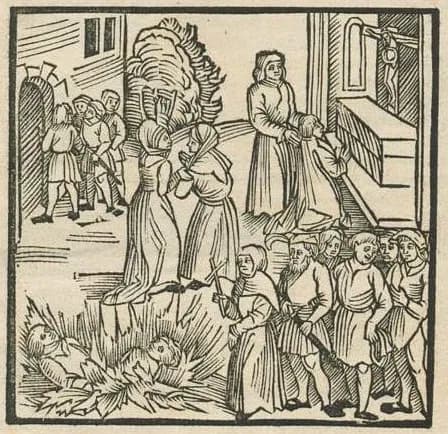
Monday was worse. More than a thousand local men joined the foreigners. Finding the streets empty, they broke into houses with ladders and battering poles, dragged out whole families and burned them. Góis wrote that children were torn apart and dashed against walls, and that people who had fled into churches were pulled away from the altars. Personal enemies settled scores by pointing out Old Christians as Jews.
“On that day more than a thousand souls perished, with nobody in the city daring to resist, because there were few people of standing in it, most of the honourable men being away because of the plague.”
The richest victim was João Rodrigues Mascarenhas, a New Christian tax farmer whom the crowd hated. On Sunday he had shouted insults from his window, barricaded his house and fled over the roof. On Monday afternoon he was recognised in disguise as he tried to escape by horse, and was hacked to death in an alley. The crowd dragged his body along the Rua Nova, stabbing it as they went, and carried bits of his furniture to burn him with in front of São Domingos.
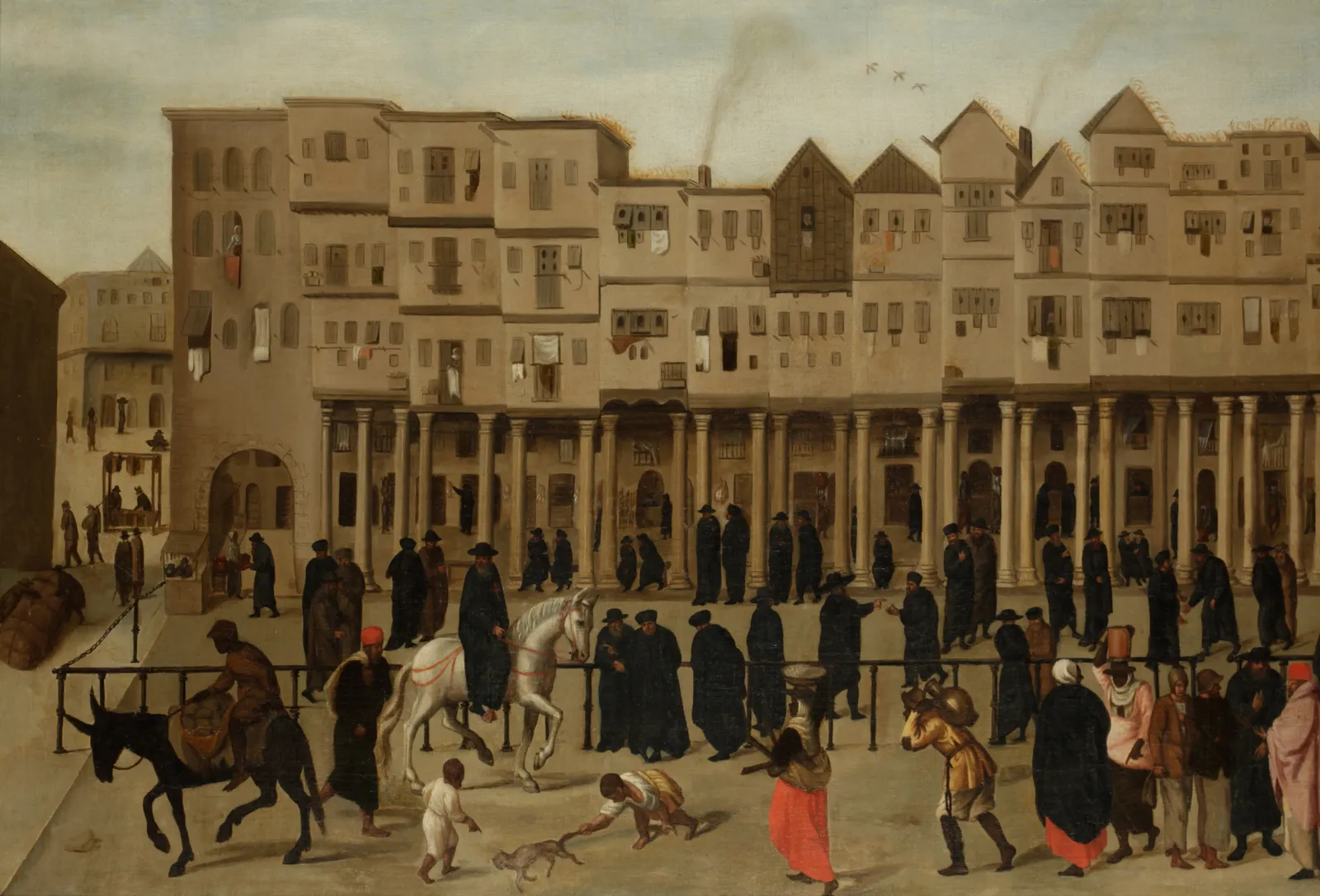
The German witness took part. He and some of his countrymen saw corpses outside São Domingos only half burned for lack of wood, and each gave 100 pfennig to buy more. Mascarenhas was thrown onto their pyre. “We were glad at heart,” he wrote, because the Germans had long wished him dead. In a second pamphlet he worried that the king's penalties might fall on him and his companions too.
On Tuesday the authorities came back. Aires da Silva, the regedor, who headed the royal court of appeal, and Dom Álvaro de Castro, governor of the Casa do Cível, gathered men outside the walls near São Vicente and ordered citizens to join them on pain of losing their goods. The German put the force at about 4,000. The crowd answered that it was loyal to the king but would not fight against the cross.
Herculano wrote that the magistrates, through friars acting as go-betweens, ended the riot by promising impunity. The killing in the city died down that afternoon, Góis said, because there was nobody left to kill: honourable and pious people had hidden the surviving New Christians or helped them escape. Bands of rioters and peasants went on hunting fugitives in the villages around Lisbon, and the German's account runs to 29 April.
- Date
- Sunday 19 to Tuesday 21 April 1506 in the city; killings in nearby villages for days after
- Place
- Church of São Domingos, the Rossio and the Ribeira, then across Lisbon and its district
- Victims
- New Christians, Jews baptised by force in 1497 and their families
- Ringleaders
- Dominican friars João Mocho of Évora and Bernardo of Aragon
- King
- Manuel I, away from the plague; he heard the news at Avis
- Dead
- About 1,000 to 4,000, depending on the source
Counting the dead
Nobody counted the bodies, and the figures written down in the following decades are far apart. François Soyer, a historian of the forced conversion, puts the toll anywhere between 1,000 and 4,000 men, women and children. Most estimates cluster around 2,000, and the highest come from Jewish writers and from Garcia de Resende, a courtier-poet who wrote that he saw the killing.
The German gave two numbers. His pamphlet reported that 1,930 Jews died in and around Lisbon, and a later edition added his own view that no more than 1,000 to 1,200 had died, since many had fled or hidden. Góis, writing sixty years after the events, gave more than 1,900. Isaac ibn Faraj, a New Christian who survived and later escaped to Salonica, where he returned to Judaism, gave 1,200.
How many died? Death tolls given by early writers and one historian
people killed
Where a writer gave “more than” a figure, or a range, the chart shows the figure given or the top of the range. The German witness's pamphlet of 1506 reported 1,930 deaths; a later edition added his own estimate of 1,000 to 1,200. Góis (1566) gave more than 1,900, Resende more than 4,000 and Usque (1553) 4,000. The figures for Ibn Faraj, Ibn Verga and Bernáldez are as reported by Rita Ribeiro Voss.
Show the data
| Estimated deaths | |
|---|---|
| German witness, own view | 1,200 |
| Isaac ibn Faraj | 1,200 |
| Damião de Góis | 1,900 |
| German witness, report | 1,930 |
| Herculano (1854) | 2,000 |
| Ibn Verga | 3,000 |
| Andrés Bernáldez | 3,000 |
| Samuel Usque | 4,000 |
| Garcia de Resende | 4,000 |
Solomon ibn Verga, a Spanish Jewish exile, wrote that the killing lasted three days and took 3,000 lives, and the Castilian chronicler Andrés Bernáldez also gave 3,000. Usque gave 4,000, as did the Jewish envoys who later took their case to the pope. Herculano, writing in 1854, concluded that the memoirs of the time and the historians agreed on about 2,000 dead by Tuesday afternoon.
“I saw that in Lisbon the low folk and villeins rose against the New Christians; they killed more than four thousand of those they laid hands on. Some of them they burned alive, they tore little children to pieces.”
The king punishes his capital
The news reached Manuel at Avis, in the Alentejo. Góis says he was “very sad and angry”. He at once sent the Prior of Crato and Dom Diogo Lobo, Baron of Alvito, to Lisbon with full powers to punish the guilty. After moving to Setúbal to be nearer the city, he wrote letters rebuking the regedor, the governor and the city councillors for their negligence.
The sources disagree on who was hanged. Herculano counted 40 to 50 executions after summary trials, with some of the condemned first losing their hands and others quartered. Góis wrote that most of those hanged were Portuguese, because the foreign sailors had sailed off with their loot. The German witness, who counted 42 executions between 1 and 7 May, said only eight were from Lisbon and 34 were foreigners, before an order from the king on 8 May stopped further executions.
The Dominicans of São Domingos were thrown out of their convent, which was handed to secular clergy. The German wrote that more than 42 friars left the country. According to Herculano, the two ringleaders, João Mocho, a Portuguese from Évora, and Bernardo, an Aragonese, were arrested and stripped of their orders.
The heaviest blow fell on the city as a whole. In a sentence signed at Setúbal on 22 May 1506, which Góis copied word for word into his chronicle, Manuel blamed the people of Lisbon both for the killings and for failing to stop them.
| Who | Penalty | What happened later |
|---|---|---|
| Those who killed or robbed, or gave help or advice | Bodily punishment and loss of all their goods to the crown | Not recorded in these sources |
| Residents of the city and its district who were present but did not resist | Loss of a fifth of all their goods, including their wives' share | Not recorded in these sources |
| The Twenty-Four of the crafts (Casa dos Vinte e Quatro) | No more elections, and their four procurators removed from the city council | Restored in 1508 |
| The people of Lisbon | Lost their exemption from lodging the king and his court | Privileges later restored, by Resende's account |
| The city | Lost its title of “noble and always loyal”, according to Resende | Title later restored, by Resende's account |
| The Dominicans of São Domingos | Expelled from the convent | Convent returned to the order after about five months, without those friars |
Penalties as set out in the sentence of 22 May 1506 printed by Góis, with Resende's verses, Herculano and Voss for what happened later.
The council sent one of its members to beg for mercy. Manuel replied that the world needed an example of rigour, against the atrocities of the wicked and against the negligence of everyone else. The German, whose sympathies were with the rioters, feared that if the decree were enforced people would flee the city and the countryside.
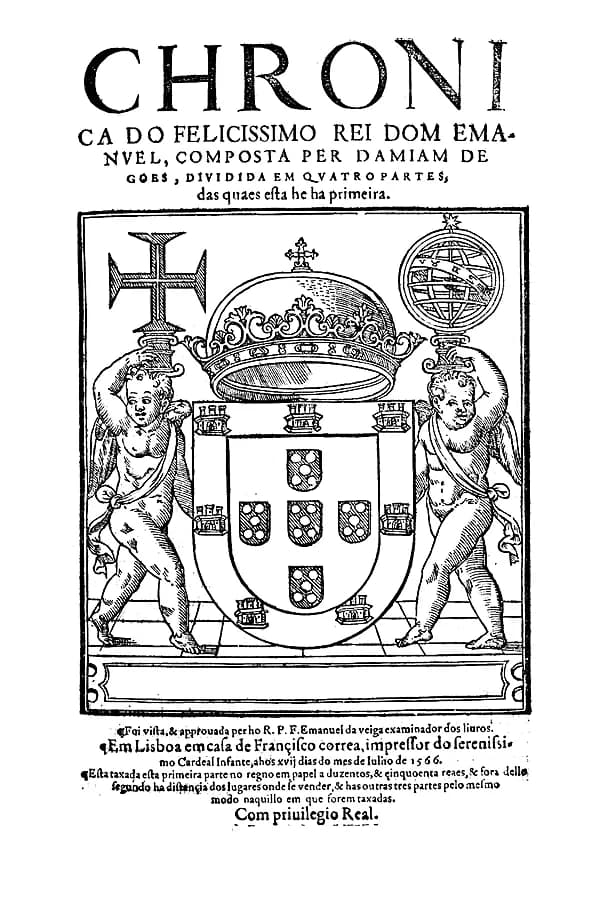
After the massacre
The king's anger cooled within months, but he also changed course on the New Christians. A law of 1 March 1507 repealed the ban on their leaving the kingdom, let them sell their property and move their money abroad, and promised that no further special laws would be made against those who stayed. On 13 March the 1497 promise that nobody would inquire into their beliefs was solemnly renewed.
Few took the chance. Herculano, citing a later New Christian memorial to the pope, says that almost none left, held back by their businesses and their attachment to the country. He judged the years from 1507 to Manuel's death in 1521 a time of relative peace for them, with the crown enforcing their protection.
Autumn 1505
Plague appears in Lisbon; the court leaves the city
Early April 1506
Plague deaths reach 130 on some days
15 April 1506
Penitential procession ends at São Domingos; talk of a miracle spreads
17 April 1506
Seventeen New Christians arrested at a Passover meal
19 April 1506
A New Christian is killed in São Domingos; friars lead the crowd
20 April 1506
The worst day; João Rodrigues Mascarenhas is killed
21 April 1506
Royal officials muster outside the walls; killing in the city winds down
1 to 8 May 1506
Executions in and around Lisbon, by the German witness's count
22 May 1506
Royal sentence on Lisbon, signed at Setúbal
1 March 1507
New Christians allowed to leave Portugal freely
1508
The Casa dos Vinte e Quatro is restored
The peace did not last. In 1531, after an earthquake shook Lisbon and the Tagus valley, friars in Santarém preached that it was God's punishment for Portugal's sins, and the playwright Gil Vicente wrote to João III that after the first sermon the New Christians went about “dying of fear of the people”. In 1536 the pope granted João III the Inquisition he had asked for, and its main target from the start was Judaism among the New Christians.
Europe had heard about the massacre at once. The German's account was printed in at least three editions, and two Spanish chroniclers who never mentioned the forced conversions of 1497 gave the massacre whole chapters. The Jewish historians Ibn Verga and Usque made it a chapter in the long story of their people's sufferings.
Remembering 1506
For centuries Lisbon had no public marker of the killing. In 2006, the 500th anniversary, people gathered in the Largo de São Domingos, the square in front of the church, and Esther Mucznik, a leader of Lisbon's Jewish community, regretted that the city still had no monument to the persecution of the Jews.
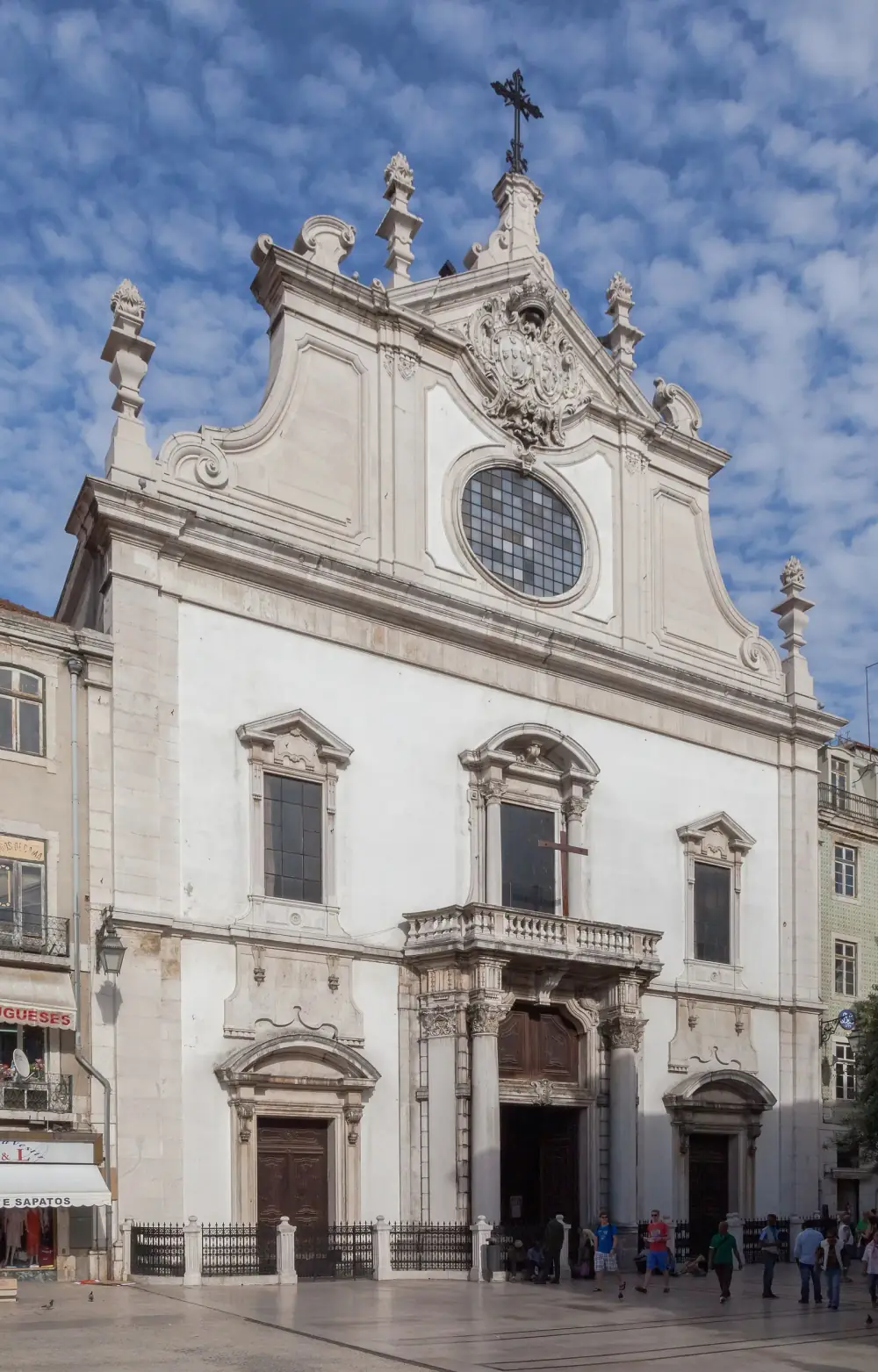
That changed in April 2008, when two monuments were unveiled in the square, organised by the city council with the Jewish and Catholic communities. One is a memorial designed by Graça Bachmann at the proposal of the Jewish community: a tilted stone hemisphere carved with a Star of David, on a base inscribed with a verse from the Book of Job. Sources give its inauguration as 19 or 23 April 2008.
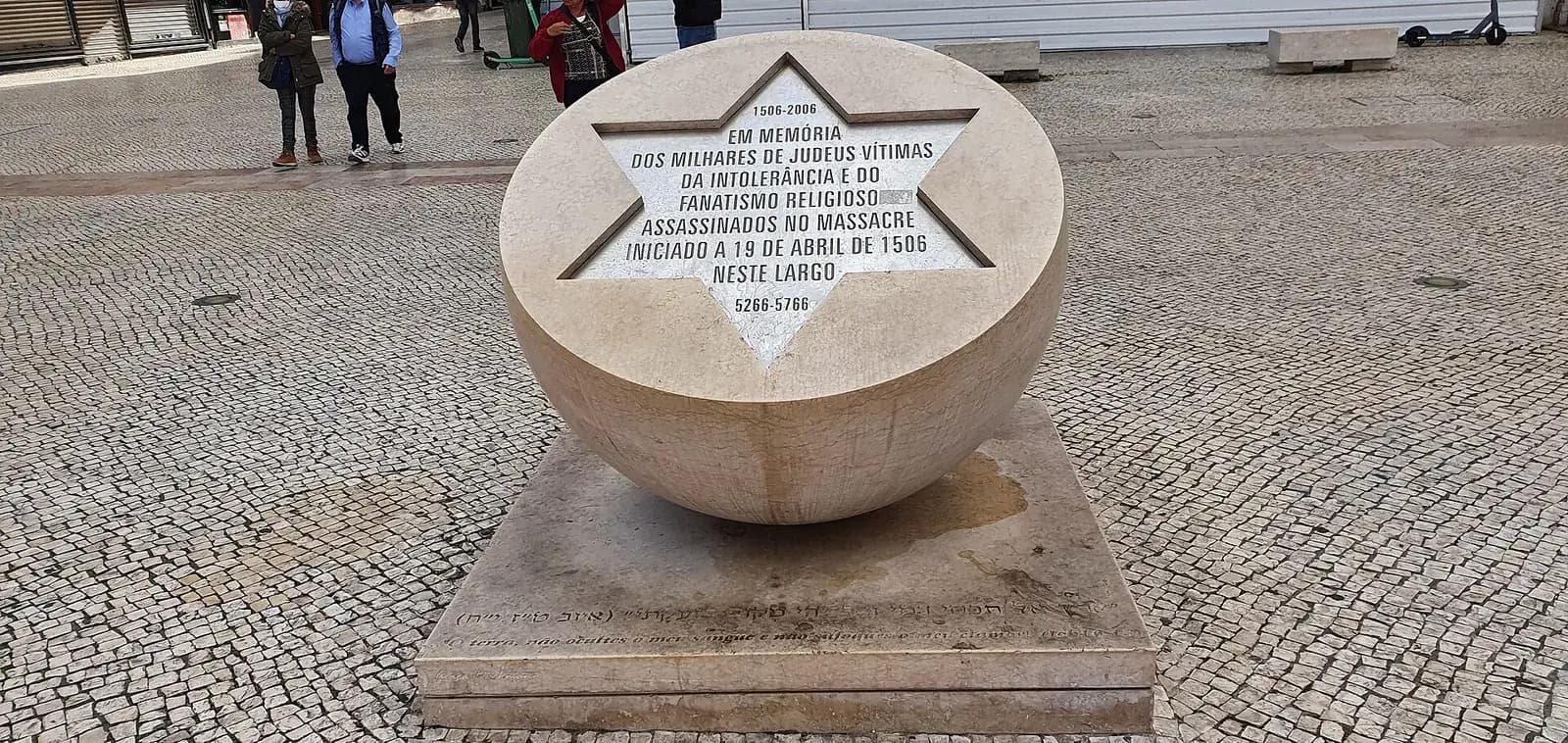
Beside it, in front of the church door, another monument marks the place where in 2000 the Cardinal Patriarch of Lisbon, José Policarpo, expressed the Church's shame for the persecution of the Inquisition. Since 2015 Portugal has also let descendants of Portuguese Sephardic Jews apply for citizenship, though the rules have since been tightened.
The massacre is still argued over. In 2024 the Jewish Community of Porto released a short film reconstructing the events, “1506: O Genocídio de Lisboa”, and at a screening the audience divided over whether to call it a genocide or a massacre. Richard Zimler's novel The Last Kabbalist of Lisbon is set during those April days.
FAQs
What was the Lisbon Massacre of 1506?
It was a riot against New Christians, Jews forcibly baptised in 1497 and their families, that began on Sunday 19 April 1506 at the church of São Domingos in Lisbon after a New Christian doubted a reported miracle. Urged on by Dominican friars and joined by foreign sailors, crowds killed New Christians in the city until Tuesday 21 April and in nearby villages for some days after.
How many people died in the Lisbon Massacre?
Nobody knows. Estimates run from about 1,000 to 4,000. The German eyewitness reported 1,930 but thought 1,000 to 1,200 more likely, Damião de Góis gave more than 1,900, Alexandre Herculano about 2,000, and Samuel Usque and Garcia de Resende 4,000 or more.
Why did the massacre happen?
Lisbon was suffering from plague and hunger, and preachers blamed the New Christians, whom many Old Christians resented and suspected of secretly practising Judaism. The king and many leading citizens had left the city to escape the plague, and Dominican friars turned a dispute over a miracle into a call to kill.
How did King Manuel I punish Lisbon?
He sent commissioners who had dozens of rioters hanged, expelled the Dominicans from São Domingos and had the two ringleading friars condemned. His sentence of 22 May 1506 took all the goods of the guilty and a fifth of the goods of residents who had not resisted, and suspended the guild representatives on the city council. Most of these penalties were relaxed within a few years.
Where is the memorial to the victims of 1506?
In the Largo de São Domingos, beside the Rossio in central Lisbon, in front of the church where the killing began. Designed by Graça Bachmann, it was unveiled in April 2008.
On the timeline
Open the timelineNearby moments from the age of discoveries (1415–1580).
Portuguese navigator Diogo Dias, blown off course during Pedro Álvares Cabral's voyage to India, becomes the first European to sight Madagascar, naming it Ilha de São Lourenço after the feast day of St Lawrence.
The Infanta Isabel, daughter of Manuel I and Maria of Aragon, is born in Lisbon. Married to the Emperor Charles V in 1526, she became Queen of Spain and Holy Roman Empress and governed Spain as regent during her husband's long absences.
Francisco de Almeida departs Lisbon with a fleet of 22 ships as the first Viceroy of Portuguese India, tasked with establishing permanent Portuguese naval dominance in the Indian Ocean.
The Lisbon Massacre of 1506
The Lisbon Massacre begins: urged on by Dominican friars, a mob attacks New Christians (forcibly converted Jews) at the Church of São Domingos. The killing lasts three days and leaves an estimated 1,000 to 4,000 dead — one of the darkest episodes in the history of Portugal's Jewish community, three decades before the Inquisition was established.
Days after his handful of ships destroyed the fleet of Hormuz, Afonso de Albuquerque has its young king, Seyf ad-Din, accept terms of submission: a yearly tribute of 15,000 xerafins, duty-free entry for goods from Portugal and a site for a fort. Mutiny among his own captains wrecked the plan within months, and Portugal only took the Gulf trading hub in 1515.
A Portuguese fleet under Viceroy Francisco de Almeida defeats the combined fleets of Mamluk Egypt, the Sultanate of Gujarat and the Zamorin of Calicut at the Battle of Diu, off western India, leaving Portugal the strongest naval power in the Indian Ocean.
By the date usually given today, the 'Flor de la Mar', the old carrack carrying Afonso de Albuquerque and the plunder of Malacca, is wrecked off Sumatra, though no sixteenth-century source gives the day and Gaspar Correia has Albuquerque leave Malacca only on 1 December. He escaped on a raft, but almost all the cargo was lost, and no find of the wreck has ever been confirmed.
Coming up in history
All long reads 21 April 1985Senna's first Formula One win, in the Estoril rain, 1985
 22 April 1500Monte Pascoal on the horizon: Cabral's fleet reaches Brazil, 22 April 1500
 23 April 1909The Benavente earthquake: when the Tagus valley shook in 1909
 24 April 1970Cassiano Branco, Lisbon’s Art Deco dissenter, dies: 24 April 1970
20 sources
Archives, scholarship and reporting this article was checked against.
- 1
Chronica do felicissimo rei Dom Emanuel (Damião de Góis), parts III and IVFrancisco Correia, Lisbon, 1566–1567; John Carter Brown Library copy (Internet Archive scan)
- 2
- 3
Uma narrativa sobre o Massacre de Lisboa: a emergência do discurso de ódio nos panfletos da testemunha anônima alemã (Rita Ribeiro Voss)Revista Lusófona de Ciência das Religiões, no. 21, 2018, pp. 253–277
- 4
O massacre de Lisboa de 1506 e o discurso de ódio antijudaico (Rita Ribeiro Voss)Revista de História das Ideias, vol. 35, 2017, Universidade de Coimbra
- 5
The Massacre of the New Christians of Lisbon in 1506: A New Eyewitness AccountFrançois Soyer, Cadernos de Estudos Sefarditas, no. 7, 2007, pp. 221–244 (repository record, University of New England)
- 6
- 7
- 8
Review of François Soyer, The Persecution of the Jews and Muslims of Portugal: King Manuel I and the End of Religious Tolerance (1496–7) (Brill, 2007)Ariel Hessayon, Reviews in History (Institute of Historical Research), review no. 797, September 2009
- 9O dia em que os judeus foram expulsos de PortugalMaria José Oliveira, Observador, 29 December 2016
- 10
Lisbon (Richard Gottheil, Meyer Kayserling and others)The Jewish Encyclopedia, Funk & Wagnalls, 1901–1906
- 11Comunidade judaica portuguesa recorda massacre anti-semita de 1506 (Maria João Martins)Diário de Notícias, 4 May 2024
- 12
A carta de Gil Vicente a D. João III (Ana Carolina de Souza Ferreira and Manoel Mourivaldo Santiago-Almeida)Linguasagem 25 (1), 2016, Universidade Federal de São Carlos
- 13
Notas sobre a Inquisição portuguesa: história e historiografiaGrayce Mayre Bonfim Souza, Politeia: História e Sociedade (Uesb), v. 20, n. 1, 2021
- 14O descobrimento de PortugalDiário de Notícias, opinion column, 24 June 2018
- 15
Monumentos portugueses que fazem justiça pela própria arte (Renata Lima Lobo)Time Out Lisboa, 1 July 2020
- 16
Memorial to the Victims of the 1506 Massacre - LisbonCaminhos da Fé / Paths of Faith (Turismo de Portugal)
- 17
Memorial às Vítimas do Massacre de 1506Visit Portugal (Turismo de Portugal)
- 18
Decreto-Lei n.º 30-A/2015, de 27 de fevereiroDiário da República, 1.ª série, n.º 41 (supplement), 27 February 2015
- 19Nova Lei da Nacionalidade limita acesso de sefarditas e facilita para imigrantesAmanda Lima, Diário de Notícias, 21 February 2024
- 20
Igreja de São DomingosVisit Lisboa (Turismo de Lisboa)
Image credits
- Lisbon from the Tagus in Georg Braun and Franz Hogenberg's atlas of cities, Civitates orbis terrarum, 1572. The Rossio and the Dominican convent lay in the low valley behind the waterfront, and in April 1506 sailors from foreign ships in the river joined the killing. Georg Braun and Franz Hogenberg, Public domain, via Wikimedia Commons.
- Woodcut from one of the German pamphlets printed in 1506, “Of the Christian strife that took place in the year 1506 at Lisbon”: the crucifix in São Domingos, armed men at a door, a friar with a cross leading a crowd, and bodies burning. Unknown author, Public domain, via Wikimedia Commons.
- The Rua Nova dos Mercadores, Lisbon's main merchant street, painted by an unknown artist in the sixteenth century. On 20 April 1506 the crowd dragged João Rodrigues Mascarenhas's body along the Rua Nova. The street was destroyed in the earthquake of 1755. Unknown author, Public domain, via Wikimedia Commons.
- Title page of the first part of Damião de Góis's chronicle of Manuel I, printed in Lisbon by Francisco Correia in 1566. Chapters 102 and 103 tell the story of the massacre and print the king's sentence on the city. Damião de Góis, Public domain, via Wikimedia Commons.
- The memorial in the Largo de São Domingos, photographed on 19 April 2022. The star reads, in translation: “In memory of the thousands of Jews, victims of intolerance and religious fanaticism, murdered in the massacre that began on 19 April 1506 in this square.” Yair Haklai, CC BY-SA 4.0, via Wikimedia Commons.
- The church of São Domingos in 2012. It was remodelled after the earthquake of 1755, and a fire in 1959 destroyed its interior. Diego Delso, CC BY-SA 3.0, via Wikimedia Commons.