

Carlos Lopes, 1984: Portugal's first Olympic gold
A builder's labourer turned bank clerk, held back for years by injury, ran away from the world's best marathon men in the Californian heat. In Portugal it was three in the morning, and the country stayed up to watch.
At a glance
- On Sunday 12 August 1984 Carlos Lopes, aged 37, won the Olympic marathon in Los Angeles in 2:09:21, an Olympic record, 35 seconds ahead of Ireland's John Treacy and 37 ahead of Britain's Charlie Spedding.
- It was Portugal's first Olympic gold medal. In 72 years of Games since 1912 the country had won nine medals, four silver and five bronze, among them Lopes's own silver in the 10,000 metres at Montreal in 1976.
- Born in Vildemoinhos, outside Viseu, in 1947, Lopes worked as a builder's labourer as a boy and as a bank clerk in Lisbon while he ran for Sporting under the coach Mário Moniz Pereira.
- He broke away at about 37 km in heat put at 27 to over 30 °C, entered the Coliseum some 200 metres clear and finished at 3.09 am Lisbon time. About two weeks earlier a car had knocked him down while he trained in Lisbon.
- Eight months later, in Rotterdam on 20 April 1985, he ran 2:07:12, the first marathon under 2 hours 8 minutes. His Olympic record lasted until 2008.
Into the Coliseum
A small, slight man came out of the tunnel into the Los Angeles Memorial Coliseum shortly after seven on the evening of 12 August 1984. He had run more than 41 kilometres from Santa Monica. About 90,000 people in the stands applauded him, and he had some 550 metres of track to run, alone.
In Portugal it was past three in the morning. Families who had stayed up drinking coffee in front of the television watched Carlos Lopes, a 37-year-old from Viseu, raise his arms as he neared the line.
The clock stopped at 2 hours 9 minutes 21 seconds, an Olympic record.
“I'll never forget it: I crossed the line and shouted, “Fogooooo! Nobody can take this one from me now!” In fact it wasn't quite fogooooo that I said, it was another word, a similar word I can't repeat in a book!”
Ireland's John Treacy came in 35 seconds later and Britain's Charlie Spedding two seconds after him. For Portugal, which had first sent athletes to the Olympic Games in 1912, it was the first gold medal of any kind. Lopes kept running after the line and went round the track again.
From Vildemoinhos to Sporting
Carlos Alberto de Sousa Lopes was born on 18 February 1947 in Vildemoinhos, a village on the edge of Viseu, in the Beira Alta. He was the eldest child of a large family, of seven children by RTP's account and eight by World Athletics'. He left school young and worked as a builder's labourer and a metalworker.
He played football for the village club, Lusitano de Vildemoinhos, but weighed 48 kilos and rarely got a game. Running found him by accident. Walking home at midnight from a party in nearby Abraveses, he and his friends raced each other through the pine woods to see who would get back first. A few days later they formed an athletics team.
At 16 he came second in Viseu's New Year's Eve road race. He won the district cross-country title, came third in the national championship and in 1966, still a junior, was picked for Portugal's team at the International Cross Country Championships in Rabat, Morocco, where he finished 26th of 106. Several clubs then bid for him, and Sporting won.
He joined the Lisbon club in 1967 and stayed with it for the rest of his best years. His coach throughout was Mário Moniz Pereira, a former national triple-jump record holder who also wrote popular songs. From 1970 Lopes dominated Portuguese distance running, but abroad he was a modest figure: 30th in the 10,000 metres at the 1971 European Championships, out in the heats of both the 5,000 and 10,000 metres at the Munich Olympics of 1972.
1976: Chepstow and Montreal
The 25 April 1974 revolution, which ended the Estado Novo dictatorship, changed Lopes's working life. He secured part-time hours at the bank, where he earned 7,105 escudos a month, and began training twice a day: in the morning, then to the office after lunch. Two years earlier he had been running at dawn before work.
On 28 February 1976 he lined up for the world cross-country championship on the muddy racecourse at Chepstow, on the Welsh border, ten days after his 29th birthday. His best placing in the race had been 24th. He took the lead with his flowing stride, was nearly 200 metres clear with a kilometre left and won by 16 seconds from Tony Simmons of England. “I was surprised to win,” he said. “I thought I would finish no higher than fifth.”
Five months later he ran the Olympic 10,000 metres final in Montreal. Nobody else would set the pace, so from about the eighth lap he did it himself. Only the Finn Lasse Virén, the defending champion, and Britain's Brendan Foster could follow, and Foster fell away with 2,000 metres left. Just before the bell Virén went past. He won in 27:40.38, Lopes was second in 27:45.17 and Foster third.
It was Portugal's first Olympic medal in athletics. Lopes said that after the race he told Virén, “You won, but you didn't convince.” Rumours of blood doping followed Virén's knack for peaking at the Olympics; Olympedia notes that nothing was ever proven.
The lost years and a new event
Illness and injury, above all to an Achilles tendon, held him back for the next four years, and by his own account he could not train at all for almost two. He missed the Moscow Olympics of 1980, where he was sure he would have won another medal. At the end of 1976 he had been leading the São Silvestre road race in São Paulo, with the finish in sight, when a muscle went.
The cure came from an unlikely source. Kiyoshi Kobayashi, a Japanese judo master who lived in Portugal for more than 40 years, treated him with alternative medicine, and in 1981 Lopes ran under 28 minutes for 10,000 metres again. In Oslo in 1982 he set a European record of 27:24.39, and on New Year's Eve that year he finally won the São Silvestre in São Paulo.
Track championships went less well: fourth at the 1982 European Championships and sixth in the 10,000 metres at the first World Championships in 1983. His first marathon, New York in 1982, ended at 21 miles after he crashed into a spectator. His second, Rotterdam in April 1983, made his name in the event: a European record of 2:08:39, two seconds behind Australia's Rob de Castella. After the World Championships he gave his attention fully to the marathon.
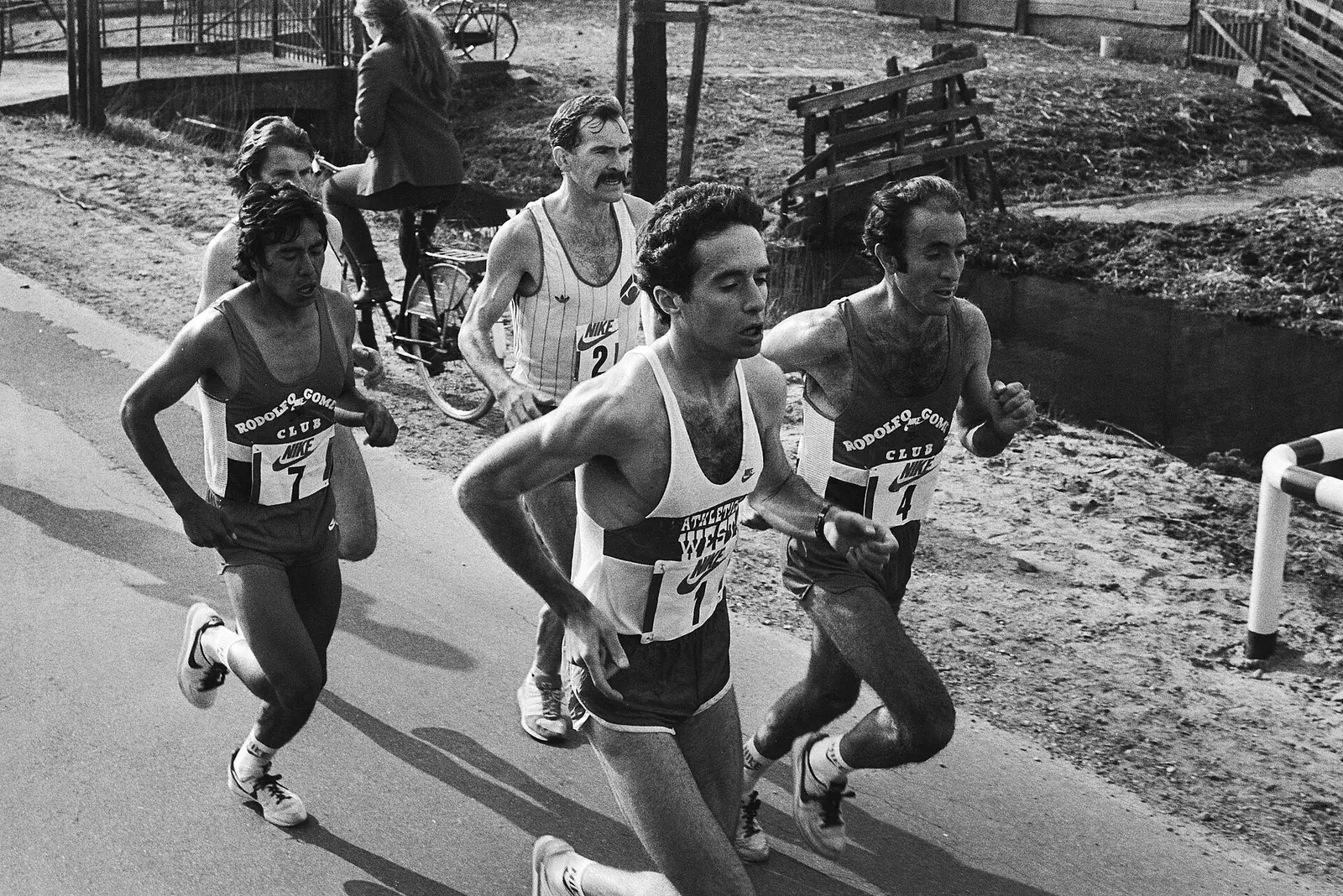
In 1984 he won the world cross-country title for a second time, at East Rutherford, New Jersey, near New York. He went back to Rotterdam that year and dropped out on purpose, he said later, to save himself for the Games, with a promise to return the next year and break the world best.
| Race | Place | Time | Note |
|---|---|---|---|
| New York, 1982 | Did not finish | - | Stopped at 21 miles after colliding with a spectator |
| Rotterdam, April 1983 | 2nd | 2:08:39 | European record, two seconds behind Rob de Castella |
| Rotterdam, 1984 | Did not finish | - | Withdrew, by his account to save himself for Los Angeles |
| Los Angeles Olympics, 12 August 1984 | 1st | 2:09:21 | Olympic record |
| Chicago, October 1984 | 2nd | 2:09:06 | Behind Steve Jones's world best of 2:08:05 |
| Rotterdam, 20 April 1985 | 1st | 2:07:12 | World best, 53 seconds faster than Jones |
A later attempt in Tokyo, which World Athletics places after Rotterdam 1985, ended when he dropped out ill at 19 km.
Two and a half years of preparation
Lopes said he spent two and a half years preparing for the Olympic marathon, and that he went to Los Angeles only to win it. He averaged about 36 kilometres a day and, he said, always ran at 20 km an hour. To get used to the heat and humidity he expected in California, he ran in the middle of the day, from after eleven to almost two, on narrow roads between Malveira and Coutada, north of Lisbon.
His wife, Teresa, and his brother-in-law followed in a car, putting drinks on the bonnet every five kilometres. The ten kilometres from Torres Vedras to his house at Coutada had to take 29 minutes. He had worked out, he said, that to win in Los Angeles he would need to run the last ten kilometres in that time.
On 27 July 1984, 16 days before the race (World Athletics says 15), he was training on the Segunda Circular ring road beside Benfica's Estádio da Luz when a car hit him from behind. He was thrown on to the bonnet and his elbow went through the windscreen. The driver, Lobato Faria, was a candidate for the presidency of Sporting and was in a hurry to catch a plane. Lopes got up, found nothing broken and finished his session with a badly grazed thigh.
“As I watched my elbow go through the windshield, I thought, ‘There goes the Olympics.’ I was lucky not to be seriously injured.”
In Los Angeles, Nike delivered shoes made specially for him the day before the race; he tried them on for half an hour on a short run. The masseur of the tennis player John McEnroe treated a blister on his toe. It was, Lopes said, the first proper massage of his life.
The race on 12 August 1984
The marathon was the last event of the Games. At 5 pm the field, 107 men from 59 countries by Olympedia's count, set off from the track at Santa Monica City College and headed through the city towards the Coliseum. The sun shone throughout, and accounts of the heat run from 27 °C to over 30 °C in Santa Monica. Sprinklers and hoses had been hung over the road to cool the runners.
The favourites were the three best marathon runners of the previous four years: de Castella, the world champion; Alberto Salazar of the United States, three times the New York winner; and Toshihiko Seko of Japan. The boycott led by the Soviet Union kept out the defending champion, Waldemar Cierpinski of East Germany, and the Ethiopians. Lopes had finished only one marathon in his life.
The first five kilometres, he said later, were the worst: he felt stiff. After that he settled in a big pack and watched. By halfway, reached in about 1:04:53, ten or so men were together, including Lopes, de Castella, Seko, Treacy and Spedding. Salazar was already slipping back. From about 28 kilometres, Lopes said, he could tell who was running to win.
At about 33 kilometres Spedding saw de Castella struggling and pushed hard. At 35 kilometres, passed in 1:48:23, six or seven men were left, and soon only Lopes, Treacy and the Kenyan Joseph Nzau could stay with the Englishman. At about 37 kilometres Lopes went. By 38 he was some ten seconds ahead and pulling away at under three minutes a kilometre.
“Whoever came with me came; whoever didn't was left behind.”
Spedding remembered glancing across and seeing the Portuguese running with his mouth closed after 35 kilometres in that heat. Lopes ran the 7.195 kilometres from the 35 km point to the finish in 20 minutes 58 seconds, by Olympedia's timings. He went through the tunnel into the stadium about 200 metres clear and finished half a lap ahead.
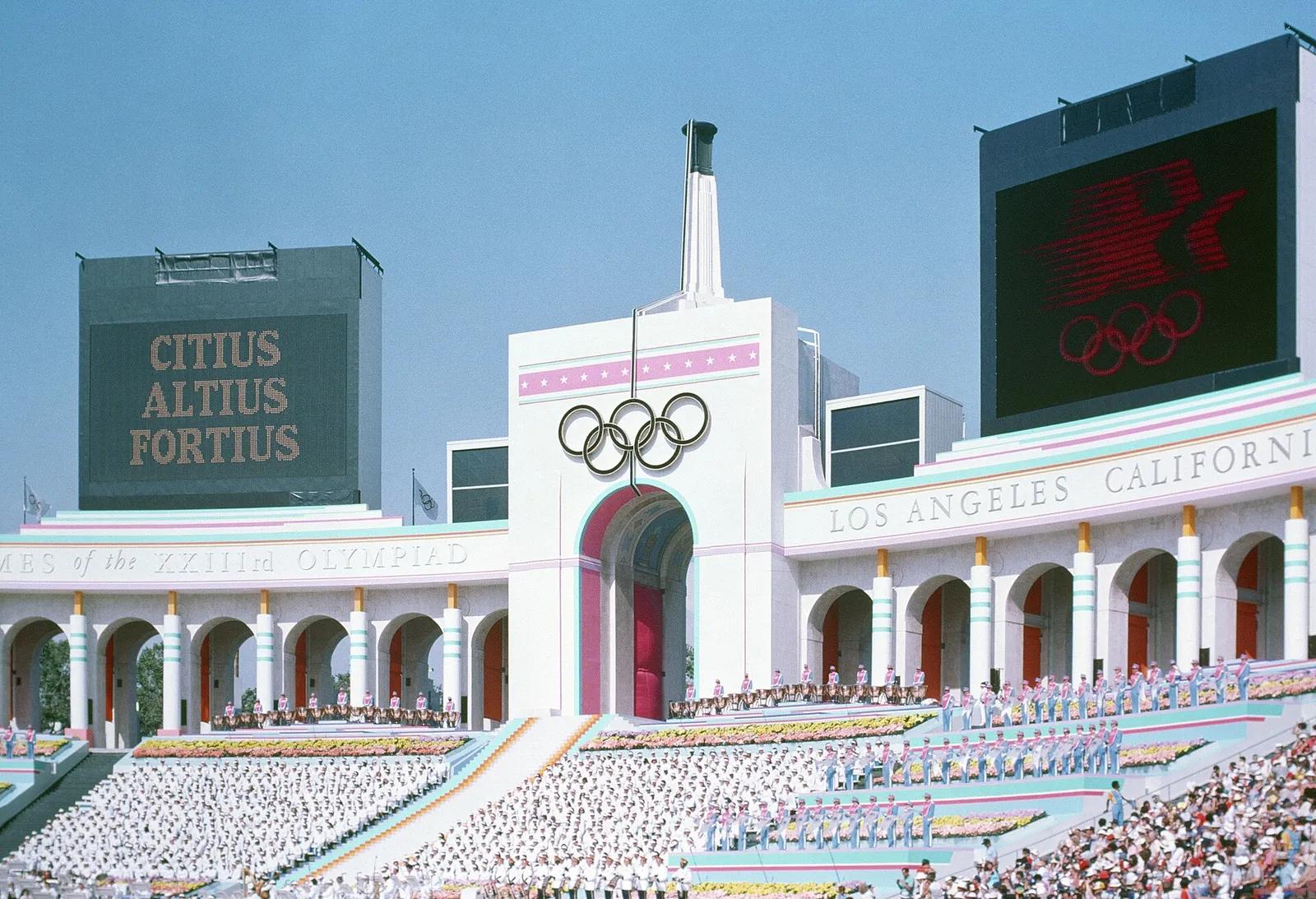
Behind him, Treacy, running his first marathon, passed Spedding on the descent to the stadium and held him off on the track. Takeshi So of Japan was fourth and de Castella fifth. Seko came 14th and Salazar 15th. Only 78 men finished, and neither of Portugal's other runners, Cidálio Caetano and Delfim Moreira, was among them.
How far behind Lopes the next seven finished
seconds behind Lopes
Gaps worked out from Olympedia's official finishing times: Lopes 2:09:21, Treacy 2:09:56, Spedding 2:09:58, Takeshi So 2:10:55, de Castella 2:11:09, Juma Ikangaa 2:11:10, Joseph Nzau 2:11:28 and Djama Robleh 2:11:39.
Show the data
| Gap at the finish | |
|---|---|
| Treacy (IRL) | 35 |
| Spedding (GBR) | 37 |
| T. So (JPN) | 94 |
| de Castella (AUS) | 108 |
| Ikangaa (TAN) | 109 |
| Nzau (KEN) | 127 |
| Robleh (DJI) | 138 |
- Course
- 42.195 km, Santa Monica City College to the Los Angeles Memorial Coliseum
- Field
- 107 starters from 59 countries; 78 finished and 29 dropped out
- Winning time
- 2:09:21, beating Cierpinski's Olympic record of 2:09:55 (1976) by 34 seconds
- Winner's age
- 37 years and 176 days
- Average pace
- About 3 minutes 4 seconds a kilometre, or 19.6 km an hour
5.00 pm
Start at Santa Monica City College
107 runners leave the track after a few laps and head out on to the roads.
Halfway
About ten men together in 1:04:53
Lopes, de Castella, Seko, Treacy and Spedding among them; Salazar is losing touch.
30 km
Lopes in the leading group in 1:33:02
About 33 km
Spedding surges and de Castella drops back
35 km
Six or seven men pass together in 1:48:23
About 37 km
Lopes attacks and goes clear
38 km
About ten seconds ahead of Spedding and Treacy
About 7.09 pm
Lopes wins in 2:09:21
It is 3.09 am on 13 August in Lisbon.
Portugal won three medals in those Games, more than in any edition before. A week earlier Rosa Mota had taken bronze in the first women's Olympic marathon, the start of a career told in its own article, and the evening before Lopes's race António Leitão won bronze in the 5,000 metres.
A hero's welcome and a world best
Because the race had ended in the small hours, Diário de Notícias ran a second edition. Its headline read, in translation, “Lopes brings Portugal its first gold medal”. Three days after the race he landed in Lisbon to a tumultuous welcome, and the Prime Minister, Mário Soares, gave a barbecue in his honour at São Bento, the official residence.
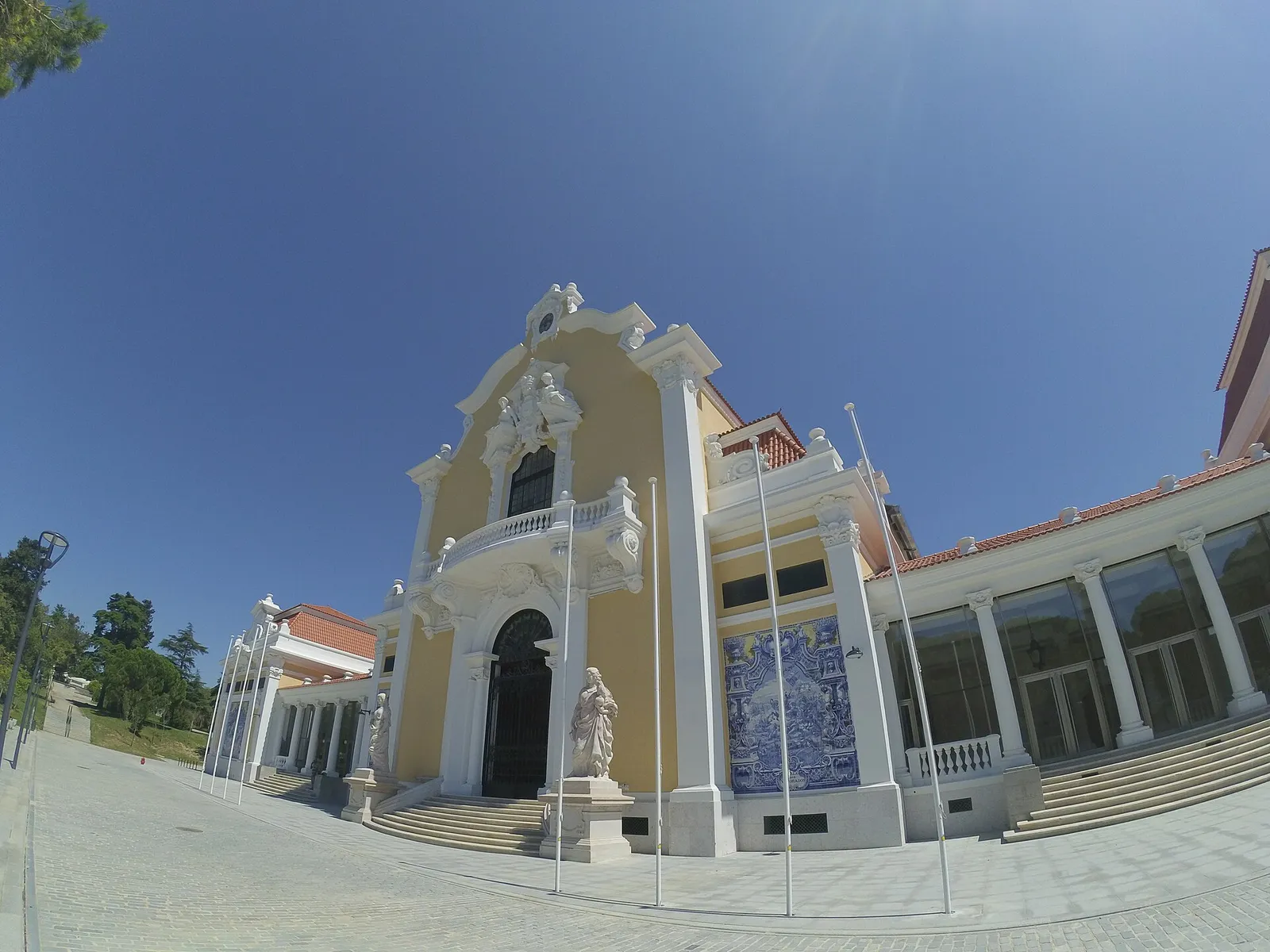
The state honours came in quick succession. According to Record, already a Knight of the Order of Prince Henry since 1977, he was made an Officer in July 1984, Grand Officer in October 1984 and Grand Cross on 24 August 1985. Lisbon's old sports hall, the Pavilhão dos Desportos in the Parque Eduardo VII, was renamed the Pavilhão Carlos Lopes in 1984.
He kept racing. Ten weeks after the Games he was second in the Chicago marathon in 2:09:06, behind the Welshman Steve Jones's world best of 2:08:05. In March 1985 he won the world cross-country title for the third time, at home: the championships were held in Lisbon.
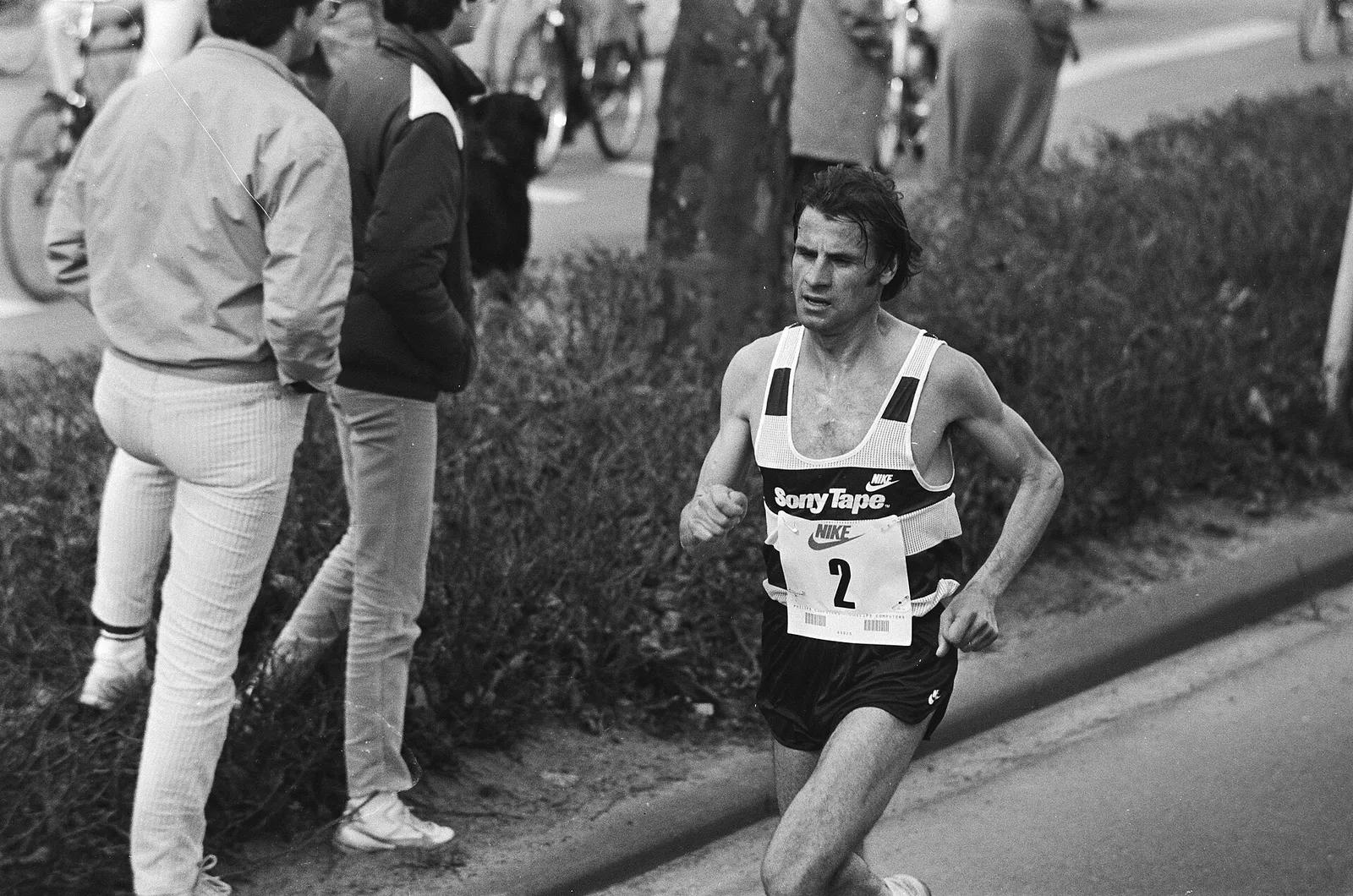
Less than a month later he kept his promise to Rotterdam. On Saturday 20 April 1985, the day before Ayrton Senna won his first Formula One race at Estoril, Lopes ran alone through crowds that RTP put at more than 600,000 and finished in 2:07:12. He was 38. He had taken 53 seconds off Jones's time and was the first man to run the marathon in under 2 hours 8 minutes.
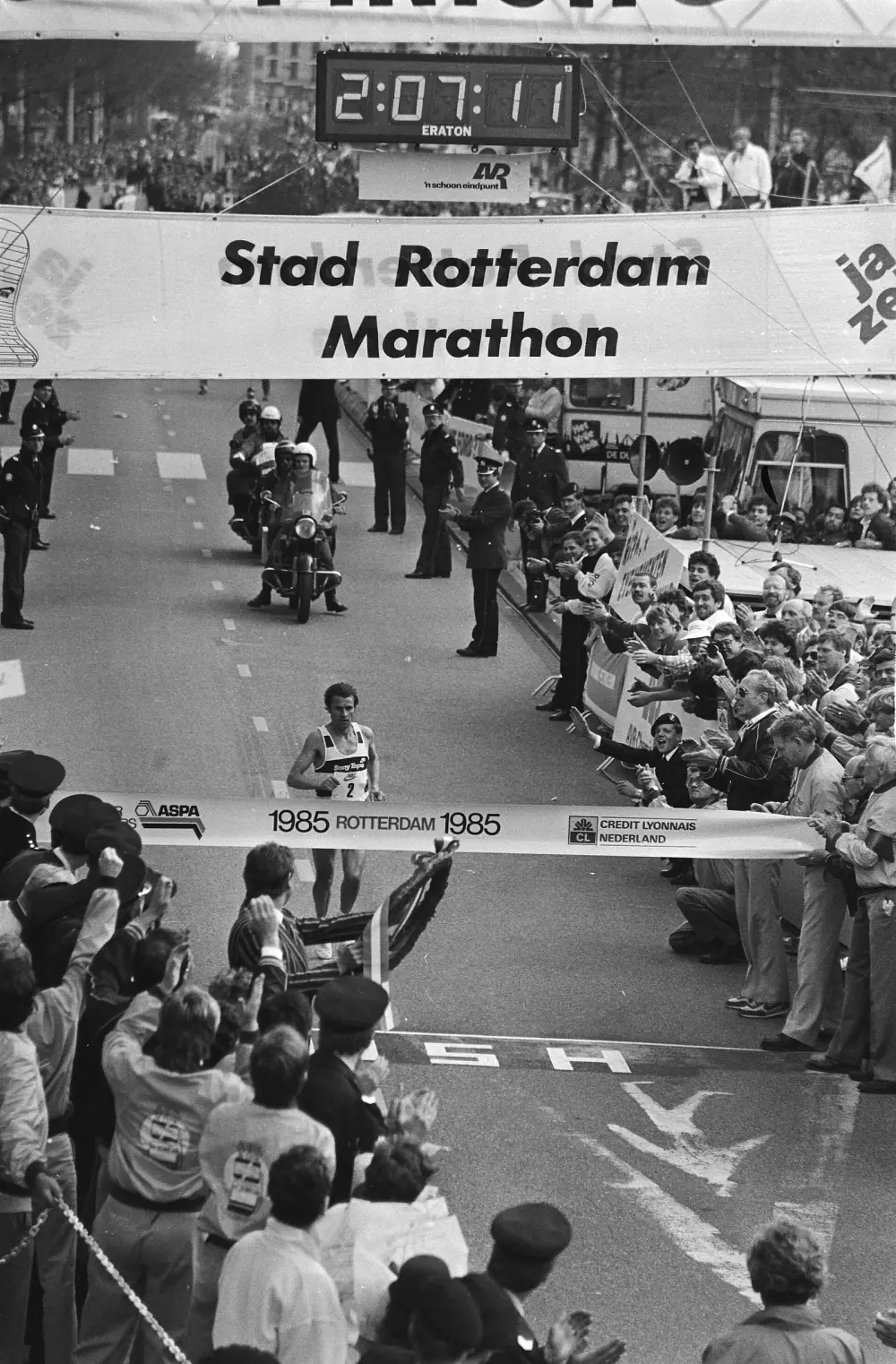
The French sports daily L'Équipe called it “Fantastic! Extraordinary!”. Lopes said in 2020 that, with a good pacemaker to 30 kilometres and the way he felt that day, he could have run about 2:05:45 to 2:05:50. It was close to the end. A marathon in Tokyo ended at 19 kilometres when he fell ill, more injuries followed, and he retired shortly before his 40th birthday, according to World Athletics.
Why it still matters
Lopes's Olympic record stood for 24 years, until Samuel Wanjiru of Kenya ran 2:06:32 at Beijing in 2008. World Athletics describes him as the oldest man to have won the Olympic marathon. Portugal's next gold came four years after his, when Rosa Mota won the women's marathon in Seoul in 1988.
| Games | Event | Medal | Winner(s) |
|---|---|---|---|
| Paris 1924 | Equestrian jumping, team | Bronze | Aníbal d'Almeida, Hélder Martins, José Mouzinho de Albuquerque, Luís de Menezes |
| Amsterdam 1928 | Fencing, épée team | Bronze | Six fencers, including João Sassetti and Paulo d'Eça Leal |
| Berlin 1936 | Equestrian jumping, team | Bronze | José Beltrão, Marquês Domingos Coutinho, Luís Mena e Silva |
| London 1948 | Equestrian dressage, team | Bronze | Fernando Paes, Francisco Valadas Júnior, Luís Mena e Silva |
| London 1948 | Sailing, Swallow class (two-person keelboat) | Silver | Duarte Manuel Bello and Fernando Bello |
| Helsinki 1952 | Sailing, Star class (two-person keelboat) | Bronze | Francisco Rebello de Andrade and Joaquim Fiúza |
| Rome 1960 | Sailing, Star class (two-person keelboat) | Silver | Mário Quina and José Manuel Quina |
| Montreal 1976 | Athletics, 10,000 metres | Silver | Carlos Lopes |
| Montreal 1976 | Shooting, trap | Silver | Armando Marques |
| Los Angeles 1984 | Athletics, women's marathon | Bronze | Rosa Mota |
| Los Angeles 1984 | Athletics, 5,000 metres | Bronze | António Leitão |
| Los Angeles 1984 | Athletics, marathon | Gold | Carlos Lopes |
Compiled from Olympedia's page for each Portuguese team from 1912 to 1984; Portugal won no medals at the other Games in that period, including the separate 1956 equestrian Games in Stockholm. Olympedia names the 1948 and 1952 to 1960 sailing events as the two-person keelboat; the boat classes are given for clarity.
By 2025, Diário de Notícias counted six more Portuguese Olympic champions: Rosa Mota, Fernanda Ribeiro, Nelson Évora, Pedro Pichardo, and the cyclists Rui Oliveira and Iúri Leitão. Two of the country's titles were won in the marathon. In a 2018 interview, Lopes joked that Portugal would win another Olympic marathon only in a thousand years.
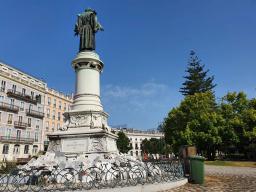
In 2004, before the Athens Games, the Assembleia da República unanimously passed a motion holding up his career as an example to Portugal's Olympic team. In Viseu, his home town, there is a Praça Carlos Lopes and a statue of him, and since 2021 the new athletics track at Fontelo has carried his name.
Lopes himself put his career in terms of a change of attitude. He arrived, he said, just as Portuguese sport began to get some support, and once he became world cross-country champion people began to believe, himself included, that a Portuguese runner could beat anyone.
FAQs
Who won Portugal's first Olympic gold medal?
Carlos Lopes, in the men's marathon at the Los Angeles Games on 12 August 1984. Before that Portugal had won nine Olympic medals since its debut in 1912, all silver or bronze. The second gold came in 1988, when Rosa Mota won the women's marathon in Seoul.
How old was Carlos Lopes when he won the Olympic marathon?
He was 37. Born on 18 February 1947, he was 37 years and 176 days old on 12 August 1984. World Athletics describes him as the oldest man to win the Olympic marathon. He was 38 when he ran 2:07:12 in Rotterdam the following April.
What was Carlos Lopes's winning time, and how long did the record last?
He won in 2:09:21, beating the Olympic record of 2:09:55 set by Waldemar Cierpinski in 1976. It remained the Olympic record until Samuel Wanjiru ran 2:06:32 in Beijing in 2008.
Did Carlos Lopes set a marathon world record?
Yes. In Rotterdam on 20 April 1985 he ran 2:07:12, 53 seconds faster than Steve Jones's 2:08:05 of October 1984, and became the first man to run the marathon in under 2 hours 8 minutes. World Athletics calls it a world best.
Where can you see tributes to Carlos Lopes?
In Lisbon, the Pavilhão Carlos Lopes in the Parque Eduardo VII has carried his name since 1984. Viseu, his home town, has a Praça Carlos Lopes, a statue and an athletics track named after him.
On the timeline
Open the timelineNearby moments from revolution and democracy (1974–1986).
A Spanish traditionalist priest, Juan María Fernández y Krohn, lunges at Pope John Paul II with a bayonet at the Fátima shrine, where the Pope is marking the first anniversary of the 1981 Rome assassination attempt. The Pope continues the visit and Fernández y Krohn is convicted of attempted murder by a Portuguese court.
Adriano Correia de Oliveira, the Coimbra-trained singer whose ballads such as 'Trova do Vento que Passa' became anthems of resistance to the dictatorship, dies aged 40 in Avintes, Vila Nova de Gaia, the town where he grew up.
Cyclist Joaquim Agostinho dies in Lisbon, ten days after hitting a dog that ran across the sprint about 300 metres from the stage finish at Quarteira while he led the Volta ao Algarve. Twice third in the Tour de France and a stage winner on Alpe d'Huez in 1979, he is widely regarded as Portugal's greatest cyclist.
Carlos Lopes's Olympic marathon
Carlos Lopes wins the Olympic marathon in Los Angeles in an Olympic record of 2:09:21, claiming Portugal's first ever Olympic gold medal at the age of 37.
Niki Lauda finishes second behind his McLaren team-mate Alain Prost at the Portuguese Grand Prix in Estoril, the circuit's first world championship race, and takes the Formula One title by half a point, still the narrowest margin in the sport's history.
Cristiano Ronaldo is born in Funchal, Madeira. The forward would win five Ballon d'Or awards and five Champions League titles, become the all-time leading goalscorer in men's international football, and captain Portugal to victory at Euro 2016.
Carlos Lopes wins the Rotterdam Marathon in 2:07:12, a world best that would stand for three years. Then aged 38, the runner from Vildemoinhos, near Viseu, had won Olympic gold in Los Angeles eight months earlier.
Coming up in history
All long reads
30 sources
Archives, scholarship and reporting this article was checked against.
- 1
Marathon, Men, 1984 Summer Olympics: results and 5 km splitsOlympedia
- 2
- 3
Lopes: from surprise world cross winner to marathon legendWorld Athletics, Heritage (28 February 2026)
- 4
- 5Lopes voa na 2ª Circular, por Rui AlvesRTP Memória
- 6
Carlos Lopes e o ouro na maratona de 1984: «Só fui a Los Angeles para ser campeão olímpico»Record, 2024
- 7“Senti a minha obrigação cumprida”. Há 35 anos, Carlos Lopes vencia a maratona e chegava ao OlimpoDiário de Notícias, 12 August 2019
- 8
Olympic Distance Classics: Men's Marathon, Los Angeles 1984, Part 2: The Race (Brett Davies)Runner's Tribe
- 9
12 de agosto de 1984: o ouro olímpico de Carlos LopesA Bola, 11 August 2024
- 10
- 11Ouro de Carlos Lopes faz 41 anos. “Nunca mais o esquecerei...”Diário de Notícias, August 2025
- 12
- 13Lopes corre a 20 km por hora, por Rui AlvesRTP Memória
- 14Carlos Lopes: “É mais provável o Lusitano vencer o Sporting do que ganharmos outra maratona olímpica”Diário de Notícias, 18 November 2018
- 15Foram precisos 11 anos, por Rui AlvesRTP Memória
- 16O bancário campeão do mundo, por Rui AlvesRTP Memória
- 17
- 18
- 19
- 20
- 21
- 22
John Treacy, 1984: marathon silverRTÉ
- 23
- 24
- 25
Pavilhão Carlos LopesVisit Lisboa (Turismo de Lisboa)
- 26
- 27
- 28
- 29
- 30
Image credits
- Carlos Lopes alone at the front of the Rotterdam marathon on 20 April 1985, eight months after his Olympic win. He finished in 2:07:12, a world best. Sjakkelien Vollebregt, CC0, via Wikimedia Commons.
- The leading group in the Rotterdam marathon on 10 April 1983, Lopes's second marathon. The Dutch National Archives lists Lopes, José Gómez, Rob de Castella, Alberto Salazar and Rodolfo Gómez. De Castella won by two seconds from Lopes. Rob Croes for Anefo, CC0, via Wikimedia Commons.
- The peristyle of the Los Angeles Memorial Coliseum, with the Olympic torch, at the opening ceremony on 28 July 1984. The marathon finished on the stadium's track on the last day of the Games. unknown, U.S. Air Force, Public domain, via Wikimedia Commons.
- Lopes approaches the finish of the Rotterdam marathon on 20 April 1985. The race clock reads 2:07:11; the official time was 2:07:12, then the fastest marathon ever run. Sjakkelien Vollebregt, CC0, via Wikimedia Commons.
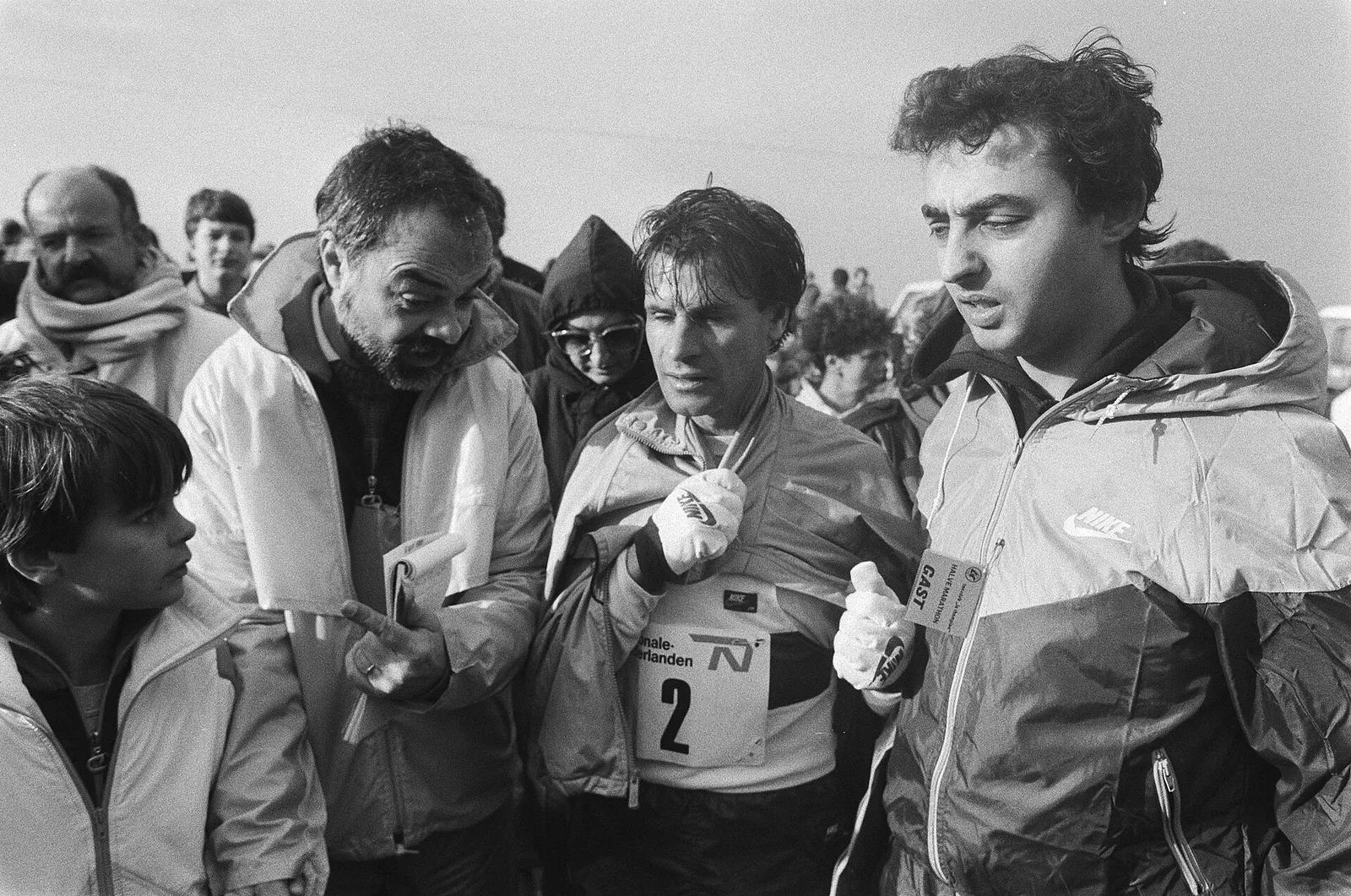
- Lopes, still wearing his race number, surrounded by people at the Egmond aan Zee half marathon in the Netherlands on 12 January 1986, in his last seasons of racing. Rob Croes for Anefo, CC0, via Wikimedia Commons.
- The Pavilhão Carlos Lopes in the Parque Eduardo VII, Lisbon, in August 2017, after its restoration. The former sports hall took his name in 1984. Joseolgon, CC BY-SA 4.0, via Wikimedia Commons.