

Ramalho Eanes sworn in: the general who sent the army back to barracks
Less than eight months after he led the operation that ended Portugal's revolutionary period, a 41-year-old general swore to defend the new Constitution. During his ten years in office the soldiers' hold on the state was dismantled, his own powers included.
At a glance
- General António Ramalho Eanes, aged 41, was sworn in as President of the Republic in the Assembly of the Republic at São Bento, Lisbon, on 14 July 1976.
- On 27 June 1976 he had won the first round with 2,967,137 votes, 61.59 per cent of the valid votes, against Otelo Saraiva de Carvalho, Admiral Pinheiro de Azevedo and the Communist Octávio Pato.
- He was the first president elected under the 1976 Constitution. He was also chief of the General Staff of the Armed Forces and, by virtue of his office, president of the Council of the Revolution, the military body that could strike down laws.
- He was re-elected on 7 December 1980 with 56.44 per cent, three days after Prime Minister Sá Carneiro died at Camarate, and served until 9 March 1986.
- The constitutional revision he promulgated in September 1982 abolished the Council of the Revolution and ended the armed forces' formal role in government. His successor, Mário Soares, was the first civilian president since 1926.
Six in the evening at São Bento
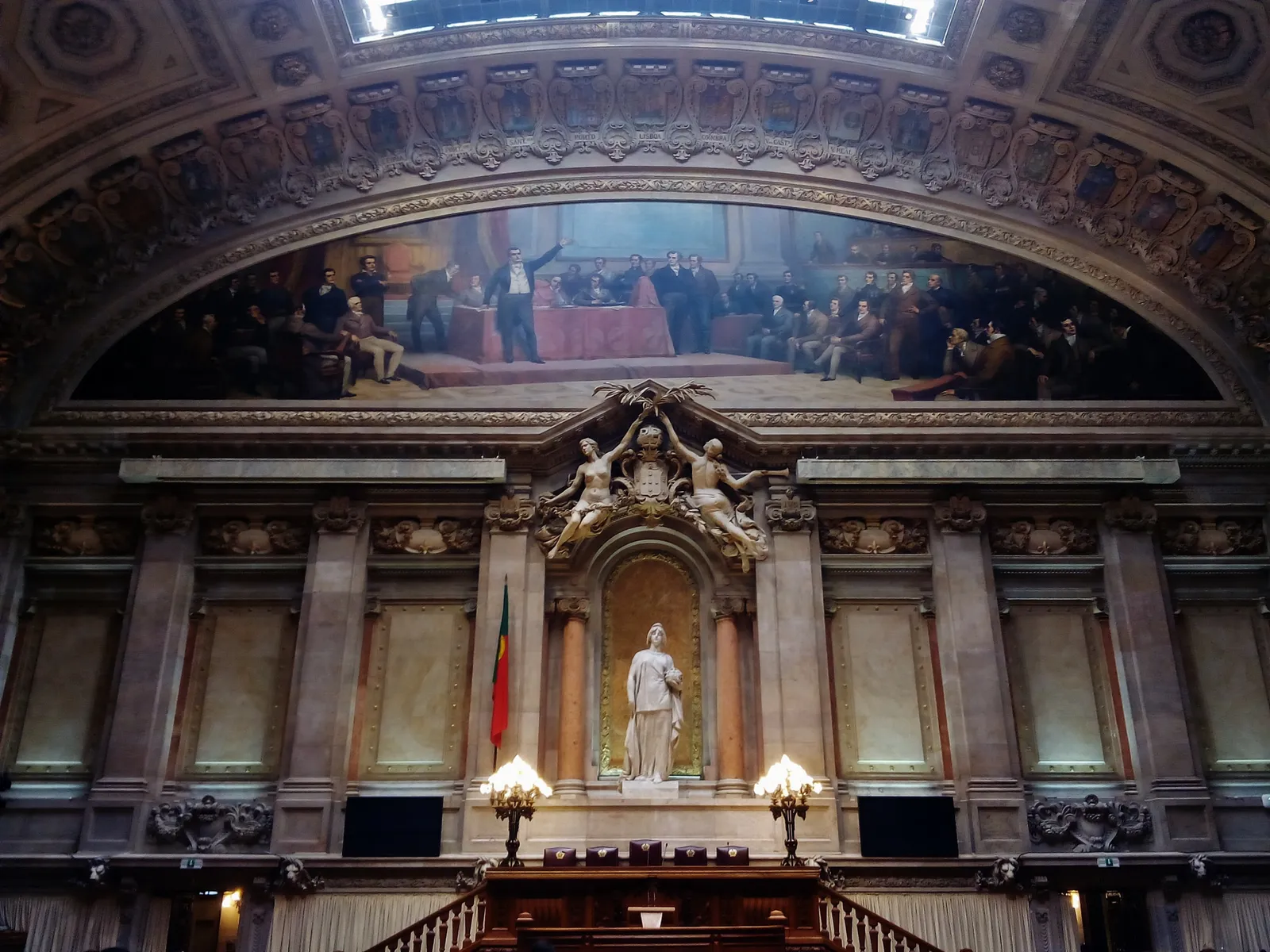
The deputies of the new Assembly of the Republic answered the roll at four in the afternoon of Wednesday 14 July 1976. With 235 of them present, the Assembly's president, Vasco da Gama Fernandes, opened the sitting at 16:25 and suspended it two minutes later, asking them to be back in their seats by 17:50. At six o'clock a procession entered the chamber of the Palácio de São Bento to warm applause.
At its centre walked General António dos Santos Ramalho Eanes, the President-elect. He greeted the outgoing President, General Francisco da Costa Gomes, bowed to the diplomatic corps and took his place at the right of the Assembly's president. The members of the Council of the Revolution, the government and the senior judges were already in the room.
A secretary read the minutes of the national count, held at the Supreme Court of Justice on 5 and 6 July. The counting panel of judges and mathematics teachers had had to settle whether blank ballots counted as valid votes (they decided they did not) and had waited a day for the returns from Lisbon and Macau. Then Eanes stood and swore on a copy of the Constitution, reading the formula it laid down.
“I swear on my honour to perform faithfully the functions with which I am invested and to defend and enforce the Constitution of the Portuguese Republic.”
A band of the Republican National Guard played the national anthem, and Eanes and the Assembly's president signed the record of investiture. In his address Eanes said the ceremony crowned a long road of resistance to oppression, and he warned that no attempt to create “parallel powers” rooted in insurrection would be tolerated. The deputies of the Socialist Party, the centre-right PPD and the conservative CDS rose to applaud.
He promised the new government the authority it needed to answer the hopes of “a people tired of living in a provisional country, postponed time after time”. Portugal had “closed the cycle of empire”, he said, and it was poorer than before. He ended on a line that brought the whole chamber to its feet: “that Portugal, with everyone, may fulfil itself in Portugal”.
- Date
- Wednesday 14 July 1976, from about 6 pm
- Place
- Chamber of the Assembly of the Republic, Palácio de São Bento, Lisbon
- New president
- General António Ramalho Eanes, aged 41
- Outgoing president
- General Francisco da Costa Gomes
- Why that day
- The Constitution set the swearing-in for the eighth day after the official count, completed on 6 July
- Election
- 27 June 1976, won in the first round with 61.59% of valid votes
The officer from Alcains
Eanes was born in Alcains, near Castelo Branco, on 25 January 1935, the son of a building contractor. According to the presidency's biography, he would have liked to study medicine, but the family could not afford it and he went to the Army School instead. He was commissioned as an infantry officer in 1957 and served in Portuguese India, Macau, Mozambique, Guinea and Angola as the colonial wars went on.
In Guinea he ran radio and press for General António de Spínola, with Otelo Saraiva de Carvalho, a former room-mate, at his side. He was in Angola on 25 April 1974, when the Armed Forces Movement (MFA) overthrew the dictatorship, and took no part in the coup. Called back to Lisbon, at once according to the presidency's biography, he ran the state broadcaster RTP from October 1974. Accused of a part in the failed right-wing coup of 11 March 1975, he resigned, demanded an inquiry and was cleared.
By the autumn of 1975 the revolution had split the army. Eanes sided with the moderates of the “Group of Nine” and prepared their plan against a coup by the radical left. On 25 November 1975, when paratroopers seized air bases, he directed the response from the Commando Regiment at Amadora. A separate article tells that story. On 6 December he became chief of staff of the Army, with the acting rank of general.
That was when most Portuguese learnt his name. The historian Rui Ramos describes him in camouflage and dark glasses, with a closed face on which a smile always looked forced. Over the following months he dismantled the army of assemblies, motions and show-of-hands votes that had grown up since 1974.
Three soldiers and a Communist
Eanes announced his candidacy on 14 May 1976. Rui Ramos argues that the parties chose him for the reason the moderates had given him command on 25 November: he could talk to everyone. The Socialists, the PPD and the CDS backed him, and so did smaller groups such as the far-left MRPP.
Two of his three opponents were also military men. Major Otelo Saraiva de Carvalho, a central figure of the 25 April coup who had commanded COPCON, the revolutionary operational command, until November 1975, ran for a coalition of small far-left groups. Admiral José Pinheiro de Azevedo, the serving prime minister, stood without any party and spent the last days of the campaign in hospital after a heart attack. The Communist Party ran Octávio Pato, the only civilian.
“I am convinced that General Ramalho Eanes went around torpedoing 25 April, and I myself was several times on the point of having him arrested, but Otelo never let me.”
The campaign was violent. Stones and shots met Otelo's convoy at Lamego. In Évora, a Communist stronghold, gunfire greeted Eanes's visit and left one dead and six wounded; Diário de Lisboa dated it 17 June, the presidency's biography the 18th. Rui Ramos writes that Eanes climbed onto the roof of his car and stood there, unmoved. At a rally in Lisbon's Alameda at the end of the campaign he told the crowd: “Fascism died in this country.”
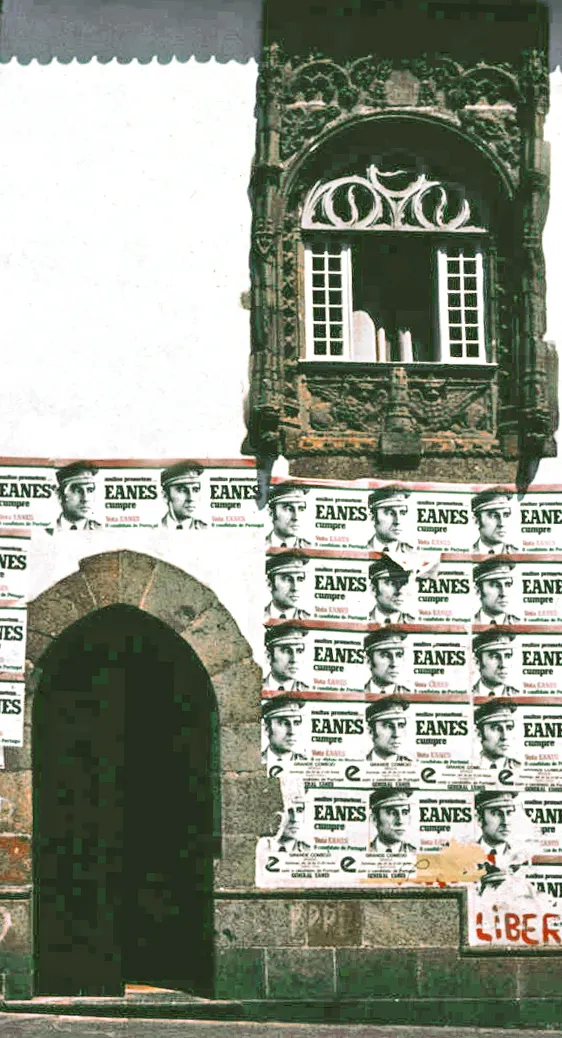
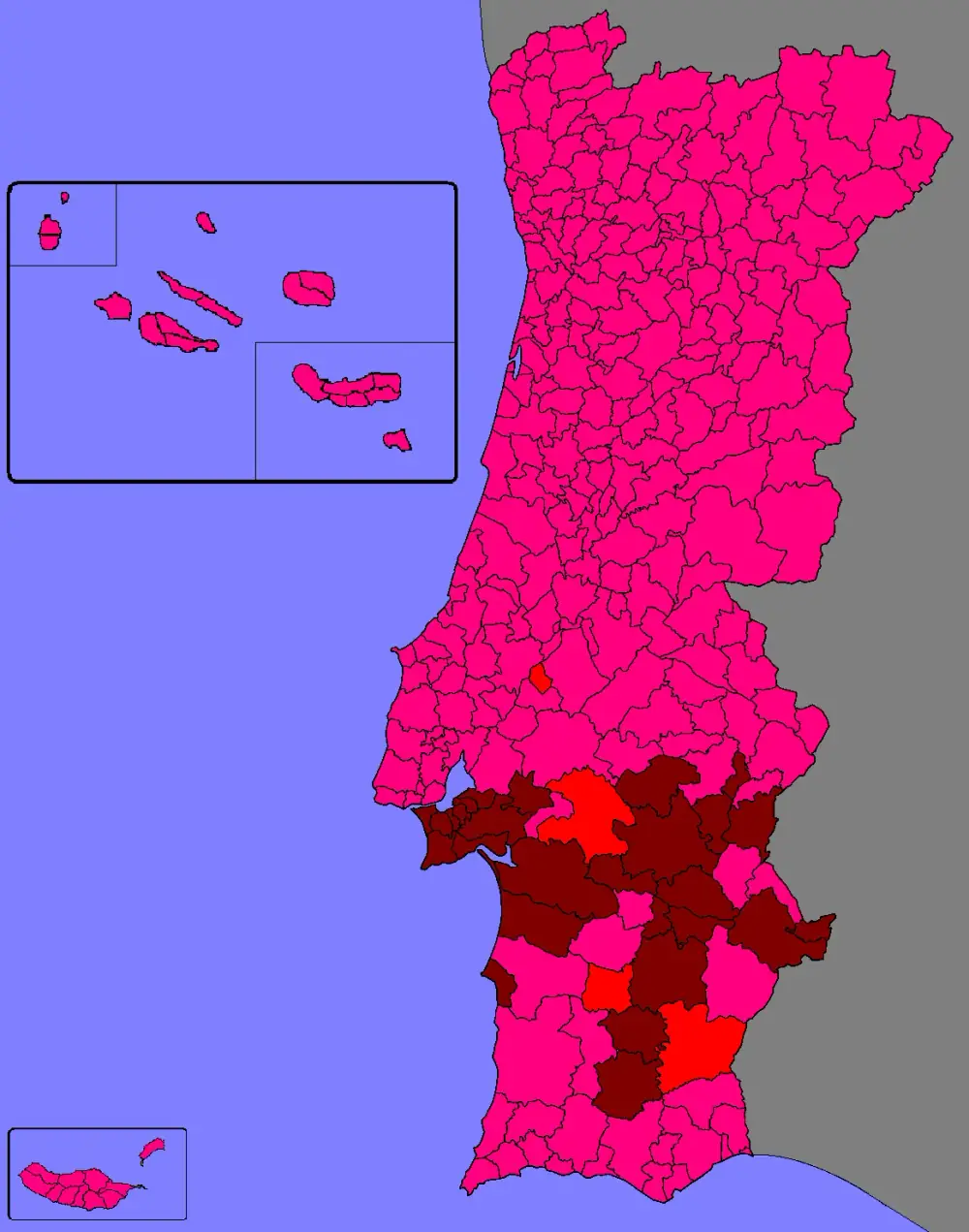
On Sunday 27 June, 4,881,125 of the 6,467,480 registered voters cast a ballot, a turnout of about 75.5 per cent. Eanes won outright with 2,967,137 votes. Otelo came second with 792,760, ahead of Pinheiro de Azevedo with 692,147 and Pato with 365,586. The presidency's biography reads the result as a popular seal on the end of the revolutionary period, which had already been defeated by force of arms months before.
Presidential election, 27 June 1976
% of valid votes
Official result published by the National Elections Commission in the Diário da República of 6 July 1976. Shares are of the 4,817,630 valid votes; the 20,253 blank and 43,242 spoilt ballots were left out, as the count decided.
Show the data
| Share of valid votes | |
|---|---|
| Eanes | 61.6 |
| Otelo | 16.5 |
| Pinheiro de Azevedo | 14.4 |
| Pato | 7.6 |
One man, three offices
The Constitution made the President, by virtue of his office, president of the Council of the Revolution and supreme commander of the armed forces. The Council, an organ of sovereignty made up only of officers, advised the President, judged whether laws were constitutional and alone could legislate on military matters. He could not even leave the country without its authorisation.
Eanes added a third office. A month after his election he announced that, like Costa Gomes before him, he would “temporarily” be chief of the General Staff of the Armed Forces as well. Otelo said the President-elect could “become a dictator”. On 14 July he took both posts. Rui Ramos thinks no president since Sidónio Pais had held so much power.
He used it to push the soldiers back to barracks. Less than a month after taking office he had the Council forbid its members to hold commands at the same time: five of the eighteen had to choose, and two kept their commands. He also proposed that the President appoint the chiefs of staff, with the Council merely consulted. In April 1977 the Council approved a military justice code and discipline regulations that required “strict political non-partisanship”.
Some councillors, led by Ernesto Melo Antunes, wanted the Council to keep pushing the revolution forward. Eanes kept it quiet. When one member, Franco Charais, put forward a plan for military organisation in April 1978 that would have extended the Council's powers, the President controlled the agenda so well that eight months later it had still not been discussed, the historian David Castaño found in the Council's archives.
- Opinions on constitutionality, 1976 to 1983
- 213 from the Constitutional Commission, the Council's panel of legal advisers; the Council went against its advice 13 times (6.1%)
- Rulings on appeal
- 481 judgments by the Commission, on about fifty different questions
- Preventive review
- Sought for 1.5% of the 4,600 laws and decrees sent to the President to sign or promulgate, 1976 to 1983
- Laws sent back to parliament
- Two in six years, according to Maria Carrilho
- Promotions to general officer
- Only 1.5% originated in the Council, according to Medeiros Ferreira
A president against the party leaders
Eanes saw the presidency as an arbiter that could, and should, criticise the government and the parties in public, and in 1976 he refused calls to found a presidential party. In Rui Ramos's account, party leaders took that view of the office as a challenge, and the first term became a long quarrel with Mário Soares and then with Francisco Sá Carneiro.
Soares's Socialist minority government lost a vote of confidence, and in January 1978 he formed a second, backed by the CDS. The CDS withdrew in July, and on 27 July Eanes dismissed him. The President then made three governments of his own choosing. Nobre da Costa's programme was rejected by parliament within three weeks. Carlos Mota Pinto lasted until June 1979. Maria de Lourdes Pintasilgo held office only until an early election.
| Government | Prime minister | Support | Took office | How it ended |
|---|---|---|---|---|
| I | Mário Soares | PS alone | July 1976 | Lost a vote of confidence; replaced in January 1978 |
| II | Mário Soares | PS with CDS | January 1978 | CDS withdrew; Eanes dismissed Soares on 27 July 1978 |
| III | Nobre da Costa | Presidential initiative | August 1978 | Programme rejected by parliament, 14 September 1978 |
| IV | Carlos Mota Pinto | Presidential initiative | November 1978 | Mota Pinto resigned, June 1979 |
| V | Maria de Lourdes Pintasilgo | Presidential initiative | August 1979 | Caretaker until the early election of December 1979 |
| VI | Francisco Sá Carneiro | AD (PSD, CDS, PPM) | January 1980 | Sá Carneiro killed at Camarate, 4 December 1980 |
| VII | Francisco Pinto Balsemão | AD | January 1981 | Balsemão resigned in August 1981 to settle the coalition's support |
| VIII | Francisco Pinto Balsemão | AD | September 1981 | Balsemão resigned in December 1982; early election called |
| IX | Mário Soares | PS and PSD | June 1983 | PSD left after the EEC accession treaty; Soares resigned |
| X | Aníbal Cavaco Silva | PSD | November 1985 | Still in office when Eanes left |
From RTP's list of governments. Sources differ by a day on some swearing-in dates, so only months are given.
According to Ramos, Sá Carneiro saw Mota Pinto's appointment as a manoeuvre to break up his PSD (the former PPD), and the quarrel over it split the party: in April 1979 almost half its deputies left. The early election of 2 December 1979 was won by Sá Carneiro's Democratic Alliance (AD), which won again in October 1980.
Re-elected in the shadow of Camarate
The AD wanted “one government, one majority, one president” and ran another general, António Soares Carneiro. Eanes stood again as an independent. Soares, who had suggested the Socialists find another candidate, withdrew his personal support less than two months before the vote and suspended himself as party leader, though the PS stayed behind Eanes. The Communist candidate, Carlos Brito, withdrew a few days before polling day in Eanes's favour.
On 4 December Sá Carneiro and his defence minister, Adelino Amaro da Costa, were killed when their plane crashed at Camarate on the way to a rally for Soares Carneiro; another article covers the crash. The National Elections Commission ruled that it gave no legal ground to postpone the vote. Their funerals were broadcast for hours on the eve of the election, and on Sunday 7 December Eanes won again in the first round.
| Candidate | Votes | Share of valid votes |
|---|---|---|
| António Ramalho Eanes | 3,262,520 | 56.44% |
| António Soares Carneiro | 2,325,481 | 40.23% |
| Otelo Saraiva de Carvalho | 85,896 | 1.49% |
| Carlos Galvão de Melo | 48,468 | 0.84% |
| António Pires Veloso | 45,132 | 0.78% |
| António Aires Rodrigues | 12,745 | 0.22% |
Official result in the Diário da República of 26 December 1980. 5,840,332 of 6,920,869 registered voters cast a ballot (84.4%); 16,076 ballots were blank and 44,014 spoilt.
He was sworn in again on 14 January 1981 and told parliament that by the end of February he would no longer be chief of the General Staff. The Christian Science Monitor recalled that in 1976 his advisers had first asked him to drop his dark glasses, which made him look “too much like a South American dictator”, and that he had done so at once.
The revision that sent the soldiers home
The Council of the Revolution had been meant as a transition. As early as December 1978, at a CDS congress, Francisco Lucas Pires called it a “postponed corpse”, and in January 1979 Sá Carneiro proposed a revision that would end it and any political role for the armed forces. In July 1981 the Council declared unconstitutional the AD's law redrawing the line between the public and private sectors of the economy. The government attacked the decision; Eanes told the councillors he saw no advantage in a reply, and they made none.
In 1982 the AD and the Socialists agreed a revision between them. Parliament approved it on 12 August with 195 votes, against those of the Communists and the far-left UDP. Eanes promulgated it on 24 September. It was published on 30 September and took effect thirty days later.
The revision deleted the Council of the Revolution from the organs of sovereignty, and it ceased to exist. A Council of State took over its role as the President's advisers and a new Constitutional Court its role as guardian of the Constitution. The President was shut out of choosing the court's thirteen judges. The government stayed responsible to him, but the word “politically” went, and he could now dismiss it only to ensure the regular functioning of democratic institutions, after hearing the Council of State.
Rui Ramos sees the revision as the party leaders finally agreeing on something: cutting the President down. The presidency's own biography says it narrowed his room for manoeuvre in foreign and defence policy. Eanes fought one more round. He vetoed the new National Defence Law, saying it turned the defence minister into a “minister of the armed forces” and restricted soldiers' individual rights beyond what the Constitution allowed. Parliament passed it again unchanged in December 1982, with only the Communists against.
The last years in Belém
When Pinto Balsemão resigned at the end of 1982, Eanes refused to appoint the PSD's choice of successor, Vítor Crespo, and on 4 February 1983 called an early election. It was held on 25 April and brought a “central bloc” coalition of the PS and the PSD under Soares, with which the President got on fairly well.
With his powers cut and his last term running out, he gave in to the idea of a party in his image. The Democratic Renewal Party (PRD) was founded on 24 February 1985, with Eanes still in Belém, and won 17.9 per cent in the election of 6 October 1985. Ramos says its votes came above all from Socialist voters, and notes that the President was not invited to the public signing of Portugal's treaty of accession to the European Economic Community on 12 June 1985.
Francisco Salgado Zenha, the candidate Eanes backed to succeed him, came third in the first round in January 1986. On 9 March 1986 Eanes handed the presidency to his old adversary Mário Soares, the first civilian in the post since the end of the First Republic in 1926. He led the PRD from August 1986 and resigned after its poor result in 1987.
25 November 1975
Directs the moderates' operation against the left-wing military revolt
6 December 1975
Chief of staff of the Army
14 May 1976
Announces his candidacy
27 June 1976
Elected President in the first round with 61.59%
14 July 1976
Sworn in; also takes over as chief of the General Staff
27 July 1978
Dismisses Soares's second government
1978 to 1979
Three governments of presidential initiative
7 December 1980
Re-elected with 56.44%
14 January 1981
Second term begins
24 September 1982
Promulgates the revision that abolishes the Council of the Revolution
4 February 1983
Calls an early election
24 February 1985
The PRD is founded
9 March 1986
Hands over to Mário Soares
Why it still matters
Rui Ramos calls Eanes the last of a line of military presidents running from the election of General Óscar Carmona in 1928 (Carmona had been head of state since July 1926), and at 41 the youngest President Portugal has had. He also presided over the end of the soldiers' share in power. The revision he promulgated and the defence law of 1982 left the armed forces under elected civilian government, and his successor was a civilian.
His wish to be “President of all the Portuguese” has been taken up as a motto by his successors. As a former president elected under the current Constitution he sits for life on the Council of State. In 2000 he turned down promotion to marshal, and in 2006 he took a doctorate in political philosophy at the University of Navarra with a thesis on civil society and political power in Portugal.
On Portugal Day, 10 June 2025, in Lagos, President Marcelo Rebelo de Sousa gave him the grand collar of the Military Order of Avis. He was 90.
FAQs
When was Ramalho Eanes sworn in as President, and why on 14 July?
He took the oath before the Assembly of the Republic at São Bento on the evening of Wednesday 14 July 1976. The transitional rules of the 1976 Constitution set the first president's swearing-in for the eighth day after the official count of the votes, held at the Supreme Court of Justice and completed on 6 July.
How many votes did Eanes win in 1976 and 1980?
On 27 June 1976 he won 2,967,137 votes, 61.59 per cent of the valid votes, against Otelo Saraiva de Carvalho (16.46), Pinheiro de Azevedo (14.37) and Octávio Pato (7.59). On 7 December 1980 he won 3,262,520 votes, 56.44 per cent, against António Soares Carneiro's 40.23. Both times he won in the first round.
Was Eanes the first Portuguese president elected by universal suffrage?
He was the first president elected under the Constitution of 1976, by direct, secret and universal vote, and the first chosen by the voters after the Carnation Revolution of 25 April 1974. The historian David Castaño calls him the first elected by direct, secret and universal suffrage, and Rui Ramos the first democratically elected president.
What was the Council of the Revolution, and when did it end?
A body of military officers set up in March 1975 and kept by the 1976 Constitution as an organ of sovereignty. It advised the President, ruled on whether laws were constitutional and legislated on military matters, with the President of the Republic as its president. The first constitutional revision, approved on 12 August 1982 and promulgated by Eanes on 24 September, abolished it; the Council of State and the Constitutional Court took over its functions.
What did Eanes do after leaving office?
He led the Democratic Renewal Party (PRD) from August 1986 until August 1987, when he resigned after a poor election result. He has been a member of the Council of State since 1986, refused promotion to marshal in 2000 and earned a doctorate from the University of Navarra in 2006.
On the timeline
Open the timelineNearby moments from revolution and democracy (1974–1986).
Nine days after Fretilin declared East Timor's independence, Indonesia launches a full-scale invasion of the former Portuguese colony with an assault on Dili. The occupation lasted 24 years; East Timor's truth commission later documented at least 102,000 conflict-related deaths between 1974 and 1999, most from hunger and disease.
The Constituent Assembly approves the Constitution of the Portuguese Republic, founding the democratic regime that followed the Carnation Revolution. It enters into force on 25 April.
General Ramalho Eanes, Chief of Staff of the Army and architect of the 25 de Novembro 1975 intervention that ended the radical phase of the revolution, is elected first President of the Portuguese Republic under the new democratic constitution, winning more than 60% of the vote in the first round.
Ramalho Eanes sworn in as President
General António Ramalho Eanes, aged 41, is sworn in as President of the Republic after winning 61.6% of the vote in the first round — the first head of state elected by universal suffrage after the Carnation Revolution. The career soldier would serve two terms until 1986, overseeing the end of military tutelage over Portugal's new democracy.
The first Regional Government of the Azores, led by João Bosco Mota Amaral, takes office in Ponta Delgada, inaugurating the autonomous government of the archipelago under Portugal's new democratic constitution.
Portugal becomes the 19th member state of the Council of Europe, with Foreign Minister José Medeiros Ferreira signing the instrument of accession in Strasbourg, a club the dictatorship had never been invited to join.
Portugal holds its first democratic local elections, choosing 304 mayors and thousands of councillors and parish representatives. The Socialists win the most votes, about a third, and take Lisbon and Porto, though they tie with the PPD at 115 mayors each; abstention, at around 35%, is more than double that of the parliamentary election held that April.
Coming up in history
All long reads 16 July 1590Bartolomeu dos Mártires: the archbishop who took Trent home to Braga
 17 July 1859Queen Estefânia's death in 1859 and the hospital it left Lisbon
 18 July 197418 July 1974: Vasco Gonçalves becomes the MFA's prime minister
 19 July 1717Portugal's ships against the Ottoman fleet at Matapan, 19 July 1717
20 sources
Archives, scholarship and reporting this article was checked against.
- 1
Diário da Assembleia da República, I série, n.º 6, 15 July 1976: sitting of 14 July (posse de S. Ex.ª o Presidente da República)Assembleia da República, Debates Parlamentares
- 2
António Ramalho Eanes (1976-1986)Presidência da República Portuguesa
- 3
Mapa oficial com o resultado final da eleição para a Presidência da República, 27 de Junho de 1976 (Diário da República, I série, suplemento ao n.º 156, 6 July 1976)Comissão Nacional de Eleições
- 4Eanes, o Presidente do 25 de Novembro (Rui Ramos)Observador, 25 November 2017
- 5Como Eanes pôs os militares nos quartéis (David Castaño)Observador, 27 June 2016
- 6
O Conselho da Revolução e a imprensa (1976-1982) (David Castaño)Media & Jornalismo 35 (2019), Universidade de Coimbra
- 7
Lei Constitucional n.º 1/82, de 30 de Setembro: primeira revisão da ConstituiçãoTribunal Constitucional (from Diário da República, I Série, n.º 227, 30 September 1982)
- 8
- 9
Constituição da República Portuguesa, texto original de 1976Assembleia da República
- 10
O Conselho da Revolução (Maria do Céu Filipe)Arquivo Nacional Torre do Tombo, 2014
- 11Eleições presidenciais em 8 takesObservador, with Lusa, 11 January 2016
- 12
- 13
Da consolidação tutelada ao predomínio civil democrático (Maria Carrilho)O Mundo em Português 60 (December 2005), Instituto de Estudos Estratégicos e Internacionais
- 14Governos de PortugalRTP Notícias
- 15
Portuguese President promises to take off his military hat (Richard Timsar)The Christian Science Monitor, 19 January 1981
- 16Nos 40 anos da Constituição portuguesa, já aprovadas sete revisões ao textoObservador, 1 April 2016
- 17
Óscar Carmona (biography)Museu da Presidência da República
- 18
Ramalho Eanes condecorado com Ordem Militar de AvisA Bola, with Lusa, 10 June 2025
- 19
- 20
Image credits
- The debating chamber of the Palácio de São Bento in Lisbon, home of the Assembly of the Republic, in 2017. Ramalho Eanes swore the presidential oath here on the evening of 14 July 1976. RickMorais, CC BY-SA 4.0, via Wikimedia Commons.
- Campaign posters reading “Eanes cumpre” (“Eanes delivers”) on the Casa dos Coimbras in Braga, photographed in August 1976, weeks after the vote. LBM1948, CC BY-SA 4.0, via Wikimedia Commons.
- The leading candidate in each municipality on 27 June 1976, in a map drawn for Wikimedia Commons in 2020: Eanes in magenta, Otelo in dark brown and Pato in red. Otelo led on the south bank of the Tagus around Setúbal and in much of the Alentejo. Giloliveira1994, CC BY-SA 4.0, via Wikimedia Commons.
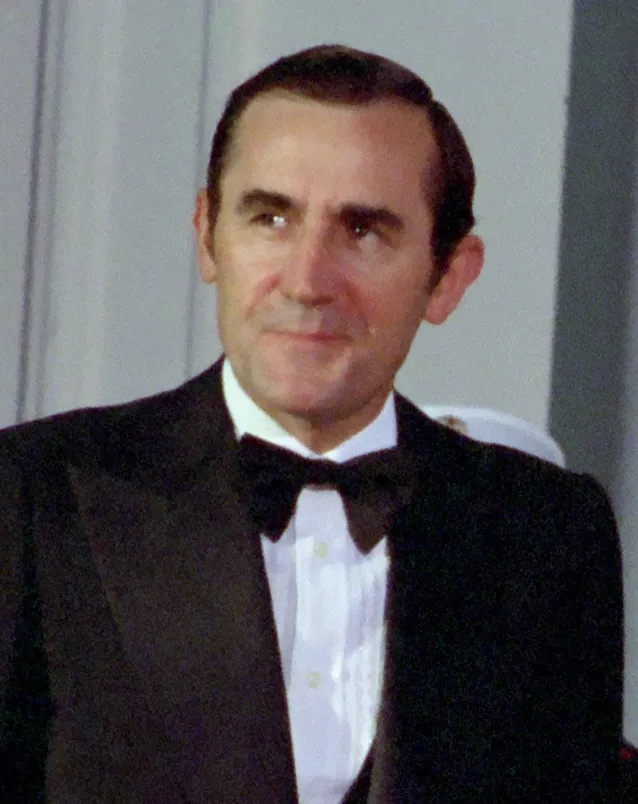
- Eanes at the White House before a state dinner on 15 September 1983, during his visit to the United States. White House Photographic Office, Public domain, via Wikimedia Commons.
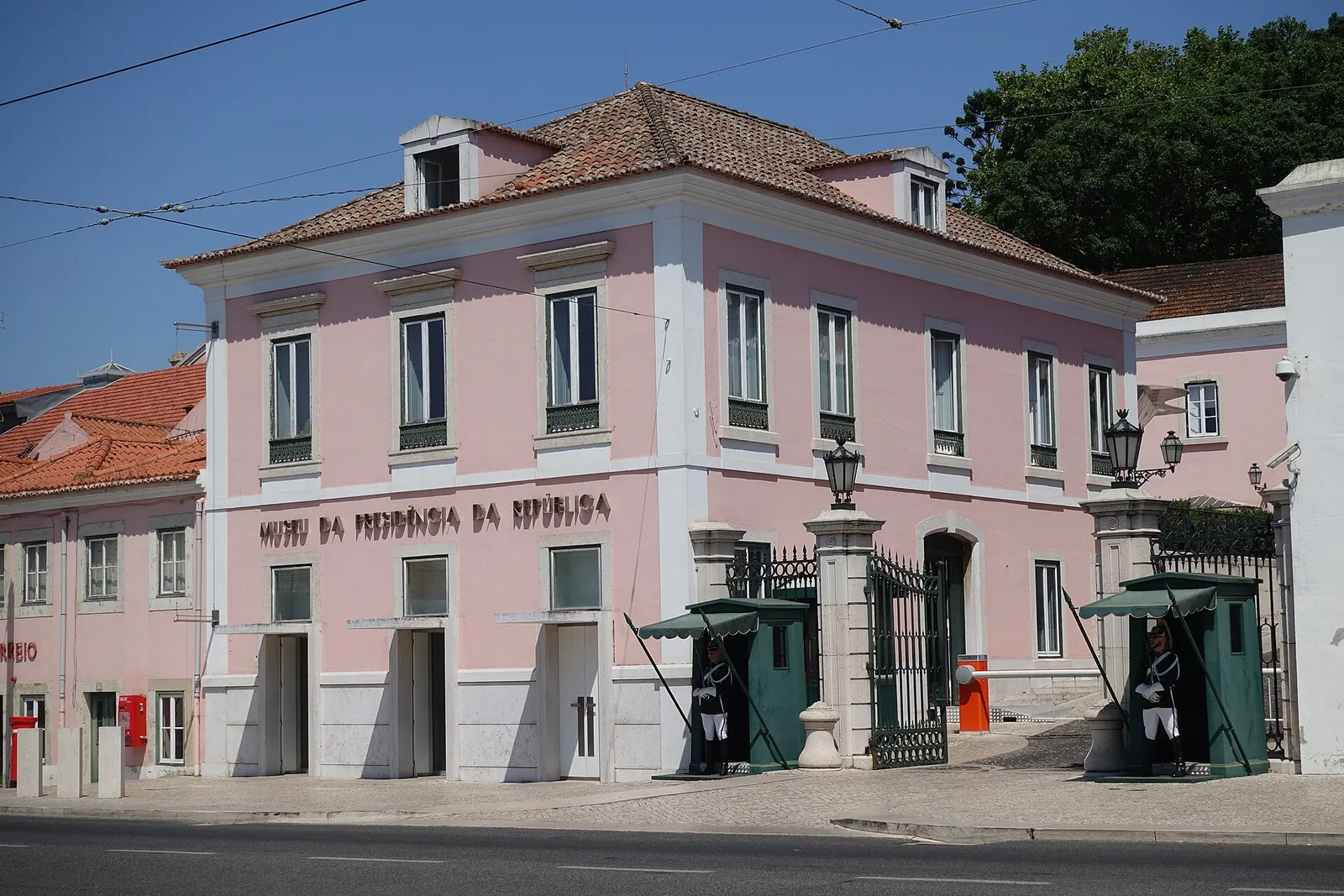
- The entrance to the Museu da Presidência da República next to the Palácio de Belém, Lisbon, in 2016. Joseolgon, CC BY-SA 4.0, via Wikimedia Commons.