

Francisco Lázaro: the Lisbon carpenter who died in the 1912 Olympic marathon
Portugal sent six men to its first Olympic Games, and pinned its hopes on a carpenter from Benfica who had won every Lisbon marathon he had run since 1908. He fell on a hill north of Stockholm and died the next morning.
At a glance
- Portugal first took part in the Olympic Games at Stockholm in 1912, with six athletes. Francisco Lázaro, a carpenter in a Lisbon car-body works and the country's best marathon runner, carried the flag at the opening ceremony on 6 July.
- In the marathon on Sunday 14 July, run in hot sun over 40.2 km, he staggered and fell on the hill at Öfver-Järva, about 30 km into the race, and was taken unconscious to the Royal Seraphim Hospital with a temperature of 41.2 °C.
- He died there early on 15 July 1912, at 6 am by the official report or 6.20 am by other accounts, aged 24 by the birth date sports records give. Olympedia records him as the first athlete to die during an event at the modern Olympic Games.
- His teammate Armando Cortesão later said that he and Fernando Correia had found Lázaro greasing his body with tallow before the start. The autopsy confirmed sunstroke; whether the grease played any part has been argued over ever since.
- A benefit festival in the Olympic Stadium raised about 14,000 kronor for his family. His body came home on a Swedish warship, and on 24 September 1912 a procession on foot took it to the cemetery in Benfica, Lisbon.
The hill at Öfver-Järva
The road north of Stockholm was hot and dusty on the afternoon of Sunday 14 July 1912. Somewhere near the 30th kilometre of the Olympic marathon, on the hill at Öfver-Järva, a dark, moustached runner was seen to stagger. He fell, got up and ran on, fell again, rose again, and then went down and stayed down.
A Swedish physician who happened to be standing by, Dr C. R. Torell, reached him almost at once. Within minutes Dr G. Liljenroth arrived from the medical station at Silfverdal, followed by Dr K. A. Fries, the doctor in the race director's car. They packed ice on the runner's head and tried to bring him round. When nothing worked they telephoned the Stadium and put him in a motor car for the Royal Seraphim Hospital.
The runner was Francisco Lázaro, a carpenter from the Lisbon district of Benfica and the man who had carried Portugal's flag into the Stadium eight days earlier. He reached the hospital at about 5.30 pm, still unconscious, convulsing and delirious, with a temperature of 41.2 °C. He did not recover.
A young republic goes to the Games
Portugal had been a republic for less than two years. In 1912 the Lisbon press, led by the daily O Século and the sports paper Os Sports Ilustrados, campaigned for the country to be seen at the Olympic Games, and on 30 April clubs and sports journalists founded a Portuguese Olympic Committee in Lisbon. In early July, while the team was in Stockholm, royalists led by Paiva Couceiro made their second armed incursion against the Republic.
Money was the problem. The government gave no subsidy, a public subscription started with a donation from the President of the Republic raised little, and a fundraising gala at the Coliseu dos Recreios on 22 June drew a thin crowd because a tram strike had paralysed Lisbon. The committee had picked ten athletes. Short of money, and unimpressed by some trial results, it sent six.
They sailed from Lisbon on 26 June on the Royal Mail liner Astúrias, with first-class passages paid for by the Pinto Basto family. Fernando Correia, a fencer, journalist and committee member, led the team; the wrestler Joaquim Vital doubled as trainer and masseur. Among the families on the quay was Lázaro's partner, Sofia, five months pregnant.
At the opening ceremony on Saturday 6 July, the nations marched in alphabetical order. Portugal came after Norway and before Russia, Lázaro in front with the new green and red flag of the Republic. Twenty-eight countries and about 2,400 competitors took part in the Stockholm Games, and for Portugal, as for Japan, it was a first appearance.
| Athlete | Sport | Event | Result |
|---|---|---|---|
| António Stromp | Athletics | 100 metres | 3rd in heat 5, out in round 1 |
| António Stromp | Athletics | 200 metres | 3rd in heat 18, out in round 1 |
| Armando Cortesão | Athletics | 400 metres | 3rd in heat 3, out in round 1 |
| Armando Cortesão | Athletics | 800 metres | Reached the semi-finals; withdrew injured |
| Francisco Lázaro | Athletics | Marathon | Collapsed about 30 km in; died the next day |
| Fernando Correia | Fencing | Épée, individual | Disqualified in his first-round pool after a protest |
| António Pereira | Wrestling | Greco-Roman featherweight | Out in round 3 |
| Joaquim Vital | Wrestling | Greco-Roman middleweight | Out in round 3 |
Results as recorded by Olympedia; the reasons for Cortesão's withdrawal and Correia's disqualification are from Pinheiro and Nolasco, who place Stromp fourth, not third, in his 200-metre heat. Cortesão's 49.8 seconds for 400 metres was never ratified as a Portuguese record.
The carpenter who outran the tram
Lázaro was born in Benfica, on the edge of Lisbon. Olympedia and Portuguese athletics records give his birth date as 21 January 1888.
He was baptised Francisco da Silva, the son of Lázaro da Silva. In the neighbourhood he was Chico do Lázaro, Lázaro's Chico (short for Francisco), and the name stuck. He could not read, and worked for six tostões a day as a carpenter at Ferreira & Viegas in the Bairro Alto, which built car bodies when they were still largely made of wood.
The story told in Lisbon is that he could not afford the tram fare, so he raced the tram from Benfica to work. The director of the magazine Tiro & Sport, riding in one, is said to have stepped off to ask which club he ran for. He belonged to none. In 1908 he won the magazine's Maratona Portuguesa, a 24 km race, at his first attempt.
Illness kept him out in 1909. After that he won everything: the Lisbon marathon of 1910 in 2 hours 57 minutes 35 seconds, again in 1911, and the first cross-country race held in Portugal, at Lumiar in April 1911. He ran for Benfica, then in 1912 moved to the Lisboa Sporting Clube, as Pinheiro and Nolasco name it (Olympedia lists him under Sporting Clube de Portugal), whose president, José de Mascarenhas, paid for better food and training.
On 2 June 1912 he won the Lisbon marathon again, in 2 hours 52 minutes 8 seconds, over a course that finished up the steep Calçada de Carriche; accounts give its length as 42.26 km or 42.8 km. The press did the sums. That was faster than the American Johnny Hayes had run to win the Olympic marathon in London in 1908, and the papers began to talk of a medal.
| Race | Runner | Distance | Time | Average pace per km |
|---|---|---|---|---|
| Lisbon marathon, 2 June 1912 | Francisco Lázaro (1st) | 42.8 km, as reported | 2:52:08 | 4 min 01 s |
| Olympic marathon, London, 24 July 1908 | Johnny Hayes (gold) | 42.195 km | 2:55:18.4 | 4 min 09 s |
| Olympic marathon, Stockholm, 14 July 1912 | Kenneth McArthur (gold) | 40.2 km | 2:36:54.8 | 3 min 54 s |
| Olympic marathon, Stockholm, 14 July 1912 | Otto Osen (34th, last finisher) | 40.2 km | 3:36:35.2 | 5 min 23 s |
Paces are our arithmetic (time divided by distance). The Lisbon course was not measured to modern standards: Pinheiro and Nolasco give 42,800 metres, used here, and Observador 42,262 metres, which would make Lázaro's pace 4 min 04 s. Pinheiro and Nolasco give the London course as 42,263 metres; Olympedia gives 42,195 metres, used here. Courses and weather differed, so this compares hopes, not abilities.
Sunday 14 July
The day before the race, Swedish doctors examined every entrant's heart. Nobody was ruled out, and Lázaro was passed as good. According to Observador, he had told the press a few days earlier that he welcomed hot weather.
“The heat doesn't bother me. I'm even glad of it, because it will drive off some of the competitors.”
On the day he ate an early lunch at about 10 and was driven to the Stadium with Cortesão and Correia. Shortly before the start, wearing number 518, he still had not come out. According to Cortesão, he and Correia went to the dressing room and found him smearing his body with sebo, tallow. They tried to get him to wash it off, but there was no time.
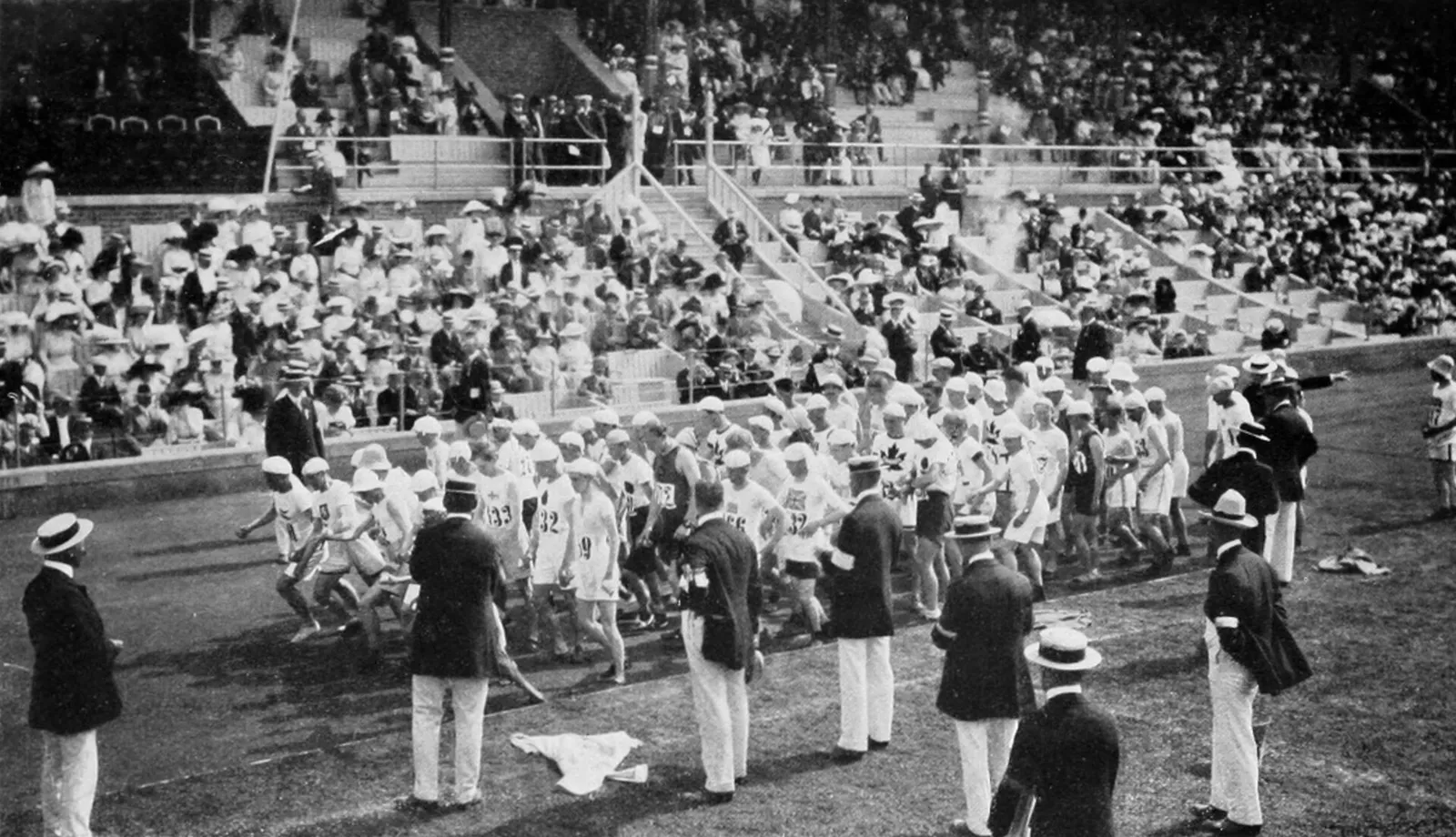
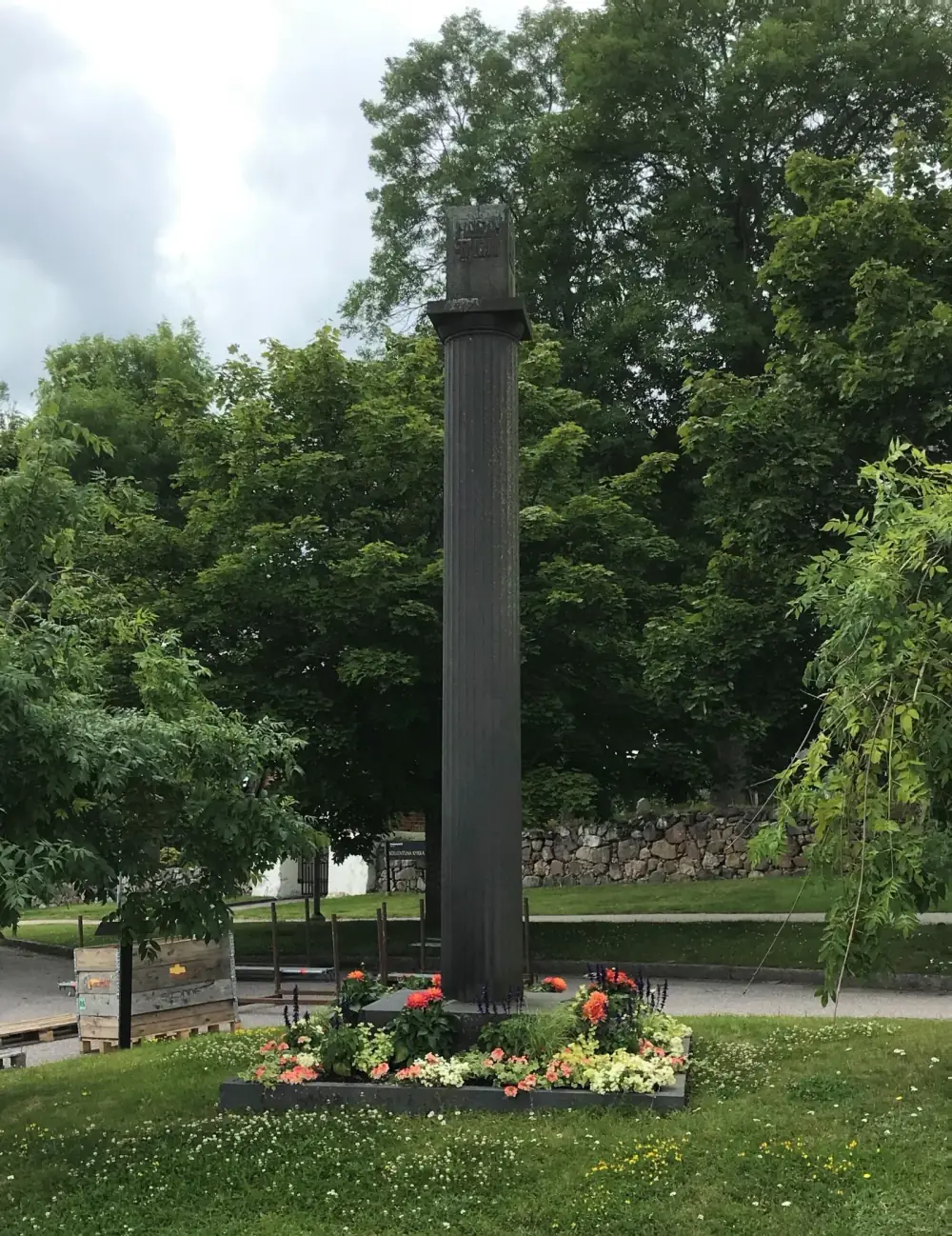
At 1.48 pm the 68 starters ran 350 metres round the track and out through the gate on to Valhallavägen. The course went north along a country road, swept and watered against the dust, through control points at Stocksund and Tureberg to a turn by Sollentuna church, and back the same way: 40.2 km in all. Nearly every runner wore a white hat or handkerchief, the official report says. Lázaro set off bareheaded.
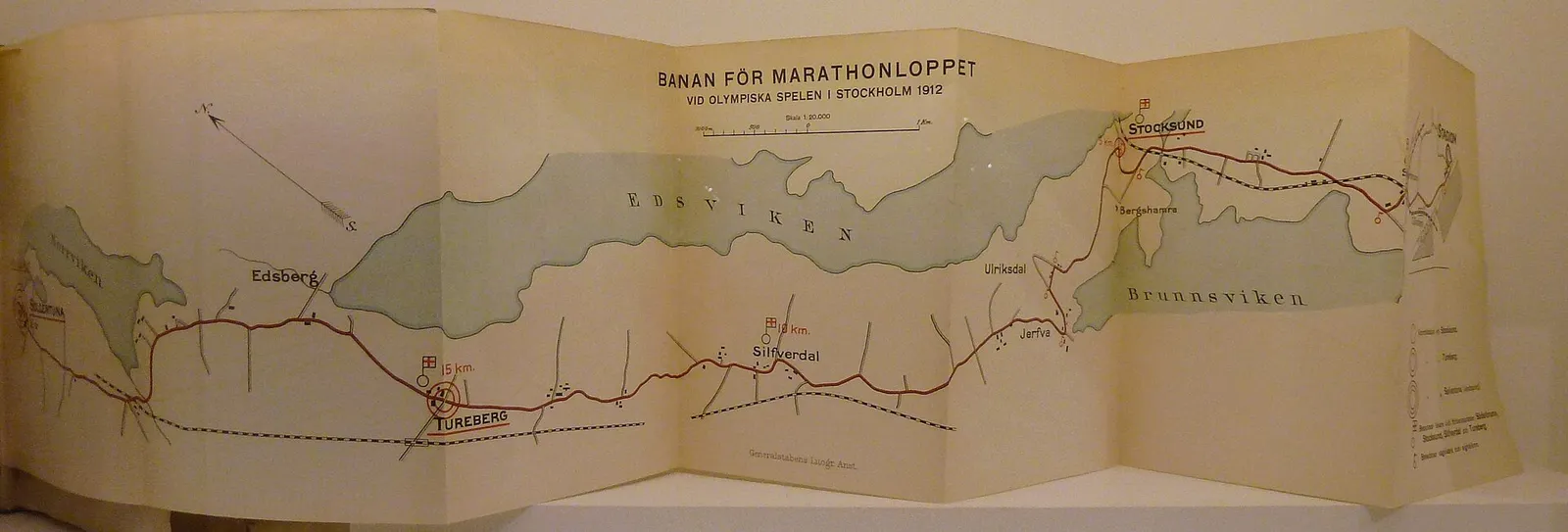
Lázaro went out with the leaders, then dropped back as the Finn Tatu Kolehmainen forced the pace. At Tureberg, 15 km out, where his teammate Vital stood waiting, he was 27th. That was how he liked to race: he had said in Stockholm that he usually hung back early on to save his strength. The South African Chris Gitsham reached the turn first, at 3.00 pm. When Lázaro passed Vital again on the way back, around 25 km, he said he felt fine, only thirsty, and drank.
Stromp and Pereira waited at the 35 km point and Cortesão near the Stadium, and he never came. Kenneth McArthur of South Africa won in 2 hours 36 minutes 54.8 seconds, with Gitsham second and Gaston Strobino of the United States third. Only 34 of the 68 starters finished. The Japanese runner Shizo Kanakuri dropped out near the turn and, to Swedish legend, vanished; he had been taken in by a family in a garden.
- Date
- Sunday 14 July 1912, start at 1.48 pm
- Course
- 40,200 metres, Olympic Stadium to Sollentuna and back
- Starters
- 68 from 19 countries; 34 finished
- Winner
- Kenneth McArthur (South Africa), 2:36:54.8
- Lázaro
- Bib 518; fell near 30 km at Öfver-Järva
- Medical cover
- 11 doctors, 7 medical assistants, 30 sick-attendants and 2 nurses
1.48 pm
68 runners start in the Olympic Stadium
2.17 pm
The leaders pass Stocksund, about 5 km
2.42 pm
Kolehmainen leads at Tureberg, 15 km; Lázaro is about 27th
3.00 pm
Gitsham rounds the turn at Sollentuna first
Later in the afternoon
Lázaro falls on the hill at Öfver-Järva, near 30 km
c. 4.25 pm
McArthur wins in 2:36:54.8
c. 5.30 pm
Lázaro reaches the Royal Seraphim Hospital, at 41.2 °C
15 July, 6 am to 6.20 am
He dies
A night at the Seraphim
His teammates gave up waiting and went back to the Stadium. The Portuguese minister in Stockholm, António Feijó, brought them the news. At the hospital, Dr Arnold Josefson, who had come in from the medical station at Stocksund, saw at once that the case would probably be fatal. The Portuguese were told it was meningitis brought on by sunstroke.
Feijó stayed at the hospital all night. The official programme had farewell festivities for the athletes in the Stadium that evening, and Pinheiro and Nolasco describe a banquet for some 4,000 people in honour of the winner. Doctors gave Lázaro injections of salt water; for a while he moved his hands when his name was spoken, then he grew delirious and moved his legs as if still running. He died early on Monday 15 July, at 6 am according to the official report and 6.20 am in the Portuguese accounts.
“One poor fellow, indeed, who had started in the best of health, was struck down by the sun and never recovered.”
He was not the only casualty. A Bohemian runner was found senseless on the road and spent a night in the same hospital, and two of the youngest competitors reached Stocksund with violent headaches. The organisers had laid on medical stations with beds at Sollentuna, Tureberg, Silfverdal and Stocksund. The sick-rooms soon filled with runners who had dropped out.
How hot was it?
Every account calls the day scorching. The official report speaks of oppressive warmth and an almost tropical sun, and the Swedish National Archives of oppressive heat. A figure of 32 °C in the shade is often repeated, but the marathon historians Roger Gynn and David Martin, quoted by Olympedia, call it unconfirmed. Observador says the temperature passed 40 °C during the race, a figure that could only describe direct sun.
Portuguese accounts add that doctors asked for the start to be moved to the cooler evening and were refused; the official report does not mention it.
Stockholm's Old Astronomical Observatory kept a thermometer outside a north-facing first-floor window, behind a screen. On 14 July 1912 its noon reading and its maximum for the day were both 25 °C. The days either side were much the same, and 16 July, at 29.5 °C, was the hottest of the month.
Daily maximum temperature in Stockholm, 1 to 20 July 1912
°C
Raw daily maxima from the city-centre observatory, read on a thermometer outside a north-facing window. They are not corrected for the instrument's exposure and say nothing about the sun on the dusty road north of the city, where the runners were.
Show the data
| Daily maximum, Old Astronomical Observatory | |
|---|---|
| 1 Jul | 21 |
| 2 Jul | 15 |
| 3 Jul | 16 |
| 4 Jul | 20.5 |
| 5 Jul | 26 |
| 6 Jul | 23 |
| 7 Jul | 26.5 |
| 8 Jul | 27 |
| 9 Jul | 25 |
| 10 Jul | 21.5 |
| 11 Jul | 23.5 |
| 12 Jul | 25 |
| 13 Jul | 26 |
| 14 Jul | 25 |
| 15 Jul | 27.5 |
| 16 Jul | 29.5 |
| 17 Jul | 21 |
| 18 Jul | 22 |
| 19 Jul | 23.5 |
| 20 Jul | 24 |
The doctors who had worked the race drew their own conclusion. A couple of days later the seven physicians on duty at the Stadium wrote to the International Olympic Committee. If the marathon stayed on the programme, they said, it should be run in the coolest part of the day.
“The Marathon race, as an athletic feat, is not of such value as to counterbalance the risk that attends it.”
Tallow, strychnine or the sun
The post-mortem was done by Dr Folke Henschen, and the official report says it fully confirmed the clinical diagnosis of sunstroke. It says nothing about grease. Pedro Nolasco, a Portuguese physical-education teacher who later studied pathology under Henschen in Stockholm and talked to him about the case, wrote in 1985 that the liver had been found shrivelled to the size of a fist and as hard as stone. Francisco Pinheiro and Carlos Nolasco, in their 2025 study, read that finding as support for sunstroke and for the grease story alike.
The tallow story comes from Armando Cortesão, the team's 800-metre runner. He named two causes: the grease, which he said clogged Lázaro's pores and stopped him sweating, and the bare head. In Pedro Nolasco's 1985 book, Lázaro is said to have greased himself on purpose, reasoning that runners who sweated heavily wore themselves out. Olympedia repeats that version as fact.
“Lázaro wasn't poisoned. That's nonsense! Lázaro died for two reasons: first, because he greased himself with tallow.”
Others doubt it. Cortesão himself could not say how Lázaro, who spoke no foreign language, had got hold of tallow in Stockholm. Observador's 2016 article added that he had no money to buy it, that runners greased their joints only in cold weather, and that in that heat it would have melted; it also states, without naming a document, that the autopsy found no trace of it. Lázaro was not the only runner without a hat either, and film shows he later tied on a white handkerchief.
Other theories followed. Some Portuguese papers said Lázaro took strychnine, a stimulant some endurance athletes used at the time; Benfica published a denial. In 2009 Gustavo Pires, a professor at Lisbon's Faculty of Human Kinetics, blamed embrocation, a rub of turpentine and acetic acid recommended to athletes in Tiro & Sport.
His grandson, Eduardo Lázaro da Silva, told the sports paper A Bola that the tallow and strychnine stories were lies. He says the wrestler António Pereira later told Sofia that the sun had killed Lázaro, and the refusal to move the race to the evening.
What Sweden did next
The Games went on. Crown Prince Gustaf Adolf and Pierre de Coubertin, founder of the modern Olympics, called on Correia and Feijó to offer condolences. A provisional funeral was held in Stockholm on 16 July, and the coffin was left in a Catholic church while a way was found to send it home.
Swedish newspapers opened a fund once readers learned that the dead man was a carpenter with a pregnant partner. The Crown Prince turned the idea into a sports festival at the Olympic Stadium on Saturday 20 July. Olympians who had not yet left competed, and the evening ended with fireworks in Portugal's colours and a flaming L.
The official report puts the takings at about 14,000 kronor, which it converted to £770 or $3,850. Olympedia gives the crowd as 23,000; Pinheiro and Nolasco, from the Portuguese press, about 32,000. Observador reckons that 14,040 kronor was some 3,500 escudos, about twenty years of Lázaro's wages. The money was invested in Sweden and, according to Pinheiro and Nolasco, paid in full to his daughter in 1930.
Sofia's child, a girl, was born four months after her father's death and named Francisca after him. Observador says Lázaro and Sofia had planned to marry when he got back; Pinheiro and Nolasco, and Olympedia, call her his wife. In 1968, speaking to a newspaper in Lourenço Marques, Sofia remembered their parting on the quay.
“When we said goodbye I cried a great deal, though he was in high spirits and happy, assuring me that he would either win or die.”
The last walk to Benfica
Lázaro's body came home on a Swedish warship, with the funeral costs paid by the Swedish crown, according to Observador. The ship reached Lisbon on Sunday 22 September 1912 and entered the Tagus the next afternoon. Rowing crews from the Lisbon boat clubs carried the coffin ashore with oars raised, and it lay overnight at the Navy Arsenal by the Terreiro do Paço, watched in two-hour shifts by club delegates.
At 4 pm on Tuesday 24 September the procession set off on foot for the cemetery in Benfica, with delegations from 78 clubs and associations, a band from Benfica and four carts of wreaths, among them one from the King of Sweden and one from Coubertin. Some factories stopped work so their men could walk. The coffin, under the Republic's flag, reached the cemetery gate at about 8 pm.
Correia was one of three speakers at the cemetery. Then four of the Stockholm team, Correia, Stromp, Pereira and Vital, carried the coffin into the cemetery's holding vault, where it stayed until the next day.
“At this moment, when we leave our unfortunate companion to his eternal rest, I ask everyone here to engrave deep in their minds these two words, which stand for a sporting character and which lived together in Francisco Lázaro: Tenacity and Discipline.”
Why he is still remembered
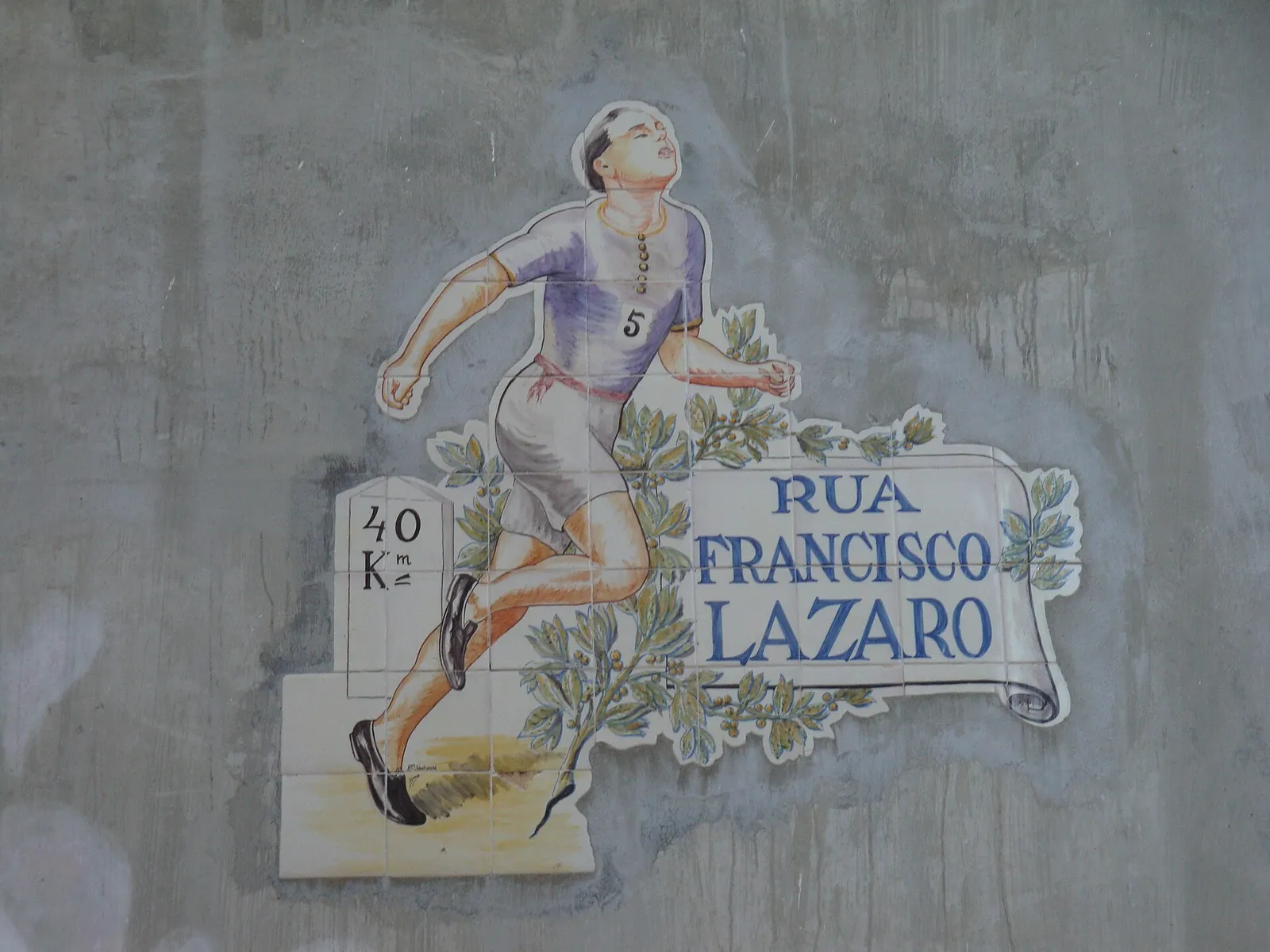
The Portuguese press turned Lázaro into a national hero within days. The Republic was looking for a new kind of citizen, and the papers held up the working-class runner who died for his flag. In April 1924 Lisbon city council unanimously renamed the Travessa do Borralho, between Anjos and Intendente, as Rua Francisco Lázaro.
Clube de Futebol Benfica, the neighbourhood club he once played football for, named its ground the Estádio Francisco Lázaro after it was refounded in 1933, and holds a 10 km memorial race through Benfica each year. On 14 July 2012, the centenary, a plaque in his memory was unveiled at the Marathon Gate of the Stockholm Olympic Stadium.
He lives on in fiction too. José Luís Peixoto, whom José Saramago called a surprising revelation, based his novel Cemitério de Pianos (The Piano Cemetery) in part, and very freely, on Lázaro's life; its longest passage follows the runner's thoughts kilometre by kilometre.
FAQs
How did Francisco Lázaro die?
He collapsed on the hill at Öfver-Järva, about 30 km into the Olympic marathon in Stockholm on 14 July 1912, and was taken unconscious to the Royal Seraphim Hospital with a temperature of 41.2 °C. He died there early the next morning. The doctors diagnosed sunstroke, and the post-mortem by Dr Folke Henschen confirmed it.
Did Lázaro cover himself in suet or wax?
His teammate Armando Cortesão said that he and Fernando Correia found Lázaro greasing his body with sebo, tallow, before the start. The official report does not mention it, Observador's 2016 article doubts it, and his grandson denies it. Olympedia and many English accounts repeat the story as fact.
Was Lázaro the first athlete to die at the Olympic Games?
Olympedia, the reference database of Olympic results, records his death as the first fatality during an event at the modern Olympic Games.
When did Portugal first take part in the Olympic Games?
At Stockholm in 1912, with six men: Lázaro, António Stromp and Armando Cortesão in athletics, António Pereira and Joaquim Vital in wrestling, and Fernando Correia in fencing. Lázaro carried the flag at the opening ceremony on 6 July.
How much money was raised for Lázaro's family?
A benefit festival at the Olympic Stadium on 20 July 1912 raised about 14,000 kronor, which the official report converted to £770 or $3,850. According to Pinheiro and Nolasco, the money was invested in Sweden and paid to his daughter, Francisca, in 1930.
On the timeline
Open the timelineNearby moments from the first republic (1910–1926).
The Constituent Assembly elects Manuel de Arriaga as the first President of the Portuguese Republic, days after approving the new republican Constitution.
João Chagas, a Rio de Janeiro-born journalist and veteran republican agitator, heads the first constitutional government of the young Portuguese Republic, formed after Manuel de Arriaga's election as president; the official list of heads of government dates his term from 3 September.
Portugal makes its Olympic debut as the Stockholm Games open. In the 100-metre heats that day the 18-year-old sprinter António Stromp, a founder member of Sporting, runs in Portugal's first Olympic race. Just six Portuguese competed, in athletics, fencing and Greco-Roman wrestling.
Francisco Lázaro, Stockholm 1912
Francisco Lázaro, a Lisbon carpenter and Portugal's flag-bearer at its first Olympic Games, dies in Stockholm the morning after collapsing near the 30-km mark of the marathon in fierce sun. A teammate said he had greased his body with tallow, a claim still disputed; he is the first athlete to die as a result of competing at the modern Olympics.
Afonso Costa, the fiery lawyer behind the 1911 law separating Church and State, forms his first government and also takes the finance ministry. His budgets closed with rare surpluses, but his anticlericalism and his push to deny the vote to illiterate citizens made him the most divisive figure of the First Republic.
Álvaro Cunhal is born in Coimbra. Secretary-general of the Portuguese Communist Party from 1961 to 1992, he was one of the most determined opponents of the Estado Novo and remained a towering figure of the Portuguese left until his death in 2005.
Bernardino Machado becomes prime minister of the young Portuguese Republic. A Coimbra professor and veteran republican, he was later twice elected President of the Republic, and was forced from office both times by military coups, in 1917 and again in 1926.
Coming up in history
All long reads 17 July 1859Queen Estefânia's death in 1859 and the hospital it left Lisbon
 18 July 197418 July 1974: Vasco Gonçalves becomes the MFA's prime minister
 19 July 1717Portugal's ships against the Ottoman fleet at Matapan, 19 July 1717
 20 July 2012José Hermano Saraiva: the minister who became Portugal's TV historian
13 sources
Archives, scholarship and reporting this article was checked against.
- 1
The Fifth Olympiad: The Official Report of the Olympic Games of Stockholm 1912 (ed. Erik Bergvall, trans. Edward Adams-Ray)Swedish Olympic Committee / Wahlström & Widstrand, Stockholm, 1913 (Internet Archive scan)
- 2
Imprensa e olimpismo: a primeira participação portuguesa nos Jogos Olímpicos (Francisco Pinheiro and Carlos Nolasco)FuLiA/UFMG, vol. 10, no. 1 (2025), pp. 30–64
- 3
Athletics at the 1912 Summer Olympics: Marathon, MenOlympedia
- 4
- 5Francisco Lázaro. A morte ao sol do carpinteiro que se fez mito na maratona (Tiago Palma)Observador, 6 August 2016
- 6
Stockholm Historical Weather Observations: thermometer observations since 1756 (Anders Moberg, dataset version 1)Bolin Centre Database, Stockholm University (2019)
- 7
Maratonloppet (Solskensolympiaden 1912)Riksarkivet (Swedish National Archives)
- 8Francisco Lázaro. O maratonista que morreu na estreia de Portugal nos Jogos OlímpicosDiário de Notícias, 15 July 2019
- 9
- 10
- 11
Francisco Lázaro: principais feitos (athlete profile)Estatísticas do Atletismo Português (Manuel Arons de Carvalho)
- 12
- 13
The Piano Cemetery by José Luís Peixoto: review (Ursula K. Le Guin)The Guardian, 19 February 2011
Image credits
- The start of the Olympic marathon in Stockholm's Olympic Stadium, 14 July 1912. The official report noted that nearly all of the 68 runners wore white linen hats or handkerchiefs against the sun. photographer of IOC, Public domain, via Wikimedia Commons.
- The 1912 marathon course, from the Stadium (right) to the turn at Sollentuna (left) and back, as printed for the Games. Lázaro fell on the return leg, on the hill at Öfver-Järva, about 30 km into the race. Unknown author, Public domain, via Wikimedia Commons.
- The black granite column at the 1912 turning point in Norrviken, Sollentuna, photographed in 2020. It marks the race's turn and bears the words Marathon and Vändpunkten. Johannes Scherman, CC BY-SA 4.0, via Wikimedia Commons.
- The tiled street sign of Rua Francisco Lázaro in Lisbon, photographed in 2010. The council gave the street his name in April 1924. Lijealso, CC BY 3.0, via Wikimedia Commons.