

“O povo é sereno”: smoke over the Terreiro do Paço, 9 November 1975
A Sunday rally for an embattled government, a bang in the crowd and an admiral who kept talking. The phrase he used outlived his government by decades.
At a glance
- On Sunday 9 November 1975 the Socialist Party (PS) and the Popular Democratic Party (PPD) filled Lisbon's Terreiro do Paço with a rally in support of the Sixth Provisional Government and its prime minister, Admiral José Baptista Pinheiro de Azevedo.
- During his speech a canister went off in the crowd, described as tear gas by RTP's history project and as smoke bombs by other accounts, and people began to panic.
- The admiral kept the microphone and told the crowd there was no danger: “O povo é sereno, ouçam. É apenas fumaça” (“The people are calm, listen. It's only smoke”).
- The rally came after the “hot summer” of 1975. Portugal was on its sixth provisional government in 18 months, party offices were being attacked and the armed forces had split into rival camps.
- Three days later construction workers besieged the Constituent Assembly; on 20 November his government suspended its own work, and the military crisis of 25 November ended the revolutionary period.
Smoke over the square
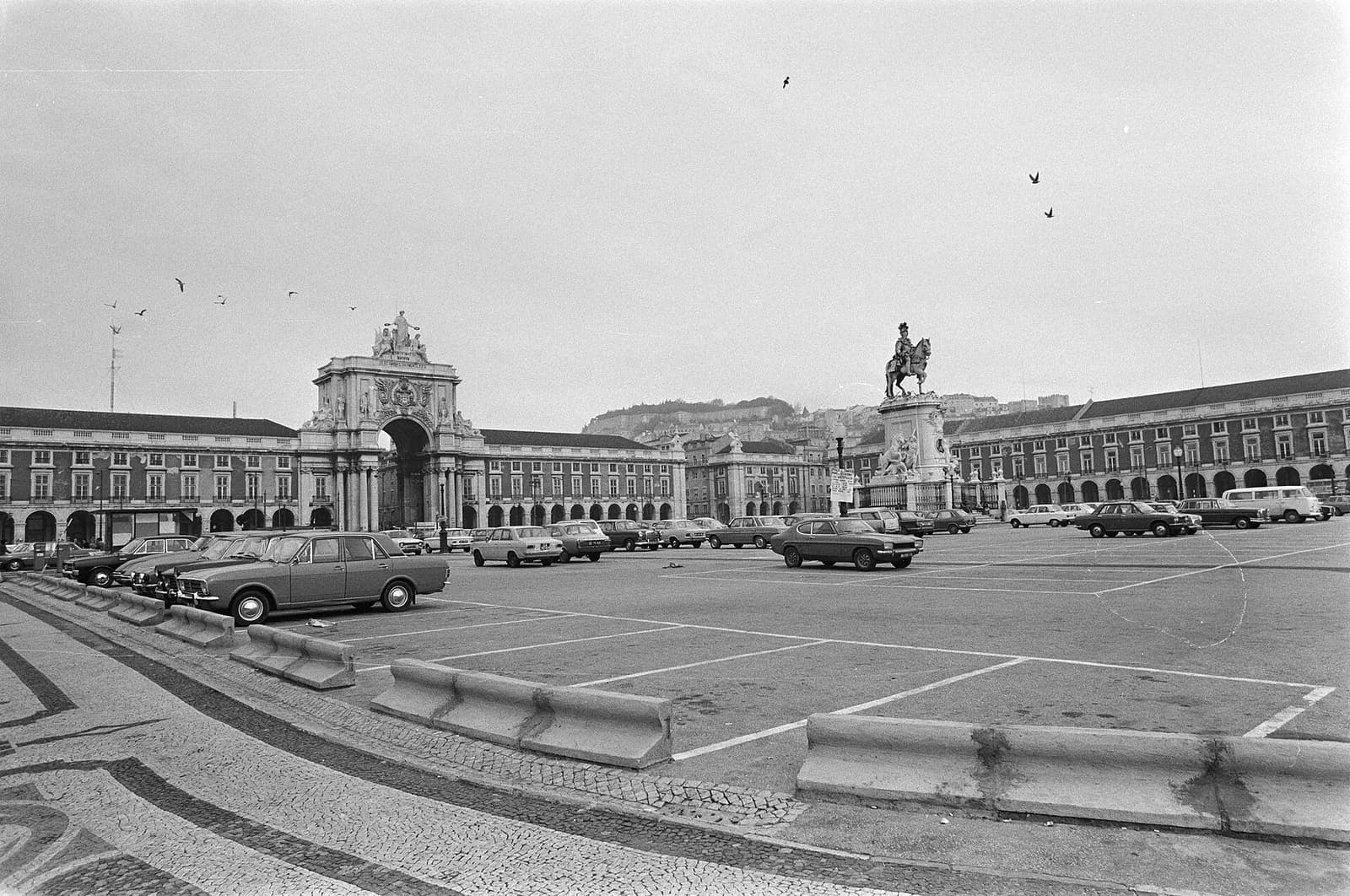
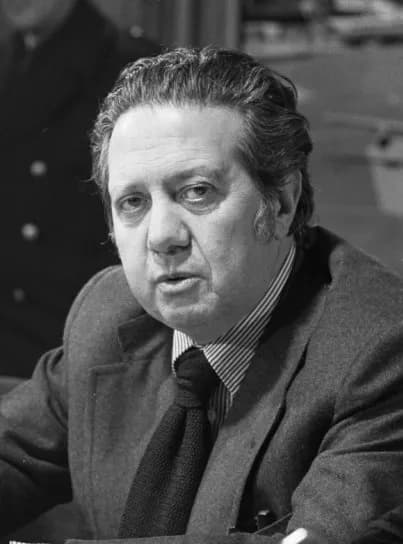
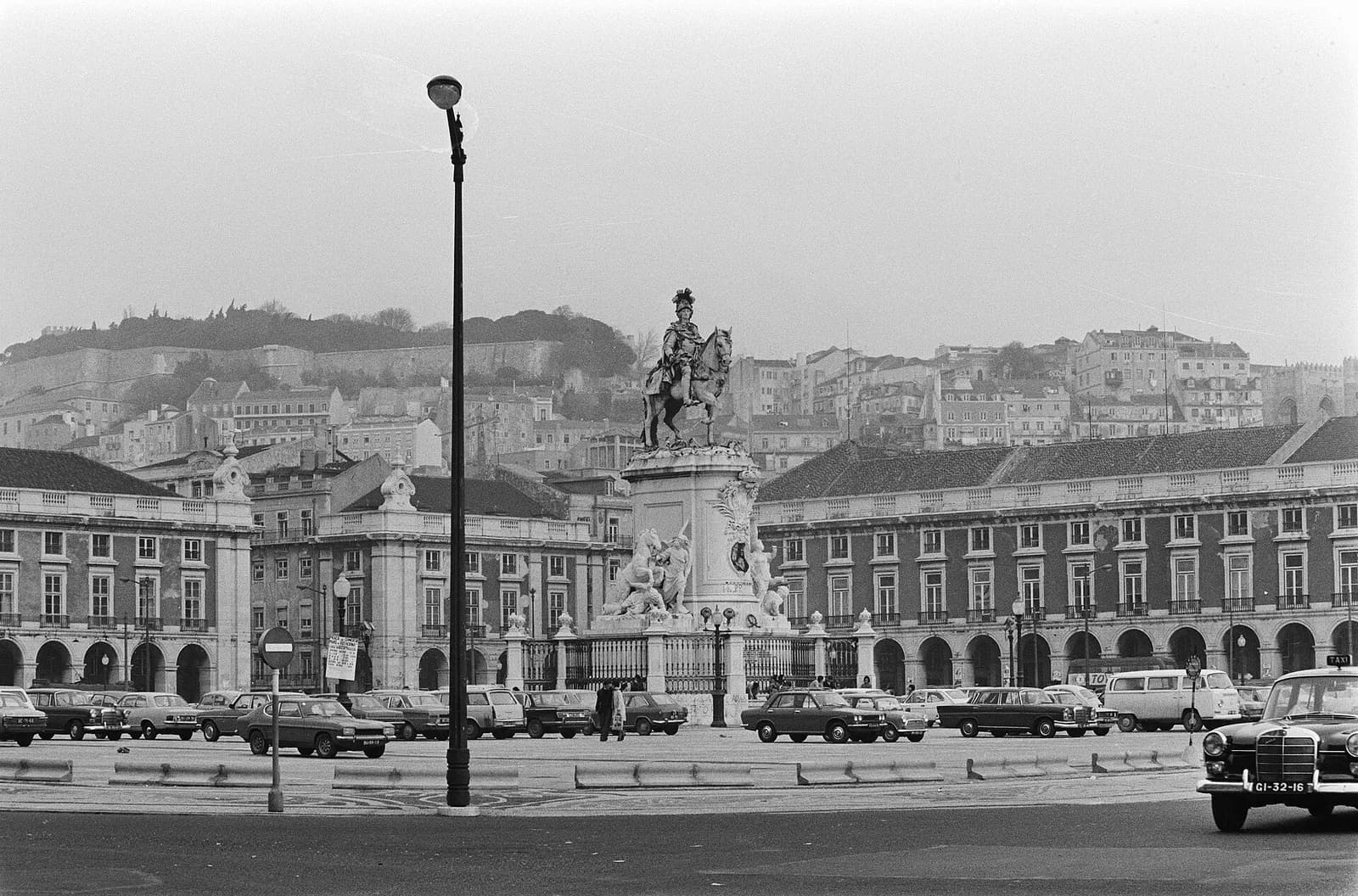
On the afternoon of Sunday 9 November 1975 the Terreiro do Paço, the great riverside square at the foot of Lisbon's Baixa, was full. The crowd had come to back the Sixth Provisional Government, seven weeks old, and its prime minister, a navy admiral named José Baptista Pinheiro de Azevedo. Beside him on the platform stood the two civilian leaders whose parties had called the rally: Mário Soares of the Socialist Party and Francisco Sá Carneiro of the Popular Democratic Party.
The admiral was in the middle of his speech when something went off in the crowd. RTP's history project describes an explosion of tear gas; a 2021 article in the weekly Sábado speaks of smoke bombs. Either way, smoke rose over the heads of the people in front of him and part of the crowd began to panic.
Pinheiro de Azevedo did not leave the microphone. He spoke straight to the crowd, and RTP's history project keeps a short sound clip of the moment under the title “O povo é sereno”.
“There is no danger. The people are calm, listen. It's only smoke.”
“O povo é sereno” became one of the best-remembered lines of the revolutionary years, quoted alongside the admiral's other outbursts. Behind it was a government that, within a fortnight, would declare itself unable to act.
A revolution with six governments
On 25 April 1974 a military coup led by the Armed Forces Movement (MFA) ended the Estado Novo, the dictatorship built by António de Oliveira Salazar and run since 1968 by Marcelo Caetano. The officers promised to settle the colonial war in Africa and, within a year, to call an elected assembly to write a new constitution. Until then the country was run by provisional governments under military oversight.
There were six of them in just over two years. The first, under Adelino da Palma Carlos, lasted two months. Then came four led by General Vasco Gonçalves; the last of them was backed by the Portuguese Communist Party (PCP) and its ally, the Portuguese Democratic Movement (MDP). The Portuguese call these years the PREC, the Processo Revolucionário em Curso, or “revolutionary process under way”.
| Government | Prime minister | In office | Parties with ministers |
|---|---|---|---|
| I | Adelino da Palma Carlos (independent) | 16 May to 18 July 1974 | PS, PPD, PCP, MDP |
| II | Vasco Gonçalves (military) | 18 July to 30 September 1974 | PS, PPD, PCP, PDC |
| III | Vasco Gonçalves | 30 September 1974 to 26 March 1975 | PS, PPD, PCP |
| IV | Vasco Gonçalves | 26 March to 8 August 1975 | PS, PPD, PCP, MDP (PS and PPD left in July) |
| V | Vasco Gonçalves | 8 August to 19 September 1975 | Mostly independents, with one MDP minister |
| VI | José Pinheiro de Azevedo (military) | 19 September 1975 to 23 July 1976 | PS, PPD, PCP |
Dates from the Portuguese government's list of heads of government; parties from CIDOB's chronology. Many ministers in every provisional government were officers or independents. MDP: Portuguese Democratic Movement; PDC: Christian Democratic Party.
The promised election came on 25 April 1975, the revolution's first anniversary. It was the first in Portugal held by truly universal suffrage, and 91.66 per cent of registered voters took part. The Socialists won 37.87 per cent of the vote and 116 seats. The PPD of Francisco Sá Carneiro came second with 26.39 per cent. The Communists, with 12.46 per cent, came third.
Constituent Assembly election, 25 April 1975: share of the vote
% of votes cast
National results from the Comissão Nacional de Eleições' official map. Seats: PS 116, PPD 81, PCP 30, CDS 16, MDP 5, UDP 1 and ADIM (Macau) 1, out of 250. Invalid ballots (“votos nulos”, 6.94 per cent) are counted in votes cast, as in the official map.
Show the data
| Share of the vote | |
|---|---|
| PS | 37.9 |
| PPD | 26.4 |
| PCP | 12.5 |
| CDS | 7.6 |
| MDP | 4.1 |
| FSP | 1.2 |
| MES | 1 |
| UDP | 0.8 |
The vote split the country in two. In northern districts such as Braga and Viseu, the PPD came first and the Communists took less than 4 per cent. In Setúbal, south of the Tagus, and in the Alentejo districts of Évora and Beja, the PCP ran level with the Socialists, and in Beja it came first.
A divided country: vote share in seven districts, April 1975
% of votes cast
- PS
- PPD
- PCP
Districts ordered roughly from north to south. Figures from the district rows of the Comissão Nacional de Eleições' official map of 19 May 1975.
Show the data
| PS | PPD | PCP | |
|---|---|---|---|
| Braga | 27.4 | 37.7 | 3.7 |
| Viseu | 21.5 | 43.8 | 2.3 |
| Porto | 42.6 | 29.4 | 6.7 |
| Lisboa | 46 | 15 | 18.9 |
| Setúbal | 38.2 | 5.7 | 37.8 |
| Évora | 37.9 | 6.9 | 37.1 |
| Beja | 35.4 | 5.3 | 39 |
The Socialists, backed by the PPD and the CDS, argued for representative democracy, with power resting on elections. The PCP and the far-left groups argued for a socialist revolution resting on “revolutionary legitimacy”. Within weeks the argument moved from the newspapers into the streets and the barracks.
The hot summer of 1975
The break came over a newspaper. When the Lisbon daily República reappeared in July under the control of its workers' committee, the PS walked out of the Fourth Provisional Government, and the PPD followed a week later. On 18 and 19 July the Socialists packed the Antas stadium in Porto and the Alameda in Lisbon, where Soares asked the President, General Francisco da Costa Gomes, to dismiss Vasco Gonçalves.
That summer, still remembered as the Verão Quente, the “hot summer”, turned violent. RTP's history project counts 64 violent acts in July alone: raids, arson and assaults, mostly against left-wing parties, activists and associations. It says they were driven by far-right movements such as the ELP and the MDLP, and by senior clergy in some dioceses. In August, attacks on offices of the PCP, the MDP and the far left multiplied.
The army split as well. On 7 August nine members of the Council of the Revolution, the MFA's ruling body, published the Documento dos Nove, with Ernesto Melo Antunes as one of its main authors. It rejected both the Eastern European model and the social democracy of Western Europe, and called for a gradual road to socialism through political democracy. The next day Gonçalves swore in his fifth government, without the Socialists or the PPD.
On 18 August Gonçalves gave a speech in Almada defending the revolutionary vanguards and arguing that election results could not overturn “revolutionary legitimacy”. Otelo Saraiva de Carvalho, commander of the COPCON security force, barred him from military units and told him to go and rest. On 30 August he resigned as prime minister. At Tancos on 5 September an assembly of army delegates rejected him as chief of the armed forces general staff, by 180 votes to 47 with 38 abstentions, and at the MFA assembly that followed he left the Council of the Revolution.
The new prime minister was Pinheiro de Azevedo, an admiral without a party who also kept the defence portfolio. His Sixth Provisional Government, sworn in on 19 September 1975, brought back the Socialists and the PPD, who held most of the ministries, with the Communists still represented. The MDP, the PCP's ally, had no ministers at all.
A government that could not govern
The government had a majority in the Constituent Assembly but little control over the streets or the barracks. On 6 September a group calling itself Soldados Unidos Vencerão (SUV), “Soldiers United Will Win”, had presented itself in Porto. It was anti-capitalist and anti-imperialist, close to far-left groups such as the Revolutionary Party of the Proletariat (PRP), and called on soldiers to organise against “reactionaries in the barracks and bourgeois officers”.
October brought open talk of coups, and the rival factions used the press and radio to prepare the country for a fight. The Church-owned station Rádio Renascença had been occupied by its workers for months, despite government orders to hand it back. At 4.30 in the morning of 7 November, on orders from the Council of Ministers and the Council of the Revolution, Paratrooper Company 122 planted two bombs at its transmitters at Buraca and silenced it. The station went back to the Church on 28 December.
The historians who wrote RTP's account call this “bomb of the powers that be” the lowest point of state authority. The government saw it differently. Two days later its supporters filled the Terreiro do Paço, after rallies that the prime minister said had already been held in Porto and Faro.
Sunday at the Terreiro do Paço
- Date
- Sunday 9 November 1975, afternoon
- Place
- Terreiro do Paço (Praça do Comércio), Lisbon
- Called by
- PS and PPD, backed by the CDS, the monarchist PPM and the Marxist-Leninist PCP(M-L)
- On the platform
- Pinheiro de Azevedo, flanked by Mário Soares and Francisco Sá Carneiro
- Incident
- A canister went off in the crowd: tear gas in RTP's account, smoke bombs in Sábado's
- Crowd
- No reliable count found; the prime minister spoke of a massive demonstration
The speech, whose full text is kept by the Centro de Documentação 25 de Abril at the University of Coimbra, was a sustained attack on the far left. Pinheiro de Azevedo told the crowd that the people wanted the Sixth Government and wanted it to govern, and that democracy meant the will of the majority. He mocked “the professionals of the demonstration” and claimed the square for his side.
“To the professionals of the demonstration we will oppose this spectacle, this enthusiasm, this truth. This Terreiro that was the Palace's and today is the People's.”
He defended the destruction of the Renascença transmitters as a decision of the Council of the Revolution, carried out “with consented discipline”. He complained of soldiers and officers who appeared hooded at street demonstrations to challenge military discipline. And he listed what had to return to its place: “the weapons to the barracks, the trials to the courts, the workers to work, calm to the streets”.
The sources do not say at which point in the speech the canister went off, and who set it off is less clear still. Sábado's obituary of Carlos Antunes in 2021 states that the smoke bombs were planted by the far-left PRP, which it describes as the party of “the duo Isabel do Carmo and Carlos Antunes”. This article has found no second source that confirms it.
| Source | Words in Portuguese | In English |
|---|---|---|
| RTP, Memórias da Revolução, event page | Não há perigo. O povo é sereno, ouçam. É apenas fumaça. | There is no danger. The people are calm, listen. It's only smoke. |
| RTP, Memórias da Revolução, “A caminho de Novembro” | O povo é sereno … Não tem perigo, é só fumaça | The people are calm … There's no danger, it's just smoke |
| Diário de Notícias, 2016 | O povo é sereno, é só fumaça | The people are calm, it's just smoke |
| Sábado, 2021 | É só fumaça! O povo é sereno! | It's just smoke! The people are calm! |
| Text of the speech kept by CD25A | O povo é sereno, não tem medo. | The people are calm, they are not afraid. |
The words about smoke vary slightly from one account to another. The CD25A text does not mention smoke; its sentence comes from a passage about the people refusing to be intimidated.
The rest of the day showed how little the square could settle. The same Sunday the commanders of the Southern, Central and Northern military regions met in Porto; Costa Gomes met ministers, Soares, Sá Carneiro and the Communist leader Álvaro Cunhal about the coming independence of Angola; and the PCP's office in Alfândega da Fé, in the district of Bragança, was attacked.
Sixteen days to 25 November
The calm did not last the week. On 10 November construction workers went on strike for a collective labour contract. On 12 November they gathered outside the Constituent Assembly at São Bento, and when the prime minister went out on the balcony to speak to them, he was booed. The workers would not let the deputies leave, except those of the PCP and the MDP. RTP's accounts differ on how long this lasted: one says the siege went on until late morning the next day, another that union leaders and the prime minister reached an agreement only in the early hours of 14 November.
RTP's “phrase of the day” for the siege belongs to Pinheiro de Azevedo again, and is much coarser: “Olhe, bardamerda para o fascista!”, which might be politely rendered as “Look, the fascist can go to hell!”. It joined “o povo é sereno” in the anthology of the admiral's sayings.
July 1975
PS and PPD leave the Fourth Government
The República affair; 64 violent acts recorded during the month.
7 August
Documento dos Nove
Nine Council of the Revolution members break with the Gonçalves line.
25 August
Fifth Division wound up
Costa Gomes signs its deactivation.
5 September
Tancos assembly
Army delegates reject Gonçalves as armed forces chief.
19 September
Sixth Provisional Government sworn in
Pinheiro de Azevedo becomes prime minister.
7 November
Renascença transmitters blown up
Paratroopers silence the occupied station.
9 November
Rally at the Terreiro do Paço
“O povo é sereno.”
12–14 November
Siege of the Constituent Assembly
Construction workers hold deputies inside São Bento.
16 November
Rally for “popular power”
Called by the PCP and the far-left front FUR.
20–28 November
The government suspends its work
The cabinet declares it cannot act.
25 November
Military showdown
The end of the revolutionary period.
On 16 November workers from Lisbon's industrial belt and the Alentejo rallied for “popular power”, at the call of the PCP and the far-left front FUR. Then Pinheiro de Azevedo became the first head of a Portuguese government to go on strike. At a Council of Ministers that began on 19 November and ran into the next morning, the cabinet suspended its own activity, unable to act in the face of an “avalanche” of events.
The strike lasted until 28 November. In between came 25 November, a military confrontation that ended with the moderate officers around the Group of Nine in control of the armed forces and the revolutionary units around COPCON pushed aside. That story is told in its own article.
The admiral and his phrase
The Sixth Provisional Government survived 25 November and stayed in office until 23 July 1976, when Mário Soares formed the first constitutional government. Pinheiro de Azevedo ran for president in June 1976. He came third, with 692,147 votes or 14.37 per cent, behind the winner, António Ramalho Eanes, with 61.59 per cent, and Otelo Saraiva de Carvalho, with 16.46 per cent.
He died on 10 August 1983, the day after an International Monetary Fund delegation signed a rescue agreement with Portugal. Diário de Notícias remembered him as the “admiral without fear”, the first head of government to go on strike, and the author of two famous phrases: “O povo é sereno, é só fumaça” and “Bardamerda para o fascista!”.
The phrase has lasted longer than the man or his government. When a Portuguese “yellow vests” protest that promised to “stop Portugal” fizzled in December 2018, a columnist in A Voz de Trás-os-Montes explained the flop with the admiral's words: the people are calm. The same column, by Armando Moreira, misremembered the 1975 rally as one led by the Communists.
FAQs
Who said “O povo é sereno”?
Admiral José Baptista Pinheiro de Azevedo, prime minister of Portugal's Sixth Provisional Government, at a rally in Lisbon's Terreiro do Paço on 9 November 1975, when a canister of tear gas or smoke went off in the crowd during his speech.
What exactly did he say?
RTP's history project gives “Não há perigo. O povo é sereno, ouçam. É apenas fumaça” (“There is no danger. The people are calm, listen. It's only smoke”). Other accounts shorten it to “O povo é sereno, é só fumaça”. The text of his speech kept by the Centro de Documentação 25 de Abril, which does not mention smoke, already contains “O povo é sereno, não tem medo” (“The people are calm, they are not afraid”).
Who organised the rally of 9 November 1975?
The Socialist Party and the Popular Democratic Party (today's PSD), with support from the CDS, the monarchist PPM and the small PCP(M-L). Mário Soares and Francisco Sá Carneiro stood beside the prime minister.
Who threw the gas at the Terreiro do Paço?
It is not settled. A 2021 article in Sábado says the smoke bombs were planted by the far-left Revolutionary Party of the Proletariat (PRP); this article found no second source confirming it. RTP's history project describes the canister as tear gas.
What happened to the Sixth Provisional Government?
Three days after the rally construction workers besieged the Constituent Assembly and kept most deputies inside, and on 20 November the government suspended its own work. It resumed on 28 November, after the events of 25 November, and stayed in office until 23 July 1976.
On the timeline
Open the timelineNearby moments from revolution and democracy (1974–1986).
Portugal's Sixth Provisional Government takes office under Admiral José Pinheiro de Azevedo, steering the country through the turbulent final months of the post-revolutionary period.
Mário Soares and Álvaro Cunhal face each other on RTP in a debate lasting 3 hours, 40 minutes and 52 seconds, moderated by Joaquim Letria and José Carlos Megre. Cunhal's repeated 'Olhe que não, olhe que não' ('Look, it isn't so') passed into Portuguese folklore, and the clash is still remembered as the longest and most famous political debate on Portuguese television.
At 4.30 in the morning, soldiers of Paratrooper Company 122 blow up the Buraca transmitters of Rádio Renascença, silencing the Catholic station whose Lisbon studios had been occupied by its workers for months. Ordered by the government and the Council of the Revolution, the explosion began the station's return to the Church, completed on 28 December 1975.
“O povo é sereno”, 1975
At a mass rally in Lisbon's Terreiro do Paço in support of his Sixth Provisional Government, Prime Minister Admiral José Pinheiro de Azevedo is interrupted when gas canisters go off in the crowd. His unflappable 'O povo é sereno' ('The people are calm'), and his assurance that it was only smoke, became one of the best-remembered lines of the revolutionary period.
At midnight in Luanda, Agostinho Neto of the MPLA proclaims the independence of the People's Republic of Angola, ending nearly five centuries of Portuguese rule, as the rival FNLA and UNITA declare their own states in Ambriz and Huambo. Neto becomes the country's first president.
Tens of thousands of demonstrators, most of them construction workers demanding a collective labour agreement, surround the Constituent Assembly at São Bento, keeping the deputies inside for some 36 hours and holding Prime Minister Pinheiro de Azevedo in his official residence next door until the government gives in to their demands. The siege marked the final phase of the revolution, ended by the events of 25 November.
Units loyal to the moderate wing of the Armed Forces Movement, with Lieutenant-Colonel Ramalho Eanes directing operations, put down an uprising by left-wing paratroopers who had seized air bases. A state of siege is declared in the Lisbon region, and the defeat of the radical left ends the revolutionary period and sets Portugal on course for parliamentary democracy.
Coming up in history
All long reads
25 sources
Archives, scholarship and reporting this article was checked against.
- 1
“O povo é sereno”RTP and Instituto de História Contemporânea (NOVA FCSH), Memórias da Revolução
- 2
Pinheiro de Azevedo no Terreiro do Paço (9/11/75)Centro de Documentação 25 de Abril, Universidade de Coimbra
- 3
- 4
Carlos Antunes (1940-2021): o revolucionário que cortou com Cunhal e influenciava Otelo (Fernando Madaíl)Sábado, 24 January 2021
- 5
Mapa nacional da eleição para a Assembleia Constituinte, 25 de Abril de 1975 (Diário do Governo, II série, suplemento ao n.º 115, 19 May 1975)Comissão Nacional de Eleições
- 6
Tomada de posse do VI Governo ProvisórioRepública Portuguesa, Arquivo Histórico do Governo
- 7É um mito o agosto sem alguns picos de calor políticoDiário de Notícias, 31 July 2016
- 8
- 9
Estado democráticoAssembleia da República
- 10
Cronología de gobiernos de Portugal (1974-2025) (Roberto Ortiz de Zárate)CIDOB, Barcelona Centre for International Affairs
- 11
Chefes do Governo desde 1821República Portuguesa, Governo de Portugal
- 12
O povo é serenoA Voz de Trás-os-Montes
- 13
- 14
- 15
- 16
- 17
- 18
- 19
- 20
- 21
- 22
Há 50 anos, os emissores da Renascença explodiram. Foi o início da devolução da rádio à IgrejaRenascença, 7 November 2025
- 23
- 24
- 25
Image credits
- The Terreiro do Paço (Praça do Comércio) on 11 February 1975, then largely a car park, with the triumphal arch of Rua Augusta at the far end. Nine months later the square was packed for the rally in support of the Sixth Provisional Government. Rob Mieremet / Anefo, CC0, via Wikimedia Commons.
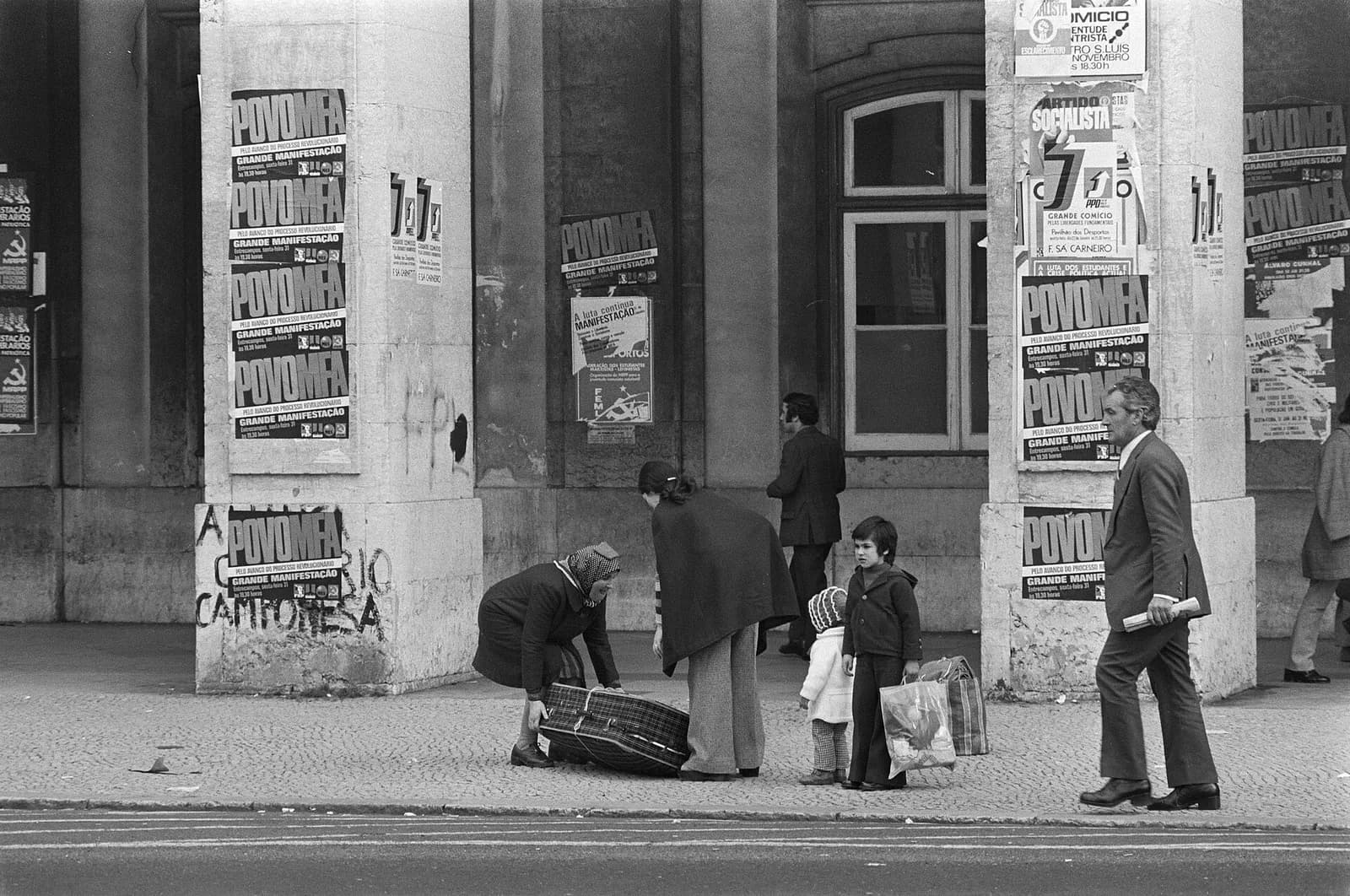
- Political posters on a street in Portugal on 11 February 1975, ten weeks before the election. Most read “Povo MFA” (“People, MFA”) and call a “grande manifestação”, a big demonstration, “for the advance of the revolutionary process”; beside them are posters for the Socialist Party and for a PPD rally with Francisco Sá Carneiro. Rob Mieremet / Anefo, CC0, via Wikimedia Commons.
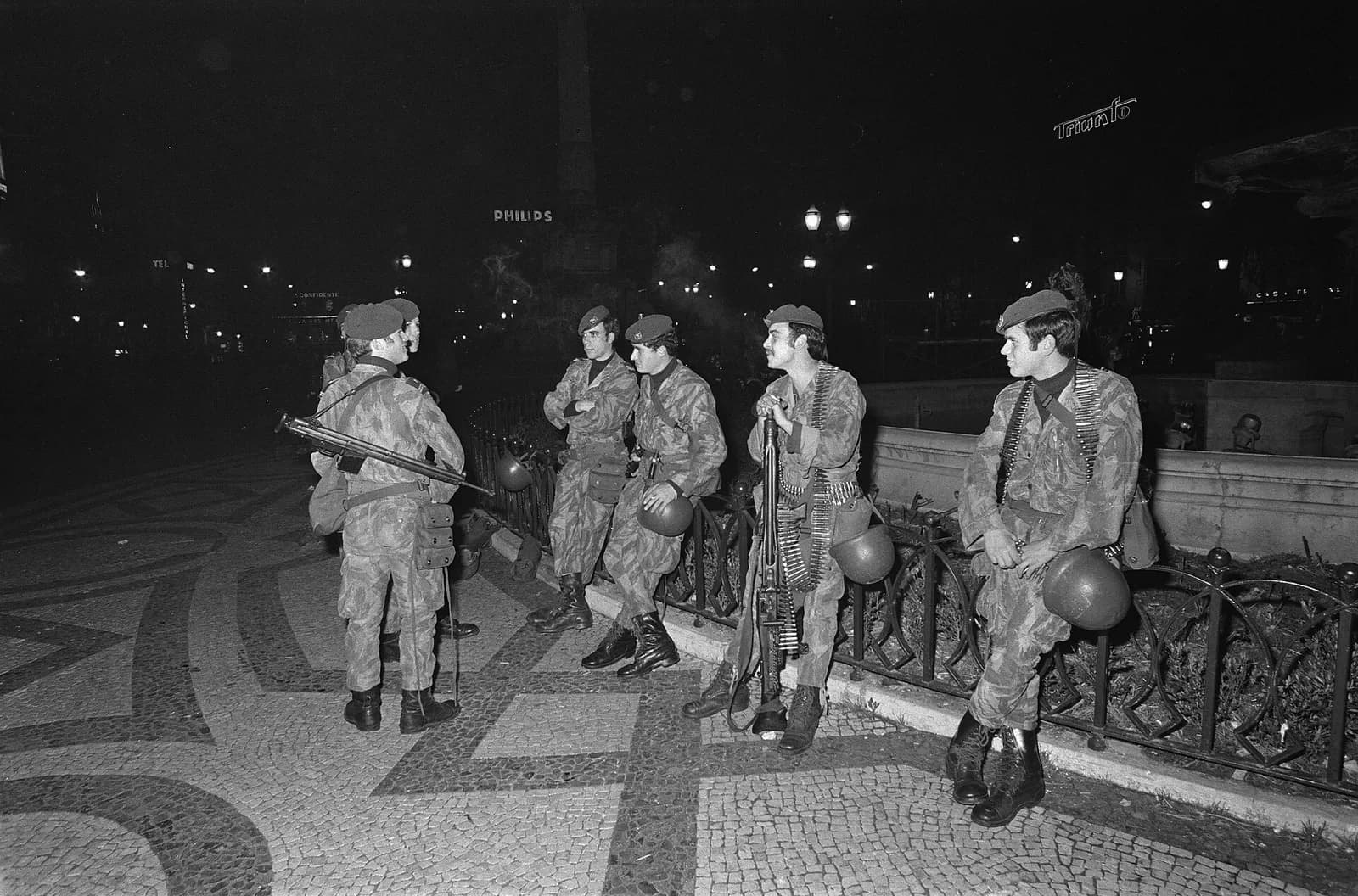
- Armed soldiers on a Lisbon square at night, in a Dutch agency report dated 2 February 1975, after troops stopped members of the Maoist MRPP from marching through the city on 31 January in defiance of a ban. By the summer the armed forces were divided among themselves. Anefo, CC0, via Wikimedia Commons.
- Mário Soares, leader of the Socialist Party, in January 1975. He stood beside Pinheiro de Azevedo on the platform at the Terreiro do Paço. Hans Peters for Anefo, CC BY-SA 3.0, via Wikimedia Commons.
- The Terreiro do Paço on 11 February 1975, looking north towards the equestrian statue of King José I, with the Castelo de São Jorge on the hill behind. Rob Mieremet / Anefo, CC0, via Wikimedia Commons.