

Almada Negreiros, the rebel of Orpheu, dies in Lisbon: 15 June 1970
He began as the loudest young man in Lisbon, booing a famous playwright and calling himself a Futurist. He ended painting murals for the dictatorship's new buildings, and died, it is said, in the hospital room where his friend Fernando Pessoa had died 34 years before.
At a glance
- José de Almada Negreiros, painter, writer and performer, died at the Hospital de São Luís dos Franceses in Lisbon on Monday 15 June 1970, aged 77.
- Born on 7 April 1893 in São Tomé, then a Portuguese colony, he wrote for the first issue of the magazine Orpheu in 1915 alongside Fernando Pessoa and Mário de Sá-Carneiro.
- His Manifesto Anti-Dantas, an all-capitals attack on the playwright Júlio Dantas printed in 1916, made him the public face of Portuguese Futurism.
- Between 1943 and 1949 he painted 14 mural panels in the two passenger stations of the port of Lisbon, at Alcântara and at Rocha do Conde de Óbidos.
- His 1954 portrait of Pessoa at a café table, sold at auction in January 1970 for a record 1,350 contos (1,300 in some accounts), hangs in the Casa Fernando Pessoa; a second version of 1964 belongs to the Gulbenkian.
The same room, 34 years apart
At five in the afternoon on 14 January 1970, at the Irmãos Unidos restaurant on Lisbon's Rossio, a portrait of Fernando Pessoa came up for auction. José de Almada Negreiros had painted it for the restaurant in 1954, a picture of the poet at a café table. He had come with his wife, the painter Sarah Affonso, but during the bidding he waited outside and followed the price through a friend's hand signals. It sold for what the press called a record for a living Portuguese painter.
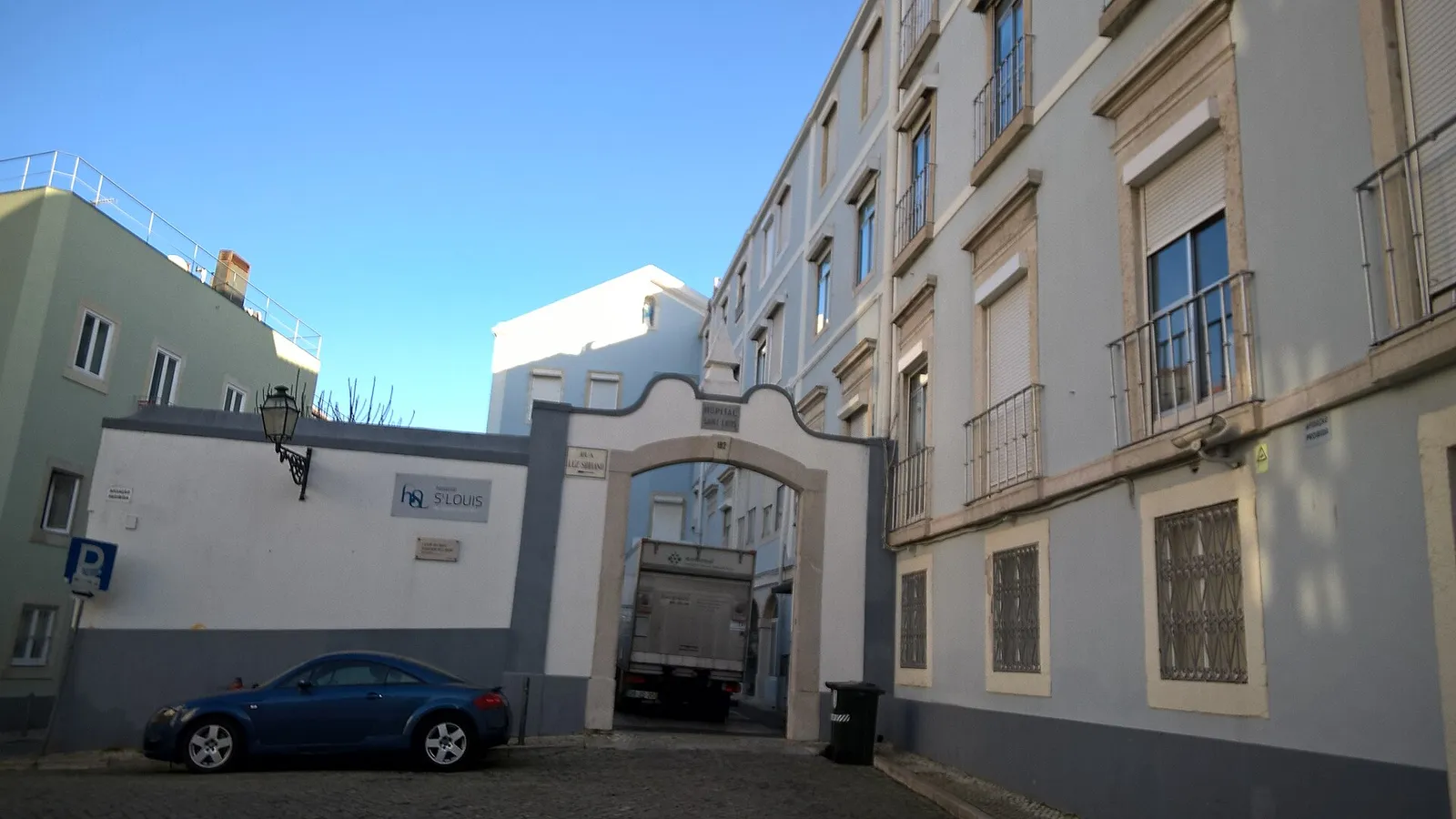
Five months later, on Monday 15 June 1970, Almada died at the Hospital de São Luís dos Franceses, a hospital in a former palace in Lisbon's Bairro Alto. He was 77. According to Lisbon's tourism board and to the Diário de Notícias, he died in the same room where Pessoa had died on 30 November 1935.
He had outlived almost everyone he started with. Mário de Sá-Carneiro killed himself in Paris in 1916, the painters Amadeo de Souza-Cardoso and Santa-Rita Pintor died in 1918, and Pessoa in 1935. Almada, “the baby of Orpheu” as a Gulbenkian curator puts it, had lived 55 years past the magazine. Pessoa, writing as Álvaro de Campos, had called him a man of genius, younger than the others in spontaneity and effervescence as well as in age.
The auction was one sign of a late fame. Television had found him: in 1969 Raul Solnado and Carlos Cruz interviewed him on the first broadcast of their show Zip-Zip, and two films about him were made or begun that year. Since October 1969 visitors to the new Gulbenkian Foundation had walked past his last large work, a stone panel called Começar.
From São Tomé to the Chiado
José Sobral de Almada Negreiros was born on 7 April 1893 at Roça Saudade, a plantation estate on São Tomé, an island in the Gulf of Guinea that stayed a Portuguese colony until 1975. His father, António Lobo de Almada Negreiros, a poet and journalist from Aljustrel, was an official in the colony. His mother, Elvira Freire Sobral, was the daughter of a Portuguese landowner and an Angolan woman.
In 1895 the family sailed for Lisbon, and José never went back. His parents returned to Africa and left him and his younger brother with their maternal grandparents in Cascais. Their mother died in December 1896, aged 24. From 1900 the boys boarded at the Jesuit college at Campolide, in Lisbon.
The monarchy fell in October 1910 and the new Republic closed the Jesuit schools. After a spell at the liceu in Coimbra, Almada moved to the International School of Lisbon, and in 1911, aged 18, he published his first cartoon in the magazine A Sátira. In 1913 he showed about ninety drawings at the school. Pessoa went to see them first in Almada's room and noted in his diary that he found them very good. He then reviewed the show in print.
By then Almada was a regular at A Brasileira, the Chiado café. His new friends included Pessoa and Sá-Carneiro and the painters Amadeo, Santa-Rita, Eduardo Viana and José Pacheco, several of whom had lived in Paris and brought back the new art being made there. Almada did not get to Paris until 1919. Until then he took the new art in at second hand and turned it into performance.
Orpheu, and “Morra o Dantas”
Orpheu, a “quarterly magazine of literature”, came out in March 1915. The idea was the poet Luís de Montalvor's, and its first directors were Montalvor and the Brazilian Ronald de Carvalho; Sá-Carneiro and Pessoa took over for the second issue in June. Almada, 21, contributed Frisos (Friezes) to the first issue, twelve short pieces of prose poetry built on visual images. Lisbon papers called the contributors madmen and their work “asylum literature”.
The loudest of the critics was Júlio Dantas, a doctor, playwright and, from 1913, president of the Academy of Sciences. He called the Orpheu writers “paranoid poets”. On 21 October 1915 his new play, Soror Mariana, opened at the Teatro Ginásio. Almada booed it, and the next day, at the Café Martinho in the Rossio, he read his friends the first draft of a reply.
The Manifesto Anti-Dantas e por extenso was printed at his own expense in June or July 1916. It was set entirely in capitals and signed by “José de Almada-Negreiros, poeta d'Orpheu, futurista e tudo”, poet of Orpheu, Futurist and everything. Its refrain was “MORRA O DANTAS, MORRA! PIM!”: die, Dantas, die. The story goes that Dantas bought up as many copies as he could to keep them out of circulation.
“Dantas might know grammar, he might know syntax, he might know medicine, he might know how to cook suppers for cardinals, he might know everything, except how to write, – unfortunately this is the only thing he does.”
The suppers were a dig at A Ceia dos Cardeais (The Cardinals' Supper, 1902), Dantas's most famous play. Pessoa answered Almada's devotion in kind: writing as Álvaro de Campos, he dedicated his long Passagem das Horas to him.
“Almada Negreiros: you can't imagine how thankful I am for the fact that you exist.”
Futurism, the Italian avant-garde movement led by Filippo Tommaso Marinetti, gave Almada a costume. On 14 April 1917, with Santa-Rita, he held a Futurist session at the Teatro República, today's São Luiz, wearing a home-made outfit somewhere between a pilot's suit and a workman's overall, and read his Ultimatum Futurista to the Portuguese generations of the twentieth century. “It's not my fault that I'm Portuguese,” it said, but he would not be a coward and let his homeland rot.
In November 1917 the only issue of Portugal Futurista came out, with his Ultimatum and a photograph of him in the suit. The police seized it within about two weeks. A year later Santa-Rita and Amadeo were dead, and Portuguese Futurism, which had lasted roughly from Orpheu to the seizure, was over.
Paris, Lisbon, Madrid
For a while Almada put his energy into dance. He staged ballets with amateur performers from Lisbon high society at the São Carlos and Trindade theatres in 1918, and in December 1917 he befriended Sergei Diaghilev, whose Ballets Russes were stranded in Lisbon. Then, at the end of January 1919, with the country in civil war after a monarchist rising in the north, he left for Paris.
Paris was not a triumph. He took a room in a cheap hotel and danced in cabarets, spent the summer in Biarritz working at a nightclub run by an old friend, and then took a job in a factory making candles and lights. He met Picasso, Max Jacob, Erik Satie and Constantin Brancusi, and he drew and wrote. He came back to Lisbon on 7 April 1920, his 27th birthday.
In the 1920s he painted two large canvases for A Brasileira, among them a Self-Portrait in a Group, and a nude for the Bristol Club, wrote the novel Nome de Guerra and drew comics. Living, he wrote, was what was impossible in Portugal.
He had joined Ramón Gómez de la Serna's gatherings at the Café Pombo in Madrid on a visit in 1923. On 31 March 1927 he went back and stayed five years, taking painting and illustration commissions, befriending Federico García Lorca and making twelve painted stucco reliefs for the Cine San Carlos on the Calle de Atocha.
A modernist and the New State
When he came home in 1932, Portugal was a different country. A military coup in 1926 had put the country under a dictatorship, and in 1933 a constitution drafted by the head of government, António de Oliveira Salazar, and approved by plebiscite founded the Estado Novo (New State): an authoritarian regime with a single party, which left freedom of speech, assembly and association to special laws. Its new propaganda office, the Secretariado de Propaganda Nacional (SPN), was run by António Ferro, a writer who had been close to the Orpheu generation.
Almada's relations with the regime were never simple. In 1932 he attacked both Marinetti, then visiting Lisbon, and Ferro for receiving him. In 1933 he drew an SPN poster urging people to vote for the new Constitution. He exhibited at the SPN's modern art shows and won its Columbano Prize in 1942, but in 1938 he turned down an invitation from Franco's fine arts chief to show in the Spanish pavilion at the Venice Biennale.
On 31 March 1934 he married the painter Sarah Affonso; their son José was born that December and their daughter Ana Paula in 1942. Public commissions gave him the steady income he had never had, and many came through one architect, Porfírio Pardal Monteiro. Almada designed the stained glass for Pardal Monteiro's Church of Our Lady of Fátima, finished in 1938, and frescoes for his Diário de Notícias building on the Avenida da Liberdade.
Fourteen panels at the water's edge
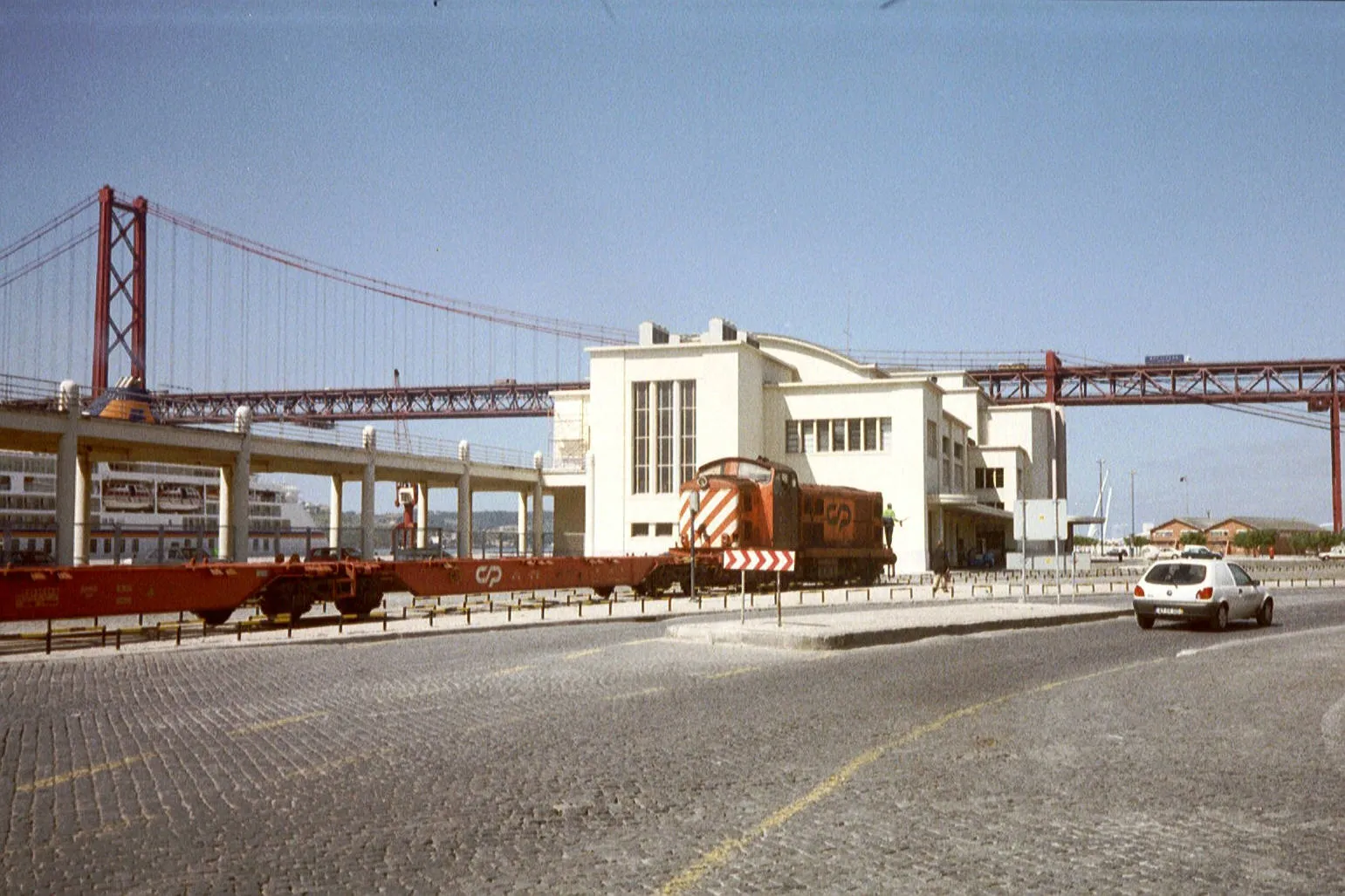
In the 1940s the port of Lisbon got two new passenger terminals, both by Pardal Monteiro; Visit Lisboa describes the second as a regime commission meant to impress passengers on the liners. Duarte Pacheco, the Minister of Public Works, asked Almada to decorate their great halls. The centre's account of the commission dates his first studies for Alcântara to 1941; its chronology of his life says 1943. The building opened on 17 July 1943, and the murals were finished in 1945.
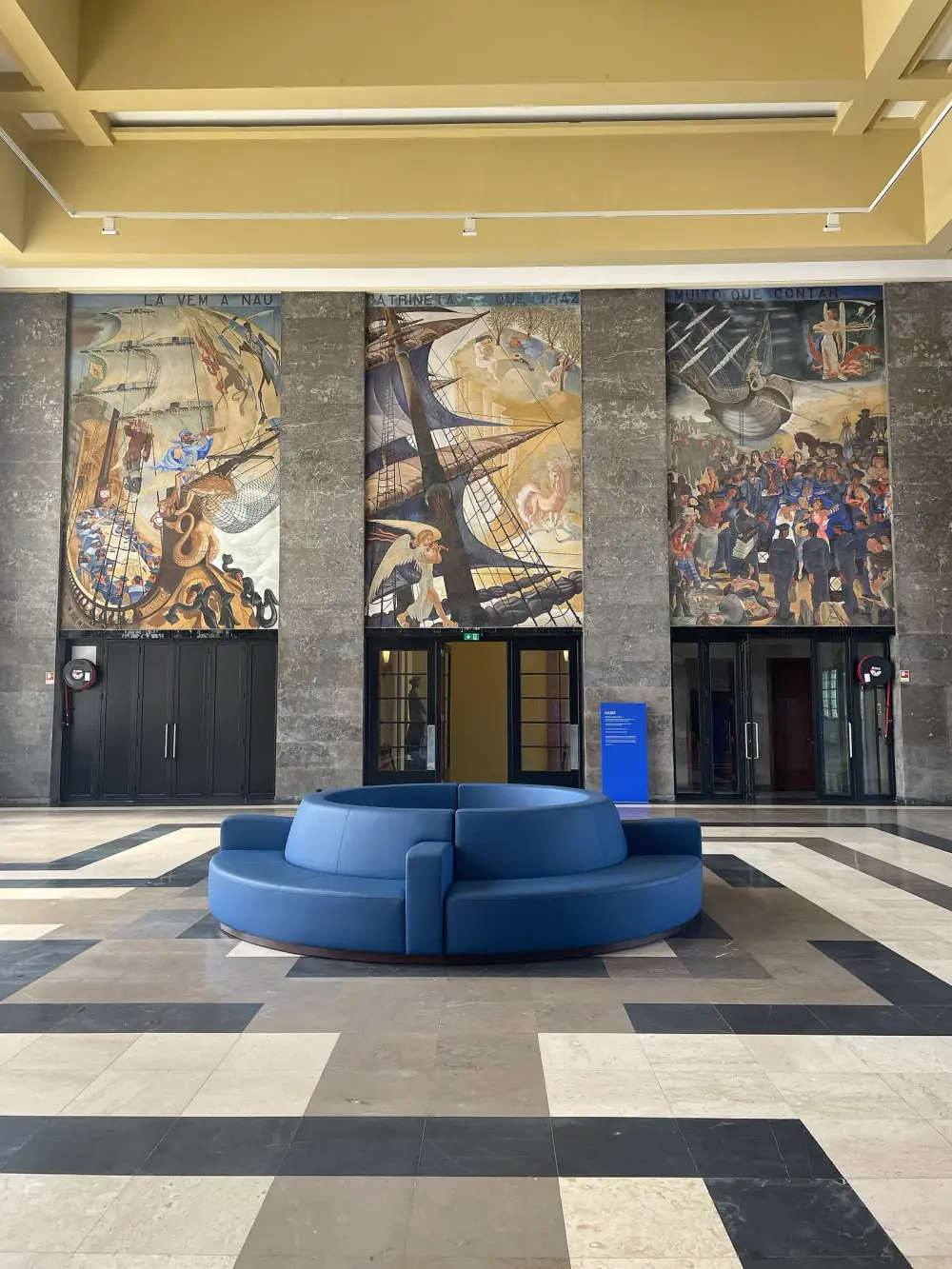
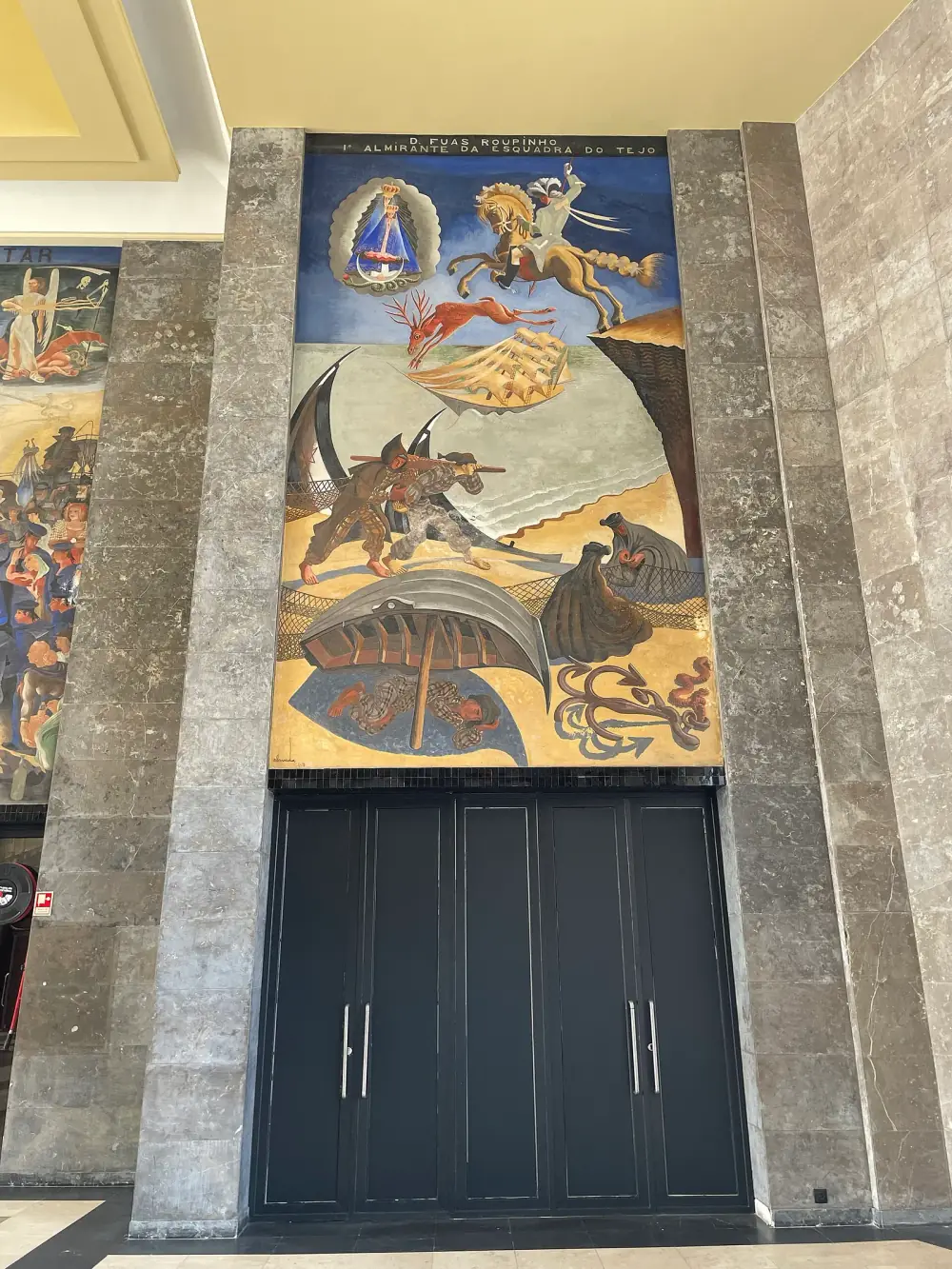
Alcântara has eight panels: two triptychs and two single panels. One triptych, Quem não viu Lisboa não viu coisa boa (Whoever hasn't seen Lisbon hasn't seen a good thing), shows the riverside city, including the women who carried coal on the quays. The other retells the old ballad of the Nau Catrineta, a sixteenth-century ship, with a crew who look like Almada's contemporaries. A single panel is given to Dom Fuas Roupinho, a twelfth-century knight of the Nazaré legend, but its lower half belongs to fishing people at work and at rest.
The regime wanted heroes, and Almada painted coal carriers. When the time came to commission the second station, João Couto, director of the National Museum of Ancient Art, advised that Alcântara had caused controversy and distrust. Almada got the job anyway, signed the contract on 17 February 1947 and started painting at the end of 1948, with Sarah Affonso helping him enlarge the sketches and transfer them to the walls.
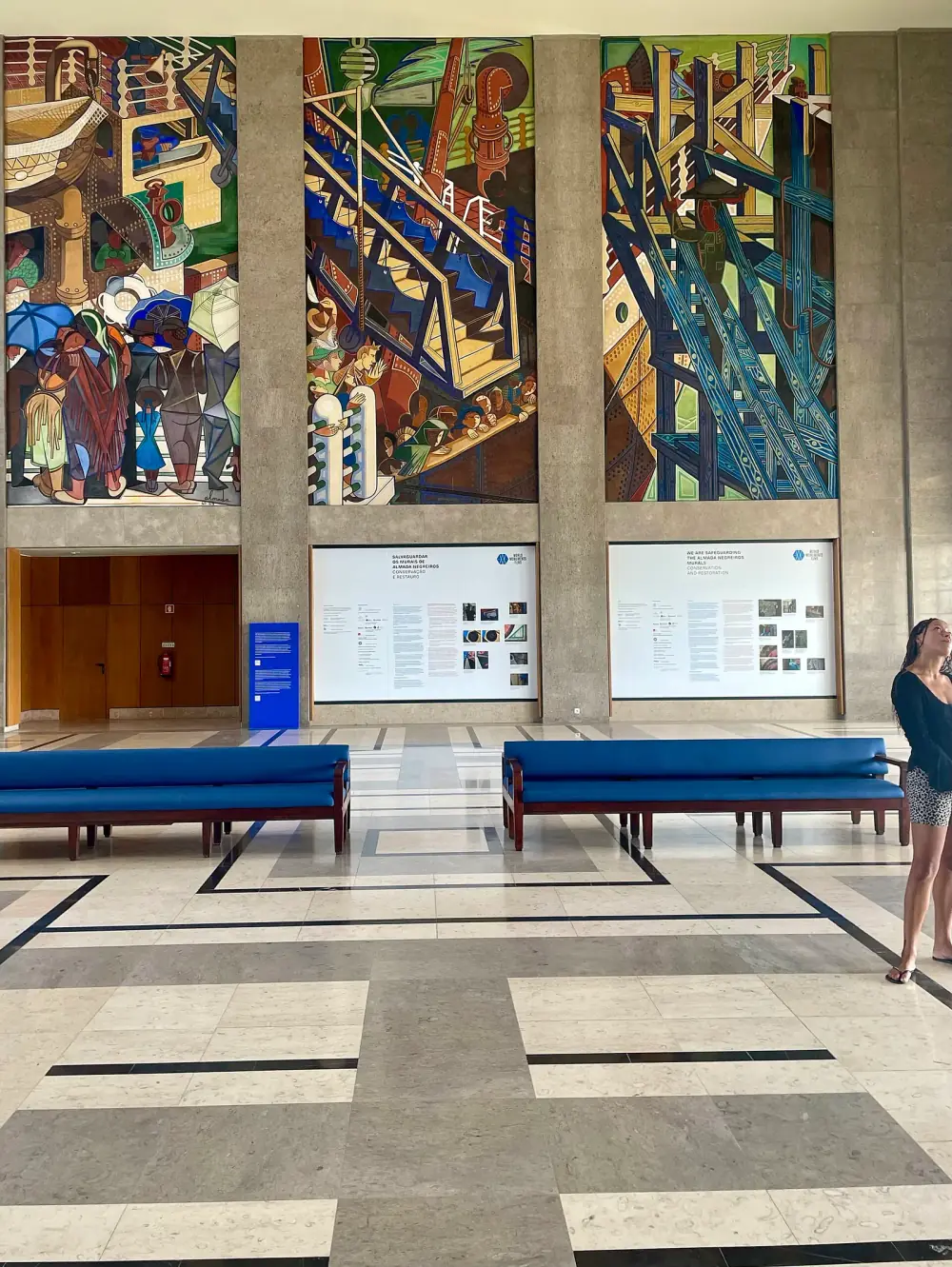
The six panels at Rocha do Conde de Óbidos, finished in 1949, are flatter and more geometric, a mix of Cubism and graphic art. One triptych, Partida de Emigrantes, shows the emotional farewells of people leaving to find a better life. The other, Domingo Lisboeta (Lisbon Sunday), has a family and two fishermen in small boats, monumental fishwives, one of them African, and a crowd watching acrobats. On one panel Almada painted himself and Sarah on a balcony.
Emigrants and poverty were not what the New State wanted travellers to see first. According to Almada and Sarah Affonso, the paintings caused a scandal, and the minister of public works, José Frederico Ulrich, is said to have led the campaign against them. They were at risk of being destroyed. In November 1949 written opinions from Pardal Monteiro and João Couto defending the murals appear to have saved them.
| Gare Marítima de Alcântara | Gare Marítima da Rocha do Conde de Óbidos | |
|---|---|---|
| Building opened | 17 July 1943 | 18 June 1948 |
| Murals | Studies from 1941; finished 1945 | Contract 17 February 1947; painted end of 1948 to 1949 |
| Panels | 8: two triptychs and two single panels | 6: two triptychs |
| Titles | Quem não viu Lisboa não viu coisa boa; Ó terra onde eu nasci; Lá vem a Nau Catrineta; Dom Fuas Roupinho | Partida de Emigrantes; Domingo Lisboeta |
| Agreed fee | 200 contos, verbally, with Duarte Pacheco | 500 contos promised; set at 450 contos in 1946 |
A conto was 1,000 escudos. Both buildings are by Porfírio Pardal Monteiro. The fees come from the documents and testimony summarised by the interpretation centre: Duarte Pacheco agreed 200 contos for Alcântara on condition that Rocha would be paid 500; after his death in November 1943 the new budget was judged excessive and cut.
Pessoa at the café table
When Pessoa died in 1935, Almada wrote “Fernando Pessoa, o Poeta Português” for the Diário de Lisboa of 6 December. Almost twenty years later the poet came back to him through a restaurant. The Irmãos Unidos, on the Rossio, had been the Orpheu group's meeting place in 1915, because Alfredo Guisado, one of its poets, worked there. In 1954, during a refit, his brother António ordered a painting in honour of Orpheu.
Almada painted it that summer in the garden of his house at Bicesse, near Estoril. After studies he called Lendo o Orpheu (Reading Orpheu), he settled on a portrait of Pessoa at a café table, with the two published issues of the magazine lying in the corner. He was paid 30 contos, in three instalments of 10.
The Calouste Gulbenkian Foundation wanted the picture. The owner asked 400 contos, so the foundation ordered a second one instead, for which Almada was paid 200 contos. He painted it in 1964 as a mirror image of the first, with a different geometric background and stronger colour.
On 14 January 1970 the contents of the Irmãos Unidos, from pans to the painting, went under the hammer. The portrait went to the antiques dealer Joaquim Mitnitsky (Mitnitzky in the Gulbenkian's account) for 1,350 contos, which Observador, drawing on the press of the day, calls a record for a living Portuguese painter. The Gulbenkian and the interpretation centre give 1,300 contos.
The month after the auction António Guisado gave him 228 contos from the sale.
What the Pessoa portrait was worth, 1954 to 1970
contos (thousands of escudos, not adjusted for inflation)
Sums in nominal escudos, from Observador's account of the auction (the 30 contos, the 200 contos for the 1964 version, the 1,350 contos hammer price and the 228 contos paid to Almada) and the Gulbenkian's account of the 400 contos asking price, which came before the 1964 commission. The Gulbenkian and the interpretation centre give the auction price as 1,300 contos.
Show the data
| Contos | |
|---|---|
| 1954: paid to Almada | 30 |
| Before 1964: owner's asking price to the Gulbenkian | 400 |
| 1964: Gulbenkian version | 200 |
| 14 Jan 1970: auction price | 1,350 |
| Feb 1970: Guisado's payment to Almada | 228 |
Mitnitsky sold the picture on to the banker and collector Jorge de Brito, who gave it to Lisbon City Council. Since 1993 it has hung at the Casa Fernando Pessoa, the city's museum of the poet; the Gulbenkian lists it as belonging to the Museum of Lisbon. The 1964 version is in the Gulbenkian's modern art collection, and in 2017 the two were shown side by side.
Começar: geometry and the last years
In his later decades geometry and proportion absorbed Almada. He argued in print about the original arrangement of the fifteenth-century St Vincent Panels, the altarpiece attributed to Nuno Gonçalves, and in 1957 showed four abstract geometric paintings at the Gulbenkian's first art exhibition. For Pardal Monteiro's University City in Lisbon he cut drawings into the stone façades of the law and arts faculties and the rectorate, finished in 1961.
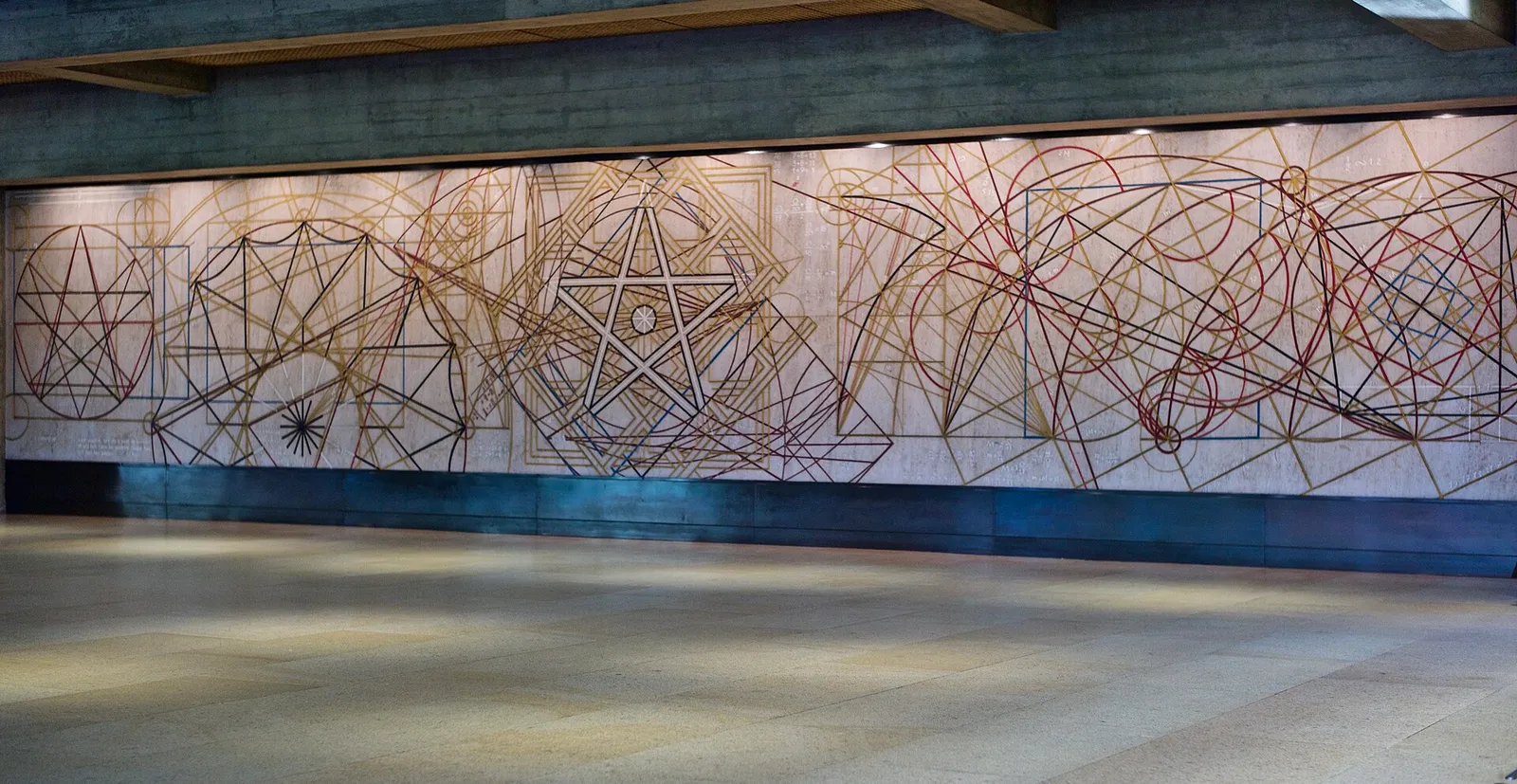
His geometry went into stone once more in Começar (To Begin). Planned from 1968, it is a limestone panel about 12.9 metres long and 2.3 metres high in the entrance hall of the Gulbenkian headquarters, its circles, stars and polygons incised and coloured. It was unveiled when the building opened in October 1969. Almada was 76.
The honours had arrived by then. He won the SNI's National Prize for the Arts in 1959, the year he also signed a protest against the appointment of the academic painter Eduardo Malta to run the Museum of Contemporary Art. The first book on him, by José-Augusto França, appeared in 1963. In 1966 the National Academy of Fine Arts made him an honorary member, and in 1967 the state made him a Grand Officer of the Order of Sant'Iago da Espada.
7 April 1893
Born at Roça Saudade, São Tomé
1911
First published cartoon, in A Sátira
March 1915
Frisos in Orpheu no. 1
June–July 1916
Manifesto Anti-Dantas printed
14 April 1917
Futurist session at the Teatro República
1919–1920
Paris
1927–1932
Madrid
31 March 1934
Marries Sarah Affonso
1943–1945
Murals at the Gare Marítima de Alcântara
1946–1949
Rocha do Conde de Óbidos murals: commissioned 1946, contract 17 February 1947, painted end of 1948 to 1949
1954
Portrait of Fernando Pessoa for the Irmãos Unidos
1964
Second Pessoa portrait, for the Gulbenkian
October 1969
Começar unveiled at the Gulbenkian
14 January 1970
The 1954 portrait sold at auction
15 June 1970
Dies at the Hospital de São Luís dos Franceses
- Full name
- José Sobral de Almada Negreiros
- Born
- 7 April 1893, Roça Saudade, São Tomé
- Died
- Monday 15 June 1970, Hospital de São Luís dos Franceses, Lisbon, aged 77
- Married
- Sarah Affonso, painter, 31 March 1934
- Best-known public works
- Gare Marítima murals (1943–1949); Começar, Gulbenkian Foundation (1968–1969)
Why he still matters
Almada is remembered first as the noisiest of the Orpheu generation, the author of “Morra o Dantas, morra! Pim!”. The interpretation centre opened at the docks in 2025 shows another side: murals commissioned for the regime's new stations, in which Almada painted ordinary people instead of the heroes the Estado Novo celebrated. RTP's report on the opening said the panels kept their distance from the dictatorship's propaganda aims and showed the poorer Lisbon it wanted to hide.
The harbour murals are the clearest case. In September 2012 the state heritage office, the DGPC, announced its intention to classify both stations as monuments of public interest. In November 2023 the Port of Lisbon signed a first protocol with World Monuments Fund Portugal, worth 427,000 euros, to restore the Rocha panels. The cleaning brought back their original colours; they had been restored only once before, in the early 1970s.
On 7 April 2025, the 132nd anniversary of his birth, an interpretation centre opened in nine rooms of the Alcântara station with all 14 panels restored. RTP described them as the largest set of twentieth-century Portuguese mural painting. The centre tells the story of the stations too: from 21 April 1961 the Rocha quay was the main departure point for soldiers sent to the colonial wars, wars that ended after 1974 with the independence of the colonies, São Tomé among them in 1975.
FAQs
When and where did Almada Negreiros die?
On 15 June 1970, aged 77, at the Hospital de São Luís dos Franceses in Lisbon's Bairro Alto. Lisbon's tourism board and the Diário de Notícias say he died in the same room as Fernando Pessoa, who died there in 1935.
Was Almada Negreiros a founder of Orpheu?
He belonged to the group around it and wrote for its first issue in 1915, but the magazine was proposed by Luís de Montalvor and directed by Montalvor and Ronald de Carvalho, then by Pessoa and Sá-Carneiro.
What was the Manifesto Anti-Dantas?
A pamphlet attacking the playwright Júlio Dantas, who had called the Orpheu writers paranoid. Almada drafted it after booing Dantas's play Soror Mariana in October 1915 and printed it at his own expense in 1916, all in capitals, with the refrain “Morra o Dantas, morra! Pim!”.
Where can I see Almada's murals in Lisbon?
In the two passenger terminals of the port: eight panels at the Gare Marítima de Alcântara, where an interpretation centre opened in April 2025, and six at the Gare Marítima da Rocha do Conde de Óbidos. His panel Começar is in the entrance hall of the Gulbenkian Foundation.
Where is Almada's portrait of Fernando Pessoa?
There are two. The 1954 original, painted for the Irmãos Unidos restaurant and auctioned in 1970, is in the Casa Fernando Pessoa. A mirror-image version painted in 1964 belongs to the Gulbenkian's Centro de Arte Moderna.
On the timeline
Open the timelineNearby moments from dictatorship and the estado novo (1926–1974).
The headquarters and museum of the Calouste Gulbenkian Foundation are inaugurated in Lisbon in the centenary year of the collector's birth, opening to the public a collection of some 6,000 works gathered from Paris, London and Washington. The modernist complex by Ruy d'Athouguia, Pedro Cid and Alberto Pessoa became one of the city's landmarks.
Portugal holds its first legislative election under Marcelo Caetano. Although no opposition candidate is elected, the vote brings into the National Assembly the 'liberal wing' of Sá Carneiro, Pinto Balsemão and Miller Guerra, who would press for reform from within.
Death of Cassiano Branco, one of the most inventive Portuguese architects of the Art Deco years, designer of Lisbon's Hotel Vitória on Avenida da Liberdade, the Coliseu do Porto and Coimbra's miniature park Portugal dos Pequenitos. An outspoken opponent of Salazar who worked mostly for private clients, he was detained by the PIDE in June 1958 for backing Humberto Delgado.
Almada Negreiros dies, 1970
Death of José de Almada Negreiros in Lisbon. Born in São Tomé in 1893, painter, novelist, dramatist and provocateur, Almada wrote for the first issue of the magazine 'Orpheu' (1915) alongside Fernando Pessoa and Mário de Sá-Carneiro and is considered the most exuberant figure of Portuguese modernism. His 14 murals at Lisbon's maritime stations of Alcântara and Rocha do Conde de Óbidos are among the great monuments of 20th-century Portuguese art.
Death of António de Oliveira Salazar at the São Bento residence in Lisbon, aged 81. Removed from office in September 1968 after suffering a brain haemorrhage, Salazar was never formally told he had been replaced, and visitors kept up the pretence that he was still Prime Minister. His passing closes the personal chapter of the Estado Novo, even as the regime would stagger on for almost four more years under Marcelo Caetano.
In Operation Green Sea (Operação Mar Verde), Portuguese commandos led by Alpoim Calvão land at Conakry, capital of the Republic of Guinea, and free 26 Portuguese soldiers captured by the PAIGC independence movement. The raid failed to topple President Sékou Touré and was condemned by the UN Security Council.
Death of António Silva, the irascible, bumbling star of the golden age of Portuguese film comedy. From 'A Canção de Lisboa' (1933) to 'O Pátio das Cantigas' (1942) and 'O Leão da Estrela' (1947), his films remain much-loved classics of Portuguese cinema.
Coming up in history
All long reads 17 June 1665Montes Claros, 1665: the last great battle of Portugal's Restoration War
 18 June 1946Goa Revolution Day: Lohia and Menezes defy the ban in Margão, 1946
 19 June 1911Green, red and A Portuguesa: the Republic fixes its flag and anthem, 1911
 20 June 1924Seventy-four days to Macau: the 1924 flight of the Pátria
21 sources
Archives, scholarship and reporting this article was checked against.
- 1
Almada Negreiros, artist (chronology 1893–1970)Centro Interpretativo Murais de Almada nas Gares Marítimas (Port of Lisbon, Turismo de Lisboa, Lisbon City Council)
- 2
Almada Negreiros, a Portuguese Futurist (Fernando Cabral Martins and Sílvia Laureano Costa)International Yearbook of Futurism Studies, vol. 3 (2013), De Gruyter; copy in the Arquivo Virtual da Geração de Orpheu
- 3
- 4Tachos, panelas e um retrato de Fernando Pessoa: o leilão dos Irmãos Unidos foi há 50 anosObservador, 19 January 2020
- 5
José de Almada Negreiros (artist biography)Centro de Arte Moderna Gulbenkian
- 6Centro Interpretativo das Gares Marítimas abre ao público com murais de Almada restauradosRTP Notícias, 7 April 2025
- 7
- 8
Rota do Almada (points of interest, page 2)Turismo de Lisboa (Visit Lisboa)
- 9Almada Negreiros, o grande iconoclasta, morreu há 50 anos (Maria João Martins)Diário de Notícias, 15 June 2020
- 10
Esboço para o painel Começar (1968–1969)Arquivo Virtual da Geração de Orpheu (modernismo.pt), Espólio Almada Negreiros e Sarah Affonso
- 11Orpheu: 100 anos da revista que escandalizou LisboaObservador, 25 March 2015
- 12
- 13
O Estado Novo (1933-1974)Assembleia da República
- 14
- 15
- 16
- 17
- 18Cores originais dos painéis de Almada Negreiros em gare de Lisboa revelam-se com restauroDiário de Notícias / Lusa, 18 April 2024
- 19
Anúncio n.º 13419/2012: projeto de decisão relativo à classificação como monumentos de interesse público da Gare Marítima de Alcântara e da Gare Marítima da Rocha do Conde de ÓbidosDiário da República, 2.ª série, n.º 179, 14 September 2012
- 20Painéis de Almada Negreiros no Porto de Lisboa vão começar a ser restauradosObservador / Lusa, 23 November 2023
- 21
Image credits
- Começar (To Begin), the incised limestone panel Almada worked on in 1968 and 1969 for the entrance hall of the Calouste Gulbenkian Foundation in Lisbon. It is about 12.9 metres long. Photographed in December 2016. Pedro Ribeiro Simões from Lisboa, Portugal, CC BY 2.0, via Wikimedia Commons.
- The gateway of the Hospital de São Luís dos Franceses, in the former Palácio do Cunhal das Bolas in the Bairro Alto, photographed in 2019. Fernando Pessoa died here in 1935 and Almada in 1970. GualdimG, CC BY-SA 4.0, via Wikimedia Commons.
- The Nau Catrineta triptych in the hall of the Gare Marítima de Alcântara, painted between 1943 and 1945. Almada retold the old ballad of a sixteenth-century ship with characters closer to his own time. Photographed in September 2025. Jula2812, CC BY 4.0, via Wikimedia Commons.
- The Partida de Emigrantes (Departure of Emigrants) triptych at the Gare Marítima da Rocha do Conde de Óbidos, finished in 1949. Photographed in September 2025. Jula2812, CC BY 4.0, via Wikimedia Commons.
- The single panel on Dom Fuas Roupinho at Alcântara, labelled as the first admiral of the Tagus squadron. The legend of his horse stopped at the cliff edge by the Virgin of Nazaré fills the top; fishing people fill the rest. Photographed in September 2025. Jula2812, CC BY 4.0, via Wikimedia Commons.
- The Gare Marítima de Alcântara in May 2002, with a goods train on the quay, a cruise ship alongside and the 25 de Abril Bridge behind. Almada's eight panels are in the main hall. MaxEmanuel, CC BY-SA 4.0, via Wikimedia Commons.