

Green, red and A Portuguesa: the Republic fixes its flag and anthem, 1911
Eight months after the revolution, Portugal's first republican parliament held its first full sitting and, without a word of debate, confirmed a flag that had split the country's writers and a march written in anger at Britain in 1890.
At a glance
- On Monday 19 June 1911, at its first full sitting in Lisbon, the Constituent Assembly decreed the green and red national flag and declared A Portuguesa the national anthem.
- The flag came from a five-man commission named on 15 October 1910: the painter Columbano Bordalo Pinheiro, the writer Abel Botelho, the journalist João Chagas and two officers of the revolution.
- The Provisional Government had approved the design on 29 November 1910, reportedly by one vote, after a public quarrel with writers who wanted to keep the old blue and white.
- A Portuguesa, a march by Alfredo Keil with words by Henrique Lopes de Mendonça, was written in January 1890 in protest at the British Ultimatum; army bands stopped playing it after the failed republican rising of 1891.
- The 1976 Constitution keeps both: the flag adopted by the Republic of 1910, and the line 'O Hino Nacional é A Portuguesa', word for word the 1911 decree in modern spelling.
Monday morning at São Bento
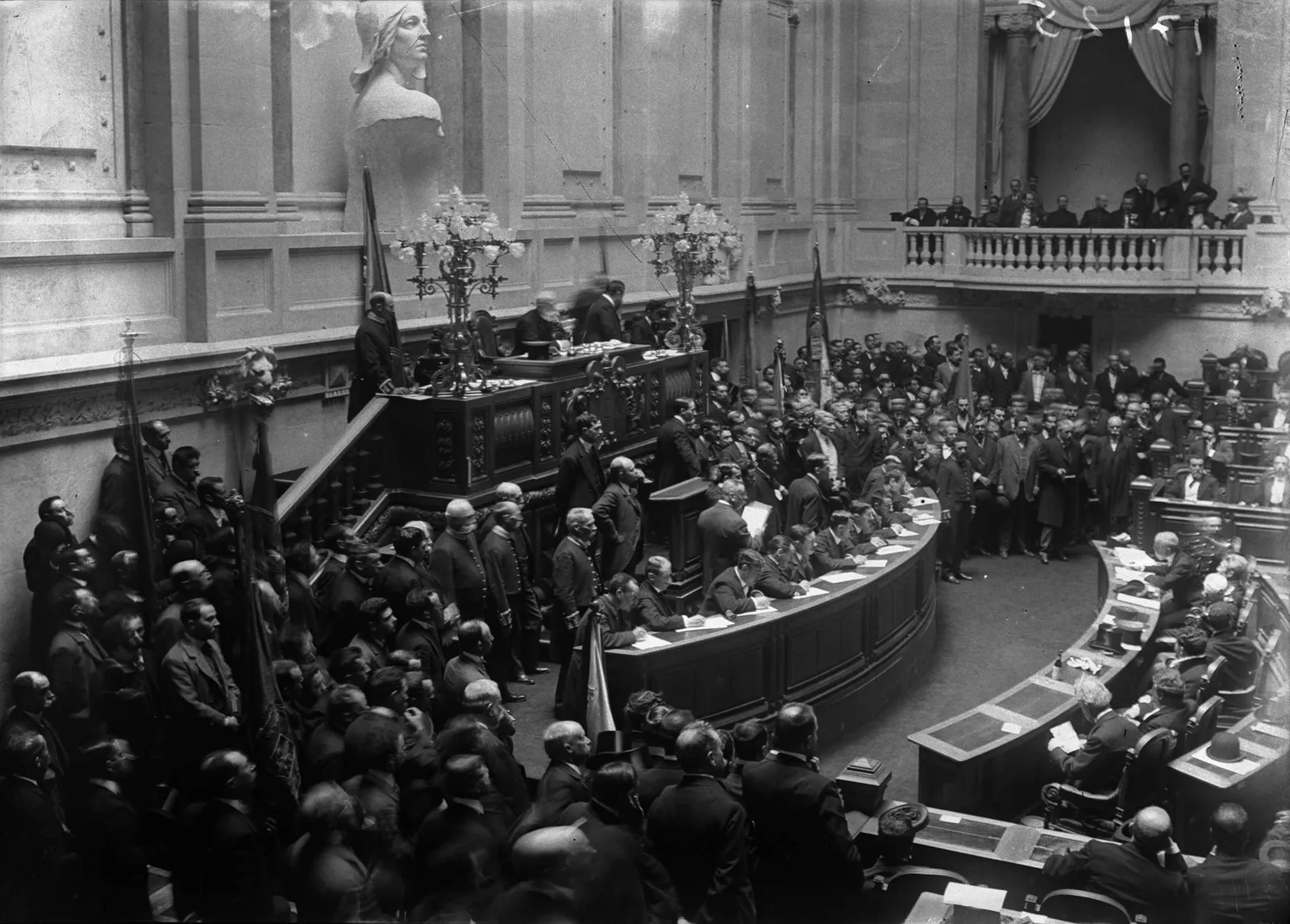
At 11.35 on the morning of Monday 19 June 1911 the roll call began in the Palácio das Cortes, the old monastery of São Bento that housed Portugal's parliament. The president would count 166 deputies present. Spectators watched from the public galleries, and in the Sala dos Passos Perdidos, the hall outside, waited the delegates of more than two hundred town councils, who had come to Lisbon to see the Republic proclaimed by the nation's elected representatives.
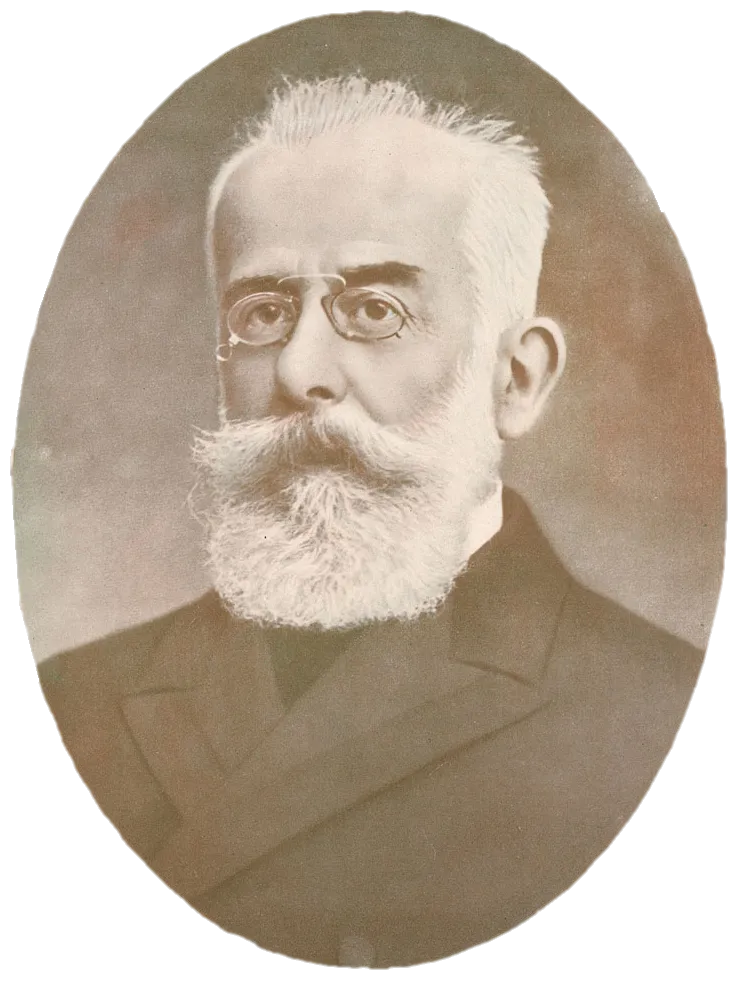
The president, Anselmo Braamcamp Freire, asked the deputies sitting at the sides of the chamber to give up their seats to the visitors, and the councillors filed in. Then he made it clear how the day would run. When José Jacinto Nunes, chairman of one of the committees that had checked the deputies' elections, asked to speak, Braamcamp refused him three times.
“Today I have decided not to give the floor to anyone.”
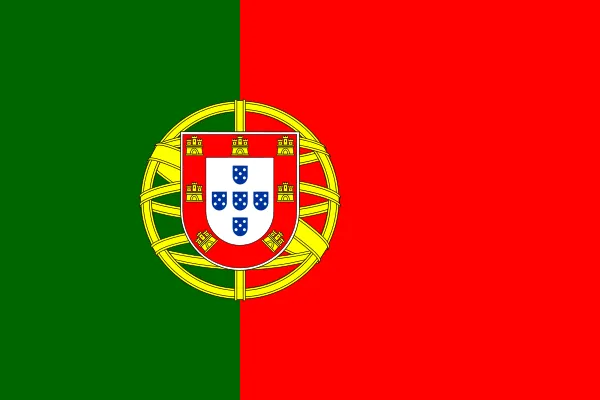
Within the hour the assembly had abolished the monarchy for ever, banished the House of Braganza and declared Portugal a democratic republic. Braamcamp then called for silence and read a second, shorter decree. Its first article described a flag of dark green and scarlet. As the deputies cheered the Republic, the homeland and the flag, the assembly's first secretary waved the national flag over the president's table. The second article had six words: the national anthem is A Portuguesa.
There was an irony in the chair. Braamcamp Freire had been among the well-known names who argued for keeping the blue and white flag of the old Portugal. It fell to him to read out the colours that replaced it.
What you need to know first
On 5 October 1910 a revolution in Lisbon overthrew King Manuel II, and a Provisional Government under the writer and positivist philosopher Teófilo Braga ruled by decree. It promised elections for a Constituent Assembly, a parliament whose task was to write a constitution. Only literate citizens and heads of household over 21 could vote, and in about half the constituencies there was no contest: unopposed candidates were simply declared elected.
The monarchy's colours were blue and white, in use on the flag since the time of King Pedro IV. The official anthem was the Hino da Carta, written by Pedro IV himself and played from 1834 until the revolution.
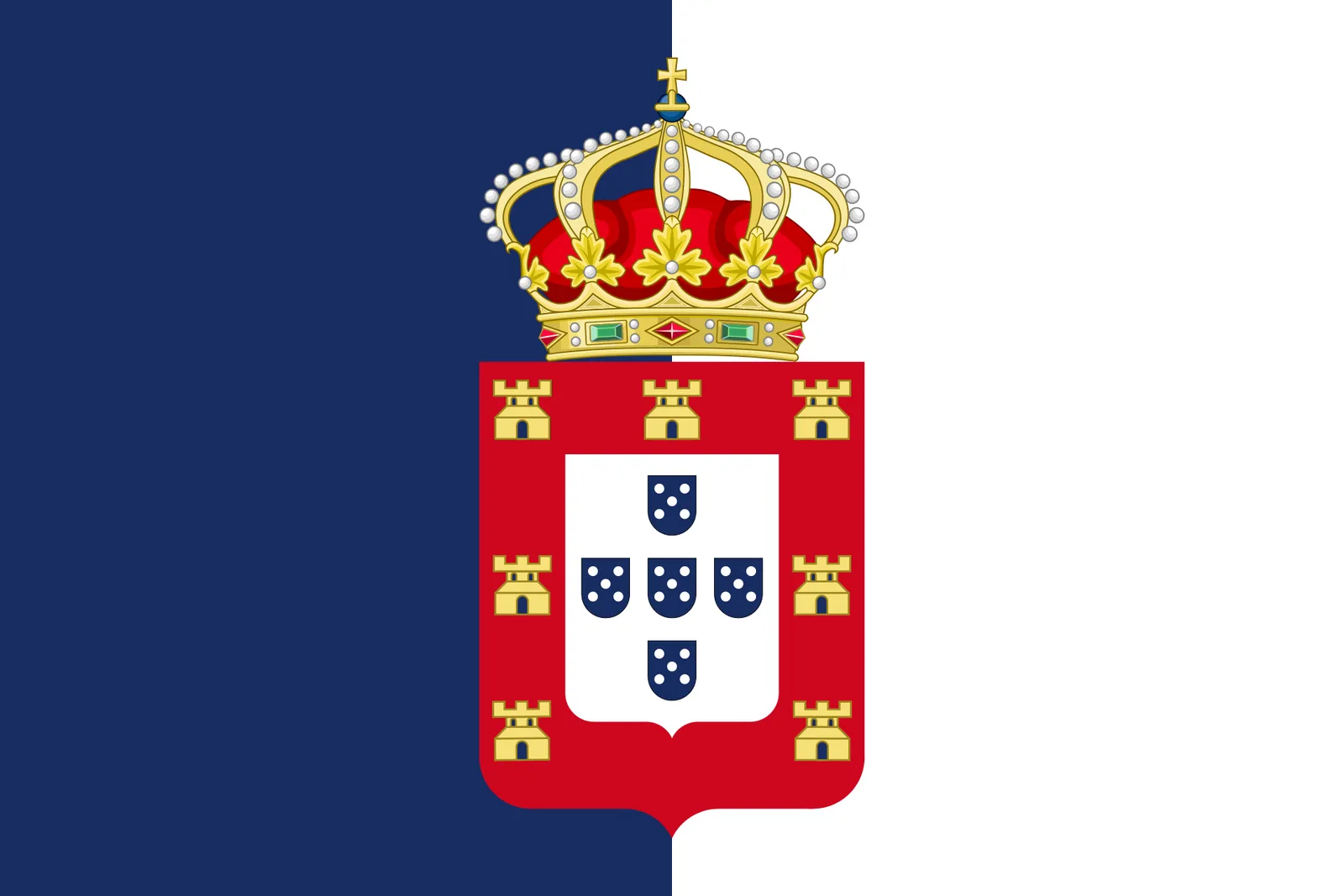
For many republicans, starting again meant changing those symbols. Green and red had been carried in the streets during the revolution. A Portuguesa had been the movement's song for twenty years. The question was whether a new regime should impose its party colours on the whole country.
The colours were older than the revolution. In the failed republican rising in Porto on 31 January 1891, a flag of the city's Centro Democrático, red with a green circle, was raised over the town hall. The flag the rebel regiments and ships hoisted in October 1910 was not today's either: according to Severiano Teixeira it was red at the hoist and green over the larger part, with a gold armillary sphere on a blue ground and a silver star.
Five men and a report
In the first weeks the Provisional Government was rumoured to lean towards keeping blue and white, without the royal crown. Severiano Teixeira writes that the Carbonária, the secret society that had done much of the fighting on 5 October, stepped in to stop it. Faced with the deadlock, the government handed the question to a commission.
On 15 October 1910, ten days after the revolution, the Provisional Government named a commission to design a national flag. It had five members: the painter Columbano Bordalo Pinheiro, the writer Abel Botelho, the journalist and politician João Chagas, and two men who had fought on 5 October, the artillery captain José Afonso Palla and the naval first lieutenant António Ladislau Parreira.
The commission finished its report on 29 October. According to the Diário de Notícias, the Council of Ministers asked for changes the next day and looked at the design again on 6 November. The report threw out blue because it was tied to the cult of Our Lady of the Conception, and called it a condemned colour.
Green, it said, was the colour of hope; it was also, as the Museu da Presidência notes, the colour the positivist philosopher Auguste Comte linked to progress. The report's main claim, though, was that the people had chosen it in the revolution. Green, in the report's words, sprang from spontaneous popular instinct.
“It recalls blood and urges victory … it is the only colour that can give us the blaze of great enthusiasms and raise us to the utmost devotion to a sacred duty.”
Red came first as a combative, warm and virile colour, and only then as a reminder of blood. White, a fraternal colour in which all the others merge, stayed for the sake of tradition. To the revolutionary colours the commission added two old emblems: the Manueline armillary sphere, a navigator's instrument that stood for the age of the Discoveries, and the national shield of five blue escutcheons and seven castles.
| Element | Rule | Where it is set |
|---|---|---|
| Colours | Dark green and scarlet, divided vertically, green at the hoist | Decree of 19 June 1911, art. 1 |
| Emblem | The national arms, bordered in white, on the Manueline armillary sphere in yellow outlined in black | Decree of 19 June 1911, art. 1 |
| Proportions | Length one and a half times the height (2:3) | Regulation of 30 June 1911, art. 2 |
| Division | Green two-fifths of the length, red three-fifths | Regulation of 30 June 1911, art. 2 |
| Size of emblem | Half the height of the flag, equidistant from top and bottom | Regulation of 30 June 1911, art. 2 |
| Anthem | A Portuguesa (no text or score specified) | Decree of 19 June 1911, art. 2 |
The decree left the dimensions and drawing to the commission's report, which it ordered to be published in the Diário do Governo; the regulation appeared there on 30 June 1911.
The quarrel of the flag
The commission's choice did not end the argument. Newspapers filled with letters and designs, and according to the historian Nuno Severiano Teixeira the flag commission received more than forty proposals. About a third kept the blue and white, about a third were green and red, and the rest tried to reconcile the two with four colours. One compromise, by the poet Delfim Guimarães and drawn by the painter Roque Gameiro, separated the green and red with a white band.
The poet Guerra Junqueiro led the blue and white camp. He argued that a flag should express the soul of the nation and that blue and white were national colours, not the monarchy's. He put forward his own design: the old blue and white field and shield, without the crown, with the armillary sphere and five stars.
Álvaro Foito, Duarte Leal and Carvalho Neves were among those who drew other blue and white flags. The philosopher Sampaio Bruno wanted the same flag with a gold star where the crown had been, partly because people in the African colonies knew blue and white as the mark of Portuguese rule. Braamcamp Freire was on their side.
Teófilo Braga, Afonso Costa and António José de Almeida defended green and red. Braga gave the colours a medieval history: the red banner he said Afonso III had carried in the conquest of the Algarve in 1249, and the green of the banner that won the Battle of Aljubarrota in 1385. Green and red had also been the colours of the Iberian federalists of the nineteenth century, Braga among them. Raul Brandão later wrote down the rows between Braga and Junqueiro.
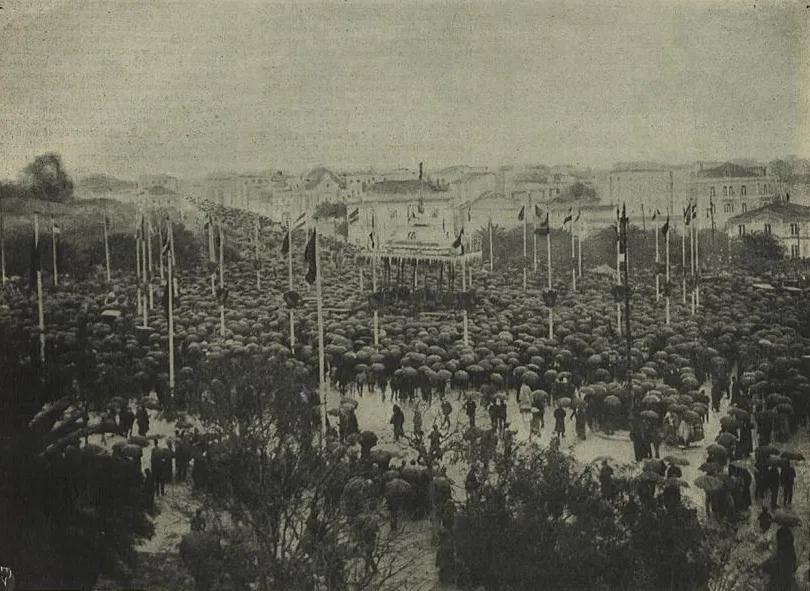
The government settled it on 29 November 1910, after changing the commission's first proposal. Two newspaper accounts, one citing Severiano Teixeira, say the Council of Ministers approved the design by a majority of one vote. A decree of 22 November had already made 1 December, a national holiday, the day of the Festa da Bandeira, and on that day the new flag was presented in Lisbon.
Supporters of blue and white kept asking for a plebiscite, a national vote on the colours. The Provisional Government refused, which left the final word to the Constituent Assembly.
Meanwhile the state printer, the Imprensa Nacional, prepared a special edition of the approved models on Japanese paper, finished in April 1911 with Columbano supervising. It showed the national flag, the regimental flag carrying the motto Esta é a ditosa Pátria minha amada (this is my beloved, happy homeland) and the jack flown at a warship's bow.
A march from 1890
The anthem caused no such fight. On 11 January 1890 Britain had ordered Portugal to withdraw from the lands between Angola and Mozambique, and the government gave way. On the night of 12 January the composer Alfredo Keil is said to have written a march at a dinner of friends that included the publisher Augusto Neuparth, the cartoonist Rafael Bordalo Pinheiro, the journalist Sebastião de Magalhães Lima and Teófilo Braga. The poet and naval officer Henrique Lopes de Mendonça wrote the words before the month was out.
“A song in which the soul of the wounded homeland would take shape, with its hopes of liberty and vigorous revival.”
In February 1890 Neuparth printed more than 22,000 free copies of the score, with a cover in the monarchy's blue and white. Its first audiences were not only republican. On 20 April 1890, at a bullfight in Sintra attended by King Carlos, the crowd asked for the march; the king agreed, and most of them heard it standing, hats off. By the end of that month Keil and Mendonça were publicly distancing themselves from those who used it for politics.
When republican rebels marched through Porto to the march on 31 January 1891, the government grew suspicious, and the regimental bands stopped playing it. Keil, a Lisbon-born painter and composer of German descent, died in Hamburg in 1907 and never heard it become the anthem.
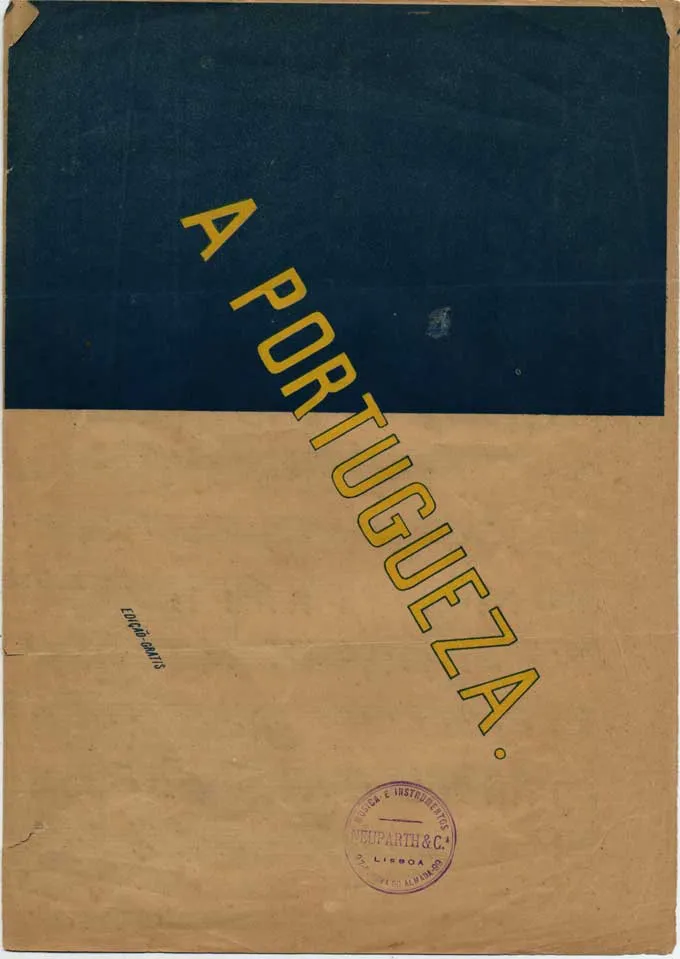
On the morning of 5 October 1910 the republican columns came down the Avenida da Liberdade with the bands of two regiments playing A Portuguesa without pause. On 17 November the Provisional Government's war minister ordered that the national anthem, A Portuguesa, always be played. New editions of the score came out from Neuparth and the Imprensa Nacional, the state printer, with the backgrounds now green and red.
Read, waved and cheered
The assembly had met once before, on 15 June, to choose a provisional chair and elect the committees that checked each deputy's election. They picked Braamcamp Freire. The sitting of 19 June was numbered the first session, and it was built as a ceremony. There was no debate, no amendment and no vote count on the flag. The record's summary says the decree was read and voted; the minutes show it read and cheered.
“The National Flag is divided vertically into two basic colours, dark green and scarlet, with the green on the side of the hoist. In the centre, over the join of the two colours, it will bear the shield of the National Arms, bordered in white and resting on the Manueline armillary sphere, in yellow outlined in black.”
11.35
Session opens
The summary says 11.30. Roll call: 166 deputies present. Delegates of more than 200 town councils are let into the chamber.
Late morning
Credentials
The committees hand in their reports and the deputies receive their diplomas.
Before 12.35
Republic decreed
Monarchy abolished, the Braganzas banished, a democratic republic declared; approved unanimously, standing, then by acclamation.
Before 12.35
Flag and anthem
Braamcamp reads the second decree; the first secretary waves the new flag over the presiding table.
12.35
To the balcony
The session is suspended so the presiding officers, the government and the deputies can proclaim the Republic to the crowd outside.
13.45
Session resumes
Braamcamp reports that the Lisbon garrison has marched past the building in salute.
Shortly after
Powers handed over
Teófilo Braga returns the powers his government received on 5 October; the assembly confirms it as the executive for now.
13.55
Session closes
Deputies shout 'Long live the Portuguese Republic!' and 'Long live independent Portugal!'
Teófilo Braga, listed among the friends at the 1890 dinner where A Portuguesa was conceived, was in the chamber twenty-one years later as head of government when it became the anthem. So was Magalhães Lima, another guest at that dinner, now a deputy. The anthem's lyricist had been on the losing side of the flag quarrel: the Diário de Notícias lists Henrique Lopes de Mendonça among the supporters of blue and white.
Aftermath
The decree was printed in the official gazette, the Diário do Governo, number 141, on Tuesday 20 June 1911. The commission's report, with the exact dimensions, followed in number 150 on 30 June. The assembly went on to write the Constitution, and approved its final text on 21 August 1911.
A decree did not make the flag popular. For many it remained too closely tied to the republican revolution. The Museu da Presidência da República points to the First World War, which united the Portuguese under the new flag at a tragic moment, as the turning point. In January 1919 monarchist rebels in the north raised the blue and white again over public buildings from Viana do Castelo to Bragança, for less than a month.
The meaning of the colours drifted too. The commission had put red's fighting spirit first and blood second. Over the years the association with blood came to prevail, as the Museu da Presidência notes.
Why it still matters
Both choices outlived the First Republic and the long dictatorship that followed it. The democratic Constitution of 1976 wrote them into its opening articles. Article 11 says the national flag is the one adopted by the Republic established by the revolution of 5 October 1910, and that the national anthem is A Portuguesa, in the same words the 1911 decree used, in modern spelling.
The technical rules of 1911 are still the reference. In 2013 the defence ministry found that the army's uniform regulations set its flag arm badge at 5 by 3 centimetres. It quoted the 1911 rule, length one and a half times the height, and changed the badge to 4.5 by 3.
- Commission named
- 15 October 1910
- Design approved by the government
- 29 November 1910
- First Festa da Bandeira
- 1 December 1910
- Decree of the Constituent Assembly
- 19 June 1911, read at the first session
- Published
- Diário do Governo n.º 141, 20 June 1911
- Dimensions published
- Diário do Governo n.º 150, 30 June 1911
- In the Constitution
- Article 11 of the 1976 Constitution
FAQs
When did Portugal adopt its current flag?
The Provisional Government approved the green and red design on 29 November 1910 and presented it at the first Festa da Bandeira on 1 December 1910. The Constituent Assembly made it law by decree on 19 June 1911; the decree was published on 20 June and the exact dimensions on 30 June 1911.
What do the green and red of the Portuguese flag mean?
The 1910 commission called green the colour of hope and progress and, above all, the colour the people had carried in the revolution. Red was a combative, warm colour that 'recalls blood and urges victory'. The reading of red as blood came to prevail only later.
Who designed the Portuguese flag?
A five-member commission named on 15 October 1910: the painter Columbano Bordalo Pinheiro, the writer Abel Botelho, the journalist João Chagas, Captain José Afonso Palla and Lieutenant António Ladislau Parreira. Columbano is often credited with the drawing, but the government changed the commission's first proposal before approving it.
When did A Portuguesa become Portugal's national anthem?
It was treated as the anthem from the revolution of 5 October 1910, and the war minister ordered on 17 November 1910 that it always be played. The Constituent Assembly made it the national anthem by decree on 19 June 1911. The simplified official version sung today was published in the Diário do Governo in 1957.
Was the flag debated in parliament?
Not on 19 June 1911. The president, Braamcamp Freire, gave nobody the floor, and the decree was read and acclaimed. The real debate had taken place in the newspapers in 1910 and 1911, between supporters of green and red and of the old blue and white.
On the timeline
Open the timelineNearby moments from the first republic (1910–1926).
The young Republic founds the University of Porto, built on the city's Polytechnic Academy and Medical-Surgical School, with the mathematician Francisco Gomes Teixeira as first rector. It has grown into one of the country's largest universities.
The Provisional Government of the Portuguese Republic decrees the Law of Separation of Church and State, drafted by Afonso Costa — one of the most sweeping anticlerical measures in Europe, nationalising church property and ending the state religion.
A decree of the Provisional Government creates the escudo as Portugal's new currency, replacing the real at a rate of one escudo to 1,000 réis in the wake of the Republican Revolution.
The flag and anthem, 1911
The Constituent Assembly of the young Republic formally adopts the green-and-red flag bearing the armillary sphere and the shield of Portugal, and confirms 'A Portuguesa', the march written against the 1890 British Ultimatum, as the national anthem. Both remain the symbols of Portugal today.
The Constituent Assembly elects Manuel de Arriaga as the first President of the Portuguese Republic, days after approving the new republican Constitution.
João Chagas, a Rio de Janeiro-born journalist and veteran republican agitator, heads the first constitutional government of the young Portuguese Republic, formed after Manuel de Arriaga's election as president; the official list of heads of government dates his term from 3 September.
Portugal makes its Olympic debut as the Stockholm Games open. In the 100-metre heats that day the 18-year-old sprinter António Stromp, a founder member of Sporting, runs in Portugal's first Olympic race. Just six Portuguese competed, in athletics, fencing and Greco-Roman wrestling.
Coming up in history
All long reads 21 June 1813Vitoria, 21 June 1813: the Portuguese army that helped drive Joseph out of Spain
 22 June 1874The cable that put Brazil a day from Europe: Carcavelos, 22 June 1874
 23 June 1940The Exposição do Mundo Português: Salazar's empire on show in Belém, 1940
 24 June 1128São Mamede, 24 June 1128: Afonso Henriques defeats his mother
22 sources
Archives, scholarship and reporting this article was checked against.
- 1
Diário da Assembleia Nacional Constituinte, Junta Preparatória, 1.ª sessão, 19 de Junho de 1911Assembleia da República, Debates Parlamentares
- 2
Bandeira NacionalMuseu da Presidência da República
- 3
- 4
Quando a nossa bandeira deu uma polémica incendiária (J. Plácido Júnior)Visão, 30 April 2023
- 5
Portaria n.º 88/2013, de 28 de fevereiro (Diário da República, 1.ª série, n.º 42)Ministério da Defesa Nacional, Diário da República
- 6
Bandeira NacionalImprensa Nacional (INCM), História e Património, 5 October 2020
- 7
Constituição da República Portuguesa, artigo 11.º (Símbolos nacionais e língua oficial)Assembleia da República
- 8
O mosteiro que se tornou ParlamentoVisit Lisboa (Turismo de Lisboa)
- 9
Joaquim Teófilo Fernandes BragaArchontology.org
- 10
- 11100 anos de bandeira portuguesaDiário de Notícias, 18 June 2011
- 12
- 13República: “Adesivos”, “thalassas” e heróis esquecidosDiário de Notícias (archive section), 4 October 2023
- 14
Um objeto e seus discursos: postal de Silva e Sousa, Guerra Junqueiro e a derrotada bandeira nacional azul e brancaMuseu do Porto (Câmara Municipal do Porto), 2023
- 15
Em torno de duas Repúblicas (Luís da Cunha Pinheiro and Maria Manuel Marques Rodrigues, eds.)LusoSofia Press, Universidade da Beira Interior, 2013
- 16
Alfredo KeilMACAM (Museu de Arte Contemporânea Armando Martins)
- 17
- 18
- 19Sem rei nem roque? Os 100 anos da Monarquia do Norte, by Rui RamosObservador, 19 January 2019
- 20
A Monarquia do Norte (1919) no discurso iconográfico da Ilustração Portuguesa, by Jorge Pedro Sousa, Fátima Lopes Cardoso and Celiana AzevedoMATRIZes, vol. 18, no. 1 (2024), Universidade de São Paulo
- 21
“Bretões” ou “canhões”? A história do hino de PortugalRFM
- 22
Image credits
- The Constituent Assembly in the session chamber of the Palácio de São Bento, Lisbon, with Anselmo Braamcamp Freire in the president's chair. The Lisbon municipal archive's print is dated 19 June 1911, the day the assembly decreed the flag and the anthem. Unknown author, Public domain, via Wikimedia Commons.
- The blue and white flag of the constitutional monarchy, as flown on land from 1830 to 1910 (modern drawing). The republicans kept the shield, removed the crown and replaced the colours. Tonyjeff, based on ancient national symbol., Public domain, via Wikimedia Commons.
- The national flag as decreed in 1911 and still flown today: green two-fifths, red three-fifths, and the shield on the armillary sphere at the join (modern drawing). Original: Columbano Bordalo Pinheiro (1910; generic design) Vector: Vítor Luís Rodrigues; António Martins-Tuválkin (2004; this specific vector set: see sources), Public domain, via Wikimedia Commons.
- Crowds under umbrellas on the Avenida da Liberdade, Lisbon, on 1 December 1910, the first Festa da Bandeira, when the new flag was presented. Published in O Occidente on 10 December 1910. Unknown author, Public domain, via Wikimedia Commons.
- Cover of the free 1890 edition of A Portugueza, printed in the monarchy's blue and white. After 1910 new editions were printed in green and red. Biblioteca Nacional de Portugal. Alfredo Keil, Public domain, via Wikimedia Commons.
- Anselmo Braamcamp Freire, president of the Constituent Assembly, who read the flag decree although he had argued for keeping blue and white. Ilustração Portuguesa, 31 July 1911. Unknown author, Public domain, via Wikimedia Commons.