

São Mamede, 24 June 1128: Afonso Henriques defeats his mother
A young prince and the barons of the north fought his mother's Galician favourite in a field below Guimarães Castle. The annals give it one sentence; later centuries added chains, a curse and a name: the first Portuguese afternoon.
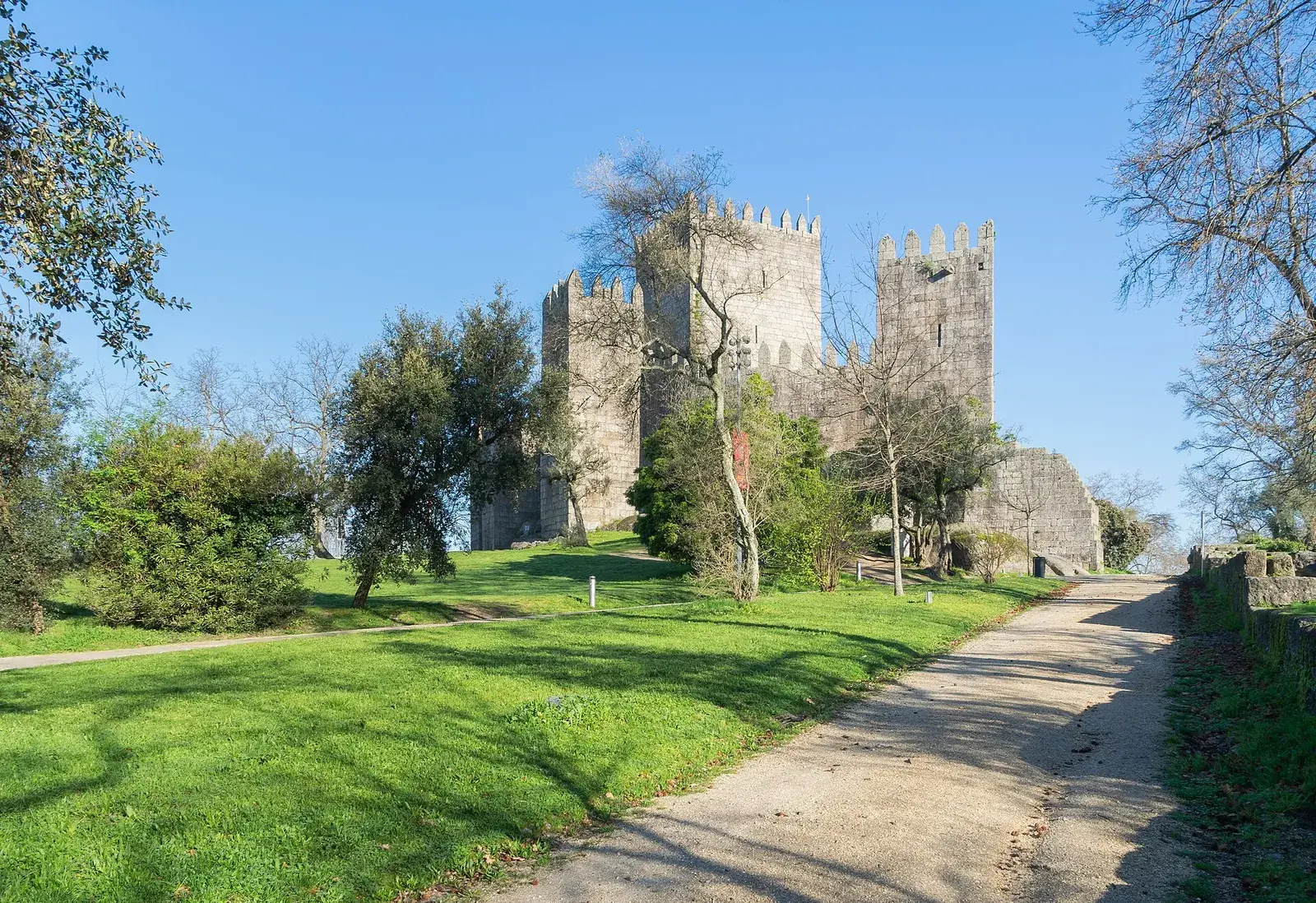
At a glance
- On 24 June 1128, the feast of Saint John, Afonso Henriques defeated the forces of his mother, Teresa, and her Galician ally Fernão Peres de Trava in the field of São Mamede, near Guimarães Castle.
- Afonso was between about 16 and 22, depending on which proposed birth year is right. He led the northern barons and the archbishop of Braga, who resented the power the Trava family had gained at Teresa's court.
- The earliest account, in annals kept at Santa Cruz de Coimbra, says his enemies were crushed, fled and were caught, and that he took over the County of Portugal.
- The stories that Afonso imprisoned his mother and that she cursed him first appear in a chronicle of the late thirteenth century, more than 150 years later.
- Twelfth-century writers counted his reign from 1128. Portugal's official 900th-anniversary commemorations take 24 June 2028 as their first major date.
Midsummer below the castle
The feast of Saint John the Baptist fell on a Sunday in 1128. Below the castle of Guimarães, a hilltop fort that the countess Mumadona had raised in the tenth century and that documents called the castle of São Mamede, two armies met on open ground.
On one side were the men of Teresa, who governed the County of Portugal and called herself queen, and of Fernão Peres de Trava, the Galician count who shared her power and her bed. On the other was her son, Afonso Henriques, still a young man, with the barons of the north behind him.
Nobody wrote down how many men fought, how long it lasted or who died. The oldest known account runs to a few lines in Latin, written in the late twelfth century by a canon of Santa Cruz in Coimbra, a monastery devoted to his memory. It says his enemies were crushed and fled, that he caught them, and that he took the principality and sole rule of Portugal.
Alexandre Herculano, the nineteenth-century historian who first made the battle a national beginning, put it in one sentence: in a single day of fighting, the supreme power the young prince wanted had fallen into his hands.
A county held by a queen
In the 1120s there was no Kingdom of Portugal. There was a county, roughly the later provinces of Minho, the coastal Douro and Beira, and part of Trás-os-Montes, held from the king of León and Castile. Alfonso VI had given it, by hereditary title, to his natural daughter Teresa and her husband, Henry, a nobleman from Burgundy, in the mid-1090s. By 1128 it was divided into nearly sixty terras, districts each held by a noble tenant.
Henry and Teresa favoured the local elites: the archbishop of Braga and five great families, the Maia, Sousa, Baião, Ribadouro and Bragança. Henry died, probably in April 1112, at Astorga. Teresa took over the government, and from 1117 she used the title regina, queen. At the time the word could also mean a king's daughter, but it signalled her ambitions, and it strained relations with her nephew Alfonso VII of León and Castile.
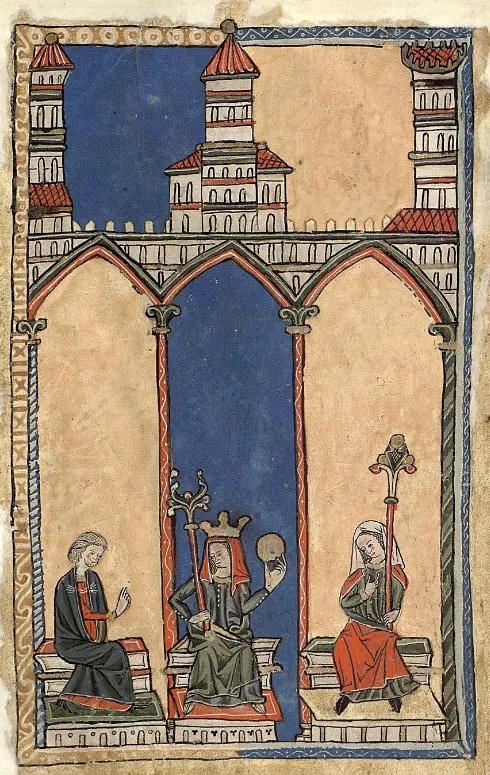
Her chosen partner came from Galicia, north of the Minho. The Trava were the most powerful family there, and Fernão Peres became her companion, perhaps her husband in the loose aristocratic sense of the day, and had children with her. His elder brother Bermudo married Teresa's daughter Urraca and in early 1128 was in charge at Viseu.
Galician nobles followed the Trava into the county's top posts. By the mid-1120s four of the five great families had left or been pushed out of Teresa's court; only the Baião remained. The archbishop of Braga, Paio Mendes, possibly a Maia, had his own grievance: his see was locked in a rivalry with Compostela and its archbishop, Diego Gelmírez, an old patron of Fernão Peres.
The historian José Mattoso thought Teresa probably aimed to restore the old kingdom of Galicia, joining Portuguese and Galician lands. Afonso claimed royal rank through his mother, a king's daughter, but in 1128 he was in practice a lord chosen by other lords who would not do homage to a mere count such as Trava.
A prince without a place
Afonso, “son of Henry”, was born around 1109, the year the Coimbra annals give. The Chronica Gothorum, another set of Santa Cruz annals, says he was almost fourteen when he armed himself as a knight in 1125, which points to 1111, the year Herculano preferred; other medieval records give 1106. He was brought up in the Ribadouro country, almost certainly in the household of Egas Moniz.
That knighting was a statement. At Pentecost 1125, in the cathedral of Zamora, he took the arms from the altar of the Saviour and put them on himself, “as is the custom of kings”. The chronicler describes a youth large of body, “like a giant” in his mail.
In 1127 Alfonso VII invaded the county to make it recognise his authority, and besieged Guimarães, where Afonso was. Herculano argued that the besieged barons bought peace by promising, in the prince's name, that he would be the king's vassal. Gelmírez then brokered terms between Alfonso VII and Teresa.
Spring 1128: the prince picks his side
A handful of charters show the break coming. On 19 March 1128 Teresa and Count Fernando gave the castle of Soure, south-west of Coimbra, to the Knights Templar. On 31 March Afonso was still confirming one of his mother's grants. By April he had gone north to the region between the Douro and the Minho, where the revolt seems to have started.
On 27 April 1128 he confirmed and enlarged the town charter that his parents had given Guimarães. The new clauses rewarded the burgesses who, in the charter's words, had “suffered harm and pain” with him in Guimarães during the siege. The historian José Marques reads the new privileges as a way of making sure of their help on the decisive day that was coming.
“When I have acquired the land of Portugal... that you may be my helper.”
At Braga, on 27 May, he enlarged the archbishop's domain and said openly that he meant to take the county. Herculano lists the men around him: Archbishop Paio, his brother Soeiro Mendes, known as the Fat, of the Maia family, Ermígio Moniz, Sancho Nunes and Garcia Soares.
c. 1096
Henry and Teresa give Guimarães its town charter
The critical date of the charter, the couple's oldest known document.
c. 1109
Afonso Henriques is born
The year in the Coimbra annals; 1106 and 1111 have also been proposed.
1112
Count Henry dies, probably at Astorga
Teresa governs the county.
1117
Teresa takes the title of queen
Pentecost 1125
Afonso arms himself as a knight at Zamora
1127
Alfonso VII besieges Guimarães
Teresa submits to her nephew.
19 March 1128
Teresa and Fernão Peres give Soure to the Templars
27 April 1128
Afonso confirms the Guimarães charter
He rewards the burgesses who held out with him during the siege.
27 May 1128
Grant to the archbishop of Braga
Afonso promises more once he has acquired the land of Portugal.
24 June 1128
Battle of São Mamede
Teresa and the Trava party are defeated and leave the county.
The battle in the field of São Mamede
Teresa marched on Guimarães with the Galician lords and her Portuguese supporters. The Chronica Gothorum, in its longer version, sets out the quarrel from the winners' side before it reaches the fighting.
“Certain unworthy men and foreigners claimed the kingdom of Portugal, with the consent of his mother, Queen Dona Teresa, who wished herself to reign proudly in her husband's place, with her son removed from the business of the kingdom.”
Afonso, the annal goes on, called together his friends and the nobler men of Portugal, who wanted him to rule them far more than his mother or the foreigners. He gave battle in the field of São Mamede, near the castle of Guimarães. A shorter version of the annal adds a cautious correction: on Saint John's day Afonso entered upon the kingdom, “or rather the principality”, of Portugal.
“And they were crushed and beaten by him, and fled before him, and he took them. He obtained the principality and sole rule of the kingdom of Portugal.”
These are panegyrics, written in the second half of the twelfth century at a monastery devoted to Afonso's memory. Moreira points out that there were Portuguese on both sides, and that the fight was against Fernão Peres's circle and its close allies rather than against “the Galicians”. The result, he adds, is beyond dispute: Teresa and her allies lost the government of the county.
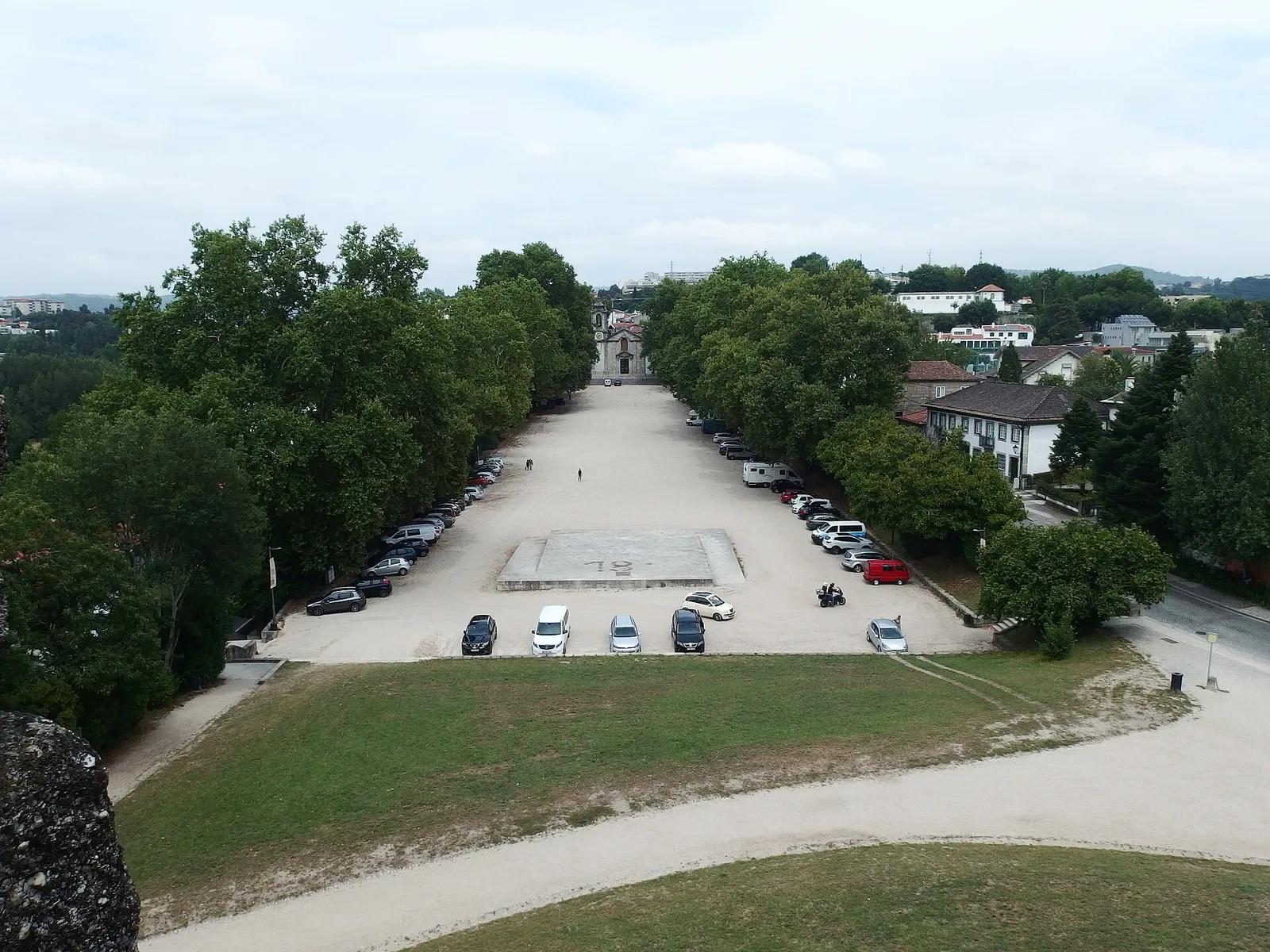
Where exactly they fought is still argued over. The open ground just below the castle has long been called the Campo de São Mamede, after the annal's phrase. Two other sites have been proposed on firmer grounds: the Campo da Ataca, in the parish of São Torcato, where a group of statues was put up in the late twentieth century, and a meadow on the far side of town, by the old road to Porto and a thirteenth-century bridge.
Chains, a curse and a broken leg
Within two centuries the battle had grown a plot. A chronicle in Galician-Portuguese from the late thirteenth century says Afonso and Fernão Peres agreed to settle the quarrel by battle. Afonso's men broke at first, and the baron Soeiro Mendes forced him back into the fight. The same text is the first to say that Afonso imprisoned his mother, and it has her curse him and ties the curse to his capture at Badajoz in 1169.
Duarte Galvão's chronicle, written for King Manuel I in the early sixteenth century, tells the fuller version. The armies meet at a place “they call Santilanhas”, Teresa rides with her count and urges him to capture her son, and Afonso flees a league from Guimarães before Egas Moniz turns him round. Back in the field, he captures both of them, lets the count go on his oath never to return, and puts his mother in irons.
“Son Afonso, you have imprisoned me and disinherited me of the land and honour my father left me, and parted me from my husband. I pray God that you be imprisoned as I see myself. And because you put in irons my legs, which helped to carry you and bring you up with much pain, in my womb and out of it, may yours be broken with irons. May it please God that it be so.”
Like the older chronicle, Galvão then links the curse to a real event. In 1169, as king, Afonso broke his leg riding out of a gate at Badajoz and was captured by Fernando II of León, and everyone said it had happened because his mother cursed him.
| Source | Written | What it adds |
|---|---|---|
| Chronica Gothorum (Santa Cruz annals) | Second half of the twelfth century | The date, the field near Guimarães Castle, a quick victory over “unworthy men and foreigners”, and Afonso taking the principality |
| Chronicle in Galician-Portuguese | Late thirteenth century | A battle agreed with Fernão Peres, Soeiro Mendes's rally, Teresa imprisoned, and her curse fulfilled at Badajoz in 1169 |
| Chronicles of the fourteenth century, among them the Crónica Geral of 1344 | From the 1300s | The site renamed São Redanhas; Ourique treated as the founding moment |
| Duarte Galvão's chronicle | Early sixteenth century | Egas Moniz's rally, Teresa in irons and the words of her curse |
| Alexandre Herculano, História de Portugal | 1840s | Rejects the chains as unproven and treats the battle as the dawn of the nation |
Later chronicles also replaced Soeiro Mendes with Egas Moniz.
Exile in Galicia
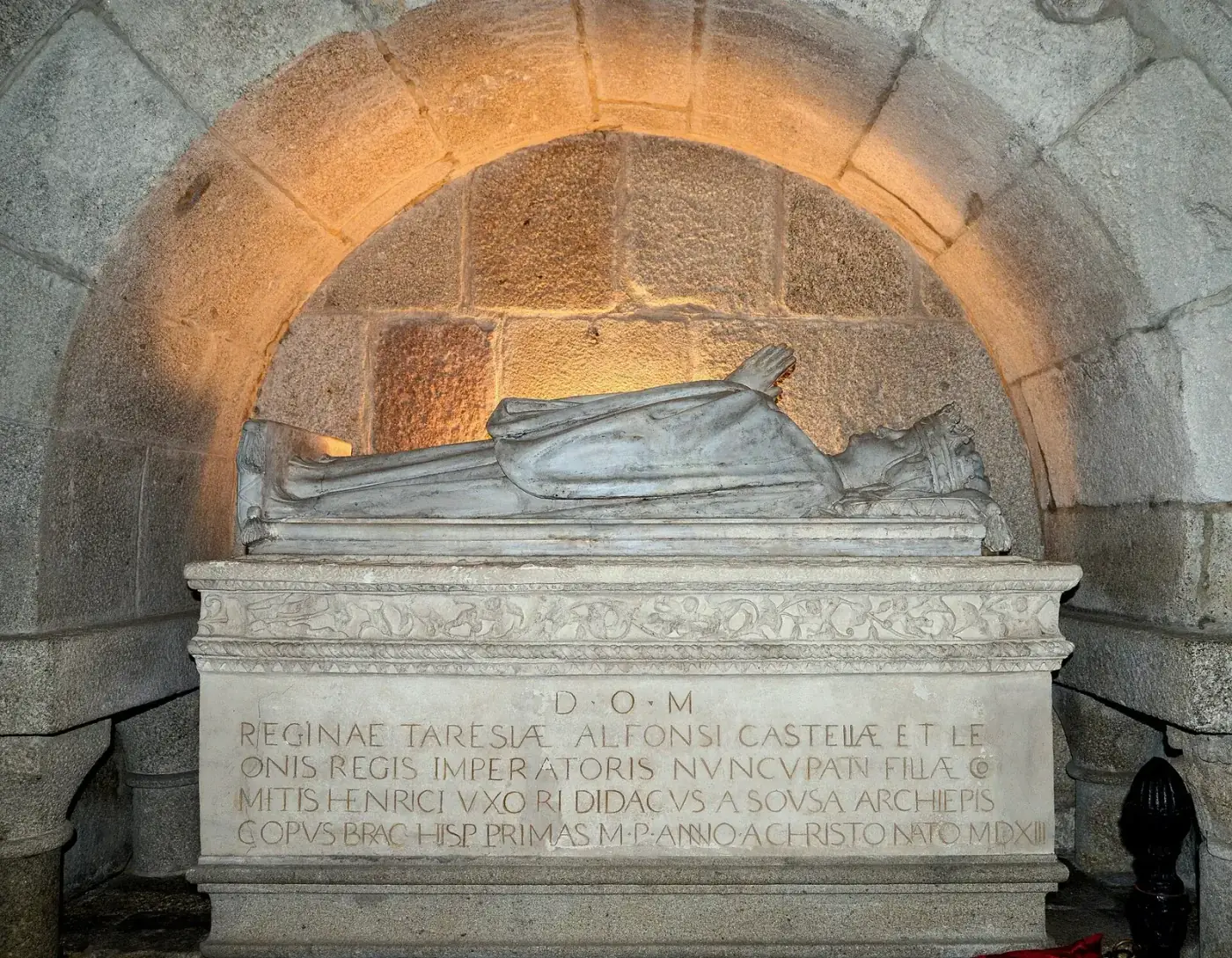
Teresa went into exile in Galicia. She died on 1 November 1130, which the annal counts as the second year of her son's rule, at about fifty. Her body was brought back to Braga Cathedral and buried beside Henry.
Fernão Peres did not forget her. In a later grant of land to the cathedral of Coimbra, made so that God would join the dead princess to the blessed, he threatened anyone who undid it with the fate of Dathan and Abiram, whom the earth swallowed. He went on to serve Alfonso VII, and he and a brother later returned to Portugal without challenging Afonso's rule.
The Trava did not all go quietly. In 1131 Bermudo Peres, Teresa's son-in-law, tried to hold the castle of Seia against Afonso, who marched on him and threw him out. Not long after the battle, Afonso confirmed the Soure grant his mother had made to the Templars, asking to share in the order's brotherhood.
Mattoso wrote that São Mamede might have been nothing more than a feudal skirmish. It mattered because of what Afonso did with the power he took that day. He moved his base to Coimbra, on the frontier with Muslim al-Andalus, won at Ourique in 1139, was calling himself king by about 1140, and was recognised as king by the pope in 1179. He died in 1185.
How a skirmish became “the first Portuguese afternoon”
In the twelfth century, texts and even inscriptions counted Afonso's reign from 1128, so contemporaries plainly took the battle as his starting point. From the late thirteenth century, though, Ourique took its place as the founding moment of his kingship, and with it of Portugal.
Mattoso explained why in a lecture in Guimarães on 24 June 1978. When national feeling sharpened after the war of independence of 1385, Ourique suited it better: a battle between Christendom and Islam, later embroidered with a vision of Christ, gave the king a sacred mission.
“Only with Alexandre Herculano is São Mamede considered, for the first time, as the dawn of the homeland.”
Herculano saw it as the result of collective action rather than a simple change of leader, and so as the event without which the later victories, Ourique among them, would not have been possible. Mattoso spoke of a close-knit social group that showed its strength against powerful opponents and became more clearly aware that it could govern itself.
Why it is remembered as the founding
Portugal has no single founding date. The battle of 1128, Ourique in 1139, the meeting with Alfonso VII at Zamora in 1143 and the papal bull Manifestis probatum of 1179 all have their champions.
The case for São Mamede is the oldest one: the twelfth century counted Afonso's reign from that day, before Ourique took over the story, and Herculano and Mattoso built on it, as the previous section shows.
The state now follows that reading. The commission for the 900th anniversary of Portugal's founding, created in July 2026, takes the whole founding period as its reference but makes 24 June 2028, the anniversary of the battle, its first major date. Guimarães's mayors have long asked for 24 June to be a national holiday.
FAQs
When and where was the Battle of São Mamede?
On 24 June 1128, the feast of Saint John the Baptist, in the field of São Mamede near the castle of Guimarães, in northern Portugal. Both versions of the Santa Cruz annals give the feast day; Herculano, in a note to his history, put the battle in July, but later historians follow the annals. The exact spot is disputed: the open ground below the castle, the Campo da Ataca in São Torcato and a site by the old Porto road have all been proposed.
Why did Afonso Henriques fight his mother?
Teresa governed the County of Portugal with the Galician count Fernão Peres de Trava, whose family and followers took the top posts. The northern Portuguese nobles and the archbishop of Braga, pushed aside, rallied to her son Afonso, who claimed the right to rule his father's county.
Did Afonso Henriques imprison his mother?
The twelfth-century annal says only that he caught his defeated enemies. The tales of Teresa imprisoned by her son and of her curse first appear in a chronicle of the late thirteenth century. Teresa went into exile in Galicia and died there on 1 November 1130.
Is São Mamede the birth of Portugal?
It is when Afonso Henriques took power, and twelfth-century writers counted his reign from it. He took the title of king around 1140 and the pope recognised him in 1179. Since Herculano, many have seen 1128 as the beginning, and the official 900th-anniversary commemorations take 24 June 2028 as their first major date.
What does “a primeira tarde portuguesa” mean?
“The first Portuguese afternoon” is a name for the battle. It is the title of Acácio Lino's 1922 painting in the parliament building, and José Mattoso used it for a lecture in Guimarães in 1978.
On the timeline
Open the timelineNearby moments from from county to kingdom (1096–1249).
The Battle of São Mamede
Battle of São Mamede, near Guimarães. Afonso Henriques defeats the army of his mother Teresa and her Galician ally Fernão Peres de Trava and takes control of the County of Portugal. Since the nineteenth century the battle has been widely seen as the founding act of the future Kingdom of Portugal.
Battle of Ourique. On the feast day of Saint James, Afonso Henriques's army defeats a larger Muslim force under a commander the chronicles call 'Esmar', at a place tradition puts near Castro Verde in the Baixo Alentejo, though the site is disputed. Later tradition says his knights acclaimed him king on the field; his own charters first use the royal title in 1140.
By the Treaty of Zamora, Alfonso VII of León and Castile recognises his cousin Afonso Henriques as king, with the papal legate Cardinal Guido de Vico as mediator. The date is traditionally taken as the birth of the independent Kingdom of Portugal.
Afonso Henriques takes Muslim Santarém in a surprise attack before dawn: about 25 of his men climb the walls on two ladders and raise his banner, and a gate is broken open for the rest. The prize opens the road to Lisbon, which he captures that October.
Coming up in history
All long reads 26 June 1828The Belfastada: the steamer that carried Porto's liberal leaders off in 1828
 27 June 1214The will of Afonso II, 1214: a king's wishes in early Portuguese
 29 June 1958Rosa Mota, the girl from the Foz who became Olympic marathon champion
 30 June 1991Rui Costa's penalty at the Luz: Portugal's second youth world title, 1991
16 sources
Archives, scholarship and reporting this article was checked against.
- 1
Portugaliae Monumenta Historica: Scriptores, vol. I (Lisbon, Academia das Ciências, 1856): Chronicon Conimbricense, Chronica Gothorum and De expugnatione ScalabisInternet Archive (scan of the 1856 edition)
- 2
S. Mamede, «a primeira tarde portuguesa» (Filipe Alves Moreira)Super Interessante, special issue “Portugal, nação independente há 900 anos” (2025), pp. 33-41; Repositório Aberto, Universidade Aberta
- 3
Entre Oriente e Ocidente. Contactos de Portugal com o mundo nas origens da nacionalidade (José Mattoso), in No tempo de D. Afonso Henriques: reflexões sobre o primeiro século português, ed. Mário Jorge BarrocaCITCEM, Faculdade de Letras da Universidade do Porto (repositório Ler Letras)
- 4
- 5
Chronica de El-Rei D. Affonso Henriques (Duarte Galvão), Bibliotheca de Classicos Portuguezes, vol. LI, Lisbon, 1906Project Gutenberg, from Biblioteca Nacional de Portugal scans
- 6
Foral de Guimarães. Apresentação (José Marques)Revista de Guimarães 106 (1996), Sociedade Martins Sarmento
- 7Portugal, desde 1128 (Florentino Cardoso)Observador, opinion, 27 February 2025 (Portugal 900 Anos series, Sociedade Histórica da Independência de Portugal)
- 8
Comemorações dos 900 anos da Fundação de Portugal já têm comissão executivaXXV Governo Constitucional (portugal.gov.pt), 2026
- 9
Guimarães Castle: historyPaço dos Duques, Castelo de Guimarães e Paço de Vila Flor (Museus e Monumentos de Portugal)
- 10
- 11
- 12
- 13
- 14Carneiro defende em Guimarães feriado nacional no dia da Batalha de S. MamedeCorreio da Manhã, 5 October 2025
- 15
- 16
Image credits
- Guimarães Castle, which faces the Campo de São Mamede on its northern side. Its towers and keep were added in the late thirteenth or early fourteenth century; in 1128 it was a simpler walled enclosure. Krzysztof Golik, CC BY-SA 4.0, via Wikimedia Commons.
- Teresa, crowned, between Bermudo Peres de Trava (left) and her daughter Urraca, in a miniature from the cartulary of the Galician monastery of Toxos Outos, made around 1289. Bermudo, Fernão Peres's elder brother, married Urraca. Unknown author, Public domain, via Wikimedia Commons.
- The Campo de São Mamede seen from Guimarães Castle in 2017, with the church of São Dâmaso at the far end. Tradition puts the battle here; historians have proposed two other sites nearby. Palickap, CC BY-SA 4.0, via Wikimedia Commons.
- Teresa's tomb in Braga Cathedral. The Latin inscription names her queen, daughter of Alfonso, king of Castile and León, and wife of Count Henry, and says Archbishop Diogo de Sousa set it up in 1513. Alvesgaspar, CC BY-SA 4.0, via Wikimedia Commons.
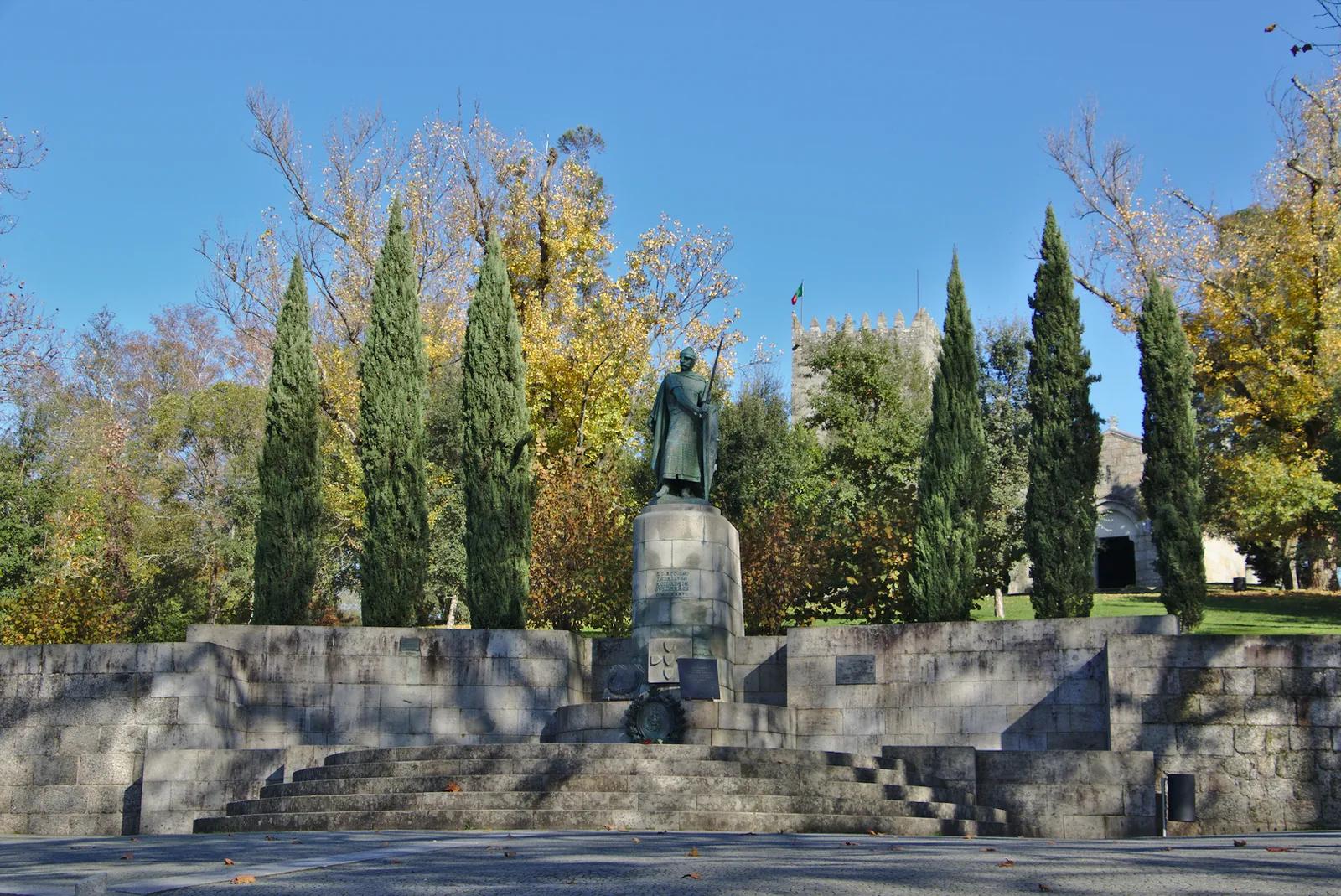
- António Soares dos Reis's bronze statue of Afonso Henriques below Guimarães Castle, photographed in 2018. Halley Oliveira, CC BY-SA 2.0, via Wikimedia Commons.