

The Exposição do Mundo Português: Salazar's empire on show in Belém, 1940
The day after France signed an armistice with Germany, Salazar's regime opened a city of plaster pavilions beside the Jerónimos to celebrate eight centuries of Portugal. In its gardens, about 138 people from Africa and Asia were put on show.
At a glance
- The Exposição do Mundo Português (Portuguese World Exhibition) opened in Belém, Lisbon, on 23 June 1940 and closed on 2 December 1940. It drew an estimated three million visits.
- It was the centrepiece of the Estado Novo's Double Centenary, which dated Portugal's founding to 1140 and celebrated the Restoration of independence from Spain in 1640.
- The minister of public works, Duarte Pacheco, drove the project; the architect Cottinelli Telmo drew the plan around a new square, the Praça do Império, and designed the first Padrão dos Descobrimentos with the sculptor Leopoldo de Almeida.
- In the Colonial Section, run by Henrique Galvão, about 138 men, women and children, most of them brought from the colonies, lived in mock villages and streets for visitors to watch, and anthropologists measured them.
- Almost everything was built of plaster and pulled down. The square and its fountain, the building of the Museu de Arte Popular and remains in the tropical garden survive; the Padrão was rebuilt in stone in 1960.
A Sunday in Belém
On Sunday 23 June 1940 the regime's notables arrived in Belém in the best cars Lisbon had and filed through the main gate in their finest clothes, uniforms and medals. The head of state, General Óscar Carmona, opened the exhibition with the head of government, António de Oliveira Salazar, and the minister of public works, Duarte Pacheco. At the entrance to the main building a slogan read: “We gave new worlds to the old world.”
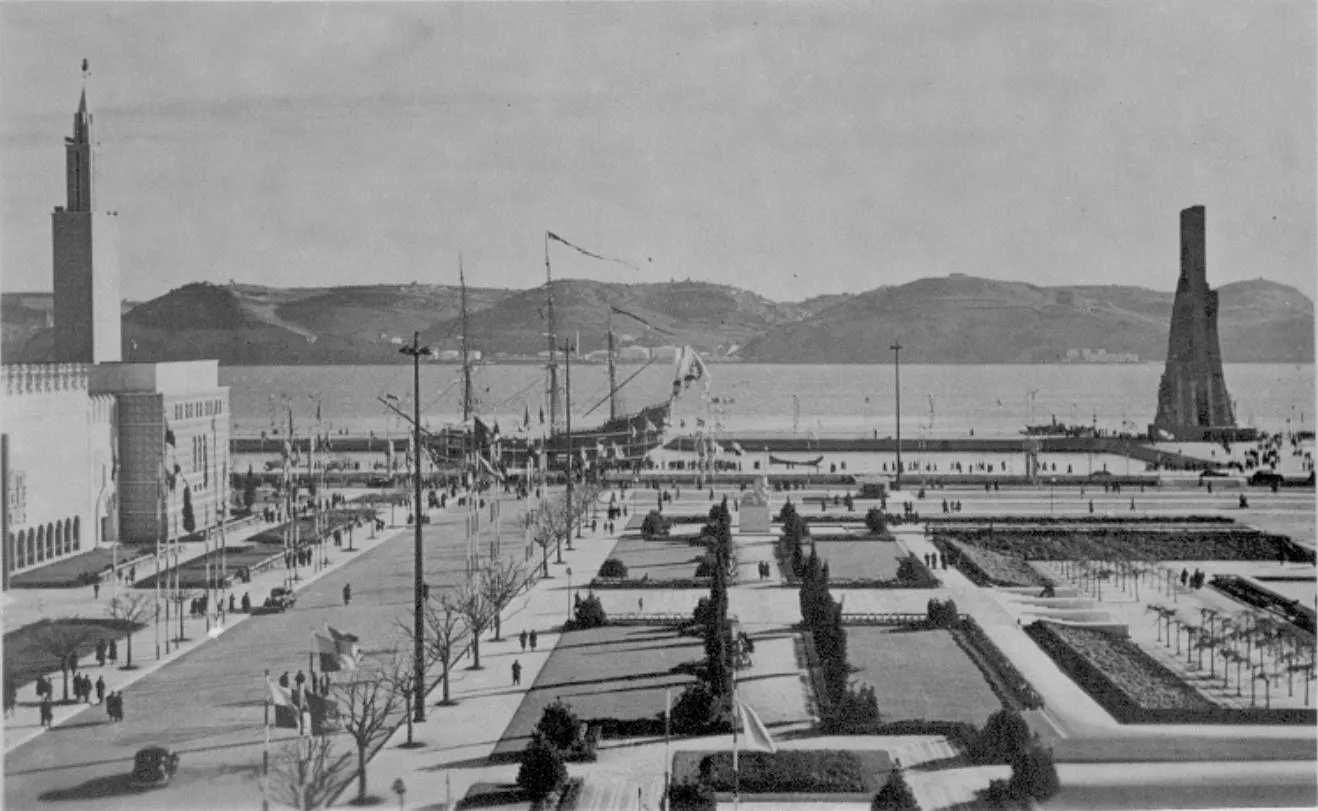
Behind them stood the Jerónimos Monastery, which King Manuel I had built after Vasco da Gama came back from India. In front, a new square ran down towards the Tagus between long pavilions, and at the water's edge rose a plaster monument shaped like the prow of a caravel. The colonial section, in the tropical garden beside the monastery, opened to the public four days later, on Thursday 27 June.
That day's Lisbon papers put the opening on their front pages beside two other stories. One was the armistice France had signed with Germany at Compiègne the day before. The other was an exchange of telegrams between Adolf Hitler and Portugal's president about the country's centenary celebrations.
The exhibition stayed open until 2 December 1940 and drew an estimated three million visits. It had been planned with foreign visitors in mind, but by the time it opened Europe was at war and they never came. Portugal itself stayed officially neutral.
- Open
- 23 June to 2 December 1940 (colonial section from 27 June)
- Site
- Belém, Lisbon, from the Praça Afonso de Albuquerque towards the Torre de Belém; about 560,000 m²
- Occasion
- Double Centenary: founding (dated to 1140) and Restoration (1640)
- Commissioner-general
- Augusto de Castro
- Chief architect
- José Ângelo Cottinelli Telmo
- Cost
- About 35,000 contos (35 million escudos)
- Visits
- About 3 million
Two centenaries for a new regime
Portugal had been a dictatorship since the military coup of 1926. In 1933 a constitution drafted by Salazar and approved by plebiscite founded the Estado Novo, or New State. It left freedom of expression, assembly and association to “special laws”, and the regime ran on a single party.
The late 1930s were among its most repressive years. The historian Júlia Leitão de Barros, writing in the magazine Electra, cites statistics of more than 8,000 political prisoners arrested in 1937 and 1938, and says that most of those sent to the Tarrafal camp in Cape Verde were held without trial.
The regime counted the founding of the kingdom from 1140 and the Restoration of independence from Spain from 1640, so 1940 was a double centenary. The idea of marking it was older than Salazar. In a letter printed in the Diário de Notícias on 20 February 1929, Alberto de Oliveira, then ambassador in Brussels, argued that both centenaries deserved solemn and well-prepared celebrations.
António Ferro, the journalist who ran the regime's propaganda office, the Secretariado de Propaganda Nacional, turned it into a plan. His 17-page report on the commemorations, dated 24 February 1938 and kept in Salazar's papers at the Torre do Tombo, names Duarte Pacheco, Henrique Galvão and the architect Pardal Monteiro among its authors. In March 1938 an official note from Salazar's office, written in the first person, set out the programme.
“A synthesis of our civilising action... of our action in the history of the world... all the footprints and traces of Portugal on the globe.”
Salazar said he hoped to give the people “a tonic of joy and confidence in itself”. A decree of 28 October 1938 created the commission of the centenaries. A national commission chaired by Alberto de Oliveira had Ferro as secretary-general, the writer Júlio Dantas led the executive commission, and the exhibition itself went to a commissioner-general, Augusto de Castro, a former editor of the Diário de Notícias.
The minister, the architect and 5,000 workers
Duarte Pacheco was an electrical engineer from the Algarve who had become director of Lisbon's engineering school, the Instituto Superior Técnico, in 1927 and built its new campus. He was minister of public works and communications from 1932 to 1936. After two years out of power he was made president of Lisbon city council in January 1938, and on 25 May 1938 he was back at the ministry, in charge of delivering the centenaries.
He used the deadline as leverage. A decree allowed expropriation for twelve works in the centenary programme, and between 1938 and 1943 the state took about 1,300 hectares of land in Lisbon, the basis of a plan for the city's growth. In Belém, houses, shops and sheds in front of the monastery were pulled down to clear the site.
The plan was by José Ângelo Cottinelli Telmo, an architect born in 1897 who was also a film director. He laid the exhibition out around a new square, the Praça do Império, with a monumental fountain at its centre and the monastery as a backdrop. Pacheco, Cottinelli later said, was “the dreamer of great things”.
Sources count the artists differently. One study gives 12 architects, 19 sculptors and 43 painters; the Diário de Notícias lists 17 architects besides Cottinelli, and 43 painters and sculptors. About 5,000 workers were employed on the site for more than two years. When war broke out in September 1939 the work stopped for a month before the government decided to carry on.
One monument was left out. The official note had promised to free the Torre de Belém, the sixteenth-century fort on the river, from the gasworks built beside it in 1888. The gas company did not move in time, so the tower stayed outside the exhibition grounds; the works stopped making gas only in February 1949.
A “symbolic city” of Portuguese history
Augusto de Castro called the exhibition the “symbolic city of the history of Portugal”. The Praça do Império, a quadrangle with the fountain in the middle, was framed by the two largest pavilions: Cottinelli's Pavilion of the Portuguese in the World on the west side and Cristino da Silva's Pavilion of Honour and Lisbon on the east, 150 metres long with a 50-metre tower.
Across the railway line, by the river, the Historical Section told the national story in order, in the pavilions of the Foundation, of Formation and Conquest, of Independence, of the Discoveries and of Colonisation. The story ended with the regime. In the rooms on the Estado Novo a panel told visitors that “the leader is the living image of the Nation”, and a finance room with large statues of Salazar and Carmona declared Portugal “a country of good accounts”.
Brazil, the only foreign country invited, had a pavilion by Raul Lino. A Regional Centre rebuilt Portuguese village houses, and people from the provinces were brought to live in them while the exhibition lasted. The Pavilions of Popular Life displayed folk art and crafts.
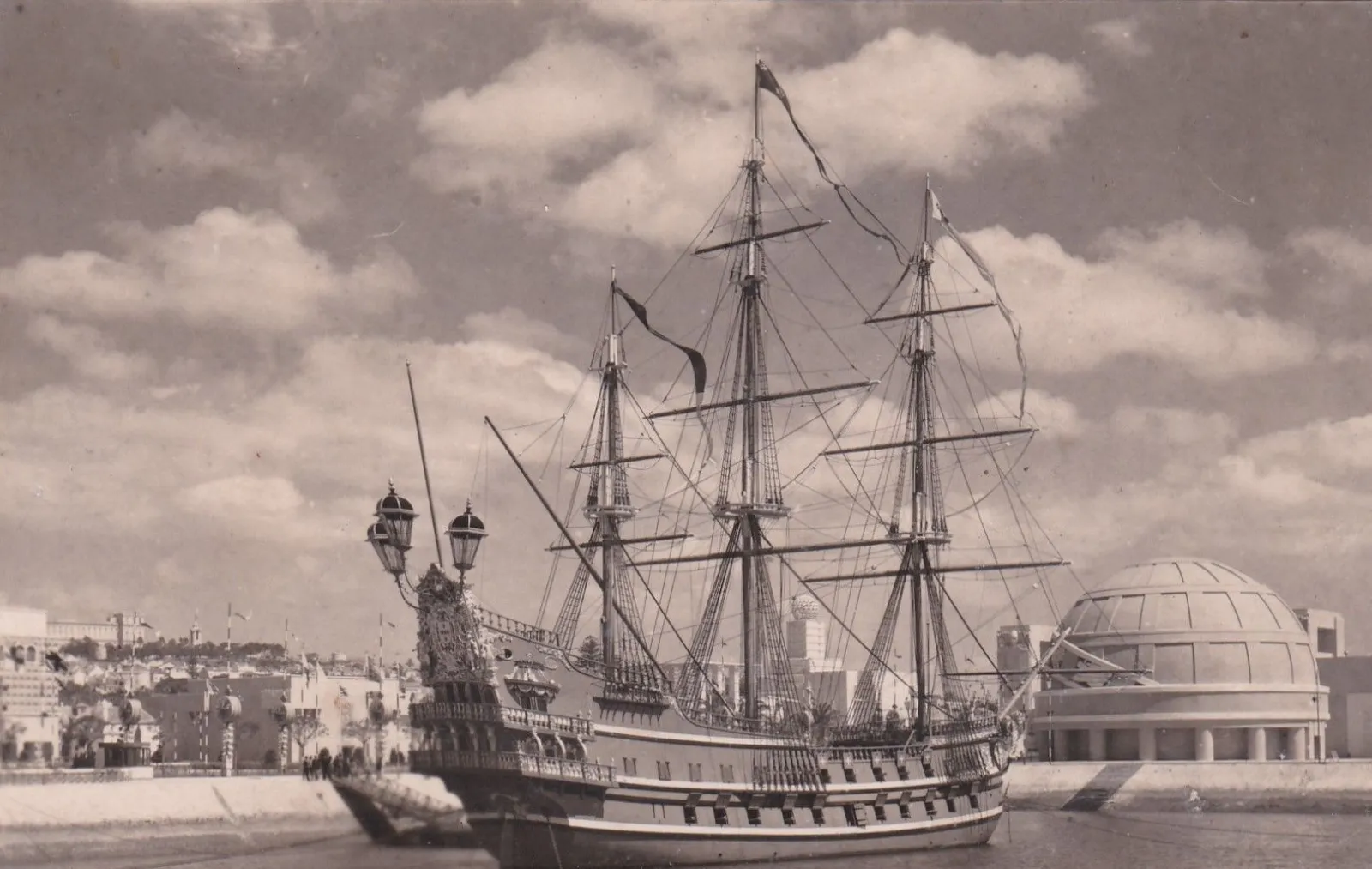
In the Belém dock lay the Nau Portugal, a replica of an old Portuguese ship designed by Leitão de Barros, Martins Barata and Quirino da Fonseca. Sources date its model anywhere from the sixteenth to the eighteenth century. It turned over minutes after it was launched at Aveiro, was recovered and towed to Lisbon, and became one of the sights of the exhibition.
| Building | Designer | Afterwards |
|---|---|---|
| Pavilion of Honour and Lisbon | Luís Cristino da Silva | Demolished |
| Pavilion of the Portuguese in the World | Cottinelli Telmo | Demolished |
| Pavilions of the Foundation, Formation and Conquest, and Independence | Rodrigues Lima | Demolished |
| Pavilion of the Discoveries | Porfírio Pardal Monteiro | Unclear: missing from the survival lists, but a 2012 heritage order calls the Associação Naval de Lisboa building at the Belém dock the former pavilion |
| Pavilion of Colonisation | Carlos Ramos | Demolished |
| Brazil pavilion | Raul Lino | Demolished |
| Pavilions of Popular Life | Veloso Reis Camelo and João Simões | Adapted by Jorge Segurado; opened as the Museu de Arte Popular in 1948 |
| Portuguese villages | Jorge Segurado | Demolished |
| Espelho de Água (water mirror) and the building beside it | António Lino (the pool) | Kept |
| Padrão dos Descobrimentos | Cottinelli Telmo with Leopoldo de Almeida | Removed in 1943; rebuilt in stone, inaugurated 9 August 1960 |
| Colonial Section | Directed by Henrique Galvão | A few buildings and sculptures remain in the Jardim Botânico Tropical |
The Diário de Notícias says almost all the buildings were demolished after the exhibition, leaving the Praça do Império garden, the Padrão (in fact removed in 1943) and the building of the Museu de Arte Popular; Castro lists the square, the museum building, the Espelho de Água and its building. Fates not given building by building in the sources are inferred from those lists.
The empire in a garden
The Colonial Section was run by Captain Henrique Galvão, a senior official of the colonial ministry who had directed the Porto Colonial Exhibition of 1934. He later broke with the regime and was behind the seizure of the liner Santa Maria in 1961. In 1940 he set up his section in the Jardim Colonial, a garden of tropical plants created in 1906 and installed in Belém in 1912, and in the Calheta palace at its top, home of the Colonial Agricultural Museum.
His programme promised that in two hours a visitor could cross “the whole of our empire, from Africa to the Pacific”. There were pavilions for Angola and Mozambique, Portuguese Guinea, Cape Verde, São Tomé and Príncipe and Timor, “typical” streets of India and Macau, a pavilion of the Catholic missions, crocodiles and caimans in a new pond, a stretch of mock jungle, and an avenue of sculpted heads of the “races and tribes of the Portuguese Colonial Empire”.
And there were people. About 138 men, women and children were recruited to live in the reconstructed villages and streets: Bijagós, Mandinka and Fula from Guinea, Chopi and Makonde from Mozambique, Angolans, Cape Verdeans, São Tomeans, Indians and Macanese. Pedro VII, king of Kongo, came with the queen and a princess, and the Timorese chief Francisco da Costa Aleixo with his wife, Verónica, two children and two servants. Some of the Africans had in fact been living and working in Lisbon, and the small Indian group came from British India.
Visitors watched them at their daily routines. The programme listed African drumming, an Indian snake charmer and craftsmen from Macau carving cedar and camphor wood. A missionary nun gave sewing lessons to Chopi women and children. Every day, teams led by the anthropologists António de Almeida and Artur Ricardo Jorge came to measure the “natives” for their anthropometric studies. The layout ranked the groups: the Indians and Macanese lived in “streets”, the Africans in “villages”, a distinction meant to mark degrees of “civilisation”.
“It is forbidden to enter the native villages, but all of them are perfectly visible from outside the stockades.”
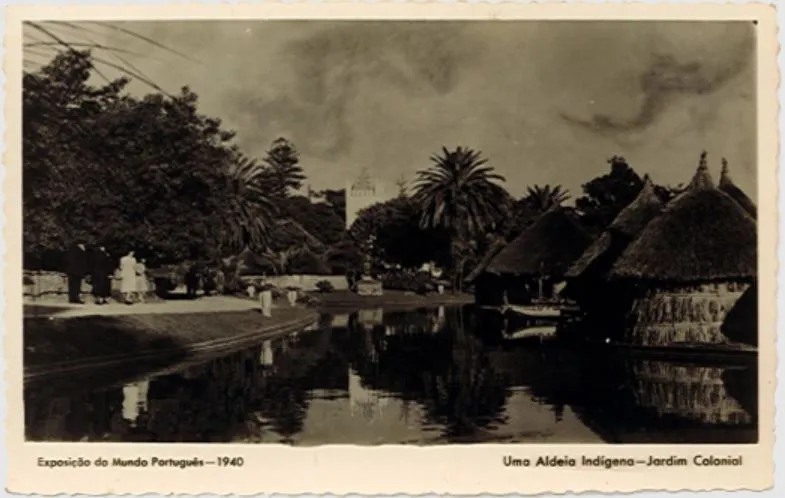
The historian Cláudia Castelo calls it a “human zoo”, one of the ethnic shows staged at exhibitions in European and American cities since the nineteenth century. Postcards and the section's official guide carried photographs of half-dressed African women, and they travelled all over the country. The participants' names and origins survive in the colonial archive, Castelo notes, but little is known of how they saw the journey and the show.
In October 1940 the exhibition's executive commission voted unanimously to send the colonial participants home before winter, citing their health. These shows had a long record of illness and death; in Porto in 1934, Papé, a member of the group from Guinea, had died.
A 2026 leaflet by the artist Márcio Carvalho, published by the University of Lisbon's museums, puts the 1940 group at about 160, citing Castelo, who gives 138. It also says several people died during the exhibition, five of them children. It gives no source for the deaths, and neither Castelo nor Ribeiro records any.
| Porto, 1934 | Lisbon, 1940 | |
|---|---|---|
| Setting | Palácio de Cristal gardens, whole exhibition colonial | Colonial Section of a historical exhibition, in the Jardim Colonial |
| Length | About three and a half months | 27 June to 2 December 1940; participants to be sent home before winter |
| Visitors | About 1,300,000 | About 3,000,000 visits to the whole exhibition |
| People brought to be displayed | About 324 | About 138 |
| Area | Not given in these sources | About 50,000 m² (Castelo: seven hectares of garden) |
Ribeiro gives the area of the 1940 section as 50,000 m²; Castelo describes Galvão's programme as filling the garden's seven hectares. The October 1940 decision did not give a departure date.
A monument sketched in the small hours
The Padrão dos Descobrimentos was a late addition. The film director José Leitão de Barros, Cottinelli's brother-in-law, told the story in 1960. One night Duarte Pacheco went to the architect's house and studio in Rua Saraiva de Carvalho to see the general plan. Leitão de Barros had said nothing all evening, and on the way out Pacheco pressed him for his opinion, then offered him a lift home.
“It has many palaces, many static pavilions, many relics... But it lacks the sense of DEPARTURE!”
Pacheco sent him straight back to win Cottinelli over. It was half past one in the morning. Cottinelli shouted about “literary nonsense”, then began sketching a profile with burnt matches on a scrap of blotting paper. The sculptor Leopoldo de Almeida was fetched from his bed and two lumps of clay from a pottery in Rua da Imprensa. Half an hour later, Leitão de Barros wrote, the Padrão was born.
It went up in eight months. Like most of the exhibition it was temporary: a light iron and cement frame, with the figures moulded in estafe, a mix of plaster and tow on a wooden or iron armature. A stylised caravel carried Henry the Navigator at its prow, with other figures of the Discoveries behind him. Critics of many leanings praised it. Adriano de Gusmão, in O Diabo, a paper the government closed down that December, hoped to see it “transposed for ever into marble or granite”.
It was taken down in 1943. For the 500th anniversary of Henry's death it was rebuilt in concrete and rose-coloured Leiria stone, following Cottinelli's design under António Pardal Monteiro, and inaugurated on 9 August 1960 during a state visit by Brazil's president, Juscelino Kubitschek. By the monument's own figures, the new Padrão is 56 metres high; Henry is nine metres tall and the 32 figures behind him seven. A Diário de Notícias article of 2021 counts 35 figures.
Taking it down
The exhibition closed on 2 December 1940 and most of it was demolished. The Praça do Império with its fountain stayed, as did the Pavilions of Popular Life and the Espelho de Água, and the Padrão until 1943. In February 1941 the cyclone that swept the country heeled the Nau Portugal over, and some of the people who shared childhood memories of the exhibition with the Padrão in 2016 date its real end to that storm.
The Colonial Garden stayed closed to the public for almost eight years. The pavilion of Angola and Mozambique, built in permanent materials, was demolished at the request of the garden's director to make room for an experimental field and a weather station, and in 1944 the garden merged with the agricultural museum. Galvão's hope of a permanent “Popular Museum of the Colonies” came to nothing.
The Pavilions of Popular Life had a second life. Jorge Segurado adapted them, with the ethnographer Francisco Martins Lage and the artist Tomás de Mello, and they opened as the Museu de Arte Popular in 1948. The collection, gathered for the regime's exhibitions at home and abroad, is now displayed at the Museu Nacional de Etnologia.
The two men behind the exhibition did not see the next decade out. Duarte Pacheco died in November 1943, after his official car left the road between Montemor-o-Novo and Vendas Novas and hit a cork oak. Cottinelli Telmo died at sea off Cascais in 1948, aged 50, in circumstances the Diário de Notícias has called never fully explained.
20 February 1929
Alberto de Oliveira proposes celebrating the centenaries
Letter published in the Diário de Notícias.
24 February 1938
Ferro's report on the planned commemorations
March 1938
Salazar's official note sets out the programme
25 May 1938
Duarte Pacheco returns as minister of public works
28 October 1938
Decree creating the commission of the centenaries
September 1939
War breaks out; work stops for a month
23 June 1940
Carmona, Salazar and Pacheco open the exhibition
27 June 1940
The Colonial Section opens to the public
October 1940
Executive commission decides to send the colonial participants home
2 December 1940
The exhibition closes
1943
The plaster Padrão is removed; Pacheco dies in November
1948
Museu de Arte Popular opens; Cottinelli Telmo dies
9 August 1960
The Padrão is inaugurated in stone
14 February 2023
The renovated Praça do Império garden reopens
What Belém kept
Much of Belém's layout today comes from the exhibition, starting with the Praça do Império in front of the Jerónimos. Later buildings filled the plots it cleared, among them the stone Padrão in 1960 and the Centro Cultural de Belém in 1992, whose construction again swept away houses in front of the monastery.
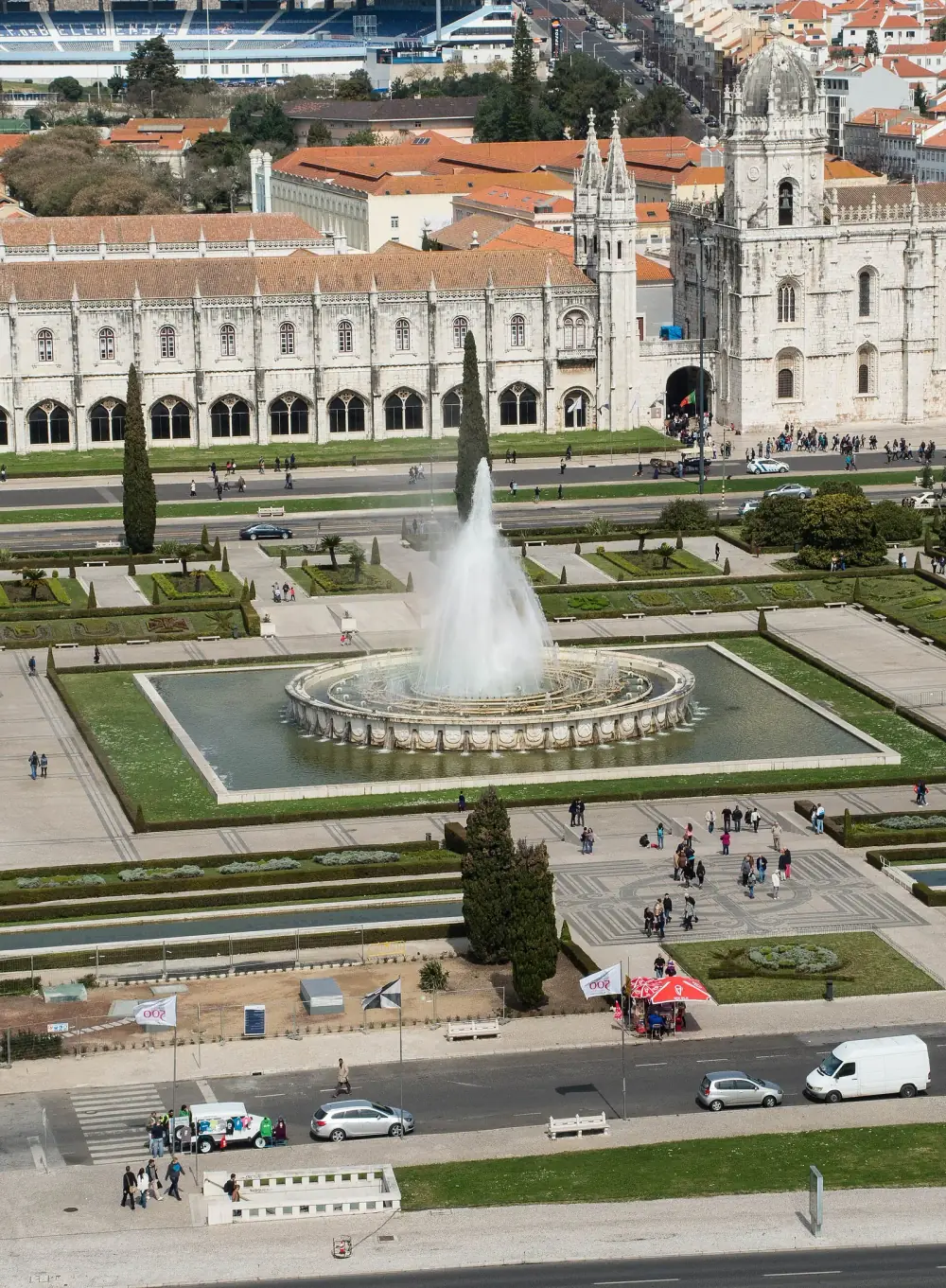
Its symbols are still argued over. For the Henrician celebrations of 1960 and 1961 the square's lawns gained coats of arms in clipped box: the Portuguese districts and the former overseas “provinces”. Whether to keep them held up the square's renovation for years. It reopened on 14 February 2023 with the arms remade in Portuguese pavement.
In February 2021 the deputy Ascenso Simões wrote in Público that “even the Padrão, in a respectable country, should have been destroyed”, and started a row between left and right. The monument he had in mind received 309,159 visitors in 2019, nine in ten of them foreign tourists, according to the city company that runs it.
The colonial section is the hardest legacy. The tropical garden, now part of the University of Lisbon and classified as a national monument in 2007, still holds the Macau arch, the colonial house and restaurant, and 14 busts of colonial “types”, painted black, by Manuel de Oliveira from the Colonial Section.
The university put plaques beside the busts in 2019, but in 2021 Castelo found that neither the garden's panels nor its visitor leaflet explained its place in the exhibition. In 2026 Márcio Carvalho showed 14 drawings beside the busts, meant to make the garden a place that remembers the “human zoo”.
Fifty-eight years after Belém, Lisbon held another exhibition, Expo '98, on run-down land in the east of the city. Its theme was the oceans, and in Corkill and Almeida's reading the nationalist and imperial propaganda of 1940 had gone, replaced by a country presenting itself as part of the international community. Its gates recorded about 9.76 million visits in 1998, a count made differently from the rounded totals of about 1.3 million visitors at Porto in 1934 and three million visits at Belém.
FAQs
What was the Exposição do Mundo Português?
The Portuguese World Exhibition was a historical and colonial exhibition held in Belém, Lisbon, from 23 June to 2 December 1940. The Estado Novo staged it for the Double Centenary of Portugal's founding (dated to 1140) and of the Restoration of 1640. It covered about 560,000 square metres and drew about three million visits.
Were people really put on display at the 1940 exhibition?
Yes. About 138 men, women and children from Guinea, Angola, Mozambique, Cape Verde, São Tomé, India, Macau and Timor were recruited to live in reconstructed villages and streets in the Colonial Section, where visitors watched them through stockades and anthropologists measured them. Most came from the colonies, but some of the Africans were already living in Lisbon and the Indian group came from British India. The historian Cláudia Castelo calls it a “human zoo”. In October 1940 the organisers decided to send the participants home before winter.
Is the Padrão dos Descobrimentos from 1940?
Its design is. Cottinelli Telmo and Leopoldo de Almeida first built it in 1940 from plaster and other temporary materials; it was removed in 1943. The stone and concrete monument you see today was built for the 500th anniversary of Henry the Navigator's death and inaugurated on 9 August 1960.
What is left of the exhibition in Belém?
The Praça do Império garden and fountain, the Espelho de Água, the building of the Museu de Arte Popular (originally the Pavilions of Popular Life) and, in the Jardim Botânico Tropical, the Macau arch, the colonial house and restaurant and 14 busts from the Colonial Section. The Padrão is a 1960 rebuild.
Who designed the Exposição do Mundo Português?
The chief architect was Cottinelli Telmo, who drew the general plan, the Pavilion of the Portuguese in the World and the Padrão. Other pavilions were by Cristino da Silva, Pardal Monteiro, Carlos Ramos, Rodrigues Lima, Raul Lino and others. The minister of public works, Duarte Pacheco, drove the project, and Augusto de Castro was commissioner-general.
On the timeline
Open the timelineNearby moments from dictatorship and the estado novo (1926–1974).
Jorge Sampaio, lawyer, opponent of the Estado Novo dictatorship and later Mayor of Lisbon and President of Portugal from 1996 to 2006, is born in Lisbon.
Carlos do Carmo is born in Lisbon, the son of the fadista Lucília do Carmo, and grows up around his parents' fado house, O Faia. His 1977 album 'Um Homem na Cidade' became a landmark of modern fado, and in 2014 he became the first Portuguese artist to receive the Latin Grammy lifetime achievement award.
Portugal and the Holy See sign a Concordat and a Missionary Agreement in the Vatican. Settling the conflict opened by the First Republic's 1911 separation of Church and State, the deal recognised the Church's legal personality and gave it a central role in the empire's missions. It also barred couples married in church from civil divorce, a rule changed only in 1975.
The Portuguese World Exhibition
The Exposição do Mundo Português opens in Belém, Lisbon, marking eight centuries of independence and three of the Restoration. Its original Padrão dos Descobrimentos and colonial 'villages' — some peopled with men, women and children brought from Africa and Asia to be put on display — stage the Estado Novo's vision of a pluricontinental empire as war rages across Europe.
A violent cyclone sweeps across mainland Portugal, uprooting trees by the thousands, tearing roofs from buildings and wrecking boats in the Tagus and along the coast. Remembered simply as 'o ciclone de 1941', it remains one of the most destructive storms ever recorded in the country.
Birth in Póvoa de Varzim of Diogo Freitas do Amaral, founder and first leader of the Christian-democratic CDS after the Carnation Revolution. He lost the 1986 presidential run-off to Mário Soares by barely two points and remains the only Portuguese to have presided over the United Nations General Assembly, in 1995–96.
Cesária Évora, the 'barefoot diva' of Cape Verdean morna, is born in Mindelo on the island of São Vicente, then a Portuguese colony. Singing in Creole, she found international fame only in her late forties and won a Grammy in 2004.
Coming up in history
All long reads 25 June 1975Mozambique's midnight: independence at Machava, 25 June 1975
 26 June 1828The Belfastada: the steamer that carried Porto's liberal leaders off in 1828
 27 June 1214The will of Afonso II, 1214: a king's wishes in early Portuguese
 29 June 1958Rosa Mota, the girl from the Foz who became Olympic marathon champion
21 sources
Archives, scholarship and reporting this article was checked against.
- 1
Simulação e dissimulação do império colonial português em Belém, Lisboa (1940/2020): a secção colonial e o jardim botânico tropical (Cláudia Castelo)Anais do Museu Histórico Nacional 54 (2021), Rio de Janeiro
- 2
O «Feitiço do Império»: a encenação do universo colonial português nas exposições de 1932, 1934 e 1940 (Carla Ribeiro)CEM – Cultura, Espaço & Memória 17 (2024), CITCEM, Universidade do Porto
- 3
Commemoration and propaganda in Salazar's Portugal: the Portuguese World Exhibition of 1940 (David Corkill and José Carlos Almeida)Manchester Metropolitan University repository (journal contribution, 2009)
- 4
Da Viagem. A Torre de Belém e a Grande Exposição do Mundo Português (Maria João Castro)Instituto de História da Arte, FCSH, Universidade Nova de Lisboa
- 5
Dar a ver Portugal: uma análise do planejamento das Comemorações dos Centenários de 1940 (Marlise Maria Giovanaz)Processos de Musealização, conference proceedings, Faculdade de Letras da Universidade do Porto
- 6
Monument to the DiscoveriesPadrão dos Descobrimentos (EGEAC, Lisbon)
- 7A exposição do Império que juntou três milhões de portugueses (João Céu e Silva)Diário de Notícias, 23 June 2020
- 8
- 9
O Estado Novo (1933-1974)Assembleia da República
- 10
The Portuguese World Exhibition and Catholic nationalism (Júlia Leitão de Barros)Electra 11 (winter 2020–21), Fundação EDP
- 11
Revista dos Centenários (Helena Bruto da Costa)Hemeroteca Digital, Câmara Municipal de Lisboa
- 12
Catálogo do arquivo pessoal do Eng. Duarte Pacheco (1900–1943)Núcleo de Arquivo, Instituto Superior Técnico, Universidade de Lisboa
- 13Padrão dos Descobrimentos. A nau da discórdia (Maria João Martins)Diário de Notícias, 25 February 2021
- 14
Portaria n.º 263/2012: classifies the Museu de Arte Popular building as a monument of public interestDiário da República, 2.ª série, n.º 125, 29 June 2012
- 15
Museu de Arte PopularOpen House Lisboa, Trienal de Arquitectura de Lisboa
- 16
- 17
Henrique GalvãoMuseu do Aljube Resistência e Liberdade
- 18
Memórias para 14 Bustos (Márcio Carvalho): exhibition leafletMuseus da Universidade de Lisboa (MUHNAC), 2026
- 19
- 20
A Praça do Império reabriu com os polémicos brasões em pedra (Hugo Torres)Time Out Lisboa, 14 February 2023
- 21
Auditoria ao Projecto EXPO'98 (Relatório n.º 43/2000, 2.ª Secção), Volume ITribunal de Contas
Image credits
- The Praça do Império in 1940, looking south to the Tagus: the tower of the Pavilion of Honour and Lisbon on the left, the replica ship Nau Portugal at the Belém dock and the first, plaster Padrão dos Descobrimentos on the right. Exposição do Mundo Português, Public domain, via Wikimedia Commons.
- The Nau Portugal moored at the Belém dock on a 1940 exhibition postcard, with one of the exhibition's domed pavilions behind it. Unknown author, Public domain, via Wikimedia Commons.
- A 1940 exhibition postcard captioned “An indigenous village, Colonial Garden”: thatched huts built beside the garden's pond, with visitors on the far bank. Exposição do Mundo Português, Public domain, via Wikimedia Commons.
- The Praça do Império and its fountain from the top of the Padrão in March 2015, with the Jerónimos Monastery behind. Cottinelli Telmo laid out the square for the 1940 exhibition. Theo K, CC BY-SA 2.0, via Wikimedia Commons.