

Montes Claros, 1665: the last great battle of Portugal's Restoration War
A Spanish army of veterans from Flanders and Italy had Vila Viçosa, the old seat of the Braganzas, under siege. On a June morning the Portuguese army marched out of Estremoz to relieve it, and its enemy came to meet it in the open.
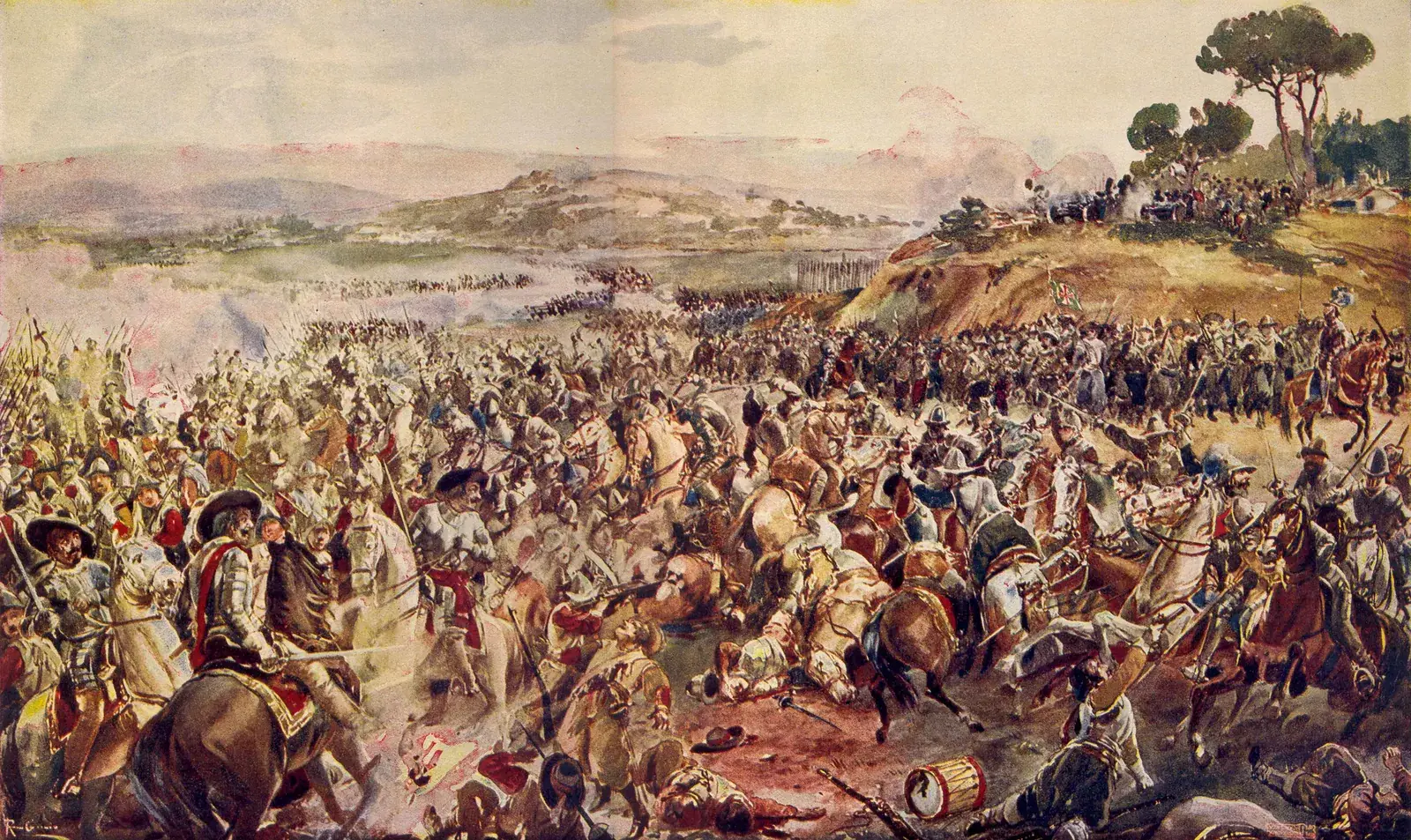
At a glance
- On Wednesday 17 June 1665 a Portuguese army of about 20,500 men marched out of Estremoz to relieve Vila Viçosa, which a Spanish army had besieged since 10 June.
- The Spanish commander, the Marquis of Caracena, left a screen at the siege and attacked the Portuguese on the march at Montes Claros, about a league from each town, in the parish of Rio de Moinhos, Borba.
- The Portuguese were led by António Luís de Meneses, Marquis of Marialva, with the German-born general Frederick Herman von Schomberg handling the battle line. After hours of cavalry charges the Spanish army broke and fled towards Juromenha.
- Portuguese accounts put Spanish losses at over 4,000 dead and 6,000 prisoners, with all 14 of its guns, against about 700 Portuguese dead and over 2,000 wounded. Almost all these figures come from the Portuguese side.
- It was the last big battle of the war that began in 1640. Spain recognised Portugal's independence in the peace signed in Madrid on 5 January 1668 and concluded in Lisbon on 13 February 1668.
Dawn at Estremoz
At daybreak on Wednesday 17 June 1665, the Catholics in the Portuguese army camped at Estremoz went to confession and communion, and the officers passed down the word for the day: Conceição, for Our Lady of the Conception. Her shrine in Vila Viçosa, two leagues away, was surrounded by a Spanish army, and part of the garrison's outer defences had been lost in a night assault two days before.
Then the army moved off, cavalry in front, then six light guns, then the infantry in its marching order, with 500 men of the militia ahead carrying tools to knock down the field walls. Each musketeer had a pound of powder and twelve balls. The plan was to halt that night at a place called Montes Claros, a league along the road, and fight for the hills above Vila Viçosa the next day.
Two officers rode ahead with the first squadron: the Count of São João, governor of arms of Trás-os-Montes, and Luís de Meneses, general of the artillery. They had heard no guns from Vila Viçosa in the night and feared it had surrendered. From a rise they caught the distant sound of the castle's cannon, still firing. Then they saw something worse. On top of the Serra da Vigária ahead were the guard companies of the Spanish commander himself, recognisable by their kettledrums and trumpets.
Luís de Meneses later wrote the best-known history of the war, the História de Portugal Restaurado, under his later title of Count of Ericeira; the volume covering 1665 appeared in 1698. Most of what we know about that day comes from him, an eyewitness and a commander with a reputation to keep.
A war already twenty-five years old
Portugal had broken away from the Spanish monarchy on 1 December 1640, when a group of nobles proclaimed the Duke of Braganza king as João IV. Spain never accepted it. For most of the next two decades it was tied down by war with France and a revolt in Catalonia, and the Portuguese border saw mostly raids, sieges and plunder.
That changed with the Treaty of the Pyrenees of 1659, which ended the Franco-Spanish war and left Portugal without an open ally. Lisbon turned to England: João IV's daughter Catarina married Charles II, and English troops, 2,000 foot and 700 horse, landed in 1662. France sent regiments and officers too. The most valuable was Frederick Herman von Schomberg, a German Protestant officer from the Palatinate who had risen to lieutenant-general in the French army.
In Lisbon, the young Afonso VI had taken power from his mother, the regent Luísa de Gusmão, in June 1662. His chief minister, the Count of Castelo Melhor, ran the war with a firm hand. The Spanish king, Philip IV, now sent his best generals west, and lost two campaigns in a row.
In 1663 his son Don John of Austria took Évora, then was trapped on the way back and beaten at Ameixial, near Estremoz, on 8 June by Sancho Manoel, Count of Vila Flor, and Schomberg. On 7 July 1664 Pedro Jacques de Magalhães, governor of arms of the Beira, routed the Duke of Osuna outside the hill town of Castelo Rodrigo; some accounts give 6 July, the day his night march began.
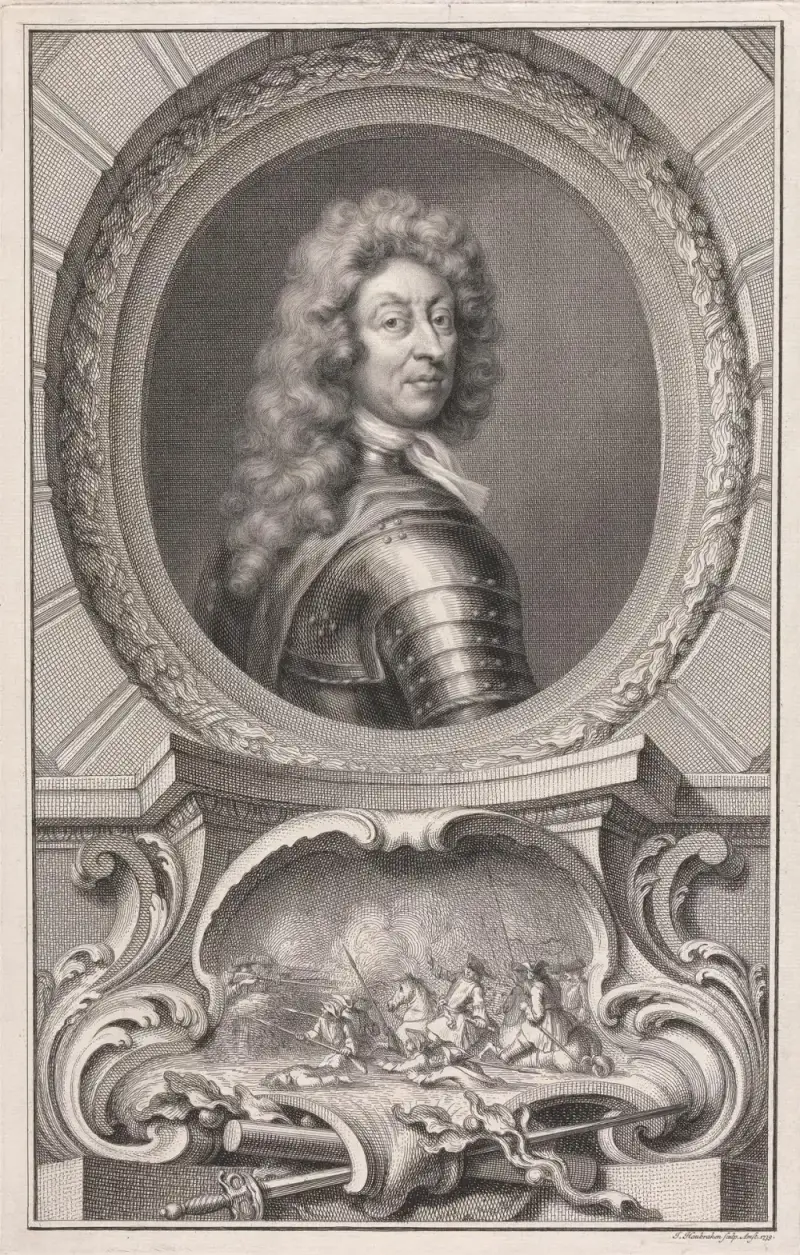
The army Marialva gathered at Estremoz in May 1665 was a mixture. Portuguese regular regiments, called terços, stood beside regiments of provincial militia and companies sent down from the Beira and Trás-os-Montes. Of the 5,500 cavalry, four regiments were French and one English, and the infantry included a regiment of Germans and Italians. A thousand more French foot landed in Lisbon in time to join the campaign.
Caracena's army and the siege of Vila Viçosa
For 1665 Philip IV chose Luis de Benavides Carrillo, Marquis of Caracena. Born in 1608 and from Valencia, he had a long and successful military career behind him and had governed the Spanish Netherlands from 1659 (1658 in some accounts) until his recall in 1664. One Portuguese account calls him the only senior Spanish general the war had not yet discredited. With France at peace, Spain could send him seasoned regiments from Flanders, Italy and Germany.
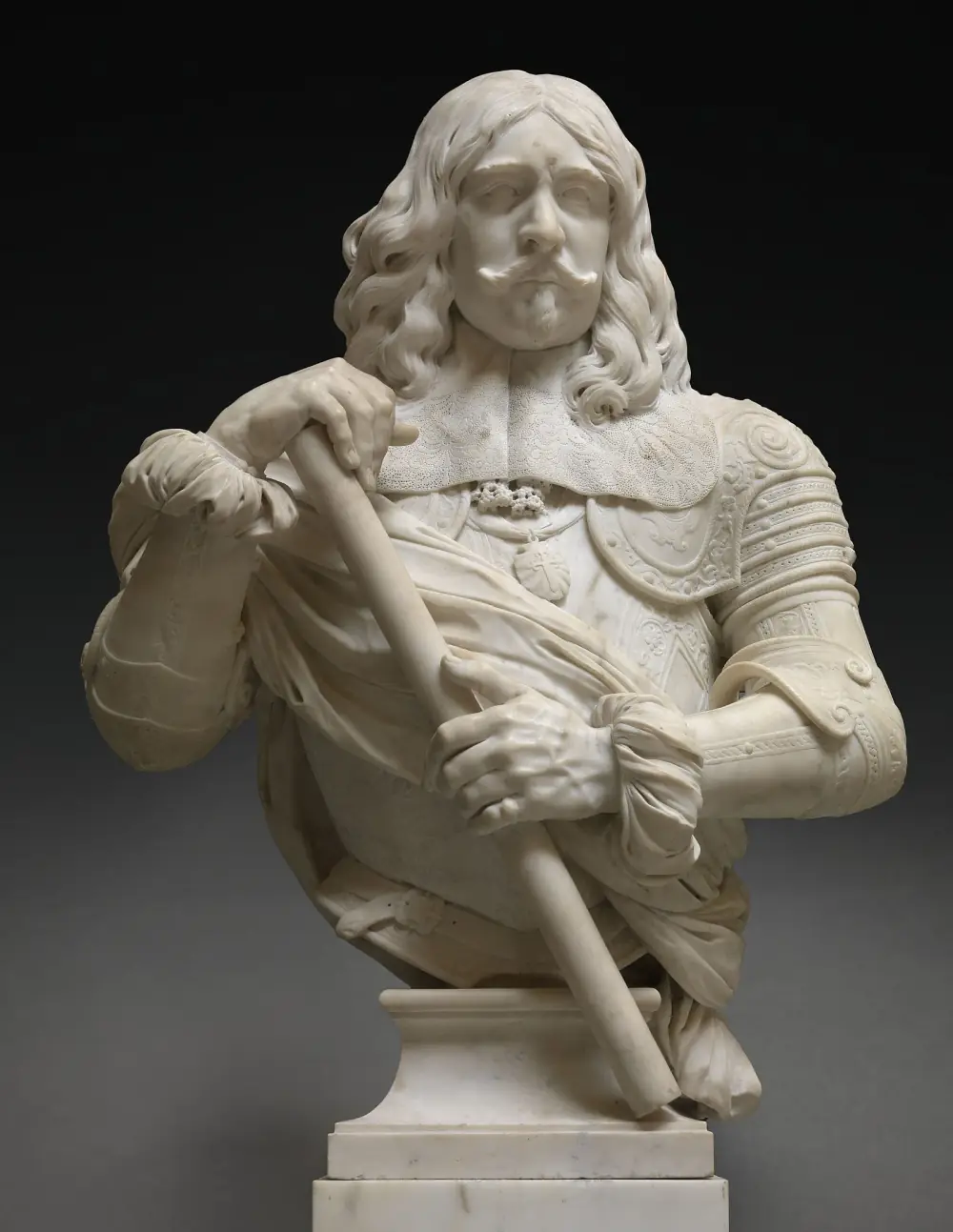
Ericeira counted Caracena's army at 15,000 infantry, 7,600 horse, 14 guns and two mortars. The plan, as Portuguese officers understood it, was to secure a base in the Alentejo and then push west towards Setúbal and Lisbon, helped by a fleet from Cádiz. The army marched from Badajoz on 1 June, crossed the Caia, the border river, on 7 June, and on 9 June occupied Borba, which its people had abandoned.
Vila Viçosa was close by, half a league away by Ericeira's reckoning. It was a poor fortress: a medieval castle with a small star-shaped outwork, overlooked by hills. It was also the town where the dukes of Braganza had kept their court before 1640, and where João IV had made Our Lady of the Conception patron of Portugal in 1646. Its governor, Cristóvão de Brito Pereira, had about 1,400 infantry and eleven guns.
The defenders gave ground slowly. A Spanish mine against the old town wall blew back on its own diggers. Caracena's men threw grenades into the covered way, and the garrison threw them back before they burst, Ericeira wrote, though many lost their hands doing it. Brito and two of his colonels were wounded, and by the night of 15 June the attackers held two lodgements on the covered way.
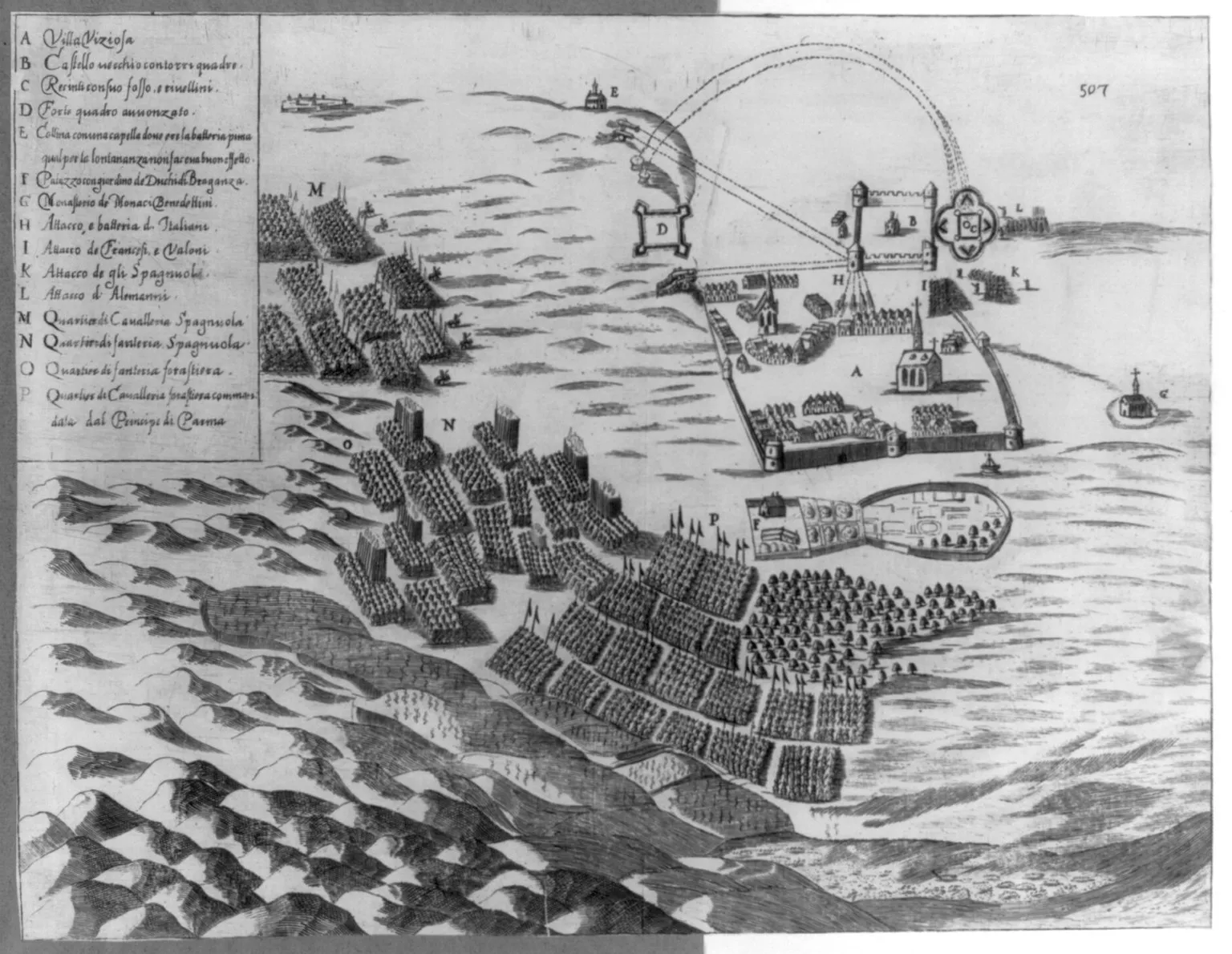
In Estremoz, Marialva's council of war weighed the risk. A lost battle could lose the kingdom, and Vila Viçosa could be retaken later. They decided to relieve it anyway. If it fell, Spain would command the roads to Elvas and Campo Maior and the rich country around Borba, Redondo, Alandroal and Terena, and the Braganza palace was, in Ericeira's words, a temple to the memory of the author of Portuguese liberty. Afonso VI's councillors in Lisbon agreed.
Nine hours at Montes Claros
Caracena could have stayed in his lines and made the Portuguese fight uphill through walled olive groves and vineyards. His senior officers urged him to. Instead, when his scouts reported the enemy leaving Estremoz, he decided to catch them on the march, before they could form up. He left about 1,800 infantry in the siege works under Nicolau de Langres, a Frenchman who had once served Portugal and gone over to Spain, and led the rest out.
“Portugal is too large a kingdom to be won fortress by fortress, and too small to survive the loss of a battle.”
The Portuguese were quicker. Marialva halted the army on the plain of Montes Claros, between the Serra da Vigária and the foothills of the Serra de Ossa, and Schomberg formed it in two lines with a reserve. Guessing where the Spanish horse would strike, he shifted cavalry from the vineyards on the left to the right. Caracena watched from the top of the Vigária, out of range, and did not come down while the fighting lasted.
The fighting began in the morning, at nine by the reckoning carved on the battlefield memorial, with a cannonade. The Spanish cavalry, its first lines made up of foreign regiments, charged the Portuguese right and centre. The Portuguese guns, loaded with bags of musket balls, held their fire until the horsemen were fifty paces away. The first squadrons wheeled back, then re-formed, and more than a thousand riders burst through a gap between two infantry regiments to the second line, where Marialva stood.
Schomberg rode through the enemy to reach him. His horse was so badly wounded that he could have been killed or taken if three of his sons and two other officers, with their troops, had not cut him out. On the left, the Spanish infantry pushed through the vineyards, and English, French and Portuguese units gave ground until fresh regiments were fed in. The rear ranks of the front-line infantry turned about to face horsemen behind them.
Charge followed charge for hours. Marialva thinned his right to reinforce the left. By about three in the afternoon the Spanish cavalry had stopped attacking and its guns had fallen silent. When the Spanish horse tried to slip away, the lieutenant general João da Silva saw it, and the Portuguese cavalry under Dinis de Melo e Castro charged and turned the withdrawal into a rout.
Caracena left the field before the end with the Duke of Osuna, the loser of Castelo Rodrigo, who had come as a volunteer. Four regiments that held together on the hill surrendered later, Ericeira says; a modern account by the Fundação Batalha de Aljubarrota has them escaping with Caracena.
At Vila Viçosa, Langres had called on the garrison to surrender. Brito refused and was shot in the chest; he died the next day. When the defenders saw the confusion in the trenches, everyone who could hold a weapon sallied out, took the siege lines and captured the heavy guns and a mortar. Marialva marched on and entered the citadel in triumph.
1 June
Caracena marches
The Spanish army leaves the Badajoz area.
7 June
Across the Caia
It crosses the border river into Portugal.
9 June
Borba
The vanguard occupies the deserted town.
10-15 June
Siege of Vila Viçosa
Trenches, a failed mine and night assaults on the covered way.
17 June, dawn
March from Estremoz
Marialva's army sets out to relieve the town.
17 June, about 9:00
Battle begins
Caracena attacks the Portuguese on the march at Montes Claros.
17 June, afternoon
Rout
The Spanish cavalry breaks; the Vila Viçosa garrison storms the siege lines.
18 June, 19:00
News in Lisbon
Simão de Vasconcelos brings word of the victory to the king.
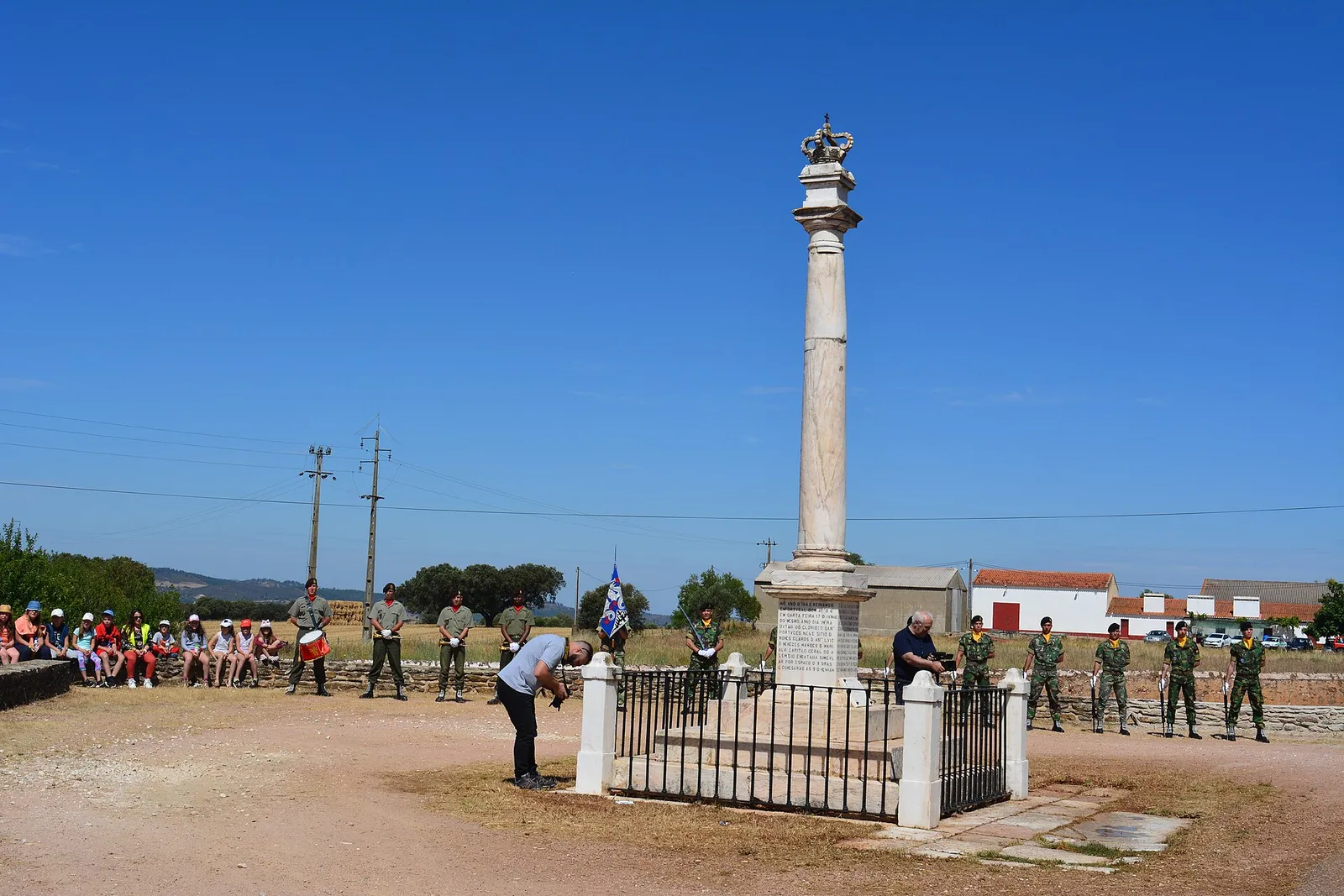
“On Wednesday 17 June of the same year … at this place of Montes Claros, Dom António Luís de Meneses, Marquis of Marialva, captain general of the Alentejo, in a singular battle lasting nine hours, which began at nine in the morning and ended at six in the evening, killed, broke, routed and defeated the Castilian army that the Marquis of Caracena, captain general of Extremadura, commanded.”
Ericeira, writing later, put the fighting at eight hours; the inscription says nine.
Counting the cost
The two armies were close in size. Ericeira, who saw both, gave each 15,000 infantry and the Spanish 2,100 more horsemen, in the arm that did most of the attacking that day.
The armies at Montes Claros, as counted by Ericeira
men
- Portuguese army
- Spanish army
Figures from the Count of Ericeira, who commanded the Portuguese artillery. His Portuguese figures come from a muster the day before the battle, taken before the regiments from Setúbal and Valença had arrived; he does not say where his Spanish figures come from. The Fundação Batalha de Aljubarrota gives 20,500 Portuguese and about 22,000 Spanish (7,000 cavalry). The garrison of Vila Viçosa is not included.
Show the data
| Portuguese army | Spanish army | |
|---|---|---|
| Infantry | 15,000 | 15,000 |
| Cavalry | 5,500 | 7,600 |
| Ericeira (vol. IV, 1698) | Fundação Batalha de Aljubarrota | |
|---|---|---|
| Spanish dead | More than 4,000 | 4,000 |
| Spanish prisoners | More than 6,000 | 6,000 |
| Horses taken | 3,500 | 3,500 |
| Guns taken | 14 guns and 2 mortars | 14 guns |
| Infantry flags taken | 86 | 80 |
| Cavalry flags taken | 18 | 18 |
| Portuguese dead | No more than 700 | About 700 |
| Portuguese wounded | More than 2,000 | Not given |
No independent Spanish count has been found for this article. Ericeira took part in the battle, and the foundation's figures follow his. In his report to Philip IV, as Ericeira summarises it, Caracena admitted the defeat but claimed to have inflicted heavy losses and asked for men and money to try again.
Treat these numbers with care. Ericeira commanded the Portuguese guns that day, his account appeared in print only in 1698, and later Portuguese writers follow him closely. His figures for his own side came from a muster, but he does not say how he counted the enemy. Taken together, they mean that almost half of Caracena's army, as Ericeira counted it, was killed or captured.
Among the prisoners were Diego Correa, general of the Spanish cavalry, and Gaspar de Haro, captain of Caracena's guard and his son-in-law, who died of his wounds a few days later in Estremoz. The Portuguese took Caracena's own kettledrums. They took less baggage than at Ameixial, because Juromenha, a fortress then in Spanish hands, was close enough for the men left in camp to escape with their tents.
The road to the peace of 1668
Schomberg, São João and Luís de Meneses wanted to march straight on Mérida, across the border, while the Spanish army was broken. Marialva refused to decide without the king, and Lisbon ordered the army into quarters for the summer. The war went on in raids and small sieges on both sides of the border, but no Spanish field army of that size entered Portugal again before the peace.
The fighting moved to the edges. In late October 1665 an army under the Count of Prado, governor of arms of the Minho, with Schomberg, Pedro Jacques de Magalhães and the Counts of São João and Miranda, crossed into Galicia; the fort of La Guardia surrendered to it on 20 November. The Galicians answered with raids on Barroso, Montalegre and Chaves.
In 1666 Schomberg broke into the Spanish border town of Alburquerque and sacked it, at heavy cost, without trying for its castle. A clash at Monterrei in Galicia on 20 November 1667 settled nothing; by then both crowns were seeking peace.
“It seems God wills it.”
Philip IV died on 17 September 1665. His heir, Charles II, was a small child, and his widow, Mariana of Austria, governed as regent. England and France both wanted Spain weakened. France signed a ten-year alliance with Portugal on 31 March 1667, while the English ambassador in Madrid worked for a settlement. Caracena kept his command, though his own soldiers blamed him for attacking before his army had formed; he died in 1668.
In Lisbon the victory did not save the government that won it. Castelo Melhor was driven from office in September 1667, and on 23 November Afonso VI's younger brother, Pedro, took over the government. The peace was signed for Spain in Madrid on 5 January 1668 and concluded at the convent of Santo Elói in Lisbon on 13 February, in Afonso VI's name, with Charles II of England as mediator and guarantor.
- Signed for Spain
- Madrid, 5 January 1668
- Concluded
- Convent of Santo Elói, Lisbon, 13 February 1668
- Mediator
- Charles II of England, also guarantor of the peace
- Terms
- Perpetual peace; places taken in the war returned; all prisoners freed
- Exception
- Ceuta, in North Africa, stayed Spanish
Why it still matters
Montes Claros was the last great battle of the war, and in February 1668, less than three years later, Spain made peace. Portugal did not get the war indemnity Castelo Melhor had wanted. It got what it had fought for since 1640: Spain's recognition that the Braganzas were kings of an independent Portugal and its empire. Only Ceuta, in North Africa, stayed Spanish.
Montes Claros was the last of the war's big Portuguese victories, after Montijo in 1644, Elvas in 1659, Ameixial and Castelo Rodrigo; Ericeira counted six battles won since 1640. In Spain it is known as the Battle of Villaviciosa, after the besieged town, and a 2019 Spanish study calls it the definitive defeat of the Spanish army in Philip IV's reign.
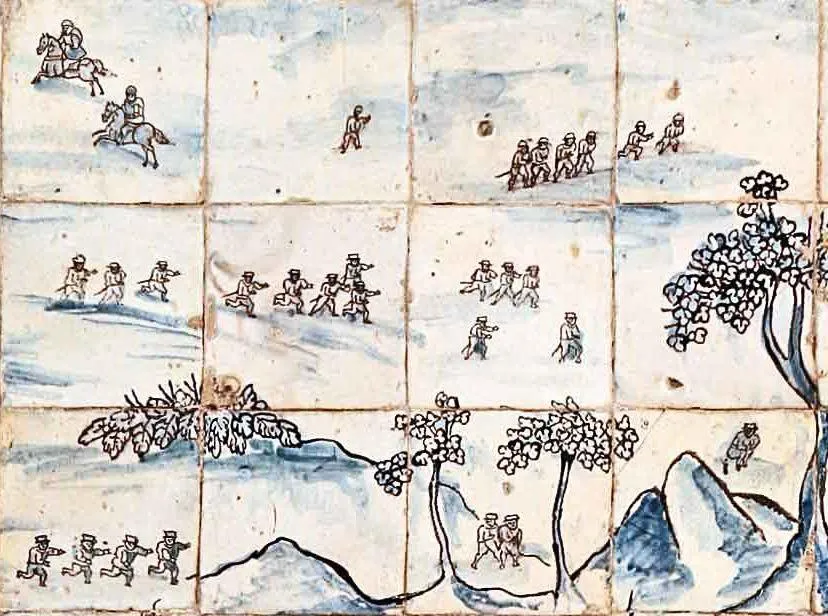
The victors made sure the battle was remembered. A padrão, a commemorative stone column, was raised on the battlefield in the third quarter of the seventeenth century. Around 1670 João de Mascarenhas, 1st Marquis of Fronteira, began his palace in what is now the Lisbon district of São Domingos de Benfica, and lined its Sala das Batalhas with tiled scenes of the war's battles, Montes Claros among them.
The state has tied the site to the same outcome. A government decree published on 31 December 2012 classified the Terreiro da Batalha de Montes Claros, the battleground, as a national monument, noting the battle's place in ending the war in 1668. It covers the farmland where the armies formed up, the padrão and the site's archaeological potential. In February 2025 a second decree enlarged the protected area after new research redrew the limits of the battlefield.
FAQs
Who won the Battle of Montes Claros?
Portugal. On 17 June 1665 a Portuguese army under the Marquis of Marialva, with Schomberg forming and directing the battle line, defeated the Spanish army of the Marquis of Caracena near Borba and relieved the siege of Vila Viçosa.
How many men died at Montes Claros?
Portuguese accounts, chiefly the Count of Ericeira's, give more than 4,000 Spanish dead and 6,000 prisoners, against no more than 700 Portuguese dead and more than 2,000 wounded. No independent Spanish count has been found, so treat these as the victors' figures.
Did Montes Claros end the Restoration War?
Not at once. Raiding went on for more than two years, but no large Spanish army invaded again. Philip IV died in September 1665, and Spain recognised Portuguese independence in the peace signed in Madrid on 5 January 1668 and concluded in Lisbon on 13 February 1668.
Why is it also called the Battle of Villaviciosa?
Spanish writers name it after Vila Viçosa (Villaviciosa in Spanish), the town Caracena was besieging.
Where was the battle fought?
On the plain of Montes Claros between the Serra da Vigária and the foothills of the Serra de Ossa, in the parish of Rio de Moinhos, Borba, about a league from both Estremoz and Vila Viçosa. The site has been a national monument since 2012, and its protected area was enlarged in 2025.
On the timeline
Open the timelineNearby moments from restoration and the gold of brazil (1640–1750).
Catherine of Braganza, daughter of King João IV, marries Charles II of England at Portsmouth. Her dowry includes Bombay and Tangier, and as queen she is credited with making tea-drinking fashionable at the English court.
The Portuguese army wins the Battle of Ameixial, near Estremoz, in the Alentejo. Under Sancho Manoel, Count of Vila Flor, with the German-born general Frederick Schomberg and an English brigade, it routs the larger Spanish army of Don John of Austria. Évora, taken by the Spanish on 22 May, surrenders to the Portuguese on 24 June, and the victory turns the Restoration War in Portugal's favour.
At the Battle of Castelo Rodrigo (also known as the Battle of Salgadela), a Portuguese force under Pedro Jacques de Magalhães falls on the Spanish army of the Duke of Osuna, which had been besieging the fortress and its garrison of just 150 men. The Spanish are routed, leaving their artillery and Osuna's archive behind — tradition says he fled disguised as a friar — ending the invasion of the Beira frontier.
Battle of Montes Claros
A Portuguese army under the Marquis of Marialva, with the German-born general Schomberg, routs the Spanish army of the Marquis of Caracena at Montes Claros, near Borba, and relieves besieged Vila Viçosa. It is the last big battle of the Restoration War; Spain recognises Portugal's independence in 1668.
At the Battle of Ambuíla in northern Angola, a Portuguese force from Luanda under Luís Lopes de Sequeira defeats the army of the Kingdom of Kongo. King António I is killed and beheaded, and the once-powerful kingdom slides into civil war.
Queen Luísa de Gusmão (born Luisa de Guzmán), widow of João IV, dies in Lisbon. Credited, perhaps apocryphally, with urging her husband to take the crown in 1640 because it was better to be queen for a day than duchess for life, she later ruled as regent and helped secure the Bragança dynasty.
Spain formally recognises Portuguese independence through the Treaty of Lisbon, ending the 28-year Portuguese Restoration War.
Coming up in history
All long reads 19 June 1911Green, red and A Portuguesa: the Republic fixes its flag and anthem, 1911
 20 June 1924Seventy-four days to Macau: the 1924 flight of the Pátria
 21 June 1813Vitoria, 21 June 1813: the Portuguese army that helped drive Joseph out of Spain
 22 June 1874The cable that put Brazil a day from Europe: Carcavelos, 22 June 1874
13 sources
Archives, scholarship and reporting this article was checked against.
- 1
História de Portugal Restaurado, vol. IV (Luís de Meneses, 3rd Count of Ericeira), Lisbon, 1759 editionInternet Archive (University of Toronto copy)
- 2
Batalha de Montes Claros (versão desenvolvida)Fundação Batalha de Aljubarrota, Centro de Interpretação da Batalha de Aljubarrota
- 3
A importância da resistência de Vila Viçosa nos 350 anos da Batalha de Montes Claros (Nuno Correia Barrento de Lemos Pires)Revista de Cultura Callipole, no. 22 (2015), Vila Viçosa, pp. 123-142; reprint on Dialnet
- 4
Decreto n.º 31-D/2012, de 31 de dezembro: classifica como monumento nacional o Terreiro da Batalha de Montes ClarosDiário da República, 1.ª série, no. 252, 31 December 2012, pp. 7424-(248) to 7424-(249)
- 5
- 6
Tratado de Paz de 1668 entre Portugal e EspanhaArquivo Nacional Torre do Tombo
- 7
Schomberg (Schönberg), Frederick Herman (1615–90), cr. duke of Schomberg 1689The History of Parliament: The House of Lords 1660-1715
- 8
- 9
Espetáculo multidisciplinar assinala 350 anos da morte do Marquês de MarialvaCâmara Municipal de Cantanhede
- 10
Luis de Benavides Carillo, Marquis of Caracena, Governor of the Spanish Netherlands (Artus Quellinus I, 1664)The Flemish Art Collection (Royal Museum of Fine Arts Antwerp)
- 11
Cartagena y la Guerra de Restauración Portuguesa (1640-1668) (Vicente Montojo Montojo and Federico Maestre de San Juan Pelegrín)Revista de Estudios Extremeños, vol. LXXV, no. II (2019), pp. 381-404
- 12
- 13
Palácio FronteiraFundação das Casas de Fronteira e Alorna
Image credits
- The Battle of Montes Claros as Alfredo Roque Gameiro imagined it for Quadros da História de Portugal, published in 1917, two and a half centuries after the event. Roque Gameiro, Public domain, via Wikimedia Commons.
- Frederick Herman von Schomberg in old age, engraved by Jacobus Houbraken in Amsterdam in 1739. Schomberg was 49 at Montes Claros; he later became a marshal of France and an English duke, and was killed at the Boyne in 1690. Jacobus Houbraken, CC0, via Wikimedia Commons.
- The Marquis of Caracena in marble by Artus Quellinus the Elder. Antwerp's painters' guild commissioned the bust in 1664, shortly before Caracena was recalled from Brussels to command against Portugal. Royal Museum of Fine Arts, Antwerp. Artus Quellinus the Elder, CC0, via Wikimedia Commons.
- An Italian print of the Spanish siege of Vila Viçosa, dated 1665 by the Library of Congress. The key marks the old castle (B), the Braganza dukes' palace and garden (F), the attacks of the Italians, the French and Walloons, the Spaniards and the Germans, and the foreign cavalry under the Prince of Parma (P). Unknown engraver (Franz Hauslab collection, Library of Congress), Public domain, via Wikimedia Commons.
- Fleeing soldiers in the Montes Claros panel of the Sala das Batalhas at the Palácio Fronteira, Lisbon. The tiles are attributed to a Lisbon workshop and dated around 1670. Oficina de Lisboa, Public domain, via Wikimedia Commons.
- Soldiers at the padrão of Montes Claros on the battle's anniversary, 17 June 2019. The inscription on the base records Marialva's victory. Sqjaques, CC BY-SA 4.0, via Wikimedia Commons.