

The Salazar Bridge opens over the Tagus: 6 August 1966
For ninety years engineers had drawn bridges across the Tagus at Lisbon. An American steel company built one in under four years, the dictatorship put Salazar's name on it, and the revolution of 1974 took the name off.
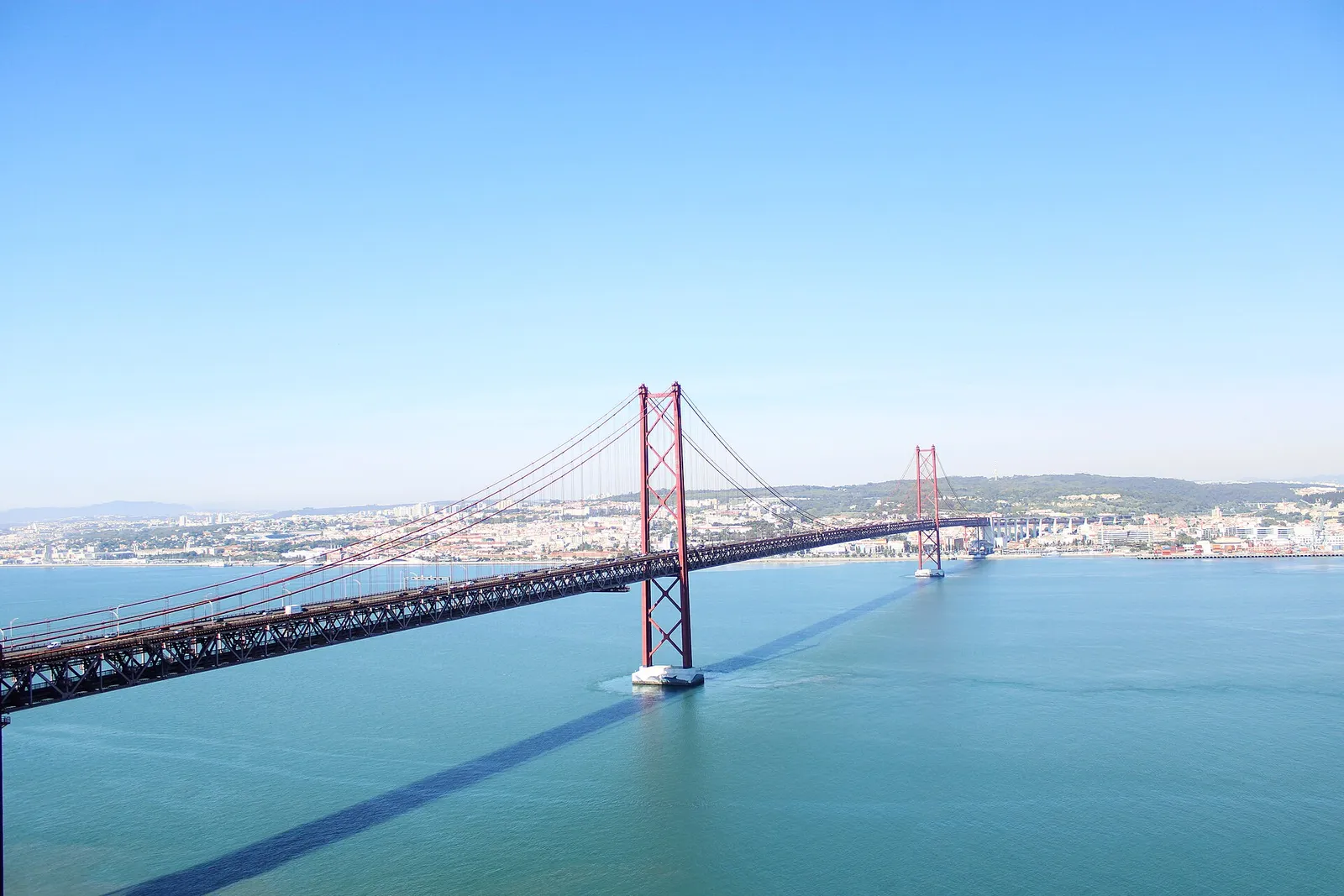
At a glance
- The first bridge across the Tagus estuary at Lisbon opened on Saturday 6 August 1966, linking the city to Almada on the south bank. It opened to the public at 15:00.
- Its main span of 1,013 metres was then the longest of any suspension bridge in Europe; only four bridges, all in the United States, had longer spans.
- The United States Steel Export Company won an international tender opened in 1959; the contract was signed on 21 February 1961 and work began on 5 November 1962.
- It opened as the Ponte Salazar, though some sources say its legal name was always Ponte sobre o Tejo. Workers replaced the lettering with “Ponte 25 de Abril” for the 5 October 1974 commemorations.
- A railway deck, allowed for in the original design, opened on 29 July 1999. The bridge now carries about 150,000 vehicles and 174 trains a day.
A Saturday in August
On the afternoon of Saturday 6 August 1966, about two hours after the official cars had gone over, a green Austin Seven, registration DC-72-48, was the first private car onto the deck of the new bridge over the Tagus. At the wheel was Carlos Braz, a driver for a textile firm, on holiday in Lisbon with his family. He put it down to pure chance.
Only the day before, joking with friends, he had decided to go and see the opening, and they went without going to bed. Reporters and onlookers greeted him with enthusiasm, and the Cardinal Patriarch of Lisbon, Manuel Gonçalves Cerejeira, made a point of shaking his hand.
Earlier that day the President of the Republic, Admiral Américo Tomás, had opened the bridge. The national anthem played and a 21-gun salute was fired at Almada. The first vehicle across was a traffic-police car. Behind it came the car of the President's wife and a second car carrying the prime minister, António de Oliveira Salazar, whose name was on the bridge.
The public was let on at 15:00. In the first ten hours about 50,000 cars crossed, carrying perhaps 200,000 people.
A late project for a thrifty regime
In 1966 Portugal was a dictatorship. The Estado Novo (New State) of António de Oliveira Salazar prized balanced budgets above almost everything, and costly public works came slowly. The historian António Costa Pinto calls the bridge an extremely late project for that reason, and a symbol of the modernisation of the late 1950s and early 1960s.
At Lisbon the Tagus is a wide estuary, with Almada and the other towns of the south bank on the far side. Until 1966 no bridge crossed it there. The nearest, the Ponte Marechal Carmona at Vila Franca de Xira, opened upstream in 1951.
Ninety years of plans
The first proposal on record came from the engineer Miguel Pais in 1876: a mainly railway bridge from the Grilo, in eastern Lisbon, to Montijo, tied to plans for a new port. After that, says the architect Luís F. Rodrigues, author of a history of the bridge, A Ponte Inevitável, Lisbon was flooded with bridge proposals.
An American engineer named Lye proposed a bridge from Almada to the Chiado in 1888. In 1889 the French engineers Bartissol and Seyrig offered a road and rail bridge of about 2,500 metres from the Rocha do Conde de Óbidos to Almada, and a German firm from Nuremberg drew one from Beato to Montijo in 1890. A 1919 study proposed a tunnel instead.
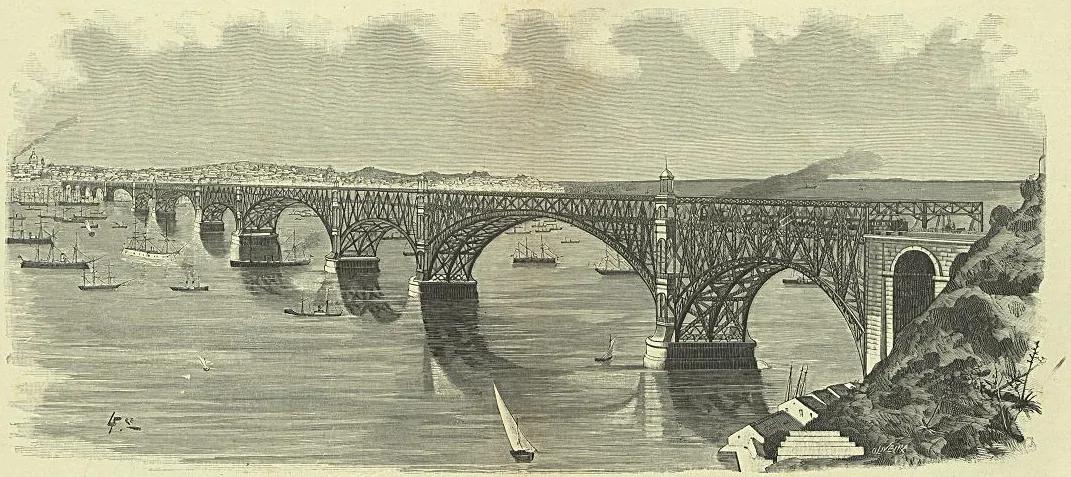
In 1921 the Spanish engineer Alfonso Peña Boeuf proposed a bridge with a double railway and four road lanes, the layout eventually built; parliament discussed it and nothing happened. A concession sought by the engineer António Belo for a Beato to Montijo railway bridge led to a tender in 1934 that failed, and a proposal from United States Steel Products in 1938 came to nothing.
In Rodrigues's view it was the Golden Gate Bridge, opened in San Francisco in 1937, that made a crossing of more than two kilometres without piers in the shipping lane thinkable. After the Second World War the fast growth of the towns on the south bank made a bridge more pressing, and in 1953 a commission under the engineer Barbosa Carmona concluded that a crossing was technically and financially feasible.
1876
Miguel Pais proposes a Grilo to Montijo bridge
1888–1890
Proposals from Lye, Bartissol and Seyrig, and a Nuremberg firm
1919
A tunnel from Santa Apolónia to Cacilhas is proposed
1921
Peña Boeuf's road and rail bridge is debated in parliament
1934
A tender for António Belo's concession fails
1951
The Vila Franca de Xira bridge opens upstream
1953
A government commission finds a Lisbon crossing feasible
1959
International tender opened by the Gabinete da Ponte sobre o Tejo
3 March 1960
Four bids are submitted
21 February 1961
Contract signed with the United States Steel Export Company
An American contract
A special office, the Gabinete da Ponte sobre o Tejo, ran the project under the engineer José Estêvão Canto Moniz, later a minister. It opened an international tender in 1959 for a bridge from Alcântara, in western Lisbon, to Almada. Four bids came in on 3 March 1960, and a group of American and Portuguese firms led by the United States Steel Export Company met most of the requirements.
The Minister of Public Works, Eduardo Arantes e Oliveira, signed the contract with the US Steel company on 21 February 1961. The design came from the New York firm of Steinman, Boynton, Gronquist and Birdsall. David B. Steinman had designed the Mackinac Bridge in Michigan, opened in 1957.
Salazar wanted the bridge but not the bill. According to Rodrigues, he did not want to break with his financial orthodoxy and at one point opposed the project because of its cost, about two million contos (a conto was 1,000 escudos). He gave way because foreign banks put up most of the money. A British trade journal put the price in 1965 at £50 million.
Building it, 1962 to 1966
Work began on 5 November 1962, with 51 months allowed. Two towers went up in the river, each 483 metres from its bank. Visit Lisboa's figures put the southern tower's foundation about 80 metres below the water and the northern one's 35 metres; RTP says both rest on basalt more than 80 metres down. The 1965 trade journal claimed the deepest bridge pier in the world.
The two main cables were spun on site from parallel steel wires, 37 bundles of 304 wires each, and weigh 8,000 tonnes together. The stiffening truss under the road went up in 300-tonne sections brought by barge and lifted into place one at a time. The deck clears the water by about 70 metres.
- Main span
- 1,013 m between the towers
- Length between anchorages
- 2,300 m
- Tower height
- About 190 m
- Main cables
- Two, each 58.6 cm across with 11,248 steel wires
- Steel
- 82,000 tonnes of steel parts
- Concrete
- 300,000 m³
- Earth and rock moved
- 6.6 million m³
About 3,000 people worked on the site each day, for 14 construction firms, 11 of them Portuguese. Accounts of the dead run from four workers in the official record to eleven in Rodrigues's history; Canto Moniz told a railway magazine there had been six, against the sixty that accident rates on similar works would have predicted.
The contractors handed over the bridge on 27 May 1966 and it opened on 6 August, six months before the 51-month term, counted from 5 November 1962, ran out. The cost is given differently: about 2.2 million contos in a 2016 account, and 4.49 million contos as the final figure in Lusa's 60th-anniversary report, about €22.4 million at the escudo's conversion rate, with no allowance for inflation.
| Bridge | Place | Opened | Main span |
|---|---|---|---|
| Verrazzano-Narrows | New York City, United States | 1964 | 1,298 m (4,260 ft) |
| Golden Gate | San Francisco, United States | 1937 | 1,280 m (4,200 ft) |
| Mackinac | Michigan, United States | 1957 | 1,158 m (3,800 ft) |
| George Washington | New York–New Jersey, United States | 1931 | 1,067 m (3,500 ft) |
| Ponte Salazar (25 de Abril) | Lisbon, Portugal | 1966 | 1,013 m |
| Forth Road | Firth of Forth, Scotland | 1964 | 1,006 m |
Spans from each bridge's operator or official page; metres for the Verrazzano-Narrows and George Washington bridges converted from feet. The Forth Road Bridge had been the largest outside the United States when it opened in 1964. A British trade journal in 1965 called the Lisbon span the fourth longest in the world; RTP and this list make it fifth.
The engineers also planned ahead. The bridge was built for road traffic only, but the deck was designed so that a lower level for a double-track railway could be added later with little effort. A tunnel of about 600 metres for the future line was dug under the toll plaza on the south bank, and waited 33 years for trains.
The opening: God, the nation and Salazar
The regime made the opening a two-day festival. Cardinal Cerejeira said a Mass of thanksgiving at the Cristo Rei sanctuary on the Almada cliff, attended by the papal nuncio and almost the whole government. He dedicated the work to God and, the historian Costa Pinto notes, by the grace of God to Salazar.
“The glory of this bridge belongs to the man who built it, to the man who directed it, to the man who conceived it, to the man who decreed it.”
President Tomás spoke the formal words. Salazar attended but kept away from the microphones, according to the Diário de Notícias's retrospective. The mayor of Lisbon thanked him by name.
“I declare the Ponte Salazar open to traffic and to the service of the nation.”
The next day the Diário de Notícias ran the headline “A Ponte nasceu Estrela” (“The bridge was born a star”) and claimed that a hundred million Europeans had watched on television. On 8 August it reported a sailing regatta under the deck and the biggest traffic jam ever recorded in Portugal, with 150,000 vehicles and a million people. These were the figures of a censored, pro-regime press and cannot be checked.
The crossing was not free: from the first day a car paid a toll of 10 escudos. Roger Blough, head of United States Steel, compared the bridge, as a symbol of Lisbon, to the Eiffel Tower and the Statue of Liberty.
From Ponte Salazar to Ponte 25 de Abril
On 25 April 1974 a military coup ended the dictatorship. At about 07:00 that morning a company from the artillery school at Vendas Novas closed the bridge to hostile forces, and later let rebel units from the south across into the city.
People called at once for the dictator's name to come down, but the iron letters stayed up for more than five months. Colonel João Varela Gomes, a leading figure of the anti-fascist resistance, was given less than a week to organise the 5 October commemorations of the Republic, and settled it himself.
With a team of workers from the Sorefame engineering firm he took down “Ponte Salazar” and put up “Ponte 25 de Abril”.
The president and the prime minister took him to task for usurping powers that belonged to the proper channels.
The formal change came later. The Associação 25 de Abril, the association of the officers who made the coup, dates the new name to 1979, on a proposal from the committee organising the revolution's fifth anniversary.
Trains at last: the rebuilding of the 1990s
By the 1990s traffic had outgrown the design. In 1994 drivers staged the buzinão, a mass horn-blowing protest, against a 50 per cent toll rise. In January 1996 the private company Lusoponte took over the road concession, and in March 1998 a second Tagus bridge, the Vasco da Gama, opened further upstream.
The railway deck needed more than new track. Engineers found the towers and foundations could take the extra load but the cables and deck truss could not. Between early 1995 and July 1999 the towers were extended, a second set of cables was spun above the old ones while traffic kept moving, and the road deck was widened to six lanes. Civil Engineer International called it the largest and most complicated bridge strengthening yet attempted.
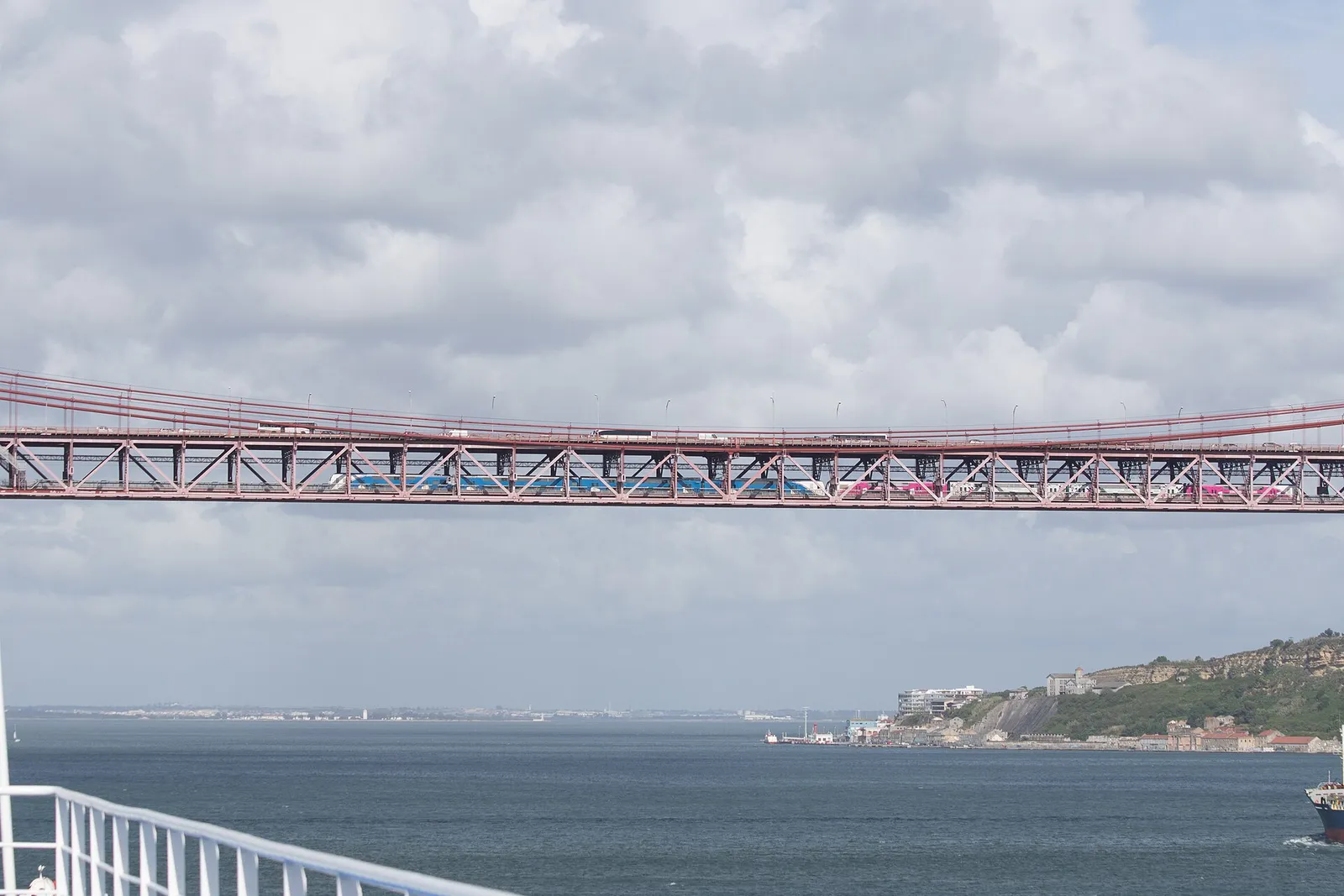
The rail link was opened on Thursday 29 July 1999, with the prime minister, António Guterres, present (Fertagus dates the start of its operations to 27 July). The service was run by Fertagus, Portugal's first private passenger railway operator, from Fogueteiro, on the south bank, to Entrecampos in Lisbon. It reached Roma-Areeiro in 2003 and Setúbal in 2004.
Fertagus passengers across the bridge
million passengers a year
Annual passengers on the Fertagus line, which crosses the bridge's lower deck: 3.5 million in its first year of operation from July 1999, 21 million in 2018 and 31.8 million in 2025. Figures given by Fertagus to Lusa in August 2026.
Show the data
| Passengers | |
|---|---|
| First year | 3.5 |
| 2018 | 21 |
| 2025 | 31.8 |
Fertagus says it has carried 560 million passengers since 1999 and now carries about 133,000 a day. Its demand grew by half between 2018 and 2025, which the company puts down to the cheaper Navegante travel passes that came with a fare-cutting programme in 2019, and to the growing population south of the river.
Why it still matters
Sixty years on the bridge carries about 150,000 vehicles and 174 trains a day, more than 100 million journeys a year. The busiest year was 2005, with more than 57 million vehicles, about 156,000 a day; the pandemic low was about 115,000 a day in 2020. Infraestruturas de Portugal, the state infrastructure company responsible for the structure, spends about €1.6 million a year on inspection and maintenance.
In 2016 Infraestruturas de Portugal counted its main span as the longest of any road and rail suspension bridge in Europe and the third longest of its kind in the world. The state heritage office was then working on classifying it as a national monument.
In a 2017 study the historian Annarita Gori uses the bridge and its three names (the official one, Salazar's and the revolution's) to trace Portugal's economic and technical development in the 1950s and 1960s, changes in Lisbon's population and city, and the country's foreign relations.
It also had a cost on the Lisbon side. Thousands of people in the shanty neighbourhoods of the Vale de Alcântara lost their homes to the approach roads and piers. In a clandestine leaflet the architect Nuno Teotónio Pereira attacked the inhumane evictions and the hasty rehousing at the Musgueira, and wrote that as the opening neared the clearances openly aimed to tidy up the view around the bridge.
FAQs
When did the Ponte 25 de Abril open?
On Saturday 6 August 1966. President Américo Tomás opened it, and it was opened to the public at 15:00. Work had begun on 5 November 1962.
Why was it called the Ponte Salazar?
The regime named it after the prime minister, António de Oliveira Salazar, on the initiative of the Minister of Public Works, Arantes e Oliveira, backed by President Tomás. According to the architect Luís F. Rodrigues, who wrote a history of the bridge, Salazar was reluctant to lend his name. Sources disagree on whether the name was ever legal: some say the official name stayed Ponte sobre o Tejo (the bridge over the Tagus).
When was it renamed the Ponte 25 de Abril?
Workers replaced the iron letters reading “Ponte Salazar” with “Ponte 25 de Abril” in time for the 5 October 1974 commemorations, more than five months after the revolution. The Associação 25 de Abril dates the formal adoption of the name to 1979.
Who built the bridge, and is it a copy of the Golden Gate?
It was built by the United States Steel Export Company with Portuguese firms, to a design by the New York firm of David B. Steinman. It is a suspension bridge like San Francisco's Golden Gate, but a different design: its main span is 1,013 metres against the Golden Gate's 1,280, and it was built to carry a railway as well as a road. Observador notes that its X-braced towers follow those of the San Francisco–Oakland Bay Bridge.
When did trains start crossing the bridge?
On 29 July 1999, after four years of work that added a lower railway deck, a second set of cables and a sixth road lane. Fertagus runs the trains between Lisbon and the south bank.
On the timeline
Open the timelineNearby moments from dictatorship and the estado novo (1926–1974).
Actress and director Maria de Medeiros is born in Lisbon. She played Anaïs Nin in 'Henry & June' and Fabienne, Bruce Willis's girlfriend, in 'Pulp Fiction', and directed 'Capitães de Abril' (2000), a film about the Carnation Revolution screened at Cannes.
Birth in Madeira of José Tolentino de Mendonça, priest, theologian and one of the most admired Portuguese poets of his generation. Called to Rome by Pope Francis as Archivist and Librarian of the Holy Roman Church in 2018, he was made a cardinal in 2019 and later became Prefect of the Vatican's Dicastery for Culture and Education.
Portugal beat the Soviet Union 2–1 at Wembley to finish third at the FIFA World Cup in England, on their first appearance at the tournament. Eusébio converts a penalty to end as the competition's top scorer with nine goals, and José Torres strikes the late winner.
The Ponte 25 de Abril opens
The Salazar Bridge over the Tagus, linking Lisbon and Almada, is inaugurated as the longest suspension bridge in Europe at the time. After the Carnation Revolution it was renamed the Ponte 25 de Abril.
Birth in Praia da Vitória, on Terceira in the Azores, of Nuno Bettencourt, youngest of ten children of a family that emigrated to Massachusetts when he was four. As guitarist of Extreme he co-wrote the 1991 US number one 'More Than Words', and later played for Rihanna, including at the 2023 Super Bowl half-time show.
The Hotel da Penina opens near Alvor, on former rice fields outside Portimão, with a golf course designed by the British champion Henry Cotton — the Algarve's first grass course. The press of the day called it the region's largest and most luxurious hotel. Paul McCartney later made up a song, 'Penina', for its resident band.
During the night of 25 to 26 November, torrential rain sets off flash floods across the Lisbon region, sweeping away shanty towns and villages in Loures, Odivelas, Vila Franca de Xira and Alenquer. The censored official count stopped at 462 dead, though historians estimate about 700, in Portugal's deadliest storm since at least the early nineteenth century. Students' relief work fuelled opposition to the regime.
Coming up in history
All long reads
23 sources
Archives, scholarship and reporting this article was checked against.
- 1
50º aniversário da Ponte 25 AbrilInfraestruturas de Portugal, 6 July 2016
- 2História da Ponte 25 de AbrilRTP Notícias
- 3Construção da Ponte 25 de Abril (Pedro A. Pina and Nuno Patrício)RTP Notícias
- 4Salazar deu nome à ponte sobre o Tejo, mas não interferiu na construçãoObservador (Lusa), 2 August 2016
- 5Exaltação patriótica em festa do regimeDiário de Notícias, 6 August 2016
- 6
The Ponte sobre o Tejo: a key to reading the Contemporary Portugal (Annarita Gori)Memoria e Ricerca 2/2017, pp. 283–300
- 7“Ponte 25 de Abril” fez 40 anosRTP Notícias, 2014
- 8
High wire action (D. Parker), Civil Engineer International 31, October 1997Transport Research International Documentation (TRID)
- 9Uma “direta” que valeu um lugar na históriaDiário de Notícias, 6 August 2016
- 10Lisboa. As primeiras imagens (raras) da Ponte 25 de Abril (Marta Leite Ferreira)Observador, 9 May 2016
- 11Ponte 25 de Abril, um “sonho” que demorou 90 anos a realizarObservador (Lusa), 2 August 2016
- 12
1966 25 de Abril (Tagus, Salazar) bridge recordBridgemeister
- 13
Facts and figuresMackinac Bridge Authority
- 14
Bridge over the River Tagus (from Building with Steel, 1965)New Steel Construction
- 15
Ponte 25 de AbrilTurismo de Lisboa (Visit Lisboa)
- 1660 anos de Ponte 25 de Abril. Preferida na travessia, “comboio da ponte” revolucionou mobilidade entre margens do TejoObservador (Lusa), 6 August 2026
- 17
Verrazzano-Narrows BridgeMetropolitan Transportation Authority
- 18
Design and construction statisticsGolden Gate Bridge, Highway and Transportation District
- 19
World's busiest span turns 80Occupational Health & Safety, 25 October 2011
- 20
Forth Road Bridge: facts and figuresThe Forth Bridges (Transport Scotland)
- 21Travessia ferroviária na Ponte 25 de Abril “foi um milagre”, coordenador da obraRTP Notícias (Lusa)
- 22
Ponte 25 de Abril, 25 April 1974, 07:00 (Lugares de Abril)Associação 25 de Abril
- 23
Experiência Pilar 7Open House Lisboa, Trienal de Arquitectura de Lisboa
Image credits
- The Ponte 25 de Abril seen from above the Almada bank in October 2022, looking north across the Tagus to Lisbon. Próxima Etapa, CC BY-SA 4.0, via Wikimedia Commons.
- A road and rail bridge from Lisbon to Almada as drawn by Luciano Freire for the magazine O Occidente on 11 July 1889, one of the plans of that decade that were never built. Luciano Freire (1864-1935), Public domain, via Wikimedia Commons.
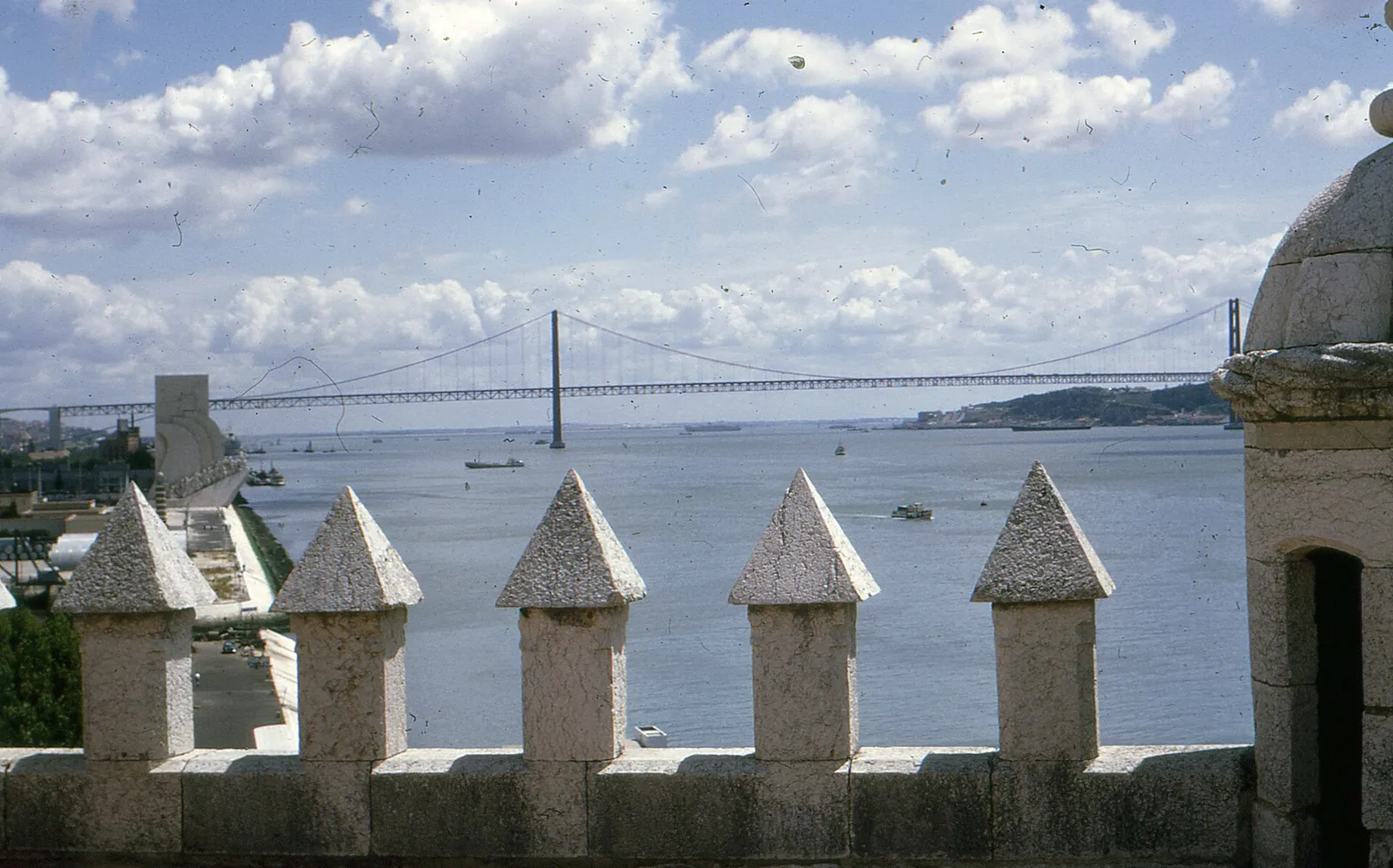
- The bridge a year after it opened, seen from the Tower of Belém on 3 August 1967. The Padrão dos Descobrimentos is on the waterfront at left. Daniel VILLAFRUELA., CC BY-SA 3.0, via Wikimedia Commons.
- Two trains pass on the lower deck with road traffic above, May 2016. The railway deck opened in 1999, 33 years after the bridge. Industrial Wales, CC BY-SA 2.0, via Wikimedia Commons.