

Carmen Miranda, the Portuguese-born star, dies at 46
She left northern Portugal as a baby, became Brazil's most-recorded woman singer and then the highest-paid woman in America. Brazil argued over her image for years, then gave her a funeral that, one historian says, stopped Rio.
At a glance
- Carmen Miranda died of a heart attack at her home in Beverly Hills early on Friday 5 August 1955, aged 46, hours after collapsing briefly while taping The Jimmy Durante Show.
- She was born Maria do Carmo Miranda da Cunha on 9 February 1909 in Marco de Canaveses, northern Portugal, and was taken to Rio de Janeiro as a baby, the daughter of an emigrant barber.
- Between 1929 and 1940 she made about 280 recordings in Brazil; her 1930 carnival march “Taí” sold 35,000 copies in a year when 1,000 counted as a hit.
- Signed for Broadway in 1939, she became a Hollywood star in the years of Roosevelt's Good Neighbor policy, and Treasury figures for 1945 put her pay above that of any other woman in the United States.
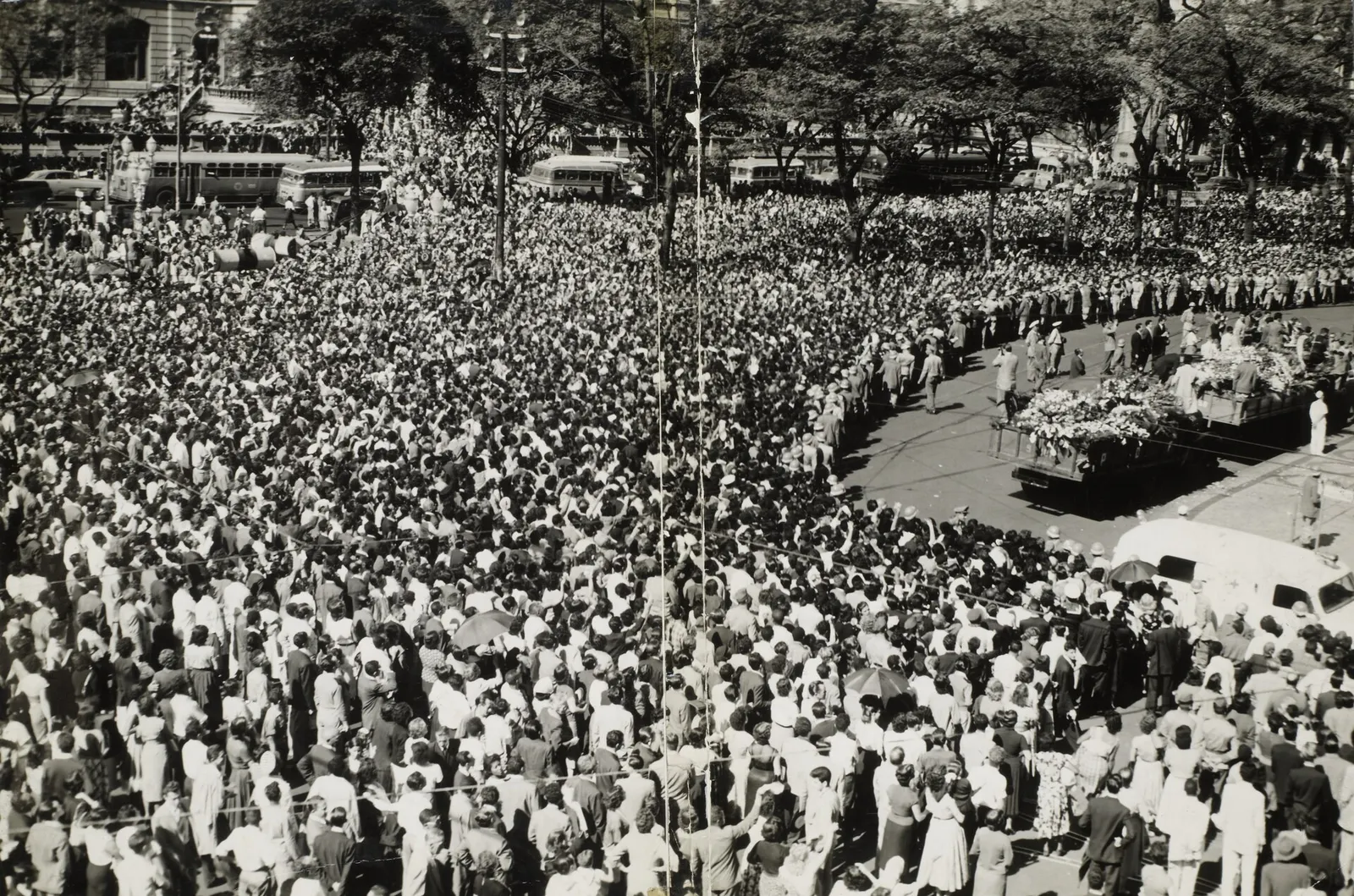
- Her body was flown to Rio, where estimates of the crowds at her funeral on 12 and 13 August range from 50,000 to about half a million. Museums keep her memory in Rio (since 1976) and in Marco de Canaveses (since 1985).
Out of breath
On Thursday 4 August 1955, Carmen Miranda was dancing for the cameras of The Jimmy Durante Show, a variety programme for American television. At one point she dropped to her knees and said she was out of breath. Durante told the band to stop the music and said he had her lines. She got up and danced on to the end.
That evening, at her house in Beverly Hills, she had friends round and they talked and sang well into the night. At about half past two in the morning she went to her room.
She was found a few hours later, fully dressed, on the floor. Accounts differ on who found her: her husband, David Sebastian, in some versions, the housekeeper in others.
The cause was a heart attack. She was 46, although the New York Times and the Los Angeles Mirror-News both reported her as 41. The segment she had taped was her last filmed appearance.
- Born
- Maria do Carmo Miranda da Cunha, 9 February 1909, Marco de Canaveses, Portugal
- Died
- 5 August 1955, at home in Beverly Hills, California, aged 46
- Cause
- Heart attack
- Buried
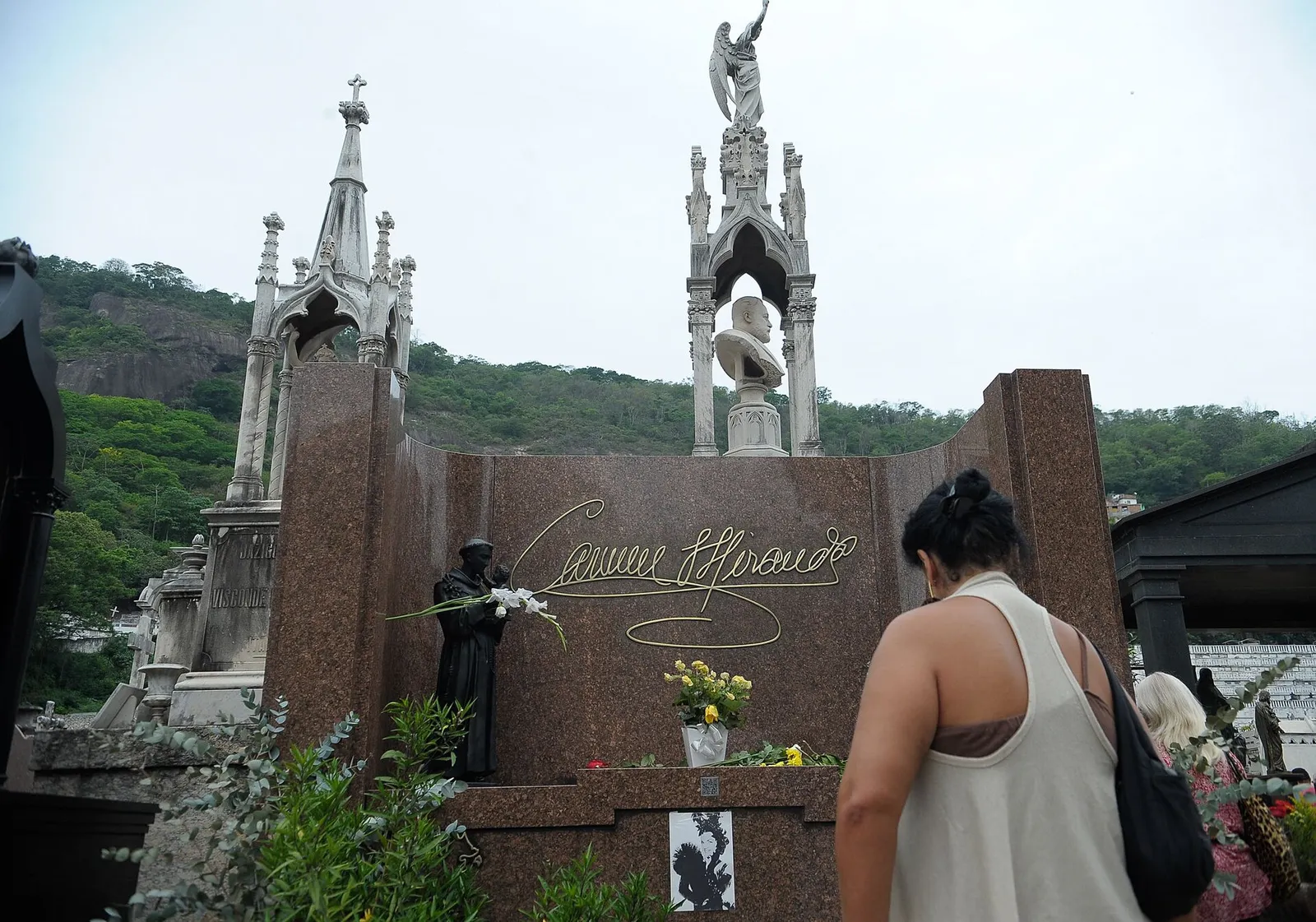
- 13 August 1955, Cemitério de São João Batista, Rio de Janeiro
- Nicknames
- “A Pequena Notável” in Brazil; “the Brazilian Bombshell” in the United States
- Nationality
- Portuguese all her life, by the account of Diário de Notícias
A barber's daughter from the Tâmega valley
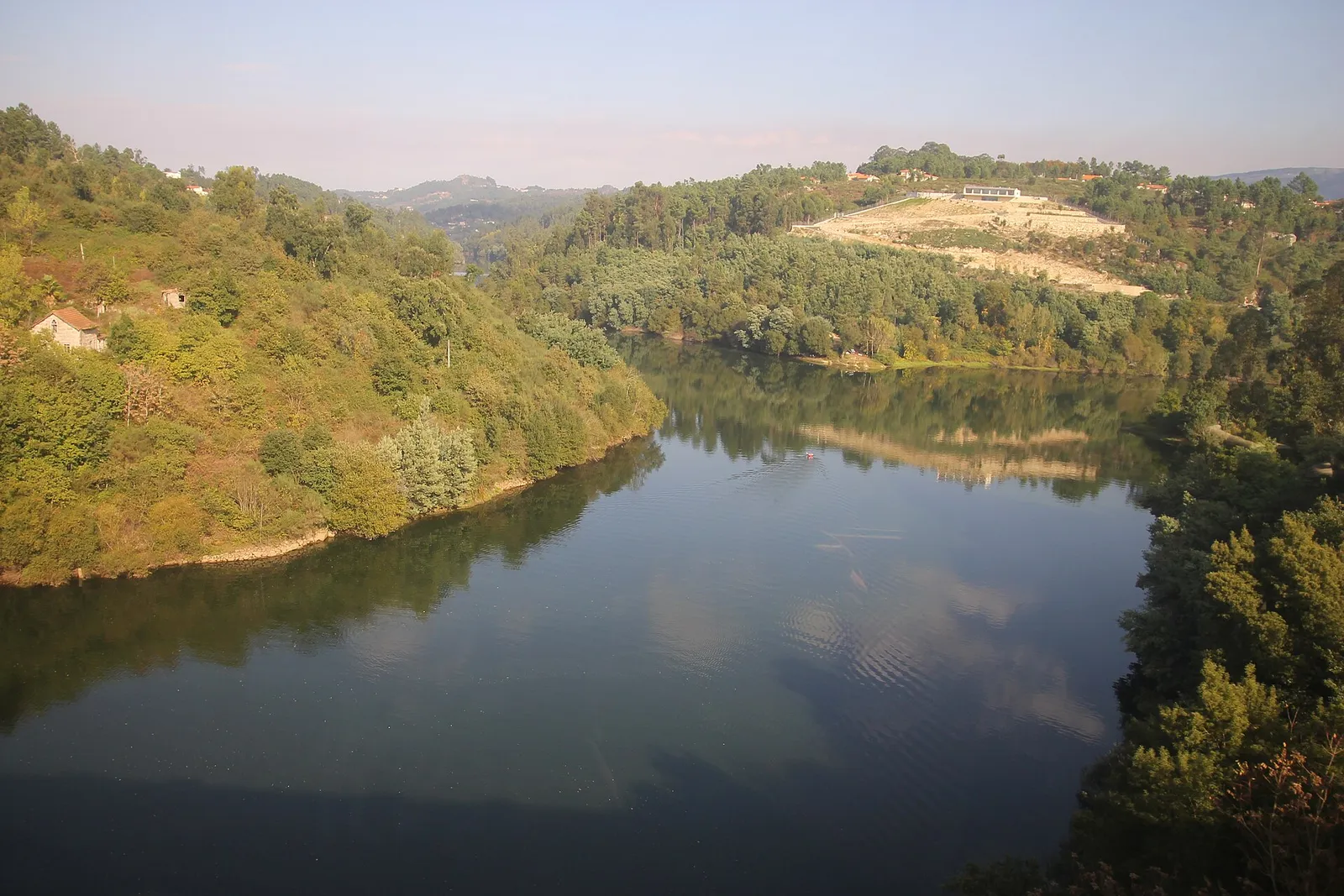
Her father, José Maria Pinto da Cunha, came from Várzea de Ovelha, a village of about 300 people in the municipality of Marco de Canaveses, inland from Porto. He was a barber in his spare time. In September 1909, seven months after his second daughter was born, he sailed for Brazil, shortly before the peak years of Portuguese emigration there, 1911 to 1913.
His wife, Maria Emília Miranda, followed with the two girls, Olinda and the baby Maria do Carmo. They settled in Rio de Janeiro, then Brazil's capital, where some 172,000 Portuguese lived in 1920, about 15 per cent of the city. The father went into partnership with a fellow Portuguese who owned a barber's shop on the Avenida Central, and in 1911 opened his own with his brother-in-law. Four more children were born in Brazil, among them Aurora, who also became a singer.
The family moved several times around the poor central districts where the Portuguese lived, reaching Lapa in 1915. Maria do Carmo went to a convent school run by Vincentian nuns, left in her mid-teens and sold ties in a shop in the centre. Later she worked in a milliner's, where she learned the skills she would use to make her own turbans. From 1925 her mother ran a boarding house near the Praça XV that served Portuguese meals.
The voice of samba and radio
In 1928 she met the composer and guitarist Josué de Barros, who took her to the Brunswick and Victor record companies the next year. She began performing as Carmen Miranda, partly so that her father would not find out. Josué later remembered her words turning into music and her hands moving “as if driven by an electric current” (translated from Portuguese).
The breakthrough was “Taí”, a carnival march by Joubert de Carvalho that she recorded on 27 January 1930. It sold 35,000 copies within a year (within a month, by one account), at a time when 1,000 copies counted as a success. Radio was taking over from sheet music as the way songs reached Brazilians, and the stations competed for her. At Rádio Mayrink Veiga she had an exclusive contract that paid her as much as the men.
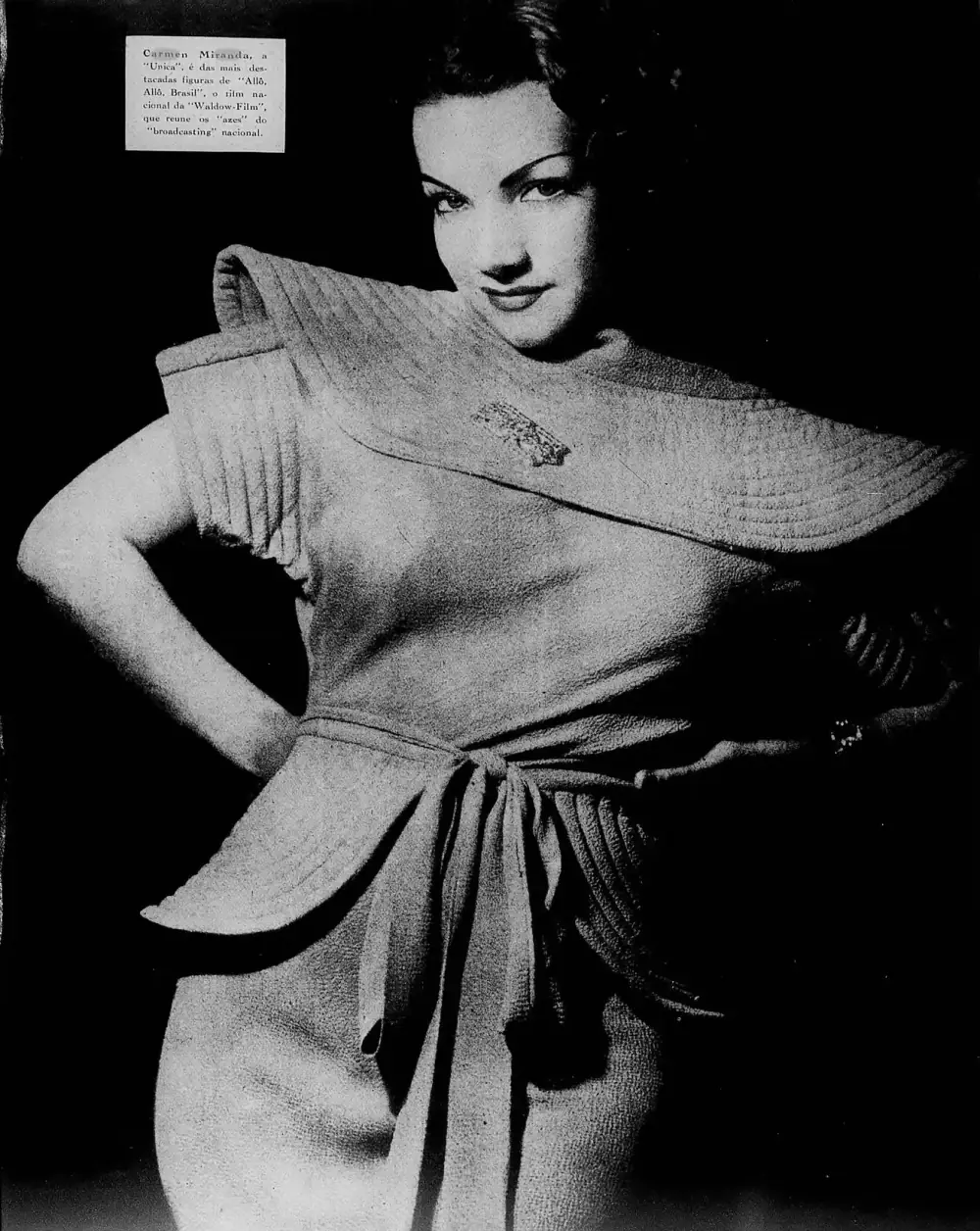
From 1935 announcers billed her as “A Pequena Notável”, the Remarkable Little One, a slogan coined by the radio presenter César Ladeira. She stood about 1.52 metres tall. She also made films, among them A Voz do Carnaval (1933), Alô, Alô, Brasil! (1935) and Alô, Alô, Carnaval! (1936).
Brazil was then ruled by Getúlio Vargas, who took power in 1930 and from 1937 to 1945 ran a dictatorship called the Estado Novo, the same name as Salazar's regime in Portugal. His government mixed his speeches with popular music on the official radio hour, and the regime censored more than 300 songs. Samba, born among the Black population of Rio, was becoming the national music, and Carmen was its best-known voice.
In late 1938 she filmed Banana da Terra (released in 1939). The producer would not meet Ary Barroso's fee, so she sang “O que é que a baiana tem?” by Dorival Caymmi, a Bahian composer newly arrived in Rio, instead. For the number she dressed for the first time as a baiana, the woman of Bahia who sells food from a tray carried on her head, in a stylised turban, necklaces and bracelets. It was the image she carried to her last screen appearance.
Broadway, Hollywood and the Good Neighbor
In February 1939 the Broadway producer Lee Shubert saw her in her baiana costume at the Cassino da Urca, Rio's most fashionable casino, and signed her. She insisted on taking her own band, the Bando da Lua, which his contract did not cover; Alzira Vargas, the dictator's daughter, helped get the musicians on board. They sailed for New York on 4 May 1939.
The Streets of Paris opened at the Broadhurst Theatre on 19 June 1939 and ran for 274 performances. She sang “South American Way”, and the press named her the Brazilian Bombshell; Kendall Brown credits the nickname to the columnist Walter Winchell, DW to the journalist Earl Wilson. She had almost no English at the time.
Twentieth Century-Fox cast her in Down Argentine Way (1940) with Betty Grable and Don Ameche, and a run of Technicolor musicals followed. In March 1941 she left her hand and shoe prints at Grauman's Chinese Theatre. In Hollywood she came to stand for Latin America in general rather than Brazil. Of Springtime in the Rockies, Time wrote: “Only the addition of an Eskimo and a penguin could have made the show still more hemispheric in scope.”
| Year | Film | Made in | Note |
|---|---|---|---|
| 1933 | A Voz do Carnaval | Brazil | Her film debut, by Schpun's account |
| 1936 | Alô, Alô, Carnaval! | Brazil | |
| 1939 | Banana da Terra | Brazil | First appearance as a baiana, singing Caymmi's “O que é que a baiana tem?” |
| 1940 | Down Argentine Way | United States | With Betty Grable and Don Ameche |
| 1941 | That Night in Rio | United States | |
| 1941 | Weekend in Havana | United States | |
| 1942 | Springtime in the Rockies | United States | |
| 1943 | The Gang's All Here | United States | Directed by Busby Berkeley |
| 1947 | Copacabana | United States | |
| 1948 | A Date with Judy | United States | |
| 1953 | Scared Stiff | United States | Her last film |
Carlos Palombini counts 14 Hollywood films between 1940 and 1953, for Fox, United Artists, MGM and Paramount. Kendall Brown lists an earlier Brazilian film, O Carnaval Cantando no Rio (1932).
In 1942 she bought herself out of her Shubert contract, and she moved into a house at 616 North Bedford Drive. Her earnings in 1945, more than $201,000, were the highest of any woman in the United States, and a US Treasury list for that year made her the country's best-paid artist.
The turban, and the charge of “Americanisation”
The baiana costume came from the Afro-Brazilian women of Bahia: the cloth worn over the shoulders, the beads and the turban, which also served to steady a load carried on the head. Bahian women brought it to Rio, where the “Tias”, community leaders of the city's small Bahian diaspora, wore it in public. Schpun writes that Carmen, a white woman with green eyes, took the costume from them and gave it a prestige its originals never had.
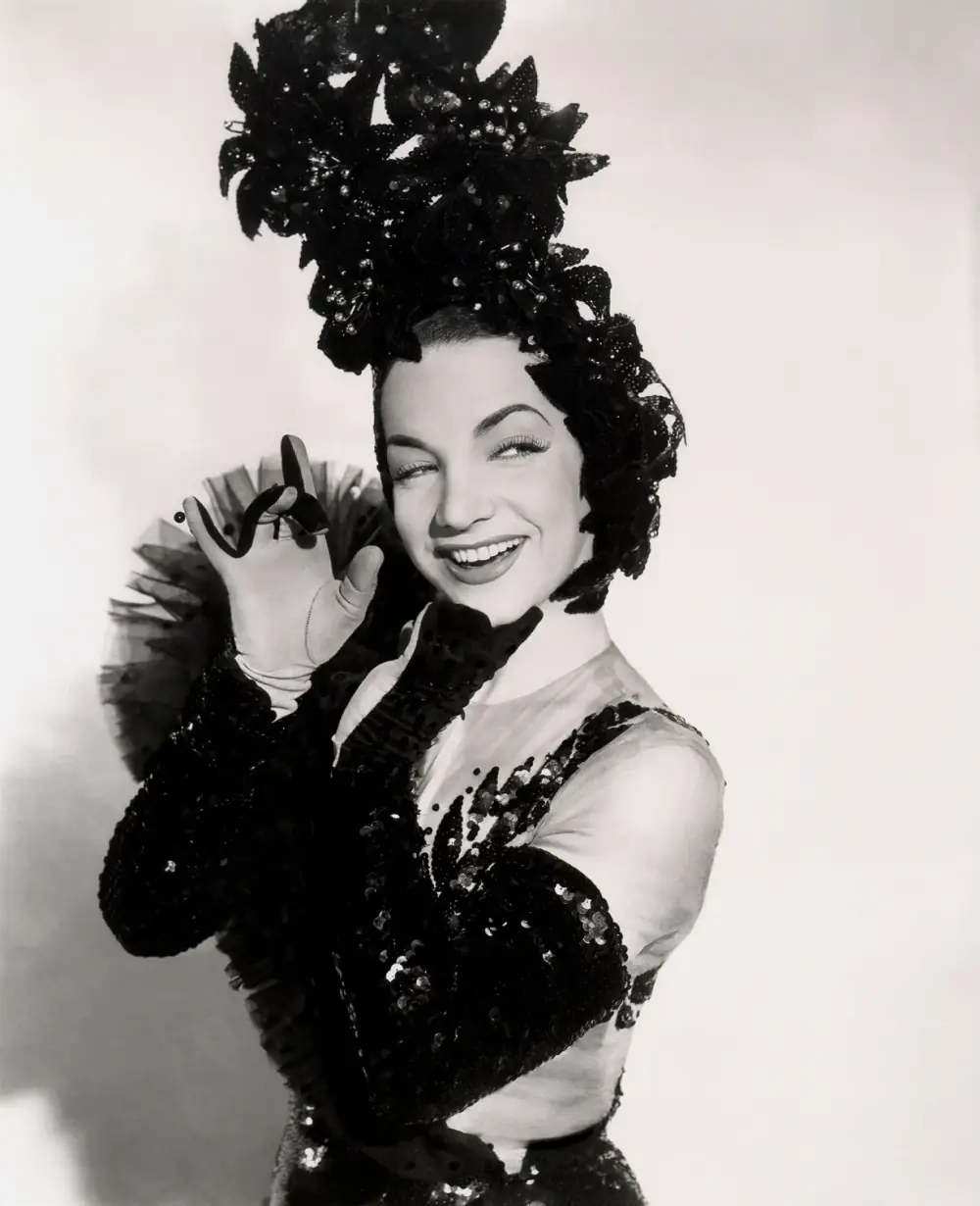
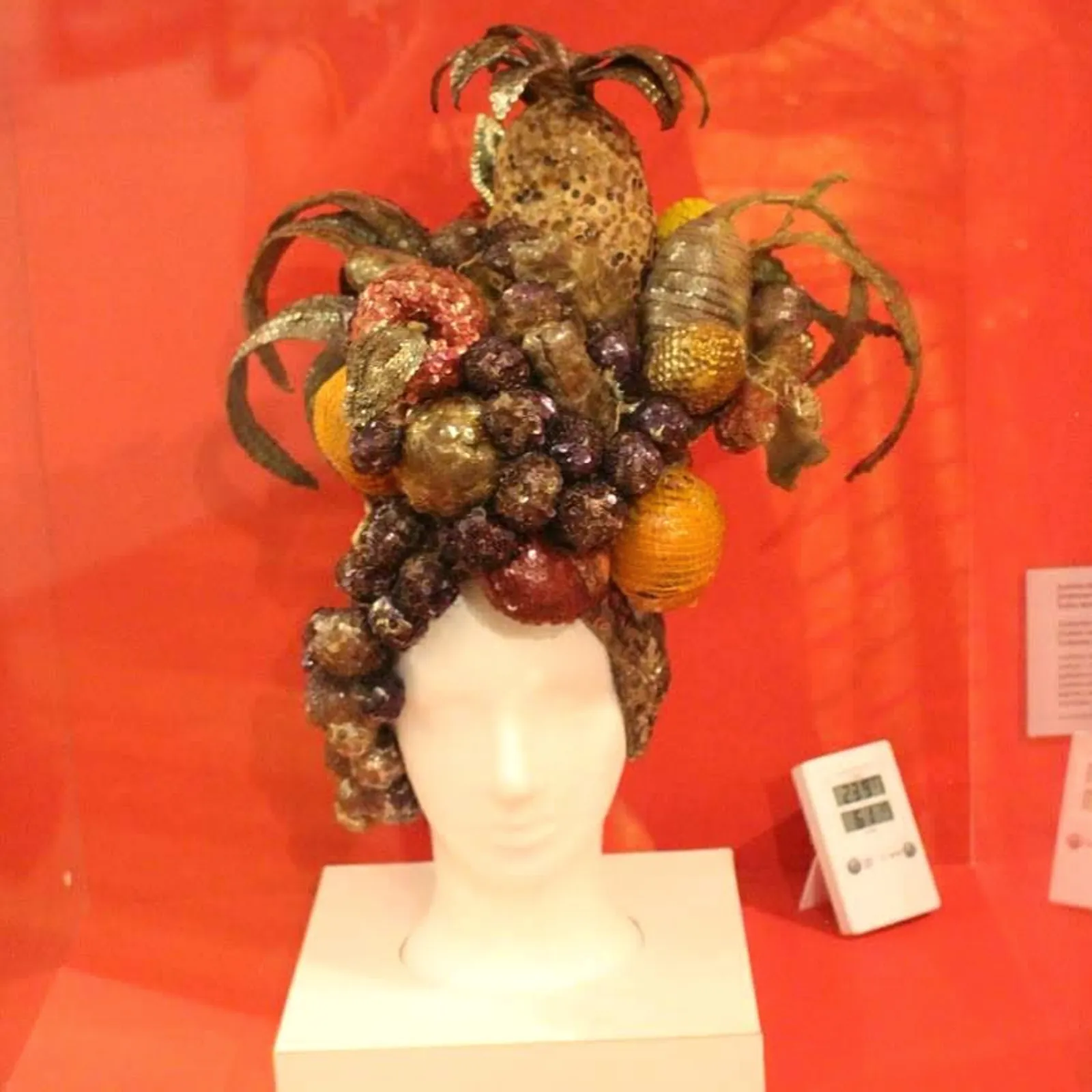
In Hollywood the turbans filled with tropical fruit and could weigh nearly three kilograms. She paired them with platform shoes about 20 centimetres high, partly because she was only 1.52 metres tall. She told a British interviewer where the headdress came from: “In Brazil, in Bahia, the girls carry a basket with their fruit on their heads.” The historian Allen Woll wrote that she introduced the turban to the American scene.
When she came home in July 1940, crowds met her ship. On 15 July she sang at a charity show at the Urca casino for an audience that included the regime's officials, greeted them in English and was received coldly. The rest of the season was cancelled. Her biographer Ruy Castro blames part of the hostility on pro-Hitler guests. Some journalists, he says, threw her Portuguese birth in her face, knowing it hurt her.
“Carmen has ruined our music by soaking it in American things.”
She answered with songs. In September 1940 she recorded ten new numbers for Odeon, most of them for a new show that opened at the Urca on 12 September. Among them was “Disseram que eu voltei americanizada” (They said I came back Americanised), a samba by Vicente Paiva and Luiz Peixoto. The show was a success, though other accounts put it a week, a month or two months after the first night. On 2 October she left for the United States again, and she did not return to Brazil for 14 years.
Brazilians went on arguing about her. Some saw her as a caricature of their country; others credited her with taking samba to the world. The historian Tânia da Costa Garcia, who studied the stylised baiana, called the dispute a sign of Brazil's uneasy relationship with its own identity. Schpun points to another misunderstanding: Carmen was white in Brazil, but in Hollywood she was always the Latin “other”, never the romantic lead.
“Carmen is a caricature, but she is at the same time what we are: underdeveloped, tropical, mixed-race, Dionysian.”
Pills, shock treatment and a last visit home
After the war the parts got smaller. She married David Sebastian, an American production assistant, on 17 March 1947; a pregnancy ended in miscarriage in 1948, and the couple separated in 1949 before reconciling. Her sister Aurora later told Jornal do Brasil that he “only saw Carmen's money”. She toured Europe in 1948 and 1953.
By 1953 she was relying on amphetamines, sleeping pills and alcohol. In late 1953 or early 1954 (accounts differ) she was admitted to a sanatorium in Palm Springs for electric shock treatment. She arrived in Brazil to rest on 3 December 1954, spent weeks out of public view under medical care and went back to the United States in April 1955. On stage she began to forget her lines, and doctors could not say why.
“Brazilians don't understand me but I do what I can for the country.”
Diário de Notícias dates a similar remark, made to the journalist Dulce Damasceno de Brito, to 1940.
The funeral that stopped Rio
Thousands of people filed past her body at the Cunningham and O'Connor mortuary chapel in Hollywood, and a requiem mass was said on 8 August. Her family wanted her buried in Brazil, and the Brazilian government sent a plane to bring her home.
Thursday 4 August 1955
Last taping
She collapses briefly during a number for The Jimmy Durante Show, then finishes it.
Friday 5 August, early morning
Death
She dies of a heart attack at home in Beverly Hills after an evening with friends.
8 August
Requiem mass
Her body has lain in state in a Hollywood mortuary chapel; a funeral mass is held.
Friday 12 August
Arrival in Rio
The coffin lands at Galeão airport and lies in state at the Câmara Municipal, the city council, through the night.
Saturday 13 August
Burial
A procession takes the coffin to the Cemitério de São João Batista in Botafogo.
On Friday 12 August the coffin was flown into Galeão airport. Mourners followed it from the airport to the city council waving white handkerchiefs, and as it passed they sang “Taí” softly. Through the night hundreds of thousands filed past it.
Nobody agrees how many came. A Reuters report of 1995 put the funeral at about 50,000 people, and CBS News speaks of tens of thousands. The Dicionário Cravo Albin counts about half a million on the road from the airport, and the historian Paulo Rezzutti half a million for the procession to the cemetery the next day. The funeral, Rezzutti says, “stopped the city”.
Two museums, one in each country
Rio's mayor, Francisco Negrão de Lima, decreed a Carmen Miranda museum on 5 December 1956 (Kendall Brown dates the decision to December 1955), but it took 20 years to open. In 1968 her belongings, packed in 12 suitcases, went into the care of Rio's Museu da Imagem e do Som. The museum finally opened in the Parque do Flamengo in 1976.
It holds 3,348 items, including more than 1,000 photographs and 400 items of clothing and accessories, among them the turban she wore at her wedding. Closed in 2013, it reopened on 4 August 2023 with an exhibition, Viva Carmen, curated by her biographer Ruy Castro and the writer Heloisa Seixas. It is run by the Rio de Janeiro state culture foundation, Funarj.
In Portugal, Marco de Canaveses opened its municipal Museu Carmen Miranda in 1985. After works costing €1.4 million, which restored and enlarged the museum together with the municipal library, it reopened in February 2024 in the presence of the then Minister of Culture, Pedro Adão e Silva. The permanent exhibition sets her story beside the emigration that marked the municipality, and by its first anniversary, the town council says, about 5,000 people had visited, from countries including Brazil, England, Nepal, Peru and the United States.
How Portugal remembers her
She never went back to Portugal, but she never gave up Portuguese nationality either, Diário de Notícias reported in 2009, on the eve of her centenary. Her elder sister Olinda, who fell ill with tuberculosis after an unhappy love affair, was sent to Marco de Canaveses to recover. She died in the Caramulo sanatorium in Portugal on 3 March 1931, aged 23.
Diário de Notícias called her “the most famous Portuguese woman ever”. In February 2025 Marco de Canaveses marked her 116th birthday, and the museum's first year, with three days of concerts, guided tours and a children's programme.
“The diversity of nationalities among the visitors proves that her legacy is still alive and universal.”
A school of 711 pupils in the town, the EB 2,3 Carmen Miranda, bears her name. In Lisbon, the director Filipe La Féria staged Carmen Miranda – O Grande Musical at the Teatro Politeama in 2026, billed as a tribute to the “Luso-Brazilian star”.
FAQs
Was Carmen Miranda Portuguese or Brazilian?
Both, in different senses. She was born in Marco de Canaveses, Portugal, on 9 February 1909 and kept Portuguese nationality, but she was taken to Rio de Janeiro as a baby, grew up there and became famous as a Brazilian singer.
How did Carmen Miranda die?
She died of a heart attack at her home in Beverly Hills early on 5 August 1955, aged 46. The day before, she had collapsed briefly while taping The Jimmy Durante Show for television, and that night she entertained friends into the early hours.
Where is Carmen Miranda buried?
In the Cemitério de São João Batista in Botafogo, Rio de Janeiro. Her body was flown from Los Angeles, lay in state at Rio's city council on 12 August 1955 and was buried the next day.
Why did Brazilians criticise Carmen Miranda?
When she came back from Broadway in 1940, part of her audience at the Urca casino and some of the press accused her of having become “Americanised”. Later critics said her Hollywood image turned Brazil into a caricature. She answered in 1940 with the samba “Disseram que eu voltei americanizada”.
Is there a Carmen Miranda museum in Portugal?
Yes. The municipal Museu Carmen Miranda in Marco de Canaveses opened in 1985 and reopened in February 2024 after €1.4 million of works. A larger museum, with more than 3,000 of her belongings, is in Rio de Janeiro.
On the timeline
Open the timelineNearby moments from dictatorship and the estado novo (1926–1974).
General José Norton de Matos dies in his home town of Ponte de Lima aged 87. As war minister he built the expeditionary force sent to Flanders in 1917, as governor of Angola he founded the city of Huambo, and in 1949 he stood as the first opposition candidate for president against the Estado Novo, withdrawing before the vote.
Death of Artur Alves dos Reis, author of one of history's boldest frauds. In 1925, with forged contracts, he persuaded the London printers Waterlow & Sons to print genuine-looking Bank of Portugal 500-escudo notes, flooding the country with money worth about 1% of GDP. The scandal shook the First Republic months before the 1926 coup.
Death of Calouste Gulbenkian in Lisbon, aged 86. The Armenian oil magnate — known as 'Mr Five Per Cent' for his stake in Middle Eastern oil — had taken refuge in neutral Portugal in 1942, living at the Hotel Aviz, and left most of his fortune and his celebrated art collection to a foundation based in the city.
The death of Carmen Miranda
Carmen Miranda, the Portuguese-born singer and actress who became a Hollywood and Brazilian music icon, dies in Beverly Hills aged 46. Born in Marco de Canaveses in northern Portugal, she was for a time the highest-paid woman in American show business.
Construction work begins on the Lisbon Metropolitano, Portugal's first underground railway. The inaugural line opened to the public in December 1959.
On India's Independence Day, about 3,000 unarmed satyagrahis march across the borders of Portuguese Goa, Daman and Diu to demand integration with India. Portuguese police and troops open fire, killing 22 by India's official count and up to 32 by later counts. The bloodshed hardened Indian opinion against Lisbon's rule, which ended when India annexed Goa in December 1961.
Francisca Van Dunem is born in Luanda, Angola. A public prosecutor for more than three decades, she became the first Black woman to serve as a minister in Portugal when António Costa appointed her Minister of Justice in 2015, a post she held for six years.
Coming up in history
All long reads
19 sources
Archives, scholarship and reporting this article was checked against.
- 1
Miranda, Carmen (1909–1955)Kendall W. Brown, Women in World History: A Biographical Encyclopedia (Gale), via Encyclopedia.com
- 2
Carmen Miranda, uma star migranteMônica Raisa Schpun, Revista de Antropologia (Universidade de São Paulo), vol. 51, no. 2, 2008, pp. 451–471
- 3
Creating Carmen Miranda (excerpt from the introduction)Kathryn Bishop-Sanchez, Vanderbilt University Press, 2016, published in Literal Magazine
- 4
Carmen de Ruy Castro, artista multimídia do disco (review of Ruy Castro, Carmen: uma biografia, 2005)Carlos Palombini, Per Musi (Universidade Federal de Minas Gerais), no. 13, 2006, pp. 112–119
- 5
Carmen MirandaDicionário Cravo Albin da Música Popular Brasileira
- 6
Mais notável do que pequenaCarlos Haag, Pesquisa FAPESP, no. 107, January 2005
- 7
70 anos sem Carmen Miranda: por que a “Pequena Notável” ganhou fama internacionalDW, in O Povo, 6 August 2025
- 8Carmen MirandaDiário de Notícias, 7 February 2009
- 9
Brazilian superstar or Hollywood stereotype? Miranda's legacy still bears fruit of controversy 40 years after deathReuters, in Deseret News, 6 August 1995
- 10
The Streets of Paris (Broadway, Broadhurst Theatre, 1939)Playbill Vault
- 11
Good Neighbor Policy, 1933Office of the Historian, US Department of State
- 12
Rockefeller's Department: the Office of the Coordinator of Inter-American AffairsIndiana University Libraries Moving Image Archive
- 13
Almanac: Carmen MirandaCBS News, 9 February 2020
- 14
Museu Carmen MirandaTime Out Rio de Janeiro
- 15
Museu Carmen Miranda reabre com atrações artísticas no Rio de JaneiroSuper Rádio Tupi, 3 August 2023
- 16
Percurso pedestre: percurso cidadeCâmara Municipal de Marco de Canaveses
- 17
- 18
- 19
Carmen Miranda – O Grande Musical para ver no PoliteamaRenascença, 7 January 2026
Image credits
- Crowds in Rio de Janeiro as Carmen Miranda's funeral procession passes in August 1955, from the archive of the newspaper Correio da Manhã. Estimates of the mourners range from 50,000 to about half a million. Unknown author, Public domain, via Wikimedia Commons.
- The River Tâmega at Marco de Canaveses in 2016. Her father came from Várzea de Ovelha, a village in the municipality. Draceane, CC BY-SA 4.0, via Wikimedia Commons.
- Carmen Miranda in the Rio film magazine A Scena Muda on 2 February 1935. The printed caption calls her one of the stars of Alô, Alô, Brasil!, a film that brought together the aces of Brazilian radio. Autor da Foto Desconhecido, publicado em: A Scena Muda, 1935 (nr. 724)., Public domain, via Wikimedia Commons.
- A publicity photograph for Greenwich Village (1944), one of her wartime Hollywood musicals, with the towering headdress that became her trademark. Unknown author, Public domain, via Wikimedia Commons.
- Carmen Miranda's grave in the Cemitério de São João Batista, Rio de Janeiro, on All Souls' Day, 2 November 2015. Her signature is reproduced in metal on the granite. Tomaz Silva/Agência Brasil, CC BY 3.0, via Wikimedia Commons.
- A sequinned fruit turban from the last baiana costume Carmen Miranda designed, in the Museu Carmen Miranda in Rio de Janeiro, photographed in 2018. Rn.brito, CC BY-SA 4.0, via Wikimedia Commons.