

Diogo Dias and the sighting of Madagascar, 1500
A storm in the South Atlantic sank four of Cabral's ships and scattered the rest. One of them, alone and lost, found a coast its crew took for Mozambique: it was Madagascar, and by one chronicler's account they named it São Lourenço.
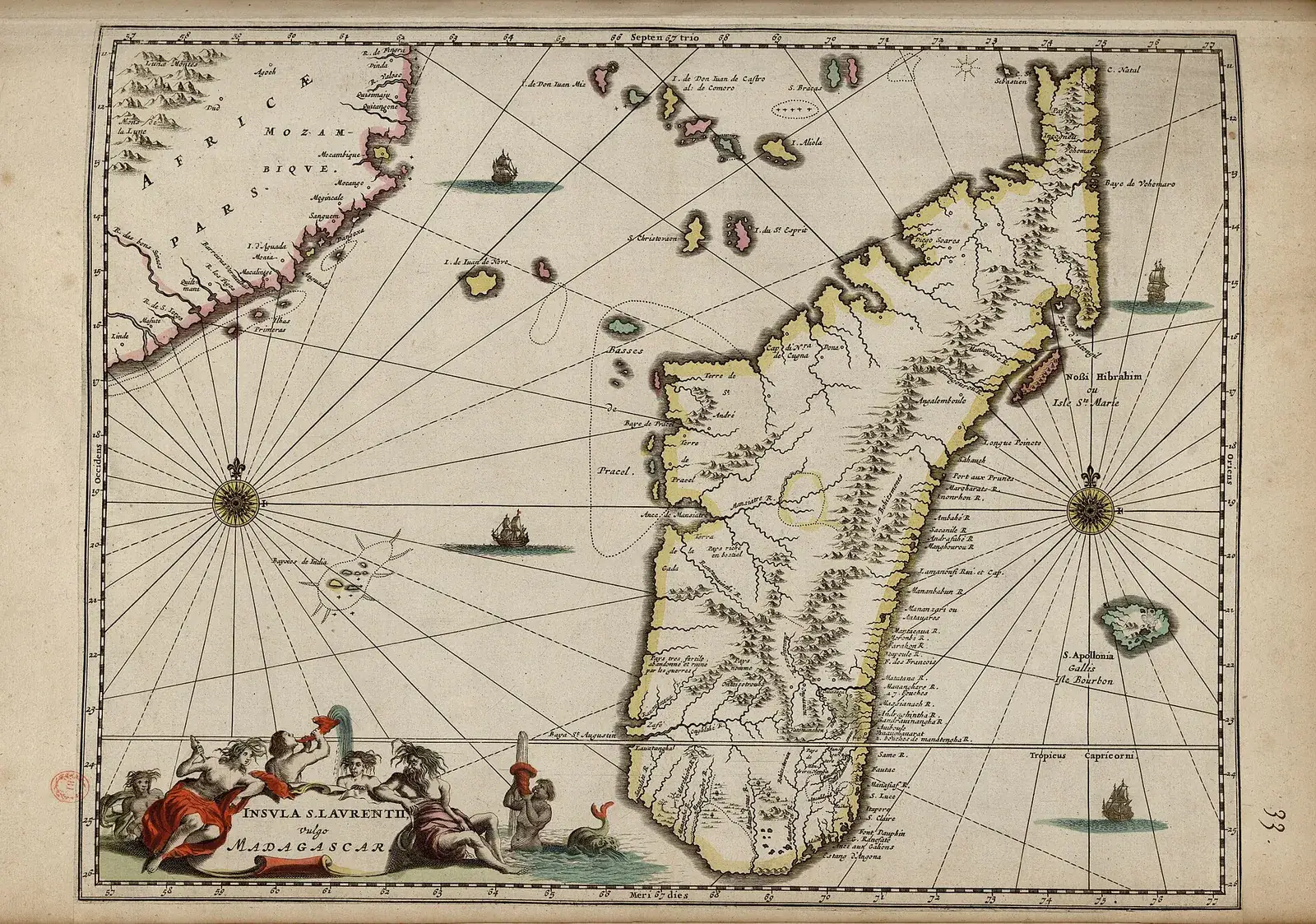
At a glance
- On 24 May 1500, by an eyewitness's account, a squall in the South Atlantic sank four ships of Pedro Álvares Cabral's India fleet, including Bartolomeu Dias's; his brother Diogo's ship was blown away from the rest.
- According to the chronicler Gaspar Correia, Diogo Dias's crew sighted an unknown coast on St Lawrence's day, 10 August, followed it north, found it was an island and named it São Lourenço: Madagascar.
- No eyewitness record mentions Madagascar. The date and the name rest on Correia's chronicle alone, which the French historian Alfred Grandidier accepted in 1884 against the older view that the island was first found in 1506.
- The ship strayed on to the Horn of Africa, where a boatload of its men was seized at Mogadishu or Berbera, and it limped back to Cape Verde with between six and thirteen men aboard, depending on the source.
- Madagascar was new only to Europeans: it had been settled by Austronesian-speaking people from Island Southeast Asia, and Arab traders from the East African coast had trading posts there long before 1500.
A coast on St Lawrence's day
The ship had been alone for some eleven weeks. A squall had torn Pedro Álvares Cabral's fleet apart in the South Atlantic in May, and its captain, Diogo Dias, had no Arab pilot who knew the Indian Ocean, only written sailing directions. When land rose out of the sea, the crew took it for the coast of Mozambique, where the scattered ships seem to have been told to regroup.
They ran north along it with a sharp lookout, searching for the town. Instead the land curved away, the wind came round against them, and they understood that it was an island and that they had gone wrong. The day they first saw it, says the chronicler Gaspar Correia, was the feast of St Lawrence, which in 1500 fell on Monday 10 August.
So they called it the island of São Lourenço.
“Except Diogo Dias, who, not knowing where he was going, did not arrive at land as soon as he should, and went on the other side of the island of Sam Laurenzo. And because they saw it on his day, they gave his name to it.”
It was Madagascar, the great island off the south-east coast of Africa. People had lived there for centuries and Arab traders sailed its coasts, but no European is known to have seen it before. The man who did was never trying to get there, and much of what is told about his voyage comes from one chronicler writing half a century later.
The brothers Dias and the Sofala mission
Diogo Dias was the brother of Bartolomeu Dias, who in 1488 had become the first European known to sail round the Cape of Good Hope. Some sources call him Pêro or Pedro Dias, Barros among them. Little is known of the family's early life.
He had been east before. In 1497 he sailed with Vasco da Gama as clerk of the flagship São Gabriel, and at Calicut, on the Malabar coast of India, he acted as Gama's factor ashore. In August 1498 Gama sent him to the ruler of Calicut with a present and a message. He waited four days for an audience, and when he came back to the warehouse he was held under guard; word of it reached the ships on 13 August.
In March 1500 King Manuel I sent Cabral to India with 13 ships. Two of them, under the Dias brothers, had their own instructions: to go on to Sofala, on the coast of what is now Mozambique, and find out about its trade in gold. They carried copper, bells, looking-glasses and coloured beads, the goods the Portuguese had learned to sell on the coast of Guinea.
On the way the fleet stopped for ten days at a coast in the South Atlantic that turned out to be Brazil. Pêro Vaz de Caminha, a clerk in the fleet, wrote that Diogo Dias, revenue officer of Sacavém near Lisbon, crossed a river with a bagpiper and danced with the local people, taking them by the hands, “an agreeable and pleasure-loving man”. The landing is told in its own article.
The storm of May 1500
By then the fleet was down to eleven ships: one had vanished near the Cape Verde islands in March, and another had been sent home from Brazil with news of the landfall. The eleven left Brazil on 2 May for the Cape of Good Hope. On 12 May a comet appeared and hung in the sky for eight or ten nights. Then, according to an anonymous member of the fleet, on Sunday 24 May a head wind struck so suddenly that the sails were flung back against the masts before anyone could react.
Four ships went down with everyone aboard.
Barros dates the squall to 23 May, Castanheda has a thunderstorm on Saturday 23 May and the fatal gust the next day, and João Paulo Oliveira e Costa's chronology, built from the eyewitness papers, gives 20 May. All agree that Bartolomeu Dias drowned, short of the cape he had been the first to round.
The seven survivors ran before the gale under bare masts for some twenty days and lost sight of one another. Cabral's ship and two others took one course, the vice-admiral's ship and two more another, and the six were together again on the East African coast by late July. The seventh, alone, was Diogo Dias's. “Diogo Dias ran before the wind alone, and what happened to him I will tell further on,” Castanheda wrote (translated from Portuguese).
9 March 1500
Cabral's 13 ships leave Lisbon
22 April-2 May
The fleet at Porto Seguro, Brazil
24 May
Squall sinks four ships; Dias's ship separated
Other sources give 20 or 23 May.
20 July
Cabral's ships at Mozambique; on 7 August they leave Malindi for India
10 August
Dias's crew sight São Lourenço (Madagascar)
Date from Gaspar Correia only, inferred from the saint's day.
Late 1500 or early 1501
Along the Horn of Africa; men seized at Mogadishu or Berbera
Correia says the ship reached Cape Verde three months after its escape.
By early June 1501
The ship found at Beseguiche, near Cape Verde, with a handful of men
Late July or early August 1501
Back in Lisbon, after Cabral
São Lourenço
By the time Dias's crew saw the island, Cabral was already crossing to India: his ships had left Malindi, on the coast of what is now Kenya, on 7 August. Correia says Dias, not knowing where he was going, kept too far from the land and passed outside, that is east of, the island. Taking it for the mainland, he coasted north looking for Mozambique until he reached its northern end.
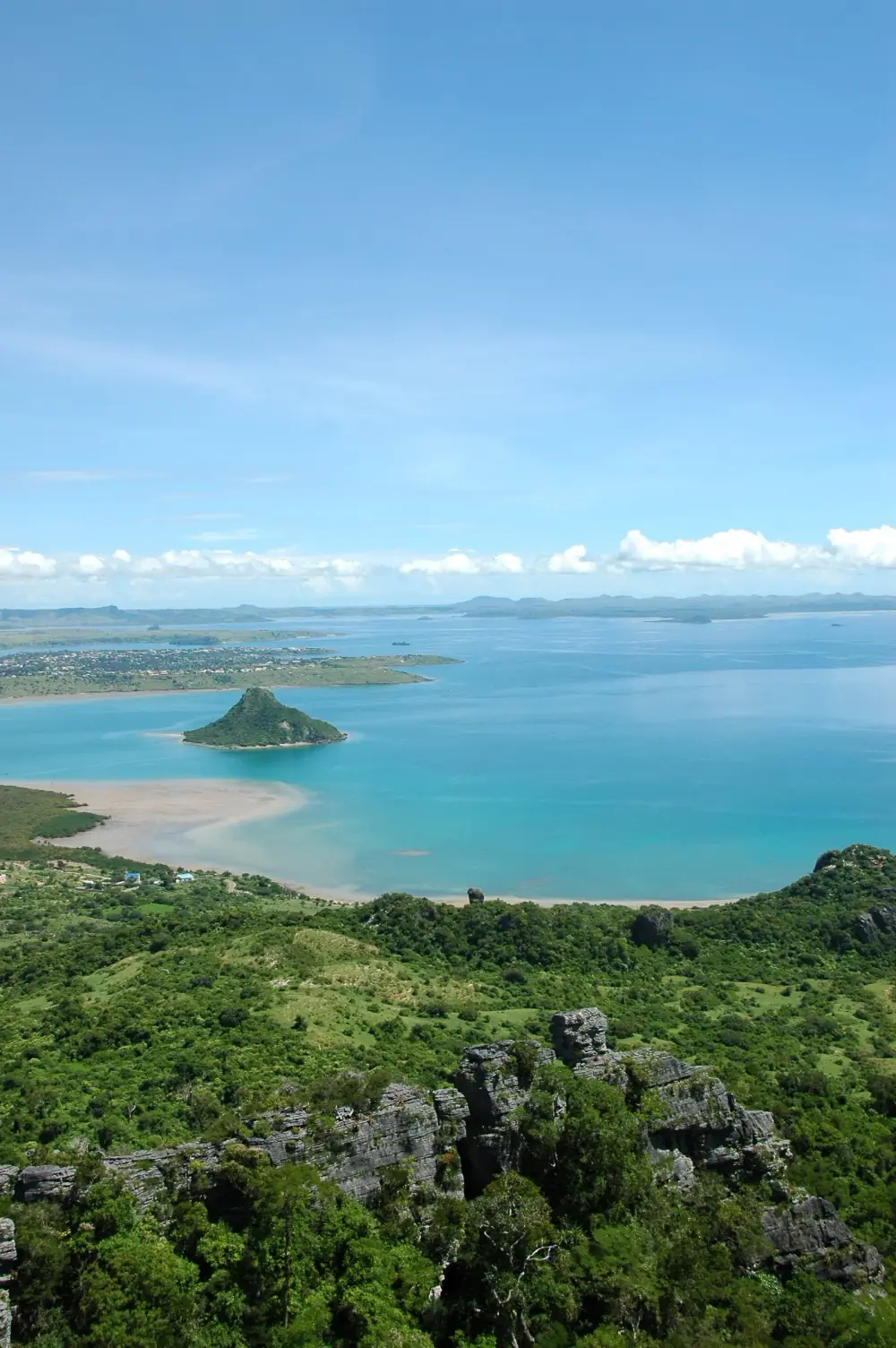
They anchored in a harbour sheltered from the sea winds, sent the boat ashore and found a spring of good water and plenty of fish, but no people. Alfred Grandidier, the nineteenth-century French geographer of Madagascar, suggested the bay of Ambavanibe or that of Amponkarana.
Dias then landed one of the convicts the king put aboard every ship to take risks in unknown lands, with a pardon whatever happened. The man walked inland, found villages of straw houses and talked with the inhabitants by signs.
Some of the islanders came back with him to the ship and sold chickens, yams and wild fruit for knives, axes, small iron goods, painted beads, bells and little mirrors. The crew stayed several days. Then fever broke out and men began to die, and Dias sailed again, heading as close to the wind as he could for the African coast.
Lost on the Horn of Africa
Dias reached the mainland north of Malindi, past the ports he was looking for, and kept going. Correia says the crew rounded Cape Guardafui, the tip of the Horn of Africa, “since they did not know where they were”, and sailed inside the Gulf of Aden as far as Berbera, on the coast of what is now Somaliland. Barros puts the ship at Mogadishu instead.
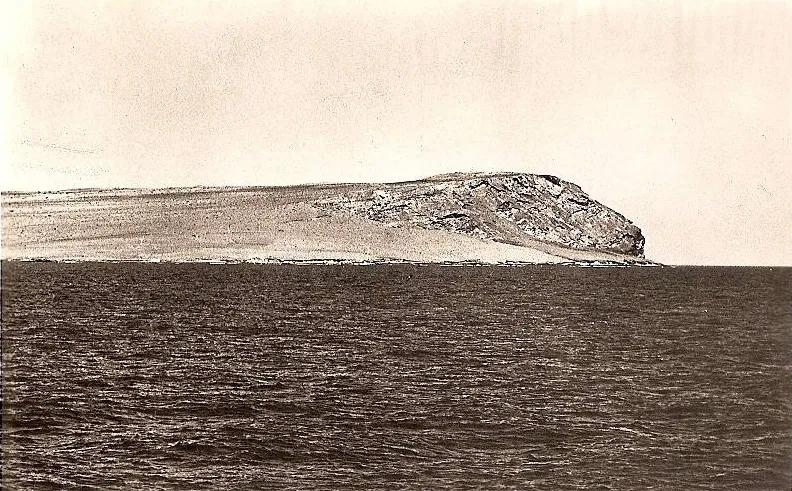
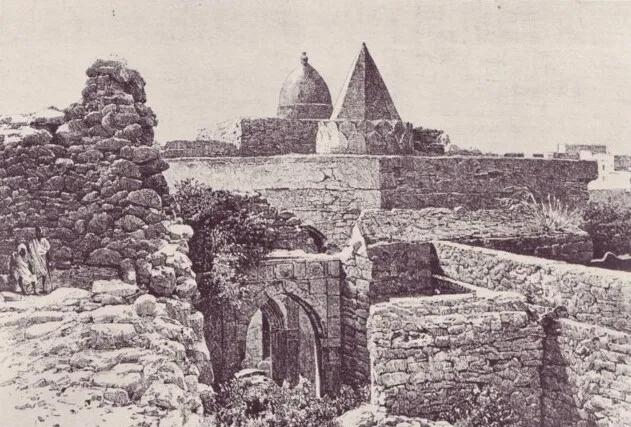
Both versions end in an ambush. In Barros's, Dias found two ships at Mogadishu loaded with spices from Cambay, in Gujarat, and was well received, until the merchants had unloaded. Then the townsmen told him the water was far inland and that he should send his boat with all the casks and men he could, and when it went ashore the boat and its crew were taken. Armed men came out in local boats, and Dias, with only seven people left aboard, cut his cables and fled with no pilot.
Correia's Berbera version is longer and more dramatic. The king laid out pepper and cinnamon on the beach to be weighed, invited the sick ashore to recover, and then seized the clerk's party and more than fifty sick men. The constable, the chief gunner, rose from his sickbed, fired the loaded guns and sank three of the attacking boats, and the ship escaped with about twenty men fit to work.
Greenlee warns that Correia cannot be relied on for the early voyages to India, and Oliveira e Costa uses him as his example of a chronicler who confuses the story of this fleet.
| Source | Written | Madagascar? | Where the men were seized | Men aboard at Cape Verde |
|---|---|---|---|---|
| Anonymous narrative, member of the fleet | 1501 | Not mentioned | A city at the mouth of the strait of Mecca | 6, most of them ill |
| King Manuel I to Ferdinand and Isabella | 29 July 1501 | Not mentioned | Not given; says the ship entered the Red Sea | Not given |
| Fernão Lopes de Castanheda | Printed in the 1550s | Not mentioned | Not given; the ship lost its boat in the Red Sea | 7 |
| João de Barros | Printed 1552 | Not mentioned | Mogadishu, towards Cape Guardafui | 7 |
| Gaspar Correia | Mid-sixteenth century, printed 1858 | Sighted and visited | Berbera, inside the Gulf of Aden | 13 |
Barros gives seven as the people left aboard when the ship fled; Castanheda gives seven as those still alive after the hunger and thirst of the voyage home. Barros calls the captain both Diogo and Pêro Dias. The king's letter refers to the ship sent to Sofala that had not yet arrived.
Home by way of Cape Verde
The pilot did not dare try for India. With too few men to handle the sails, the survivors lashed the yards so that the sails could never be lowered and ran before whatever wind came. The sick all died, and on the way home so many more died of hunger and thirst that only a handful were left, working the ship by what Castanheda called a miracle.
“And thus the ship came with only six men, most of them ill, and they had nothing to drink but water which they collected in the ship when it rained.”
The ships of Cabral's fleet seem to have arranged to meet at Beseguiche, a harbour by Cape Verde, close to today's Dakar. Dias seems to have got there first. Amerigo Vespucci, outward bound for Brazil, wrote from Beseguiche on 4 June 1501 that he had found two of the India ships at anchor there, which Greenlee identifies as Nicolau Coelho's Anunciada and Dias's ship.
Cabral had counted the ship as lost as surely as those that went down in the storm, Barros says, and when he found it he felt that God had raised all those men from the dead. Men from the ships at anchor rowed over, took in its sails, which nobody aboard could reach, and put a crew aboard to take it to Lisbon.
“And now a certain message comes to me saying that one of the ships that was going to Çoffala which he believed lost, is coming, and will be here shortly. They say that it entered the Red Sea, and that it is bringing from there some silver and also some information concerning matters there.”
Cabral's flagship reached Lisbon in the second half of July 1501: Greenlee suggests the 21st, Castanheda says the last day of the month. Dias's ship came in after it. Greenlee dates its arrival to 27 July, but the king's letter of the 29th says it was still on its way. What became of Diogo Dias afterwards is not recorded in these sources.
An island already known
Madagascar was new only to Europeans. Linguistic, ethnographic and genetic evidence shows it was colonised by Austronesian-speaking people from Island Southeast Asia. Archaeologists long failed to find their traces, until Asian crops turned up at early sites in Madagascar and the Comoros.
Arab sailors knew it too. Grandidier identified it in Ptolemy and in Arab geographers from the tenth century on, under several names, and wrote, citing Barros and other chroniclers, that Arabs from the East African coast had many trading posts there.
Pêro da Covilhã, sent overland by King João II to scout the Indian Ocean, visited Sofala about 1489. As Francisco Álvares later retold his report (in Lord Stanley's translation), he wrote that ships could reach India by way of Sofala or of “a great island which the Moors call the island of the moon”.
When Tristão da Cunha's fleet visited in 1506, the people he questioned told him that the inhabitants of the island were Black, with curled hair like the people of Mozambique, except for some settlements of Moors along the coast. Barros says Tristão da Cunha had first learned about the island through Bogimá, a Muslim living at Mozambique who knew its people's language.
The Portuguese come back
For a few years the island was a landmark rather than a destination. In February 1506 Fernão Soares, sailing home from India, followed its eastern coast south for about two weeks; Barros wrote that he was the first to discover the island from the south.
The same year Rui Pereira, a captain in Tristão da Cunha's fleet, met islanders wearing silver bracelets who said, by signs, that their country had silver, cloves and ginger, and Tristão da Cunha went to see for himself. The expedition of 1506-1507 was a failure. In an attack on a Muslim trading town on an islet off the north-west coast, Barros says, more than 200 people drowned in overloaded boats as they fled and more than 500, most of them women and children, were captured. The fleet found little ginger and no cloves or silver.
| Year | Who | What happened |
|---|---|---|
| 1503 | Diogo Fernandes Pereira | Follows the east coast and winters in a bay, by Correia's account |
| 1506 | Fernão Soares | Sights the island on 1 February on the way home from India; follows the east coast to its southern cape |
| 1506 | Rui Pereira | Lands at Matatana; brings two islanders and a silver bracelet to Tristão da Cunha |
| 1506-1507 | Tristão da Cunha and Afonso de Albuquerque | Attack Muslim towns in the north-west; find no spices; name Cabo Natal |
| 1507 | King Manuel I | In a letter to Pope Julius II dated 25 September, announces a great island off East Africa, no smaller than Taprobane (Ceylon), with Muslim inhabitants |
| 1508 | Diogo Lopes de Sequeira | Sent by the king to explore the island, including its west coast |
| 1613-1614 | Paulo Rodrigues da Costa, with the Jesuits Pedro Freire and Luís Mariano | Caravel sent by the viceroy of India to survey the coasts and look for Portuguese castaways |
Dates and summaries from the chronicles collected by Grandidier and from Barros. Greenlee dates Sequeira's instructions to 13 February 1508.
A century later the Portuguese still knew little of the island. In 1613 the viceroy Jerónimo de Azevedo sent a caravel to survey it, with two Jesuits aboard, partly because of reports that castaways from Portuguese wrecks were living there. The surviving accounts of that voyage are titled the discovery of the island of São Lourenço, the name Correia says Dias gave it.
Why it still matters
Until the late nineteenth century most writers put the discovery of Madagascar in 1506 and gave it to Fernão Soares or to the viceroy Francisco de Almeida. In 1884 Alfred Grandidier, a member of the Institut de France and author of a history of the island's geography, pointed to Correia's passage and argued for Diogo Dias in 1500. In 1903 he opened his collection of early texts on Madagascar with that date.
- Captain
- Diogo Dias, also called Pêro Dias, brother of Bartolomeu Dias
- Fleet
- The second Portuguese India fleet, 13 ships under Pedro Álvares Cabral, left Lisbon 9 March 1500
- Separated
- In the squall of 24 May 1500 (20 or 23 May in other sources)
- Sighting
- 10 August 1500, St Lawrence's day (Gaspar Correia)
- Name given
- Ilha de São Lourenço
- Return
- Found near Cape Verde by June 1501; reached Lisbon in late July or early August 1501
The name São Lourenço stayed in Portuguese use for more than a century: the survey of 1613 was still sent to the island of São Lourenço. The Portuguese Navy's cultural service marked the 520th anniversary of the sighting on 10 August 2020, crediting Dias with finding an island until then unknown to the Portuguese.
One lost ship, with a few men alive at the end, left half a dozen accounts that disagree on where it went, and only one of them mentions the island it found. Greenlee trusted Correia on Madagascar while doubting him elsewhere, and the 10 August date rests on that one chronicle.
FAQs
Who was the first European to see Madagascar?
The first known European sighting is credited to Diogo Dias, captain of a ship in Pedro Álvares Cabral's India fleet, on 10 August 1500. The only source for it is the chronicler Gaspar Correia; the eyewitness accounts of the voyage do not mention the island.
Why did the Portuguese call Madagascar São Lourenço?
Correia says Dias's crew first saw the island on the feast of St Lawrence, 10 August, and named it after the saint. The Portuguese used the name Ilha de São Lourenço well into the seventeenth century.
Why is the island called Madagascar?
The name comes from Marco Polo's Madeigascar, which Alfred Grandidier argued was really Mogadishu on the African mainland. Mapmakers attached the name to the newly reported island in 1502, and it stuck.
Did Diogo Dias land on Madagascar?
According to Correia, yes. His crew anchored in a sheltered harbour near the northern end of the island, sent a convict inland to make contact and traded iron goods and beads for chickens, yams and fruit for several days before fever drove them away.
What happened to Diogo Dias after Madagascar?
His ship strayed north to the Horn of Africa, where men sent ashore were seized at Mogadishu or Berbera, depending on the source. It returned to Cape Verde with between six and thirteen men aboard and reached Lisbon in the summer of 1501.
On the timeline
Open the timelineNearby moments from the age of discoveries (1415–1580).
Pedro Álvares Cabral's India fleet, swinging far west across the Atlantic, sights a high, round mountain that Cabral names Monte Pascoal: its first sight of Brazil. The clerk Pero Vaz de Caminha's letter on the next ten days has been called the account of Brazil's birth.
A boat under Nicolau Coelho from Pedro Álvares Cabral's fleet makes the first Portuguese contact with the indigenous people of Brazil, exchanging caps and a hat for a feathered headdress, as described by the scribe Pero Vaz de Caminha in his letter to King Manuel I.
Frei Henrique de Coimbra celebrates the first Catholic Mass in Brazil on the islet of Coroa Vermelha (now in Santa Cruz Cabrália, Bahia), four days after Cabral's fleet arrived.
Diogo Dias sights Madagascar
Diogo Dias, blown off course from Pedro Álvares Cabral's India fleet, becomes the first European known to sight Madagascar, by Gaspar Correia's account on St Lawrence's day, and names it Ilha de São Lourenço.
The Infanta Isabel, daughter of Manuel I and Maria of Aragon, is born in Lisbon. Married to the Emperor Charles V in 1526, she became Queen of Spain and Holy Roman Empress and governed Spain as regent during her husband's long absences.
Francisco de Almeida departs Lisbon with a fleet of 22 ships as the first Viceroy of Portuguese India, tasked with establishing permanent Portuguese naval dominance in the Indian Ocean.
The Lisbon Massacre begins: urged on by Dominican friars, a mob attacks New Christians (forcibly converted Jews) at the Church of São Domingos. The killing lasts three days and leaves an estimated 1,000 to 4,000 dead — one of the darkest episodes in the history of Portugal's Jewish community, three decades before the Inquisition was established.
Coming up in history
All long reads
13 sources
Archives, scholarship and reporting this article was checked against.
- 1
Lendas da Índia, tomo I (Gaspar Correia, ed. Rodrigo José de Lima Felner)Academia Real das Sciencias de Lisboa, 1858 (Digital Library of India scan, Internet Archive)
- 2
- 3
- 4
- 5
- 6
The 1500 Fleet of India (chronology) (João Paulo Oliveira e Costa)Encyclopaedia of Portuguese Expansion, NOVA FCSH, 2009
- 7
- 8
Ancient crops provide first archaeological signature of the westward Austronesian expansion (Alison Crowther et al.)Proceedings of the National Academy of Sciences 113 (24), 2016
- 9
Efeméride: Chegada de Diogo Dias à ilha de S. LourençoBiblioteca Central de Marinha, Direção Cultural da Marinha (Portuguese Navy), 10 August 2020
- 10
- 11
- 12
- 13
Image credits
- “Insula S. Laurentii, vulgo Madagascar”: the island of St Lawrence, commonly called Madagascar, in a map published in John Ogilby's Africa (London, 1670). C. Natal, at top right, is the name Tristão da Cunha's fleet gave the island's northern cape at Christmas 1506. Unknown author, CC BY-SA 4.0, via Wikimedia Commons.
- Antsiranana Bay, near the northern tip of Madagascar, from the Montagne des Français in 2008. Correia says Dias's ship followed the coast to the end of the island before anchoring; where exactly it anchored is not known. Masindrano, CC BY-SA 3.0, via Wikimedia Commons.
- Cape Guardafui, the tip of the Horn of Africa, on a postcard of about 1900 to 1910. Beyond it lies the Gulf of Aden and the way into the Red Sea. Unknown c. 1900, Public domain, via Wikimedia Commons.
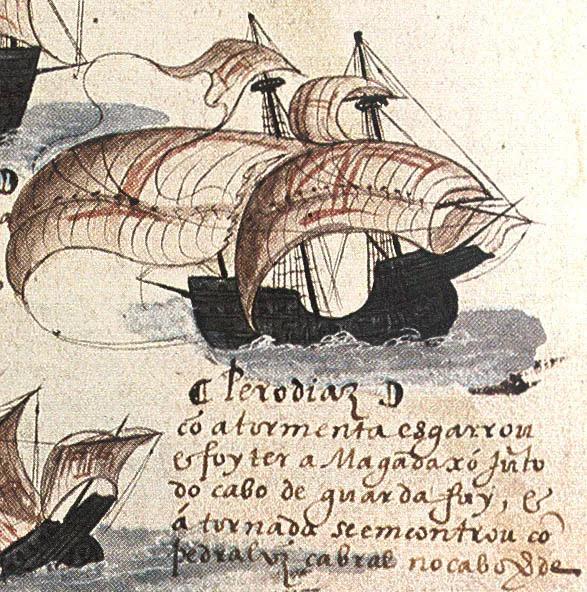
- Diogo Dias's ship in the Livro das Armadas, a register of the India fleets painted around 1568 and kept at the Academia das Ciências de Lisboa. The note reads, in translation: “Pero Diaz strayed in the storm and went to Mogadishu near Cape Guardafui, and on the way back met Pedro Álvares Cabral at Cape Verde.” It says nothing of Madagascar. Unknown author, Public domain, via Wikimedia Commons.
- The Fakhr ad-Din mosque in Mogadishu in 1882, an engraving from Georges Révoil's Voyage chez les Benadirs. Mogadishu had long been the busiest port on the coast that Dias's crew blundered along. Unknown author, Public domain, via Wikimedia Commons.