

Craveiro Lopes, the president Salazar dropped
Francisco Craveiro Lopes became Portugal's head of state after the opposition had been barred or had walked out. Seven years later Salazar replaced him, and the loyal general ended up among the conspirators.
At a glance
- On Thursday 9 August 1951 General Francisco Craveiro Lopes, a military pilot aged 57, swore the presidential oath before the National Assembly in Lisbon, succeeding Marshal Óscar Carmona, who had died on 18 April.
- He was the only name on the ballot on 22 July 1951: the Council of State excluded the communist-backed candidate Ruy Luís Gomes on 11 July, and the opposition's Admiral Quintão Meireles withdrew on 19 July.
- Real power stayed with António de Oliveira Salazar, head of government since 1932. Relations between the two men were cold, and Craveiro Lopes drew close to the regime's reformers around Marcelo Caetano.
- In 1958 the regime did not put him up for a second term and chose Admiral Américo Tomás instead. Craveiro Lopes was the only Estado Novo president to serve a single seven-year term.
- Made a marshal in 1958, he backed the failed coup of Defence Minister Botelho Moniz in April 1961, called publicly for an end to censorship in 1963 and died in Lisbon on 2 September 1964.
Ten o'clock at São Bento
At ten in the morning of Thursday 9 August 1951 a procession entered the chamber of the National Assembly in the São Bento palace in Lisbon. Protocol officials came first, then a general in uniform, then the head of government, the presidents of the two chambers and of the Supreme Court, and the ministers. Deputies, the Cardinal Patriarch of Lisbon, the diplomatic corps and, in the galleries, the mainland's civil governors and the mayors were already in their places.
The general was Francisco Higino Craveiro Lopes, a 57-year-old military pilot. The Supreme Court had proclaimed him elected by the nation. With the whole room on its feet, he rose and spoke the oath that the Constitution of 1933 required of every head of state.
“I swear to uphold and fulfil loyally and firmly the Constitution of the Republic, to observe the laws, to promote the general good of the Nation, and to sustain and defend the integrity and independence of the Portuguese Homeland.”
On his right sat António de Oliveira Salazar, President of the Council of Ministers, the man who actually ran Portugal. The deputy chosen to greet the new president, António de Sousa da Câmara, explained the succession without embarrassment. The people, he said, had not worried much about it, because good solutions had always appeared “at the simple indication of the head of government”.
“But elections were held,” he added, “and General Craveiro Lopes was elected.”
The new president read a short message asking all who had been born in Portuguese lands to gather round him, “without distinction of races, religions or ideas”. The session closed before eleven. Salazar, according to the chronology of the political scientist José Adelino Maltez, noted that there had been few people and little enthusiasm.
A regime without its marshal
Marshal Óscar Carmona had been head of state since July 1926 and had protected Salazar's rise. He died on 18 April 1951, aged 81, and lay in state in the same Assembly building and at the Jerónimos monastery before his funeral on 21 April. Salazar took over the functions of head of state on an interim basis.
The death opened a quarrel inside the regime. Monarchist deputies led by Mário de Figueiredo wanted the vacancy used to restore the monarchy, and Marcelo Caetano and others opposed them. Some ministers proposed that Salazar himself move to the presidency. Salazar had an official note broadcast against the monarchists' manoeuvres on 5 June.
The defence minister, Colonel Fernando Santos Costa, put Craveiro Lopes's name to Salazar, and that other generals were sounded out. On 1 June the central commission of the União Nacional formally launched him. The Museu da Presidência reads the choice as a turn for the air arm after a president from the army, and says Salazar liked that Craveiro Lopes, discreet and dutiful, was not part of Santos Costa's inner circle.
The aviator from a family of generals
Craveiro Lopes was born in Lisbon on 12 April 1894, the son, grandson and great-grandson of generals. His father, João Carlos Craveiro Lopes, was at the origin of the officers' protest of 1915 known as the Movimento das Espadas, was taken prisoner at La Lys in 1918 and later governed Portuguese India. The son entered the Colégio Militar at ten and volunteered for the 2nd Cavalry Regiment in 1911.
In September 1915, during the First World War, he sailed for the campaigns in Mozambique. In 1917 he took the military pilot's course at the French aviation school at Chartres and returned to Mozambique as a lieutenant of the Aeronáutica Militar, the army's air service created in 1914. In Lourenço Marques, today Maputo, he married Berta da Costa Ribeiro Arthur in 1918. They had four children.
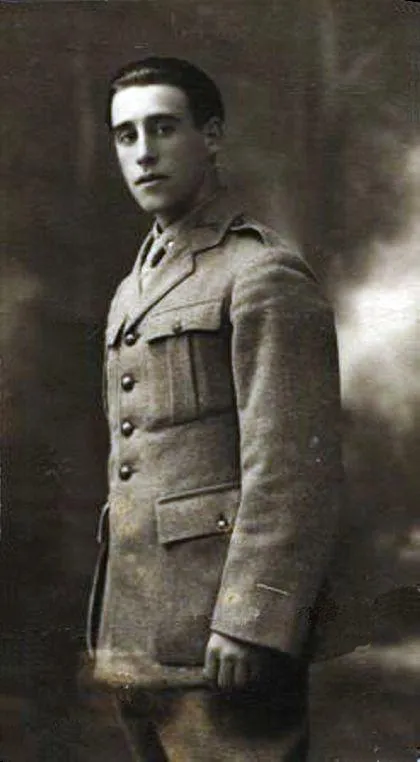
He taught flying, and after the coup of 28 May 1926 he was made mayor of Sintra for three years. In the 1930s he served in Portuguese India under his father: head of the governor-general's office, governor of the district of Damão from 1934, and in charge of the government of India in 1936. Back in Portugal he commanded the Tancos air base from 1939.
From 1944 he was commander-general of the Portuguese Legion, the regime's militia, and in the late 1940s he sat in the National Assembly for Coimbra. He also commanded the Lajes air base on Terceira in the Azores, though the two official biographies disagree on when: the museum says 1941 to 1944, the presidency's website the years he was a deputy. He became a brigadier in 1945 or 1947, depending on the source, and a general in 1949. In 1951 he commanded the 3rd Military Region at Tomar.
- Born
- 12 April 1894, Lisbon
- Trained
- Cavalry; military pilot's course at Chartres, France, 1917
- Colonial posts
- Governor of Damão from 1934; in charge of the government of Portuguese India from 1936
- President
- 9 August 1951 to 9 August 1958
- Marshal
- November 1958
- Died
- 2 September 1964, Lisbon, aged 70
An election with one name left
In 1949 the opposition's candidate, General Norton de Matos, had campaigned against Carmona for months and withdrawn only on 12 February, the day before the vote. That challenge, the Museu da Presidência says, led to a revision of the Constitution: Law no. 2048 of 11 June 1951 gave the Council of State, the president's advisory council, the job of vetting the political suitability of presidential candidates. The same law renamed the colonies “overseas provinces”.
Two opposition candidacies were announced on 3 June. The democratic, non-communist opposition backed Admiral Manuel Carlos Quintão Meireles. The essayist António Sérgio, the 1926 coup leader Mendes Cabeçadas, Francisco Cunha Leal and Henrique Galvão were among his supporters. The Movimento Nacional Democrático, the communists and the youth movement MUD Juvenil backed Ruy Luís Gomes, a mathematician whom the regime had removed from his chair at Porto in 1947.
Salazar answered both in a speech at the Pavilhão dos Desportos in Lisbon on 19 June. Gomes, he said, was “the candidate of peace” in the service of Moscow; Quintão Meireles was “the candidate of pacification”. In early July, after a campaign meeting at the Cine Victória in Rio Tinto, near Porto, police beat Gomes and several of his companions, who needed hospital treatment.
On 9 July the president of the Supreme Court reported that the papers of all three candidates were in order. Salazar convened the Council of State for 11 July, and it resolved that Gomes fell under article 73 (1) of the Constitution. On 13 July the Supreme Court declared Craveiro Lopes and Quintão Meireles eligible and Gomes ineligible.
Quintão Meireles held a single rally, at the Garagem Monumental in the Areeiro district of Lisbon. His manifesto of 3 July called the country sick and attacked the single party.
On 19 July, three days before polling, he withdrew. The presidency's biography of Craveiro Lopes says he was forced to, and places the withdrawal on the eve of the vote.
18 April 1951
Carmona dies
Salazar takes on the head of state's functions in the interim.
1 June
The União Nacional names Craveiro Lopes
3 June
Opposition candidacies
Quintão Meireles and Ruy Luís Gomes are announced.
11 June
Law no. 2048 revises the Constitution
The Council of State is to vet candidates.
19 June
Salazar attacks both opposition candidates
3 to 5 July
Gomes beaten by police after a rally at Rio Tinto
Sources give the night of 3 to 4 July or 5 July.
11 July
The Council of State excludes Gomes
The presidency's archive gives 11 July; Maltez's chronology gives 17 July.
19 July
Quintão Meireles withdraws
22 July
Polling day
Craveiro Lopes is the only candidate.
3 August
The Supreme Court declares the result
9 August
Oath before the National Assembly
On Sunday 22 July Craveiro Lopes was the only candidate. Archontology, citing the Diário de Lisboa of 3 August, gives 1,067,529 votes for him and 1,342 for the withdrawn Quintão Meireles. Other tallies differ widely: the presidency's biography gives him only about 80 per cent of the votes cast, which cannot be squared with the newspaper's count. Salazar lamented that there had been no contest of votes, which he said would have been most useful.
| Year | Regime candidate | Opposition | What happened |
|---|---|---|---|
| 1949 | Óscar Carmona | Norton de Matos | Withdrew on 12 February, the day before the vote; Carmona re-elected unopposed |
| 1951 | Craveiro Lopes | Ruy Luís Gomes; Quintão Meireles | Gomes excluded by the Council of State; Quintão Meireles withdrew three days before the vote |
| 1958 | Américo Tomás | Humberto Delgado | Delgado stayed in to the end; official count 758,998 to 236,528, contested as fraudulent |
In 1959 the Constitution was changed so that the president was chosen by an electoral college: the members of the two chambers, municipal representatives and, by the Museu da Presidência's account, delegates of the overseas legislative councils. Tomás was re-elected that way in 1965 and 1972.
Seven years at Belém
At the União Nacional's third congress, in Coimbra in November 1951 (Maltez dates it to October), the conservative wing raised the monarchy again. Caetano rejected it at the congress, and the president rejected it in a public ceremony in Porto. The Museu da Presidência dates the start of the alliance between the two men to that moment.
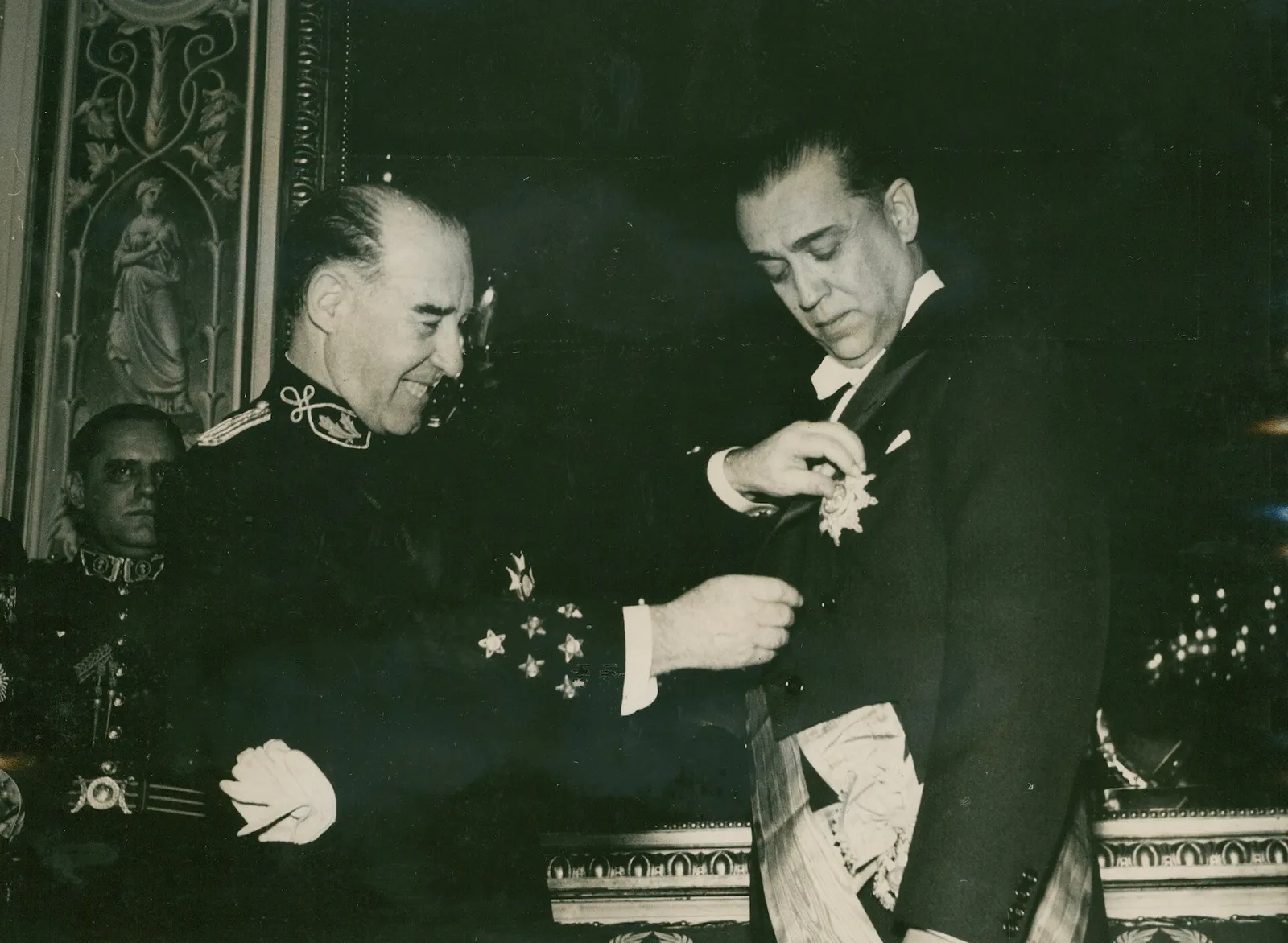
Portugal had been a founding member of NATO in 1949, and in the early Cold War the regime was treated as a useful ally. Craveiro Lopes received foreign leaders in Portugal, travelled to all the African territories and made three official visits abroad, to Spain in 1953, Britain in 1955 and Brazil in 1957. Queen Elizabeth II's visit in February 1957 drew the most press attention and the grandest protocol.
Behind the ceremonies, relations with Salazar were always cold and formal, by the presidency's own account. Craveiro Lopes felt more and more humiliated: his speeches were altered, his projects refused or put off, and his summonses to the government ignored. In his memoirs Caetano judged that he had not been cut out for the job of a moderator without initiative.
He moved away from Santos Costa and became a point of reference for reform-minded officers, many of them shaped by contact with NATO. The museum describes a “Marcelist-Craveirist” axis inside the regime's reformist wing, with the president as its military half. Opponents of the regime also wrote to him and asked for audiences about censorship and voting rights.
Dropped in 1958
Craveiro Lopes wanted a second term. According to the historian Bruno Cardoso Reis, he reportedly told Salazar that if he was really tired of power and longed to go home to Santa Comba, he saw Caetano as a worthy successor. Under the Constitution the president could dismiss the head of government, and Reis argues that Salazar saw an unacceptable risk in a president aligned with Caetano and with the chief of the armed forces general staff, General Júlio Botelho Moniz.
The regime decided against re-election in April 1958 without telling him. When Salazar saw him on 26 April he said only that there was resistance to a second term and left the decision to the União Nacional. Its central commission chose on 1 May, and the next day a letter from Salazar told the president that the candidate would be the navy minister, Rear Admiral Américo Tomás. The news took Craveiro Lopes completely by surprise.
For the first time an opposition candidate, the Air Force general Humberto Delgado, stayed in the race to polling day, and he drew huge crowds. In Caetano's memoirs, as quoted by Reis, Delgado said that he would not have stood if Craveiro Lopes had sought re-election, because he did not want to cross the path of a comrade from his own service.
Tomás won the official count on 8 June. On 5 July Berta Craveiro Lopes died suddenly of a stroke at the Belém palace, aged 58.
A few days before leaving Belém, the president wrote to Salazar about the army's anger at Santos Costa, and the defence minister was replaced in August by Botelho Moniz.
“We are on the eve of a military uprising to force Colonel Santos Costa out of the government.”
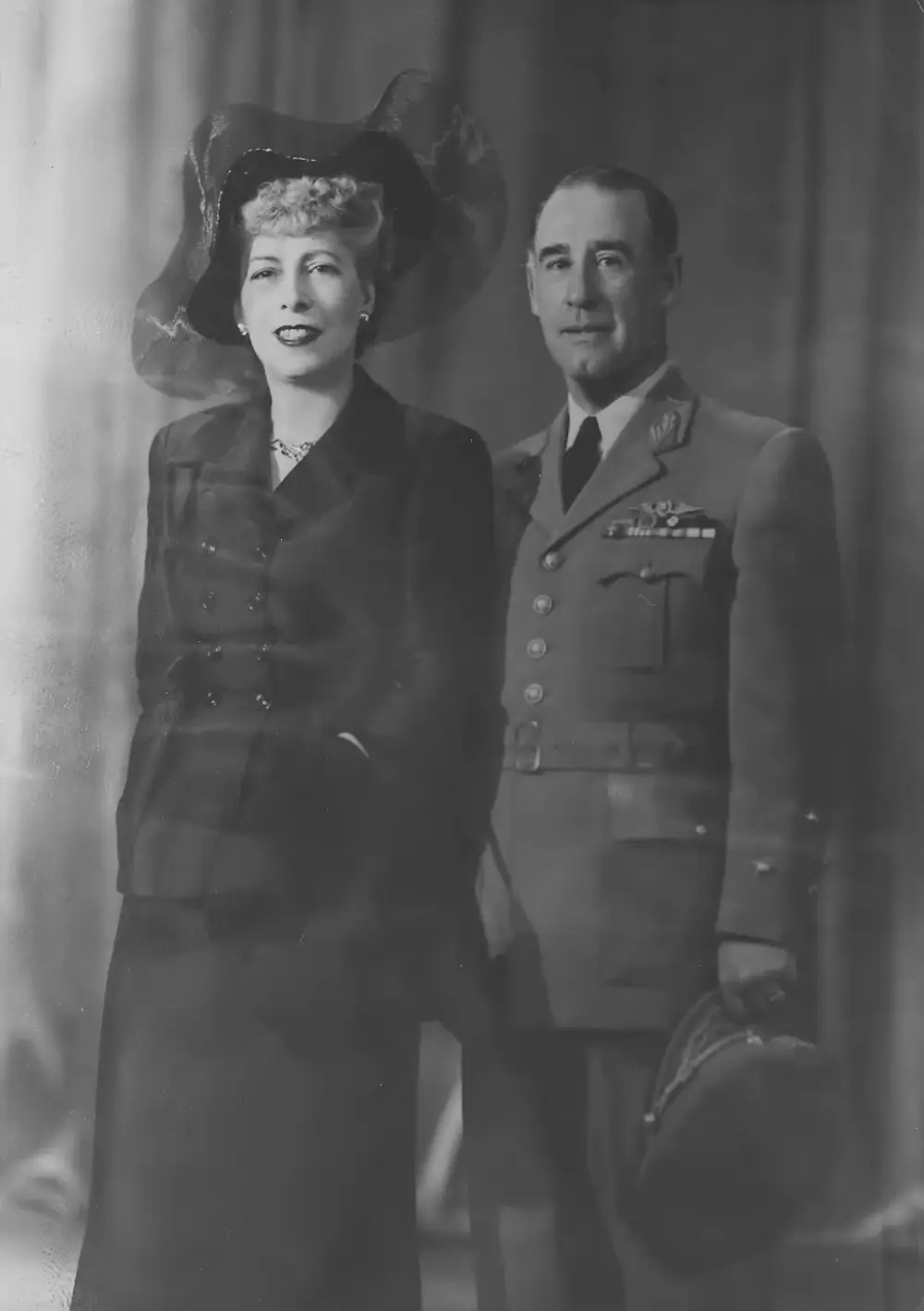
His term ended on 9 August 1958, seven years to the day after the oath. In November he was raised to marshal, a rank given to presidents. The presidency's biography wonders whether it was compensation or a way of demanding loyalty.
The marshal among the plotters
Officers close to him took part in the Sé conspiracy of 1959, a military plot by men linked to Delgado that the political police broke up. The police, the PIDE, kept him under close watch for the rest of his life.
In April 1961, with war breaking out in Angola, Botelho Moniz, now defence minister, tried to persuade President Tomás to dismiss Salazar. Craveiro Lopes was at the meeting of commanders that Botelho Moniz called at Cova da Moura on 13 April; Costa Gomes said he was with them “heart and soul”. The plotters counted on him to replace Tomás as head of state. The coup collapsed that afternoon, a story told in full in our article on the Abrilada.
Afterwards he spoke more openly. In 1962 he wrote the preface to Manuel José Homem de Mello's pamphlet Portugal, o Ultramar e o Futuro, calling for a “truly national solution” and free discussion of the colonial question. In an interview with the Diário de Notícias in 1963 he asked for the gradual evolution of the regime, the abolition of censorship and freedom of expression.
He had a first heart attack early in 1963 and spent about three months recovering in Angola, where he had earlier visited his son João. He died in Lisbon on 2 September 1964. He had a state funeral as a former president, but no national mourning was declared, and the defence ministry, against custom, did not offer to pay for it.
Why it still matters
In 1951 the rules were rewritten weeks before the vote so that one opponent could be struck off, and the other quit. After the scare of 1958 the regime stopped direct presidential elections altogether: from 1959 an electoral college of deputies, members of the Corporative Chamber, municipal delegates and overseas representatives chose the president.
Years as head of state: Carmona, Craveiro Lopes and Tomás
years
Calculated from the dates in the Museu da Presidência's biographies: Carmona from 9 July 1926 to his death on 18 April 1951, Craveiro Lopes from 9 August 1951 to 9 August 1958, Tomás from 9 August 1958 until the revolution of 25 April 1974. Mendes Cabeçadas and Gomes da Costa each led the state for a few weeks in 1926, and Salazar acted as head of state from April to August 1951.
Show the data
| Years in office | |
|---|---|
| Óscar Carmona (1926-1951) | 24.8 |
| Craveiro Lopes (1951-1958) | 7 |
| Américo Tomás (1958-1974) | 15.7 |
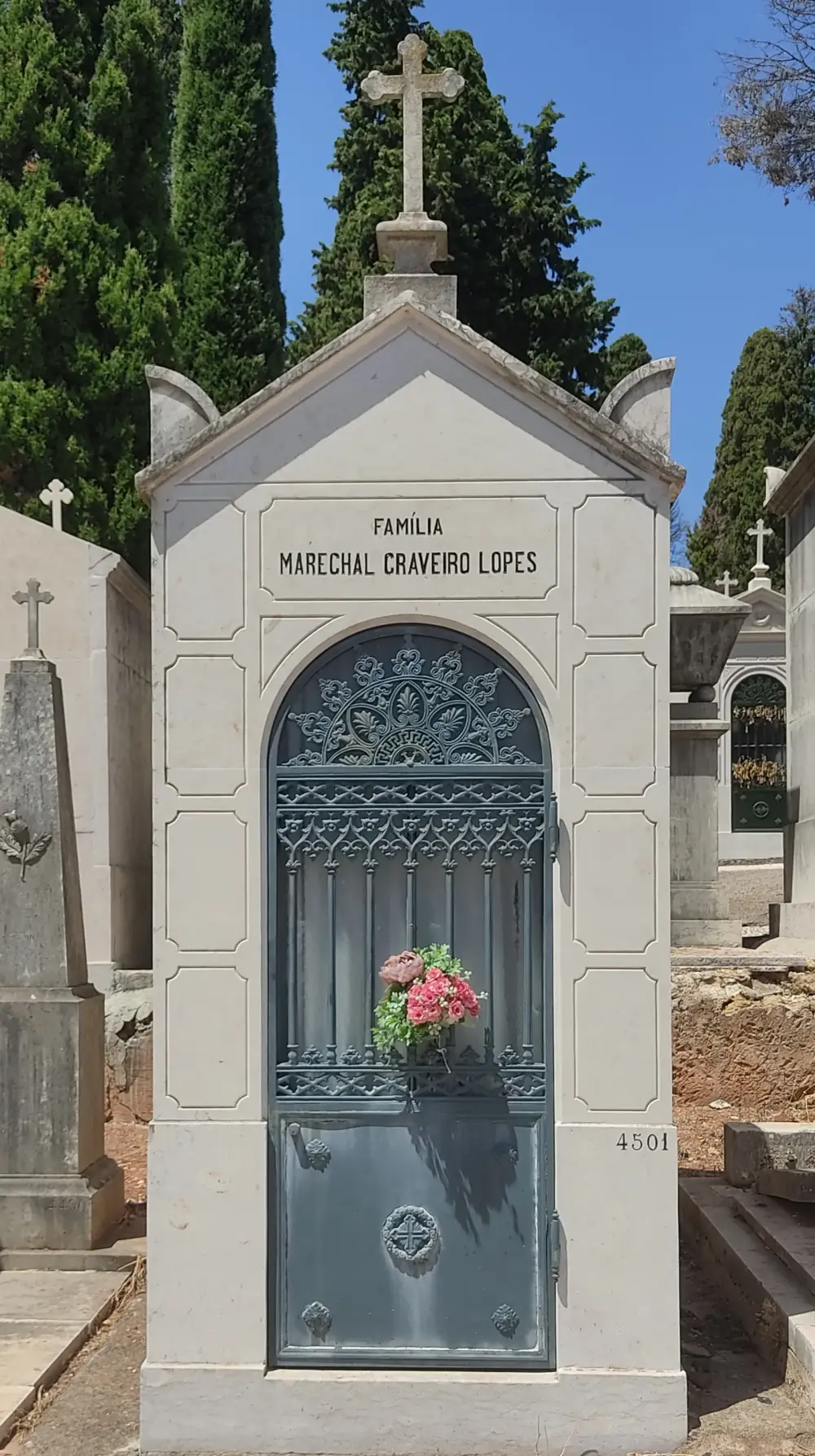
Craveiro Lopes was the only Estado Novo president to serve a single term. And the general the regime chose in 1951 was, ten years later, the conspirators' choice to replace his successor.
FAQs
Who was Francisco Craveiro Lopes?
A Portuguese military pilot and general, born in Lisbon in 1894, who was President of the Republic from 9 August 1951 to 9 August 1958 under Salazar's Estado Novo dictatorship. He was made a marshal in 1958 and died in Lisbon on 2 September 1964.
Was the 1951 presidential election contested?
Not in the end. Two opposition candidates came forward, but the Council of State excluded Ruy Luís Gomes on 11 July under a constitutional change passed in June, and Admiral Quintão Meireles withdrew on 19 July. Craveiro Lopes was the only candidate on 22 July 1951.
Why did Craveiro Lopes serve only one term?
His relations with Salazar were cold, and he grew close to the regime's reformers around Marcelo Caetano and to officers hostile to the defence minister, Santos Costa. In 1958 the União Nacional chose Admiral Américo Tomás instead, and Salazar told him by letter on 2 May.
What was his role in the 1961 coup attempt?
He attended the meeting of commanders called by the defence minister, Júlio Botelho Moniz, on 13 April 1961, and the plotters expected him to replace Américo Tomás as president. The coup collapsed the same day when most commanders stayed away.
On the timeline
Open the timelineNearby moments from dictatorship and the estado novo (1926–1974).
José Ramos-Horta is born in Dili, Portuguese Timor, to a Portuguese father and a Timorese mother. A founder of Fretilin, he spent 24 years in exile as the voice of East Timor's resistance to the Indonesian occupation, sharing the 1996 Nobel Peace Prize with Bishop Ximenes Belo; he survived being shot in 2008, was President from 2007 to 2012 and was elected again in 2022.
Death in Porto of Guilhermina Suggia, aged 65, the cellist who studied with Pablo Casals and Julius Klengel, shared Casals's life and stage in Paris for about six years and became one of the most celebrated musicians in Britain. Augustus John's portrait of her belongs to Tate in London.
Salazar and President Óscar Carmona inaugurate the Castelo do Bode dam on the River Zêzere near Tomar, then the largest hydroelectric scheme in Portugal. Its 115-metre concrete wall holds back a reservoir of more than a billion cubic metres that still supplies much of Lisbon's drinking water.
Craveiro Lopes sworn in, 1951
Francisco Craveiro Lopes, a military aviator, is sworn in as President of the Republic, succeeding the late Óscar Carmona while Salazar keeps real power as head of government. Dropped by the regime in 1958, the former loyalist drew close to the opposition and was linked to the failed Botelho Moniz coup of 1961.
Death of the painter Mário Eloy, aged 51, at the Casa de Saúde do Telhal near Sintra, where Huntington's disease had confined him since 1945. A leading figure of Portugal's second modernist generation, he absorbed German Expressionism in Berlin; his surviving paintings include haunted self-portraits and 'Bailarico no Bairro', a Lisbon neighbourhood dance.
Portugal and the United States sign a NATO defence agreement in Lisbon giving the Americans the use of facilities in the Azores, chiefly the Lajes air base on Terceira: for peacetime works and transit until 1956, and in wartime for the life of the alliance.
Poet and teacher Sebastião da Gama dies of tuberculosis in Lisbon, aged just 27. The bard of the Serra da Arrábida, he wrote a letter in 1947 pleading for the hills' protection that led to the founding of the Liga para a Protecção da Natureza, Portugal's first environmental association.
Coming up in history
All long reads
18 sources
Archives, scholarship and reporting this article was checked against.
- 1
Diário das Sessões n.º 108 (10 August 1951): sessão solene da posse do Presidente da República, 9 August 1951Assembleia Nacional; Debates Parlamentares, Assembleia da República
- 2
Craveiro Lopes (biography)Museu da Presidência da República
- 3
Francisco Craveiro Lopes (antigos Presidentes)Presidência da República Portuguesa
- 4
Ofício do Secretário da Presidência da República [...] dando conhecimento da Resolução do Conselho de Estado, reunido em 11 de julho de 1951, que exclui Ruy Luís Gomes da candidatura à Presidência da RepúblicaArquivo Histórico da Presidência da República (PT/PR/AHPR-CE/CE0202/1582/007)
- 5
Anuário de 1951 (José Adelino Maltez)Respublica, Repertório Português de Ciência Política
- 6O golpe que nunca existiu mas podia ter derrubado Salazar (Bruno Cardoso Reis)Observador, 17 April 2021
- 7
Militares e política: a Abrilada de 1961 e a resistência do salazarismo (Luís Nuno Rodrigues)Ler História 65 (2013), pp. 39-56
- 8
- 9
- 10
1949 ElectionsMuseu do Aljube Resistência e Liberdade, 13 February 2025
- 11
Para a história da oposição ao Estado Novo: a candidatura à Presidência da República do general Norton de Matos e o Boletim Eleições Livres no distrito de Braga (1949) (Armando B. Malheiro da Silva)Bracara Augusta, Câmara Municipal de Braga, 2001/02; Repositório Aberto da Universidade do Porto
- 12
Gomes, Ruy Luís (1905-1984)Dicionário Cientistas, Engenheiros e Médicos em Portugal, CIUHCT
- 13
Francisco Higino Craveiro LopesArchontology.org
- 14
Matos, José Norton de (1867-1955): authority recordArquivo de História Social, Instituto de Ciências Sociais da Universidade de Lisboa
- 15
Humberto Delgado: biografia, by Rita CorreiaHemeroteca Municipal de Lisboa
- 16
Humberto DelgadoPanteão Nacional
- 17
- 18
Image credits
- President Craveiro Lopes pins a decoration on Brazil's President Juscelino Kubitschek. The archive of the Rio newspaper Correio da Manhã files the photograph under his state visit to Brazil, made in 1957. Unknown author, Public domain, via Wikimedia Commons.
- Francisco Craveiro Lopes as a young officer, in a studio portrait dated to around 1918, the year of his marriage in Lourenço Marques. Unknown author, Public domain, via Wikimedia Commons.
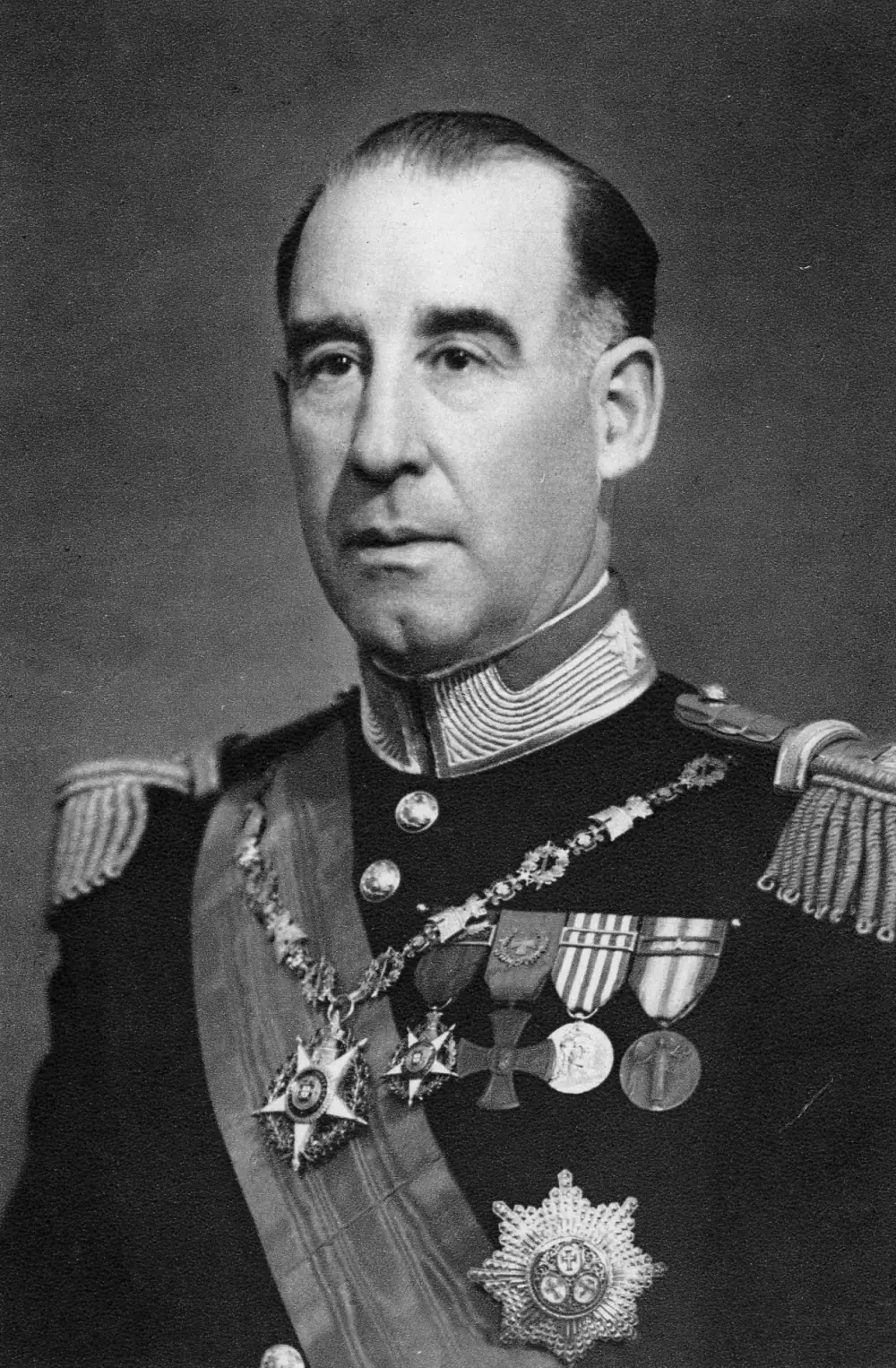
- Craveiro Lopes's official photograph as President of the Republic, taken around 1951 or 1952 by Manuel Alves de San Payo. Manuel Alves de San Payo, Public domain, via Wikimedia Commons.
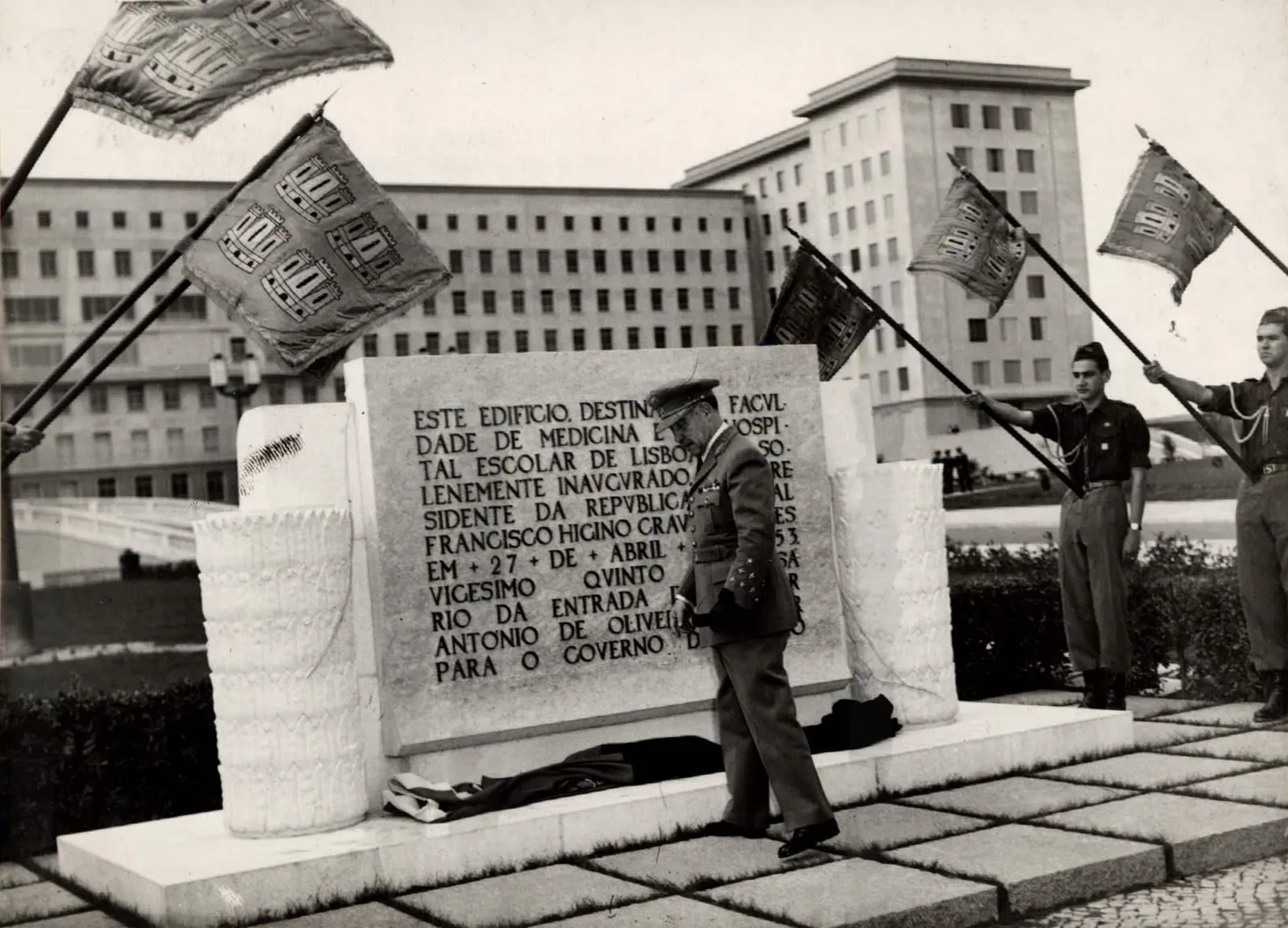
- Craveiro Lopes unveils the stone marking the opening of Lisbon's new teaching hospital, Santa Maria, on 27 April 1953, as members of the Mocidade Portuguesa youth movement dip their flags. The inscription ties the date to the 25th anniversary of Salazar's entry into government. Unknown author, Public domain, via Wikimedia Commons.
- Berta and Francisco Craveiro Lopes in a portrait dated to around 1957. She died at the Belém palace on 5 July 1958, a month before his term ended. Probably Manuel Alves de San Payo, Public domain, via Wikimedia Commons.
- The family tomb of Marshal Craveiro Lopes at the Prazeres cemetery in Lisbon, photographed in July 2023. António Fragoso, CC BY 2.0, via Wikimedia Commons.