

Alcácer Quibir, 1578: how Portugal lost its king
A Portuguese king marched inland to put a deposed sultan back on his throne. By the evening three kings were dead, thousands of Portuguese were prisoners, and the crown would pass to an old cardinal.
At a glance
- On Monday 4 August 1578, near Ksar el-Kebir in northern Morocco, the army of Sultan Abd al-Malik destroyed an invading force led by King Sebastião of Portugal, aged 24.
- Sebastião had come to restore Abd al-Malik's nephew, the deposed sultan al-Mutawakkil. All three kings died that day, which is why it is also called the Battle of the Three Kings.
- Estimates put the Christian army at 14,000 to 20,000 men. Chroniclers thought the Moroccan army three times larger; modern figures run from at least 25,000, on Luís Costa e Sousa's counts, to about 70,000. The fighting began around eleven in the morning and was over by four or five in the afternoon.
- At least 14,000 people were taken prisoner. Freeing them took years: Trinitarian friars ran the ransoms for Cardinal Henrique, and one surviving list names eighty noblemen bought back for 400,000 cruzados.
- Henrique, Sebastião's 66-year-old great-uncle and a priest, was acclaimed king on 28 August 1578 and died in January 1580 without naming an heir. By the end of 1580 Philip II of Spain held mainland Portugal.
A crucifix and a cannon
Late on the morning of Monday 4 August 1578 the Portuguese army stood in its ranks on a plain in northern Morocco, between the rivers Makhazin and Loukkos. About 600 metres ahead, a much larger Moroccan army had spread out in a long crescent. King Sebastião, aged 24, said a few words to his troops and rode to the front of his heavy cavalry.
A Jesuit, Father Alexandre Valeraggio, raised a crucifix, and the whole army knelt. Then the front ranks rose and moved forward. Across the field the artillery commander, Mustafa Chibli, asked the sultan's leave to fire a big gun. Its roar was the signal for the horsemen on the wings, who had worked round the exposed left flank, to fall on the Christian rear.
The first salvo did little harm, because most of it flew high. One ball landed near the king and another knocked down some of the gentlemen volunteers in the front line.
Within five or six hours the army had ceased to exist, and Portugal had lost its king.
A sultan, his nephew and a Portuguese king
Portugal had fought in Morocco since it took Ceuta in 1415 and once held a string of Atlantic towns. Then a new dynasty, the Saadis, rose in the south with modern firearms and took Santa Cruz (Agadir) in 1541. João III gave up Safim and Azamor that year, and Arzila and Alcácer Ceguer in 1550, keeping only Ceuta, Tangier and Mazagão.
The Saadis' weak point was the succession. By the rule usually cited, the crown passed to the late sultan's eldest brother, not to his son. When Sultan Abdallah al-Ghalib died in 1574, however, he named his son Muhammad, who took the title al-Mutawakkil. His uncle Abd al-Malik, who had spent years in Algiers and Constantinople and fought in Ottoman campaigns, claimed the throne.
In 1576 Abd al-Malik came back from Algiers with a small army of experienced mercenaries and modern weapons, backed by the Ottomans, beat his nephew twice near Fez and entered Marrakesh. Philip II of Spain, whose diplomats favoured Abd al-Malik, refused to help the fugitive. So al-Mutawakkil turned to Portugal, whose young king had long wanted a war in North Africa.
| King | Who he was | Reign | How he died on 4 August |
|---|---|---|---|
| Sebastião of Portugal | Grandson of João III, king since the age of three | 1557 to 1578 | Killed by Moroccan horsemen while fleeing with five companions, late in the afternoon |
| Abd al-Malik | Saadi prince, Ottoman-trained, sultan since 1576 | 1576 to 1578 | Collapsed during the Christian charge and died; his death was hidden from his army |
| Muhammad al-Mutawakkil | Son of Abdallah al-Ghalib, deposed by his uncle | 1574 to 1576 | Drowned trying to swim the river to safety |
Reign dates from Richard L. Smith. A fourth man, Abd al-Malik's brother Ahmad, was proclaimed sultan after the victory and took the name al-Mansur, the Victorious.
- Date
- Monday 4 August 1578
- Place
- Between the rivers Makhazin and Loukkos, near Ksar el-Kebir (Alcácer Quibir), northern Morocco
- Other names
- Battle of Wadi al-Makhazin; Battle of the Three Kings; Battle of Alcazar
- Christian army
- 14,000 to 20,000 (Athaide); about 20,000 (Smith)
- Moroccan army
- Never counted reliably: about three times larger by the chroniclers' count; Costa e Sousa gives about 15,000 foot in the centre and 10,000 to 20,000 horsemen, plus smaller contingents; Smith cites modern estimates of about 70,000
- Result
- Moroccan victory; Sebastião, Abd al-Malik and al-Mutawakkil dead
A crusade aimed at Larache
Sebastião's declared target was Larache, a walled Atlantic port and corsair base. Taking it from the sea needed galleys, which Portugal had too few of, and trained soldiers: both meant Spain. At the end of 1576 the king spent a week with his uncle Philip at Guadalupe, in Castile. Philip agreed to help on terms he knew were hard to meet: the expedition within eight months, and about 10,000 mercenaries.
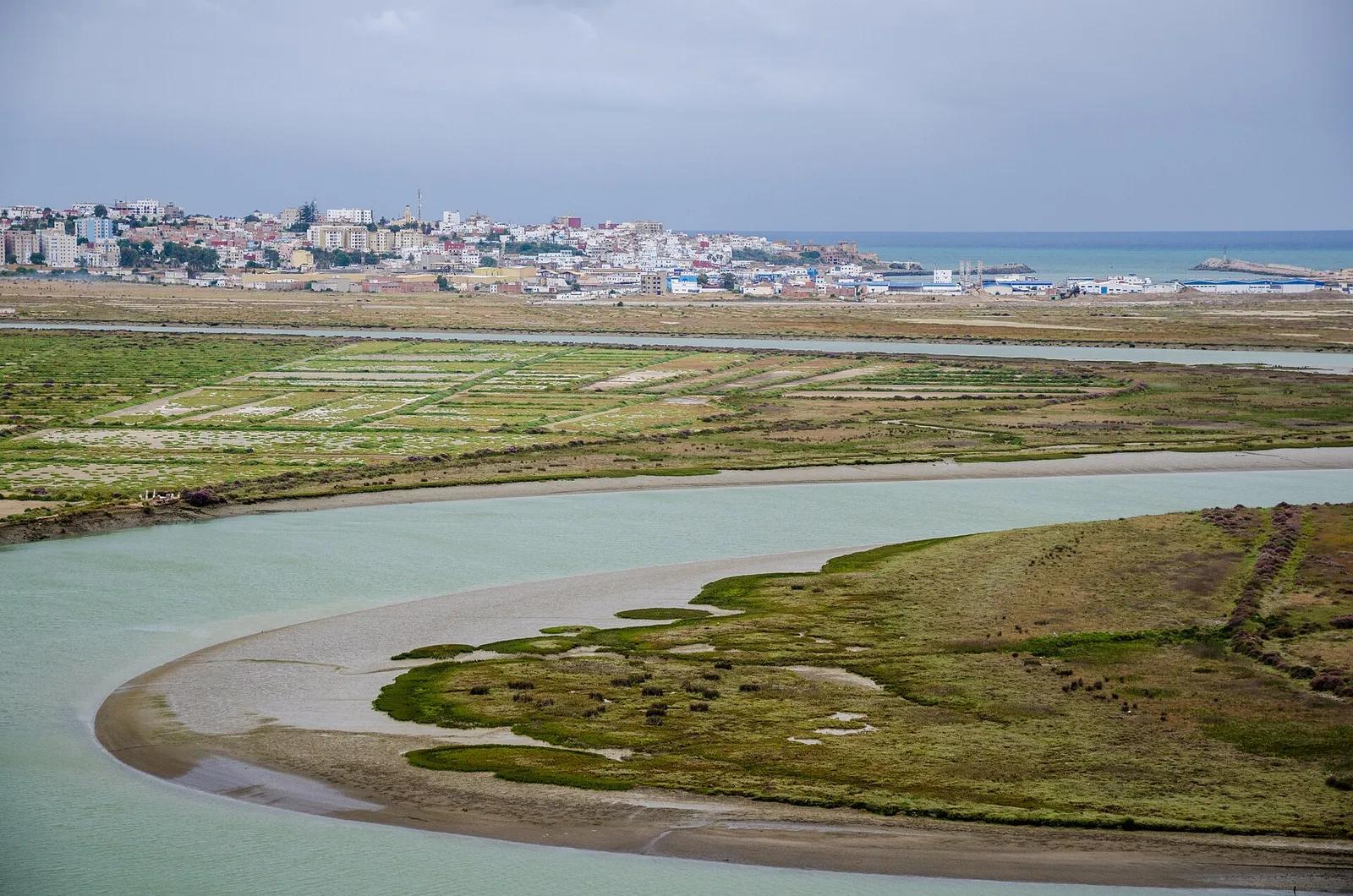
In February 1577 two Spaniards keen on the war, Diego de Torres and the poet Francisco de Aldana, went to Larache disguised as Jewish merchants to spy it out. They found the garrison reinforced with 4,000 arquebusiers, a beach easy to defend with trenches and a narrow, shallow harbour mouth. After hearing Aldana in July, Sebastião put the expedition off for a year.
Raising the army was a struggle. Of 12,000 Portuguese militiamen planned, in four terços or regiments, just over 9,000 were found. Most mercenaries and weapons came from the Low Countries; Smith says the pope paid for 600 Italians. Spanish volunteers crossed the border although Philip banned recruiting in Andalusia in April 1578. The front line would be the aventureiros: noblemen too poor to bring a horse, veterans of India and other gentlemen who chose to fight on foot.
The fleet sailed from Lisbon on 24 or 25 June 1578. An anonymous letter written in Lisbon that year counts “eight hundred and forty-odd sails” and 24,000 fighting men, though its author admits the regiments were 3,000 short and that only 18,000 men took the field. An anonymous chronicle by a veteran gives several hundred ships, five of them galleons. Behind the soldiers came priests, servants and many soldiers' families.
| Source | Total | Portuguese | Germans | Spanish | Italians |
|---|---|---|---|---|---|
| Anonymous letter, Lisbon, 1578 | 24,000 claimed; 18,000 in the field | Four terços meant to make 12,000, but 3,000 short; 450 noblemen | 3,000 | 3,000 | Not given |
| Filipe Duret Athaide (2016) | 14,000 to 20,000 | About 10,000 | About 3,000 | About 2,000 | About 600 |
| Richard L. Smith (2022) | About 20,000 | Volunteers and hastily raised levies | 2,000 to 3,000 | About the same | About 600 |
Luís Costa e Sousa gives just over 9,000 Portuguese militiamen of the 12,000 planned, plus 500 Spaniards who joined in Morocco. None of these totals counts the non-combatants who followed the army.
Nineteen days at Arzila, six days on the road
The army landed at Arzila, which its Moroccan governor had handed over the year before, in early July and stayed nineteen days. The oxen for the baggage carts arrived only around 24 or 25 July, too weak from the voyage to pull. Abd al-Malik, meanwhile, had left Marrakesh on 20 April, crushed a revolt near Taroudant and in late July met his brother Ahmad and the troops of Fez at Salé, where he had three heavy guns cast. Soon afterwards he fell ill.
At a council of war in the king's tent, probably on 20 July, the commanders argued over whether to go to Larache by sea or by land. By Jerónimo de Mendonça's account many of those present backed a march overland, which suited the king's wish for a pitched battle. On 22 July Abd al-Malik wrote to him; a seventeenth-century Italian copy of the letter survives in Paris.
| Date | What happened |
|---|---|
| Tuesday 29 July | The column leaves Arzila in the morning, marches about one league and camps at a place the chroniclers call “the mills”. |
| Wednesday 30 July | Another league, to a rise called Almenara. Shaken by the going, the commanders decide to return to Arzila and attack Larache by sea, but the fleet has already sailed on the king's orders. |
| By 1 August | Francisco de Aldana arrives with 500 Spanish soldiers. |
| Friday 1 August | The march resumes: about three leagues, to a camp called “three streams”. News reaches Abd al-Malik that the Portuguese are coming, and he moves his camp closer to Ksar el-Kebir. |
| 2 to 3 August | The column follows the Makhazin to a Roman bridge near Ksar el-Kebir, finds it held by Ahmad's horsemen and turns south towards a ford. |
| Sunday 3 August | The army fords the Makhazin around ten in the morning. Ahmad's horsemen harass the rear; the two armies face each other for about two hours, but the Christians are judged too tired to fight. |
Costa e Sousa gives the weekdays for 29 July and 1 August; the others are worked out from the Julian dates. His account dates the arrival at the bridge to 3 August in one passage and places it before an earlier camp in another, and gives Ahmad's force there as about 4,000 or about 5,000 horse.
Two armies on the plain
That last night the Portuguese camped on high ground above the Makhazin, behind a ditch and a ring of ox carts laid out by the engineers Nicolau de Frias and Filipe Terzi. At dawn on 4 August the king overruled those who wanted to wait or fall back towards Larache, and around ten the army marched out onto the plain.
The plan agreed at Arzila was a square of four infantry blocks, the textbook answer to being surrounded. On the day it changed. Three blocks of pikemen led: the Spanish on the left, the Germans on the right and the gentlemen volunteers jutting out in the centre, flanked by Italian and Tangier arquebusiers. Behind them came nearly 5,000 men in one body and two more regiments, with about 500 carts shielding the open left flank.
Sebastião rode on the left with 600 armoured horsemen, 25 ranks of 24. The Duke of Aveiro had 300 more on the right, with about 250 of al-Mutawakkil's horsemen and 400 of his arquebusiers behind him. Duarte de Meneses brought 400 or 500 riders from the Tangier garrison.
Abd al-Malik's army followed an Ottoman pattern. About 15,000 foot soldiers held the centre, with the least reliable in front, Andalusians descended from the Muslims of Granada and Jazula Berbers from the Atlas, to take the first shock. Behind them stood his best troops. Twenty-four field guns sat on a low rise, hidden behind tamarisk scrub. The sultan himself lay in a litter under a small brocade pavilion, guarded by renegades, Christian-born converts to Islam, and Turkish halberdiers.
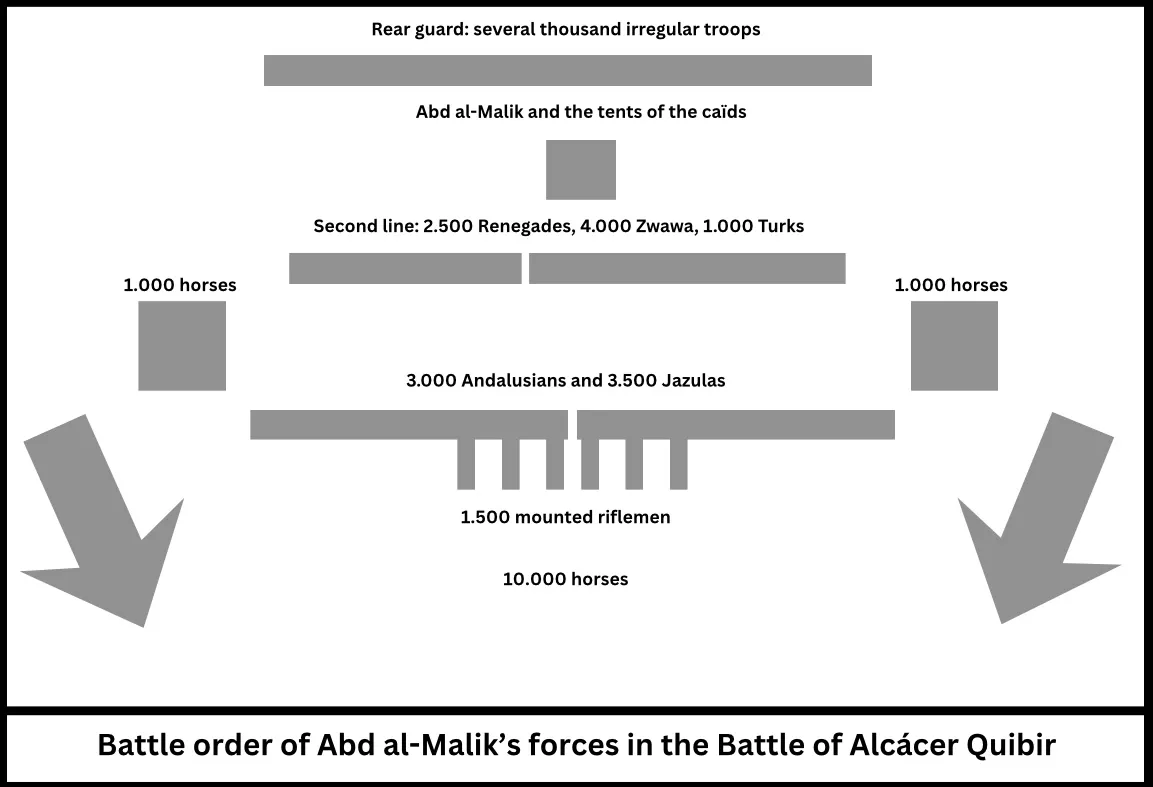
Most of the horsemen on the wings were unpaid tribal levies with lances, javelins or bows. Christian veterans spoke of “countless cavalry”; Costa e Sousa thinks loose masses of riders looked bigger than tight European ranks, and puts them at 10,000 to 20,000.
The battle, hour by hour
Mounted Moroccan arquebusiers rode out between their own front ranks, fired into the leading Christian blocks and pulled back to reload. Sebastião rode to the rear, where the fighting had already started, and back again. Smoke hid the far end of the line. When word came that the volunteers were lowering their pikes to charge, he charged with them.
The armoured cavalry tore through the horsemen and the arquebusiers in front of them, and the Duke of Aveiro struck the Moroccan riders on the other wing. The volunteers, led by Álvaro Pires de Távora, broke the Moroccan front. Miguel Leitão de Andrada, fighting in their third rank, later wrote it down.
“And we charged them with such fury, pikes lowered, that we broke them and put them to flight, and many of the Moors did not stop until Fez.”
The view from the other side was the same. Abd al-Malik's Jewish physician, standing by the litter, wrote to his brother twelve days later.
“The Christians' armoured horsemen charged us with such ferocity that our people fell back behind the king's banners, and it seemed to us beyond doubt that we were lost.”
About 300 volunteers, swords now in hand, ran on towards the guns and the litter. The sultan tried to stop his men running, and then fell from his horse, from a faint or, some said, an arquebus shot. Andrada, less than 20 metres away, saw him carried off. His officers wrapped the body, put it back in the litter and said he had fainted; the physician pretended to give him water while a Turkish servant pretended to take orders.
This was the moment the battle turned. The volunteers' colonel, Álvaro Pires de Távora, went down, hit in the leg by a cannon shot. A sergeant, Pero Lopes, seeing how far ahead the leaders had run, stepped in front with his halberd and shouted to hold, then to fall back. The squadron behind began to retreat, and the men at the guns found themselves alone. A veteran later called that retreat “the first cause” of the defeat.
The sultan's guard counter-attacked, and the renegades and Zouaoua opened their ranks to let the fugitives through, then fired a heavy volley. The retreating volunteers fell back on the Spanish, then the Germans, then the inexperienced militia of the second line, who broke before the Moroccans even reached them. Moroccan horsemen poured into the gap on the left between the leading blocks and the regiments behind.
The king charged again and again with whatever horsemen he could gather, 200, then about 100. He was hit under the arm, lost his horse and fought on foot until a Tangier horseman gave him another. The guns were lost, the baggage was looted and a powder cart exploded. Francisco de Aldana died; so did the Duke of Aveiro. When the big central squadron gave way, most of its men surrendered.
Dawn
Last council of war
The king overrules those who want to wait or retreat.
c. 10:00
The army leaves camp
About an hour later the first Moroccan horsemen appear on the flanks.
c. 11:00
The battle begins
Jerónimo de Mendonça's time; Costa e Sousa puts the volunteers at the Moroccan guns at about this hour.
Late morning
Abd al-Malik collapses
His death is hidden. The volunteers' retreat lets the Moroccans recover.
Afternoon
The Christian army breaks up
The guns and baggage are lost; a powder cart explodes; Aldana and the Duke of Aveiro are killed.
After more than three hours' fighting
The king's last stand
Sebastião reaches the two rear regiments, drinks from a soldier's water skin and fights on until their colonel, Francisco de Távora, is killed.
4 or 5 p.m.
Sebastião rides off with five companions
He is surrounded near the ford crossed the day before and killed.
5 August, night
The body is shown to captive noblemen
By torchlight, in the Moroccan camp.
“It was four or five in the afternoon, the battle having begun at eleven.”
Three kings dead
Sebastião's last companions included his favourite, Cristóvão de Távora, and Nuno de Mascarenhas. Moroccan horsemen surrounded the small group near the ford, and the king, resisting capture, was struck on the head.
Mascarenhas saw someone tear a strip from his shirt and tie it round his neck to mark the body.
Al-Mutawakkil, the man Sebastião had come to restore, drowned trying to swim the river with a number of soldiers. Abd al-Malik had died hours earlier, apparently of his illness, though the Andalusian commander al-Dughali was executed after the battle on suspicion of having poisoned him. His brother Ahmad was proclaimed sultan and took the name al-Mansur, the Victorious.
Late on 5 August the king's body was shown by torchlight to the captive noblemen. A Spanish captain, Luís de Oxeda, noted a great wound on the right side of the head and an arquebus graze under one arm. The body was buried in Fez, moved to Ceuta in December 1578 and brought to the Jerónimos monastery in Lisbon in 1582.
Nobody counted the dead. Some modern estimates, Smith writes, put them at 7,000 to 8,000 on each side; others think the Moroccans lost half as many as the Christians. The prisoners numbered at least 14,000, many more if the army's camp followers are included.
Captives and ransoms
Freeing the prisoners took years. Noblemen could be ransomed by their families; most of the rest were enslaved. Cardinal Henrique, the new king, handed the negotiations to the Trinitarians, the Order of the Most Holy Trinity for the Redemption of Captives, whose friars bought Christians back from North Africa. Their Lisbon convent's books, now in the Torre do Tombo, record ransoms from 1579 to 1607.
One captive was António, Prior of Crato, a grandson of King Manuel I. A fellow prisoner, Gaspar da Grã, persuaded their captors that the cross of the Order of Malta under António's rags marked a priest with a rich parish, whose income would lapse at the end of the year unless he was freed quickly. With help from a Jew, Abraão Gibre, he was ransomed.
When he got home is disputed. Jacqueline Hermann, following the historian Queiroz Velloso, has him landing in Lisbon on 12 October 1578, about ten weeks after the battle. An anonymous account of the campaign says instead that he was brought out after thirteen months in captivity.
Others waited much longer. Sebastião's chief armourer, Francisco da Costa, entered Morocco only on 25 June 1579, to ransom the Duke of Barcelos, heir to the Duke of Bragança, and about eighty noblemen. Miguel Leitão de Andrada and Jerónimo de Mendonça, whose accounts are quoted here, were also held captive before being bought back.
Trinitarian chronicles, pious in tone, tell the poorer captives' side. In Fez, Friar Agostinho de Meneses bought back 453 captives, children, women and clergy among them, and sent them to Ceuta by caravan.
The Moving City project at NOVA University Lisbon, funded under a 2021 grant, has transcribed the Trinitarian ransom books to learn who was in the army: where its men came from, who its officers were, and which non-combatants with civilian trades went with it into Morocco.
| Record | Date | What it counts |
|---|---|---|
| Roll of the noblemen left captive in Africa (National Library of Portugal, Cod. 1569) | Sixteenth century | 205 captive noblemen |
| Roll of the eighty noblemen ransomed (British Museum manuscript, printed in 1919) | After 1578 | 80 noblemen ransomed for 400,000 cruzados |
| Trinitarian ransom books, Lisbon convent (Torre do Tombo) | 1579 to 1607 | Almost 5,000 captives named; 1,364 very probably taken at Alcácer Quibir |
| Friar António de Alvito, in a Trinitarian chronicle of 1773 | Before his death in 1586 | Nearly 2,000 ransomed at Ksar el-Kebir |
| Richard L. Smith, modern estimate | 2022 | At least 14,000 prisoners in all |
The Trinitarian books also list captives taken in other years, so the Moving City project at NOVA University Lisbon kept only names it could tie to the battle with reasonable certainty. The 1773 figure comes from a devotional chronicle written two centuries later.
A cardinal on the throne
The first reports of a defeat reached Lisbon around 10 to 12 August. The messenger was kept out of sight, and the government tried to stop people talking or writing about the battle. Half the city had someone or something in Africa.
“There was not a living soul in Lisbon who had no stake in this war: one had a son there, another a father, one a husband and another a brother; the merchants and craftsmen who had no relatives there, though many of them had, had their money there.”
On 24 August Francisco de Sousa brought letters from Belchior do Amaral, who said he had been present at the king's burial in Fez. The bells tolled for two days. On 27 August the death was proclaimed in the streets and the funeral rites held, without a body, and on 28 August Cardinal Henrique, the last living son of King Manuel I, was acclaimed king. He was 66, a priest and in poor health.
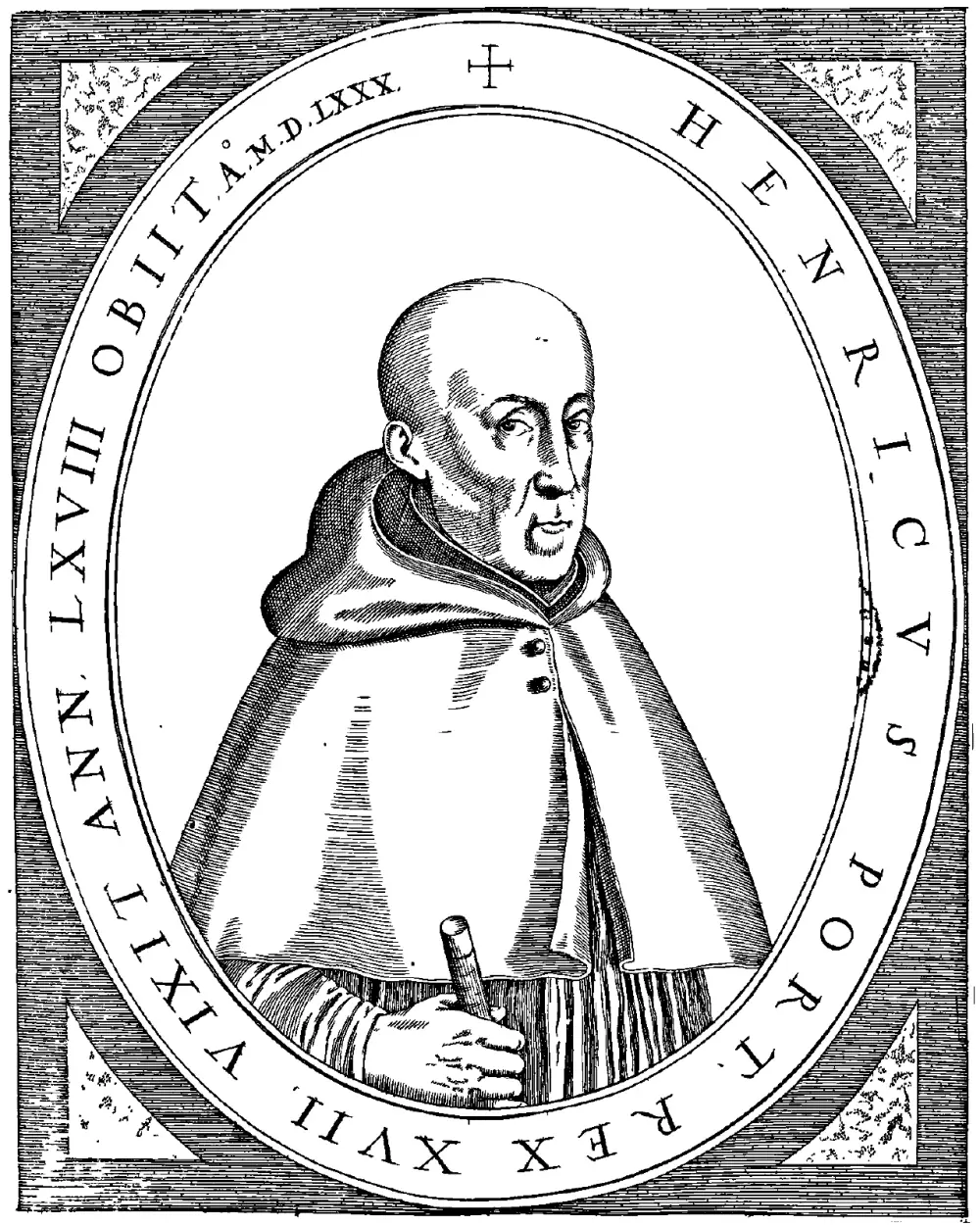
Henrique had to ransom much of the nobility and settle the succession at once. His envoys asked Rome to release him from his vows and looked for a bride; both efforts failed, very probably through Philip II's influence. The claimants included Philip, Catarina, Duchess of Bragança, and António, Prior of Crato, whom Henrique declared illegitimate. In June 1579 he named five governors and eleven judges to manage the handover.
Henrique favoured the duchess but could not win the nobility for her, and from September 1579 he seems to have weighed Philip's claim. He died on 30 or 31 January 1580 (sources differ) without naming an heir. On 25 August 1580 the Duke of Alba's army scattered about 7,000 of António's men, mostly peasants, at Alcântara outside Lisbon in no more than half an hour. The Cortes acclaimed Philip king at Tomar the following April.
4 August 1578
Battle of Alcácer Quibir
10 to 12 August 1578
First news of a defeat reaches Lisbon
24 August 1578
Letters confirm the king's death
27 August 1578
The death is proclaimed and funeral rites held
28 August 1578
Cardinal Henrique acclaimed king, aged 66
12 October 1578
António, Prior of Crato, lands in Lisbon after his ransom (Hermann's date)
June 1579
Henrique names five governors and eleven judges
25 June 1579
Francisco da Costa enters Morocco to ransom noblemen
30 or 31 January 1580
Henrique dies without naming an heir
25 August 1580
Alba defeats António at Alcântara
The king who did not come back
The legend began on the night of the battle. Four horsemen who had fled the field reached the gates of Arzila and asked to be let in, saying they were escorting the king. Costa e Sousa thinks it was a trick to get inside the walls before they were caught.
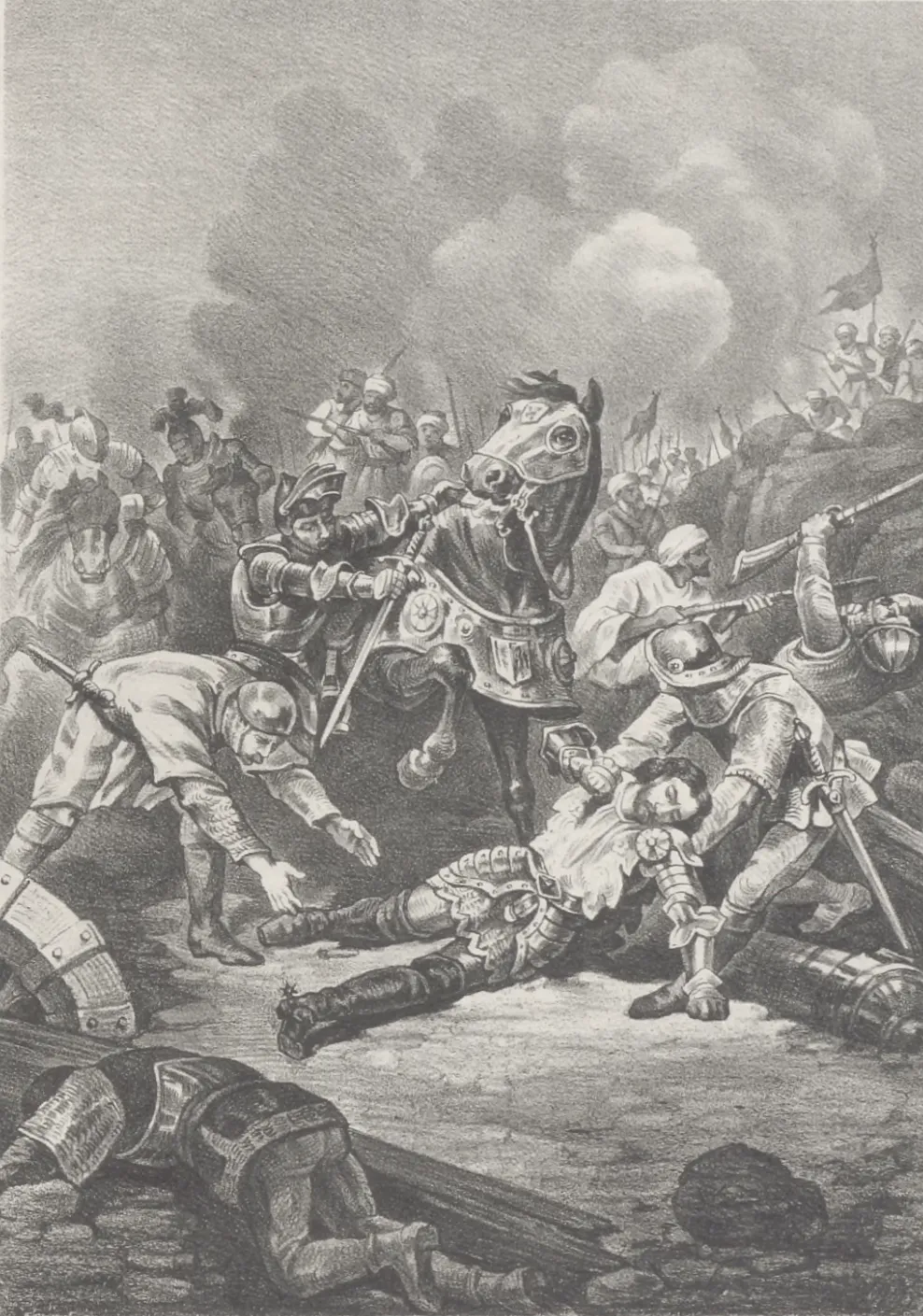
The Portuguese who saw the body saw it by torchlight, as prisoners in the Moroccan camp. The funeral in Lisbon had no body, no Portuguese at home had seen the king wounded or captive, and rumours of hooded survivors spread. Four men claimed to be Sebastião between 1584 and 1598. The belief that he would return, Sebastianism, has its own article: Sebastião the Desired.
Why it still matters
In Morocco, Ahmad al-Mansur began his reign rich with plunder and ransoms and with a standing abroad no earlier Saadi had enjoyed; his armies later conquered much of the Songhay empire. He also purged the army that had won for him, executing al-Dughali and, at about the same time, killing several thousand Zouaoua mercenaries after a string of attempted revolts.
Sebastião's militia reforms of 1568 to 1574 outlasted the battle by nearly a century and, in Costa e Sousa's view, ended medieval warfare in Portugal. But the defeat cost Portugal a king, much of the nobility, years of ransom money and, within two years, its independence: Philip II and his heirs ruled Portugal from 1580 until 1640.
FAQs
Who won the Battle of Alcácer Quibir?
Morocco. On 4 August 1578 the army of Sultan Abd al-Malik destroyed the invading army of King Sebastião of Portugal near Ksar el-Kebir. Abd al-Malik died during the battle, and his brother Ahmad, proclaimed sultan after the victory, took the name al-Mansur, the Victorious.
Why is it called the Battle of the Three Kings?
Because three kings died there: Sebastião of Portugal, killed late in the afternoon; Sultan Abd al-Malik, who collapsed during the fighting; and the deposed sultan al-Mutawakkil, Sebastião's ally, who drowned trying to escape across the river.
How many people died at Alcácer Quibir?
Estimates vary widely. Some modern estimates put the dead at 7,000 to 8,000 on each side; others think the Moroccans lost about half as many as the Christians. At least 14,000 people were taken prisoner.
What happened to the Portuguese prisoners?
Noblemen were ransomed by their families and the crown, some within months and others years later; one list records eighty noblemen ransomed for 400,000 cruzados. Most ordinary captives were enslaved. Trinitarian friars ran the ransoms for Cardinal Henrique, and their books record captives freed until 1607.
How did the battle lead to Spanish rule over Portugal?
Sebastião died unmarried and childless. His great-uncle, Cardinal Henrique, became king at 66 and died in January 1580 without naming an heir. Philip II of Spain, a grandson of Manuel I, defeated the rival claimant António, Prior of Crato, at Alcântara on 25 August 1580, and Portugal shared its king with Spain until 1640.
On the timeline
Open the timelineNearby moments from the age of discoveries (1415–1580).
João de Barros, the humanist historian whose 'Décadas da Ásia' chronicled the Portuguese conquests in the East and earned him the title of the 'Portuguese Livy', dies at Ribeira de Litém near Pombal, aged about 74.
Death in Lisbon of Martim Afonso de Sousa, who led the 1530 expedition that began the systematic colonisation of Brazil. In 1532 he founded São Vicente, the first Portuguese town (vila) in the colony; he later served as Governor of Portuguese India in 1542–45. Older reference works give 21 July 1564, but he was still signing documents in 1570.
Damião de Góis, the humanist chronicler of King Manuel I and friend of Erasmus, dies at Alenquer, just over a year after the Inquisition sent him to life confinement at Batalha. Whether he died from a fall into the fire, a fit or a blow, his death remains one of the mysteries of the Portuguese Renaissance.
The Battle of Alcácer Quibir
King Sebastião is killed at the Battle of Alcácer Quibir in Morocco, the 'Battle of the Three Kings', and much of the Portuguese nobility is killed or captured. The disaster triggered a succession crisis that led to Spanish rule over Portugal from 1580 and gave rise to the myth of Sebastianism.
Pedro Nunes, royal cosmographer and one of Europe's foremost mathematicians, dies in Coimbra. Inventor of the nonius and pioneer of the loxodrome, he placed Portuguese navigation on a scientific footing.
Cardinal-King Henrique dies at Almeirim on his 68th birthday without naming an heir. His death opens the way for Philip II of Spain to claim the throne, beginning sixty years of Iberian Union.
Death of Luís Vaz de Camões in Lisbon, by tradition on this day and in poverty. The author of 'Os Lusíadas' — the epic that crystallised Portugal's Age of Discoveries — dies only months before the kingdom passes to Philip II of Spain, beginning sixty years of Iberian Union. The date is now Portugal's National Day: Dia de Portugal, de Camões e das Comunidades Portuguesas.
Coming up in history
All long reads
9 sources
Archives, scholarship and reporting this article was checked against.
- 1
Revisitar a Batalha de Alcácer Quibir (Luís Filipe Guerreiro da Costa e Sousa)e-Stratégica, no. 1, 2017, pp. 111-159 (via Dialnet)
- 2
Battle of Ksar el-Kebir (Richard L. Smith)EBSCO Research Starters, 2022
- 3
Frei José Teixeira, defensor do Falso de Veneza: sebastianismo e cultura política na Europa seiscentista (Filipe Duret Athaide)Temporalidades, Revista de História, vol. 8, no. 3, Universidade Federal de Minas Gerais, 2016
- 4
Revisitar Alcácer Quibir: fontes para o estudo de efetivos, cativos e redentores (Diogo Reis Pereira)Projeto Moving City (EXPL/HAR-HIS/1521/2021), CHAM, NOVA FCSH, via Zenodo, 2023
- 5
- 6
Um rei indesejado: notas sobre a trajetória política de D. Antônio, Prior do Crato (Jacqueline Hermann)Revista Brasileira de História, vol. 30, no. 59, 2010, pp. 141-166
- 7
Mosteiro dos Jerónimos: fundação, o mosteiro, panteãoMuseus e Monumentos de Portugal, Mosteiro dos Jerónimos e Torre de Belém
- 8O dia em que Portugal perdeu a última batalha pela independênciaObservador
- 9
Instrumentos e escrituras dos autos seguintes: Auto do levantamento e juramento d'el-Rei nosso senhor; Auto das Cortes de Tomar; Auto do juramento do Príncipe Dom Diogo; Auto do juramento do Príncipe Dom Filipe ([Lisbon]: António Ribeiro, [1584])Biblioteca Nacional de Portugal, Biblioteca Nacional Digital
Image credits
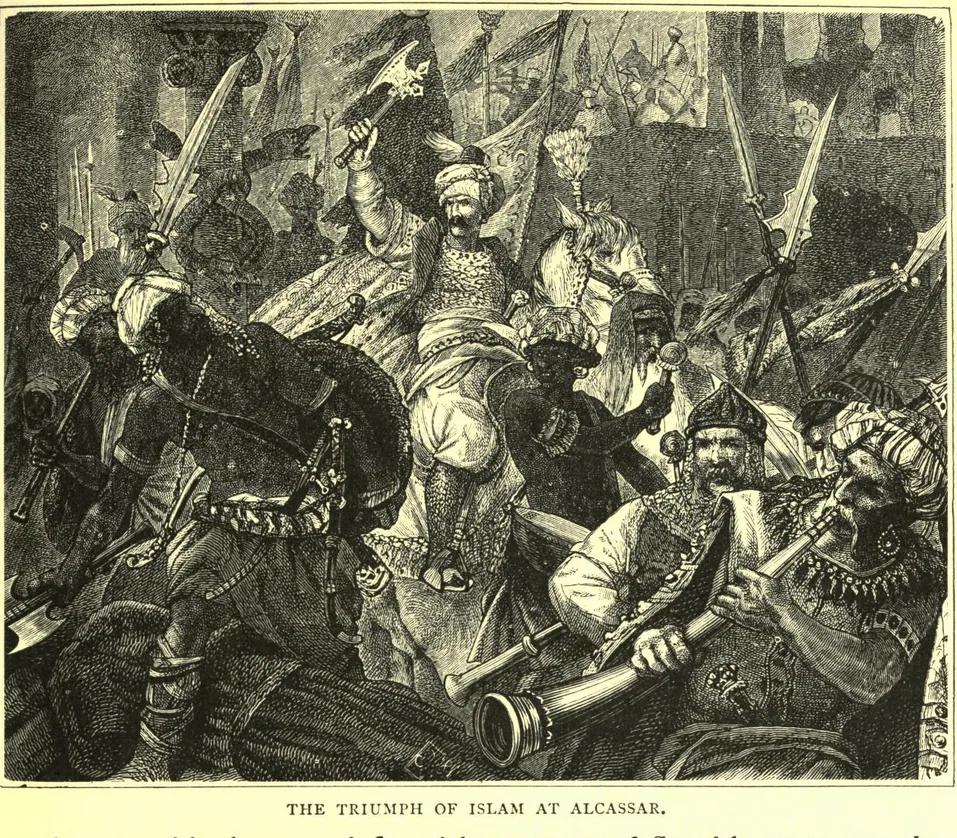
- “The triumph of Islam at Alcassar”: an English-language book illustration of 1881, imagining the Moroccan victory three centuries after the event. Anonymous authors, Public domain, via Wikimedia Commons.
- The Loukkos winding to the sea at Larache, the port Sebastião set out to take, seen from the ancient ruins of Lixus in 2014. The battle was fought upstream, near Ksar el-Kebir. Максим Массалитин (Maxim Massalitin), CC BY-SA 2.0, via Wikimedia Commons.
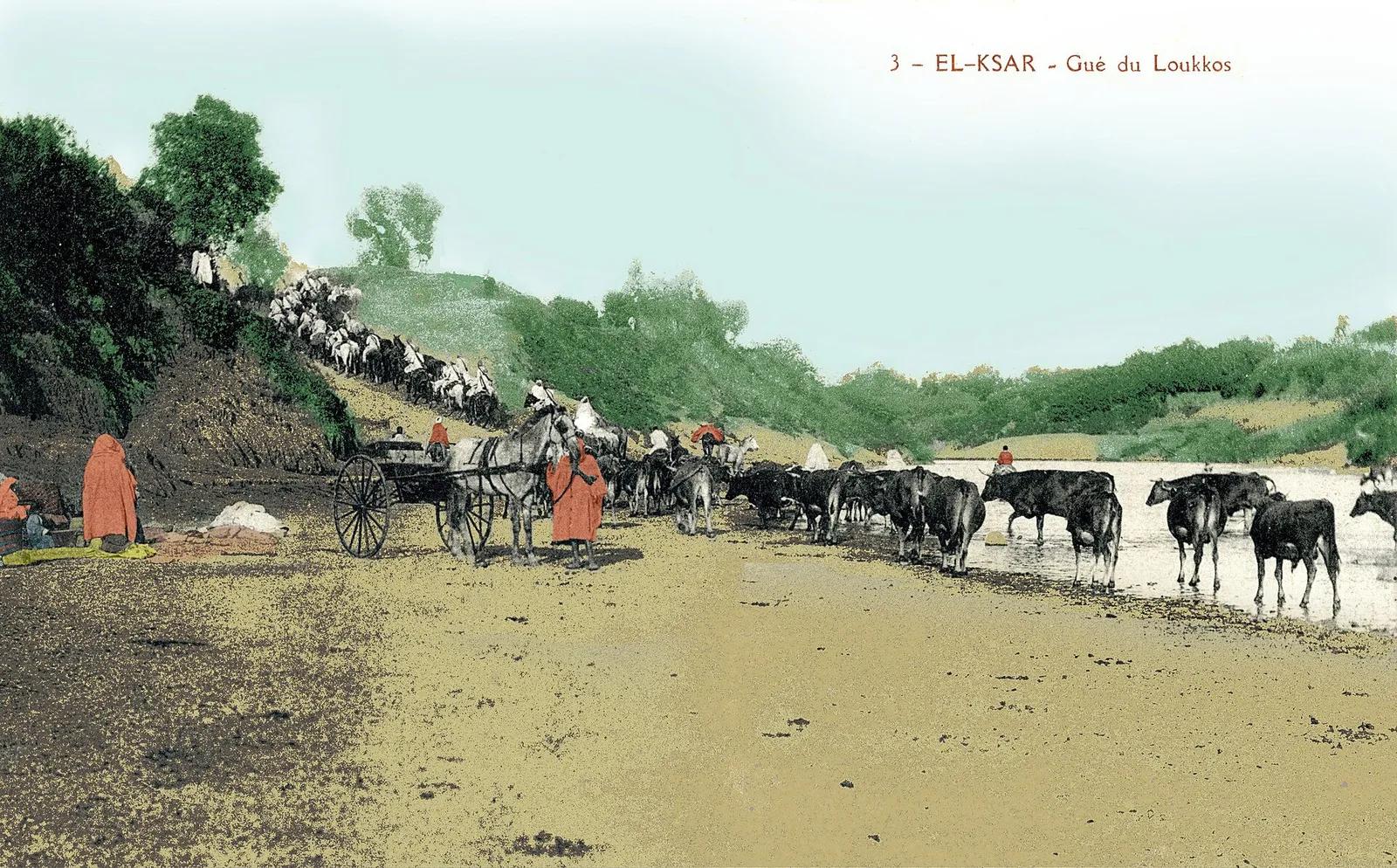
- A ford on the Loukkos at Ksar el-Kebir, on a postcard of about 1900, colourised by the uploader. The Portuguese crossed the Makhazin, a tributary, at a ford on 3 August 1578, and the king was killed near that ford the next day. Victorcouto, CC0, via Wikimedia Commons.
- Abd al-Malik's order of battle, redrawn in 2026 from a figure in Luís Costa e Sousa's 2017 study. The figure gives 1,500 mounted riflemen where his text says about 1,000. Goldfinch40, CC BY 4.0, via Wikimedia Commons.
- Cardinal-King Henrique in an engraving by Pedro Perret, 1603. The Latin border calls him the seventeenth king of Portugal and says he lived 68 years and died in 1580. Pedro Perret, Public domain, via Wikimedia Commons.
- The death of Sebastião as imagined by Josep Serra i Porsón around 1875, three centuries after the battle. Josep Serra i Porsón, Public domain, via Wikimedia Commons.