

The 1951 Azores agreement and the Lajes base
Salazar wanted the Americans' peacetime rights in the Azores to end in 1954. The agreement he signed instead put an American base inside a Portuguese one, and started decades of bargaining over Portuguese consent.
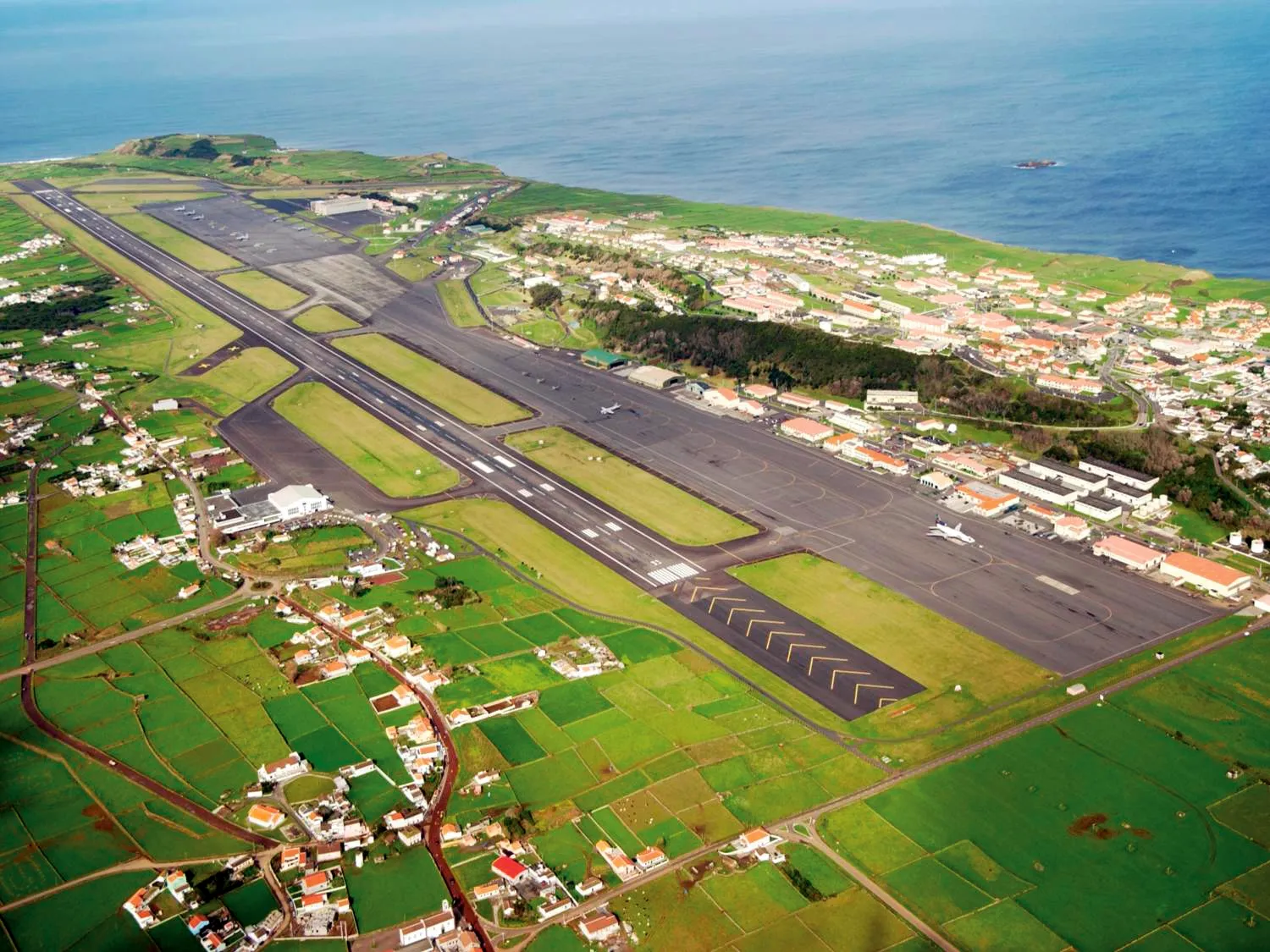
At a glance
- On 6 September 1951 Portugal and the United States signed in Lisbon a 12-article defence agreement on the use of facilities in the Azores, framed by Articles 3 and 5 of the North Atlantic Treaty.
- It gave the United States the use of the facilities in a war involving it, within the NATO framework, for the life of the treaty, and in peacetime the right to build there until 1 September 1956, plus four months' grace, to fly through and train at Lajes meanwhile, and to keep war stocks for the life of the treaty.
- Everything built belonged to the Portuguese state, and the American commander could not outrank the Portuguese one: Lajes stayed Portuguese Air Base No. 4 with an American base inside it.
- Renewals were bargained over for decades. In October 1973 Lajes was the staging post for the US airlift to Israel after other allies refused landing rights, and Portugal paid with an Arab oil embargo.
- The 1951 agreement stayed in force, extended by exchanges of notes, until it was replaced by the Agreement on Cooperation and Defense signed in 1995, which still governs the base.
Salazar's deadline
On 29 June 1951 António de Oliveira Salazar, head of Portugal's authoritarian Estado Novo regime, set down in a handwritten note how long the Americans could stay in the Azores. Washington wanted its rights at the Lajes airfield on Terceira tied to the life of NATO, with the alliance's own bodies deciding when they were no longer needed. To Salazar that meant American bases with no end date.
His answer was December 1954. By then, he reasoned, NATO's medium-term military plan would be complete, and the stand-off with the Soviet Union would have ended either in a general war or in a settlement. A short, fixed term would keep the American presence provisional. What he wanted to stress, in the historian Daniel Marcos's summary, was the originality of the arrangement: “an American base inside a Portuguese base”.
The Americans pushed back. In August the US ambassador, Lincoln MacVeagh, told Salazar that an end date in late 1954 or 1955 would not leave time to build what NATO's plans required or to train Portuguese staff to run the base. An American aide-mémoire of 14 August asked for 1958, or for no fixed term with either side free to end the agreement. Both sides gave ground.
On Thursday 6 September 1951 the two governments signed in Lisbon a Defence Agreement on the use of facilities in the Azores, in Portuguese and English, “both texts having equal value”. Peacetime works would run until 1 September 1956, with four months' grace. The next day Diário de Notícias printed the government's note presenting it as part of NATO's provisions for common defence.
The agreement replaced one of 2 February 1948. Extended and amended by exchanges of notes, it stayed on the books for 44 years, until 21 November 1995.
From a wartime airfield to NATO
Lajes was not new to the Americans. In October 1943, with Portugal neutral in the Second World War, Salazar let Britain use the airfield, then spelled Lagens, in the name of the alliance of 1373. American personnel followed under the British arrangement, and in November 1944 the United States got an airfield of its own on Santa Maria. That story is told in a separate article.
After the war Portugal wanted the islands back. On 2 June 1946 the airfields of Santa Maria and Lagens returned to Portuguese command. An exchange of notes of 30 May 1946 let American aircraft keep passing through for 18 months, tied to the needs of the US occupation forces in Germany, and a further agreement in February 1948 extended the arrangement.
The invitation to join a North Atlantic alliance came from Britain in October 1948. Salazar had three worries: anything that hinted at supranational integration, any pact that might hide a plan to keep foreign forces in the Azores in peacetime, and the exclusion of Spain. None of his reservations was accepted, yet Portugal signed the treaty in Washington on 4 April 1949 as one of the 12 founding members, the only dictatorship among them.
Lisbon understood that it had been invited because of Lajes, Marcos argues. NATO's own history calls accession a diplomatic victory for the regime. Portugal had been assured that its territory would not be used for bases in peacetime without the government's full consent, and in March 1950 it accepted that foreign forces would take on tasks only where the host could not or would not, under bilateral agreements.
“You know, Sir Nigel, we did not wish to have Gibraltars of any kind on Portuguese territory.”
- Signed
- Lisbon, Thursday 6 September 1951; in force the same day
- Parties
- Portugal and the United States, citing Articles 3 and 5 of the North Atlantic Treaty
- Wartime
- Use of facilities in the Azores in a war involving the US, within the NATO framework, during the life of the treaty
- Peacetime
- Works until 1 September 1956, with four months' grace; transit and training through Lagens meanwhile; war stocks for the life of the treaty
- Replaced
- The agreement of 2 February 1948
- Replaced by
- The Agreement on Cooperation and Defense, signed 1 June 1995, in force 21 November 1995
What the agreement said
Talks began in February 1951, when the US defence secretary, George Marshall, told Portugal's defence minister, Fernando Santos Costa, that NATO's regional plans were advanced enough to discuss the Azores. Santos Costa replied that Portuguese opinion was unanimously against foreign forces in its Atlantic islands, even temporarily. The American requirements, as a Portuguese defence memo summed them up in May, meant 3,207 American servicemen in peacetime and 22,000 in war.
The signed text was more modest. Article 1 granted the facilities only “in case of war in which they are involved during the life of the North Atlantic Treaty”. Everything else was preparation: building and enlarging installations, storing oil, munitions and spare parts, training American air and naval crews, and continued transit of American military aircraft through Lagens. The details went into technical arrangements between the two defence ministers.
| Article | What it said |
|---|---|
| 1 | Use of facilities in the Azores in a war involving the United States during the life of the North Atlantic Treaty, within its framework |
| 2 | Joint building and enlargement of installations, including stores of oil, munitions and spare parts, until 1 September 1956 with four months' grace |
| 3 | All buildings and materials fixed to the ground are Portuguese state property; the US may remove its own equipment at the end |
| 4 and 5 | Portugal maintains the facilities after the Americans leave; the US trains Portuguese personnel to run them |
| 6 | Transit of US military aircraft through Lagens and training continue; occasional visits by military aircraft to Santa Maria |
| 7 | Six months to a year for the complete evacuation of American personnel |
| 8 | The United States may renounce the concessions at any time |
| 9 | Other NATO members may use the facilities in war; Portugal may grant Britain similar facilities |
| 10 | After evacuation, transit through Lagens for NATO missions, using Portuguese services |
| 12 | In force on signature; the agreement of 2 February 1948 lapses |
Article 11 says nothing in the technical arrangements may contradict the agreement. Article 7 also allowed stockpiling of war supplies for the life of the treaty. Summaries of the English text.
Portugal wrote its own conditions into the technical annexes. Santa Maria would keep its commercial, civilian character in peacetime. Portuguese forces would defend the installations, and the American commander could not hold a higher rank than the local Portuguese commander. The works included a larger hospital, radar, a modern communications centre, ammunition stores outside the base, more fuel storage at the port of Praia da Vitória and a storage area at Ponta Delgada on São Miguel.
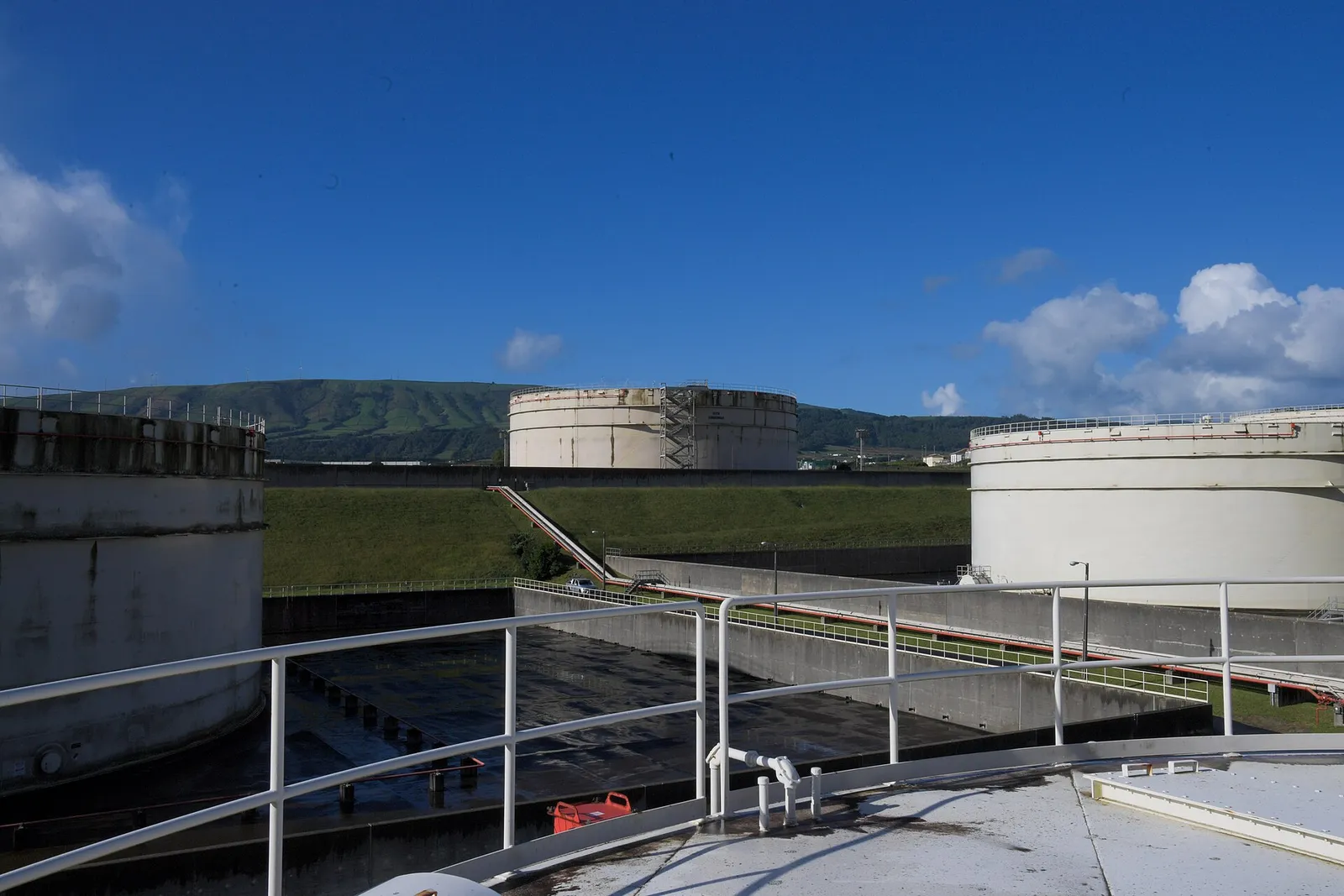
Portugal charged no rent. The first agreement, the journalist José Vegar noted in 1998, made no mention of any return beyond the training of Portuguese personnel and joint exercises. American weapons came by another route: a Mutual Defense Assistance Agreement signed on 5 January 1951, like those with other NATO countries.
Five years at a time
The Pentagon soon wanted more. In November 1954 it asked the State Department to negotiate an increase in the American personnel ceiling in the Azores “from 1200 to approximately 5800”, three squadrons of airborne early-warning aircraft, a fighter-interceptor squadron at Lajes and C-54 aircraft for the air rescue unit. It also wanted the American commander raised to general or flag rank. The technical agreement barred him from outranking the Portuguese commander, and both men were colonels.
The US ambassador, James Bonbright, reported in 1956 that the Foreign Minister, Paulo Cunha, had led the rejection in 1951 of longer peacetime rights and would again favour a short, fixed extension. That September Cunha told him the evacuation period set by the agreement would not start before 1 January 1957, once the grace period had run out. Bonbright protested that the Azores were “presently defenseless”.
On 31 December 1956 Salazar told Bonbright that Portugal “did not intend to bargain with us or attempt to hold us up”, but that any extension would have to be “for a fixed period of years”. Meanwhile he prolonged the 1951 terms by a year, to the end of 1957, and let urgent construction at Lajes begin at once. The new exchange of notes was signed in Lisbon on 15 November 1957 and extended the arrangement for five years from 1 January 1958, to the end of 1962.
The delay had little to do with the base. Marcos shows that the technical annexes had been settled in June 1956. What held things up was politics: Lisbon wanted to temper Washington's line on colonial questions, and Cunha warned that any American statement threatening Portugal's overseas territories would do great harm just after a new Azores agreement.
Africa and the Azores
From 1961 Portugal was fighting a colonial war in Angola, and the Kennedy administration supported self-determination for Portugal's African territories. In June 1962 the Secretary of State, Dean Rusk, warned the President that the peacetime rights would expire on 31 December 1962 and that prospects of renewal were “not encouraging”.
“They might be much better were we willing to back away from the position we have taken on the right of the peoples of the Portuguese territories to self-determination, but this we have no intention of doing.”
No new text was signed. In Paris on 15 December 1962 the Foreign Minister, Alberto Franco Nogueira, told Rusk that the Americans could stay as long as talks continued; if they failed, a six-month countdown would begin. Rusk protested that the base was a very large operation and that without a fixed term “we are on shifting sands”. In July 1963 Kennedy asked his defence secretary for a contingency plan for the loss of the Azores base.
The Americans stayed for nine years without a formal renewal. On 9 December 1971 an exchange of notes extended the agreement, with amendments, to early February 1974. Ufahamu, a UCLA African studies journal writing in support of the independence fighters in Portuguese Guinea, put the package at $436 million: $400 million of Export-Import Bank financing, $30 million of farm commodities, at least $5 million of surplus non-military equipment, $1 million for education and the free use of a hydrographic ship.
Three days later Richard Nixon stopped at Lajes for a summit with France's Georges Pompidou and met Portugal's prime minister, Marcelo Caetano, in the American commander's quarters. Caetano said that, looking at it realistically, “Portugal had received little and given little”, yet both men would be criticised for it at home.
October 1973: the airlift through Lajes
In October 1973 Egypt and Syria were at war with Israel, and the Soviet Union had been flying supplies to Egypt, Syria and Iraq for several days. On 12 October Washington told its chargé in Lisbon to see the Foreign Minister, Rui Patrício, at once. Chartered aircraft would carry military equipment to Israel, 10 to 20 flights a day, stopping at Lajes for fuel and a crew change and touching down nowhere else. “We will want to begin flights tonight.”
Patrício asked for weapons in return, including surface-to-air missiles. On 13 October Nixon wrote to Caetano that he could not “bargain with you about hypothetical results” or supply the weapons requested. He offered to consult if Portugal faced terrorism or an oil boycott, and warned: “your failure to help at this critical time will force us to adopt measures which cannot but hurt our relationship.”
Lisbon gave way.
That evening Portugal's ambassador in Washington, João Hall Themido, delivered a letter from Caetano and a long memorandum. He said Portugal had agreed in response to the President's direct appeal, that the risk it was taking was the largest in its history, and that it now expected more understanding, including surface-to-air missiles. The Portuguese feared an oil embargo, Arab support for the independence movements in Portuguese Africa and terrorist attacks on Portuguese aircraft and citizens.
Other American allies, with Portugal the one exception, denied landing and overflight rights, the aviation historian Walter J. Boyne wrote. Without Lajes, he added, Military Airlift Command “could not have conducted the airlift the way it did”. Daily departures from the island grew from one to 40 within a few days, and more than 1,300 people worked there. The average leg from American bases to Lajes was 3,297 miles; Lajes to Lod, in Israel, was another 3,163.
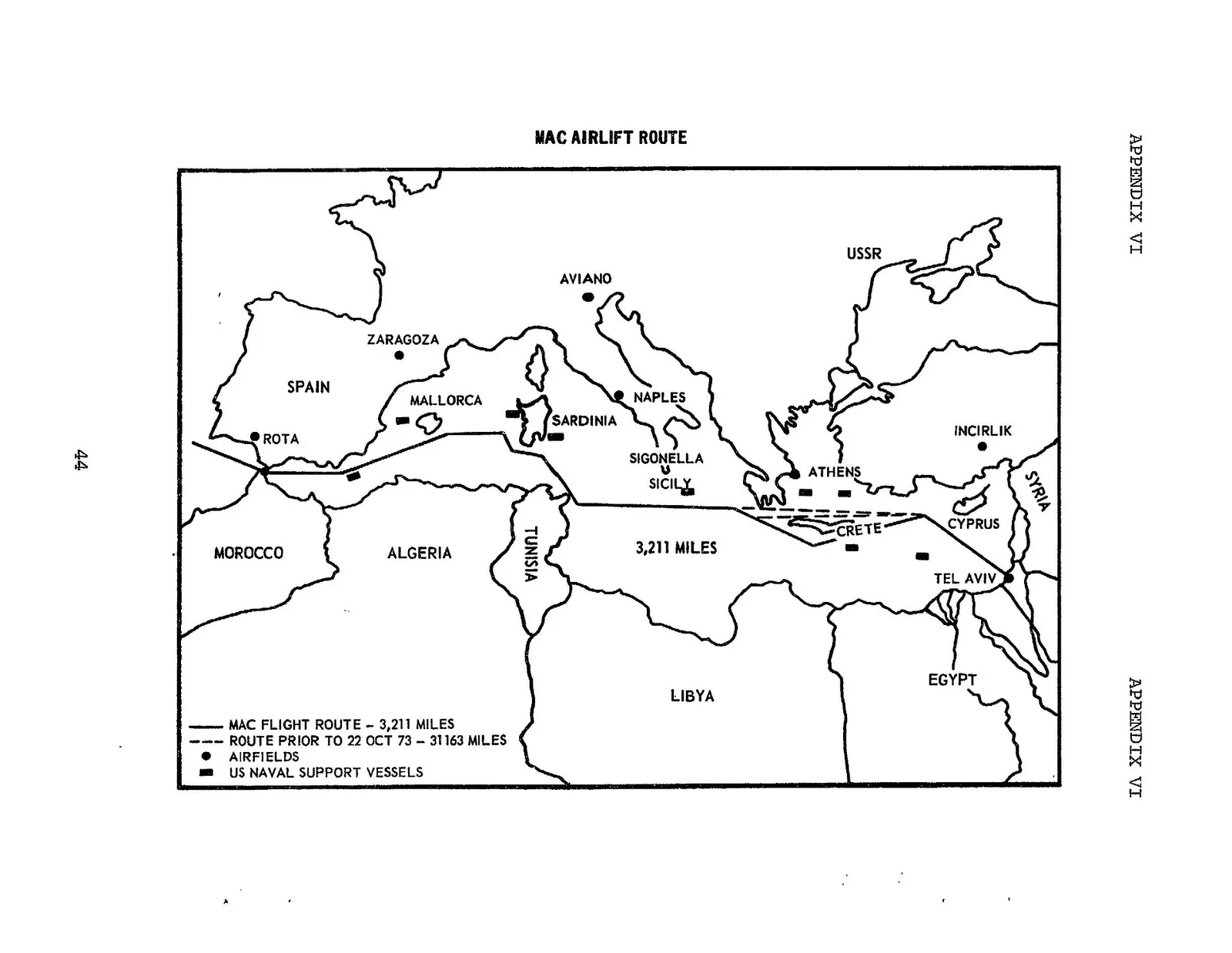
Operation Nickel Grass officially ended on 14 November. The US Air Force had delivered 22,395 tons of cargo in 567 missions: 422 by C-141 Starlifter and 145 by C-5 Galaxy, which flew about a quarter of the missions but carried about 48 per cent of the tonnage. Israel's airline, El Al, carried another 5,500 tons from the United States in eight airliners.
The Arab oil embargo of 1973 was imposed on Portugal because of Lajes, the Christian Science Monitor recalled in 1980. On 19 October Caetano wrote to Nixon that Portuguese opinion was convinced “that the United States abandons friendly countries”.
Six months later, on 25 April 1974, his regime was overthrown in the Carnation Revolution.
Renewals under democracy
The 1971 extension ran out on 4 February 1974. A new deal came only in 1979, worth $140 million in all, including $60 million of military aid that bought the Portuguese Air Force 20 A-7 attack jets, the first of which arrived in January 1982. Under its terms the United States had to seek Portugal's prior approval before sending any flight on a non-NATO mission through the base.
That deal expired in February 1983. Not until 13 December did George Shultz and the Foreign Minister, Jaime Gama, agree a seven-year extension in Lisbon, to 4 February 1991. It promised, the Christian Science Monitor reported, $38 million a year in aid for the Azores and $92.3 million a year to re-equip Portugal's armed forces.
Talks for a new framework began in 1991 and took four years. On 1 June 1995 the Foreign Minister, José Manuel Durão Barroso, and the US Secretary of State, Warren Christopher, signed the Agreement on Cooperation and Defense, with a Labour Agreement for the base's Portuguese staff. It revoked the 1951 text.
The 1995 text runs for five years and then renews itself a year at a time unless either side gives 12 months' notice, after which the Americans have 12 months to leave. A standing bilateral commission meets twice a year. Its preamble recognises that the 1951 agreement and the Azores facilities had contributed to the two peoples' common security.
| Date | Instrument | Term | Notes |
|---|---|---|---|
| 6 September 1951 | Defence Agreement, Lisbon | Peacetime works to 1 September 1956 plus four months; wartime use for the life of NATO | Replaced the agreement of 2 February 1948 |
| 15 November 1957 | Exchange of notes, Lisbon | Five years from 1 January 1958 | Technical annexes settled in June 1956 |
| 31 December 1962 | Peacetime rights expire | Day-to-day, while talks continue | Six months' notice if talks fail |
| 9 December 1971 | Exchange of notes | To early February 1974 | Aid package put at $436 million |
| 1979 | New arrangement | To February 1983 | Worth $140 million; prior approval for non-NATO flights |
| 13 December 1983 | Exchange of notes, Lisbon | To 4 February 1991 | Signed by Shultz and Gama |
| 1 June 1995 | Agreement on Cooperation and Defense, Lisbon | Five years, then renewable yearly | In force 21 November 1995; revoked the 1951 agreement |
Sources differ on the 1971 end date: the State Department gave 4 February 1974, a 1972 account 3 February. The 1983 extension was signed after the previous accord had expired in February 1983.
The Lajes summit
By 2003 Barroso was prime minister. On Sunday 16 March he welcomed George W. Bush, Tony Blair and José María Aznar to the base for a meeting on Iraq. At the press conference, from 5.30 to 6.05 in the evening, he said two statements had been approved, one on transatlantic relations and one on Iraq.
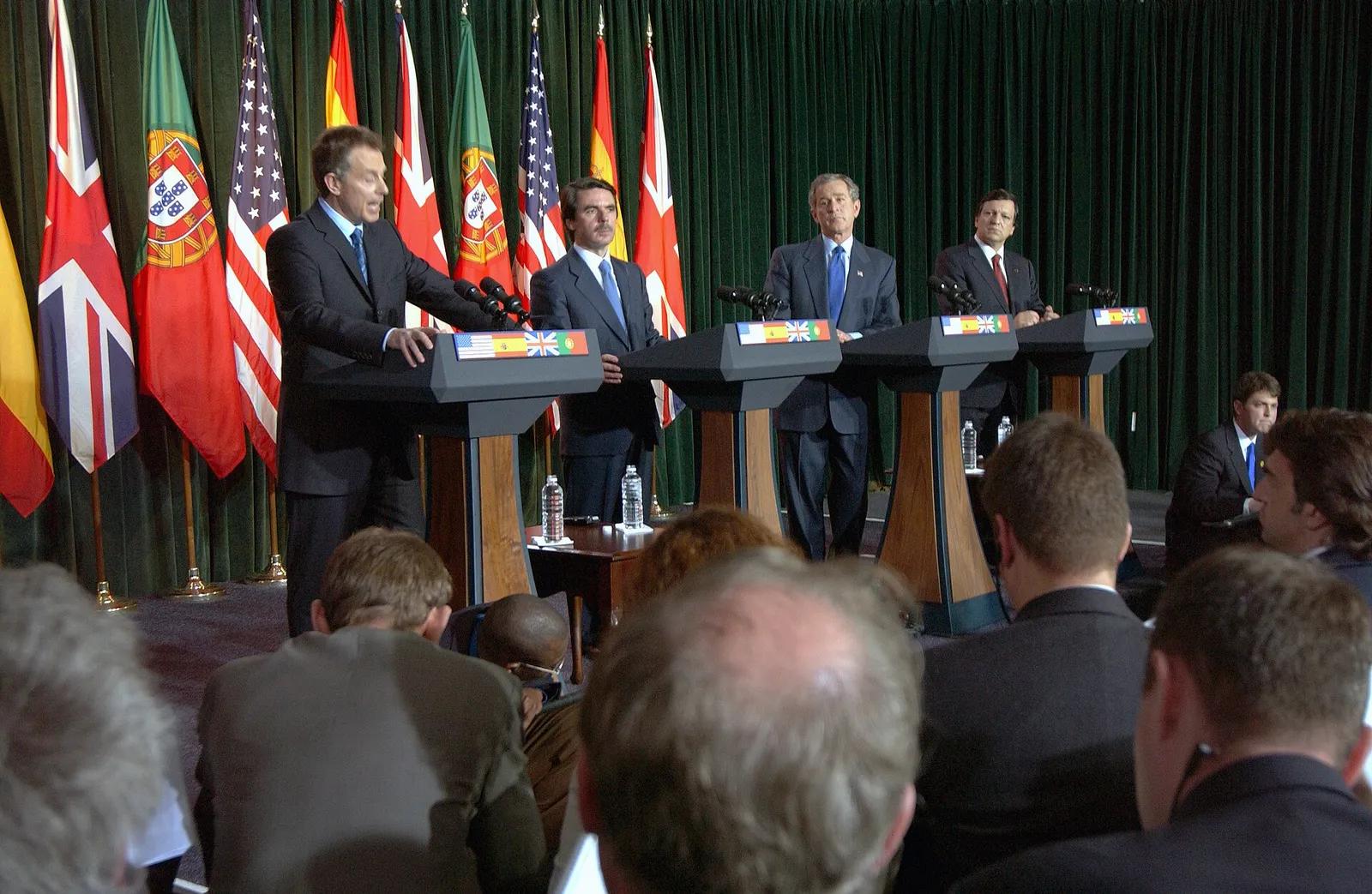
The first air strikes on Iraq came four days later, in the early hours of 20 March.
In Portugal the meeting is remembered as the Cimeira das Lajes, and its history has been argued over since. In 2016 Barroso said that the President, Jorge Sampaio, was the only person he consulted and that he agreed; Sampaio replied in writing that he raised no objection only to a last attempt at peace, and that it was not for the President to authorise foreign-policy decisions.
Lajes today
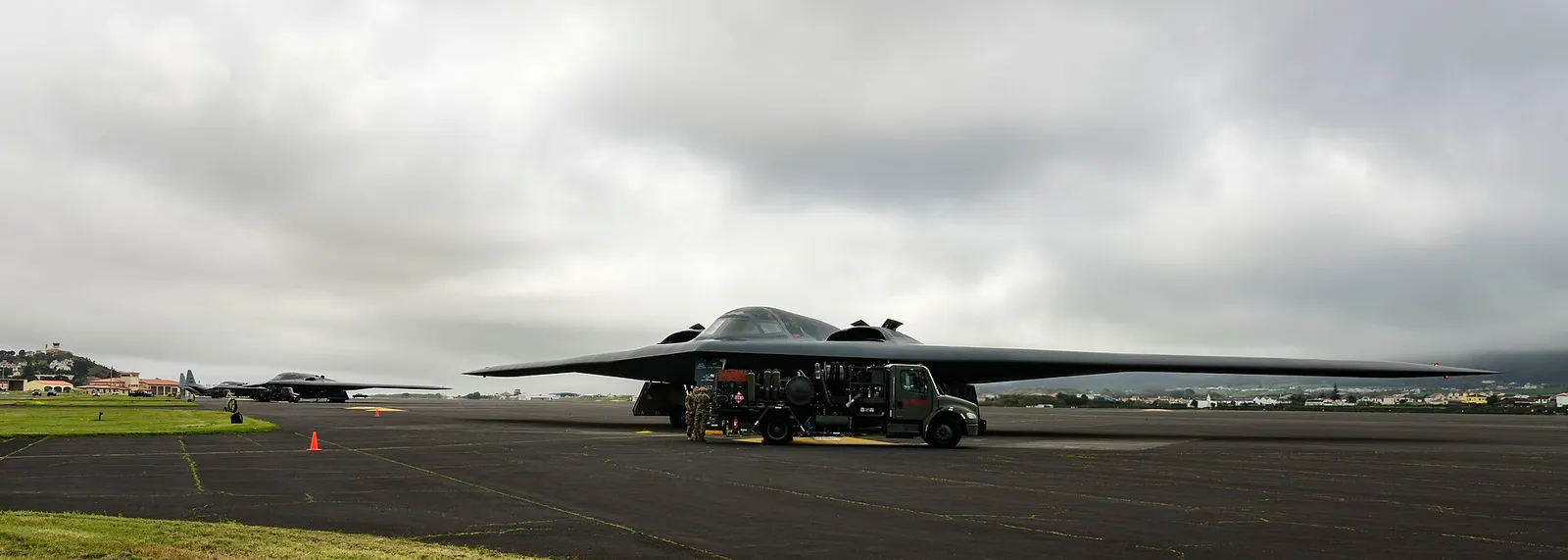
At its peak the American side of Lajes held more than 1,000 military personnel, about 5,000 people with their families. In January 2015 Washington confirmed cuts that would take its military and civilian personnel from 650 to 165 and the Portuguese civilian workforce from 900 to 400, saving about $35 million a year. That August the 65th Air Base Wing, the American unit, was redesignated as a group.
In June 2025 the United States asked, by diplomatic note on 18 June, to park 12 refuelling aircraft at Lajes, and Lisbon agreed. Portugal's defence ministry called it a routine procedure and said the Agreement on Cooperation and Defense requires Portugal's prior authorisation for military aircraft to park at or transit the base.
When the United States and Israel attacked Iran in late February 2026, the Foreign Minister, Paulo Rangel, said the government had given only conditional authorisation, after the first strike had already taken place: the base could be used only in retaliation for an Iranian attack, under the principles of necessity and proportionality, and against military targets only. On 4 March the prime minister, Luís Montenegro, said that American use of the base under the standing authorisations in force before the war had led to no breach of international law, and that prior authorisation had applied since the attack.
8 October 1943
British forces admitted to the Azores under the alliance of 1373
2 June 1946
Santa Maria and Lagens returned to Portuguese command
4 April 1949
Portugal a founding member of NATO
6 September 1951
Portugal–US Defence Agreement signed in Lisbon
15 November 1957
Extension to the end of 1962
15 December 1962
Nogueira lets the Americans stay while talks go on
9 December 1971
Extension to February 1974, with an aid package
13 October 1973
Portugal lets the airlift to Israel stage through Lajes
13 December 1983
Seven-year extension signed by Shultz and Gama
1 June 1995
Agreement on Cooperation and Defense replaces the 1951 text
16 March 2003
Bush, Blair, Aznar and Barroso meet at Lajes on Iraq
2015
US personnel at Lajes cut; the wing becomes a group
February–March 2026
Conditional authorisation for US use during the war with Iran
FAQs
What did the 1951 Lajes agreement allow?
Signed in Lisbon on 6 September 1951, it gave the United States the use of facilities in the Azores in a war involving it, within the NATO framework, during the life of the North Atlantic Treaty. In peacetime the Americans could build and enlarge installations until 1 September 1956, plus four months' grace, and meanwhile train crews and fly military aircraft through Lajes. Stocks of war material were allowed for the life of the treaty. Everything built became Portuguese state property.
Is Lajes an American base?
No. Lajes is Portuguese Air Base No. 4. The United States uses facilities there under agreements with Portugal, since 1995 the Agreement on Cooperation and Defense, which grants use of the installations without prejudice to Portuguese sovereignty. Portugal's prior authorisation is needed for military aircraft to park at or transit the base.
What role did Lajes play in the 1973 Yom Kippur War?
After other US allies refused landing and overflight rights, Portugal let the American airlift to Israel stage through Lajes from mid-October 1973, under pressure from President Nixon. By 14 November the US Air Force had flown 567 missions and delivered 22,395 tons of cargo, according to Walter J. Boyne. Portugal was then subjected to the Arab oil embargo.
When did the 1951 agreement end?
Its peacetime rights were prolonged to the end of 1957, extended to the end of 1962, continued informally while talks dragged on, and were renewed in 1971, 1979 and 1983. The agreement itself was revoked when the Agreement on Cooperation and Defense, signed in Lisbon on 1 June 1995 by Durão Barroso and Warren Christopher, entered into force on 21 November 1995.
On the timeline
Open the timelineNearby moments from dictatorship and the estado novo (1926–1974).
Salazar and President Óscar Carmona inaugurate the Castelo do Bode dam on the River Zêzere near Tomar, then the largest hydroelectric scheme in Portugal. Its 115-metre concrete wall holds back a reservoir of more than a billion cubic metres that still supplies much of Lisbon's drinking water.
Francisco Craveiro Lopes, a military aviator, is sworn in as President of the Republic, succeeding the late Óscar Carmona while Salazar keeps real power as head of government. Dropped by the regime in 1958, the former loyalist drew close to the opposition and was linked to the failed Botelho Moniz coup of 1961.
Death of the painter Mário Eloy, aged 51, at the Casa de Saúde do Telhal near Sintra, where Huntington's disease had confined him since 1945. A leading figure of Portugal's second modernist generation, he absorbed German Expressionism in Berlin; his surviving paintings include haunted self-portraits and 'Bailarico no Bairro', a Lisbon neighbourhood dance.
The Lajes defence agreement, 1951
Portugal and the United States sign a NATO defence agreement in Lisbon giving the Americans the use of facilities in the Azores, chiefly the Lajes air base on Terceira: for peacetime works and transit until 1956, and in wartime for the life of the alliance.
Poet and teacher Sebastião da Gama dies of tuberculosis in Lisbon, aged just 27. The bard of the Serra da Arrábida, he wrote a letter in 1947 pleading for the hills' protection that led to the founding of the Liga para a Protecção da Natureza, Portugal's first environmental association.
The Batepá Massacre begins in São Tomé, as Portuguese colonial authorities and plantation interests unleash deadly violence against the native forro population; 3 February is commemorated in São Tomé and Príncipe as the Day of the Martyrs of Liberty.
Aristides de Sousa Mendes dies in poverty and disgrace at the Franciscan Hospital in Lisbon. As consul in Bordeaux in June 1940 he had defied Salazar's orders and issued visas to thousands of refugees fleeing the Nazis — 'perhaps the largest rescue action by a single individual during the Holocaust', in historian Yehuda Bauer's words.
Coming up in history
All long reads
45 sources
Archives, scholarship and reporting this article was checked against.
- 1
Military Facilities in the Azores: Agreement Between Portugal and the United States, September 6, 1951 (TIAS 3087, 5 UST 2263)The Avalon Project, Lillian Goldman Law Library, Yale Law School
- 2
Entre o Império e a NATO: Portugal e os Estados Unidos da América (1949-1961) (Daniel Marcos)Imprensa de História Contemporânea, Lisbon, 2022 (open access, OAPEN)
- 3
Editorial note on the United States and Portugal, 1951 (FRUS 1951, vol. IV, part 1, Document 352)Office of the Historian, US Department of State
- 4
- 5
- 6
Nickel Grass (Walter J. Boyne)Air Force Magazine, December 1998 (Air & Space Forces Magazine)
- 7
Resolução da Assembleia da República n.º 38/95: Acordo de Cooperação e Defesa entre a República Portuguesa e os Estados Unidos da América, o Acordo Técnico e o Acordo LaboralMinistério Público, Gabinete de Documentação e Direito Comparado
- 8
Defense: Cooperation. Agreement Between the United States of America and Portugal, signed at Lisbon June 1, 1995 (TIAS 95-1121)US Department of State, via GovInfo
- 9
Azores (British Facilities In): Agreement with Portugal, HC Deb 12 October 1943 vol 392 cc716-9UK Parliament, Hansard
- 10
- 11
The Agreements for the British and American use of Bases in The Azores in WWII and the role of Portuguese Timor (Curtis Stewart)British Historical Society of Portugal, Newsletter 10, February 2021
- 12
Secret Base: Santa Maria Airfield during World War II (Daniel Haulman, Air Force Historical Research Agency)Revista LPAZ, vol. 3, December 2017, republished by the Pan Am Historical Foundation
- 13
- 14
NATO member countriesNorth Atlantic Treaty Organization
- 15
Portugal and NATONorth Atlantic Treaty Organization
- 16
- 17
Bases estrangeiras e aliadas (José Vegar)Janus 1998, Suplemento Especial Forças Armadas Portuguesas (Universidade Autónoma de Lisboa and Público)
- 18A importância da base das Lajes em sete factosObservador, 15 January 2015
- 19
- 20
- 21
- 22
- 23
- 24
- 25
- 26
- 27
- 28
Supplement to the Report by Amilcar Cabral (editors)Ufahamu: A Journal of African Studies, vol. 2, no. 3 (Winter 1972), UCLA
- 29
- 30
- 31
- 32
- 33
Portugal cool to idea of US sending spare parts to Iran via Azores baseThe Christian Science Monitor, 4 November 1980
- 34
- 35
Rádio Clube Português, 25 April 1974 (Lugares de Abril)Associação 25 de Abril
- 36
US-Lisbon ties improve as airbase talks nearThe Christian Science Monitor, 18 January 1982
- 37
- 38
- 39
Press Availability with President Bush, Prime Minister Blair, President Aznar, and Prime Minister Barroso, the Azores, Portugal, 16 March 2003The White House (archived), Office of the Press Secretary
- 40Sampaio emenda Durão: as voltas com a história da Cimeira das LajesRTP Notícias, 8 May 2016
- 41
- 42Pedido dos EUA para estacionar 12 aviões reabastecedores nas Lajes seguiu “procedimento habitual”ECO, with Lusa, 23 June 2025
- 43
Irão: Rangel explica que Portugal deu autorização condicional aos EUA para usar as Lajes (Diogo Barreto)Sábado, 2 March 2026
- 44
Montenegro assegura que do uso das Lajes não resultou qualquer violação do direito internacionalDNoticias.pt, with Lusa, 4 March 2026
- 45
Image credits
- Lajes on Terceira, Portuguese Air Base No. 4, photographed from a Portuguese Air Force helicopter in July 2009. The American facilities share the field under agreements that go back to 1951. Guido Melo, U.S. Air Force, Public domain, via Wikimedia Commons.
- Fuel tanks at Lajes in October 2022, which the US Air Force says can hold 38 million gallons. Storing oil for wartime was one of the tasks the 1951 agreement allowed. U.S. Air Force photo by Airman 1st Class Lauren Jacoby, Public domain, via Wikimedia Commons.
- The Mediterranean leg of the 1973 airlift, from the US General Accounting Office's report of April 1975: aircraft from Lajes entered at Gibraltar and flew to Tel Aviv between the coasts, past US Navy ships. The map gives the route as 3,211 miles, and 3,163 for the earlier route north of Crete (dashed) used before 22 October. Comptroller General of the United States, Public domain, via Wikimedia Commons.
- Tony Blair speaks at the joint press conference at Lajes on 16 March 2003, beside José María Aznar, George W. Bush and José Manuel Durão Barroso. Series: Combined Military Service Digital Photographic Files, 1982 - 2007 Record Group 330: Records of the Office of the Secretary of Defense, 1921 - 2008, Public domain, via Wikimedia Commons.
- B-2 Spirit bombers refuelling with engines running at Lajes during a Bomber Task Force mission, 16 March 2021. U.S. Air Force photo by Tech. Sgt. Heather Salazar, Public domain, via Wikimedia Commons.