

Mutiny on the Tagus: the sailors' revolt of 1936
In the small hours, ratings on three new warships locked up their officers to force Salazar's regime to take back seventeen sacked shipmates. By mid-morning shore guns had crippled two of the ships, and the revolt was over.
At a glance
- In the night of 7 to 8 September 1936, ratings on the sloops Afonso de Albuquerque and Bartolomeu Dias and the destroyer Dão, moored in the Tagus off Lisbon, locked up their officers and tried to take the ships out to sea.
- The rising was organised by the Organização Revolucionária da Armada (ORA), a network of communist sailors linked to the clandestine Portuguese Communist Party. Its first demand was the reinstatement of 17 sailors expelled after a voyage to Republican Spain.
- Between 07:30 and 09:00 the forts at Almada and Alto do Duque shelled the Afonso de Albuquerque and the Dão, which surrendered under white flags. Sources give between 5 and 12 dead and about 20 wounded.
- Of 208 sailors accused, 82 were convicted, with sentences of up to 20 years. Thirty-four sailed in October with the first prisoners for the new Tarrafal camp in Cape Verde, where five of them died.
- Recent research reads Spain as the rebels' fallback rather than their goal. Since 2009, 8 September has been the national day of the ratings of Portugal's armed forces.
Twenty to eight on the Tagus
At 07:35 on Tuesday 8 September 1936, the officer of the day at the Naval Artillery School heard two shots over the Tagus. Second Lieutenant Morgado Belo could not tell where they came from. Five minutes later he watched the sloop Afonso de Albuquerque, one of the newest ships in the Portuguese navy, slip her buoy without asking permission. Her guns, unlike those of her sister ship the Bartolomeu Dias, were cleared for action.
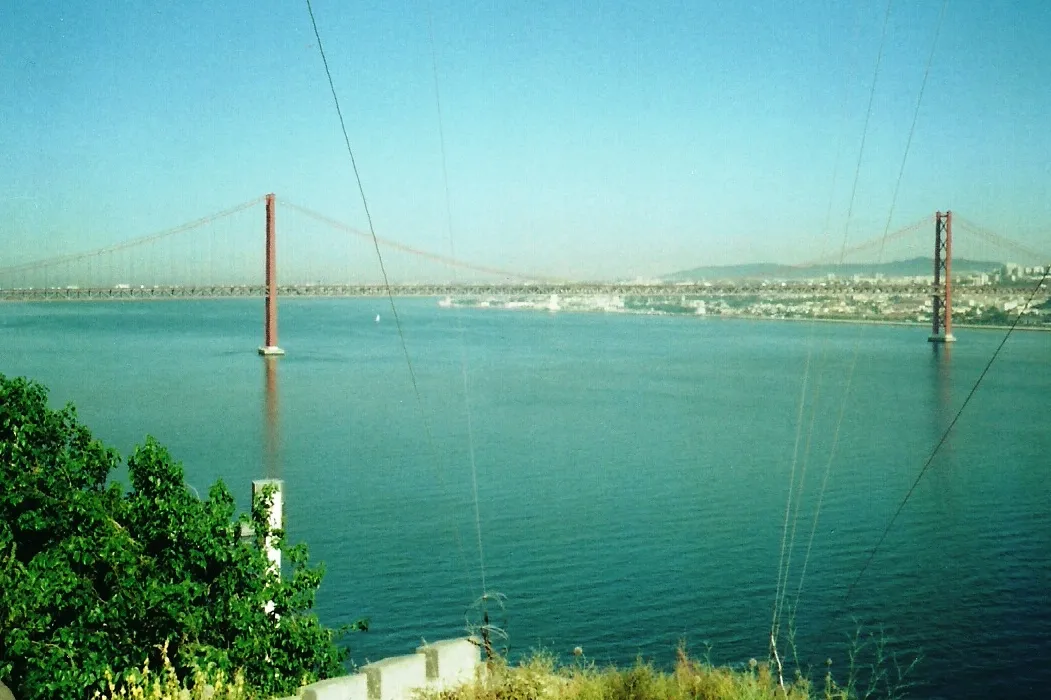
He set an armed guard and had a boat lowered. Shells from the fort at Almada, on the south bank, were falling less than 50 metres from the school's ship, and splinters broke its portholes. The guns at Alto do Duque, on the heights of the north bank, joined in, along with machine guns on the Terreiro do Paço.
The Afonso de Albuquerque got as far as Belém and hoisted a white flag. At 08:45 the destroyer Dão left her buoy in the same way, and the forts turned on her.
The men who had taken the two ships were ratings, many of them 18 to 20 years old. In the night they had locked up their officers, and their first demand was that the navy take back seventeen shipmates it had sacked four days earlier. By mid-morning both ships were holed and on fire, sailors were swimming for the shore, and the revolt was over.
- When
- Night of 7 to 8 September 1936; the shelling began at about 07:30
- Where
- The naval anchorage in the Tagus, off Lisbon
- Ships
- Sloops Afonso de Albuquerque and Bartolomeu Dias; destroyer Dão
- Organisers
- Organização Revolucionária da Armada (ORA), linked to the Portuguese Communist Party
- Dead
- 5, 10 or 12, depending on the source
- Punished
- 82 convicted; 34 sent to Tarrafal in October 1936
New ships, old grievances
Portugal had been a dictatorship since a military coup on 28 May 1926. By 1936 António de Oliveira Salazar governed through the Estado Novo, or New State, founded on a constitution approved in 1933. Its political police, the PVDE, could detain people without a warrant or charge.
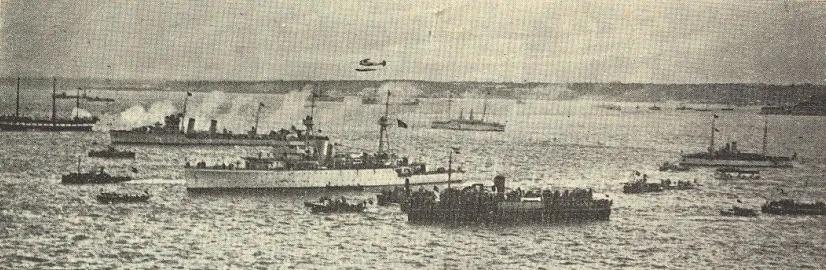
The regime was rebuilding the navy. A programme begun in 1930 paid for new warships, among them the first-class sloops Afonso de Albuquerque and Bartolomeu Dias and the destroyer Dão. The Afonso de Albuquerque was built by Hawthorn, Leslie and Company in Newcastle, launched on 28 May 1934 and entered the Tagus on 7 March 1935.
Life below decks had not kept pace with the hardware. On 1 August 1936 the Afonso de Albuquerque's own doctor reported that her galleys could reach 30 degrees above the outside temperature, and recorded the crew's complaints of food served badly cooked or rotten. That July, on garrison duty in Madeira, her commander claimed the crew's allowances at army rates, which gave a corporal or seaman 1 escudo against 25 to 35 for an officer.
Some sailors had organised. The Organização Revolucionária da Armada, the Navy Revolutionary Organisation or ORA, was founded in 1932 by communist ratings who wanted a group of their own, with no civilians. Its paper, O Marinheiro Vermelho (The Red Sailor), appeared from 1934 under the subtitle “organ of the cells of the PCP in the navy”, meaning the clandestine Portuguese Communist Party.
In 1935 the party's secretary-general, Bento Gonçalves, said about a fifth of its members were navy sailors, and that the paper printed 1,000 copies, 700 of them paid for in full, in a navy of about 5,000 men. That year about 30 sailors were arrested, the ORA's leaders among them. João Faria Borda and Fernando Vicente rebuilt the group at more distance from the party.
Talk among the sailors turned to risings: sailing to the Azores to free comrades held there, demanding Salazar's resignation, or seizing ministers during a planned visit to the Afonso de Albuquerque. Leaders of the party, among them the young Álvaro Cunhal, met the ORA to head off what they saw as a premature insurrection.
Spain and the seventeen
On 18 July 1936 a military rising against the Spanish Republic began the Spanish Civil War. Salazar's government sided with General Franco's Nationalists, letting arms reach them through Portuguese ports. For Portugal's opposition the Republic was the great hope. A veteran of the general strike of 18 January 1934, who later went to Tarrafal, put it this way.
“All our hope was Spain. All our hope was Spain! We hoped that our liberation might come from the civil war in Spain going our way.”
In the first weeks of the war Portuguese warships went to Spanish ports to bring Portuguese citizens home. Crews could go ashore in Nationalist ports but not in Republican ones. On 21 August the Afonso de Albuquerque sailed for the Republican-held Levant coast, also calling at the Balearics. A radio order of 25 August, quoted by José Luís Andrade, sent her to Valencia and Alicante and home by way of Málaga.
Several sailors ignored the rules and made contact with Spanish Republican sailors. One passenger, Nicolás Sánchez-Albornoz, the ten-year-old son of the Republic's ambassador in Lisbon, wrote decades later that he had seen Portuguese and Spanish sailors talking in lifeboats lowered at Cartagena.
The ship was back in Lisbon on 4 September. Seventeen corporals and seamen were put out of the navy at once, under a regulation that allowed the discharge of men “whose remaining in active service is not profitable to discipline”. Their shipmates blamed the contacts in Spain and feared more expulsions and the break-up of the ORA.
The ORA decided to act. The party still thought a rising premature, but Miguel Russell, a communist and a leader of International Red Aid, said in 2008 that it chose to take part once the sailors were set on going ahead, and sent him to join them. Cunhal's own writings do not mention that decision.
A night of broken boats and cold boilers
The plan, pieced together from the Navy's interrogation files by Capinha Henriques, was to start at midnight: wait until the officers of the day and the midshipmen had gone to bed, rally the ratings, lock up the officers and take the ships out past the bar. Outside the bar they would demand the seventeen's reinstatement. One organiser told a gunner that the Afonso de Albuquerque would give the signal at 02:00, and that five more ships would follow. Only three rose.
Almost nothing ran to time. Most officers stayed up until about 01:00. The Afonso de Albuquerque's motor launch, sent to Cais do Sodré for reinforcements, broke down mid-river; Joaquim Casquinha tied a line round his waist and swam towing it towards Cacilhas, and by the time he reached the quay nobody was waiting. Miguel Russell, dressed as a sailor, waited there in vain for a boat to collect him.
On the Bartolomeu Dias, where Borda was one of the leaders, rebels locked the officer of the day in his cabin at about 01:30 and ordered a sergeant to light the boilers. He told them they were dismantled and would take days to reassemble. He later testified that, on an officer's order, the ship could have sailed in four hours. Around 04:00 the rebels gave up, took the ship's small arms and firing pins, and moved to the Afonso de Albuquerque, which was to lead.
The authorities were not in the dark for long. At 02:50 the naval radio station at Monsanto picked up a garbled message, “CTV Revoltosos por ahi Bdias”, roughly “rebels about, Bartolomeu Dias”; the operator took it for a mistake. Before dawn Lieutenant Henrique Tenreiro, aide to the navy minister, came out on a tug. Told from the Afonso de Albuquerque's deck that the officer of the day no longer gave the orders, he turned back, and the rebels fired after him.
Aboard the Afonso de Albuquerque the captive officer of the day, Second Lieutenant António Dolberth Ferreira Dinis, claimed he could not connect the circuit that fired the guns electrically, and a corporal later pulled the fuses. Between 06:30 and 07:00 the rebels took him to the bridge to steer the ship out, since none of them knew how. At the door he collapsed in a faint that Oliveira says was feigned. The ship cast off without him, signalling the Dão to follow.
4 September
The Afonso de Albuquerque returns from Spain; 17 ratings are discharged
7 Sept, 22:00
Organisers gather aboard the Dão, the Afonso de Albuquerque and the Bartolomeu Dias
c. 01:00
Most officers go to bed, an hour after the planned start
c. 01:30
The Bartolomeu Dias's officer of the day is locked in his cabin
c. 02:30
Armed ratings lock up the midshipmen on the Afonso de Albuquerque
02:50
Monsanto radio station hears a garbled warning and ignores it
c. 04:00
Rebels abandon the Bartolomeu Dias; the submarine flotilla goes on full alert
After 04:30
Tenreiro's tug is fired on and turns back to raise the alarm
06:50
The navy minister orders that the Afonso de Albuquerque must not leave the river
07:35 to 07:40
Two shots; the Afonso de Albuquerque casts off and the forts open fire
08:45
The Dão casts off and is shelled until she hoists a white flag
c. 09:00
Fire on the beached Afonso de Albuquerque is put out
Under the guns of the forts
By then the navy was on alert. The submarine flotilla went to its highest state of readiness at about 04:00, and at 06:50 the minister, Manuel Ortins de Bettencourt, ordered that the Afonso de Albuquerque must not get out of the river. The submarines Espadarte and Golfinho were told to load live torpedoes. The account Capinha Henriques summarises from earlier work says Salazar himself authorised firing on the new ships.
The shells came from the forts at Almada on the south bank and Alto do Duque on the north. The Afonso de Albuquerque caught fire and took water at the bow. Men began jumping overboard, some of them unable to swim.
Oliveira writes that the shelling went on after a white flag went up; the flotilla commander's report suggests the forts stopped once it was hoisted. The Museu do Aljube adds that aircraft were used; the officers' reports Capinha Henriques read mention only Naval Aviation boats picking men out of the water.
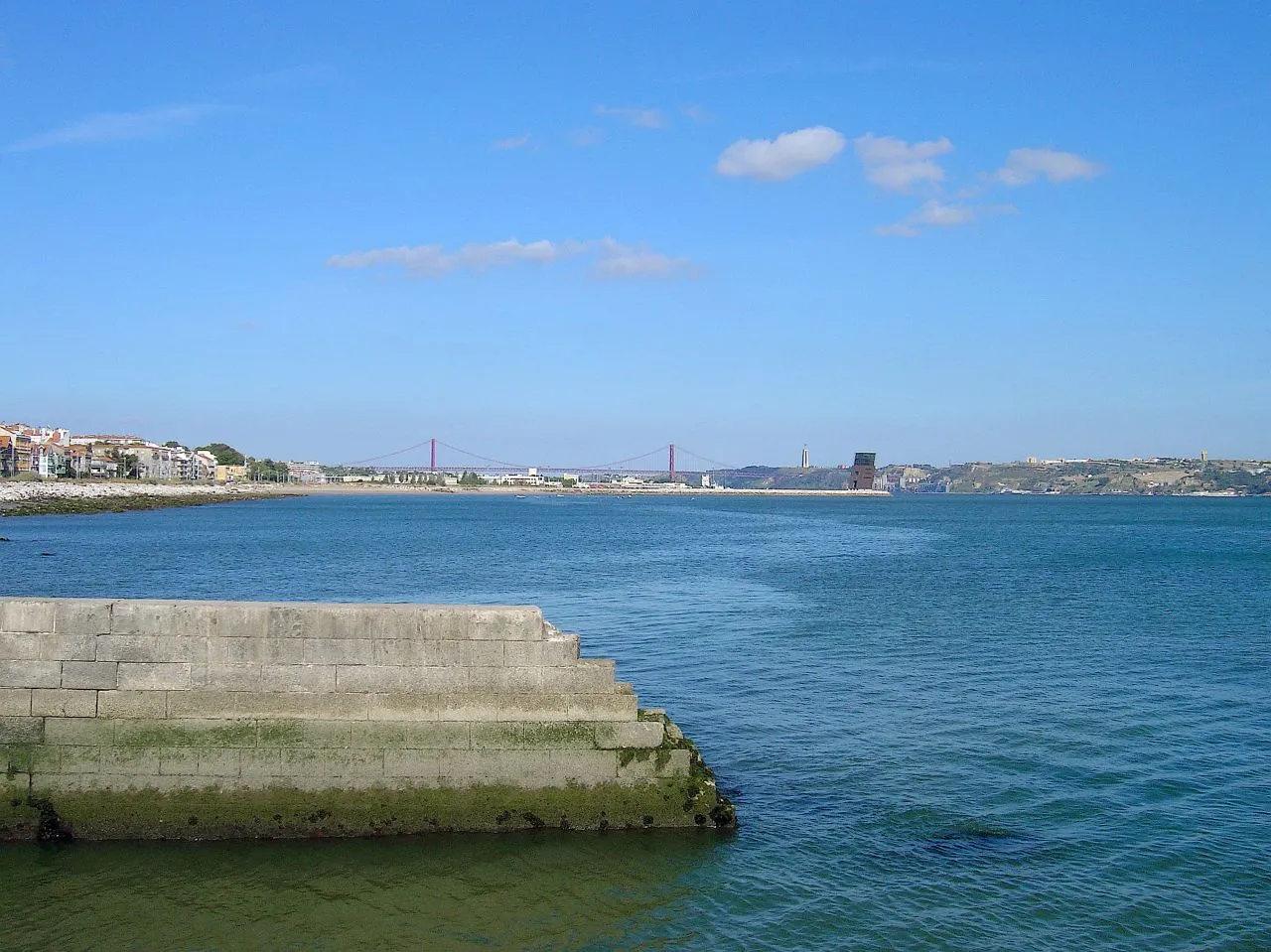
Commander Mesquita Guimarães of the submarine flotilla went out in a launch flying a white flag and boarded her, listing heavily. He found three dead, wounded men calling for help and few men left aboard. He lowered a black flag the rebels had hoisted, raised the national flag and had tugs run the ship onto the sandbank off Algés (Oliveira places it at Dafundo). The fire in her forward magazine was out by about 09:00.
On the Dão, loyal sailors fought back. Her helmsman was killed, a fire broke out, and a gunner who had broken free ran up a white sheet. She stopped off the south bank, near Porto Brandão in Oliveira's account and near Cais do Ginjal in Andrade's; her boatswain dropped anchor just before she ran aground.
A midshipman reported that the Dão fired two anti-aircraft rounds at a Naval Aviation launch. Oliveira and the newspapers of the day say the rebels returned the forts' fire. Survivors interviewed after 1974 denied it, saying loyal men had sabotaged the guns.
“The rebels were fleeing, but that did not worry me, because by that hour the banks would already be well policed to receive them.”
On the shore some people turned the swimmers in. Others, fishermen among them, hid them, fed them and gave them dry clothes. Only two escaped the round-up. António Dinis Cabaço gave himself up a few days later; Armindo Almeida, known as “Peru”, reached Spain and died in the civil war.
Counting the dead, punishing the living
Nobody agrees on the toll. Luísa Tiago de Oliveira counts five dead, all rebels, and more than 20 wounded, following Gisela Santos de Oliveira's 2009 history of the revolt. The historians Irene Pimentel and Álvaro Garrido give ten. The Museu do Aljube, Lisbon's museum of the resistance, and José Luís Andrade give twelve.
| What was counted | Number | Source |
|---|---|---|
| Dead | 5, all rebels | Gisela Santos de Oliveira (2009) and Luís Farinha (2020), cited by Luísa Tiago de Oliveira (2023) |
| Dead | 10 | Irene Pimentel (2014) and Álvaro Garrido (2009), cited by Oliveira (2023) |
| Dead | 12 | Museu do Aljube; José Luís Andrade (2020) |
| Wounded | About 20, or more than 20 | Andrade; Oliveira |
| Questioned | 227 | Navy files read by Capinha Henriques (2019); Andrade |
| Accused or arrested | 208 | Garrido, cited by Oliveira; Museu do Aljube |
| Tried | 92, or 91 on 13 and 14 October | Garrido, cited by Oliveira; Capinha Henriques and Andrade |
| Acquitted and reinstated | 43 | Capinha Henriques; Andrade |
| Convicted | 82 | Garrido and Pimentel, cited by Oliveira; Museu do Aljube |
| Sent to Angra do Heroísmo | 48, or 44 plus 4 to Peniche | Oliveira; Museu do Aljube |
| Sent to Tarrafal | 34 | All sources |
The trial figures do not reconcile: 91 tried less 43 acquitted leaves 48, against 82 convicted in Garrido, Pimentel and the Museu do Aljube, and 92 tried less 82 convicted would leave only 10 acquitted. None of the sources explains the gap.
Three days after the revolt, on Friday 11 September, the government gave the navy minister a free hand. Decree-Law 26:995, signed by President Óscar Carmona, Salazar and his ministers, let him throw out ratings and sergeants and dismiss or retire officers involved in what happened that morning. Men who could prove they had resisted the mutiny could apply to be taken back.
“The Minister of the Navy is authorised, without dependence on any formalities, to discharge the ratings and sergeants and to dismiss or retire the officers who directly or indirectly took part in, or are responsible for, the events that occurred on the morning of 8 September 1936 aboard the sloop Afonso de Albuquerque and the destroyer Dão.”
Officers paid too. The officers of the day of all three ships were dismissed, and their commanders, though not aboard that night, were put on the reserve list; one was later rehabilitated. Henrique Tenreiro, the aide who had come under fire, went on to become an admiral; his biographer Álvaro Garrido traces his rise in the regime partly to his part in putting down the revolt.
Investigators of the PVDE questioned 227 men, almost all of them ratings. A special military tribunal tried the accused on 13 and 14 October. The heaviest sentences, of prison and deportation, were 16 to 20 years; for the 34 later sent to Tarrafal, Capinha Henriques and Andrade list terms of 3, 16, 17 and a half and 20 years. Photographs of the arrests show sailors barefoot, some of them stripped of their clothes.
To Angra and Tarrafal
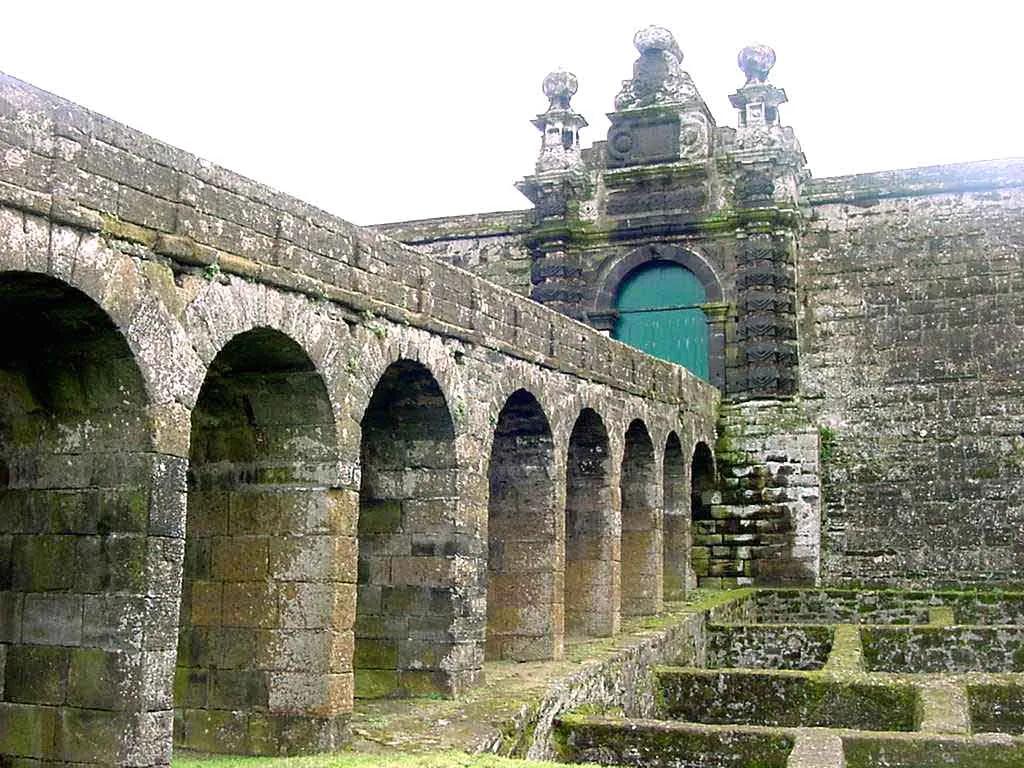
Most of the convicted sailors went to the fortress of São João Baptista at Angra do Heroísmo, on the Azorean island of Terceira, where earlier ORA prisoners were already held: 48 of them according to Oliveira, or 44, with four more sent to the fort of Peniche, according to the Museu do Aljube. The other 34 were chosen for a new camp in Cape Verde.
Before dawn on 18 October 1936 the 34 were driven from Lisbon's Penitentiary in prison vans to the Rocha do Conde de Óbidos quay, where assault vehicles of the police and the National Republican Guard were drawn up. That is the date in the survivors' account and the Museu do Aljube; Capinha Henriques has them embarking on the 14th. The survivors later wrote down the moment they boarded the ship Luanda.
“Then, in the cold morning air and in us, a woman's voice was left vibrating: “Goodbye, Josué! Don't forget to write!””
The Luanda called at Angra, where her naval officer's report says she landed 155 deportees and took on 79, and then sailed for Cape Verde. On 29 October 1936 she landed the first prisoners at Tarrafal, on the island of Santiago: 151 by that report and by Oliveira, 150 or 152 in the Museu do Aljube's notes. The camp was not finished. The officer described canvas tents inside a barbed-wire rectangle, without water or drains.
The camp later became known as the camp of slow death. Five of the 34 sailors died there, and most of the others stayed until it was emptied in 1954.
Spain, the Azores or an ultimatum?
The regime said the sailors had meant to hand Portuguese warships to the Spanish Republican navy. Much of the left came to tell the story the same way. João Faria Borda, the revolt's main organiser, wrote in 1974 that the Spanish war had been the detonator, and in 1987 the historian César Oliveira wrote that the ships were heading for Republican Spain.
Survivors told interviewers something else. The ORA's paper said soon afterwards that the crews meant to wait outside the bar until their demands were met. The Navy's own account gives the aim as the reinstatement of expelled and imprisoned sailors, and some of the men questioned in 1936 spoke of an ultimatum first, then the Azores or Madeira to free political prisoners, and Spain only if all else failed.
The Museu do Aljube puts the Azores first: storm the prisons there, free the comrades held in them and set up a provisional government to demand Salazar's fall.
“What we wanted was to get out past the bar, blockade the port of Lisbon and order the government to resign. When you make a revolution it is to win, and so we thought of coming back up the Tagus in triumph. We would only go to Spain if we lost.”
Why it is still remembered
After the Carnation Revolution of 25 April 1974 ended the dictatorship, the rebel sailors were reinstated in the navy. In 1999 President Jorge Sampaio gave the surviving Tarrafal sailors the Order of Liberty. In 2009 a monument to the Insubmissive Sailor was unveiled at Feijó, in Almada, and 8 September was chosen as the national day of the ratings of the army, navy and air force.
In 2016 the Navy's central library marked the 80th anniversary of what it called “the only revolt of ratings”. On 8 September 2023 the ratings' associations laid flowers at the Feijó monument.
The revolt also closes two major Portuguese novels. Jorge de Sena's Sinais de Fogo, published in 1979, ends as its narrator hears that the sailors have been defeated, and José Saramago's O Ano da Morte de Ricardo Reis (1984) ends in the same days.
FAQs
What was the 1936 sailors' revolt in Portugal?
In the night of 7 to 8 September 1936, ratings on the warships Afonso de Albuquerque, Bartolomeu Dias and Dão in the Tagus locked up their officers and tried to take two of the ships out to sea, to force Salazar's government to reinstate 17 sailors expelled after a voyage to Spain. Shore forts shelled the ships, and the revolt was crushed within hours.
Did the mutineers want to sail to Spain?
The regime said so, and many later accounts repeated it. Survivors and recent research say the first aim was an ultimatum from outside the bar of Lisbon for the expelled sailors' reinstatement; sailing to the Azores to free political prisoners, or to Republican Spain, were fallbacks.
How many people died in the 1936 naval revolt?
Sources differ: five dead (Gisela Santos de Oliveira, followed by Luísa Tiago de Oliveira), ten (Irene Pimentel and Álvaro Garrido) or twelve (the Museu do Aljube). About 20 more were wounded.
What happened to the sailors afterwards?
Of 208 accused, 82 were convicted, with sentences of up to 20 years. Between 44 and 48 went to the fortress at Angra do Heroísmo in the Azores, four by one count to Peniche, and 34 to the new Tarrafal camp in Cape Verde, where five died. A decree of 11 September 1936 let the navy expel those involved without formalities.
How is the revolt remembered?
The surviving Tarrafal sailors received the Order of Liberty in 1999. Since 2009 a monument at Feijó, in Almada, has honoured them, and 8 September is the national day of the ratings of Portugal's armed forces.
On the timeline
Open the timelineNearby moments from dictatorship and the estado novo (1926–1974).
The film director Paulo Rocha is born in Porto. His debut feature, 'Os Verdes Anos' (1963), about a young country boy adrift in Lisbon, is regarded as a founding work of Portugal's Novo Cinema, the 1960s new wave that broke with the cosy comedies favoured under the Estado Novo.
José Policarpo is born in Alvorninha, near Caldas da Rainha. A theologian, he served as Cardinal Patriarch of Lisbon from 1998 to 2013, the leading voice of the Portuguese Catholic Church through two papal conclaves.
Otelo Saraiva de Carvalho is born in Lourenço Marques (now Maputo), Mozambique. As chief strategist of the Armed Forces Movement he directed the 25 April 1974 coup from a command post at Pontinha; he later ran second in the 1976 presidential election and was tried over alleged links to the FP-25 armed group before a 1996 amnesty.
The 1936 sailors' revolt
Sailors of the Organização Revolucionária da Armada, linked to the clandestine Communist Party, seize the warships Afonso de Albuquerque and Dão in the Tagus, demanding the reinstatement of 17 expelled comrades. Shelled by the forts at Almada and Alto do Duque, both ships surrender; 5 to 12 men die, and 34 mutineers are among the first prisoners of the new Tarrafal camp.
The steamer Luanda lands the first 152 political prisoners at the Tarrafal concentration camp on Santiago island in Cape Verde, among them Marinha Grande strikers and sailors from the September mutiny. The 'camp of slow death' operated until 1954 and again from 1961 to 1974.
Afonso Costa dies in exile in Paris, aged 66. Leader of the Democratic Party and three times head of government of the First Republic, he wrote the 1911 Law of Separation of Church and State and, as finance minister, closed two budgets in surplus. After the 1926 coup he opposed the dictatorship from Paris.
Anarchists including Emídio Santana detonate a bomb hidden in a sewer on Avenida Barbosa du Bocage in Lisbon as António de Oliveira Salazar steps out of his car to attend Sunday Mass at a friend's private chapel. The blast goes off only a few metres away but the dictator is unhurt; thanksgiving Masses are said across the country and the failed attack burnishes his providential image.
Coming up in history
All long reads
15 sources
Archives, scholarship and reporting this article was checked against.
- 1
Uma cultura de resistência. A Revolta dos Marinheiros de 1936 (Luísa Tiago de Oliveira)Ler História, no. 82 (2023), pp. 217-237, OpenEdition Journals
- 2
A Revolta dos Marinheiros de 1936 (José Eduardo Capinha Henriques, MA dissertation in naval military sciences)Escola Naval, Alfeite, 2019 (PDF hosted by Memorial 2019)
- 3
Decreto-Lei n.º 26:995 (authorising the Minister of the Navy to discharge or dismiss those involved in the events of 8 September 1936)Diário do Governo, I série, n.º 214, 11 September 1936 (Presidência do Conselho), via Diário da República
- 4
Revolta dos Marinheiros de 1936Museu do Aljube: Resistência e Liberdade (EGEAC), 8 September 2024
- 5A Revolta dos Marinheiros de 8 de Setembro de 1936 (José Luís Andrade)Observador, 13 September 2020
- 6
80 anos da única revolta de praças: A Revolta de MarinheirosBiblioteca Central de Marinha, Arquivo Histórico (Portuguese Navy), 8 September 2016
- 7
Um golpe na República: 28 de Maio de 1926, da Ditadura Militar ao Estado NovoMuseu da Presidência da República
- 8
O Estado Novo (1933-1974)Assembleia da República
- 9
- 10
O Marinheiro Vermelho: órgão da Organização Revolucionária da Armada (scanned issues, 1934-1936)Marxists Internet Archive, Portuguese section
- 11
- 12
- 13
O território do campo de concentração português (Antónia Gato)IX Congresso Português de Sociologia, Associação Portuguesa de Sociologia
- 14
Feijó: 87.º aniversário da Revolta dos Marinheiros de 1936Almada Online, 9 September 2023
- 15
Image credits
- The Tagus from the Forte de Almada in 2009, looking across to Lisbon under the 25 de Abril bridge, which opened in 1966. On the morning of 8 September 1936 the guns at Almada shelled the two rebel ships in the river below. Carlos Luis M C da Cruz, CC BY-SA 3.0, via Wikimedia Commons.
- The new sloop Afonso de Albuquerque arriving in the Tagus in 1935, as printed in the Gazeta dos Caminhos de Ferro of 1 April 1935. Unknown author, Public domain, via Wikimedia Commons.
- The Tagus from Cruz Quebrada, next to Dafundo, in 2005, looking upriver towards Algés and the 25 de Abril bridge. The crippled Afonso de Albuquerque was run onto the sandbank off this north shore. Vitor Oliveira from Torres Vedras, PORTUGAL, CC BY-SA 2.0, via Wikimedia Commons.
- The Gate of Arms of the fortress of São João Baptista at Angra do Heroísmo, Terceira, in 2007. Between 44 and 48 of the convicted sailors were imprisoned here. José Luís Ávila Silveira/Pedro Noronha e Costa, Public domain, via Wikimedia Commons.