

“Independence or death”: Pedro at the Ipiranga, 1822
Riding up from the coast on a mule, unwell and in a hurry, the 23-year-old regent read letters from Lisbon and Rio on a hilltop outside São Paulo. Four men who were with him later wrote down what he said next, and they do not quite agree.
At a glance
- On the afternoon of Saturday 7 September 1822, on a hill above the Ipiranga stream about 6 km from the centre of São Paulo, Prince Regent Pedro declared Brazil separated from Portugal.
- He was answering despatches from Lisbon, where the Cortes, Portugal's elected constituent parliament, had annulled his council and wanted Brazil governed from Europe, and letters from his wife Leopoldina and his chief minister José Bonifácio.
- Four men who rode with him left accounts, written between about 1827 and 1862, and they give him different words. The motto “Independence or Death” appears in his proclamation to the people of São Paulo the next day.
- Pedro was acclaimed emperor in Rio de Janeiro on 12 October 1822, his 24th birthday, and crowned on 1 December. Portuguese garrisons fought on in Bahia, Piauí, Maranhão, Pará and Montevideo into 1823 and 1824.
- Portugal recognised the Empire of Brazil in a treaty signed in Rio on 29 August 1825, with Brazil agreeing to pay £2 million. Pedro became Pedro IV of Portugal in 1826, and his heart is kept in Porto.
A sick prince on the Santos road
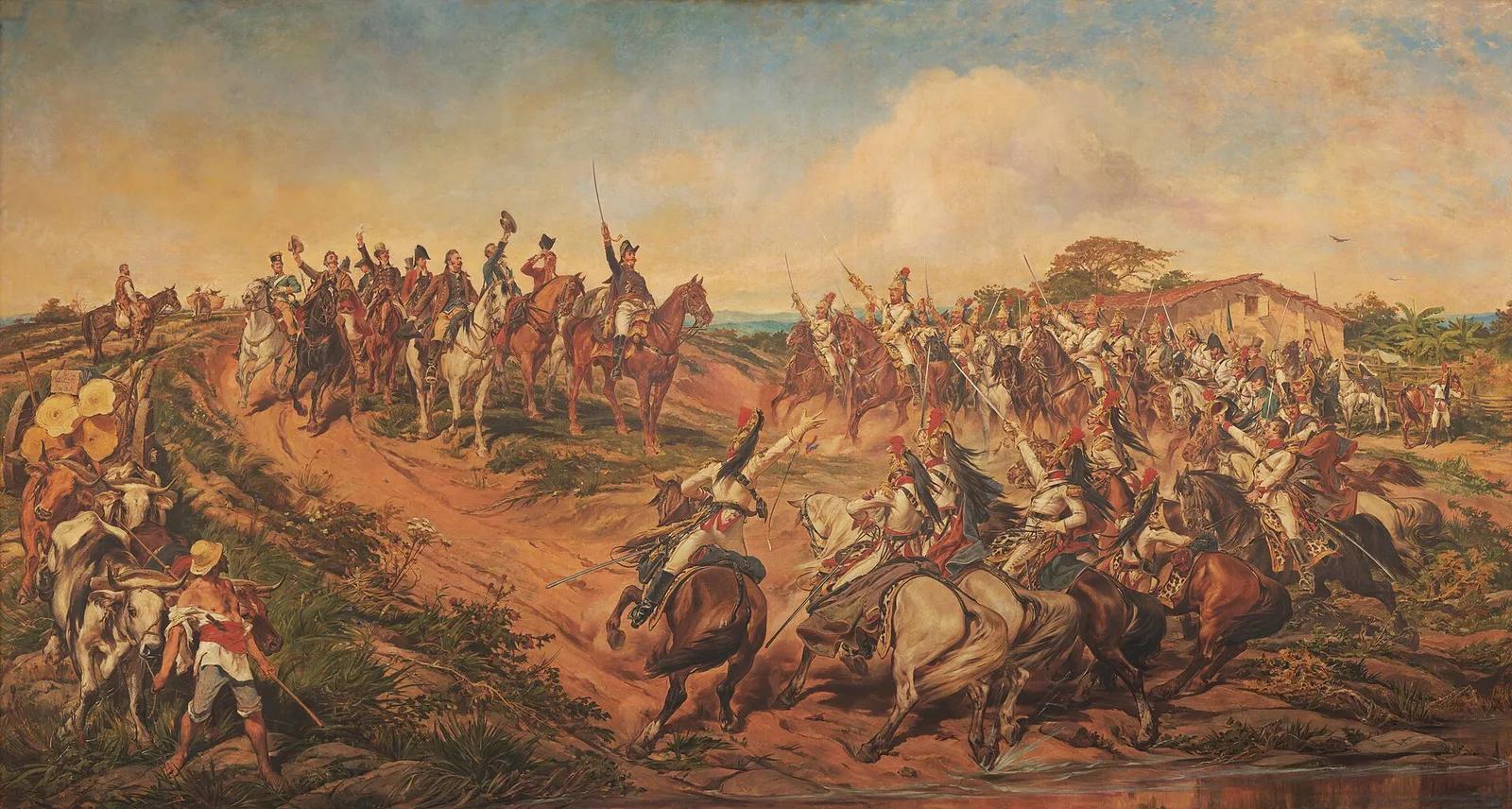
Pedro de Alcântara had a bad stomach. The Prince Regent of Brazil had ridden down from São Paulo to the port of Santos on 5 September 1822, and on Saturday the 7th he started back: by boat through the channels to Cubatão, then up the wall of the Serra do Mar on the Calçada do Lorena, a stone-paved road of tight hairpins finished in 1792. He rode a mule, a “besta baia gateada”, a dun with darker markings, according to the second commander of his escort.
Somewhere on the plateau the 23-year-old prince complained of colic and had to stop and dismount. The commander of his guard of honour, Colonel António Leite Pereira da Gama Lobo, a Portuguese officer who had come over with the royal family, took his thirty or so horsemen on ahead to wait for him by a small house beside the Ipiranga stream. The priest riding with Pedro later blamed a dysentery he had caught in Santos.
At a place called Moinhos, about three kilometres short of the stream, a young lieutenant of the guard, Francisco de Castro Canto e Melo, met him coming the other way. Couriers had reached São Paulo from Rio, he reported, with despatches from the government of Portugal, and were riding out after him. Pedro hurried on ahead of his companions and up the hill.
On the flat top of the rise, three-quarters of a league from the city in Canto e Melo's reckoning, the couriers Paulo Bregaro and António Ramos Cordeiro found him. They had ridden from Rio de Janeiro. The packet they handed over held instructions from the Cortes in Lisbon, a letter from his father, King João VI, and letters from his wife, Princess Leopoldina and from his chief minister, José Bonifácio de Andrada e Silva. Padre Belchior Pinheiro de Oliveira read them aloud.
What you need to know first: a kingdom the Cortes wanted back
Brazil had not been a mere colony for some years. The Portuguese court had moved to Rio de Janeiro in 1808, fleeing Napoleon, and in 1815 Brazil was raised to a kingdom, joined to Portugal and the Algarve in a United Kingdom under one crown. When King João VI sailed home in April 1821, after the liberal revolution of 1820 in Porto, he left his heir, Pedro, in Rio as regent by a decree of 22 April.
The new power in Lisbon was the Cortes, an assembly elected to write Portugal's first constitution. On 1 October 1821 it published laws that put each Brazilian province under a junta answering to Lisbon and ordered Pedro back to Europe. He refused on 9 January 1822, the Dia do Fico, and through 1822 the two governments drew apart. By 1 August Pedro was signing a decree that said Brazil had already proclaimed its political independence and that troops sent from Portugal were to be treated as enemies.
The Cortes had already hit back. Under three decrees of 23 July 1822, Pedro could stay in Rio to govern the southern provinces, but the king and the Cortes would choose his ministers, his council of provincial procurators was annulled, and the São Paulo junta members who had petitioned him to stay were to be held to account.
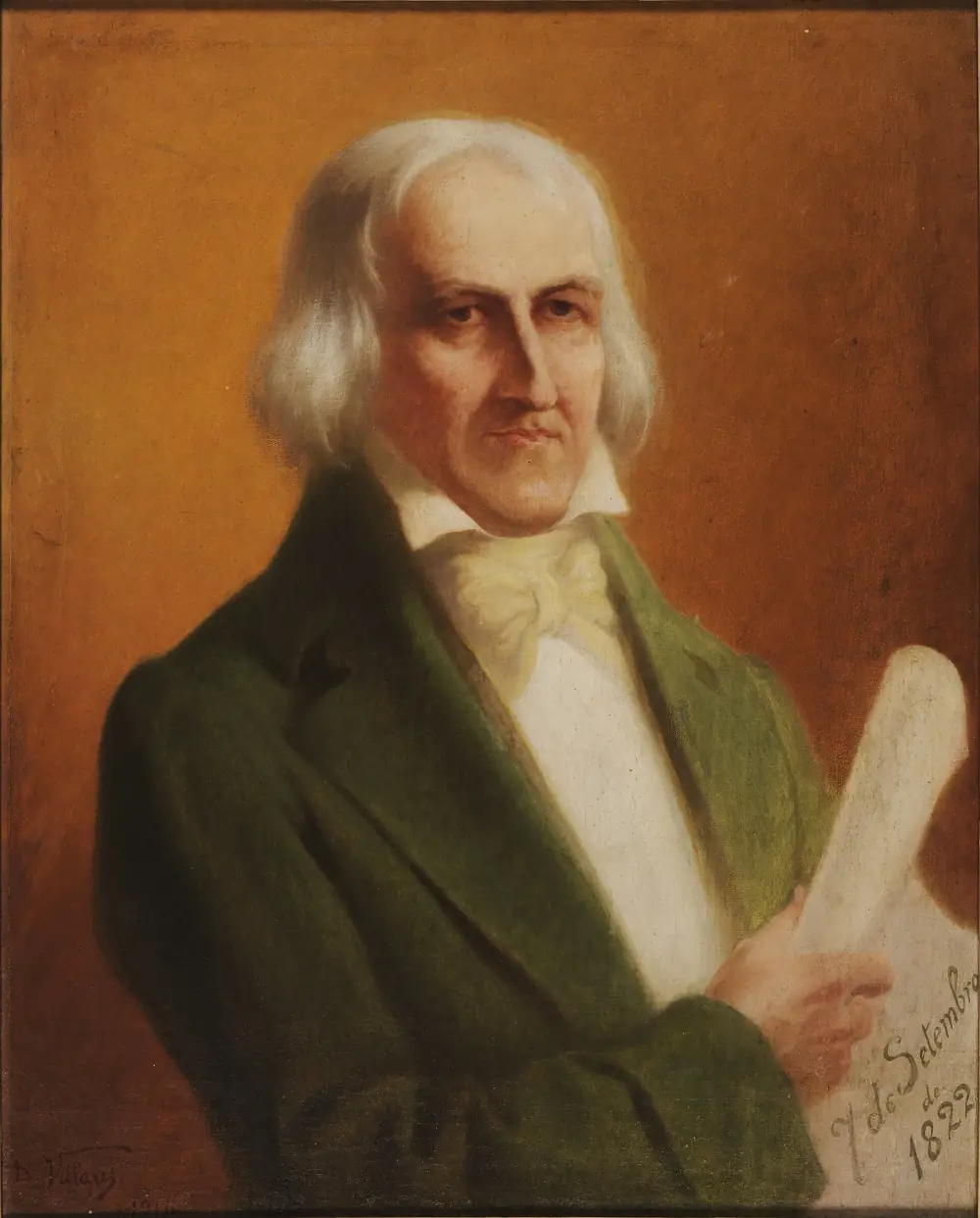
In August Pedro rode to São Paulo to settle a quarrel inside the provincial government over José Bonifácio's brother, Martim Francisco. On 14 August he left Leopoldina to preside over the council of ministers in his absence. When ships from Lisbon brought news that more troops were coming and that the Cortes had insulted the prince, she chaired a session of the council on 2 September. Its conclusion, in the words of the Brazilian Chamber of Deputies' bicentenary exhibition, was to recommend to Pedro the immediate rupture of all ties with Portugal.
“Sir! The die is cast, and from Portugal we have nothing to expect but slavery and horrors. Come, Your Royal Highness, as soon as possible and make up your mind, because irresolution and lukewarm measures, in the face of this enemy who does not spare us, are of no use, and a moment lost is a disaster.”
Half past four on the hill
The fullest account of what followed is Padre Belchior's. He was a Coimbra-educated parish priest from Pitangui in Minas Gerais, elected a deputy to the Cortes in Lisbon and close to the prince. When he finished reading, Belchior wrote, Pedro, shaking with rage, snatched the papers from his hands, crumpled them, trod on them and left them on the grass. “I picked them up and kept them,” the priest added. Pedro buttoned his tunic and asked him what to do.
Belchior gave him the choice José Bonifácio had already put to him: make himself king of Brazil, or become a prisoner of the Cortes and perhaps be disinherited by them. Pedro walked back to the road where the animals stood.
To the small group around him he said: “I proclaim Brazil forever separated from Portugal.” He sent Canto e Melo down the hill to tell the guard.
By the stream, Gama Lobo had posted a lookout, Miguel de Godoi. The two couriers had passed the resting guard a little earlier on their way to the prince. When the lookout came running, Gama Lobo had his men mount, and some barely reached their saddles before the troop set off up the slope.
“It must have been about half past four in the afternoon. The Prince was coming in haste. Seeing him turn towards us, we went out to meet him; in front of the guard, which formed a semicircle, he reined in his animal.”
The swords came out. A law of August 1821 had made the blue-and-white cockade of the Cortes, the symbol of the Portuguese nation, compulsory on the hat of every officer and soldier of the Portuguese army and navy.
Pedro tore his from his hat, Belchior wrote, threw it to the ground and called on the soldiers to do the same. Gama Lobo remembered the guard following his lead. The second declaration, in front of the guard, was louder than the first.
“By my blood, by my honour, by my God, I swear to bring about the freedom of Brazil! [...] Brazilians, our motto from this day on will be Independence. Or Death!”
The phrase was not improvised. Shortly before, José Bonifácio had given a talk with that title in Rio, either at a Masonic lodge or at the first meeting of the Apostolado, his own semi-secret society; the historians differ. The spot itself was fixed in 1825, when São Paulo's councillors went out with Canto e Melo and others who knew it and had surveyors measure along the road: 184 braças, or 404.80 metres, up the slope from the head of the bridge over the Ipiranga. A mast and stone set up there in 1902 were lost when the ground was dug over for new gardens in 1922.
Pedro galloped the last few kilometres into São Paulo. Riding through the streets, Canto e Melo called the news up to two acquaintances at their windows. At the governor's palace on the Pátio do Colégio, he wrote, Pedro at once made a paper pattern of the legend “Independência ou morte”. At the opera house beside the palace, the prince was hailed as king of Brazil.
Next day, Sunday 8 September, he issued a proclamation to the people of São Paulo. It blamed the “traitors of the Nation, the infamous Deputies” in Lisbon who meant to attack Brazil, announced that he was leaving for Rio to consult his councillors, and set down the motto.
“The Motto of Brazil must be: INDEPENDENCE OR DEATH.”
Four witnesses, four versions
None of the men on the hill wrote an account that day. What we know comes from four of them, and they wrote at very different distances from the day. Jorge Pimentel Cintra of the Museu Paulista, who compared the earliest versions of their texts and retraced the route by boat, car and on foot, finds them of unequal value but reconcilable on most points.
| Witness | Who he was | Age in 1822 | When he wrote | What he says Pedro said |
|---|---|---|---|---|
| Padre Belchior Pinheiro de Oliveira (1775-1856) | Parish priest of Pitangui, deputy elected to the Lisbon Cortes, Pedro's confidant; read the letters aloud | 47 | By 1827, probably earlier | “I proclaim Brazil forever separated from Portugal”, then before the guard: “our motto from this day on will be Independence. Or Death!” |
| Lieutenant Francisco de Castro Canto e Melo (1799-1868) | Aide to Pedro, younger brother of the future Marchioness of Santos; grew up beside the stream | 23 | 14 April 1862 | “It is time! Independence or death! We are separated from Portugal!” |
| Colonel Manuel Marcondes de Oliveira e Melo (1780-1863) | Second commander of the guard of honour, later Baron of Pindamonhangaba | 42 | 1862, answering a questionnaire | Told the guard that the Portuguese Cortes “wanted to massacre Brazil”, threw down his Portuguese cockade and gave the cry “Independence or Death!” |
| Colonel António Leite Pereira da Gama Lobo (1782-1857) | Commander of the guard of honour; had come from Portugal with the royal family | 40 | Before 1854 | With sword drawn: “Friends! The ties that bound us to the Portuguese government are broken for ever!”, then “our motto from now on will be: Independence or Death!” |
Ages as given by Cintra. Belchior's text is known from a pamphlet, now lost, that Francisco de Assis Cintra found in a small review in a library in Minas Gerais, never identified, and published in 1921. Marcondes admitted that 40 years had wiped many details from his memory. Copies of Gama Lobo's account differ on the hour: about four o'clock or about half past four. Quotations translated from Portuguese.
Cintra trusts Belchior most for the scene on the hill, because he wrote soon after and in detail that would be hard to invent, and Canto e Melo most for places, because he grew up on his father's farm a few metres from where it happened. Marcondes muddles the order of events and puts Pedro's request for an “Independence or death” legend on the roadside instead of in São Paulo. There were, on Belchior's evidence, two declarations: a nearly private one before Pedro's own companions and a public one before the guard.
Which letters Pedro read is still argued over. Two that Leopoldina wrote on 28 and 29 August survive in the imperial family's archive, and some historians took them to be the ones read on the hill; the second begins “I am sending you Paulo”. The historian Carlos Oberacker doubted it: they urge Pedro to hurry back but contain nothing to explain his rage, and Belchior says he kept the papers himself. Her letters say nothing about 7 September, and Moacyr Flores wondered whether the silence was part of a political secret.
From the hill to the throne
Back in Rio, Pedro signed decrees on 18 September that turned the motto into law. Anyone, European Portuguese or Brazilian, who embraced “the present system of Brazil” would wear on the left arm a green flower inside a gold angle with the legend “Independence or Death”. Anyone who would not was to leave his town within 30 days and Brazil within four months, or two in the coastal cities. A general amnesty covered past political opinions.
Another decree that day gave the kingdom new arms: on a green field, a gold armillary sphere crossed by the cross of the Order of Christ, ringed by 19 silver stars on a blue band for the 19 provinces, between branches of coffee and tobacco. The flag would be a green field with a gold lozenge carrying the arms. The decree still called Brazil a kingdom and Pedro its regent and perpetual defender.
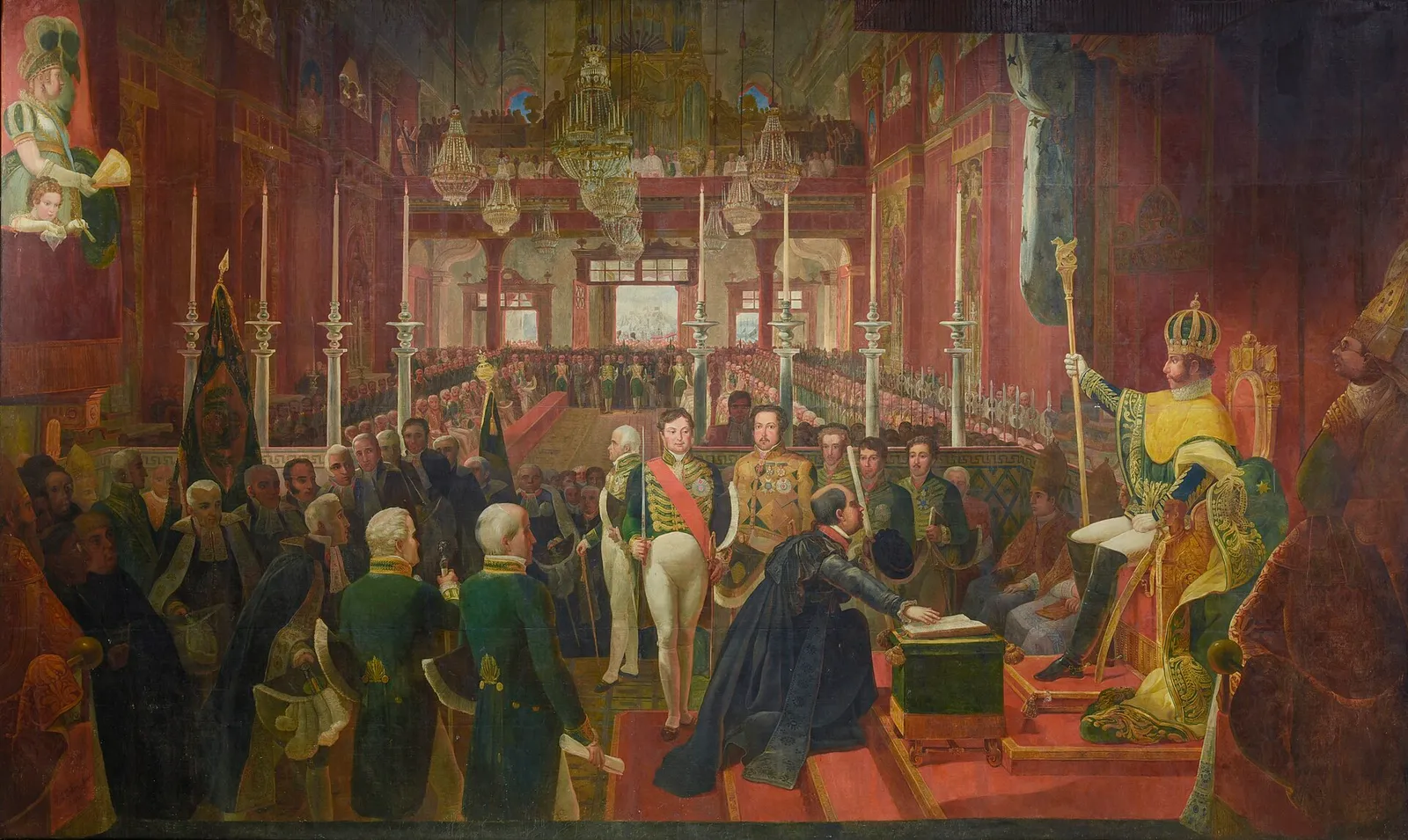
On 12 October 1822, his 24th birthday, Pedro was acclaimed Constitutional Emperor of Brazil on the Campo de Santana in Rio. He himself treated that day, not 7 September, as the date of independence. He was crowned on 1 December, the anniversary of the 1640 rising that ended Spanish rule in Portugal and put the first Bragança on the throne.
Lisbon was weeks behind. On 24 September 1822, the day after the Cortes approved the new Portuguese constitution, a law declared Pedro's constituent assembly void, removed him from the regency and named the city of Bahia, as Salvador was then called, seat of a new regency for Brazil. By then he had already broken away. News of the acclamation came to Lisbon with the captain of the ship Lusitania, and the official Diário do Governo printed it on 28 December.
22 April 1821
João VI names Pedro regent of Brazil
The king sails for Lisbon days later.
1 October 1821
Lisbon recalls the prince
Brazil's provinces are put under juntas answering to Lisbon.
9 January 1822
Dia do Fico
Pedro refuses to leave.
3 June 1822
A Brazilian constituent assembly is called
23 July 1822
The Cortes annul Pedro's council
14 August 1822
Leopoldina left to preside over the council
2 September 1822
Leopoldina's council meets in Rio
Couriers ride for São Paulo.
7 September 1822
The Ipiranga
8 September 1822
Proclamation to the Paulistanos
“Independence or Death” as Brazil's motto.
18 September 1822
Armband, amnesty, arms and flag decreed
12 October 1822
Pedro acclaimed emperor in Rio
1 December 1822
Coronation
28 December 1822
Lisbon's official paper reports the acclamation
13 May 1825
João VI signs letters patent ceding Brazil's sovereignty to Pedro
29 August 1825
Treaty of peace and alliance signed in Rio
15 November 1825
João VI ratifies the treaty in Lisbon
The war that followed
The declaration did not end Portuguese rule everywhere. Garrisons loyal to Lisbon held out in the Cisplatine province (today's Uruguay), in Piauí, Maranhão and Grão-Pará in the north, and above all in Bahia. To beat them at sea, Brazil hired the British admiral Lord Thomas Cochrane and made him First Admiral, a rank created for him alone.
| Province | What happened | When it ended |
|---|---|---|
| Bahia | Brigadier Madeira de Melo's garrison held Salvador through a long siege by Brazilian forces and a naval blockade under Cochrane | The garrison sailed for Portugal on 2 July 1823 |
| Piauí | Major João José da Cunha Fidié defeated a largely volunteer force at the Jenipapo river on 13 March 1823, then retreated into Maranhão | Fidié capitulated at Caxias after about three months and was deported to Portugal |
| Maranhão | Troops from Ceará and Piauí advanced on São Luís from May 1823; Cochrane arrived off the city on 26 July | The junta and council adhered to the Empire on 28 July 1823 |
| Grão-Pará | John Pascoe Grenfell, sent by Cochrane in the brig Maranhão, reached Belém | Adhesion to the Empire proclaimed on 15 August 1823 |
| Cisplatina | European troops under Álvaro da Costa held Montevideo for João VI against the Brazilian forces of General Carlos Frederico Lecor | After an agreement with Lecor, Costa's troops left for Portugal in 1824 |
Dates as given in the sources cited. Bahia's war is told in our article on the Battle of Pirajá.
Jenipapo was one of the most violent days of the war. Fidié's artillery caught the poorly armed cowhands and smallholders of Campo Maior on the riverbank. The journalist Laurentino Gomes, quoted in the Brazilian Chamber of Deputies' exhibition on the battle, put the dead on the independence side at more than 200, with about 500 taken prisoner, against 16 Portuguese. Fidié won the field, but the patriots made off with his baggage, leaving him short of pay and ammunition, and he turned away from Piauí's capital, Oeiras.
In the north the end came with Cochrane's ships. Chasing a few Portuguese ships north from Salvador, he arrived off São Luís on 26 July 1823, and two days later Maranhão's junta and town council adhered to the Empire. Pará followed on 15 August. Victory brought reprisals: in Belém in October 1823, 256 people were locked in the hold of the brig later called the Palhaço, and next morning 252 of them were found dead, according to figures given by the historian Aldrin Figueiredo.
Recognition, and its price
Portugal held out longest in diplomacy. With Britain mediating, João VI signed letters patent on 13 May 1825 that turned Brazil into an empire and passed its sovereignty to Pedro, a form that let Lisbon present independence as a royal gift. The Brazilians refused to treat it that way. The British envoy, Sir Charles Stuart, acting as Portugal's plenipotentiary in Rio, accepted their draft articles and insisted only that the preamble mention the king's act; the Brazilians took the letters patent on condition that they were not published.
The Treaty of Peace and Alliance was signed in Rio on 29 August 1825 by Stuart and three Brazilian negotiators. In eleven articles João VI transferred “of his own free will” the sovereignty of the Empire of Brazil to his son, recognised him as emperor and kept the imperial title for himself. Brazil promised not to accept any other Portuguese colony that wished to join it. An additional convention of the same day committed the emperor to pay £2 million to settle the claims between the two governments.
- Signed
- Rio de Janeiro, 29 August 1825
- For Portugal
- Sir Charles Stuart, British diplomat acting as plenipotentiary
- Articles
- 11, plus a 4-article additional convention
- Compensation
- £2 million, paid by Brazil
- Duties
- 15% on trade between the two countries
- Ratified by João VI
- 15 November 1825
João VI ratified it in Lisbon on 15 November 1825, against the grumbling of merchants and courtiers. Other powers followed Portugal's lead, beginning with Britain. The first state to recognise the empire had been the African kingdom of Onim, in 1823, although the United States, in 1824, is usually counted first.
Why it still matters
Seven September is the official date of Brazil's independence, and the stream is named in the national anthem. Historians now treat the day as one step in a longer process. Moacyr Flores argues that independence was already made by Pedro's manifesto to foreign nations of 6 August 1822 and that the cry on the Ipiranga was a symbolic act. The Chamber of Deputies' exhibition on Jenipapo makes the other point: the break was paid for in blood in the north and north-east, far from São Paulo.
For Portugal's liberals it was a defeat. In Tomás Brandão de Macêdo's judgement, the revolutionaries of 1820 lost Brazil and with it the support their constitutional system rested on, and the Constitution of 1822 lasted less than a year. Pedro did not stay away. When João VI died in 1826 he became Pedro IV of Portugal, and from 1832 he fought his brother Miguel for his daughter's throne, enduring a siege of 13 months in Porto. In his will he left his heart to the city.
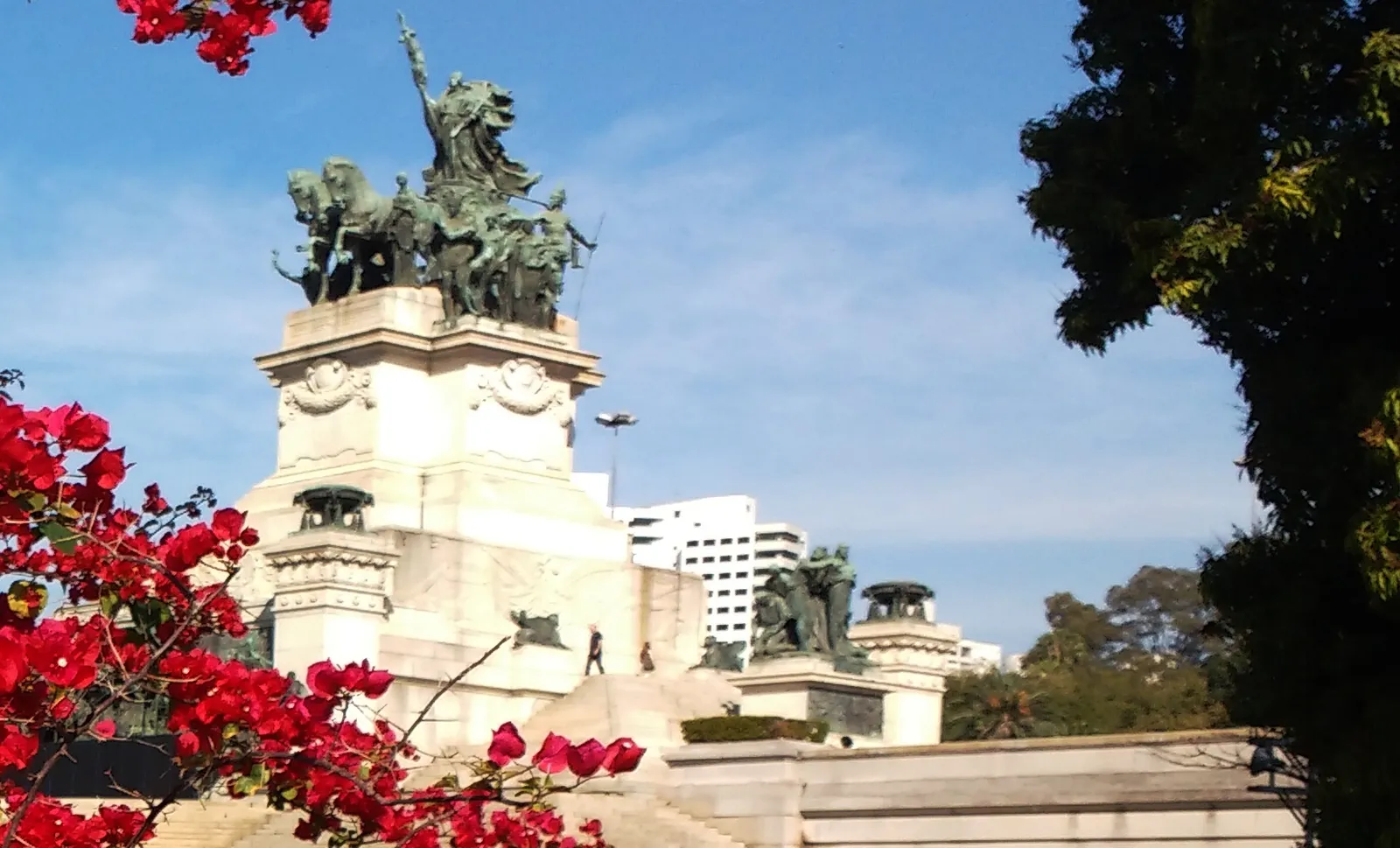
The rest of him went back to Brazil. In 1972, for the 150th anniversary of independence, when both countries were under authoritarian governments, his remains were taken from Portugal to Brazil and carried around the country before being laid in the imperial crypt under the Independence Monument at the Ipiranga, where Leopoldina already lay. His second wife, Amélia, was brought from Lisbon to join them in 1982.
For the bicentenary in 2022, Porto lent the heart. It was flown to Brasília, received with the honours of a head of state and shown at the Itamaraty Palace until 8 September, and the Portuguese president, Marcelo Rebelo de Sousa, was due at the ceremonies. Some people in Porto objected. One shopkeeper told the Diário de Notícias that in Pedro's own day some Portuguese had thought him a traitor for proclaiming Brazil's independence and then trying to keep both crowns.
FAQs
Did Pedro really shout “Independence or death” at the Ipiranga?
Probably something like it, but the wording is uncertain. The four eyewitness accounts, written between about 1827 and 1862, differ. Padre Belchior has Pedro first say “I proclaim Brazil forever separated from Portugal” and then, before the guard, make “Independence or Death” the motto; Canto e Melo has “It is time! Independence or death! We are separated from Portugal!”. All four have him use the motto that afternoon, and it is certain in writing from the next day, in Pedro's proclamation of 8 September 1822.
Why did Pedro break with Portugal on that day?
Despatches had arrived from Lisbon showing that the Cortes, Portugal's constituent parliament, would not accept a separate government in Rio: in July 1822 they had annulled his council of provincial procurators and said his ministers should be chosen in Lisbon, and more troops were expected. Leopoldina's council in Rio sent couriers urging an immediate break, and José Bonifácio wrote that from Portugal Brazil could expect nothing but slavery and horrors.
Was Brazil's independence peaceful?
No. Portuguese garrisons fought on in Bahia until 2 July 1823, in Piauí and Maranhão until mid-1823 and in Montevideo until 1824. At the Jenipapo river in Piauí on 13 March 1823, more than 200 Brazilians were killed, according to figures in a Chamber of Deputies exhibition.
When did Portugal recognise Brazil's independence?
By the Treaty of Peace and Alliance signed in Rio de Janeiro on 29 August 1825, with Britain's Sir Charles Stuart acting for Portugal. João VI ratified it on 15 November 1825. Brazil agreed in an additional convention to pay £2 million to settle the claims between the two governments, and João kept the title of emperor for himself.
Where is the Ipiranga, and can you visit the spot?
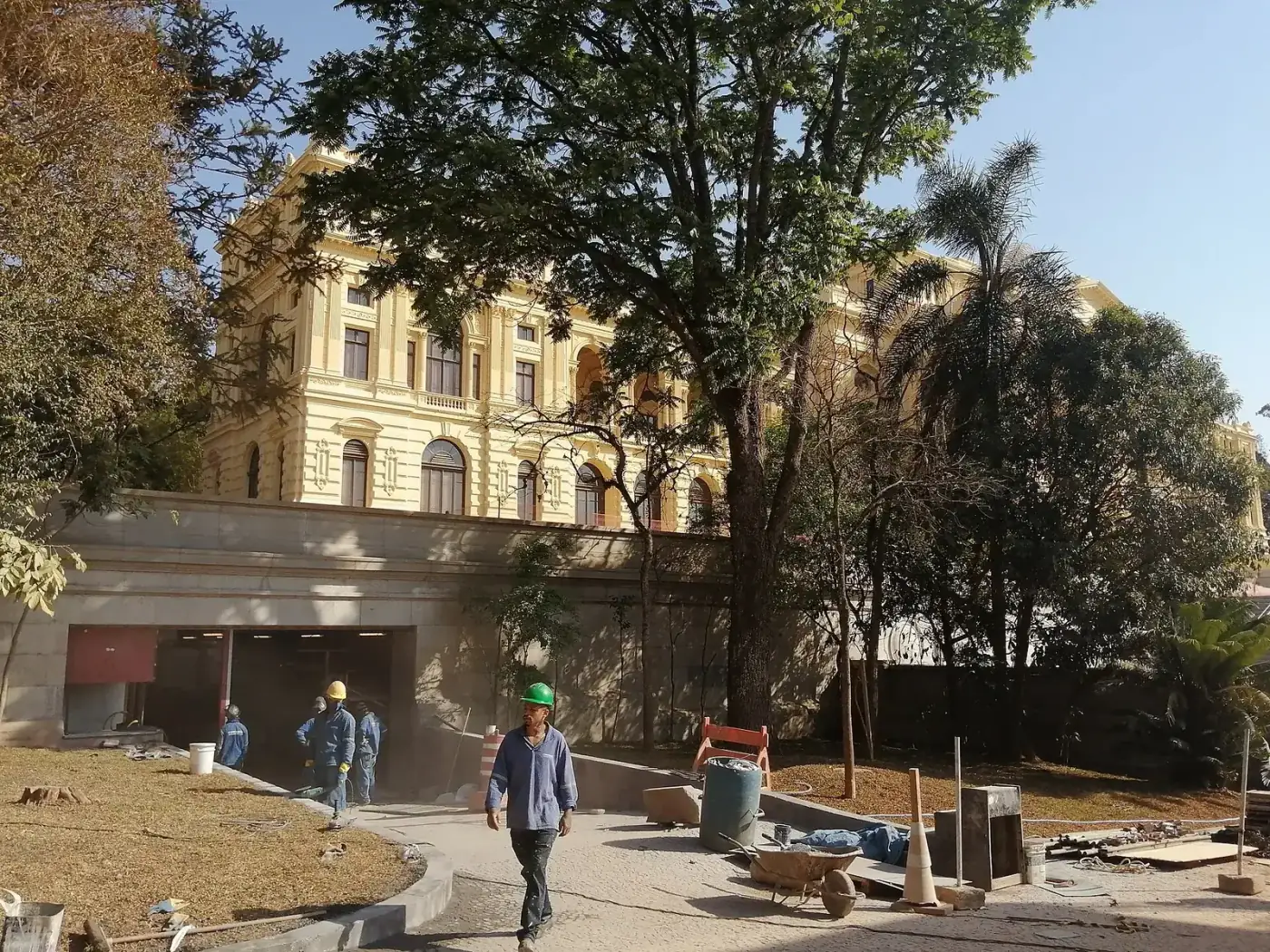
The Ipiranga is a small stream on the old road from Santos, about 6 km from the centre of São Paulo. The hillside above it is now the Parque da Independência, with the Museu do Ipiranga and the Independence Monument. The exact spot was measured in 1825 as 404.80 metres up the road from the bridge, but the marker put there in 1902 was lost when the gardens were rebuilt in 1922.
On the timeline
Open the timelineNearby moments from invasions, brazil and the liberal wars (1807–1851).
The Liberal Revolution begun in Porto on 24 August reaches Lisbon, where soldiers and townspeople in the Rossio depose the regency and rally the capital to the constitutional cause, paving the way for Portugal's first constitution in 1822.
King João VI, back from Brazil, lands at the Terreiro do Paço and at five that afternoon, in the Cortes at the Necessidades palace, swears to uphold the Bases of the new liberal constitution. The Cortes then declare the Regency extinct. Portugal's first liberal regime would unravel within two years.
On the 'Dia do Fico' (the 'I'm Staying' Day), Prince Regent Pedro defies orders from the Cortes in Lisbon to return to Portugal, reportedly declaring 'Diga ao povo que fico' — 'Tell the people I'm staying'. Eight months later he proclaimed Brazil's independence and became its first emperor.
The Grito do Ipiranga
Near the Ipiranga stream outside São Paulo, Prince Regent Dom Pedro proclaims Brazil's independence from Portugal, the 'Grito do Ipiranga'; Portuguese garrisons fought on into 1824 and Portugal recognised the new empire in 1825.
The Constituent Cortes approve the Portuguese Constitution of 1822, the country's first constitution, which sought to end absolutism and establish a constitutional monarchy; King João VI swore his oath to it on 1 October.
On his twenty-fourth birthday, Prince Regent Pedro is acclaimed Constitutional Emperor and Perpetual Defender of Brazil at the Campo de Santana in Rio de Janeiro, a month after the Cry of Ipiranga had proclaimed the country's separation from Portugal.
At Pirajá, outside Salvador da Bahia, Brazilian independence forces beat back General Madeira de Melo's Portuguese troops in the main battle of Bahia's war of independence. Tradition, first printed in the 1830s, says the tide turned when the bugler Luís Lopes, a Portuguese in Brazil's service, sounded 'cavalry, advance' and 'no quarter' instead of the ordered retreat, though no Brazilian cavalry was on its way.
Coming up in history
All long reads
31 sources
Archives, scholarship and reporting this article was checked against.
- 1
O Ipiranga na jornada da Independência (Jorge Pimentel Cintra)Anais do Museu Paulista, nova série, vol. 31, 2023, Universidade de São Paulo
- 2
Proclamação de 8 de Setembro de 1822: sobre a divisa do Brasil, Independência ou Morte (publicação original)Câmara dos Deputados (Brazil), Legislação Informatizada
- 3
Perspectivas políticas e jurídicas acerca do Brasil nas Cortes Constituintes de 1821-1822 (Tomás Brandão de Macêdo, MA dissertation)Faculdade de Direito, Universidade de Coimbra, 2015
- 4
Atas do Conselho de Estado, vol. 1: Conselho dos Procuradores Gerais das Províncias do Brasil, 1822–1823Senado Federal (Brazil)
- 5
Cartas de Dona Leopoldina (Moacyr Flores)Instituto Histórico e Geográfico do Rio Grande do Sul, 2008
- 6
A “Varanda da Europa” e o “Cais do Lado de Lá”: Tratado de paz e aliança entre D. João VI e D. Pedro (29-08-1825) (Zília Osório de Castro), in Tratados do Atlântico Sul: Portugal-Brasil, 1825-2000Fundação Alexandre de Gusmão (FUNAG) and Instituto Diplomático, Brasília, 2022 (first edition 2006)
- 7
A desagregação do império: Portugal e o reconhecimento do Estado brasileiro (1824-1826) (Valentim Alexandre)Análise Social, vol. XXVIII (121), 1993
- 8
- 9
12 October 1798: Birth of Pedro d'Alcântara de Bragança in the Room Don Quixote in the Royal Palace of QueluzParques de Sintra, Palácio Nacional de Queluz (D. Pedro IV chronology)
- 10
- 11
- 12
José Bonifácio conectou as ideias do Iluminismo ao processo de Independência (Diego Viana)Revista Pesquisa FAPESP, no. 319, September 2022
- 13
Cartas, e mais peças officiaes dirigidas a Sua Magestade o Senhor D. João VI pelo Principe Real o Senhor D. Pedro de Alcantara (Lisbon: Imprensa Nacional, 1822)Wikisource, transcription of the edition printed by order of the Cortes
- 14
- 15
- 16
- 17
- 18
- 19
- 20
Memorias historicas e politicas da provincia da Bahia, vol. IV (Ignacio Accioli de Cerqueira e Silva, annotated by Braz do Amaral)Imprensa Official do Estado, Bahia, 1933; scan on the Internet Archive
- 21
E depois da Independência? Os “portugueses” do Maranhão no Império do Brasil (Marcelo Cheche Galves and Roni César Andrade de Araújo)Revista Ágora, vol. 33, no. 1, 2022, Universidade Federal do Espírito Santo
- 22
- 23
Adesão do Pará à Independência: entenda por que o dia 15 de agosto é importante para o estado (Lívia Ximenes)O Liberal (Belém), 15 August 2026
- 24
O Império do Brasil e a Argentina (1822-1889) (Francisco Doratioto)Textos de História, vol. 16, no. 2, 2008, Universidade de Brasília
- 25
- 26
- 27O coração portuense de D. Pedro IVDiário de Notícias, 19 August 2022
- 28
O cinema ficcional histórico nas comemorações do Sesquicentenário da Independência (Lidiane Macedo Cosmelli)ANPUH, Anais do Simpósio Nacional de História
- 29
Monumento à Independência (Adote uma obra artística)Prefeitura de São Paulo, Departamento do Patrimônio Histórico
- 30Coração de D. Pedro recebido no Brasil com honras de chefe de EstadoDiário de Notícias, August 2022
- 31
Festival vai celebrar reabertura do Museu do Ipiranga (Elaine Patricia Cruz)Agência Brasil, 4 September 2022
Image credits
- Independência ou Morte!, painted by Pedro Américo in 1888, 66 years after the event, and hung in the Museu Paulista in São Paulo. The horses, the ox cart and the stream in plain view are the painter's choices: the eyewitnesses put Pedro on a mule, and trees hid the stream. Pedro Américo, Public domain, via Wikimedia Commons.
- José Bonifácio de Andrada e Silva in a portrait by Décio Villares, in the Museu Histórico Nacional, Rio de Janeiro. The painter put the date of the Ipiranga on the paper in his hand. Décio Villares, Public domain, via Wikimedia Commons.
- The coronation of Pedro I in Rio de Janeiro on 1 December 1822, painted by Jean-Baptiste Debret in 1828. The canvas belongs to Brazil's Ministry of Foreign Affairs. Jean-Baptiste Debret, Public domain, via Wikimedia Commons.
- The Independence Monument in the Parque da Independência, Ipiranga, photographed from the side of the stream in 2016. The imperial crypt lies beneath it. Sidney Santa Catharina, CC BY-SA 4.0, via Wikimedia Commons.
- The Museu Paulista on 2 September 2022, with building work still under way six days before it reopened to the public after nine years. Joalpe, CC BY-SA 4.0, via Wikimedia Commons.