

Sophia de Mello Breyner Andresen, poet of the sea, born in Porto in 1919
She learned poems by heart before she could read, wrote of beaches, light and Greece, told stories to her children when they had measles, and stood against Salazar's regime. Since 2014 she has lain in the National Pantheon.
At a glance
- Sophia de Mello Breyner Andresen was born in Porto at 11 in the morning on 6 November 1919, into a Porto merchant family of Danish descent on her father's side and the Lisbon Mello Breyners on her mother's.
- Between 1944 and 1997 she published fourteen books of poetry, full of beaches, light, Greek ruins and an insistence on the exact word.
- Her children's stories, begun when her own children had measles, include A Menina do Mar (1958) and O Cavaleiro da Dinamarca (1964), which by 2001 had reached its 56th edition.
- She opposed the Estado Novo dictatorship, helped found a commission to aid political prisoners in 1969, and after the 1974 revolution was elected for Porto to the Constituent Assembly as a Socialist.
- In 1999 she became the first Portuguese woman to win the Camões Prize. She died in Lisbon on 2 July 2004, and exactly ten years later her remains were moved to the National Pantheon.
A card from an exiled queen
Sophia was born at eleven o'clock on the morning of Thursday 6 November 1919, in a house with a garden on Rua António Cardoso in Porto. Her mother was Maria de Mello Breyner; her father was an Andresen, of a Porto merchant family of Danish origin. Nineteen days later her maternal grandfather, Thomaz de Mello Breyner, received a card of congratulations on the birth of his “Andresen granddaughter”. It came from Queen Amélia.
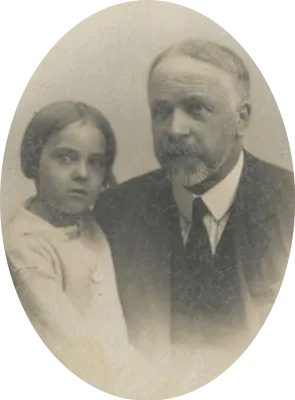
Amélia had been queen of Portugal until the monarchy fell. On 5 October 1910, as the Republic triumphed in Lisbon, fishermen took her and her son, King Manuel II, out from the beach at Ericeira in two small boats to the royal yacht that carried the family into exile. That the exiled queen still sent her congratulations shows how close Sophia's mother's family had been to the vanished court.
She grew up to be the poet the Portuguese simply call Sophia; she preferred poeta, poet, to the feminine poetisa. Her life ran through almost every turn of twentieth-century Portugal: the Republic of her birth, the long dictatorship of António de Oliveira Salazar, the revolution of 25 April 1974 and the democracy that followed, which in 2014 voted unanimously to lay her in the National Pantheon.
A Danish sailor, a red house and the beach at Granja
The Andresens were Danish. Sophia's great-grandfather had sailed from an island in Denmark as a young adventurer, quarrelled with his captain, performed a circus act with a bearskin on the quayside, abandoned ship and stayed in Porto. Sophia later turned the story into her tale “Saga”, and said the episodes were true. So were his words to one of his granddaughters: “The sea is the road to my house.”
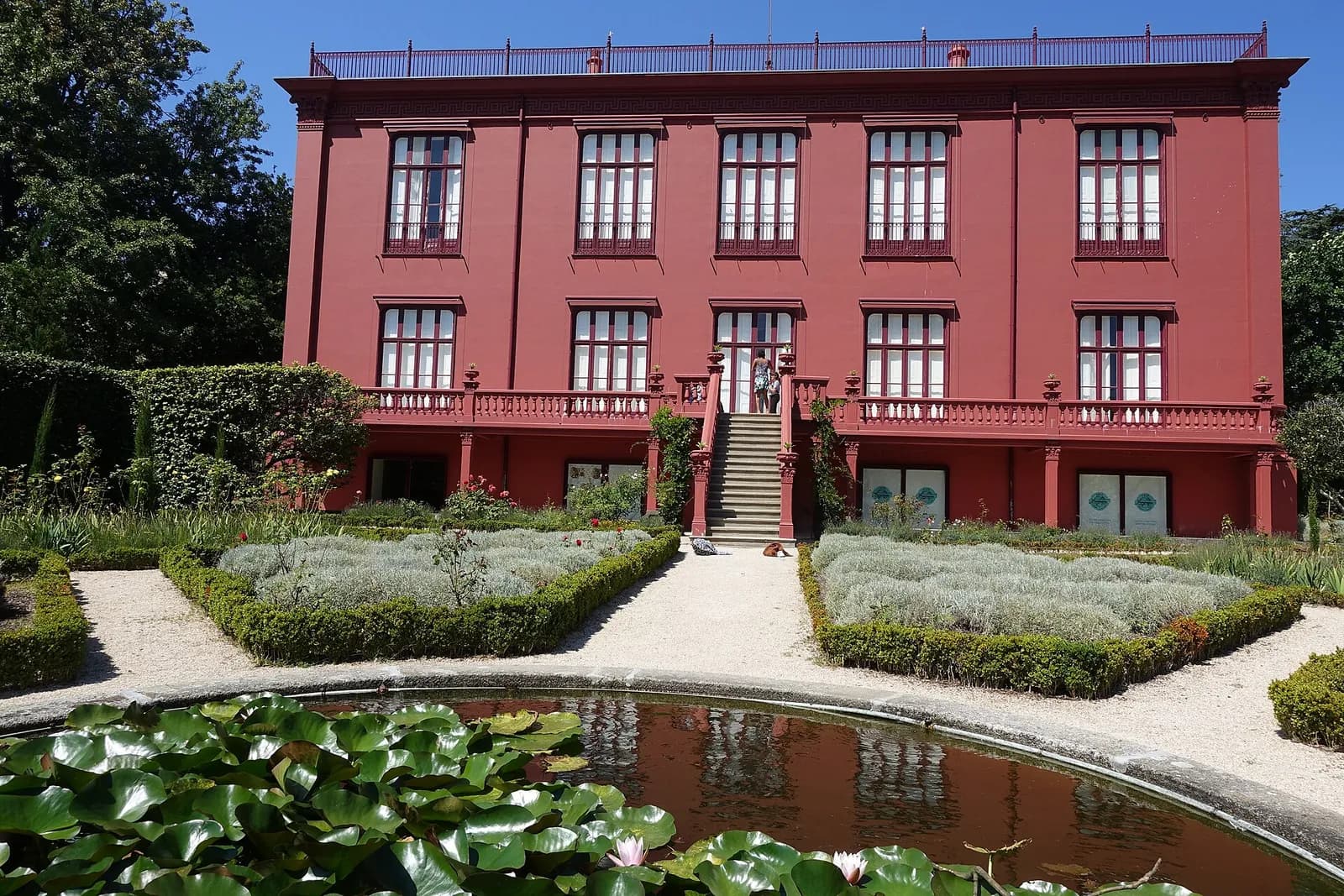
The family traded in port wine. In 1895 an Andresen bought the Quinta do Campo Alegre, an estate in Porto, and replanted its gardens. Sophia's childhood home in the city was above all the Campo Alegre house. Its garden was later cut through by a bridge and its plane trees felled.
Poetry reached her before reading did. At three, a young maid called Laura taught her the old ballad “Nau Catrineta” so that she would not be outdone by an older cousin reciting at Christmas. Between three and seven her grandfather, who recited well, taught her Camões and the nineteenth-century poet Antero de Quental by heart. She thought poems were not made by people. They existed on their own, like the sea or the wind, and you had to pay close attention to catch them.
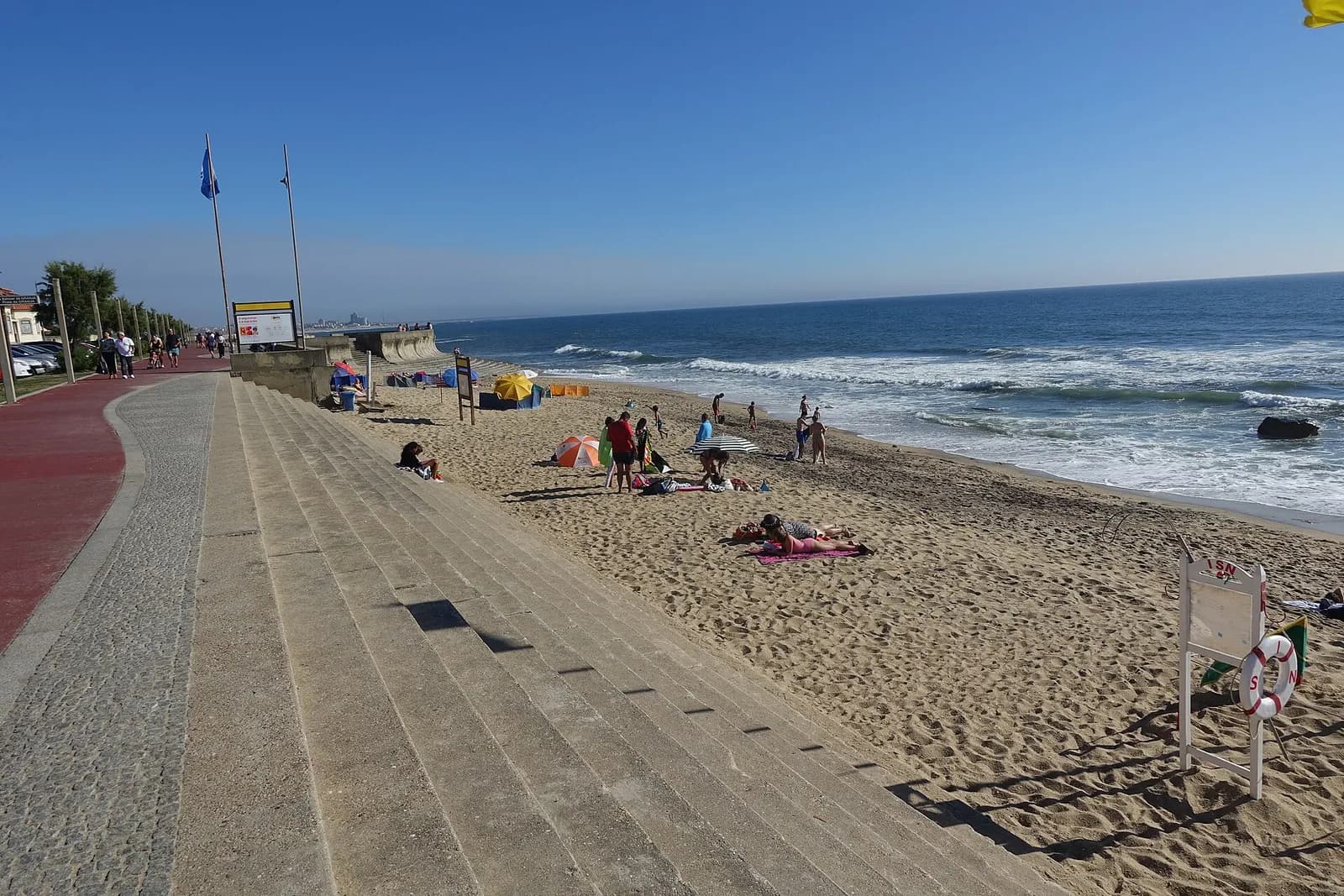
Summers were spent at Granja, a beach south of Porto, which she called a promised land. The Atlantic was her first sea. At home in Porto, on stormy nights, a governess burned rosemary, lit a candle and prayed for the fishermen still out in their boats, and Sophia later traced her first awareness of how hard other people's lives were to those nights.
“Of all the corners of the world / I love with a love stronger and deeper / That beach, enraptured and bare, / Where I was joined to the sea, the wind and the moon.”
Three hundred copies
She began to write at twelve, and between sixteen and twenty-three wrote more than in all the rest of her life. In the late 1930s she studied Classical Philology at the University of Lisbon but left without a degree; the Assembleia da República's dictionary of opposition candidates dates the course to 1936 to 1939, while the chronology prepared with her family for the National Library has her enrolling in 1938.
Her first poems appeared in 1940 in Cadernos de Poesia, a magazine run by José Blanc de Portugal, Tomás Kim and Ruy Cinatti. In February 1944 a friend took her to hear the writer Miguel Torga lecture in Porto. Torga asked to see her poems and was enthusiastic, and she finally took her friends' advice and agreed to publish.
Poesia came off the press in Coimbra at the beginning of August 1944, in an edition of 300 copies paid for by her father. She gave away about a hundred. The other two hundred sold and covered the costs, which, she said, astonished her and astonished her father even more. Her second book, Dia do Mar, followed in 1947 from Ática in Lisbon.
On 27 November 1946 she married Francisco Sousa Tavares, a lawyer and journalist, at the church of Lordelo do Ouro in Porto. They moved to Lisbon, which she disliked at first because it felt so far from the beach, and had five children: Maria, Isabel, Miguel, Sofia and Xavier.
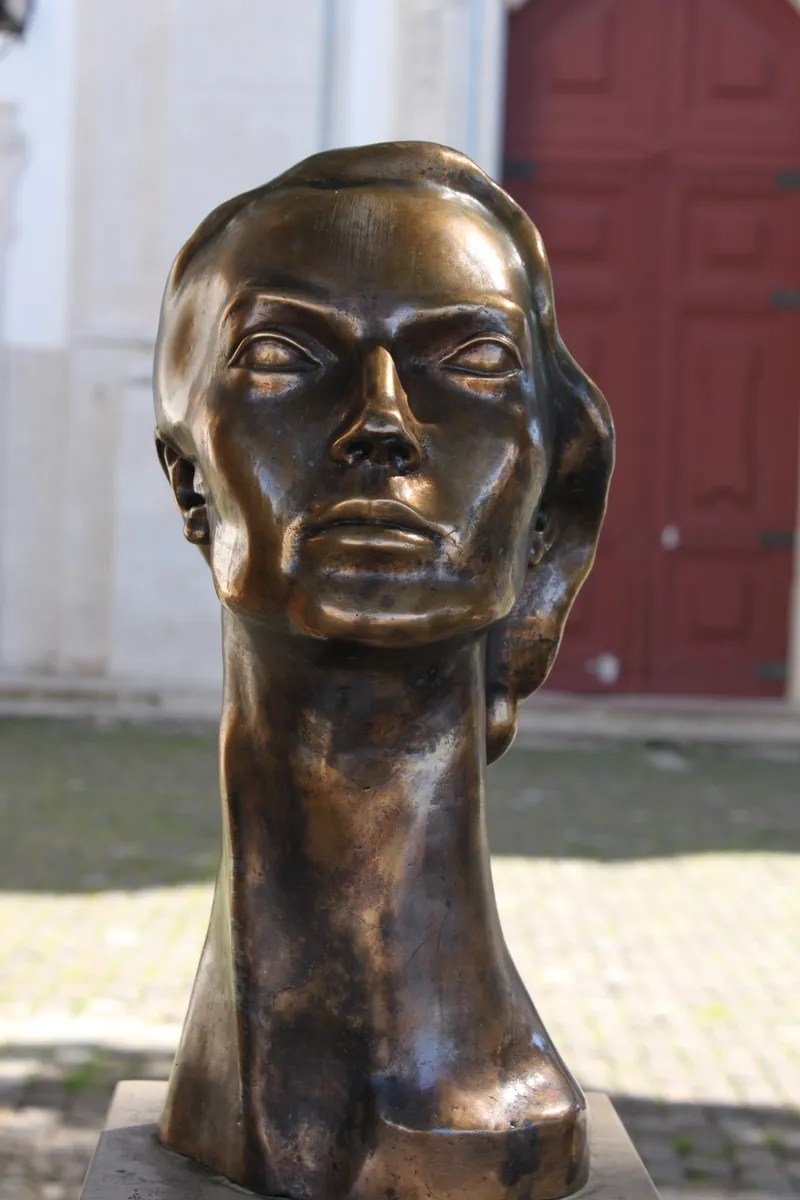
On 3 November 1951 the family moved into the first floor of number 57, Travessa das Mónicas, in the Graça district. She lived there until her death. The landscape architect Gonçalo Ribeiro Telles designed the garden, which had been a rubbish tip; one side of the house looked onto a prison, the other onto the Tagus.
Sea, light and the exact word
Her subjects stayed remarkably constant: the sea, beaches, houses, gardens, the Greek world and its myths, art, time and love. She wrote by hand in big black oilcloth notebooks, and her papers show an obstinate search for what she called the “exact” word, in draft after draft of the same poem.
The Brazilian poet João Cabral de Melo Neto once told her he liked her poetry because it had so many concrete nouns. Things in her poems are named plainly: stone, salt, wind, column, fig.
In 1963 she travelled to Greece with the novelist Agustina Bessa-Luís, and the light of Epidaurus, Sounion and Tolo runs through Geografia (1967). She discovered the Algarve around 1961 and spent several summers in a house near Lagos with a two-ring stove and no fridge, where ice came daily by cart. She later said that Algarve had been destroyed, and in 1963 argued in print that those who built there must love its space, its light and their neighbour.
| Year | Title | In English |
|---|---|---|
| 1944 | Poesia | Poetry |
| 1947 | Dia do Mar | Day of the Sea |
| 1950 | Coral | Coral |
| 1954 | No Tempo Dividido | In Divided Time |
| 1958 | Mar Novo | New Sea |
| 1961 | O Cristo Cigano | The Gypsy Christ |
| 1962 | Livro Sexto | Sixth Book |
| 1967 | Geografia | Geography |
| 1972 | Dual | Dual |
| 1977 | O Nome das Coisas | The Name of Things |
| 1983 | Navegações | Navigations |
| 1989 | Ilhas | Islands |
| 1994 | Musa | Muse |
| 1997 | O Búzio de Cós | The Conch of Kos |
First editions as listed by the Biblioteca Nacional de Portugal. The count leaves out anthologies she or others compiled, such as Grades (1970), a selection of resistance poems, and small separate collections such as 11 Poemas (1971). English titles are Lisboeta's literal translations.
Navegações, published in 1983 with a record of her reading, came out of a long flight to Macau. Seeing the coast of Vietnam from the plane at dawn, she wondered what it had been like for the Portuguese navigators to arrive with no warning of what lay beyond each cape. One line, “Navegavam sem o mapa que faziam” (they sailed without the map they were making), was described by an interviewer as the essential movement of her writing, and she agreed.
She also translated Dante's Purgatorio (1962), for which the Italian government decorated her, Shakespeare's Hamlet and Euripides' Medea, and in 1970, at the Gulbenkian Foundation's request, put four Portuguese poets into French, among them Camões and Pessoa.
Stories for children with measles
Her children's books began at home. When her children had measles and had to be kept still, she told them stories and grew irritated by the sentimental baby talk of the books she read to them. So she started telling her own, built from the places of her childhood.
The first was A Menina do Mar (The Little Girl of the Sea), told aloud in a single afternoon. Her mother had once told her, without an ending, of a tiny girl who lived among the rocks; to Sophia, who loved bathing in the sea above all things, she was perfect happiness. The house of the story is the house at Granja. When Sophia wrote it down, every sentence began “And then...”, and she had to copy it all out again.
A Menina do Mar, illustrated by the painter Sarah Affonso, and A Fada Oriana (Oriana the Fairy) both came out in 1958. O Cavaleiro da Dinamarca (The Knight of Denmark) followed in 1964, A Floresta (The Forest) in 1968 and A Árvore (The Tree) in 1985.
Telling stories to children, she said, taught her never to use abstract words or complicated constructions. The stories soon reached the classroom. When she was a deputy in 1975, children playing on a doorstep in the Bairro Alto stopped her and asked if she was Sophia de Mello Breyner Andresen. Their teacher was reading one of her stories in class.
How far her stories had run: latest edition listed by the National Library
edition number
Highest numbered edition of each book in the National Library's online bibliography, leaving out the new series that Porto Editora and Assírio & Alvim began from 2012: 56th edition (2001), 41st (2002), 37th (2010), 35th (2003), 34th (2002), 21st (2002), 19th (1994) and 13th (2002). Contos Exemplares and Histórias da Terra e do Mar are collections of short stories not written for children.
Show the data
| Latest edition recorded | |
|---|---|
| O Cavaleiro da Dinamarca (1964) | 56 |
| A Menina do Mar (1958) | 41 |
| Contos Exemplares (1962) | 37 |
| A Floresta (1968) | 35 |
| A Fada Oriana (1958) | 34 |
| Histórias da Terra e do Mar (1984) | 21 |
| O Rapaz de Bronze (1966) | 19 |
| A Árvore (1985) | 13 |
The old vulture
Her politics grew out of her faith. A Catholic upbringing, she said, made people responsible for others, and the Estado Novo irritated her deeply, from its language to its institutions. What drove her was refusing to accept the scandal of people sacrificed and lives diminished.
In 1958 she and Francisco backed General Humberto Delgado, the opposition candidate for president; from then until 1974 she worked actively with the opposition. In 1959 she was one of about forty Catholics who signed a letter to Salazar denouncing the methods of the PIDE. She and Francisco also signed the “letter of the 101 Catholics”, which backed the democratic opposition and, in the National Library's description, denounced the colonial war in Africa.
“The old vulture is wise and smooths his feathers / Rot pleases him and his speeches / Have the gift of making souls smaller”
The interviewer José Carlos de Vasconcelos called that poem “obviously” about Salazar. Sophia answered that it was poetry without rhetoric, a poem and not a pamphlet. Livro Sexto won the Grand Prize for Poetry of the Sociedade Portuguesa de Escritores, the writers' society: in 1963 according to her family's chronology, in 1964 according to a Lusa profile.
Francisco paid with his freedom. The PIDE arrested him after the failed “Sé revolt” of March 1959, and again late in 1967 on suspicion of leaking the “ballets rose” sex scandal, which involved senior figures of the regime, to the British press. Sophia wrote to him in Caxias prison in 1968. Parliament's dictionary of opposition candidates records a further arrest after anti-war vigils at the church of São Domingos and the Capela do Rato, though a 2026 Lusa report calls the 1967 arrest his last.
The couple wrote to each other in a code of their own, which their son Miguel says the PIDE never broke; he was the only child given the key. Sophia herself was questioned for hours at PIDE headquarters in Lisbon. Miguel recalls that as the inspector saw her to the lift, she told him she was afraid of only two things, ghosts and lifts. In 1969 she helped found the Comissão Nacional de Socorro aos Presos Políticos, a national committee to aid political prisoners, and stood in Porto for the opposition CEUD in that year's parliamentary elections.
Poetry in the street
Asked years later what 25 April 1974 had been for her, Sophia said: “A dazzlement, a celebration.” She remembered a Lisbon without police or violence, where young people crossed the Rossio like dancers or gulls.
“This is the dawn I was waiting for / The first day whole and clean / Where we emerge from the night and the silence / And free we inhabit the substance of time”
Before the first free May Day march, writers met at their association to choose slogans. Sophia proposed several, among them “a poesia está na rua”, poetry is in the street, which the painter Maria Helena Vieira da Silva later lettered on a poster. Not long afterwards Sophia said in public that poetry had been in the street on 25 April but had quickly been pushed back indoors.
In 1975 Portugal elected a Constituent Assembly to write a democratic constitution. Mário Soares, the Socialist leader, put Sophia at the head of the party's list in Porto, and she was elected. On 1 August 1975 she protested against plans to put the State Secretariat for Culture under the Ministry of Social Communication, a scheme she called “inherited from totalitarianism”. On 2 September she said socialism would be built through a union of intellectuals and all workers.
On 3 October 1975 she spoke for people with disabilities. That so many lived in terrible poverty without proper treatment was “a scandal we cannot accept”, she said. She singled out men disabled in the armed forces, in a country just out of thirteen years of colonial war (1961 to 1974), and argued that disabled people had a right to work and to a full part in community and cultural life, not only to treatment.
Politics did not keep her. The meeting with the children in the Bairro Alto, she said, made her realise that writing was her real political participation. On 5 February 1987 Mário Soares, by then President, appointed her Chancellor of the National Orders, the body that oversees Portugal's state honours.
The Camões Prize
The prizes came steadily from the 1980s: the critics' prize for her whole work (1984, according to Lusa), the Calouste Gulbenkian Grand Prize for children's literature in 1992, an honour from the Petrarch Prize in Padua in 1995 and the Luís Miguel Nava prize in 1998. She was made a Grand Cross of the Order of Sant'Iago da Espada, which the National Library dates to 1998 and Lusa's 2014 profile to 1988.
In 1999 she won the Camões Prize, the award for literature in Portuguese that Portugal and Brazil set up in 1988, first given in 1989 to Miguel Torga, whose enthusiasm had helped persuade her to publish in 1944. She was its eleventh laureate, the second woman after the Brazilian novelist Rachel de Queiroz, and the first Portuguese woman. The prize was presented in November 1999.
| Year | Laureate | Country |
|---|---|---|
| 1989 | Miguel Torga | Portugal |
| 1990 | João Cabral de Melo Neto | Brazil |
| 1991 | José Craveirinha | Mozambique |
| 1992 | Vergílio Ferreira | Portugal |
| 1993 | Rachel de Queiroz | Brazil |
| 1994 | Jorge Amado | Brazil |
| 1995 | José Saramago | Portugal |
| 1996 | Eduardo Lourenço | Portugal |
| 1997 | Pepetela | Angola |
| 1998 | António Cândido de Mello e Sousa | Brazil |
| 1999 | Sophia de Mello Breyner Andresen | Portugal |
| 2000 | Autran Dourado | Brazil |
| 2001 | Eugénio de Andrade | Portugal |
| 2002 | Maria Velho da Costa | Portugal |
| 2003 | Rubem Fonseca | Brazil |
| 2004 | Agustina Bessa-Luís | Portugal |
The prize was created by the governments of Portugal and Brazil in 1988. Four of the sixteen laureates in this period were women.
The Max Jacob prize followed in France in 2001, and the Queen Sofia Prize for Ibero-American Poetry in Spain in 2003. She wrote little by then. Happiness, she said, had always been what let her write, and she missed the closeness to the sea and the earth that she had once had. Asked in 2001 what she wanted for Portugal in the new century, she answered social justice: less distance between rich and poor.
She died in Lisbon on 2 July 2004, aged 84, and was buried in the cemetery at Carnide. Among her fewer than a thousand books, her grandson Martim Sousa Tavares later found 331 inscribed to her by writers and artists, 27 of them by Miguel Torga.
Into the Pantheon
Ten years after her death, and forty after the revolution, the Assembleia da República voted unanimously on 20 February 2014 to give her the honours of the National Pantheon, housed in the domed church of Santa Engrácia in Lisbon. A working group of all the parliamentary groups was set up to plan the transfer.
“the universal writer, the woman of dignity, the courageous citizen, the distinguished Portuguese”
On Wednesday 2 July 2014, the tenth anniversary of her death, the hearse left the Carnide cemetery escorted by 23 motorcycle riders of the GNR, the national guard. A private Mass, said by the Patriarch of Lisbon, Manuel Clemente, was held at the Capela do Rato, the chapel where Catholic opponents of the colonial war had kept a vigil over New Year 1972 to 1973. The procession then passed the parliament at São Bento and followed the river to the Pantheon.
On the steps, dancers of the Companhia Nacional de Bailado performed, and the programme included a 1957 recording of Sophia reading her poems. José Manuel dos Santos of the Academia Nacional de Belas Artes gave the eulogy. The honour, he said, did not make her an official writer or a poet of the regime; it made her memory “a collective symbol”.
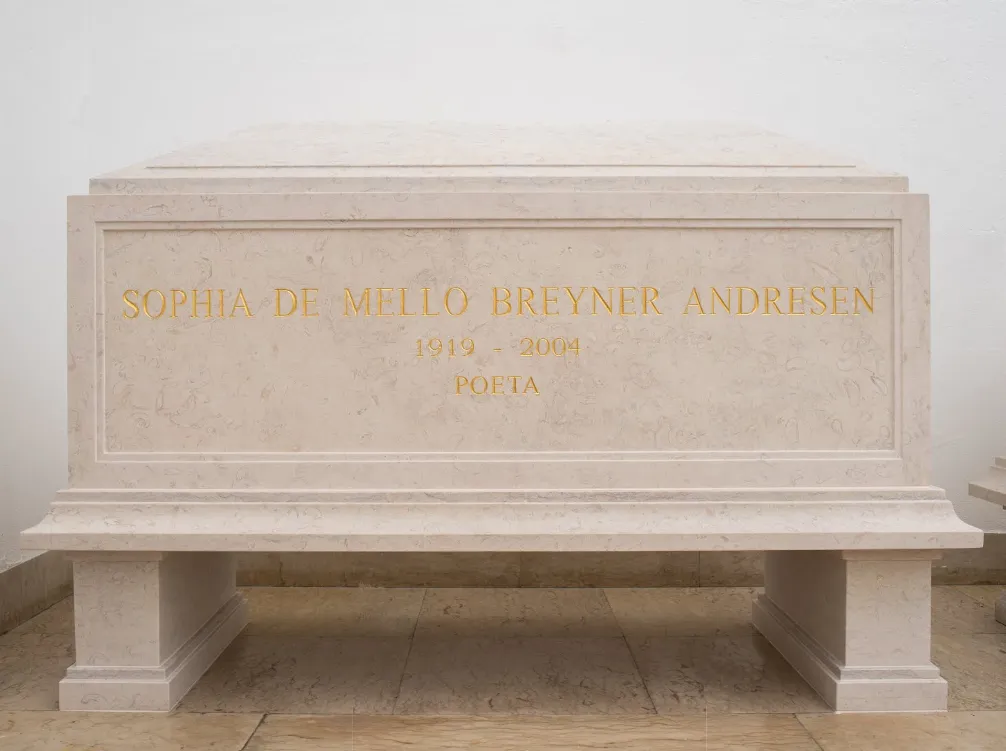
President Aníbal Cavaco Silva praised her literary genius and her civic courage in defending justice and freedom. The president of parliament, Assunção Esteves, pictured her at the gates of Caxias prison in 1974, carnations in hand. The urn entered the Pantheon at 20:05 and was placed in a tomb in the room that holds General Humberto Delgado and the novelist Aquilino Ribeiro. A bugle call from the GNR closed the ceremony.
She was the second woman given Pantheon honours. The first, in 2001, was the fado singer Amália Rodrigues, whose story Lisboeta tells in a separate article.
6 November 1919
Born in Porto
1940
First poems in Cadernos de Poesia
August 1944
Poesia, her first book, published in Coimbra
27 November 1946
Marries Francisco Sousa Tavares in Porto
3 November 1951
Moves into Travessa das Mónicas, Lisbon
1958
A Menina do Mar and A Fada Oriana; backs Humberto Delgado
1962
Livro Sexto, with “O Velho Abutre”
1969
Helps found the committee to aid political prisoners; stands for the CEUD in Porto
1975
Elected to the Constituent Assembly for the Socialists in Porto
1999
Camões Prize
2 July 2004
Dies in Lisbon, aged 84
26 January 2011
Her papers are handed to the National Library
20 February 2014
Parliament votes her Pantheon honours
2 July 2014
Remains moved to the National Pantheon
Why she still matters
Many Portuguese meet Sophia first as children, through A Menina do Mar or O Cavaleiro da Dinamarca, long before they read “25 de Abril”; the editions in the chart above give the scale. She came to think that this was her real political work. The phrase she proposed for the first free May Day, “a poesia está na rua”, lives on in Vieira da Silva's poster.
Her papers went to the National Library in 2011, among them her oldest notebooks of poems, dated 1932 to 1941, found hidden at the bottom of a small cupboard. The Pantheon's own entry says justice, a constant theme of her poetry, was also her rule of conduct.
FAQs
When and where was Sophia de Mello Breyner Andresen born?
She was born in Porto at eleven in the morning on 6 November 1919, in a house on Rua António Cardoso, the daughter of Maria de Mello Breyner and an Andresen father of Danish descent. She died in Lisbon on 2 July 2004.
What are Sophia de Mello Breyner Andresen's best-known children's books?
A Menina do Mar and A Fada Oriana (both 1958), A Noite de Natal (1959), O Cavaleiro da Dinamarca (1964), O Rapaz de Bronze (1966), A Floresta (1968) and A Árvore (1985). The first stories were told to her own children when they were ill with measles.
What did Sophia de Mello Breyner Andresen do against the dictatorship?
She backed Humberto Delgado in 1958, signed Catholic protests against PIDE methods and the colonial war, helped found a committee to aid political prisoners in 1969 and stood for the opposition CEUD in Porto that year. Her husband was jailed several times. After 1974 she sat in the Constituent Assembly as a Socialist.
When did Sophia win the Camões Prize?
In 1999. She was the eleventh winner of the prize, the second woman after the Brazilian Rachel de Queiroz in 1993, and the first Portuguese woman.
Is Sophia de Mello Breyner Andresen buried in the National Pantheon?
Yes. Parliament voted her Pantheon honours unanimously on 20 February 2014, and her remains were moved from the Carnide cemetery to the National Pantheon in Lisbon on 2 July 2014, ten years to the day after her death. She was the second woman so honoured, after Amália Rodrigues.
On the timeline
Open the timelineNearby moments from the first republic (1910–1926).
Death of Francisco Marto at age 10 in Aljustrel, one of the three shepherd children who reported the apparitions of Our Lady of Fátima in 1917. He died of the Spanish Flu and was canonised by Pope Francis in 2017.
The US Navy flying boat NC-4 takes off from Trepassey, Newfoundland, on the longest leg of the first transatlantic flight, reaching Horta in the Azores some 15 hours later. After a week's wait at Ponta Delgada, it lands on the Tagus at Lisbon on 27 May, the first aircraft to fly across the Atlantic.
Jorge de Sena is born in Lisbon. Poet, novelist, dramatist and essayist, he trained as a civil engineer, went into exile in Brazil in 1959 and from 1965 taught in the United States, at the universities of Wisconsin and California, leaving one of the most wide-ranging bodies of work in twentieth-century Portuguese letters.
Sophia de Mello Breyner Andresen
Sophia de Mello Breyner Andresen is born in Porto. One of the most important Portuguese poets of the twentieth century, she published fourteen books of poetry between 1944 and 1997 and in 1999 became the first Portuguese woman to win the Camões Prize.
Jacinta Marto, the youngest of the three shepherd children who reported visions of the Virgin at Fátima in 1917, dies aged nine in Lisbon's Dona Estefânia hospital, weakened by the Spanish flu. Canonised in 2017, she is the youngest saint in Catholic history who did not die a martyr.
The date entered on the birth registration of Amália Rodrigues in Lisbon's Pena parish. The future queen of fado, who took the genre from Alfama taverns to the world's great stages, always celebrated her birthday on 1 July instead — 'in cherry season', she said — and some researchers believe she was in fact born earlier still.
Birth of Artur do Cruzeiro Seixas in Amadora. A member of the dissident Lisbon surrealist group alongside Mário Cesariny, he joined the merchant navy in 1950 and settled in Angola, where his first solo shows caused a stir, before returning to paint, draw and write poetry — insisting he was not a 'painter' but 'a man who paints'. He died in 2020, weeks short of his 100th birthday.
Coming up in history
All long reads 8 November 1822Pirajá, 8 November 1822: the battle for Salvador da Bahia
 9 November 1975“O povo é sereno”: smoke over the Terreiro do Paço, 9 November 1975
 10 November 1913Álvaro Cunhal: prisoner, escapee and Portugal's communist leader
 11 November 1975Angola's independence at midnight, 11 November 1975
42 sources
Archives, scholarship and reporting this article was checked against.
- 1
Sophia de Mello Breyner Andresen no seu tempo: momentos e documentos. Introdução (Maria Andresen Sousa Tavares)Biblioteca Nacional de Portugal, online exhibition, 2011
- 2
- 3
- 4
Candidatos da Oposição à Assembleia Nacional do Estado Novo (1945-1973): Um DicionárioMário Matos e Lemos, Assembleia da República and Texto Editores, 2009
- 5
Resolução da Assembleia da República n.º 17/2014: Honras de Panteão Nacional a Sophia de Mello Breyner AndresenDiário da República, 1.ª série, n.º 46, 6 March 2014
- 6Sophia de Mello Breyner: do código secreto que a PIDE nunca decifrou à luta pela cultura e pelas pessoas com deficiênciaObservador (Mariana Marques Tiago and Lusa), 31 March 2026
- 7
Sophia de Mello Breyner Andresen (1919–2004)Panteão Nacional, Museus e Monumentos de Portugal
- 8Prémio Camões: lista dos 31 distinguidosDiário de Notícias (Lusa), May 2019
- 9
A Revolução Portugueza: O 5 de Outubro (Lisboa 1910), by Jorge d'AbreuLisbon, 1912 (Project Gutenberg edition)
- 10Honras de Panteão Nacional para Sophia de Mello Breyner AndresenRTP Notícias, July 2014
- 11Sophia ficará ao lado de Aquilino e Humberto DelgadoDiário de Notícias (Lusa), 18 June 2014
- 12
- 13Dedicatórias, cartas e ensaios: os tesouros escondidos na biblioteca de Sophia de Mello Breyner AndresenObservador, 22 January 2019
- 14
- 15
- 16
- 17
- 18
- 19
- 20
- 21
- 22
- 23
- 24
- 25
- 26
- 27
- 28
- 29
- 30
- 31
Um golpe na República: 28 de Maio de 1926, da Ditadura Militar ao Estado NovoMuseu da Presidência da República
- 32
- 33
- 34
- 35
- 36Cerimónia de trasladação de Sophia de Mello Breyner para o Panteão inclui missa e passa pelo ParlamentoObservador (Lusa), 30 June 2014
- 37
- 38Toque de clarim da GNR finaliza cerimóniaDiário de Notícias, 2 July 2014
- 39Honra concedida “faz da memória de Sophia um símbolo coletivo”Observador (Lusa), 2 July 2014
- 40“Sophia sintetiza todos os sinais emancipadores da História”Diário de Notícias, 2 July 2014
- 41
- 42
Panteão NacionalMuseus e Monumentos de Portugal
Image credits
- The red Casa Andresen at the Quinta do Campo Alegre in Porto, on the estate the Andresen family bought in 1895, where Sophia grew up. It now houses the Galeria da Biodiversidade in the city's Botanical Garden. Photographed in 2017. Joseolgon, CC BY-SA 4.0, via Wikimedia Commons.
- Sophia, aged six, with her grandfather Thomaz de Mello Breyner in Lisbon, 14 July 1926. He taught her Camões by heart before she could read. Unknown author, Public domain, via Wikimedia Commons.
- The beach at Granja, south of Porto, in 2020. Sophia spent her childhood summers here, and the house at Granja reappears in her poems, in the story “A Casa” and in A Menina do Mar. Joseolgon, CC BY-SA 4.0, via Wikimedia Commons.
- Sophia's tomb in the National Pantheon, Lisbon, photographed in 2020. It is inscribed simply “Poeta”, poet. António Fragoso, CC BY 2.0, via Wikimedia Commons.
- The bronze bust of Sophia at the Graça viewpoint in Lisbon, in the district where she lived. It is a copy of a bust made by the sculptor António Duarte in 1950, unveiled on 2 July 2009; the viewpoint now bears her name. Photographed in 2010. Canção de Lisboa, CC BY-SA 2.0, via Wikimedia Commons.