

CS Marítimo is founded in Funchal, 1910
Just over two weeks before Portugal became a republic, men who lived by the sea in Funchal's old town set up a football club in the republican colours. Sixteen years later it beat FC Porto 7-1 on the way to becoming champion of Portugal.
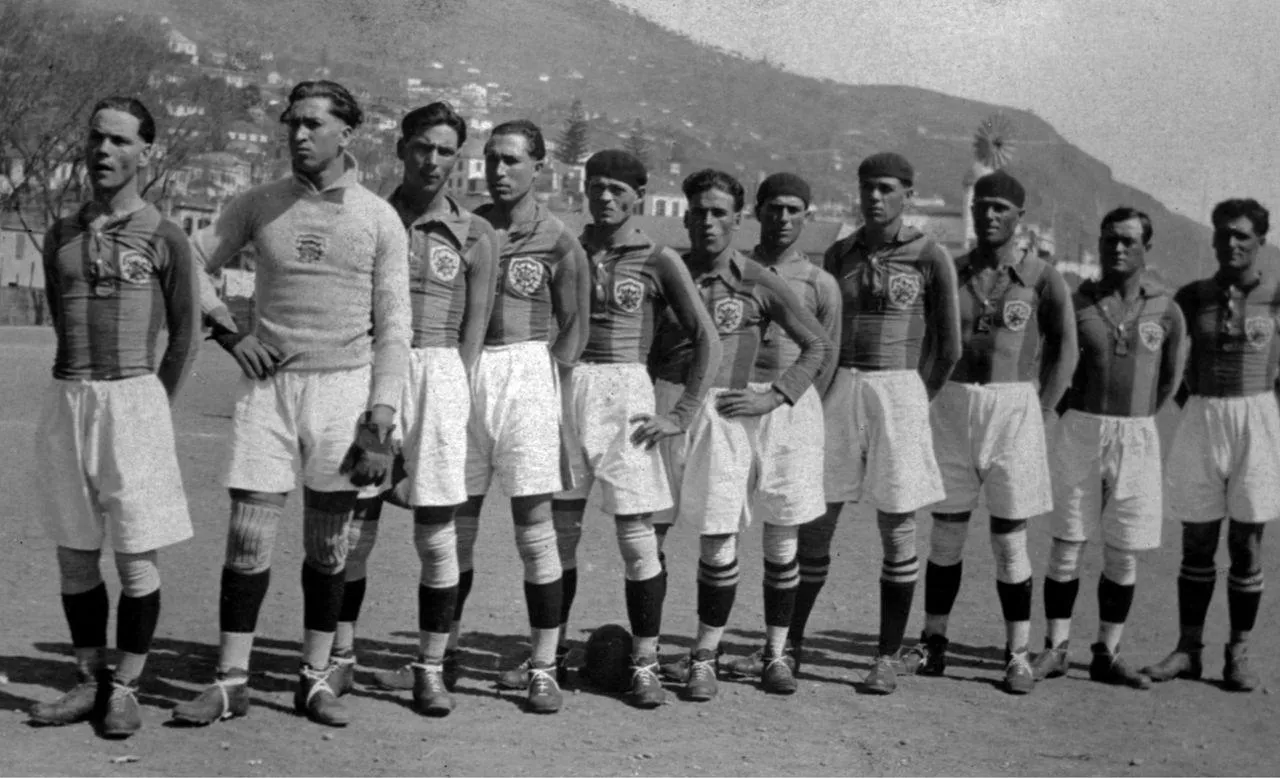
At a glance
- Club Sport Marítimo was founded in Funchal, Madeira, on 20 September 1910 by men who worked on or by the sea. Its first president was Cândido Gouveia, known as Candinho, in whose bar the founders met.
- The club took green and red, the colours of the republican movement, fifteen days before the revolution of 5 October 1910. The new regime approved a green and red national flag only on 29 November 1910.
- Marítimo won the first Madeira championship in 1916–17 and 35 of the 55 completed between then and 1972–73, by the count of the RSSSF statistics foundation.
- On 6 June 1926, at the Campo do Ameal in Porto, Marítimo beat Belenenses 2-0 in the final of the Campeonato de Portugal, then the national championship. Belenenses left the field after their captain was sent off. It is the only time a club from Portugal's islands has been champion of Portugal.
- In 1977 Marítimo became the first island club in Portugal's top division. It has played nine European campaigns, opened a rebuilt Estádio do Marítimo in 2016 and won back its top-flight place in 2026.
A ball for ten réis an hour
In Funchal's old town, a football was once a thing you rented. In the late 1890s, by the account of Funchal's old boatmen, a young seaman called João Viveiros, nicknamed O Chicago, talked the crew of the Rhouma, a British pleasure yacht that called at Madeira year after year, into giving him the ball they played with when it left after its second visit. When its rubber bladder gave out he stuffed it with an animal's bladder and hired it out to anyone who wanted a game, at ten réis an hour.
Those boatmen were the bomboteiros, who rowed out to sell to passing ships, and they had a lot to do with how football took hold in Funchal. They lived in the parish of Santa Maria Maior, around the open ground by the sea that the town council laid out in 1898 to 1901 and named after King Carlos. According to the old bomboteiros quoted in the Elucidário Madeirense, Madeira's encyclopaedia, the first match on the island was played on that site in 1895, between two teams from the Rhouma's crew.
On Tuesday 20 September 1910 some of these men founded a club of their own.
Their first meetings were held at the Aurora, a bar in the old town that belonged to Cândido Gouveia, Candinho to everyone, who became member number one and the first president. They called it Club Sport Marítimo, the seafarers' sports club, and by the club's account every member of the first board was connected with the sea.
- Founded
- 20 September 1910, Funchal, Madeira
- Meeting place
- Cândido Gouveia's bar, the Aurora, in the old town
- First president
- Cândido Gouveia (Candinho), member no. 1
- Colours
- Green and red
- Statutes approved
- 10 May 1911
- First home ground
- Campo D. Carlos, renamed Campo do Almirante Reis in 1911
How football reached Madeira
Madeira had a British community in the nineteenth century: wine shippers, merchants and the staff of the submarine telegraph company in Funchal. Their sons came home from school in England with English games. Cricket was played at the Achada, a common pasture in the hill village of Camacha, before the Madeira Cricket Club staged its first organised match there on 20 March 1888.
Football came by the same road. Madeiran tradition credits Harry Hinton, born on the island to a British family and later a Madeiran industrialist, with bringing the first ball to the island and kicking it about with friends on the Achada at Camacha. The club dates this to 1875, thirteen years before the Pinto Basto brothers are said to have brought a ball to the mainland. Hinton's ball, the story goes, soon fell apart, and the first match between organised teams came only in 1894 or 1895.
The game spread through the waterfront. Visiting warships, training ships and transports put teams ashore, and between 1908 and 1910 Humberto dos Passos Freitas, back from his studies, did more than anyone to promote it. Clubs followed: the Grupo Sportivo Internacional in 1909, which in 1921 was counted as the oldest sports club on the island, and the Club Sports da Madeira in March 1910, in blue and white.
Republican colours, two weeks early
Blue and white were the colours of the monarchy's flag. Marítimo took green and red from the start. The club's history says the founders meant to stand for the republican cause, and that in the first games, played among themselves, one side wore a green sash and the other a red one. Green and red were the colours of the republican movement: a red flag with a green circle had flown over Porto town hall during the failed republican rising of 1891.
Fifteen days after the founding, on 5 October 1910, a revolution in Lisbon overthrew King Manuel II. In 1911 Funchal's first republican council renamed the Campo D. Carlos after Admiral Carlos Cândido dos Reis, who had led the plot's military committee and was found dead in Lisbon on the first morning of the rising. The ground became the Campo do Almirante Reis, and Marítimo, which played there, was later nicknamed the lion of the Almirante Reis.
The club's statutes were approved by its general assembly on 10 May 1911, and its first headquarters was at Travessa do Pimenta 14. Its first badge was a football with a pennant and the letters CSM, an anchor, a rudder and an oar. In 1916 a lion was added, standing over a ball: the club says it was an answer to the eagle on the badge of its monarchist-coloured rival, the Club Sports da Madeira.
Champions of the island
In its early years Marítimo played whoever came: other Funchal clubs, crews from ships in the bay and, in 1912, the team of the German cruiser Pandora, which it held to a draw. That year, the club says, Cosme Damião of Benfica invited it to Lisbon, its first trip off the island. By 1914 money had run so short that the club nearly folded, and a respected Funchal figure, Gonçalo Zacarias de Ornelas, raised donations and a new board to keep it going.
In 1916 the clubs founded the Associação de Foot-ball do Funchal, and in 1916–17 it ran the first Madeira championship. Marítimo won it. Writing in the early 1920s, the sports editor of the Diário da Madeira said the club had lost only once on the island, to União in 1919. In 1920–21 it won every match and still lost the title, disqualified for fielding a player who was not properly registered.
The mainland clubs began to notice. Benfica came to Funchal and lost 3-2 on 9 April 1922 and 6-3 four days later. On 14 October 1922 Marítimo beat FC Porto, the reigning champions, 3-1 in Porto. In May 1924 Sporting played four games on the island at Marítimo's invitation and won them all.
Madeira championship titles by decade, 1916–17 to 1972–73
titles
- Marítimo
- União
- Nacional
Seasons are grouped by the year they began. Of 55 championships completed from 1916–17 to 1972–73, Marítimo won 35, União 13 and Nacional 7; the 1918–19 season was abandoned and 1919–20 was not played. The Elucidário's own count to the mid-1940s (Marítimo 17, Nacional 6, União 5) matches the same list. The RSSSF also lists Marítimo as 1973–74 champion, a season in which the club and DN Madeira say it was already playing in the national second division.
Show the data
| Marítimo | União | Nacional | |
|---|---|---|---|
| 1916–19 | 2 | 0 | 0 |
| 1920s | 8 | 2 | 0 |
| 1930s | 4 | 3 | 3 |
| 1940s | 7 | 0 | 3 |
| 1950s | 7 | 3 | 0 |
| 1960s | 4 | 5 | 1 |
| 1970–73 | 3 | 0 | 0 |
Champions of Portugal, 1926
From 1922–23 Madeira sent its champion to the mainland by sea each year to take part. Marítimo lost its first semi-final 2-1 to Académica in 1923 and went out to Olhanense in 1924 and 1925. In 1925–26, as Madeira's champion for the fifth year running, it went straight into the semi-finals, and the team left Funchal on the steamer S. Miguel on 14 May 1926.
On Sunday 23 May, at the Campo Grande in Lisbon, it beat FC Porto 7-1. That evening a telegram from Lisbon reached the club in Funchal, signed Travassos: the club's president, Joaquim Quintino Travassos Lopes, was leading the party.
“We won 7-1. We dominated the whole game; an excellent game on our part. The referee was impartial. Big crowd, crowd on our side.”
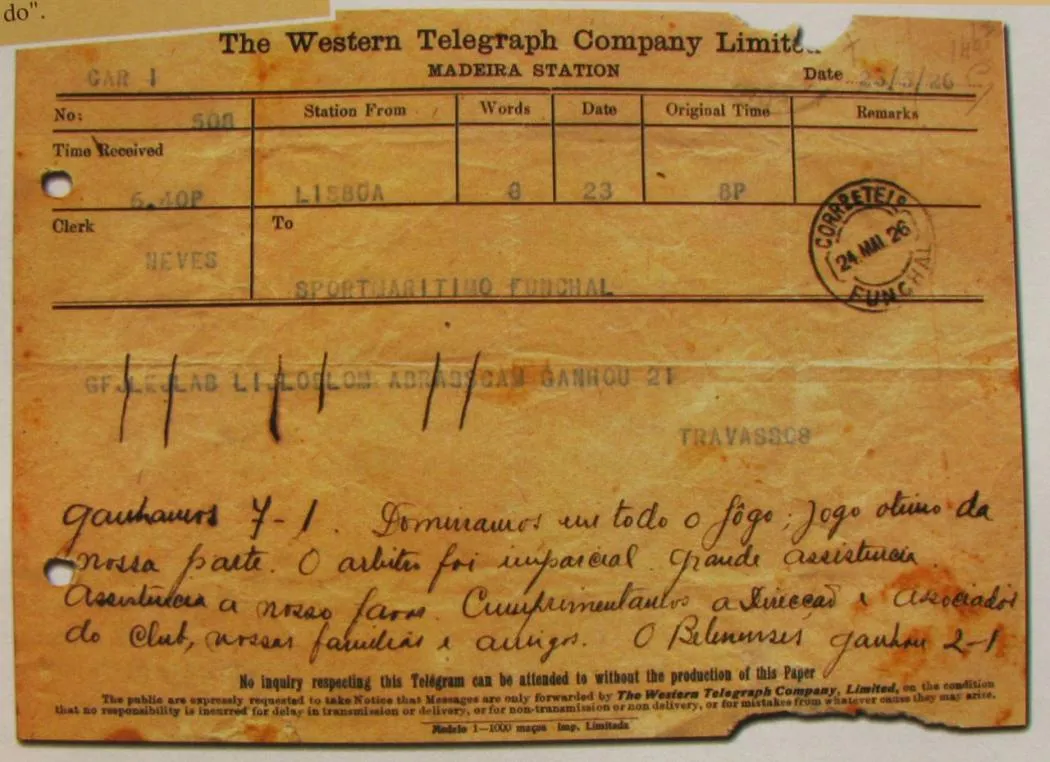
Five days later, on 28 May, a military rising that began in Braga brought down the First Republic. The final went ahead regardless, a week late, because Belenenses at first refused to play it in Porto. On Sunday 6 June 1926 the two teams met at the Campo do Ameal.
The first half ended goalless. José Fernandes, known as Bisugo, scored after 55 minutes and Manuel Ramos, Janota, added a second.
The Belenenses captain, Augusto Silva, was then sent off, refused to go, and his teammates walked off with him. With no one left to play, the referee, José Guimarães of Porto, ended the match, at about 70 minutes by most accounts, and the 2-0 score stood.
| Round | Date | Ground | Result |
|---|---|---|---|
| Madeira championship | 1925–26 season | Funchal | Champions, fifth year running |
| Semi-final | Sunday 23 May 1926 | Campo Grande, Lisbon | Marítimo 7-1 FC Porto |
| Final | Sunday 6 June 1926 | Campo do Ameal, Porto | Marítimo 2-0 Belenenses (abandoned at about 70 minutes, result stood) |
Accounts differ on the second goal and the end of the final: the DN Madeira match sheet gives Manuel Ramos at 70 minutes, the same article's narrative names José Ramos, and the Portimonense archive has the referee stopping the game at 70 minutes. The RSSSF has Ramos at 60 minutes and Belenenses leaving with about 40 minutes to play. The Madeira title was settled by a play-off against União, which the club's history gives as 2-1.
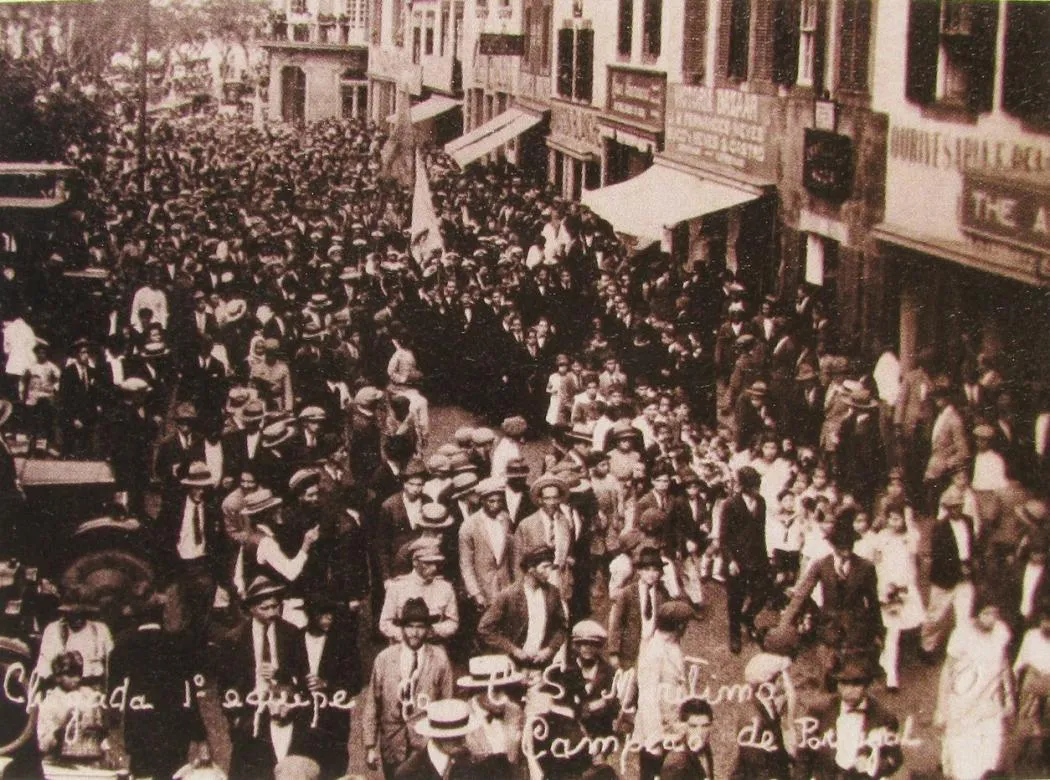
In Funchal, supporters had gathered at the Pico radio station to wait for news. The telegram came through the Western Telegraph Company soon after 5 p.m., and thousands of people filled the streets. The team sailed home on the steamer Lima and landed on 10 June. It is still the only time a club from Portugal's islands has been champion of Portugal.
Nacional and the fight over the Barreiros
Marítimo's great rival was born in the same year. On 8 December 1910 the Nacional Sport Grupo was founded. It first played at the Campo do Brás, the old cricket ground at São Martinho, and was later renamed Clube Desportivo Nacional. The two clubs have been rivals ever since, and the press still calls a game between them a derby.
In 1927 a new ground was formally opened at the Barreiros, in São Martinho, on about 18,000 square metres of Funchal's steep slopes; StadiumDB dates a first ground on the site to 1923. The club's history says it was Nacional's project, and that the island's football association then rented it for championship games. Marítimo refused to leave the Almirante Reis, near its supporters, and for one season in the 1930s it played no football at all. It came back and won the 1935–36 title at the Barreiros.
Isolation was the larger problem. Island clubs could not enter the national league. In 1941–42 Nacional qualified as Madeira's entry for the Taça de Portugal, but Madeira was dropped from it because of the war, and the club says the federation then kept island clubs out of the cup until 1948. By the mid-1940s, two Madeiran writers complained, the best players kept leaving for clubs elsewhere, the island lacked pitches, and its football was in decline.
Marítimo looked further afield. In 1950 it spent 70 days touring Angola and Mozambique, playing for Madeiran emigrants, and came home with 12 wins and one defeat. In 1956 it bought land in Santo António for a ground of its own, the Campo Imaculada Conceição. The club's sports complex in Santo António opened in stages from 2004.
Into the First Division and Europe
The barrier fell in 1973. The club's account, which DN Madeira follows, is that Marítimo, champion of Madeira in 1972–73, was invited straight into the national second division, south zone, and finished fifth in its first season; the RSSSF has it winning a play-off first and joining the national leagues in 1974. On Sunday 15 May 1977, in front of about 20,000 people at the Barreiros, by DN Madeira's reckoning the largest football crowd ever seen in the region, it beat Olhanense 4-0 and became the first club from the Portuguese islands to reach the top division.
Relegation came in 1981. The club came straight back, went down again in 1983 and returned in 1985, this time for 38 seasons. After Nacional's promotion in 1988 and União's in 1989, three Madeiran clubs played in the First Division for two seasons. Cup finals went against Marítimo: the Taça de Portugal in 1995 (2-0 to Sporting) and 2001 (2-0 to FC Porto), and the League Cup in 2015 and 2016, both to Benfica.
A fifth-place finish under the coach Paulo Autuori took the club into the UEFA Cup, and its first European match was a 2-0 defeat at Antwerp on 14 September 1993. Eight more European campaigns followed. In 2012–13 it reached the group stage of the Europa League and drew twice with Newcastle United, the second time at St James' Park, where Fidélis equalised 11 minutes from time.
| Season | Competition | How far | Notable ties |
|---|---|---|---|
| 1993–94 | UEFA Cup | First round | Lost 2-0 at Antwerp, drew 2-2 at home |
| 1994–95 | UEFA Cup | Second round | Beat Aarau 1-0 on aggregate; lost 0-1 and 1-2 to Juventus |
| 1998–99 | UEFA Cup | First round | Lost 0-1 at Leeds, won 1-0 in Funchal, lost 4-1 on penalties |
| 2001–02 | UEFA Cup | First round | Beat Sarajevo 1-0 twice; beat Leeds 1-0 at home, lost 3-0 away |
| 2004–05 | UEFA Cup | First round | Beat Rangers 1-0 at home, lost 1-0 at Ibrox and 4-2 on penalties |
| 2008–09 | UEFA Cup | First round | Lost 0-1 and 1-2 to Valencia |
| 2010–11 | Europa League | Play-off | Beat Sporting Fingal and Bangor City (8-2 at home); lost to BATE Borisov |
| 2012–13 | Europa League | Group stage | Beat Asteras Tripolis on away goals and Dila Gori; went out in a group with Newcastle, Bordeaux and Club Brugge |
| 2017–18 | Europa League | Play-off | Beat Botev Plovdiv; drew 0-0 with Dynamo Kyiv, lost 3-1 in Kyiv |
Results from UEFA's match records. UEFA lists the home legs against Sporting Fingal and Bangor City in 2010 at Nacional's ground, the Estádio da Madeira. The club's own timeline gives some different scores, including a 1-0 home win over Asteras Tripolis in 2012 that UEFA records as 0-0, and dates the first European match to 15 September 1993.
A stadium on the hill and a club for the island
The Barreiros ground was rebuilt between 1953 and 1956 and reopened on 5 May 1957 with room for 17,000. In April 2009 the public stadium was handed to Marítimo, which took on its upkeep in return for public money to rebuild it. Work stopped in 2010 when the aid was cut and resumed in 2014. The finished stadium was inaugurated on 2 December 2016, when Marítimo beat Benfica 2-1, and the Estádio do Marítimo now holds 10,932.
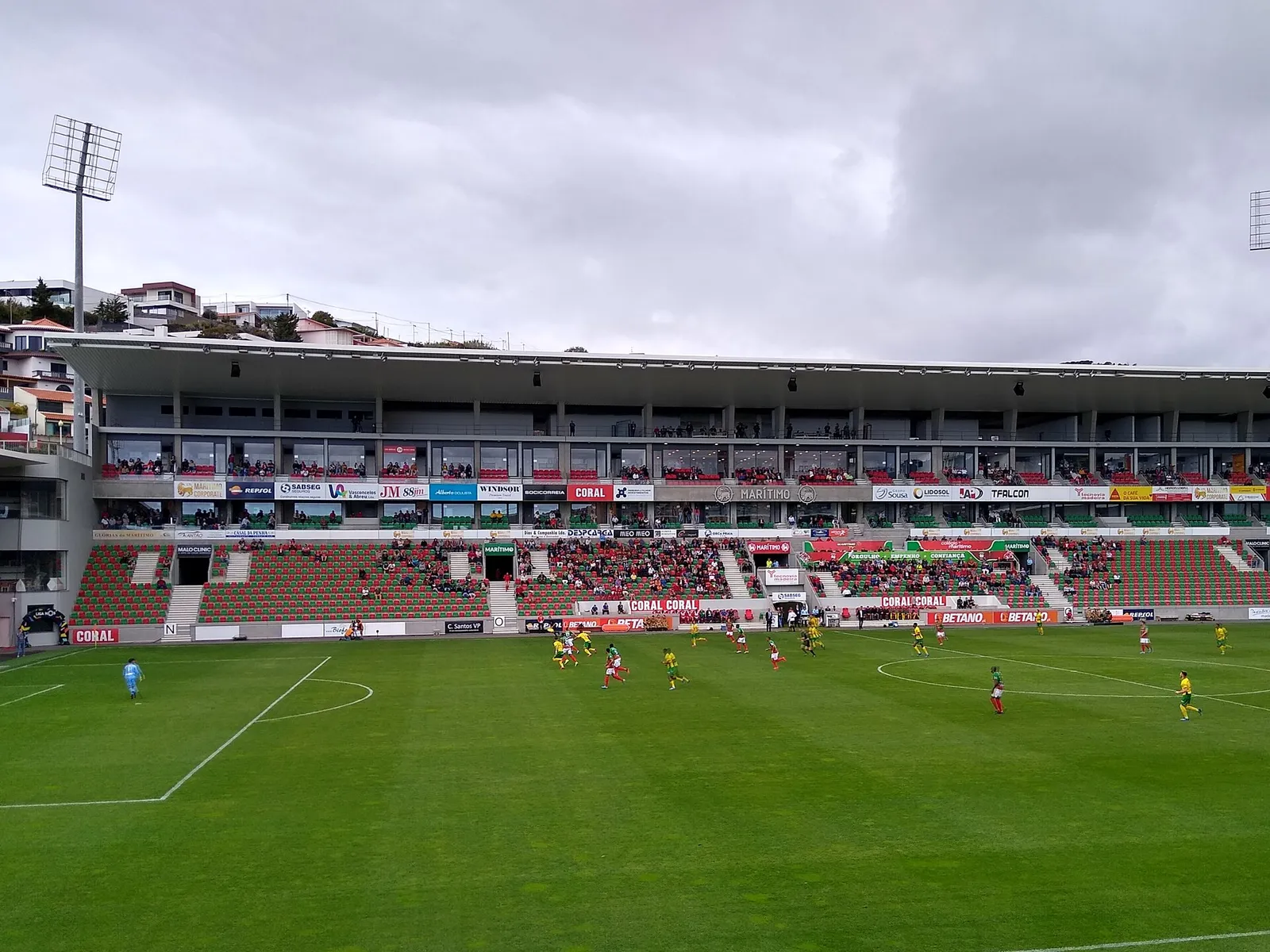
On 11 June 2023, after 38 consecutive seasons in the top division, Marítimo lost a relegation play-off to Estrela da Amadora on penalties in a full stadium, where tickets had been sold for one euro. It spent three seasons in the second tier. In 2026, a hundred years after the Ameal, it won promotion back as second-tier champions, and at the club's 116th anniversary celebration that September its president, Carlos André Gomes, tied the two together.
The old Almirante Reis ground in the old town is now a public garden, opened in 2001, with a monument to the footballers who played there. In September 2024 the club held its anniversary ceremony on the site, which DN Madeira called the place where Marítimo was born. A year later the same paper described it as the most popular football club in Madeira.
1875
Harry Hinton's ball at Camacha
The traditional date for the first football on Madeira.
1894 or 1895
First organised match in Funchal
On the site of the Campo D. Carlos; both versions of the story involve a British ship's crew.
20 September 1910
Club Sport Marítimo founded
Green and red, fifteen days before the Republic.
8 December 1910
Nacional Sport Grupo founded
10 May 1911
Statutes approved
1916–17
First Madeira championship
Won by Marítimo.
6 June 1926
Champions of Portugal
2-0 against Belenenses at the Campo do Ameal, Porto.
1927
The Barreiros opens
1973
Admitted to the national second division
15 May 1977
Promotion to the First Division
The first island club to get there.
14 September 1993
First European match
At Antwerp in the UEFA Cup.
2 December 2016
Rebuilt Estádio do Marítimo opens in full
11 June 2023
Relegated after 38 seasons
2026
Promoted back to the top division
FAQs
When was CS Marítimo founded?
Club Sport Marítimo was founded in Funchal, Madeira, on 20 September 1910, fifteen days before the Republic was proclaimed in Lisbon. Its statutes were approved on 10 May 1911.
Has Marítimo ever been champion of Portugal?
Yes, in the sense used at the time. In 1926 it won the Campeonato de Portugal, then the competition that decided the national title, beating Belenenses 2-0 in the final at the Campo do Ameal in Porto on 6 June. The modern league championship began only in the 1930s, and Marítimo has not won it.
Why does Marítimo play in green and red?
The founders chose green and red, the colours of the republican movement, in September 1910. The new regime approved a green and red national flag only on 29 November 1910, and the Constituent Assembly confirmed it in June 1911, so the club did not copy the flag; both used the same republican colours.
What is the Madeira derby?
The Madeira derby is the match between Marítimo and Nacional, both founded in Funchal in 1910. They fought for the island championship for decades and quarrelled in the 1930s over the Barreiros ground, which the club's history says Nacional built; the stadium was handed to Marítimo in 2009.
Where does Marítimo play?
At the Estádio do Marítimo, the rebuilt Barreiros stadium in Funchal, which seats 10,932 and opened in full on 2 December 2016.
On the timeline
Open the timelineNearby moments from regeneration and the last kings (1851–1910).
Manuel II takes his oath before the Cortes in Lisbon at his formal acclamation as King of Portugal, three months after inheriting the throne through the assassination of his father Carlos I and elder brother Luís Filipe. He would be Portugal's last king.
Birth in Funchal of Fernão de Ornelas, the lawyer who as president of the city council from 1935 to 1946 led a sweeping programme of public works that modernised Madeira's capital. Ousted after a clash with the island's governor, he was posthumously given Funchal's Medal of Honour in 2008, according to the local press.
An earthquake centred near Benavente strikes the Tagus valley at about 5 pm, wrecking much of Benavente, Samora Correia, Santo Estêvão and Salvaterra de Magos and killing 46 or 47 people. Aid poured in from across the country, but in 1913 Benavente still had a camp of wooden huts.
Marítimo is founded, 1910
Club Sport Marítimo, one of Portugal's historic football clubs, is founded in Funchal on the island of Madeira; it would go on to win the national Campeonato de Portugal in 1926.
Miguel Bombarda, the psychiatrist who directed the Rilhafoles asylum and was one of the leaders of the republican conspiracy, is shot in his office by a former patient and dies that evening, hours before the uprising that proclaimed the Republic on 5 October.
The republican revolution breaks out in Lisbon. With the Palácio das Necessidades under threat of bombardment, King Manuel II withdraws to Mafra, and the following day he boards the royal yacht Amélia at Ericeira for exile, never to return.
Coming up in history
All long reads
40 sources
Archives, scholarship and reporting this article was checked against.
- 1
HistóriaClub Sport Marítimo (official club website)
- 2
Sport (article no. 3537, vol. III, pp. 571–586)Elucidário Madeirense (first edition 1921, with a later supplement), digital edition
- 3
Marítimo foi Campeão de Portugal há 98 anosDN Madeira (dnoticias.pt), 6 June 2024
- 4
Portugal: Campeonato de Portugal 1922–1938Rec.Sport.Soccer Statistics Foundation (RSSSF)
- 5
- 6
- 7
Estádio do MaritimoStadiumDB
- 8
- 9
- 10
- 11
- 12100 anos de bandeira portuguesaDiário de Notícias, 18 June 2011
- 13
Quando a nossa bandeira deu uma polémica incendiária (J. Plácido Júnior)Visão, 30 April 2023
- 14República: “Adesivos”, “thalassas” e heróis esquecidosDiário de Notícias (archive section), 4 October 2023
- 15
Efeméride: Implantação da República, 5 de outubro de 1910Marinha Portuguesa, Cultura Marinha
- 16
Diário da Assembleia Nacional Constituinte, Junta Preparatória, 1.ª sessão, 19 de Junho de 1911Assembleia da República, Debates Parlamentares
- 17
- 18
1925/1926: Resultados e classificaçõesArquivos do Portimonense Sporting Clube
- 19
Telegram from Lisbon to 'Sport Maritimo Funchal', 23 May 1926 (Western Telegraph Company, Madeira station)Club Sport Marítimo collection, reproduced on Wikimedia Commons
- 20
Manuel Gomes da Costa (biography)Museu da Presidência da República
- 21
- 22
- 23
Marítimo-Nacional, 2-2: Um dérbi intenso com final à alturaRecord, 8 December 2013
- 24
- 25
- 26
Antwerp 2-0 Marítimo, UEFA Cup first round, first leg, 14 September 1993UEFA.com
- 27
- 28
- 29
- 30
- 31
- 32
- 33
- 34
- 35
- 36
- 37
- 38
Carlos André Gomes, presidente do Marítimo, admite venda parcial da SAD para aumentar competitividadeFlashscore Portugal, September 2026
- 39
Almirante Reis GardenVisit Funchal (Câmara Municipal do Funchal)
- 40

Image credits
- The Marítimo team that won the Campeonato de Portugal in 1926, photographed at the Campo Almirante Reis in Funchal, the club's ground in the old town. Unknown author, Public domain, via Wikimedia Commons.
- The telegram announcing the 7-1 semi-final win over FC Porto, received at the Western Telegraph Company's Madeira station on 23 May 1926. Its last line reports that Belenenses had beaten Olhanense 2-1 in the other semi-final. Unknown author, Public domain, via Wikimedia Commons.
- Funchal turns out for the champions: the crowd in the Rua do Aljube as the Marítimo team returned on 10 June 1926. The lettering is written on the print. Unknown author, Public domain, via Wikimedia Commons.
- The rebuilt Estádio do Marítimo, on the site of the Barreiros, during a league match against Paços de Ferreira in February 2020. The seats are in the club's green and red. Nuno Caldeira, CC BY-SA 4.0, via Wikimedia Commons.