

Portugal's first constitution, 1822
Elected after the revolution of 1820, the Cortes gave Portugal a constitution that put sovereignty in the nation and left the king a veto he could use once. Brazil had broken away two weeks before, and the text fell to a coup in 1823.
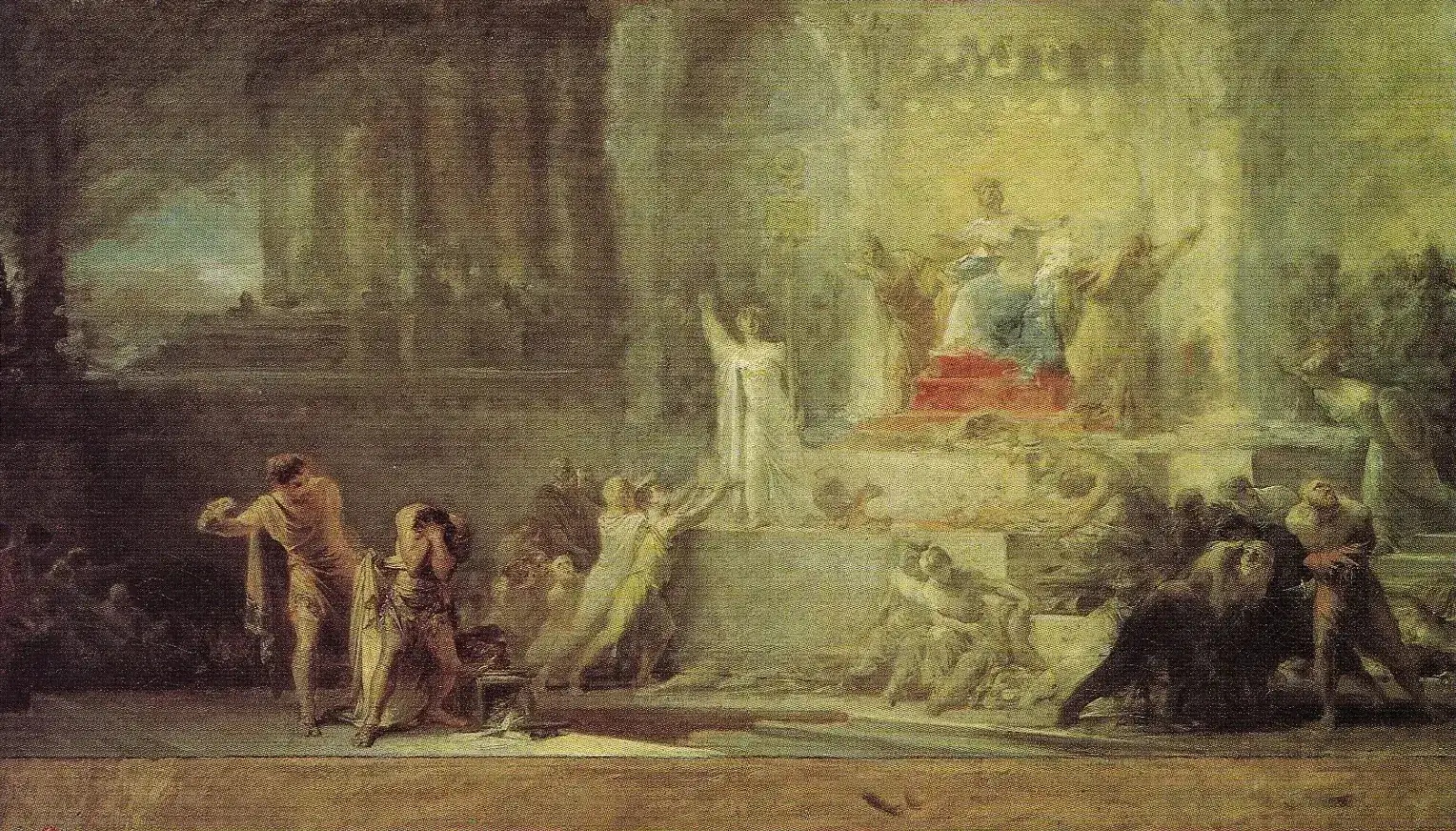
At a glance
- On Monday 23 September 1822, in the library of the Necessidades convent in Lisbon, the deputies of the Constituent Cortes signed the two copies of Portugal's first constitution, 240 articles in six titles.
- It declared that sovereignty resides essentially in the nation, put lawmaking in a single chamber elected directly every two years, and left the king a suspensive veto he could use only once on each law.
- It defined the Portuguese nation as the union of the Portuguese of both hemispheres, but Brazil had declared independence on 7 September, and the Brazilian deputy Diogo Feijó refused to sign and fled to England with six colleagues.
- King João VI swore it in the Cortes on 1 October 1822, adding “and I say it with the greatest pleasure”; Queen Carlota Joaquina refused to swear and was exiled to the Ramalhão palace near Sintra.
- After the Vilafrancada rising of May 1823 the king revoked it on 3 June 1823. It came back after the September Revolution and was in force again from 10 September 1836 to 4 April 1838.
A Monday in the convent library
The Cortes met, as they had for 20 months, in the library of the Oratorian convent of Necessidades in Lisbon, a room that ran the length of the building's east front and by 1823 held more than 30,000 volumes. On Monday 23 September 1822 the president, Agostinho José Freire, opened the session and the secretaries called the roll: 106 deputies present, 20 absent. The order of the day was the signing of the Constitution.
Nobody wanted to hear the 240 articles again. Manuel Borges Carneiro, one of the leading liberals, told the house he had checked the two fair copies against the original and found them exact, and the deputies voted not to have them read. A short argument followed about how to close the volumes. One deputy wanted the pages sewn with a ribbon and its ends sealed. Francisco Trigoso pointed out that the Congress had no chancery, and so no seal.
In the words of the minutes, the two copies were then signed by all the deputies present.
Francisco Manuel Martins Ramos, a deputy for Alagoas in Brazil, proposed an amnesty for political prisoners to mark the king's oath; the house declined to treat it as urgent. The Cortes had meant the king to swear on 1 October, but Trigoso and Borges Carneiro argued that nothing should suggest his acceptance was anything but free, and the order sent to the palace left him to name the day.
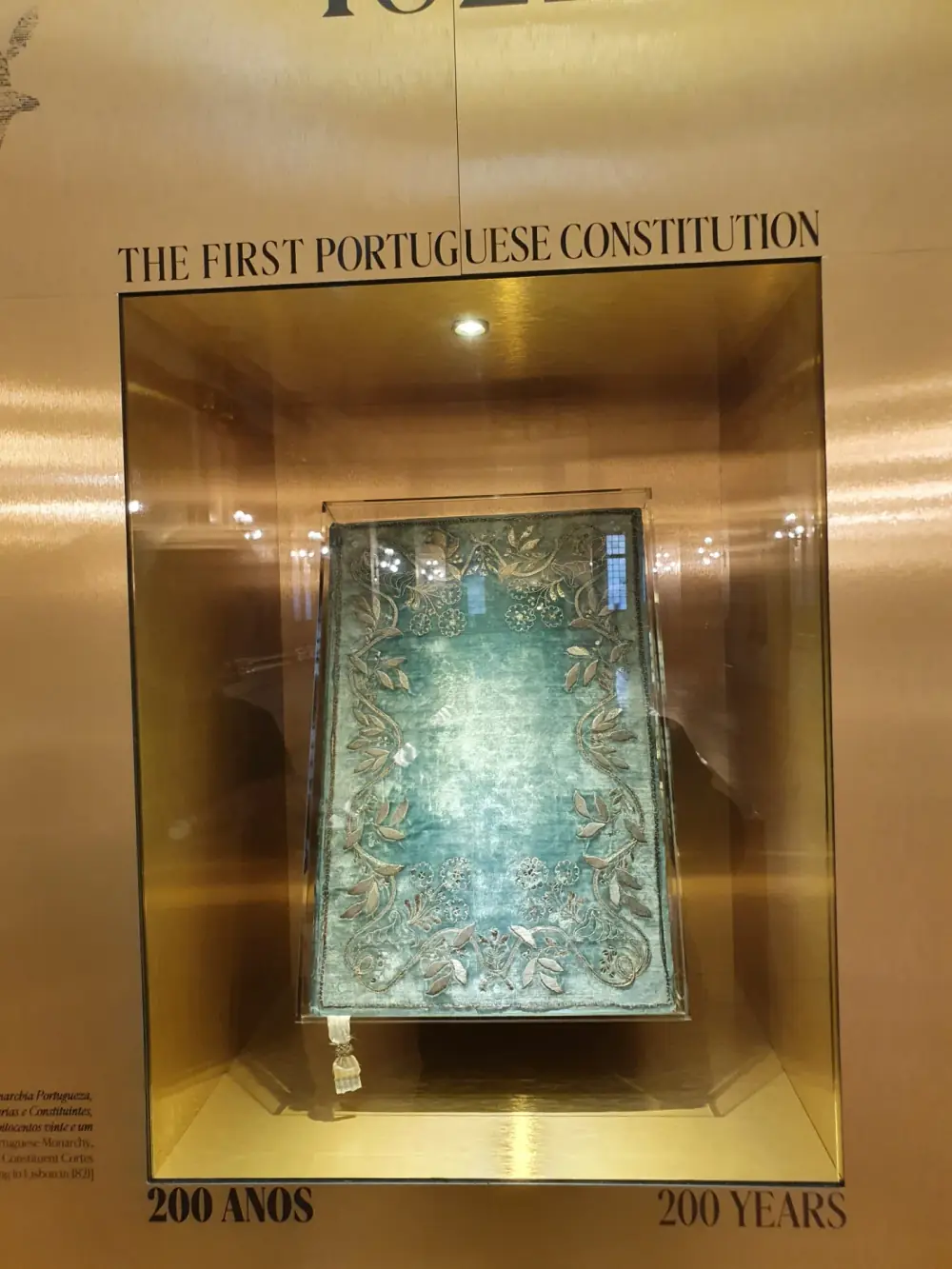
Before the session ended, a letter from Queluz was read out: João VI would receive the deputation bringing him the text at one o'clock on Wednesday 25 September. The Cortes also decreed that every edition of the Constitution would be official and national property, citing the “grave inconveniences” of printing it freely.
A kingdom without its king
In November 1807, as a French army marched on Lisbon, the Prince Regent João, the future João VI, sailed for Rio de Janeiro with the royal family and much of the court, a story told in its own article. Portugal spent more than 13 years without a resident monarch. The army, which took three-quarters of the budget, was commanded by British officers, merchants had lost their monopoly of the Brazil trade, and appeals to the court took months to come back from Rio.
On 24 August 1820 the Porto garrison rose for a constitution and the king's return, the subject of another article, and Lisbon followed. Elections held under the rules of Spain's Cádiz Constitution of 1812 produced a constituent assembly, which opened on 26 January 1821. On 9 March 1821 it approved the Bases of the Constitution, a short statement of principles. João VI came home and swore to them on 4 July 1821, having agreed in advance to accept whatever constitution the Cortes wrote.
Twenty months of debate
Priests, lawyers, university professors, landowners and merchants filled the benches. The Spanish historian Joaquín Varela Suanzes-Carpegna sorts them into four currents: royalists who wanted to reform the old monarchy without destroying it; the deputies from Brazil, who arrived only after the Bases were voted; the liberals from Portugal itself, led by Manuel Fernandes Tomás and Borges Carneiro, who dominated the house; and a small group of moderates who admired the British system, whose ideas surfaced four years later in the Charter of 1826.
The constitutional commission put a draft before the Cortes in June 1821, and the deputies debated it article by article for the next 15 months. Its main model was the Cádiz text, many of whose provisions it copied almost word for word, and behind that the French Constitution of 1791. The Portuguese liberals followed the advice of the English philosopher Jeremy Bentham on the freedom of the press. The commission that drafted the Bases claimed, all the same, to have found them in Portugal's own ancient public law.
The Cortes governed while they wrote. They abolished the Inquisition on 31 March 1821, passed a press law and an amnesty for those imprisoned for their opinions, and on Sunday 18 August 1822, before the Constitution was even signed, held the first elections for the ordinary Cortes that were to follow them.
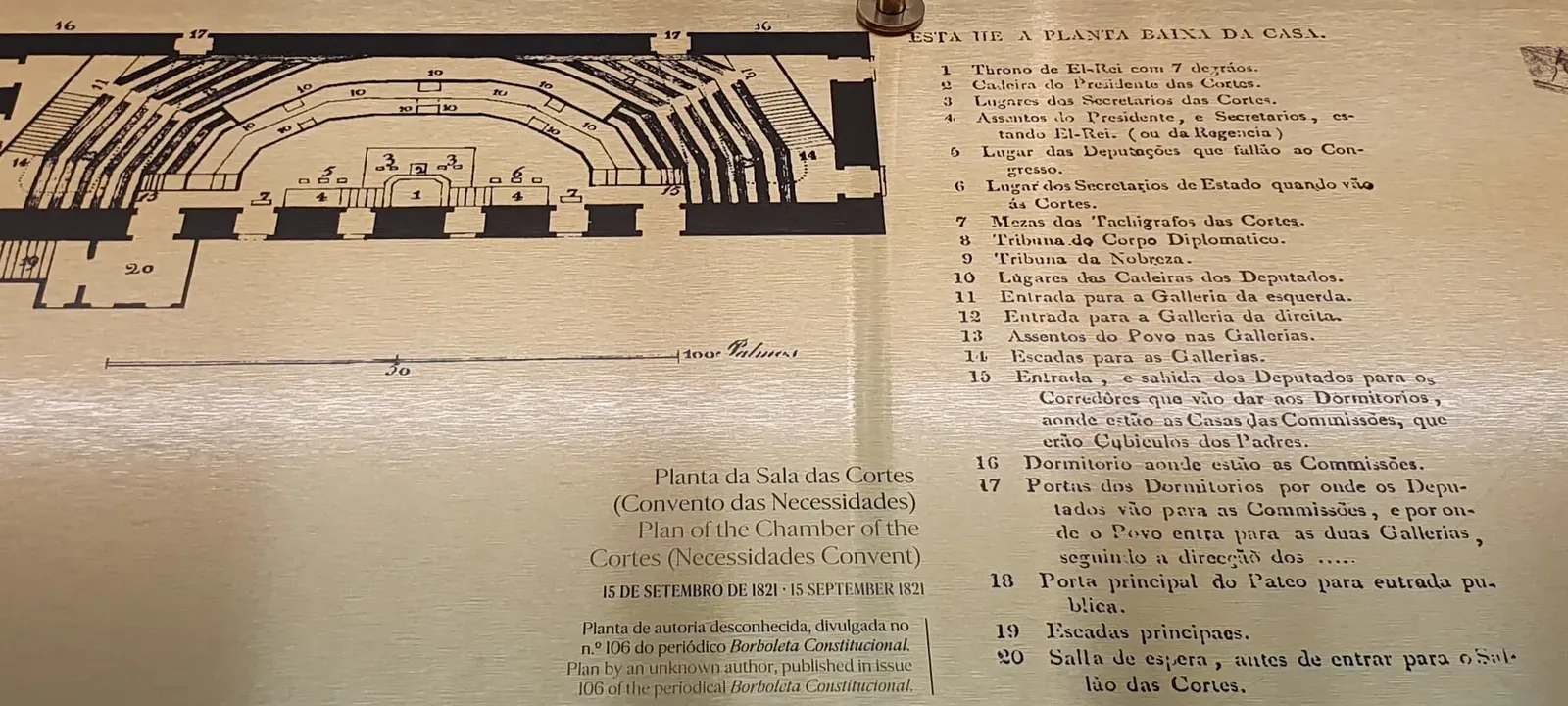
What the 240 articles said
The text opened in the name of the Holy Trinity and blamed the country's misfortunes on contempt for the rights of the citizen and neglect of the fundamental laws of the monarchy. Its six titles dealt in turn with individual rights, the nation, the Cortes, the king, the courts, and local government, finance and public services.
“Sovereignty resides essentially in the Nation. It cannot, however, be exercised except by its legally elected representatives. No individual or corporation exercises public authority that does not derive from the Nation.”
Rights came first, in 19 articles. Censorship before publication went, though bishops kept the right to censor writings on dogma and morals. A man's house was his asylum and the secrecy of letters inviolable. Foreigners could worship privately in their own faiths, which the Cádiz Constitution had not allowed.
Lawmaking belonged to the Cortes, a single chamber of deputies elected directly and by secret ballot. Each year's session opened on 1 December and lasted three months, and between sessions a permanent deputation of seven deputies watched over the Constitution.
The vote went to citizens of 25 or over, or 20 if they were married, army officers, graduates or priests in holy orders. Servants, vagrants, friars and sons living under their fathers' roof were excluded, and anyone under 17 when the text was published would be unable to vote at 25 unless he could read and write. Women were not mentioned and did not vote, and a deputy needed an income from land, trade, industry or employment.
Freed slaves were citizens, but only the free were counted when seats were shared out, and a freed slave born abroad could not be elected. Nothing in the 240 articles abolished slavery.
The king's authority, article 121 said, came from the nation. He chose and dismissed his ministers, but he could not dissolve the Cortes, levy taxes, arrest citizens outside narrow limits or give away territory, and if he left Portugal without the Cortes' consent he was deemed to have abdicated. He could enter the Cortes only for their opening and closing. Ministers could speak in the house but never be present for a vote.
His veto was suspensive. Within a month of receiving a law he could sign it, “Sanciono, e publique-se como Lei”, or send it back with his reasons, “Volte às Cortes”. If the deputies voted it again unchanged, he had to sign. Under Cádiz a king could hold a law up across two legislatures; in Lisbon he had one chance. The Constitution itself, and every act of the Constituent Cortes, needed no royal assent at all. Ron B. Thomson, writing for the British Historical Society of Portugal, calls the result as much republican as monarchical.
| Article | What it said |
|---|---|
| 7 | Opinions may be published without prior censorship; abuses answer to the law |
| 11 | Torture, confiscation, flogging, branding and other cruel or degrading punishments abolished |
| 20 | The nation is the union of all the Portuguese of both hemispheres, from the Minho to Timor |
| 25 | Catholicism is the religion of the nation; foreigners may worship privately |
| 26 | Sovereignty resides essentially in the nation |
| 28 | No amendment for four years; then a two-thirds vote in two successive legislatures |
| 37 and 41 | One deputy per 30,000 free inhabitants; legislatures of two years |
| 110 | Suspensive veto: the king may return a law once with his reasons |
| 124 | The king may not prevent elections, prorogue or dissolve the Cortes, or command armed forces |
| 128 and 129 | A five-member regency to exercise executive power in Brazil |
| 237 | Schools in every suitable place to teach children of both sexes to read, write and count |
Summaries, not translations, of the text as signed on 23 September 1822.
- Signed
- Monday 23 September 1822, Paço das Cortes (Necessidades), Lisbon
- Length
- 240 articles in six titles
- Names under the text
- 141 deputies
- King's oath
- 1 October 1822, in the Cortes
- Promulgated
- 4 October 1822, Queluz palace
- In force
- 4 October 1822 to June 1823; 10 September 1836 to 4 April 1838
A nation of both hemispheres
Article 20 defined the nation as “the union of all the Portuguese of both hemispheres” and listed its territory province by province: Portugal, the Algarve, Madeira and the Azores; the kingdom of Brazil, from Pará in the north to Rio Grande do Sul in the south; Cape Verde, Guinea, São Tomé, Angola and Mozambique; Goa, Macau and Timor. Brazil had been raised to a kingdom united with Portugal in 1815.
The text offered Brazil a regency of five to exercise executive power, a supreme court of its own and seats in Lisbon on the same basis as Portugal's. Its deputies wanted more: a legislature in Brazil for Brazilian affairs. The majority from Portugal refused, and Varela judges that their clumsiness over Brazil hastened its independence. Prince Pedro declared it on 7 September 1822, two weeks before the signing.
The quarrel reached the signing itself. On 21 September the Cortes rejected declarations by the deputies of Bahia and São Paulo and refused even to vote on whether signing and swearing were free acts or obligations. Diogo Feijó, a deputy for São Paulo, was among the 20 absent from the roll call on the 23rd. He refused to sign and, as the Brazilian Senate's biography puts it, embarked as a fugitive for England with six other Brazilian deputies. Others did sign: of the 141 names printed under the text, 36 sat for Brazilian provinces.
The 141 deputies named under the Constitution, by the region they sat for
deputies
Counted from the list headed “Deputados que a votaram” that follows article 240, in which each signatory is named with the province he represented. The largest groups were the Minho and the Beira, with 25 each, and Estremadura, with 24; Pernambuco, with eight, led the Brazilian provinces. No deputy for Goa, Macau or Timor appears. Only 106 deputies were present on 23 September, when the minutes record that all of them signed; the signing continued at the next sitting.
Show the data
| Deputies | |
|---|---|
| Portugal (mainland and Algarve) | 93 |
| Madeira and the Azores | 9 |
| Brazil | 36 |
| Africa (Cape Verde, Angola) | 3 |
“With the greatest pleasure”
The deputies swore the Constitution on 30 September. The king chose 1 October. The deputies gathered at ten in the morning, and before the king arrived Pedro Rodrigues Bandeira, a deputy for Bahia who had been ill on the day, laid his hand on the Gospels and took the oath he had missed. Shortly after midday João VI entered with his court, climbed the throne and read a speech.
He said he had examined the conditions of the new social pact, that the general will was the source and measure of all political powers, and that the first constitutional king of the Portuguese knew how sweet it was to reign over his people's hearts. Then he stood, took the paper with the formula and said he wanted to read it aloud so that everyone could hear.
“I accept, and swear to keep and to cause to be kept, the Political Constitution of the Portuguese Monarchy which the Constituent Cortes of the same Nation have just decreed. And I say it with the greatest pleasure.”
The last sentence was his own, spoken to the deputies and his court. The minister of the kingdom wrote the acceptance into both originals and the king signed each with his name in full and a flourish, as the Cortes had asked the day before. He kept one and handed the other to the secretaries of the Cortes. A carta de lei signed at Queluz on 4 October ordered the Constitution obeyed, and it took effect that day.
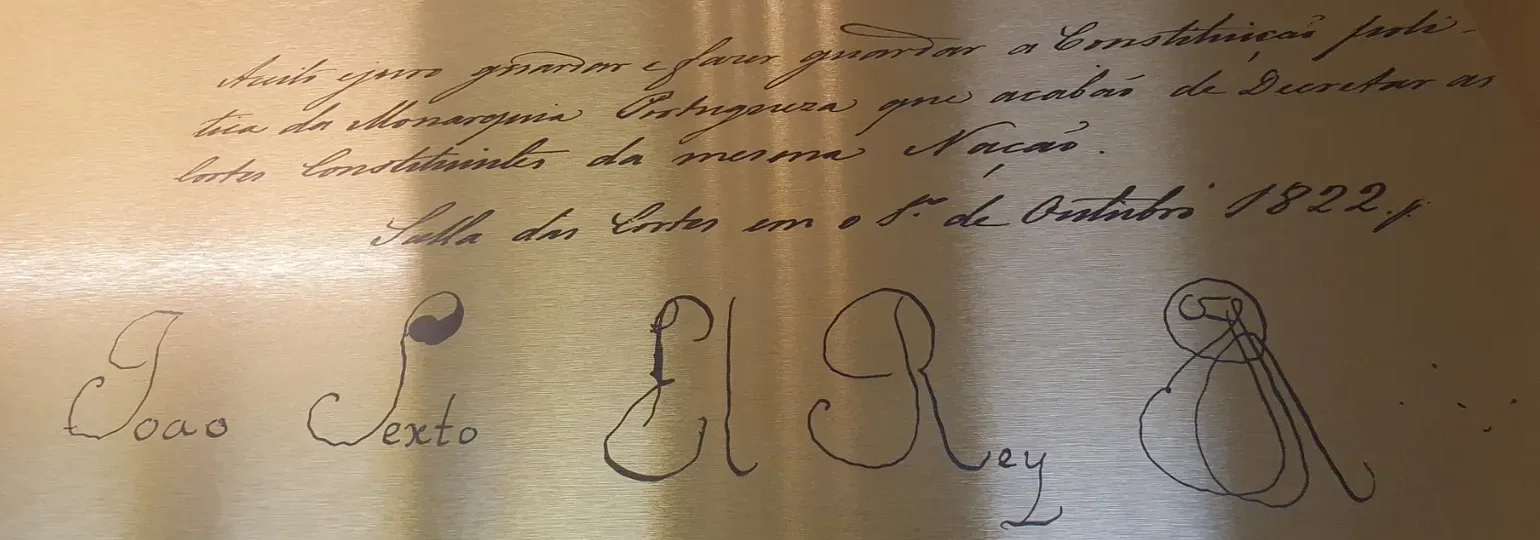
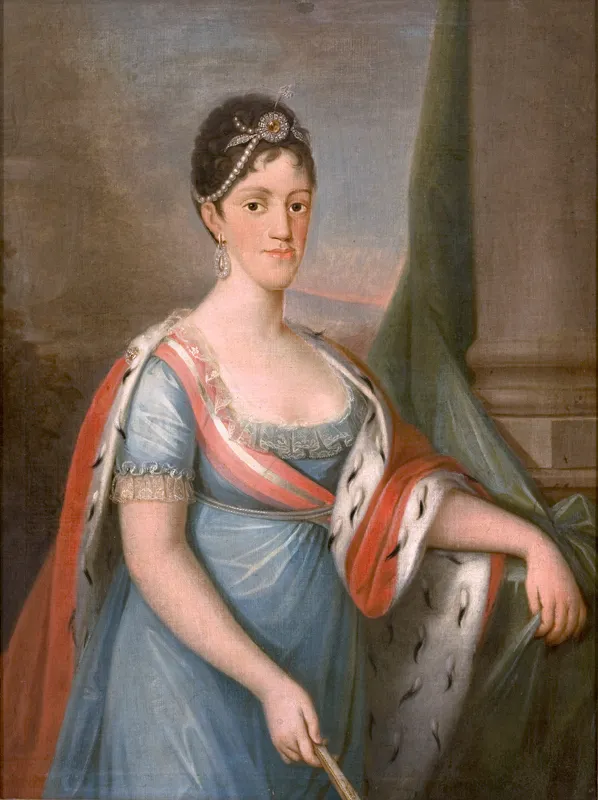
Queen Carlota Joaquina, a Spanish princess and sister of Fernando VII, refused to swear. She was exiled to the Ramalhão palace near Sintra, where she helped her favourite son, Miguel, plan a rising against the liberals.
Eight months
The Constituent Cortes closed on 4 November 1822, and the deputies of the new ordinary Cortes gathered in Lisbon. On 20 November their president opened with bad news: Manuel Fernandes Tomás, the Porto judge who was one of the four founders of the Sinédrio, the secret society behind the revolution of 1820, and who had been re-elected for several constituencies, had died at ten the night before. He had rendered great services to the country, the president said, and died poor. The ordinary Cortes held their first session on 1 December.
Opposition had never gone away. On the night of 1 to 2 June 1822 five men were arrested in Lisbon over the Rua Formosa conspiracy; they were said to want a two-chamber Cortes and Prince Miguel, João's younger son, in his father's place. In February 1823 the Count of Amarante rose in Trás-os-Montes. Vital Moreira and José Domingues name two grievances behind it all: a constitution with no second chamber for the nobility and clergy and a king with minimal powers, and the loss of Brazil.
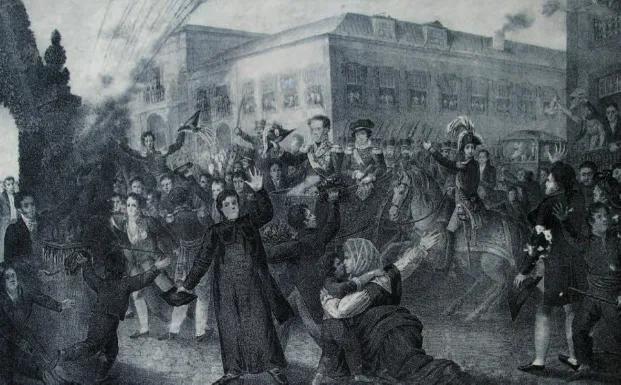
On 27 May 1823 Miguel put himself at the head of an infantry regiment in revolt at Vila Franca de Xira, up the Tagus from Lisbon, the rising remembered as the Vilafrancada. After some hesitation the king took over its leadership. On 2 June the deputies declared they could no longer carry out their mandate and protested against any change to the Constitution.
The next day João VI dissolved the Cortes and declared the Constitution revoked, promising the country a new one. The formal decree of revocation may have followed on 18 June, the date José Miguel Sardica gives.
24 August 1820
Revolution in Porto
26 January 1821
The Constituent Cortes open at Necessidades
9 March 1821
Bases of the Constitution approved
4 July 1821
João VI, back from Brazil, swears to the Bases
18 August 1822
First elections for the ordinary Cortes
7 September 1822
Pedro declares Brazil independent
23 September 1822
The Constitution is signed
1 October 1822
The king swears it; it takes effect on 4 October
19 November 1822
Death of Manuel Fernandes Tomás
1 December 1822
First session of the ordinary Cortes
27 May 1823
The Vilafrancada
3 June 1823
The king dissolves the Cortes and revokes the Constitution
The new government set out to erase the regime. Monuments to the revolution had been begun in Porto, Lisbon and Funchal. The one in Lisbon's Rossio was pulled down on 23 June 1823, its wooden fencing burned in the bonfires of St John's Eve, and a royal order of 12 August had the models made for it by the painter Domingos Sequeira destroyed. Porto's foundations were dug up from half past five on the morning of 30 June.
In August 1823 royal orders went out to the courts, the town councils and other bodies to strike through their books, or burn, any record of obedience to the constitutional institutions. A law of 5 June 1824 declared everything the Cortes had enacted null and void. It kept the Bank of Lisbon, and the Inquisition stayed abolished.
A second life, and what it left
The promised new constitution never came from João VI. A junta under his foreign minister, Palmela, drafted a fundamental law with two chambers and an absolute royal veto, but it was shelved, and in 1826 his son Pedro granted the Constitutional Charter instead, which has its own article. The Charter reversed the choices of 1822: it was a gift of the king, not a vote of the nation, with an appointed Chamber of Peers, an absolute veto and the king's power to dissolve.
The 1822 text had one more spell. After the September Revolution of 1836, also told in its own article, it was put back in force from 10 September 1836 until Queen Maria II swore the compromise Constitution of 1838 on 4 April 1838. Counting both periods it was in force for a little over two years; Sardica, counting in whole years, gives three.
Many of its liberties outlived it. Equality before the law and freedom of the press passed into the Charter of 1826, which kept most of the rights of 1822. The Assembleia da República's chronology and its archive of debates begin with the Cortes of 1821, and for the bicentenary on 23 September 2022 the post office issued two stamps showing articles 1 and 2, from photographs in parliament's archive.
FAQs
When was Portugal's first constitution approved?
The Constituent Cortes signed the final text on 23 September 1822 in Lisbon. The deputies swore it on 30 September, King João VI accepted and swore it in the Cortes on 1 October, and it took effect on 4 October 1822.
What did the Constitution of 1822 establish?
A constitutional monarchy in which sovereignty resided in the nation, a single chamber of deputies elected directly for two years, a king who could not dissolve parliament and had only a suspensive veto, and a list of citizens' rights, among them freedom of the press without prior censorship and the abolition of torture.
Why did the Constitution of 1822 last so short a time?
It had many enemies: the queen, much of the nobility and clergy, and those who blamed the liberals for losing Brazil. After Prince Miguel's rising at Vila Franca de Xira in May 1823, João VI dissolved the Cortes and revoked the Constitution on 3 June 1823, eight months after it took effect.
How was the 1822 Constitution different from the Charter of 1826?
The 1822 text was voted by elected Cortes, had one chamber and gave the king only a suspensive veto. The Charter of 1826 was granted by Pedro IV, created an appointed Chamber of Peers, gave the king an absolute veto and the power to dissolve the Chamber of Deputies, and added a royal moderating power.
Did the Constitution of 1822 apply to Brazil?
On paper it did: it defined the nation as the Portuguese of both hemispheres and gave Brazil a regency and its own supreme court. But Brazil had declared independence on 7 September 1822, before the signing, and the text never took effect there. Some Brazilian deputies in Lisbon, among them Diogo Feijó, refused to sign it.
On the timeline
Open the timelineNearby moments from invasions, brazil and the liberal wars (1807–1851).
King João VI, back from Brazil, lands at the Terreiro do Paço and at five that afternoon, in the Cortes at the Necessidades palace, swears to uphold the Bases of the new liberal constitution. The Cortes then declare the Regency extinct. Portugal's first liberal regime would unravel within two years.
On the 'Dia do Fico' (the 'I'm Staying' Day), Prince Regent Pedro defies orders from the Cortes in Lisbon to return to Portugal, reportedly declaring 'Diga ao povo que fico' — 'Tell the people I'm staying'. Eight months later he proclaimed Brazil's independence and became its first emperor.
Near the Ipiranga stream outside São Paulo, Prince Regent Dom Pedro proclaims Brazil's independence from Portugal, the 'Grito do Ipiranga'; Portuguese garrisons fought on into 1824 and Portugal recognised the new empire in 1825.
The Constitution of 1822
The Constituent Cortes approve the Portuguese Constitution of 1822, the country's first constitution, which sought to end absolutism and establish a constitutional monarchy; King João VI swore his oath to it on 1 October.
On his twenty-fourth birthday, Prince Regent Pedro is acclaimed Constitutional Emperor and Perpetual Defender of Brazil at the Campo de Santana in Rio de Janeiro, a month after the Cry of Ipiranga had proclaimed the country's separation from Portugal.
At Pirajá, outside Salvador da Bahia, Brazilian independence forces beat back General Madeira de Melo's Portuguese troops in the main battle of Bahia's war of independence. Tradition, first printed in the 1830s, says the tide turned when the bugler Luís Lopes, a Portuguese in Brazil's service, sounded 'cavalry, advance' and 'no quarter' instead of the ordered retreat, though no Brazilian cavalry was on its way.
Prince Miguel launches the Vilafrancada in Vila Franca de Xira, an absolutist military coup against the liberal Constitution of 1822 that ends Portugal's first constitutional experiment and restores the traditional powers of King João VI.
Coming up in history
All long reads
20 sources
Archives, scholarship and reporting this article was checked against.
- 1
Constituição de 1822: Constituição Política da Monarquia Portuguesa (transcription of the original in modern spelling by Luís Filipe Correia Henriques)NOVA School of Law, Universidade Nova de Lisboa
- 2
Diário das Cortes Geraes e Extraordinarias da Nação Portugueza, no. 44: end of the session of 21 September and session of 23 September 1822 (pp. 539–542)Assembleia da República, Debates Parlamentares
- 3
- 4
No bicentenário da contrarrevolução antiliberal de 1823 em Portugal: a vindicta contra o sistema político-constitucional vintista (Vital Moreira and José Domingues)Araucaria: Revista Iberoamericana de Filosofía, Política, Humanidades y Relaciones Internacionales 26, no. 55 (2024), pp. 37–60
- 5
El primer constitucionalismo español y portugués: un estudio comparado (Joaquín Varela Suanzes-Carpegna)Historia Constitucional, no. 13 (2012), pp. 99–117, Universidad de Oviedo
- 6
The Portuguese Constitution of 1822 (Ron B. Thomson)British Historical Society of Portugal
- 7
A Monarquia Constitucional (1820-1910)Assembleia da República
- 8
O Palácio das NecessidadesGoverno da República Portuguesa (Negócios Estrangeiros)
- 9
- 10
- 11
Decreto de 10 de Março de 1821: dá as Bases da Constituição Política da Monarquia Portuguesa (publicação original)Câmara dos Deputados (Brazil), Legislação Informatizada
- 12
La experiencia constitucional gaditana y la Constitución portuguesa de 1822 (José Sánchez-Arcilla Bernal)Cuadernos de Historia Contemporánea 24 (2002), pp. 105–143, Universidad Complutense de Madrid
- 13
The first Portuguese Constitution of 1822: 200 years (stamp issue brochure, text by José Manuel Araújo, Director of Information and Culture of the Assembleia da República)CTT Correios de Portugal, issue of 23 September 2022
- 14
Diogo Antônio Feijó: dados pessoaisSenado Federal (Brazil)
- 15
Carlota Joaquina: the ‘spoilt’ princess who became the ‘shrew of Queluz’Parques de Sintra – Monte da Lua
- 16
- 17
A constituição do Sinédrio e a implantação do liberalismo em Portugal (Rui de Albuquerque)1820: Revista de Ciência Política 1 (2019), Universidade Lusófona do Porto, pp. 9–26
- 18
- 19
Carta constitucional da monarchia portugueza (Lisbon: Impressão Régia, 1826)John Carter Brown Library, via the Internet Archive
- 20
Parliament Sessions HallReverbData, Instituto Politécnico de Lisboa
Image credits
- Allegory of the Constitution, an oil painting by Domingos Sequeira in the Museu Nacional de Arte Antiga in Lisbon, dated 1821 by the museum's credit and 1822 on Wikimedia Commons. Sequeira also made the models for the constitutional monument planned for the Rossio, which were destroyed in 1823. Domingos Sequeira, Public domain, via Wikimedia Commons.
- One of the two manuscript originals of the Constitution of 1822, in its velvet binding, shown at the Palácio de São Bento in the parliament's bicentenary exhibition, photographed in November 2022. GualdimG, CC BY-SA 4.0, via Wikimedia Commons.
- Plan of the Cortes hall in the Necessidades convent, by an unknown author, published in the periodical Borboleta Constitucional and dated 15 September 1821, as reproduced in the parliament's bicentenary exhibition in 2022 (photograph cropped, left end of the plan cut off). The key marks the king's throne with seven steps, the president's chair, the deputies' benches, the shorthand writers' tables and galleries for the nobility, the diplomatic corps and the public. GualdimG, CC BY-SA 4.0, via Wikimedia Commons.
- An enlarged copy of João VI's acceptance on the Constitution, “Aceito e juro guardar e fazer guardar”, dated in the Sala das Cortes on 1 October 1822 and signed “João Sexto El Rey”, on a panel of the parliament's bicentenary exhibition in 2022 (photograph cropped). GualdimG, CC BY-SA 4.0, via Wikimedia Commons.
- Carlota Joaquina, painted by Domingos Sequeira between about 1802 and 1806, now in the São Paulo Museum of Art. In 1822, as queen, she refused to swear the Constitution. Domingos Sequeira, Public domain, via Wikimedia Commons.
- “Triumphant entry of His Majesty King João VI and his august son into the capital”: the return of the king and Prince Miguel to Lisbon after the Vilafrancada, in a print by an unknown artist dated 1823 on Wikimedia Commons. Unknown author, Public domain, via Wikimedia Commons.