

The Battle of Buçaco, 1810: Wellington's ridge
At dawn on 27 September 1810 two French corps climbed a misty ridge to break Wellington's line. They were beaten in a morning by an Anglo-Portuguese army in which Beresford's rebuilt Portuguese regiments fought in strength for the first time.
At a glance
- On Thursday 27 September 1810 Marshal Masséna's French Army of Portugal attacked Wellington's Anglo-Portuguese army on the ridge of Buçaco, between Viseu and Coimbra, and was beaten back by early afternoon.
- Wellington had about 52,000 men on the field by Charles Oman's count, almost half of them Portuguese troops retrained since 1809 under the British general William Carr Beresford.
- The French return made to Masséna counted 4,498 killed, wounded and captured; Oman puts the allied loss on the day at 1,252, split exactly evenly between British and Portuguese.
- On 28 September French cavalry found a country road round the north end of the ridge, and Wellington withdrew as he had always planned, reaching the Lines of Torres Vedras north of Lisbon on 8 October.
- Wellington's headquarters was the Carmelite convent of Santa Cruz on the ridge, which still stands beside the Palace Hotel; a military museum opened on the battlefield on the centenary, 27 September 1910.
Mist on the ridge at dawn
The night before, nobody on the ridge lit a fire. Wellington's soldiers slept in their battle positions along the crest of the Serra do Buçaco, muskets beside them. Below, on the low hills around the villages of Moura and Santo António do Cântaro, the French bivouac fires burned in three great clusters, one for each of Masséna's army corps.
At first light on Thursday 27 September 1810 the slopes were thick with mist. Out of it, General Reynier's 2nd Corps began to climb towards the lowest point of the ridge, the dip where a country road crossed from Santo António do Cântaro to Palheiros. Merle's division went first, eleven battalions packed into narrow columns, wading uphill through heather and furze.
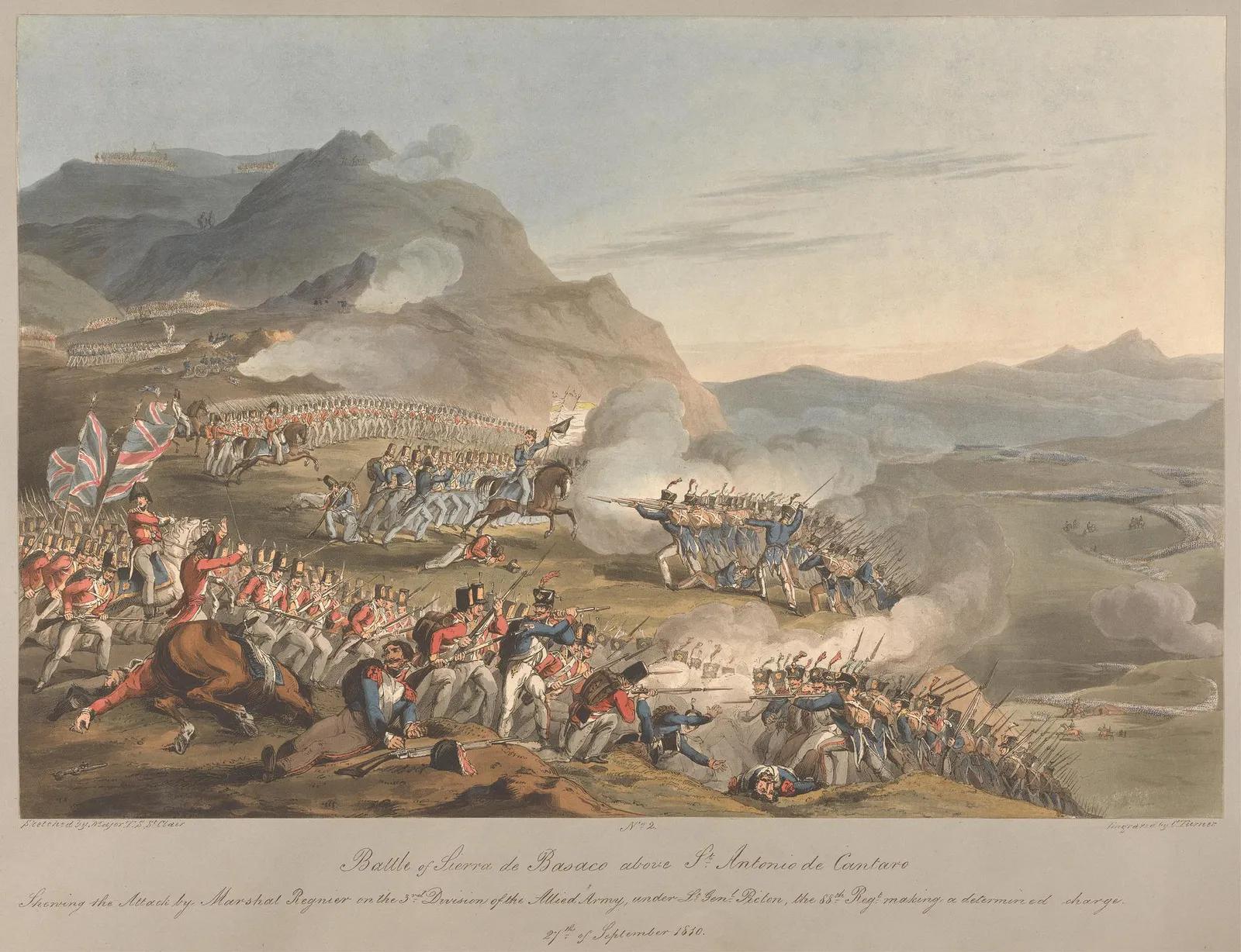
The defenders heard them before they saw them. Picton, commanding the British 3rd Division, sent part of the 45th Foot and the two battalions of the Portuguese 8th Line Regiment along the hilltop into a gap in his line. They arrived just as the head of the French column lurched over the skyline, out of breath and out of order.
Lieutenant-Colonel Alexander Wallace of the 88th, the Connaught Rangers, did not wait for the French to recover. He charged them in the flank with his own battalion and the wing of the 45th, while the Portuguese 8th fired into their front and Wellington himself, down from his lookout near the convent, turned two guns on the climbing mass.
The French broke and ran down the hill. It was the first of the French attacks that morning.
- Date
- Thursday 27 September 1810, from dawn to early afternoon
- Place
- Serra do Buçaco, between Mortágua and Luso, north of Coimbra
- Commanders
- Wellington, with Beresford, for the allies; Marshal André Masséna for the French
- Allied army present
- 52,272 (26,843 British, 25,429 Portuguese), by Oman's count
- French attacking force
- About 26,000 men in 45 battalions, from an army of about 65,000
- Losses
- Allies 1,252 (Oman); French 4,498 on their own return, at least 4,600 by Oman's estimate
- Outcome
- French repulsed; position turned by the Boialvo road; allies withdrew to the Lines of Torres Vedras
The third invasion and Portugal's new army
Napoleon's armies had already invaded Portugal twice. In 1807 Junot reached Lisbon as the royal family sailed for Brazil; in 1809 Soult took Porto. Each time a British and Portuguese army pushed the French out. In the summer of 1810 Napoleon sent a third army, the Army of Portugal, under Marshal André Masséna, Prince of Essling, with orders to drive the British out of Portugal and take Lisbon.
Masséna took the Spanish border fortress of Ciudad Rodrigo in July and the Portuguese fortress of Almeida at the end of August, after its main magazine blew up. On 15 September 1810 his army, about 65,000 strong by Oman's reckoning, began its march on Lisbon.
Wellington did not mean to stop him at the frontier. North of Lisbon, thousands of Portuguese labourers had spent a year building the Lines of Torres Vedras, chains of forts across the hills that the French knew nothing about. In front of the invader, the people were ordered to leave their villages and take or destroy their food. Wellington would fight only if Masséna offered him a strong position, and then fall back on the Lines.
So the Portuguese were Wellington's question mark. British and Portuguese brigades were mixed in the same divisions, and at Buçaco Portuguese soldiers made up about half his infantry. Nobody yet knew how they would stand up to a French attack.
| Count | Anglo-Portuguese army | French Army of Portugal |
|---|---|---|
| Wellington, Memorandum of operations in 1810 (written 1811) | About 49,000 rank and file in the battle (not quite 24,000 British, 25,175 Portuguese), besides artillery | Not less than 72,000 in all: 56,000 infantry in 89 battalions, 8,000 cavalry, about 6,000 artillery, plus sappers |
| Wellington to Lord Liverpool, 3 November 1810 | Not given | “I cannot believe that they composed an army of less than 70,000 men at the battle of Busaco” |
| Charles Oman (1908), from the returns | 52,272 present: 26,843 British and 25,429 Portuguese | 65,000 entered Portugal; Masséna's chief of staff Fririon gave 59,806 |
| Oman: troops actually sent into the fight | 24 battalions, about 14,000 men | 45 battalions, about 26,000 men |
Wellington's memorandum counts rank and file only and leaves out the artillery; Oman's totals include officers, artillery, engineers and train. Oman thought Fririon's figure left out whole battalions that marched.
The worst road in the kingdom
Wellington expected Masséna to march down the good road along the south bank of the Mondego, where a defensive position waited for him on the Alva. Instead the French crossed to the north bank and took the mountain road through Viseu. “There are certainly many bad roads in Portugal,” Wellington wrote on 18 September, “but the enemy has taken decidedly the worst in the whole kingdom.”
The detour cost Masséna days while his guns were dragged over the rocks, and it gave Wellington time to move his army across the Mondego onto the Serra do Buçaco, astride the main road from Viseu to Coimbra. From 21 September he dated his letters from the Carmelite convent on the ridge. “We have an excellent position here, in which I am strongly tempted to give battle,” he wrote that night.
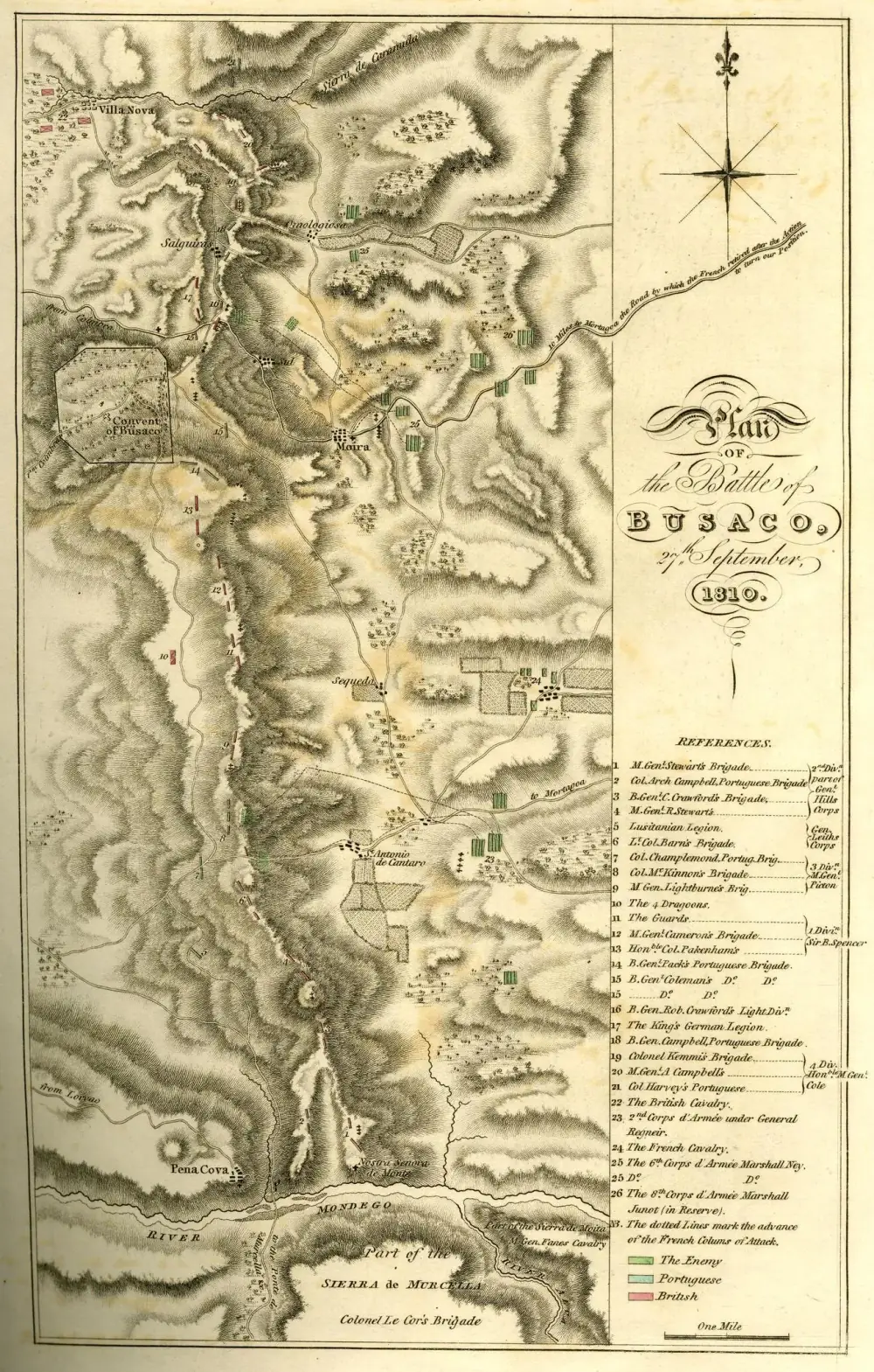
The ridge runs north from the Mondego for about eight miles by Wellington's estimate, nine by Oman's. Its eastern face, towards the French, was bare heath and rock, a natural glacis. Its top was broad enough in places for troops and even cavalry to move along it, and a track just behind the crest let Wellington shift whole divisions from one end to the other out of the enemy's sight.
The French vanguard came up late on the afternoon of 25 September, pushing Craufurd's Light Division and Pack's Portuguese brigade back up the main road past Moura. Masséna himself arrived only at about two in the afternoon of the 26th. He studied the ridge, apparently without realising how much of Wellington's army lay hidden along it, and ordered an attack for the next morning.
“You come from the old Army of the Rhine, you like manœuvring; but it is the first time that Wellington seems ready to give battle, and I want to profit by the opportunity.”
His orders were simple. Reynier's 2nd Corps would climb at Santo António do Cântaro and, once on top, turn north behind the crest towards the convent. When Ney saw Reynier on the heights, his 6th Corps would send one division up the main road past Moura and another up the spur by the village of Sula. Junot's 8th Corps would wait in reserve.
15 September 1810
Masséna's army leaves the Almeida area for Lisbon
18–22 September
The French struggle along the Viseu road; Wellington concentrates on the Serra do Buçaco
21 September
Wellington writes from the convent that he is “strongly tempted to give battle”
25 September
The Light Division and Pack's Portuguese fall back onto the ridge; the French vanguard arrives
26 September
Masséna reconnoitres in the afternoon and orders a frontal attack
27 September
Battle of Buçaco: the French attacks are beaten off by early afternoon
28 September
French cavalry find the Boialvo road round the north of the ridge; the French march off at night
29 September
The allied army leaves the ridge, the Light Division last
1 October
The French enter an emptied Coimbra and plunder it
8 October
Wellington's army reaches the Lines of Torres Vedras
11 October
French cavalry reach Sobral and find the Lines
Reynier's attack: twice on the crest
Merle's division, routed by Wallace, was only half of Reynier's effort. On the road itself a second column pushed up against Colonel Champalimaud's Portuguese brigade and the British 74th. As the mist lifted, a Portuguese battery cut lanes through the column, and British and Portuguese musketry stopped it.
Reynier then sent in Foy's brigade, seven battalions, a little to the north of the road. This time the French reached the top.
A battalion of Tomar militia bolted down the back of the ridge, and the Portuguese 8th, which had just helped to beat Merle, gave way with one of Champalimaud's battalions. A French officer was seen on the rocks, cheering with his hat off.
Help came along the hidden track behind the crest. General Leith, whose 5th Division had no enemy in front of it, had marched north towards the firing. He brought the British 9th Foot across the plateau into Foy's flank, fired a volley at a hundred yards, advanced firing and lowered bayonets. Foy's men ran. Foy himself was wounded, and his diary agrees with Leith's account of what happened.
“My heroic column, much diminished during the ascent, reached the summit of the plateau, which was covered with hostile troops. Those on our left made a flank movement and smashed us up by their battalion volleys; meanwhile those on our front, covered by some rocks, were murdering us with impunity.”
Picton's and Leith's officers argued bitterly over which of them had saved the day. Oman found that each general played down the other's part, and judged Leith's account the right one. The figures are clearer. Reynier's corps lost more than 2,000 men, and 118 of the 421 officers who climbed the hill. Picton's division lost 427 killed and wounded and Leith's 160.
Ney's attack: Sula and the convent wall
About three miles to the north by Napier's estimate, Marshal Ney waited, as ordered, until the lifting mist showed Reynier's men on the crest. Then Loison's division started up the steep slope by Sula. A screen of British riflemen and the Portuguese 3rd and 1st Caçadores fought it every yard of the way, and Captain Ross's guns, set among boulders near a windmill, fired into the village.
Craufurd had hidden his two strongest British battalions, the 43rd and 52nd, lying down in a sunken stretch of road below the skyline. When the French columns were within a few yards of the guns he waved his hat.
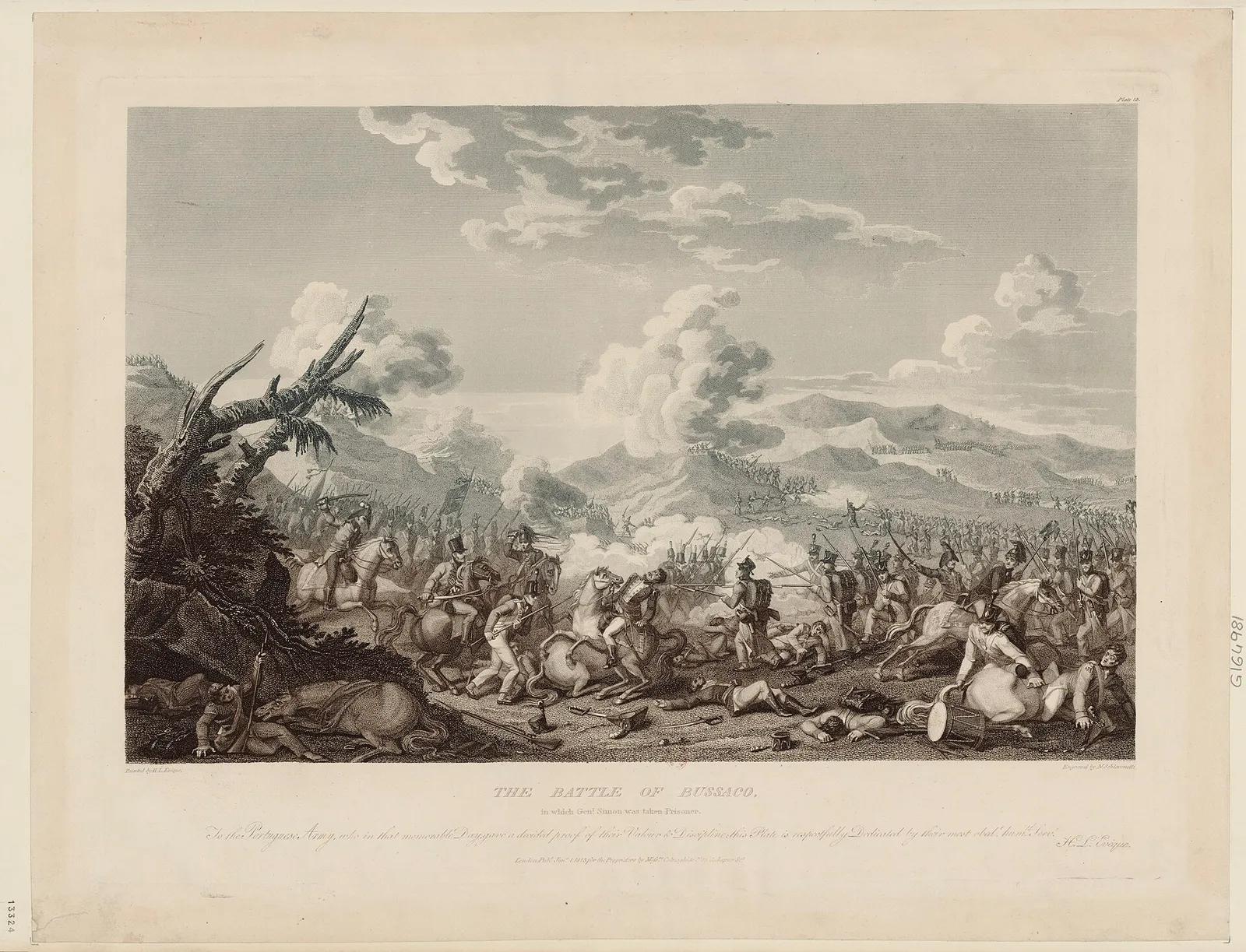
About 1,800 men stood up and fired into the heads of the columns at point-blank range, then charged. Loison's brigades went back down the hill faster than they had come up, and General Simon, wounded in the face, was taken prisoner by a private of the 52nd.
One French battalion strayed into the head of the ravine below the convent. A Portuguese battalion of the 19th Line, from Coleman's brigade, under Major McBean, charged and drove it back down. Wellington named the charge in his dispatch.
Ney's other division, Marchand's, came up the main road under the fire of three batteries, swerved into a pine wood full of Portuguese skirmishers from Pack's brigade, and then tried several times to climb towards the convent wall. Pack's Portuguese line battalions beat off every attempt. Ney called his columns back, and by early afternoon the firing had died down. In the lull, Napier recalled, parties from both armies went out together under a short truce to collect the wounded.
Masséna still had Junot's corps and one of Ney's divisions fresh, but he did not try again. That day Wellington wrote to Charles Stuart, the British minister in Lisbon, that the French must take the position “or starve”, and that the Portuguese had “conducted themselves remarkably well in several brisk attacks”.
Counting the cost
Casualty figures for Buçaco began to diverge on the day itself. Wellington's dispatch told London that the enemy had left 2,000 dead on the field. Masséna told Berthier, Napoleon's chief of staff, that he had lost about 3,000 men, three days after his own staff had given him a return of nearly 4,500. The historians who later worked through the returns land close to that last figure.
| Source | Anglo-Portuguese loss | French loss |
|---|---|---|
| Wellington to Charles Stuart, 27 September 1810 | British “about 300”; Portuguese “rather greater” | “Very large indeed” |
| Wellington's dispatch and return, 30 September 1810 (London Gazette, 15 October) | 1,269 killed, wounded and missing on 25 to 27 September: 197 killed, 1,014 wounded, 58 missing | “Two thousand killed upon the field”; wounded “immense” |
| French corps returns to Masséna, 1 October 1810 | Not given | 4,498: 522 killed, 3,612 wounded, 364 missing (prisoners) |
| Masséna to Berthier, 4 October 1810 | Not given | “About 3,000” |
| W. F. P. Napier (1831) | Not more than 1,300 | About 4,500, including about 800 killed |
| Charles Oman (1908) | 1,252 on 27 September: 200 killed, 1,001 wounded, 51 missing; 626 British and 626 Portuguese | At least 4,600, adding officers and corps the returns left out |
Wellington's return covers three days of fighting, so it is slightly higher than Oman's count for 27 September alone; the London Gazette printed it as separate British and Portuguese returns. Oman gives the French 2nd Corps at least 2,043 and the 6th Corps at least 2,455 casualties; the corps tables in his appendix add up to 2,023 and 2,456.
French casualties at Buçaco by division
killed, wounded and captured
Divisional totals from the French returns of the 2nd Corps (signed by Barbot, 1 October 1810) and the 6th Corps, printed by Charles Oman in A History of the Peninsular War, vol. III (1908), appendix XIII. They leave out the staffs, the 2nd Corps engineers and train, the cavalry, the 6th Corps artillery (which sent no return) and Junot's 8th Corps, whose loss Oman put at sixty at least.
Show the data
| Casualties | |
|---|---|
| Merle (2nd Corps) | 1,041 |
| Heudelet (2nd Corps) | 978 |
| Marchand (6th Corps) | 1,173 |
| Loison (6th Corps) | 1,252 |
| Mermet (6th Corps, reserve) | 24 |
Two details stand out. Oman counted one French officer hit for every sixteen men, against one to twenty-two in an ordinary engagement: the officers had led from the front up an impossible slope. And the allied loss fell exactly evenly, 626 British and 626 Portuguese, which Oman called a strange coincidence.
A peasant's road and the retreat to the Lines
On 28 September Masséna sent his cavalry out to look for a way round. To the north, General Montbrun, riding out with Sainte-Croix's dragoons, found a country track from Mortágua over the Serra do Caramulo by Boialvo to Sardão, by Águeda, close to the main road from Porto to Coimbra. A peasant questioned by Mascarenhas, one of the Portuguese officers on Masséna's staff, said the ox-carts used it every day and that nobody was guarding it.
Wellington had known about the road and had ordered Colonel Trant's Portuguese militia to block it. Trant's superior sent him the long way round by Porto, and he reached Sardão only on the 28th, too late and too weak; on 30 September French dragoons pushed his militia back across the Vouga. From the summit Wellington watched French columns moving off to the north-west, and that night he ordered the whole army to retreat.
“After quitting Busaco, there was no position which we could take up with advantage, in which we could be certain that we could prevent the enemy from getting to Lisbon before us, till we reached the fortified positions in front of that place.”
He reasoned that a corps sent to hold the far end of the road might be beaten and cut off to the north, and would then be missing from the Lines. By the morning of 29 September the ridge was empty except for the Light Division. Its officers found 400 badly wounded Frenchmen left behind in an enclosure and had them carried into the convent.
Coimbra, a city of about 40,000, emptied in a hurry, its people fleeing south on foot or downriver to the coast. The French entered on 1 October and plundered it. Wellington's army reached the Lines on 8 October, and on the 11th Masséna's cavalry came up against them near Sobral de Monte Agraço. The French stayed in front of the Lines for a month, spent a hungry winter around Santarém and began their retreat from Portugal in March 1811.
Why it still matters
In his dispatch of 30 September Wellington wrote that the battle had brought the Portuguese “into action with the enemy for the first time in an advantageous situation”, and gave the credit for the army to Beresford.
“They have proved that the trouble which has been taken with them has not been thrown away, and that they are worthy of contending in the same ranks with British troops in this interesting cause, which they afford the best hopes of saving.”
Not every unit held. The Tomar militia ran, and the 8th and 9th Line gave ground when Foy's larger force reached the top. But the Portuguese suffered half the allied casualties, and Pack's brigade, the 19th Line and the Caçadores of the Light Division won the highest praise from their British commanders. Oman judged that Wellington now knew how far he could trust them, at least in defence on good ground.
On the centenary, 27 September 1910, a military museum opened on the battlefield in the presence of King Manuel II, who also unveiled a bronze crown on the obelisk that commemorates the battle. The tiled entrance hall of the Palace Hotel, built over most of the old convent between 1888 and 1907, shows the Peninsular War and the battle in panels by Jorge Colaço.
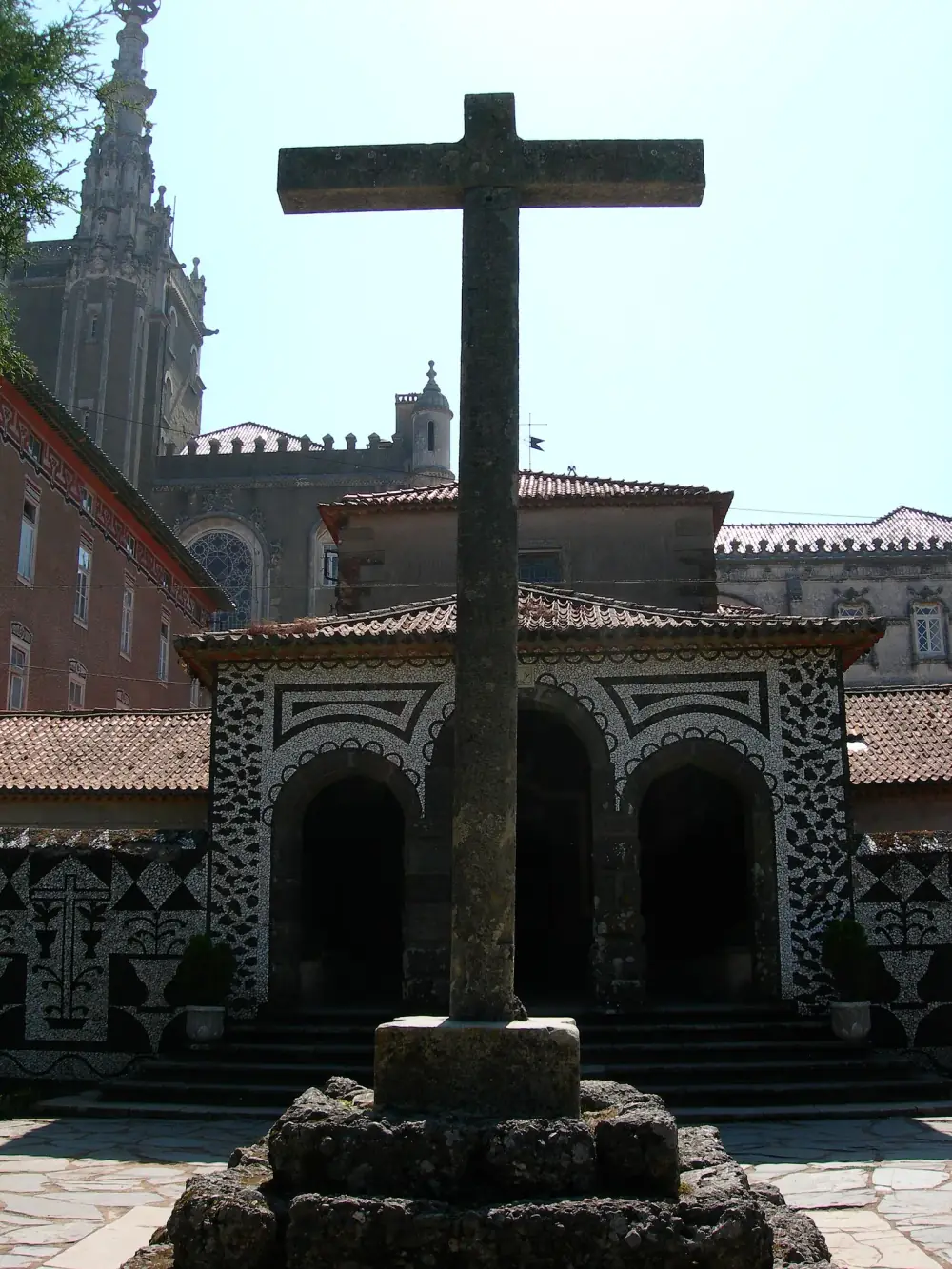
The convent itself goes back to 1628, when the Bishop of Coimbra gave the forest of Buçaco to the Discalced Carmelites as a retreat; its church was consecrated in 1639. The friars stayed until the religious orders were abolished in 1834. In December 2017 the government approved a decree classifying the forest, the convent and the hotel as a national monument.
FAQs
Who won the Battle of Buçaco?
Wellington's Anglo-Portuguese army. On 27 September 1810 it threw back every French attack on the ridge, losing about 1,250 men against some 4,500 French. But Masséna then marched round the north end of the ridge, and Wellington withdrew to the Lines of Torres Vedras as he had planned.
Why did Wellington retreat after winning at Buçaco?
On 28 September the French found the Boialvo road over the Serra do Caramulo, which let them reach the Coimbra plain behind his left flank. Wellington judged that holding it with a detached corps risked having that corps cut off from Lisbon, and that no position short of the Lines of Torres Vedras could stop the French reaching the capital first.
How many Portuguese fought at Buçaco?
About 25,000. Oman counts 25,429 Portuguese among the 52,272 allied troops present; Wellington's own figure was 25,175 Portuguese rank and file. They suffered 626 of the 1,252 allied casualties on 27 September.
Is it Buçaco, Bussaco or Busaco?
All three refer to the same place. Buçaco is the modern Portuguese spelling; Bussaco is an older Portuguese form still used by the forest foundation and the Palace Hotel; Busaco is the spelling in Wellington's dispatches and many British histories.
On the timeline
Open the timelineNearby moments from invasions, brazil and the liberal wars (1807–1851).
In Rio de Janeiro, the exiled Portuguese court signs the Strangford Treaty with Britain, its protector against Napoleon. British goods were to enter Brazil at a duty of just 15 per cent, less than the 16 per cent then charged on goods from Portugal itself; the two rates were equalised almost a year later, but Britain kept its low tariff in Brazil until the 1840s.
Birth of Alexandre Herculano in Lisbon, who would become one of Portugal's greatest historians and novelists. His monumental 'History of Portugal' and historical novels helped define Portuguese national identity and historiography.
During the French siege of Almeida, a shell sets off the main powder magazine in the town's old castle; the explosion kills some 500 to 600 people, most of them soldiers of the Portuguese garrison, and forces its surrender the next night, opening the way for Masséna's invasion of Portugal.
The Battle of Buçaco, 1810
At the Battle of Buçaco, Wellington's Anglo-Portuguese army repels repeated assaults by Marshal Masséna's invading French forces on the Buçaco ridge in central Portugal, inflicting some 4,500 casualties before withdrawing in good order to the Lines of Torres Vedras.
Masséna's invading French army comes up against the Lines of Torres Vedras near Sobral de Monte Agraço: a secret chain of forts and redoubts built on Wellington's orders to shield Lisbon. Unable to break through in a land stripped bare by scorched-earth tactics, the starving French held on for a month before falling back to Santarém.
Marshal Masséna's starving French army abandons its lines at Santarém and begins its retreat from Portugal, pursued through central Portugal by Wellington's Anglo-Portuguese forces in a month of running rearguard fights.
In thick fog and driving rain on the Côa river, Wellington's Anglo-Portuguese army defeats General Reynier's corps at the Battle of Sabugal. Within days Masséna's exhausted army was back in Spain, ending the third French invasion of Portugal apart from the besieged garrison at Almeida.
Coming up in history
All long reads
14 sources
Archives, scholarship and reporting this article was checked against.
- 1
A History of the Peninsular War, vol. III: September 1809–December 1810 (Charles Oman)Clarendon Press, Oxford, 1908; Project Gutenberg edition
- 2
The Dispatches of Field Marshal the Duke of Wellington, vol. VI (compiled by John Gurwood)John Murray, London, 1837; digitised by the Internet Archive from a University of Toronto copy
- 3
Dispatch from Viscount Wellington to the Earl of Liverpool, Coimbra, 30 September 1810, with the return of killed, wounded and missing at BusacoThe London Gazette Extraordinary, issue 16413 (15 October 1810), pp. 1617–1620
- 4
- 5
- 6
Convento de Sta. Cruz (text by Lurdes Craveiro)Fundação Mata do Bussaco
- 7
Museu Militar do BuçacoRota da Bairrada
- 8
The Lines of TorresRota Histórica das Linhas de Torres (association of six municipalities)
- 9
- 10
- 11
- 12
- 13Buçaco classificado como monumento nacionalDiário de Notícias, 7 December 2017
- 14
History of Our Weapons: route of the military museumsTurismo Militar Português
Image credits
- “The Battle of Bussaco, in which Genl. Simon was taken Prisoner”: an engraving by Nicolò Schiavonetti after a painting by H. L'Evêque, published in London in January 1813. L'Evêque dedicated the plate to the Portuguese army, “who in that memorable Day gave a decided proof of their Valour & Discipline”. Nicolò Schiavonetti (engraver) and H. L'Evêque (painter), Public domain, via Wikimedia Commons.
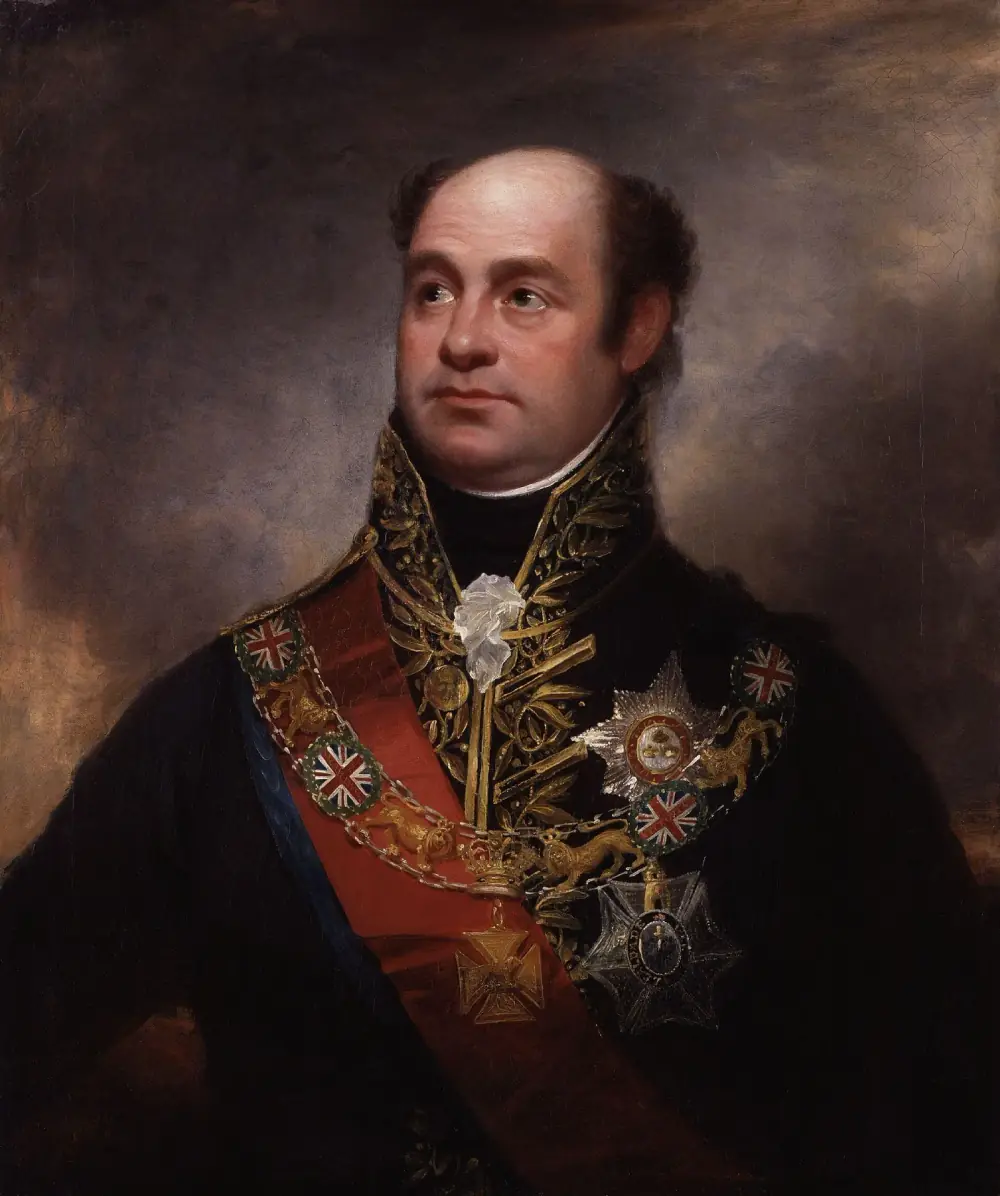
- William Carr Beresford, the British general who rebuilt the Portuguese army from 1809, painted by Sir William Beechey around 1814 to 1815. William Beechey, Public domain, via Wikimedia Commons.
- Plan of the Battle of Busaco, 27 September 1810, after Colonel George Thomas Landmann, published by Cadell and Davies in London in 1818. The allied line (red for British, blue for Portuguese) runs along the ridge from the Mondego past the convent; the French corps (green) are in the valleys to the east, and a road at top right is labelled as the one by which the French withdrew after the action to turn the position. After Col. George Thomas Landmann; published by Cadell & Davies, Public domain, via Wikimedia Commons.
- “Battle of Sierra de Basaco above St Antonio de Cantaro”: Reynier's attack on Picton's 3rd Division, with the 88th charging. Engraved by Charles Turner after a sketch by Major T. S. St Clair. Charles Turner, Public domain, via Wikimedia Commons.
- The porch of the Carmelite convent of Santa Cruz do Buçaco, Wellington's headquarters before and after the battle, with the tower of the Palace Hotel (1888–1907) behind it. Photographed in 2011. Maragato1976, CC BY-SA 3.0, via Wikimedia Commons.