

The National Pantheon: an 1836 decree, a 1966 home
Sixteen days into his ministry, a radical liberal told the young queen that the nation was ungrateful to its best citizens and needed a monument for their ashes. Portugal had the decree in 1836. It got the building in 1966.
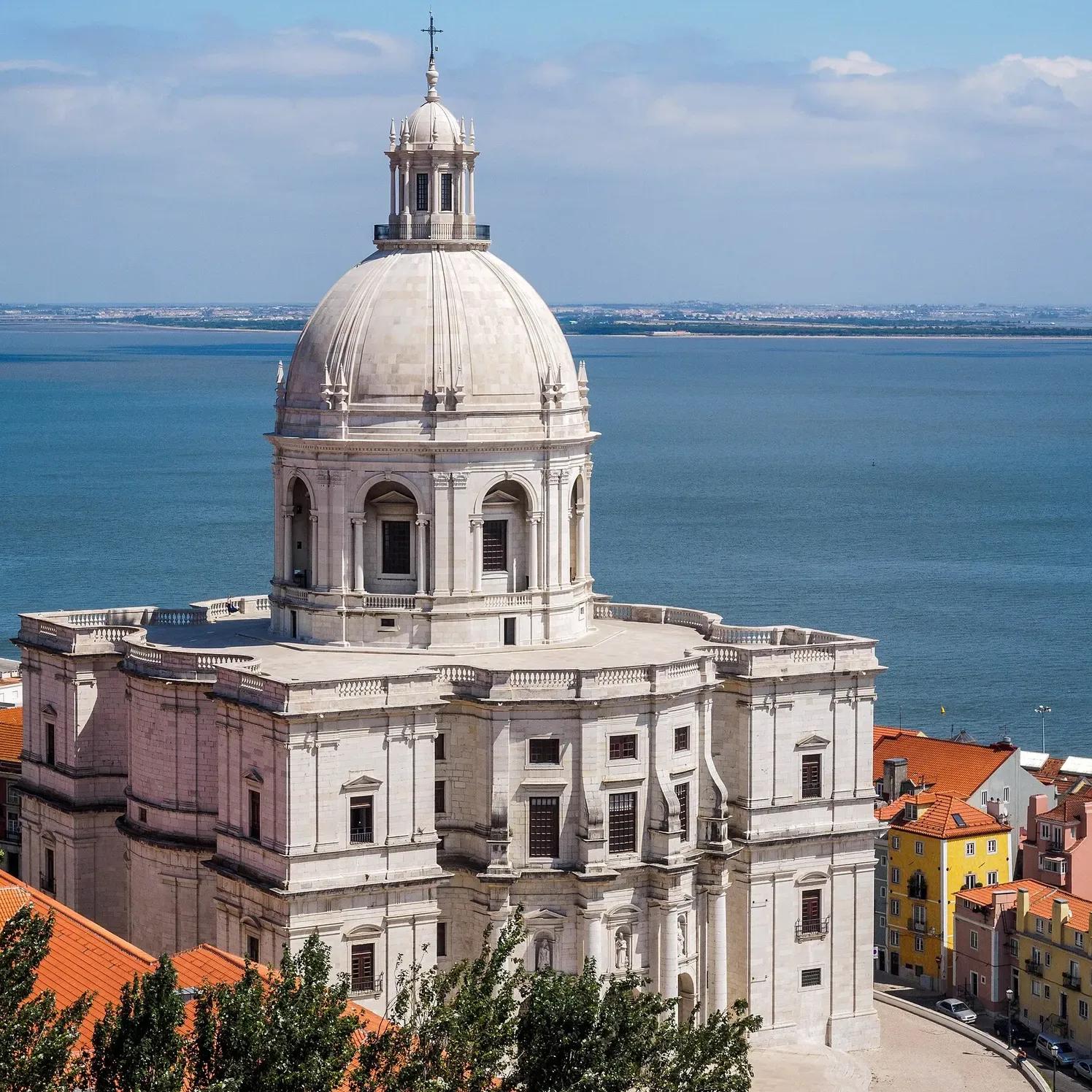
At a glance
- A royal decree dated 26 September 1836, proposed by Passos Manuel as Minister of the Kingdom, created a National Pantheon for the ashes of the “great men” who had died since the liberal revolution of 24 August 1820.
- No building was made ready for it. For more than a century the Jerónimos Monastery in Belém did the job in practice, taking the remains attributed to Camões and Vasco da Gama in 1880, then Herculano and Garrett.
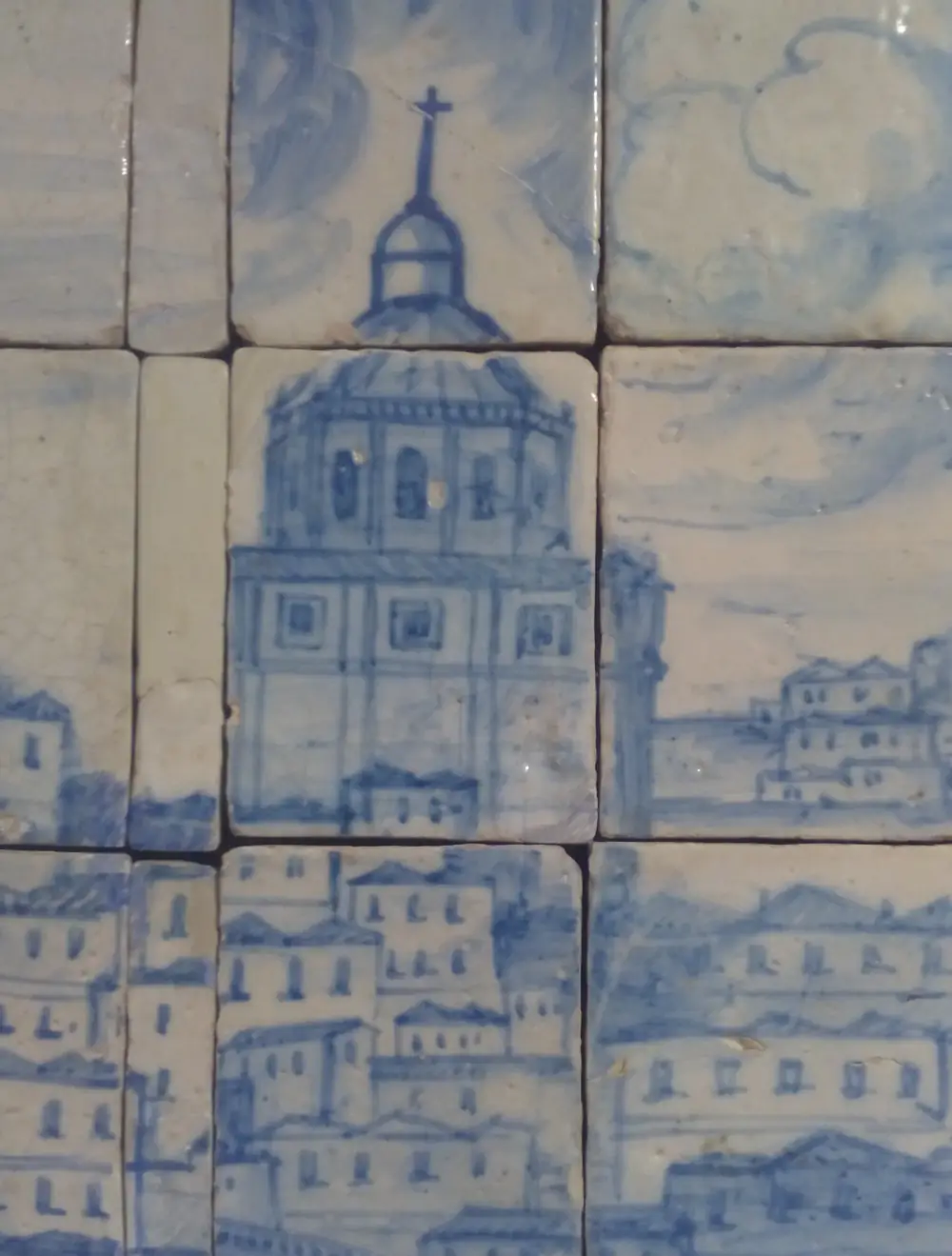
- A law of April 1916 gave the Pantheon the unfinished church of Santa Engrácia, begun in 1682 and still without its dome, whose endless building work had given Portuguese the phrase “obras de Santa Engrácia”.
- The Estado Novo finished the church and inaugurated it on 7 December 1966, moving six writers and presidents from the Jerónimos and placing six cenotaphs to heroes of the Middle Ages and the Discoveries.
- Since 2000 only parliament can grant Pantheon honours. Seven more people have been laid there since 1990, most recently Eça de Queiroz in January 2025, and Aristides de Sousa Mendes has a plaque.
A decree for an ungrateful nation
From June 1910 the army made boots inside a church with no dome. Santa Engrácia, on the Campo de Santa Clara at the eastern edge of Alfama, had been begun in 1682 and never finished, and on 15 June 1910 most of it was handed to the army's central uniform depot. It would become Portugal's National Pantheon only in 1966, under a decree that was by then 130 years old.
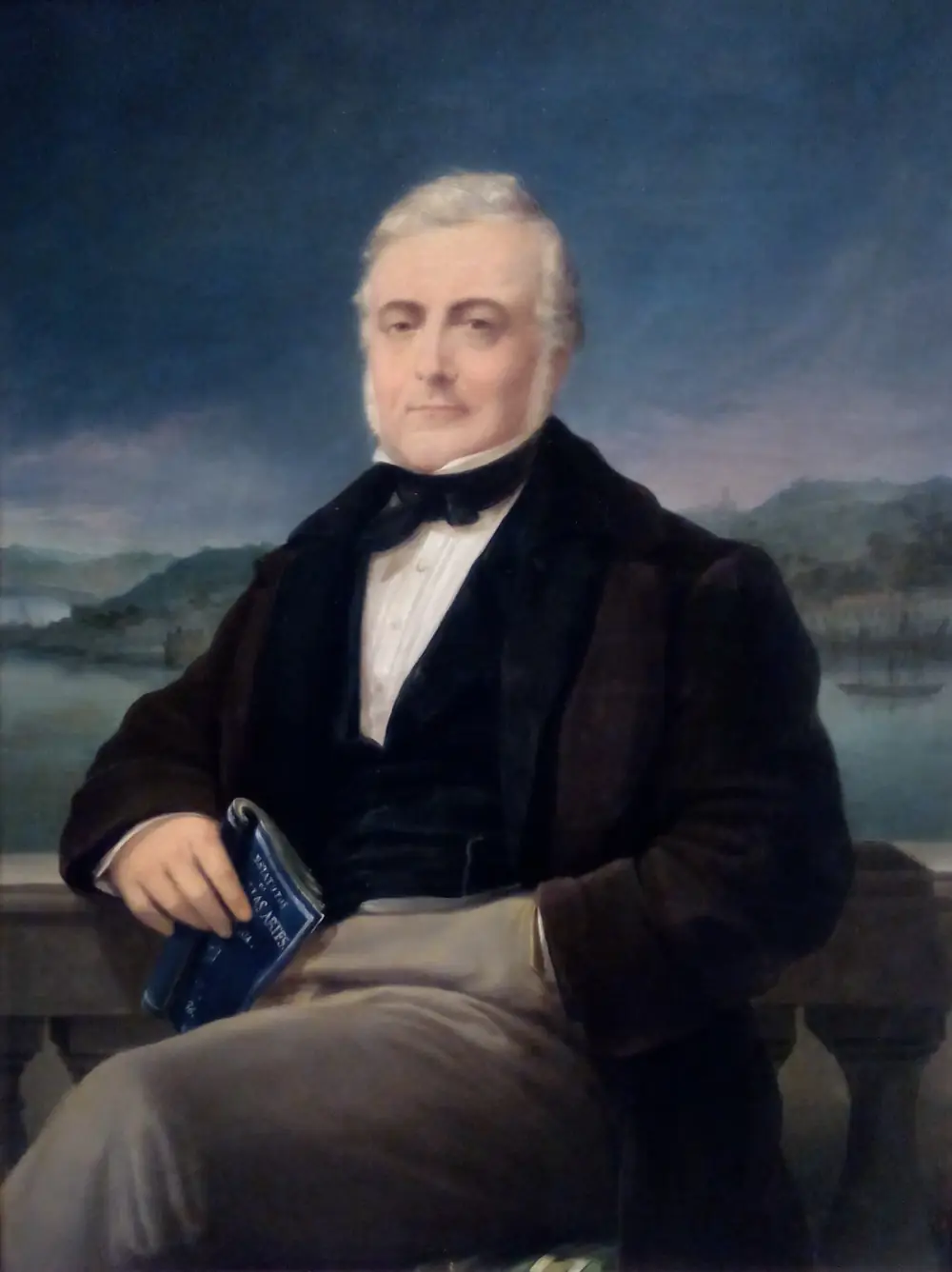
On Monday 26 September 1836, Manuel da Silva Passos, known to everyone as Passos Manuel, had been Minister of the Kingdom for sixteen days. He had come to power after a revolution in Lisbon, and he was governing by decree until new Cortes, the national parliament, could meet. Around that day he put before Queen Maria II a short report with an unusual complaint.
“The Portuguese Nation has been noted as ungrateful towards its best citizens … Foreigners never tire of throwing in our faces how little regard we have for the Prince of our Poets.”
The prince of poets was Luís de Camões, author of the epic Os Lusíadas, who had died in 1580. Passos Manuel's remedy was “a Public Monument consecrated to the Memory of the Great Men who deserved well of the Fatherland”. It would be “intended to receive the Ashes of the Great Men who died after the twenty-fourth of August one thousand eight hundred and twenty”.
On 24 August 1820 a liberal revolution in Porto had begun Portugal's turn to constitutional government, and the decree tied the honour to the men who had died since. The queen signed, and the decree appeared in the official Diário do Governo two days later.
“Our Westminster”
Portugal in 1836 was a young constitutional monarchy. On 9 September a revolution in Lisbon, the September Revolution, had brought Passos Manuel and his allies to power; our article on that revolution tells the story. In the months before the new Cortes met he created state secondary schools, an academy of fine arts, polytechnic schools in Lisbon and Porto, and reorganised the medical schools of both cities.
The pantheon belonged to the same programme. Portugal's kings had their own burial churches: Santa Cruz in Coimbra, Alcobaça, Batalha, the Jerónimos in Belém and São Vicente de Fora in Lisbon. The idea of a lay pantheon for the great men of the nation came from revolutionary France. The director of Portugal's Pantheon has described the 1836 decree as the first expression of that idea in Portugal.
Behind the decree stood the poet and playwright Almeida Garrett. Garrett had suggested that the church of Santa Maria de Belém, at the Jerónimos, could become “our Westminster”, and he had campaigned for Camões to be honoured as a national symbol.
A pantheon without a building, 1836 to 1916
The decree created an institution, but no building was made ready for it. The pantheon was first meant for the church of São Vicente de Fora, one of the royal burial churches, and from 1837 there was talk of adapting the unfinished church of Santa Engrácia instead, though people disagreed about what sort of pantheon Portugal should have. Nothing was built.
In practice the Jerónimos Monastery took on the role. In 1880, during the celebrations for the three-hundredth anniversary of Camões's death, the remains attributed to him and those of the navigator Vasco da Gama were moved to its church in Belém. Riley calls that ceremony the consecration of the Jerónimos as national pantheon. The historian Alexandre Herculano followed in 1888.
Garrett himself, who died in 1854, was not yet among them. In 1900 the republican writer Teófilo Braga demanded that his remains be brought to Belém.
“It is a matter of honour and dignity for all of us that Garrett's bones leave the hiding place where they lie forgotten for the Pantheon of Belém, which was also a creation of his initiative. The parliament that decrees this will always be remembered.”
Garrett went to the Jerónimos in 1903. Its old chapter house, the room where the monks had met, held other honoured dead as well: the poets João de Deus and Guerra Junqueiro, Teófilo Braga himself, and the presidents Sidónio Pais and Óscar Carmona.
Meanwhile the case for Santa Engrácia kept returning. The writer Ramalho Ortigão argued for it in public in 1896, and the architect Ventura Terra drew up a plan to finish the church in 1906. In 1910 it was classified as a national monument, the same year the boot factory moved in.
The young Republic then made the choice. Law 520 of April 1916, promulgated by President Bernardino Machado, assigned to the National Pantheon “the old and incomplete temple of Santa Engrácia” (the law of 2000 dates it 29 April, the Pantheon's own history 26 April). The army stayed in the building until May 1954.
The church that was never finished
Santa Engrácia had been unfinished for a very long time. In the mid-sixteenth century the Infanta Maria, a daughter of King Manuel I who lived near the Campo de Santa Clara, asked the pope for a new parish outside the city walls. Pius V granted it in 1568, and work on its church probably began around 1570. When the infanta died in 1577 the building was still incomplete.
In 1630 thieves broke into the tabernacle and stole the consecrated hosts, a crime remembered as the Desacato, the sacrilege. Simão Pires Solis, a New Christian (a descendant of Jews forced to convert) who had been seen nearby that night, was accused and burned at the stake in 1631. A group of 100 nobles formed a brotherhood to make amends and began a new chancel in 1632.
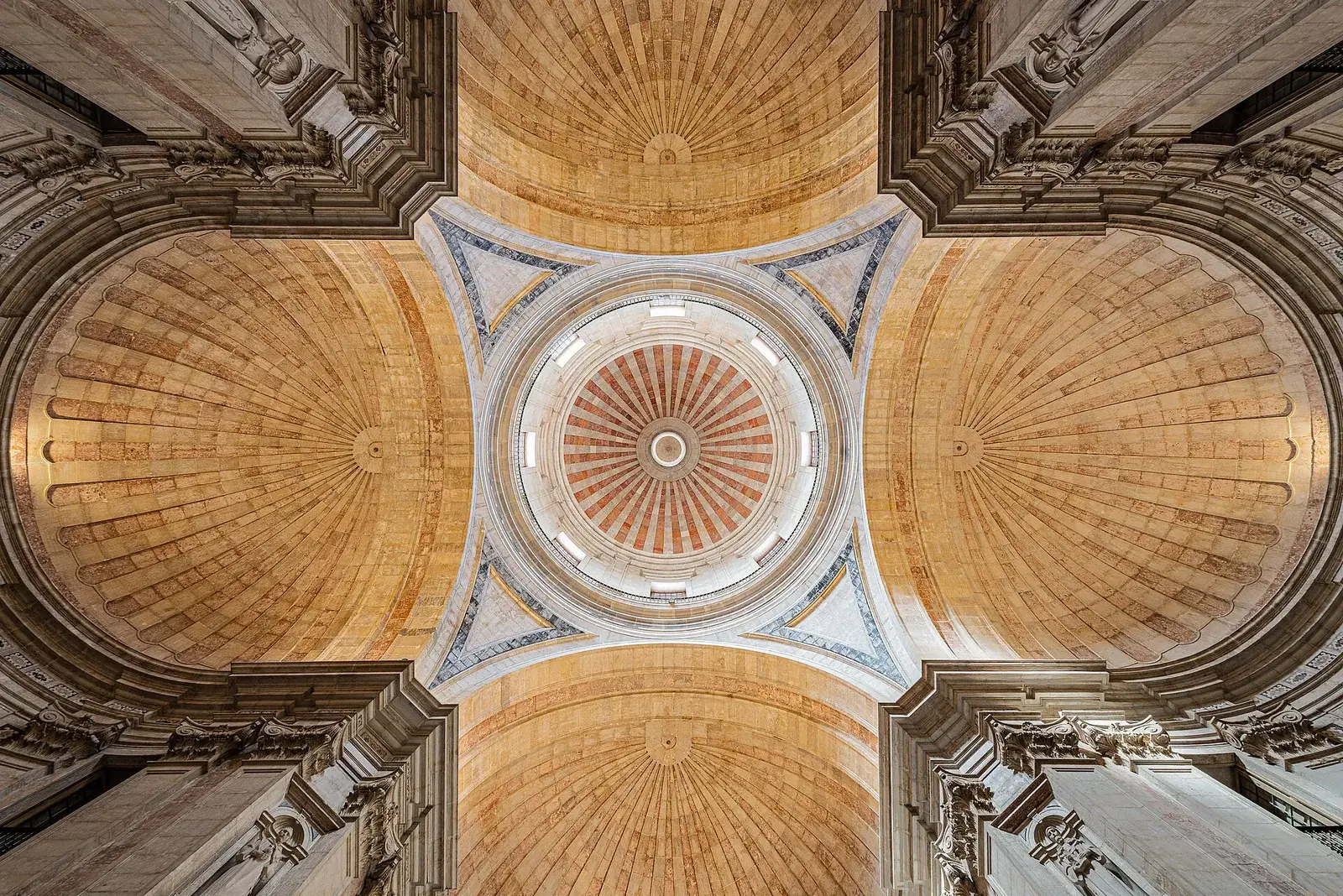
In 1681 a storm brought down the new chancel and part of the walls. The brotherhood decided to start again from scratch and chose a design by the architect João Antunes. On 31 August 1682 the first stone was laid in the presence of the prince regent, the future Pedro II. Antunes broke with Portuguese habit: a Greek-cross plan with four equal arms, joined outside by undulating walls and with towers at the corners.
Antunes died in 1712 with the church still roofless. It survived the earthquake of 1755, after which the brotherhood put a wooden roof over the top. The central dome stayed unbuilt. After the religious orders were abolished in 1834 the shell went to the Ministry of War, which covered it with iron and glass and used it as a store for scrap metal from nearby army workshops.
1568
Parish of Santa Engrácia created
By a brief of Pope Pius V, at the request of the Infanta Maria.
1630
The Desacato
Hosts stolen from the church; Simão Pires Solis is burned in 1631.
1681
A storm wrecks the chancel
31 August 1682
First stone of João Antunes's church
1712
Antunes dies; the church has no roof
1834
Handed to the army as a depot
26 September 1836
Decree creating a National Pantheon
1910
National monument; then a military boot factory
April 1916
Law 520 assigns it to the Pantheon
1956
Competition won by Luís Amoroso Lopes
1960
Work to finish the church begins
7 December 1966
Inaugurated as the National Pantheon
Finished at last, 1956 to 1966
A commission to complete the church was set up in 1934, but it could not agree whether to finish Antunes's design or restore what stood. Designs came in 1936 and 1939 and stalled; another, in 1953, was rejected. In 1956 the Minister of Public Works, Eduardo de Arantes e Oliveira, invited new designs. Seven were submitted, and the one chosen was by Luís Amoroso Lopes, an architect in the state monuments service.
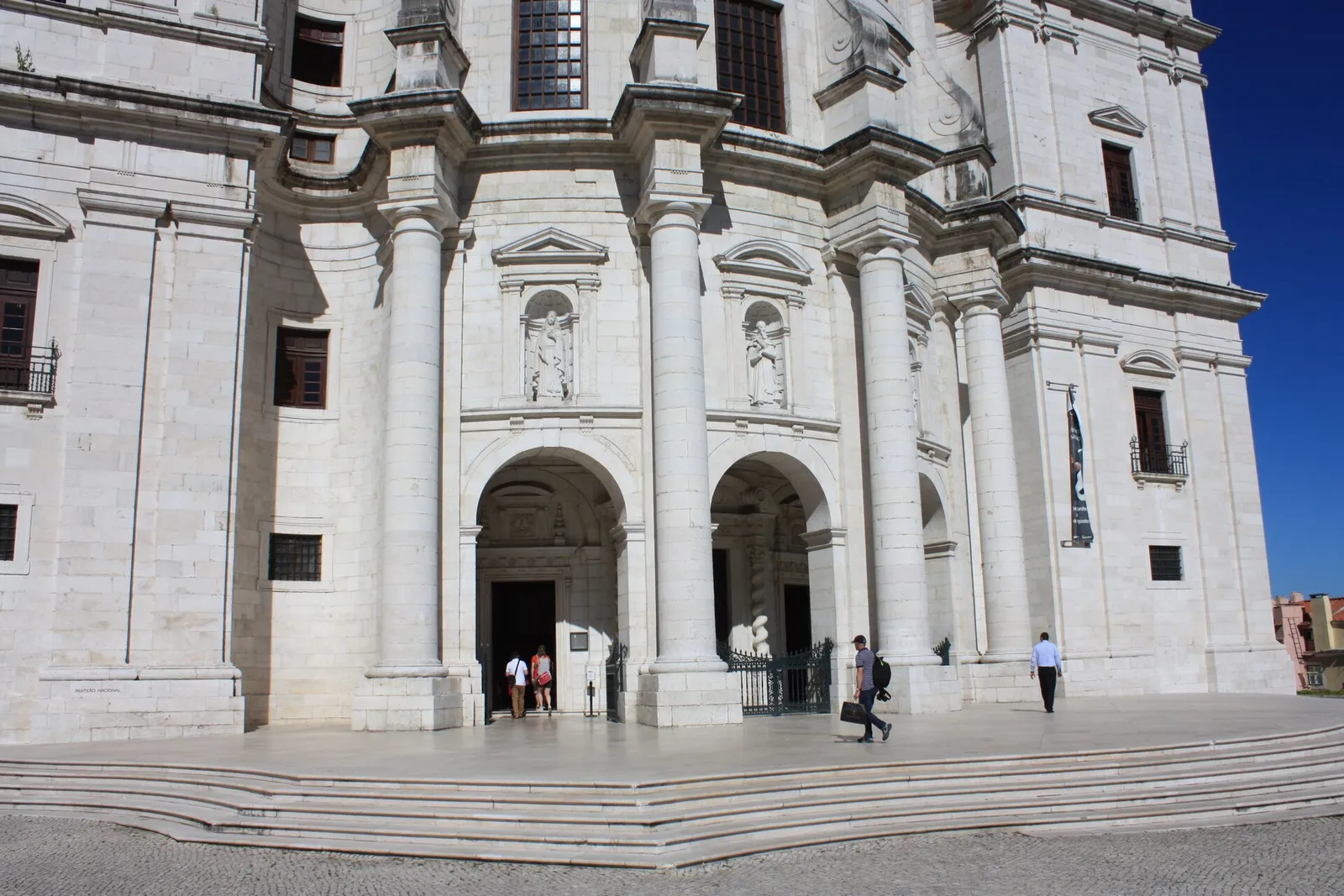
Building began in 1960 and was expected to take ten years. The regime then sped it up so that it would finish in 1966, the fortieth anniversary of the military coup of 28 May 1926 from which the Estado Novo, Salazar's dictatorship, had grown. The dome now rises 80 metres. An eighteenth-century organ from Lisbon Cathedral went into the chancel, and the city cleared the slope in front for a monumental flight of steps.
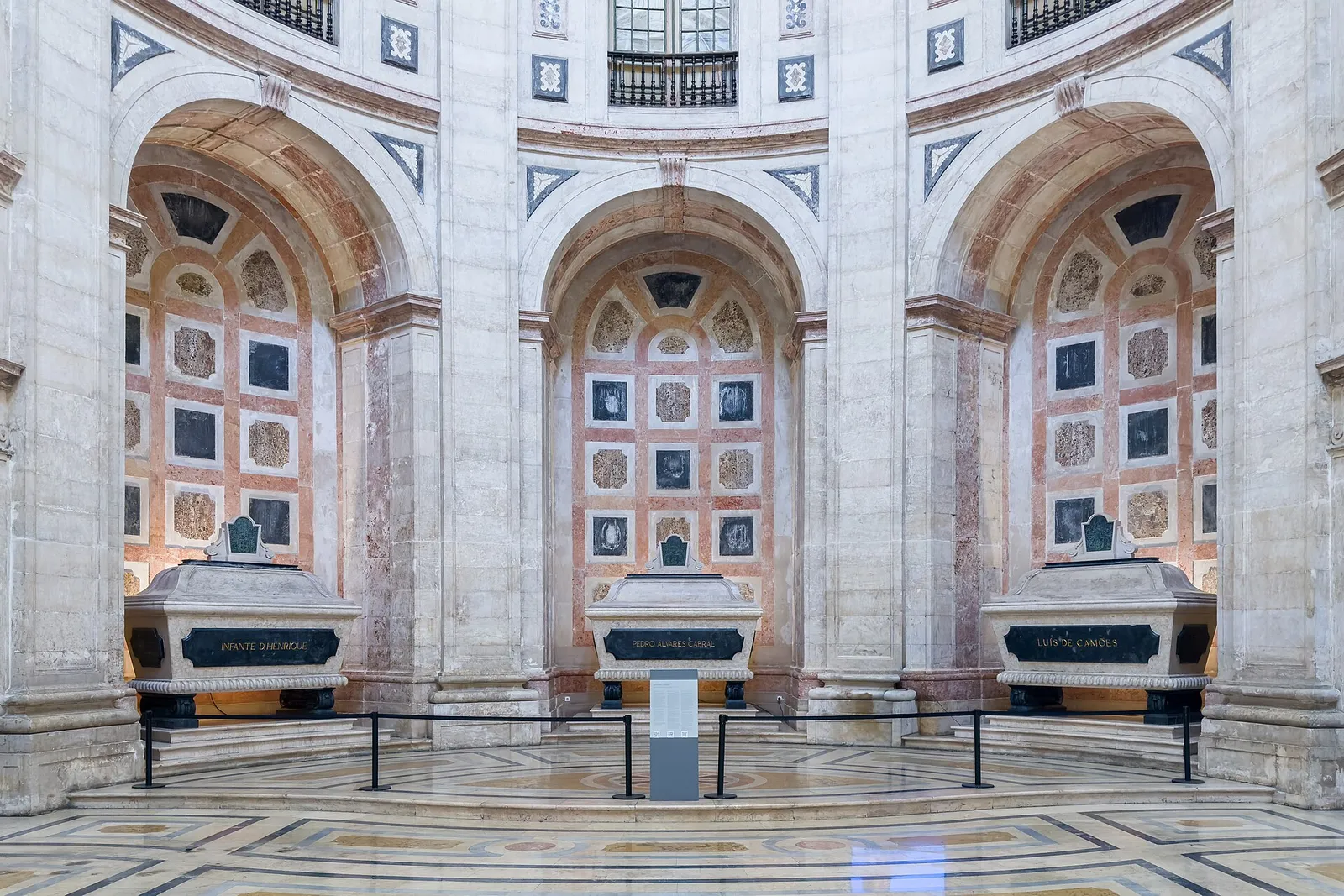
Who would go in was decided by an advisory commission formed at the end of 1965 under the historian Damião Peres. It chose six cenotaphs for heroes whose bodies lay elsewhere: Camões, Vasco da Gama, the constable Nuno Álvares Pereira, the viceroy Afonso de Albuquerque, Pedro Álvares Cabral, who reached Brazil in 1500, and Prince Henry the Navigator. Into the four corner rooms went the six men from the Jerónimos chapter house.
The monument was blessed and inaugurated on Wednesday 7 December 1966, before Cardinal Manuel Gonçalves Cerejeira, the Patriarch of Lisbon, President Américo Tomás, the head of government António de Oliveira Salazar and Arantes e Oliveira. The six transfers were made the same day.
A pantheon founded by a radical liberal had opened under a dictatorship. One of the presidents laid there was Óscar Carmona, head of state from 1926 to 1951 under the military dictatorship and the Estado Novo.
- Decree
- 26 September 1836, published 28 September
- Building assigned
- Law 520, April 1916
- First stone of the church
- 31 August 1682
- Inaugurated
- 7 December 1966
- Height of the dome
- 80 metres
- Honours today
- 13 tombs, 6 cenotaphs, 1 plaque
Who lies there
Nobody else entered for 24 years. The next transfer came after the revolution of 25 April 1974 had ended the dictatorship. On 5 October 1990, the anniversary of the Republic, General Humberto Delgado was laid there. He had challenged the regime in the 1958 presidential election and was murdered in Spain, near Olivença, in 1965.
| Date | Person | Known as | Form |
|---|---|---|---|
| 7 Dec 1966 | Luís de Camões, Vasco da Gama, Nuno Álvares Pereira, Afonso de Albuquerque, Pedro Álvares Cabral, Prince Henry | Poet, navigators, soldiers, a prince | Cenotaphs |
| 7 Dec 1966 | Almeida Garrett (d. 1854), João de Deus (d. 1896), Guerra Junqueiro (d. 1923) | Writers | Remains, from the Jerónimos |
| 7 Dec 1966 | Teófilo Braga (d. 1924), Sidónio Pais (d. 1918), Óscar Carmona (d. 1951) | Presidents | Remains, from the Jerónimos |
| 5 Oct 1990 | Humberto Delgado (d. 1965) | General and 1958 opposition candidate | Remains |
| 8 Jul 2001 | Amália Rodrigues (d. 1999) | Fado singer | Remains |
| 16 Sep 2004 | Manuel de Arriaga (d. 1917) | First elected president of the Republic | Remains |
| 2007 | Aquilino Ribeiro (d. 1963) | Writer | Remains |
| 2 Jul 2014 | Sophia de Mello Breyner Andresen (d. 2004) | Poet | Remains |
| 3 Jul 2015 | Eusébio da Silva Ferreira (d. 2014) | Footballer | Remains |
| 19 Oct 2021 | Aristides de Sousa Mendes (d. 1954) | Consul in Bordeaux in 1940 | Plaque |
| 8 Jan 2025 | Eça de Queiroz (d. 1900) | Novelist | Remains |
Dates of transfer from the Pantheon's history, the Assembleia da República, the Azores regional government (Arriaga) and the pages of each honouree; for Aquilino Ribeiro the Pantheon gives only the year. Sousa Mendes's body stayed in Cabanas de Viriato.
Amália Rodrigues, in 2001, was the first woman. Manuel de Arriaga followed from the Prazeres cemetery in 2004 with the honours of a head of state. Aquilino Ribeiro's transfer in 2007 drew a few dozen protesters outside, who accused the novelist of a part in the killing of King Carlos in 1908; the ceremony itself, the director recalled, ran at the highest level of protocol.
Some waited a lifetime and more, others barely a year. Eusébio entered the year after his death, Eça de Queiroz more than 124 years after his. The 2016 change to the law, described below, would have ruled out Amália, Sophia and Eusébio on the dates they were honoured.
Years between death and entry to Santa Engrácia, transfers since 1990
years
Calendar years between each person's death and the transfer of their remains, in the order they entered. Death and transfer years from the Pantheon's pages; the 20-year minimum from Law 14/2016.
Show the data
| Years from death to transfer | |
|---|---|
| Delgado | 25 |
| Amália | 2 |
| Arriaga | 87 |
| Aquilino | 44 |
| Sophia | 10 |
| Eusébio | 1 |
| Eça | 125 |
The rules since 2000
For 164 years the decree of 1836 stayed in force. In 2000, after a restoration of the church that ran from 1999, MPs from five parties proposed bringing “the old decree of 1836” up to date. Law 28/2000 of 29 November confirmed that the Pantheon created in 1836 is installed in Santa Engrácia and revoked both the decree and the 1916 law.
The law reserves the honours for Portuguese citizens distinguished in high office, military service, the spread of Portuguese culture, literary, scientific or artistic creation, or the defence of human dignity and freedom. Only the Assembleia da República can grant them, by a reasoned resolution. In 2003 parliament also gave pantheon status to the church of Santa Cruz in Coimbra, and in 2016 to the Jerónimos and Batalha, all old royal burial churches.
Until 2016 only a year had to pass after a death. During Eusébio's wake in January 2014 the President of the Assembleia mentioned costs of hundreds of thousands of euros, though Aquilino's transfer had cost about €40,000, and columnists argued over whether Santa Engrácia was the right place for him. Law 14/2016 raised the wait to 20 years for remains and five years for a plaque.
The newest honours show both forms. Aristides de Sousa Mendes, the consul who issued visas to refugees in Bordeaux in 1940 against orders, received a plaque on 19 October 2021 while his body stayed in his home village. Eça de Queiroz's transfer, voted unanimously in January 2021 and set for 27 September 2023, was delayed by a court challenge from some of his great-grandchildren and took place on 8 January 2025.
“The trivialisation of what is solemn is a risk.”
Space is short. Eça's arrival meant opening the last free tomb room, and Observador reported that only three places remained after it. The proposals keep coming: on 8 March 2026 the PAN party submitted a draft resolution to give the honours to Maria de Lourdes Pintasilgo, Portugal's only woman prime minister, who died in 2004. By the Diário de Notícias's count, 20 people now hold Pantheon honours.
Why it still matters
The building that became a byword for work without end had 180,705 visitors in 2023 and 168,963 in 2024, according to Museus e Monumentos de Portugal figures reported by Lusa. Each new name now needs a vote in parliament, and some have been argued over in the press.
The liberals of 1836 wrote a date from their own revolution into the decree. The Estado Novo timed the opening for the fortieth anniversary of its founding coup and placed its own president there. Democracy has added an opposition general, the first elected president, a fado singer, a poet, two novelists, a footballer and a consul who defied his orders.
FAQs
When was Portugal's National Pantheon created?
By a decree dated 26 September 1836, proposed by Passos Manuel as Minister of the Kingdom and published in the Diário do Governo on 28 September. The preamble of the 2000 bill dates it 25 September, but the law in force gives 26 September. The Pantheon only got its own building, Santa Engrácia, on 7 December 1966.
What does “obras de Santa Engrácia” mean?
It is Portuguese for a job that never ends. The church was begun around 1570, rebuilt from 1682 after a storm, and stood without a dome for almost three centuries until the work was finished in 1966.
Who is buried in the National Pantheon?
Thirteen people: the writers Almeida Garrett, João de Deus, Guerra Junqueiro, Aquilino Ribeiro, Sophia de Mello Breyner Andresen and Eça de Queiroz, the presidents Teófilo Braga, Sidónio Pais, Óscar Carmona and Manuel de Arriaga, General Humberto Delgado, Amália Rodrigues and Eusébio. Six heroes, including Camões and Vasco da Gama, have empty cenotaphs, and Aristides de Sousa Mendes has a plaque.
How does someone get into the Pantheon?
Only the Assembleia da República can grant Pantheon honours, by a reasoned resolution. Since 2016 the remains can be moved there only 20 years after death, and a plaque can be placed after five years.
Is Camões buried in the National Pantheon?
No. Santa Engrácia has a cenotaph to him. The remains attributed to Camões were moved to the Jerónimos Monastery in Belém in 1880, and that tomb is still there.
On the timeline
Open the timelineNearby moments from invasions, brazil and the liberal wars (1807–1851).
Pedro IV of Portugal, who had also reigned as Pedro I, first Emperor of Brazil, dies of tuberculosis at the Palace of Queluz aged 35, in the very room where he was born. His death came only months after the liberal victory in the Portuguese Civil War secured the throne for his daughter Maria II.
Queen Maria II, just turned 17, marries Prince Ferdinand of Saxe-Coburg and Gotha in Lisbon Cathedral, after a proxy wedding in Coburg. On the birth of their first son he became King Fernando II. Remembered as the 'artist king', he would rescue a ruined monastery above Sintra and turn it into the Pena Palace.
The September Revolution breaks out in Lisbon: crowds welcome the opposition deputies elected for the Douro, and that night National Guard battalions proclaim the Constitution of 1822 in the Rossio. The army refuses to stop them and Queen Maria II restores the 1822 text, opening the era of Setembrismo.
The National Pantheon, 1836
A decree issued under minister Passos Manuel creates Portugal's National Pantheon to honour the country's most distinguished figures. It was eventually installed in Lisbon's Church of Santa Engrácia, begun in 1682 and finished only in 1966 — hence 'obras de Santa Engrácia', Portuguese for a job that never ends.
The future King Pedro V, 'the Hopeful', is born at the Necessidades Palace in Lisbon. Acclaimed on his 18th birthday in 1855 — the day Lisbon's first electric telegraph line was inaugurated — the studious, modernising king died in an epidemic in 1861, aged just 24, along with two of his brothers.
Joaquim Guilherme Gomes Coelho, better known as Júlio Dinis, is born in Porto. A doctor who died of tuberculosis at 31, he wrote gentle novels of rural and provincial life such as 'As Pupilas do Senhor Reitor' and 'A Morgadinha dos Canaviais' that remain classics of Portuguese fiction.
Birth of Antero de Quental in Ponta Delgada, on the Azorean island of São Miguel. A charismatic student leader at Coimbra and a central figure of the Generation of '70, he is counted among the finest sonnet writers in the Portuguese language, taking Camões's sonnets as his model.
Coming up in history
All long reads
28 sources
Archives, scholarship and reporting this article was checked against.
- 1
Lei n.º 14/2016, de 9 de junho: second amendment to Lei n.º 28/2000, which defines and regulates the honours of the National Pantheon, with the 2000 law republishedDiário da República, 1st series, no. 111, 9 June 2016
- 2
Honras do PanteãoAssembleia da República, Comunicar newsletter no. 77 (November 2021)
- 3
História do Panteão NacionalPanteão Nacional, Museus e Monumentos de Portugal
- 4
Garrett de passagem por São Miguel: marcas e viagens do romantismo ilhéu (Carlos Guilherme Riley)Arquipélago. História, 2nd series, VI (2002), Universidade dos Açores
- 5
Destaques Arquivo MPR #38: the Ministry of Public Works brochure for the inauguration of the National Pantheon, 1966Museu da Presidência da República
- 6
- 7O que implica uma trasladação? 7 perguntas e respostas sobre a ida de Eça de Queiroz para o Panteão NacionalObservador, 4 January 2025
- 8
Panteão Nacional: mais perto do céu (José Cabrita Saraiva)Sol, 2 February 2014
- 9
Nótula biográfica sobre Passos ManuelMuseu da Assembleia da República
- 10Exposição no Panteão Nacional celebra centenário, inauguração e decreto de criação (Lusa)RTP Notícias, 13 December 2016
- 11
- 12
- 13
- 14
Amália Rodrigues (biography)Museu do Fado, Lisbon (EGEAC)
- 15
Uma história de Manuel de ArriagaDireção Regional da Cultura, Governo dos Açores
- 16
- 17
- 18Cerimónia de trasladação de Sophia de Mello Breyner para o Panteão inclui missa e passa pelo ParlamentoObservador (Lusa), 30 June 2014
- 19Honra concedida “faz da memória de Sophia um símbolo coletivo”Observador (Lusa), 2 July 2014
- 20Eusébio no Panteão: saiba como será a cerimóniaObservador, 11 June 2015
- 21“São raras as pessoas que na hora decisiva arriscam assim”: Aristides de Sousa Mendes é homenageado no Panteão NacionalObservador, 19 October 2021
- 22
Restos mortais de Eça de Queirós chegam ao Panteão às 11h10 com chuva e sem povoDNoticias.pt (Lusa), 8 January 2025
- 23
- 24Restos mortais de Eça de Queiroz transladados para o Panteão a 8 de janeiroDiário de Notícias (with Lusa), 2024
- 25Santos Silva pede “prudência e moderação” na concessão de honras de Panteão Nacional (Lusa)Observador, 23 May 2022
- 26PAN propõe Maria de Lourdes Pintasilgo no Panteão NacionalDiário de Notícias, 8 March 2026
- 27Visitantes de museus e monumentos nacionais mantiveram-se acima dos cinco milhões em 2024 (Lusa)RTP Notícias, 4 September 2025
- 28
Image credits
- The church of Santa Engrácia, Portugal's National Pantheon since 1966, seen from the roof of São Vicente de Fora in 2015, with the Tagus behind. The dome was finished only in the 1960s. Photo cropped to remove a border. Andreas Manessinger, CC BY-SA 2.0, via Wikimedia Commons.
- Passos Manuel, painted by António Manuel da Fonseca in 1886, after his death. The portrait belongs to the Academy of Fine Arts, which he founded by decree in October 1836, and he holds its statutes. António Manuel da Fonseca, Public domain, via Wikimedia Commons.
- Santa Engrácia as painted in the Great Panorama of Lisbon, a tiled view of the city made in the early eighteenth century and now in the National Tile Museum. The painter gave it a dome; the real one was built only in the 1960s. RickMorais, CC BY-SA 4.0, via Wikimedia Commons.
- Looking up into the crossing of Santa Engrácia in 2021. The four arms are João Antunes's Greek cross; the dome over the centre was completed between 1960 and 1966. T meltzer, CC BY-SA 4.0, via Wikimedia Commons.
- Three of the six cenotaphs placed in the nave in 1966: Prince Henry the Navigator, Pedro Álvares Cabral and Luís de Camões, photographed in January 2026. None of them is buried here. Kent Wang, CC BY 4.0, via Wikimedia Commons.
- The main entrance of the National Pantheon on the Campo de Santa Clara in August 2014. The statues of Portuguese saints in the niches were added in the 1960s campaign. Reis Quarteu, CC BY-SA 4.0, via Wikimedia Commons.