

Lisbon's first electric trams, 31 August 1901
For 28 years Lisbon's trams were pulled by horses and mules. Then a British-financed company strung wires over the streets, and on 31 August 1901 the first electric cars ran west along the river towards Algés.
At a glance
- Lisbon's first electric tram service opened on Saturday 31 August 1901, running west along the river to Ribamar, at Algés. Today's route 15E is its descendant.
- From 1873 the Companhia Carris de Ferro de Lisboa had run americanos, tramcars on rails pulled by horses or mules. In 1898 it carried 11.2 million passengers with 1,261 horses.
- Carris leased the electric operation to a London company, Lisbon Electric Tramways Ltd, which paid for the conversion and guaranteed Carris shareholders a 6 per cent dividend. The lease lasted until 1973.
- Passengers on the network rose from 11.4 million in 1901 to 49.9 million in 1910, according to the British company's accounts.
- Buses from 1944 and the Metro from 1959 shrank the network. At the end of 2025 Carris ran 6 tram routes with 60 cars, including the 28 and the 15E, the descendant of the 1901 line.
Cars with no horses
On Saturday 31 August 1901 a tramcar set off along Lisbon's waterfront with no animals in front of it. For 28 years the city's trams had been hauled by teams of horses and mules. This one drew its power from a wire strung above the street, through a pole on its roof.
It was bound for Ribamar, a bathing area at Algés, west of the city centre. The Companhia Carris de Ferro de Lisboa, the tram company, dates its first electric route to that day.
The historian Alexandre Ricardi, who worked in the company's archives, follows a 1956 history by a Carris engineer in calling them “invisibly propelled cars”.
The first electric cars were open-sided Brill cars, which Lisbon nicknamed almanjarras. Closed cars soon followed. Car 444, the first closed model in the city, arrived in 1901 from the St. Louis Car Company in the United States, with an ornamented wooden ceiling, glazed windows and reversible seats in woven straw. Lisbon called it the São Luís.
Before the wires: horses, mules and omnibuses
Carris was founded in Rio de Janeiro on 18 September 1872 by two Portuguese brothers, Luciano and Francisco Maria Cordeiro de Sousa. Their plan was an American-style transport for Lisbon: carriages on iron rails, pulled by animals. The first line opened on 17 November 1873, between the Santa Apolónia railway station and the western end of the Aterro da Boa Vista, at Santos.
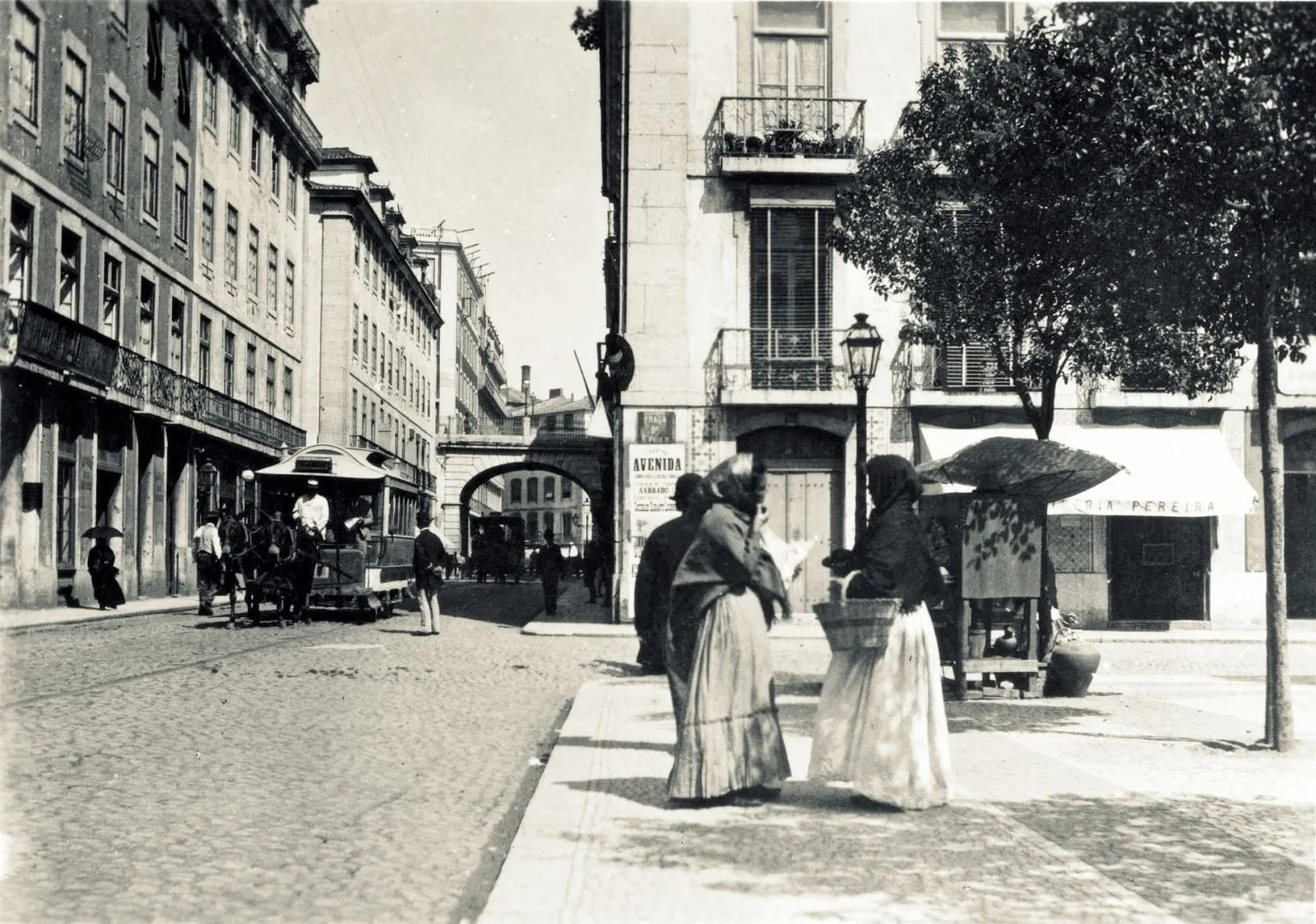
The cars were called americanos. The idea was American, and the first 32 carriages came from the New York firm of John Stephenson and Company. Each carried about 30 people behind two animals. By the end of 1874 Carris had 29.5 kilometres of line, 54 cars and 421 head of livestock, and work had begun on its depot at Santo Amaro, in Alcântara, with stables, coach houses and workshops.
Demand was modest. In the 13 years before 1892 Carris carried an average of 5.6 million passengers a year, or about 19 trips for each inhabitant. The rest of the market belonged to some 15 omnibus companies, many of them one-man businesses with dirty cars and sickly horses, which fought Carris and each other with fare wars.
“all those old, dirty, stinking cars, slovenly and rude staff, starving and sick livestock”
A contract with the city council, signed on 28 March 1892, settled the fight. Carris bought out its rivals, and that year 12 of the 15 omnibus companies disappeared. It sold 24 of the 156 vehicles it bought straight away for scrap, and 491 of the 713 horses it took over were dead by the end of the year. Among its shareholders were men who lent money to the indebted council, such as the banker Henri Burnay.
Animals could not manage everything. Experiments with steam traction failed and were publicly ridiculed, and from 1884 the steepest slopes were climbed by cable-hauled lifts such as the Elevador da Glória, run by a separate company. On the flat, Carris's horses and mules kept working, and in 1898 the company still had 1,261 horses for 329 vehicles.
Electricity on credit from London
Electric trams were still new. Frank Sprague's network at Richmond, Virginia, opened in 1888 and became the model for others, and European cities took up overhead-wire trams in the 1890s. A new Carris management that took over in 1894, in which Alfredo da Silva was prominent, contacted companies abroad and concluded that electricity was the only real alternative to animals.
A new contract with the council, signed in 1896 or 1897 depending on the source, gave Carris the sole right to run electric trams across the city, powered from overhead wires. Critics objected to its term, 99 years counted from 1888 when 20 to 40 years was usual elsewhere in Western Europe, and to the overhead wires: the engineer Vasconcelos Porto wanted underground conductors in some parts of the city. The council approved it anyway. Carris's negotiator was one of the councillors, A. J. Simões de Almeida.
Carris could not pay for the conversion. Portugal was short of capital at the turn of the century, and the work would cost 1,600 contos de réis in the first two years alone. So the rights passed, through the firm of Wernher, Beit and Co., to a British company, the Lisbon Electric Tramways Limited, and on 2 February 1899 Carris's shareholders voted to lease it the operation of the lines.
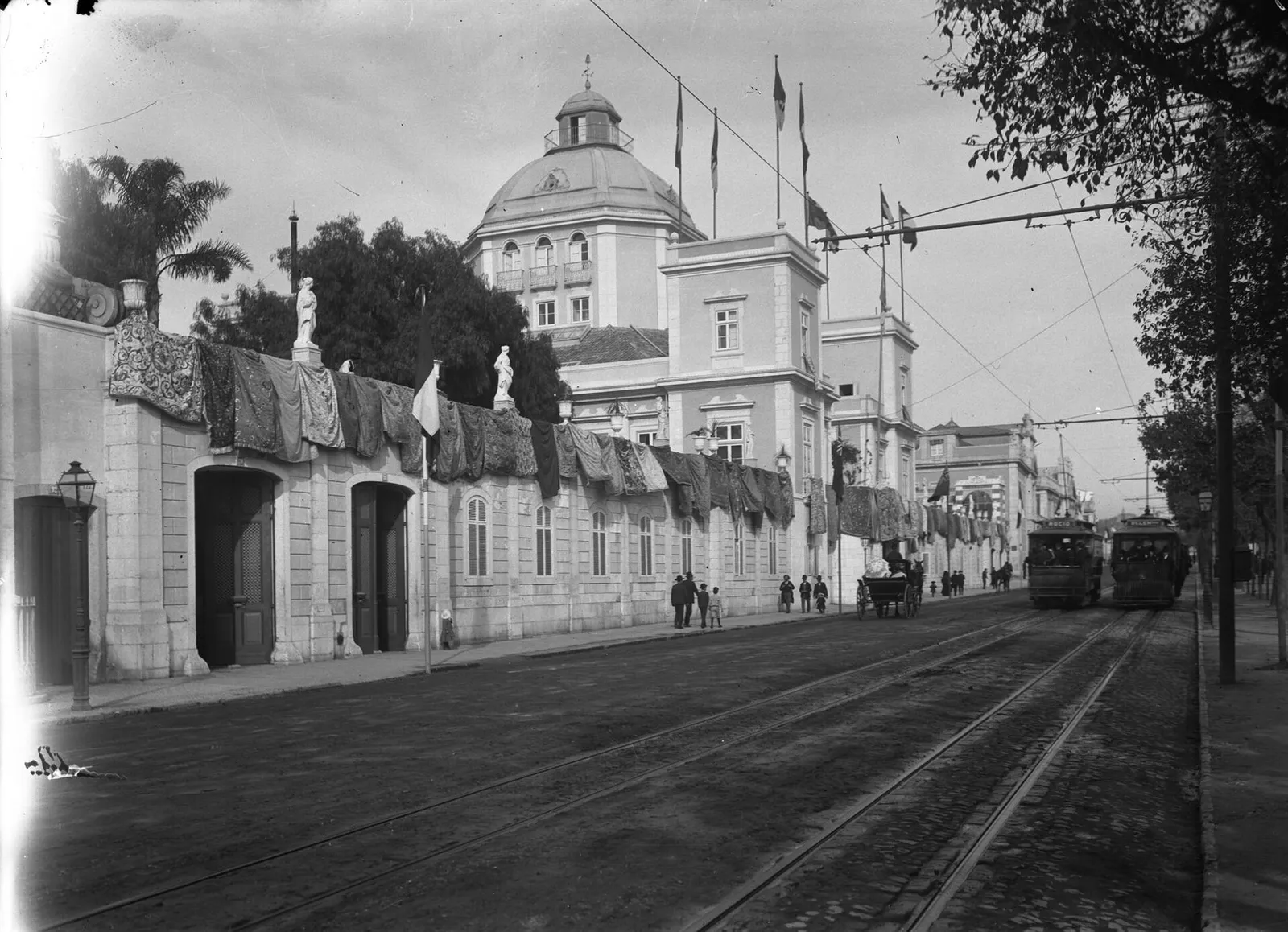
Burnay could watch the result from home. In 1882 he had bought a palace on the Rua da Junqueira, on the riverside road west of Alcântara, and by about 1907, as a photograph by Joshua Benoliel shows, electric cars to Belém ran past its gates.
“indispensable to meet a need long since met in European cities less important than Lisbon, would never have been carried out without the help of foreign capital”
Work began in 1900. The track was relaid and altered, poles and overhead wires went up, and Carris built a power station at Santos, the Geradora, to feed the new system. The conversion had cost about 7,000 contos de réis by 1910.
18 September 1872
Carris founded in Rio de Janeiro
17 November 1873
First americano line, Santa Apolónia to Santos
28 March 1892
Contract with the council; 12 of 15 omnibus companies disappear that year
1896 or 5 June 1897
Contract for electric traction by overhead wire
Vieira gives 1896, Carris 5 June 1897.
2 February 1899
Shareholders vote to lease the lines to Lisbon Electric Tramways
1900
Track, overhead wires and the Geradora power station built
31 August 1901
First electric route opens, west along the river to Algés
1902
Passengers carried more than double, to 26.5 million
The first line, and where it started
The first electric route followed the river west. Ribamar, at its end, was a bathing area where a casino even operated in the 1930s. When Carris paraded its old vehicles for its 151st anniversary in 2023, it sent them that way, from Santo Amaro along the Rua da Junqueira, past Belém and down the Rua de Pedrouços to Algés, to recall the historic route.
The eastern end is less certain than it looks. The Carris Museum and Time Out start the line at the Cais do Sodré. A brochure written by Carris's general secretary for a 2023 stamp issue, marking 150 years since the first horse tram, says the first route ran between the Terreiro do Paço, the great square of the Baixa, and Algés, and that it later became route 15E.
Ricardi, citing Vieira's longer study of 1982, gives a third version: that the first stretch electrified in 1901 was Carris's original line of 1873, which ran along the waterfront from the Santa Apolónia railway station. All three places are on the same riverside, and the sources found for this article do not settle which was the terminus on the first day.
- Date
- Saturday 31 August 1901
- Route
- West along the river to Ribamar, Algés, from the Cais do Sodré or the Terreiro do Paço (sources differ)
- Power
- Overhead wire, fed by Carris's new Geradora power station
- Operator
- Carris, running the lines for Lisbon Electric Tramways Ltd
- Cars
- Open Brill cars (almanjarras) and closed cars from the St. Louis Car Company
- Today
- Route 15E, Praça da Figueira to Algés
A city on rails
Electricity changed the scale of the business. In 1901 the network carried about as many passengers as the horse trams in their best years. In 1902 the number more than doubled.
Passengers carried on Lisbon's trams, 1893–1910
million passengers
Carris's own accounts for the horse-tram years 1893 to 1898, and the accounts of Lisbon Electric Tramways, which ran the lines, for 1900 to 1910. The source gives no passenger figure for 1899. Rounded to one decimal place from the tables in António Lopes Vieira, Análise Social, 1980.
Show the data
| Passengers | |
|---|---|
| 1893 | 9 |
| 1894 | 9 |
| 1895 | 9.4 |
| 1896 | 11.7 |
| 1897 | 12.1 |
| 1898 | 11.2 |
| 1900 | 10 |
| 1901 | 11.4 |
| 1902 | 26.5 |
| 1903 | 30.9 |
| 1904 | 34.1 |
| 1905 | 40.1 |
| 1906 | 43.3 |
| 1907 | 44.5 |
| 1908 | 46 |
| 1909 | 48 |
| 1910 | 49.9 |
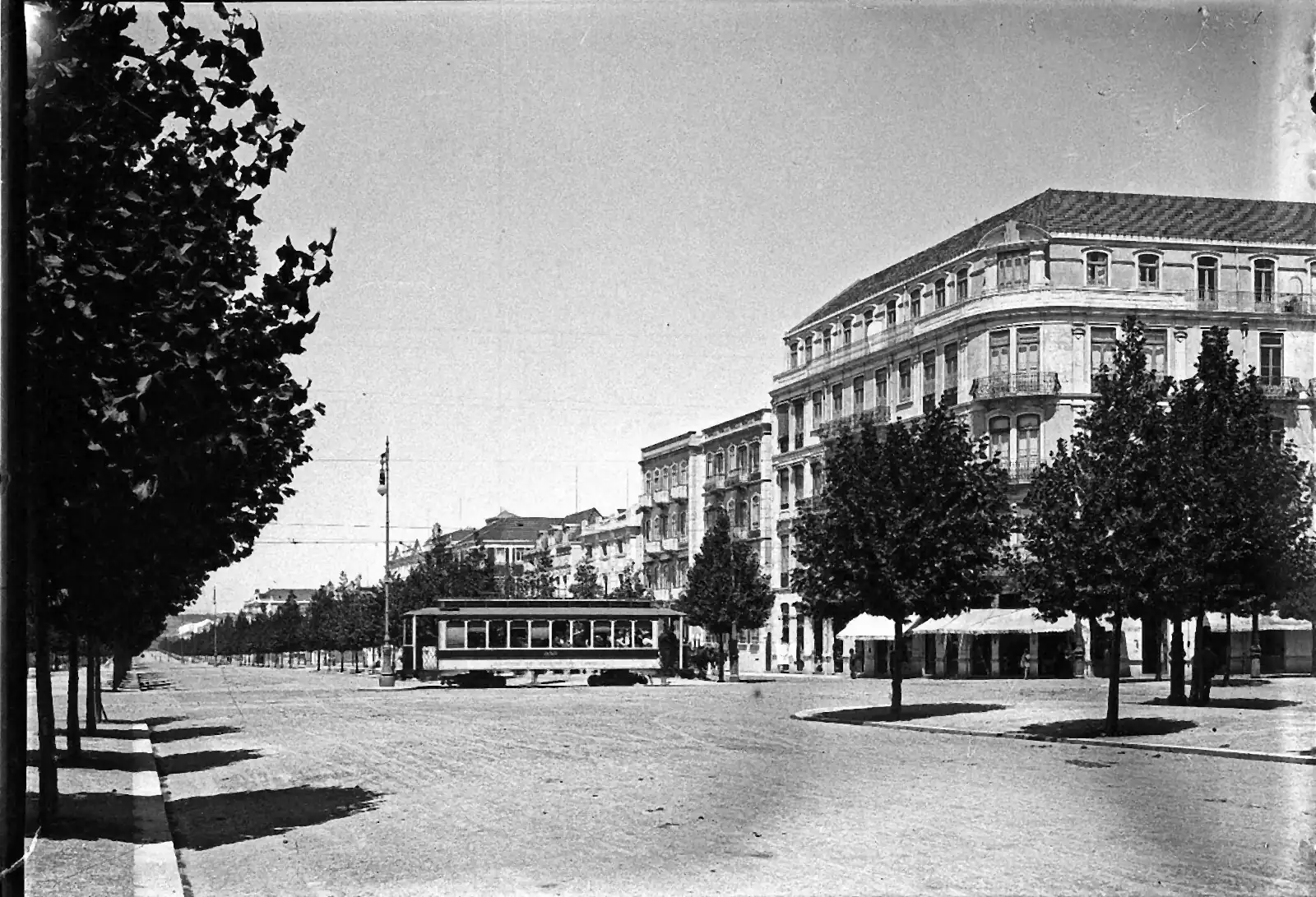
The trams let Lisbon grow outwards. Housing was cheaper in the districts the new lines reached, such as Campo de Ourique, Benfica, the Avenidas Novas and the Areeiro, and the city spread north beyond the Estrada da Circunvalação, the ring road of the 1850s that marked its official limits. Profits followed: in the first decade of the century average net profit was higher than Carris's average traffic revenue had been since 1873.
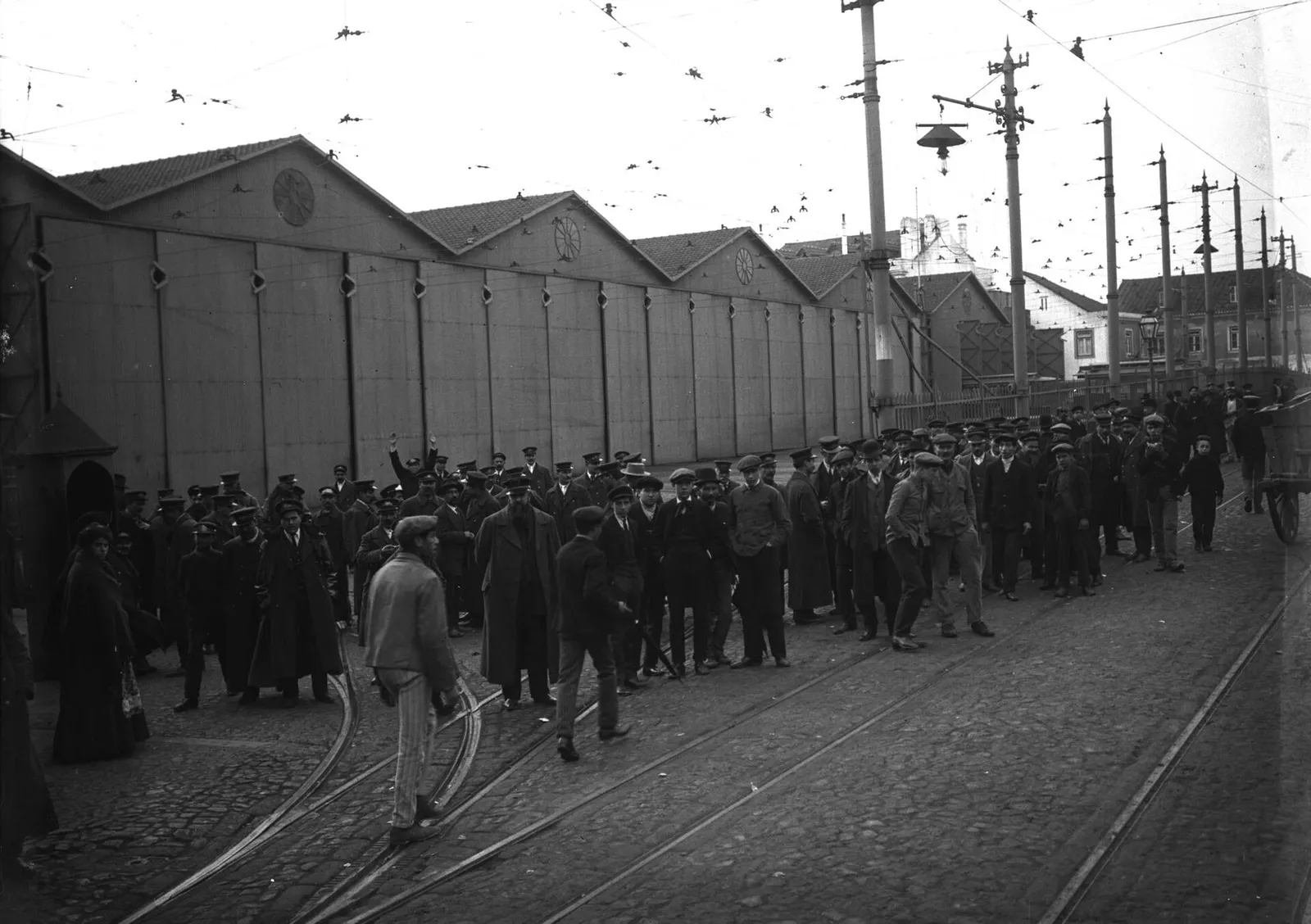
The tram became part of political life too. In October 1910, in the weeks after the monarchy fell, the photographer Joshua Benoliel pictured Teófilo Braga, head of the new republic's Provisional Government, riding on the open bench of Carris car 261. Tram crews struck in January 1912, and in June a strike by tram drivers almost brought the city's public transport to a halt; a fundraising gala for Portugal's first Olympic team drew a thin crowd because of it.
Electric cars also took over from the cable tramways. The cable line up to the Estrela was suspended in 1913 for electrification, and in 1914 an electric tram began running from the Calçada da Estrela to the Praça Luís de Camões. In 1926 Carris absorbed the company that ran the funicular lifts.
Buses, the Metro and a shrinking network
Carris tried buses early, with five vehicles on a line from Sete Rios to Carnide that opened on 14 November 1912 and ended in 1915. The real change came on 9 April 1944, when it launched a bus service with vehicles bought in 1940 to carry visitors to the Exposição do Mundo Português at Belém. Double-deckers from England followed in 1947, and by the 1950s the fleet was split almost evenly between trams and buses.
The tram network was at its largest at the end of the 1950s, with about 30 routes in 1958 by Time Out's count, most of them ending at the Restauradores, the Rossio, the Praça do Comércio or Martim Moniz.
The Lisbon Metro opened on 29 December 1959. Carris's own summary is blunt: from the end of the 1950s, as the Metro grew, the bus network was enlarged at the expense of the trams.
The British lease lasted much longer than the horse trams had. Ricardi describes it as running for about 40 years, but Carris's own chronology has it ending only on 21 December 1973, when Decree-Law 688/73 rescinded the contract with Lisbon Electric Tramways. At the same time a new contract with the city council renewed Carris's concession for buses, trams and lifts for 50 years.
Cars, buses and the Metro kept cutting the network back for decades. The 1990s were especially hard: many lines were closed, and the 24, a route dating from 1905 that linked the Rossio to Campolide, was suspended in 1995 for what was meant to be a short time. By 2008 Carris ran 5 tram routes over 48 kilometres. Its trams carried 15.7 million passengers that year, against 216.1 million on its buses.
| Year | Traction | Size of the operation | Passengers in the year |
|---|---|---|---|
| 1874 | Horses and mules | 29.5 km of line, 54 cars, 421 animals | Not given |
| 1898 | Horses and mules | 329 vehicles, 1,261 horses | 11.2 million |
| 1902 | Electric | 229 vehicles | 26.5 million |
| 1910 | Electric | Not given | 49.9 million |
| 2008 | Electric | 5 routes, 48 km, 57 cars (10 articulated) | 15.7 million |
| 2025 | Electric | 6 routes, 60 cars (38 remodelled, 22 articulated) | Not published separately |
1874 from Carris's chronology; 1898 to 1910 from the company accounts tabulated by Vieira (1980); 2008 from Carris's 2008 sustainability report; 2025 from Carris's 2025 annual report.
The 28 and the rebuilt trams
The route most visitors know grew out of that small 1914 line. It linked two neighbourhoods at similar heights separated by a dip of about 30 metres, and the slope was so hard on the first cars that a special series had to be built for it. Its extension down to the Baixa was argued over for some fourteen years, partly because shopkeepers feared accidents on the steep, busy street, before the first trams ran between the Rossio and the Estrela.
The line reached Prazeres, in Campo de Ourique, in 1936, Graça in 1973, and Martim Moniz in 1984, after routes 10 and 11 were closed. The architect Rita Varela Gomes notes that the 28 squeezes through streets too narrow even for the smallest buses, which makes it the only public transport for residents of some of the oldest parts of Lisbon.
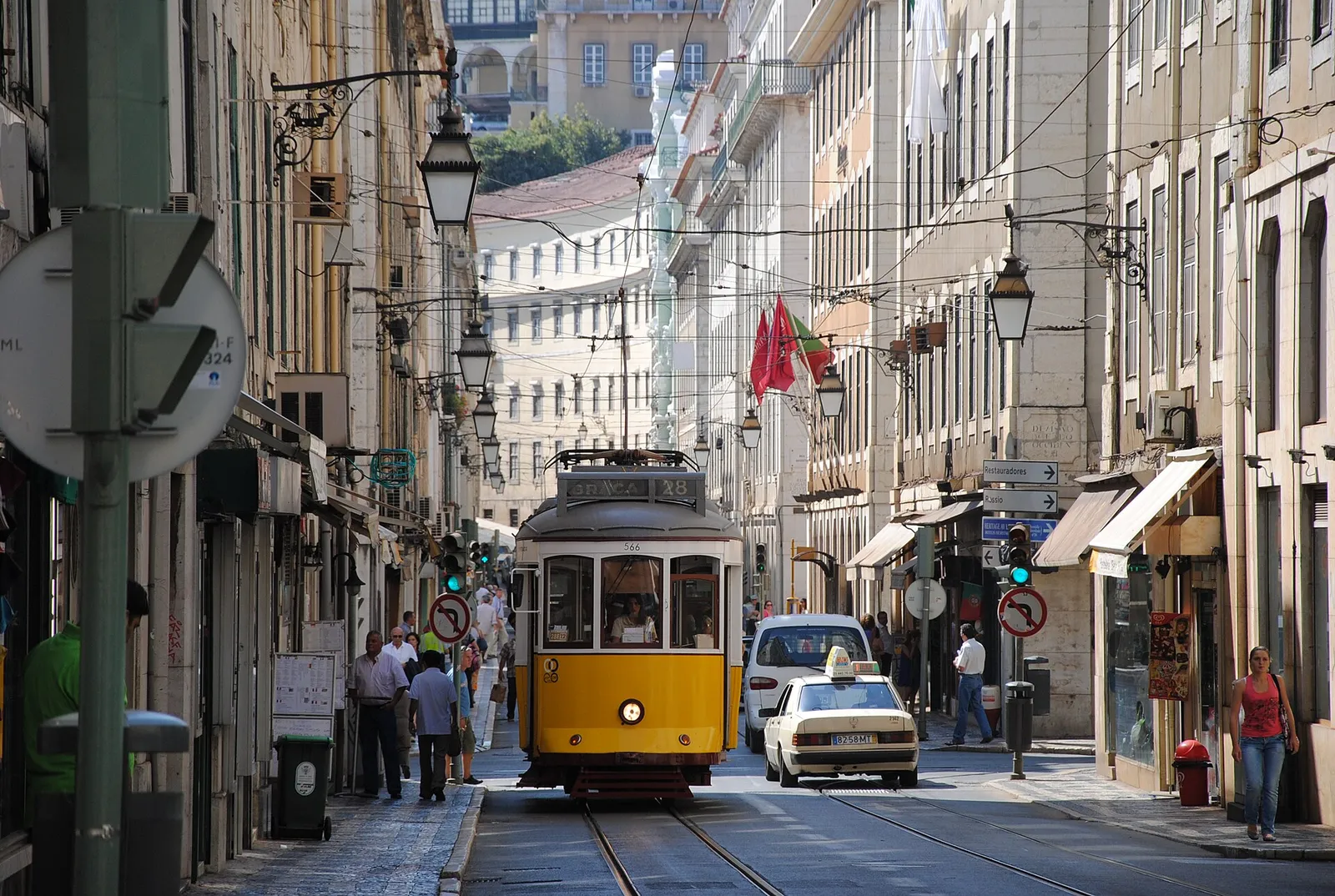
The small cars on the 28 look old, but Carris rebuilt them in the 1990s. In 1996 Carris finished remodelling 45 traditional trams, which kept their outward look and became faster, quieter and safer. In 1995 it had also put its first 10 articulated trams into service on the riverside route.
Today the trams carry a different public from the buses. In 2025 monthly passes accounted for 92.1 per cent of the demand on Carris buses but 51.6 per cent on its trams, where one-off tickets made up 33.1 per cent and fares bought on board another 15.2 per cent.
Why it still matters
On 24 April 2018 the 24 came back between Camões and Campolide, 23 years after it was suspended, after residents had campaigned for its return. In 2021 Carris ordered 15 new articulated trams for the 15E for about 43 million euros, more than doubling that route's fleet; they were built by CAF, and the last three arrived in 2024.
At the end of 2025 Carris ran 6 tram routes with 60 cars. It is planning to extend the riverside service east from Santa Apolónia to the Parque Tejo as a new route, the 16E, named after the old 16 that once ran from the Jerónimos to the Poço do Bispo.
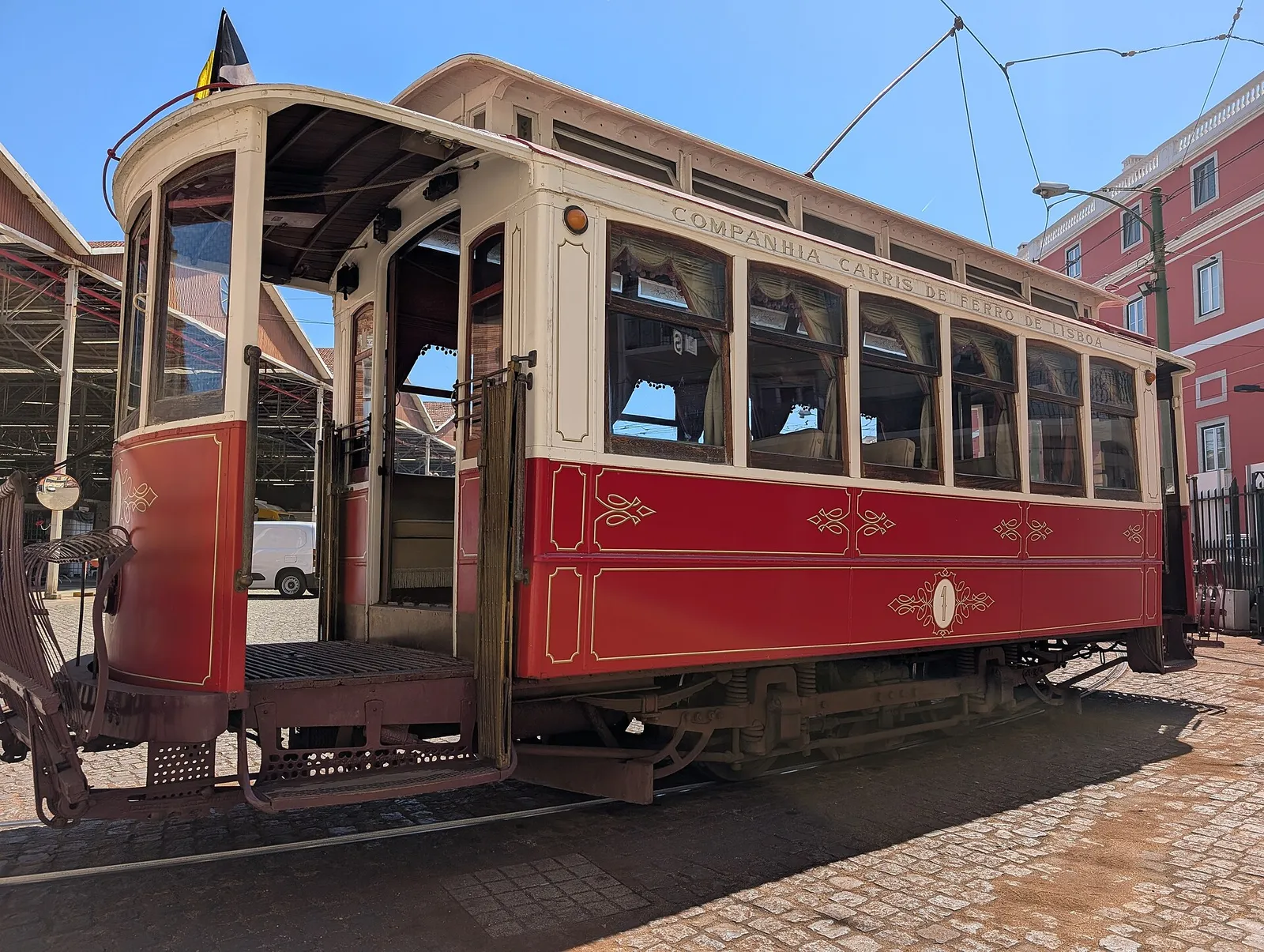
In 2026, for the 125th anniversary of electric traction, the Carris Museum covered the walls of its site and of the Santo Amaro depot with posters from its photographic archive and murals by street artists. The 1901 line's descendant, the 15E, still runs west along the river to Algés.
FAQs
When did Lisbon get electric trams?
The first electric tram service opened on Saturday 31 August 1901. The horse-drawn trams it replaced had run since 17 November 1873, and passengers on the network rose from 11.4 million in 1901 to 26.5 million in 1902.
What was Lisbon's first electric tram line?
A riverside route west to Ribamar, at Algés. The Carris Museum says it started at the Cais do Sodré; a Carris brochure for a 2023 stamp issue says the Terreiro do Paço. Either way, today's 15E is its descendant.
Who built Lisbon's electric tram network?
Carris held the concession, but the conversion was paid for and run by a London company, Lisbon Electric Tramways Ltd, which leased the lines from 1899 and guaranteed Carris shareholders a 6 per cent dividend. Carris managers ran the service on its behalf. The lease ended by decree on 21 December 1973.
How old is the number 28 tram?
The route began in 1914 as a short line from the Estrela to Camões and reached its present ends later: Prazeres in 1936, Graça in 1973 and Martim Moniz in 1984. The cars on it are traditional trams that Carris rebuilt in the 1990s.
On the timeline
Open the timelineNearby moments from regeneration and the last kings (1851–1910).
In a secret declaration signed in London by Lord Salisbury and Portugal's minister Luís de Soveral, Britain and Portugal reaffirm their ancient alliance, including the treaties of 1642 and 1661. Portugal undertakes to stop arms reaching the Boers through its territory and not to declare neutrality, while Britain's old pledge to defend Portugal's colonies is restated.
The poet António Nobre dies of tuberculosis at Foz do Douro, aged just 32. His book 'Só' (1892), with its homesick, saudade-steeped verses about his native north, later made him one of the defining voices of Portuguese symbolist poetry.
José Maria Eça de Queirós, master novelist of Portuguese realism and author of 'Os Maias' and 'O Crime do Padre Amaro', dies near Paris, where he was serving as Portuguese consul.
Lisbon's first electric trams
Lisbon's first electric trams enter commercial service, running west along the river to Algés. The Carris Museum starts the line at Cais do Sodré, a Carris stamp brochure at the Terreiro do Paço; its descendant is today's route 15E.
The writer and poet José Régio, a central figure of Portuguese modernism and co-founder of the influential literary magazine Presença, is born in Vila do Conde.
Joaquim Mouzinho de Albuquerque, the cavalry officer hailed as a national hero for capturing the Gaza emperor Gungunhana at Chaimite in Mozambique in 1895, takes his own life in Lisbon at the age of 46.
Birth in Aveiro of Fernando Pessa. As a BBC announcer in wartime London he brought uncensored news to Portuguese listeners, and decades later he was still filing wry TV street reports for RTP, signed off with the catchphrase 'E esta, hein?' ('How about that, eh?'). He died in 2002, days after turning 100.
Coming up in history
All long reads
26 sources
Archives, scholarship and reporting this article was checked against.
- 1
Algumas questões sobre os transportes públicos da cidade de Lisboa nos finais do século XIX (António Lopes Vieira)Análise Social, vol. XVI (61-62), 1980, pp. 71–84
- 2
Relatório de Sustentabilidade 2008 (company history chronology and 2008 network)Carris
- 3
História: Carris, uma empresa ao serviço de LisboaCarris (Companhia Carris de Ferro de Lisboa)
- 4
125 anos da tração elétrica em Lisboa: exposição temporáriaMuseu da Carris
- 5
Carris – 150 anos (stamp issue brochure, text by Ema Favila Vieira, Carris)CTT Correios de Portugal, 18 September 2023
- 6
From animal traction to invisibly propelled cars: public transport in Lisbon, part I (Alexandre Ricardi)Faces da História (UNESP, Assis), 2021
- 7
Pelo caminho do 28 (Rita Varela Gomes)Espaços Vividos, vol. 1, no. 7, Faculdade de Arquitectura, Universidade de Lisboa
- 8
- 9
Este sábado a Carris sopra as velas e há desfile de clássicos, claroTime Out Lisboa, 22 September 2023
- 10
- 11
Do nascimento ao abandono: as várias vidas do Palácio da Junqueira em Lisboa (Margarida Elias)Revista de História da Arte, NOVA FCSH, 2024
- 12Carris investe 60 milhões em 15 elétricos articulados e 30 autocarros elétricosECO, 20 April 2021
- 13
O MuseuMuseu do Carro Eléctrico (STCP), Porto
- 14
Teófilo Braga como passageiro do elétrico n.º 261 da Carris, na Praça da Estrela (Joshua Benoliel, October 1910)Arquivo Municipal de Lisboa, via Wikimedia Commons
- 15
“O chefe do Governo Provisorio” (Rocha Martins, text; Joshua Benoliel, photographs), Ilustração Portugueza, no. 244, 24 October 1910Hemeroteca Digital, Câmara Municipal de Lisboa
- 16
- 17
Imprensa e olimpismo: a primeira participação portuguesa nos Jogos Olímpicos (Francisco Pinheiro and Carlos Nolasco)FuLiA/UFMG, vol. 10, no. 1 (2025), pp. 30–64
- 18
Datas marcantes: 1959 (opening, fares, ML7 trains)Metropolitano de Lisboa
- 19
Lisboa em festa! Eléctrico 24 de volta a CampolideRFM, 24 April 2018
- 20
- 21
- 22
- 23
- 24
- 25
- 26Os elétricos históricos mostram-se pela Baixa de LisboaDiário de Notícias, 16 September 2018


Image credits
- Two electric trams pass on the Rua da Junqueira, on the riverside route west towards Belém, around 1907. The archive's description has the one on the right bound for Belém and the other for the Rossio. Behind them is the Palácio Burnay, hung with rugs for a festive occasion; the banker Henri Burnay, a Carris shareholder and later a director of Lisbon Electric Tramways, had bought it in 1882. Joshua Benoliel, Public domain, via Wikimedia Commons.
- An americano, one of Carris's animal-drawn trams, arriving at the Praça de São Paulo, near the Cais do Sodré, some time before 1901. Unknown author, Public domain, via Wikimedia Commons.
- An electric tram on the Avenida da República, in the Avenidas Novas, the new districts to the north that the trams helped to open up, in the early 1900s (dated around 1904 on Commons). Joshua Benoliel, Public domain, via Wikimedia Commons.
- Tram workers on strike outside Carris's Santo Amaro depot, in Alcântara, on 29 January 1912, the date given by the Lisbon municipal archive. The Carris Museum is on the same site today. Joshua Benoliel, Public domain, via Wikimedia Commons.
- Car 566, one of the rebuilt remodelados, on route 28 to Graça in the Baixa, in September 2011. Leandro Neumann Ciuffo, CC BY 2.0, via Wikimedia Commons.
- Car no. 1, a tram of 1901 refitted in the 1960s, which carries visitors between the two sites of the Carris Museum in Santo Amaro, May 2025. Philip Mallis from Melbourne, CC BY-SA 4.0, via Wikimedia Commons.