

The Maria Pia bridge: Eiffel's iron arch that took the railway into Porto
For 13 years the main line from Lisbon stopped on the wrong side of the Douro. A young Paris firm offered to jump the gorge with a single iron arch, and built it in 22 months.
At a glance
- The Maria Pia bridge is a single-track iron railway bridge over the Douro between Vila Nova de Gaia and Porto. King Luís and Queen Maria Pia inaugurated it on Sunday 4 November 1877, and the first regular train between Lisbon and Porto ran the next day.
- The Companhia Real dos Caminhos de Ferro Portugueses chose the design of G. Eiffel et Cie, the cheapest of four tenders, in 1875. Historians credit its arch largely to Eiffel's partner Théophile Seyrig.
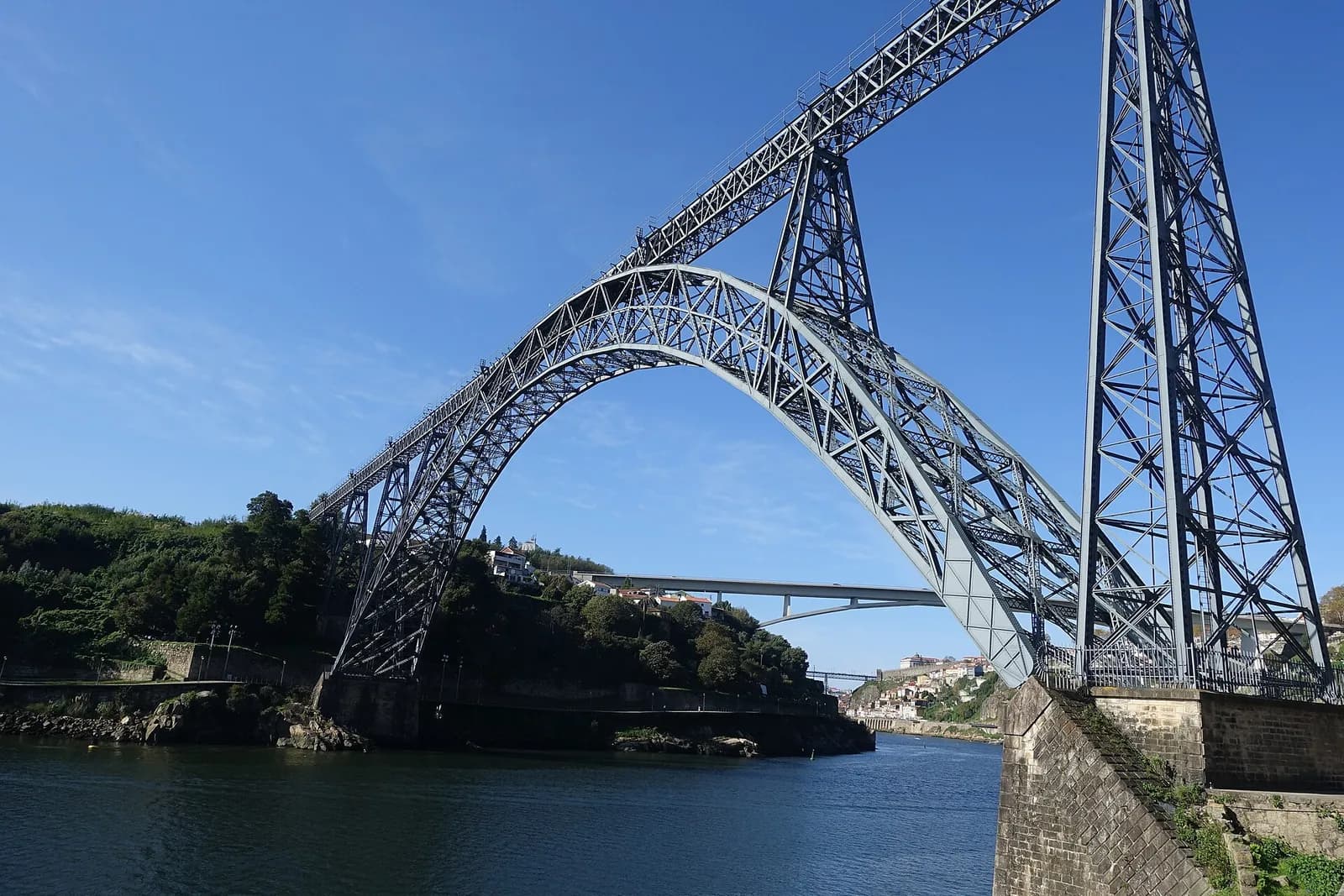
- Its crescent-shaped arch, hinged at both ends, spans 160 metres, the longest iron arch in the world when it opened. The rails run about 61 metres above the river.
- Work began on 5 January 1876. The arch was built out from both banks without scaffolding in the river, held up by steel cables, and closed in September 1877.
- Heavier trains and a single track made it a bottleneck. It carried its last trains on 24 June 1991, when the São João bridge opened beside it, and has been a national monument since 1982.
Fifty-five seconds over the Douro
On Sunday 4 November 1877 Porto was so full that, one reporter wrote, many thousands slept in the street. The night train the evening before had brought what another paper called a real invasion of tourists. There was not a room left in any lodging house; in one, the servants gave their cubbyhole to four guests and slept on the landing.
At 11 in the morning the guests gathered at Devesas station in Vila Nova de Gaia, on the south bank of the Douro. Shortly after half past twelve a train of 24 carriages carrying more than 1,200 people pulled out towards the new iron bridge. Crowds lined the track. On the slopes of both banks, the Comércio do Porto reported, many tens of thousands of onlookers packed every rock and terrace, and the river below was covered with decorated boats.
King Luís I and Queen Maria Pia arrived on a royal train with the princes Carlos and Afonso, ministers and the diplomatic corps. In a pavilion facing the bridge the engineers were presented to them, the French builder Gustave Eiffel among them. The Bishop of Porto, Dom Américo, walked out to the middle of the arch and blessed it. Then the royal train crossed, and the fort on the Serra do Pilar fired a 21-gun salute.
“Those inside did not feel the slightest swaying, nor the creaking usually felt when trains cross bridges; it seemed one was travelling over the firmest ground.”
A retrospective in the Jornal de Notícias 50 years later added two details. The engine, No. 17, took 55 seconds to cross. And Prince Carlos, the heir, and his uncle Infante Augusto stayed behind on the south bank until the royal train came back for them, so that if the first train fell into the river there would still be a king.
A main line stuck on the wrong bank
Portugal's first railway opened between Lisbon and Carregado in 1856. By 1864 the Northern Line, the Linha do Norte, had reached Gaia. Porto, the country's second city, sat on the cliffs opposite, and north of the river the state was building the Minho and Douro lines. Between the two networks lay a gorge more than 60 metres deep.
Closing that gap took 13 years of argument over the site of the Porto station, the line of the crossing and money, a story told in our article on the first railway. The line was run by the Companhia Real dos Caminhos de Ferro Portugueses, a private company run by a board in Lisbon and a committee in Paris. Its director general from 1872, the army engineer Manuel Afonso de Espregueira, settled the route. His engineer Pedro Inácio Lopes worked out the “Seminário line”, which crossed the river below the ruined seminary on the Porto bank.
A law of 26 February 1875 cleared the last obstacles. It exempted the company from a transit tax and let it build the bridges for a single track, ending a dispute that had run since the first railway contracts of the 1850s over whether every iron bridge had to be built for two.
Four tenders and a cheap arch
The company invited tenders and set 1 May 1875 as the deadline. Four builders answered: G. Eiffel et Cie and two other large French firms, and one from England. Two more withdrew. Each proposed something different, and their prices ranged widely.
| Design | How it crossed the river | Weakness the reviewers saw |
|---|---|---|
| 1 | A semicircular central arch on abutments at the water's edge, with half-arches out to the ends of the bridge | Hard to let the whole structure expand and contract freely |
| 2 | A single girder of 170 metres between two masonry piers, 22.5 metres deep in the middle | Side winds acted well below the supports and could rock the deck |
| 3 | Four spans of 78 metres, with a third support in mid-river on two great curved struts | Such long spans needed a great weight of iron, better spent on two more piers |
| 4 (Eiffel et Cie) | One great arch carrying the deck at five points, with spans of 43 and 45 metres on iron piers to each side | None serious; judged sound and buildable |
From Seyrig's 1878 memoir as summarised by Coste and Godart. The sources consulted do not say which competitor submitted designs 1 to 3.
Price per metre of bridge in the four tenders of 1875
francs per metre
Eiffel's arch was the cheapest by a wide margin, about a third of the price of the most expensive design. Figures from Seyrig's memoir to the Société des Ingénieurs Civils (1878), as given by Coste and Godart. In the society's memoirs for 1881 a critic, Bodin, questioned the economic case, and Eiffel and then Seyrig replied that he had used the wrong prices.
Show the data
| Price per metre | |
|---|---|
| Design 1 | 8,350 |
| Design 2 | 4,890 |
| Design 3 | 4,270 |
| Design 4 (Eiffel) | 2,930 |
Before accepting so bold a design, the company had it checked in Paris by a commission of three engineers, Krantz, Molinos and Henri de Dion. De Dion tested the arch with a new method of calculation he had just presented to the Société des Ingénieurs Civils. The commission found the project well conceived and buildable, and concluded that the bridge, well made and carefully erected, would behave well.
In Lisbon the government's Junta Consultiva de Obras Públicas weighed suspension bridges, straight girders and arches. A suspension bridge would have needed towers about 70 metres high; a girder, two piers 56 metres tall. The Junta's rapporteur, João Crisóstomo de Abreu e Sousa, recommended Eiffel's arch and called it one of the best-studied projects ever put to the ministry. His one regret was that the deck had not been made wide enough for a road beside the track.
“Among existing structures there is no arch of so great an opening as the one projected for the Douro bridge, nor one that at the same time rises to so great a height.”
The contract went to Eiffel's firm on 22 June 1875, according to Infraestruturas de Portugal (IP), which owns the bridge today. The company's later minutes refer to a contract dated 22 July 1875; the first date is probably the award and the second the signature, but the sources do not say.
Whose bridge? Eiffel, Seyrig and the team
In 1875 Gustave Eiffel was 42 and not yet famous. He had set up his own works at Levallois-Perret, outside Paris, in 1867, and made his name with tall iron viaducts on French railways. The Douro was his firm's first great arch. In the spring of 1876 he moved to Portugal and lived at Barcelinhos, near Barcelos, while his firm also built bridges on the state's Minho line.
The arch itself was most likely drawn by Théophile Seyrig, Eiffel's partner, who ran the firm's design office. When Eiffel et Cie showed a model of the bridge at the Paris Universal Exhibition of 1878, its own notice said that the calculations and the design were by Seyrig and Henri de Dion, and that the works were carried out by Émile Nouguier, Joseph Collin and Angevère. Nouguier devised the method of erecting the arch. Seyrig described the bridge to the Société des Ingénieurs Civils in October 1878 without once naming Eiffel.
The two men soon fell out, and by 1880 Seyrig was designing for a rival firm the Ponte Luís I, downstream in Porto; we tell that story in our article on the Luís I bridge. José Manuel Lopes Cordeiro, a historian at the University of Minho, concludes that the Maria Pia was a collective work in which Eiffel directed the project, but that its new element, the great arch, was Seyrig's.
Building an arch in mid-air
The arch is made of two latticed ribs that lean towards each other: 15 metres apart at the hinges on the banks and 3.95 metres apart at the crown. The lean steadies it against side winds. Each rib is deepest, about 10 metres, near the middle, where the bending is greatest, and tapers to a pin at each end. That gives the arch its crescent shape. The pins carry the thrust from trains and from changes of temperature into the abutments at fixed points, which also made the arch easier to calculate.
The deck is a lattice girder on wrought-iron piers, the tallest about 43 metres high. Near the crown it passes through the top of the arch rather than over it. An early draft had put the deck on top, as Eiffel later did at Garabit, but it was lowered to give the wind less to push on and the arch the greatest possible rise.
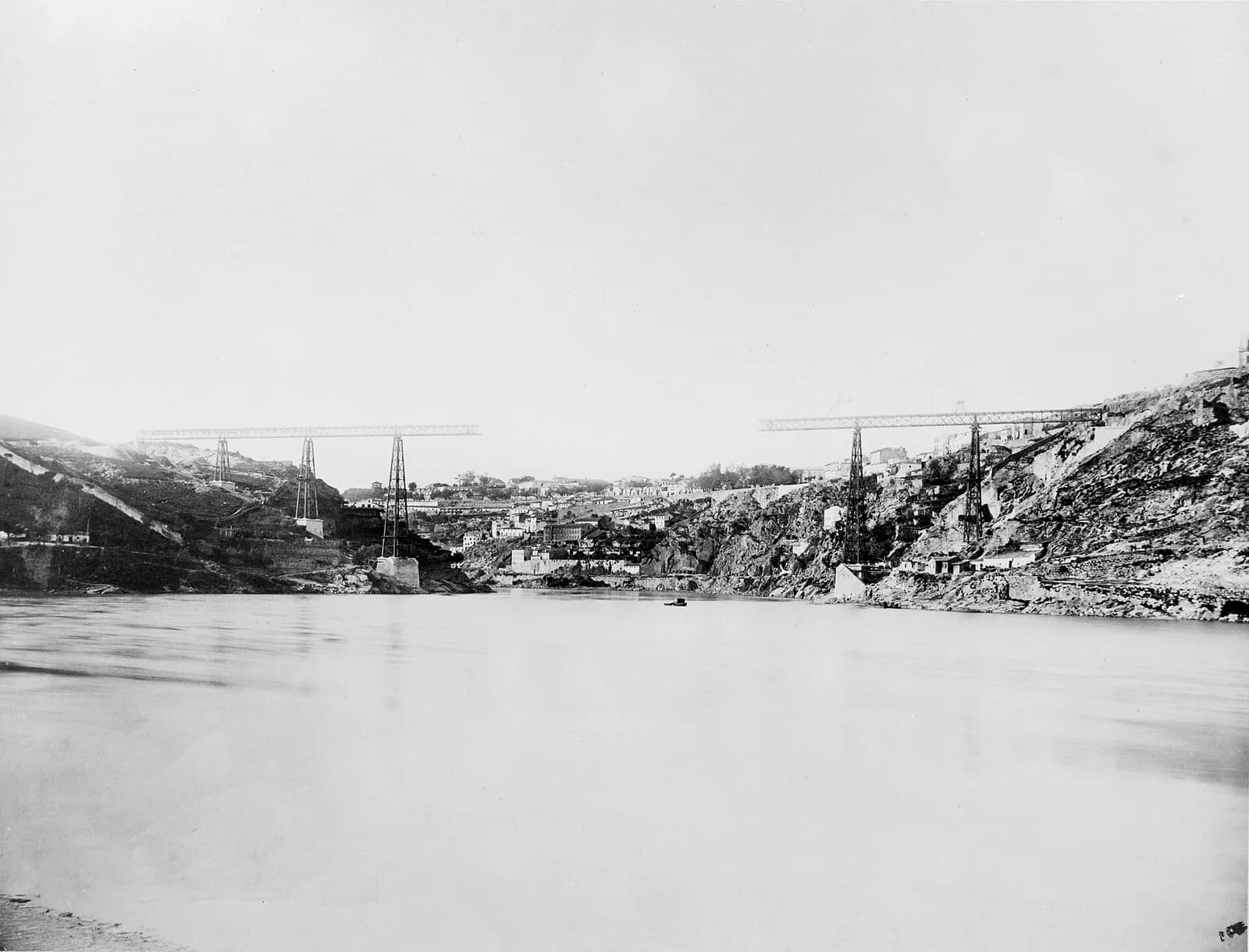
Work began on 5 January 1876. The masons built granite bases on the rock of both slopes, the iron piers went up on them, and the deck girders were assembled on each bank and pushed out over the piers, then beyond them into mid-air, as far as the points where short piers would later stand on the arch.
Then the arch began, on 2 March 1877, from both banks at once. It was divided into 21 segments. The first segments, next to the banks, were set on scaffolds on the rocks; after that there was nothing below but the river. Each new segment hung from steel-wire cables tied back to the deck on top of the main piers, and the number of cables grew with the weight to 16 for each half. The deck in turn was anchored to the rock on the Porto side and to a masonry block on the Gaia side.
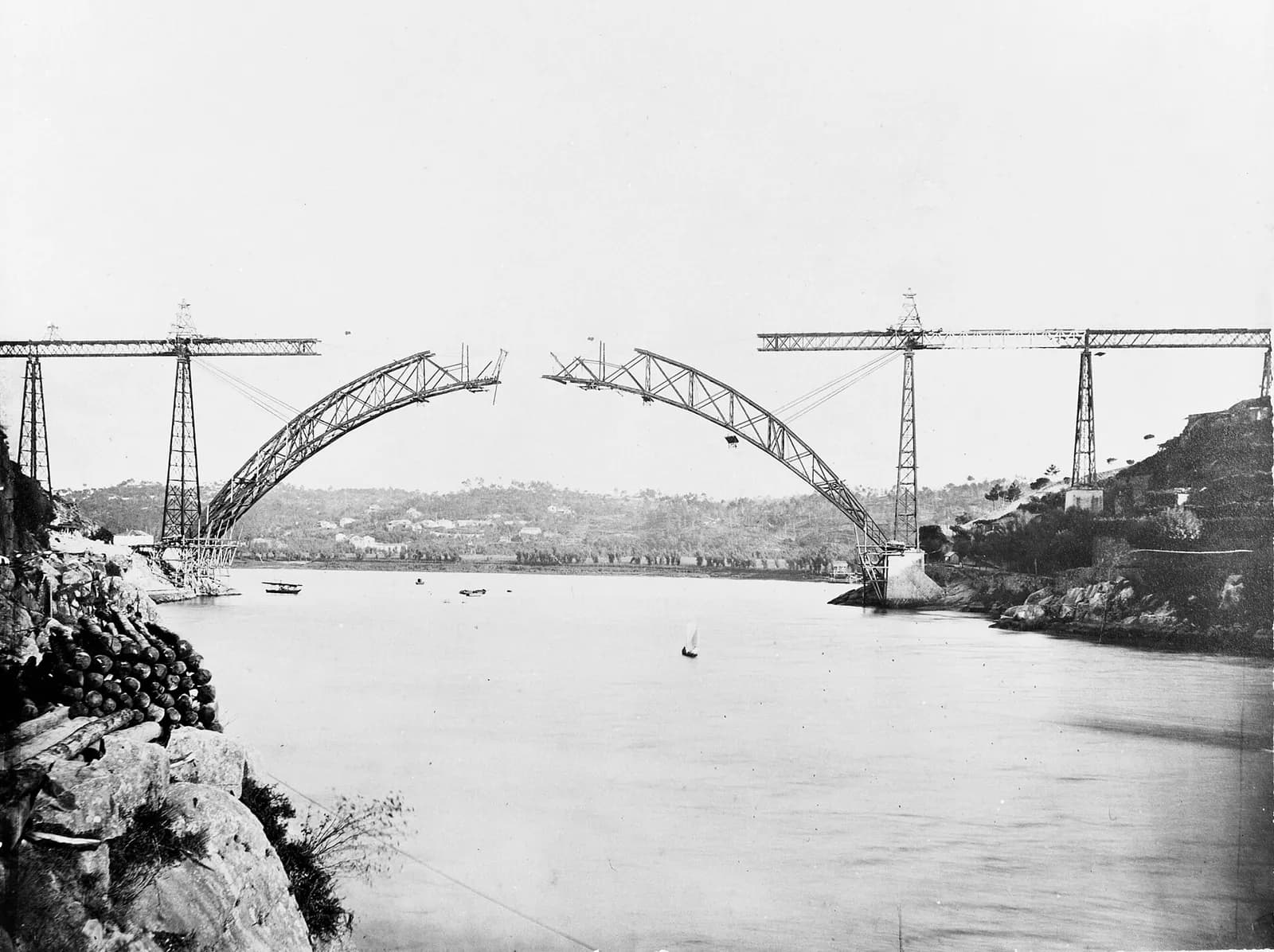
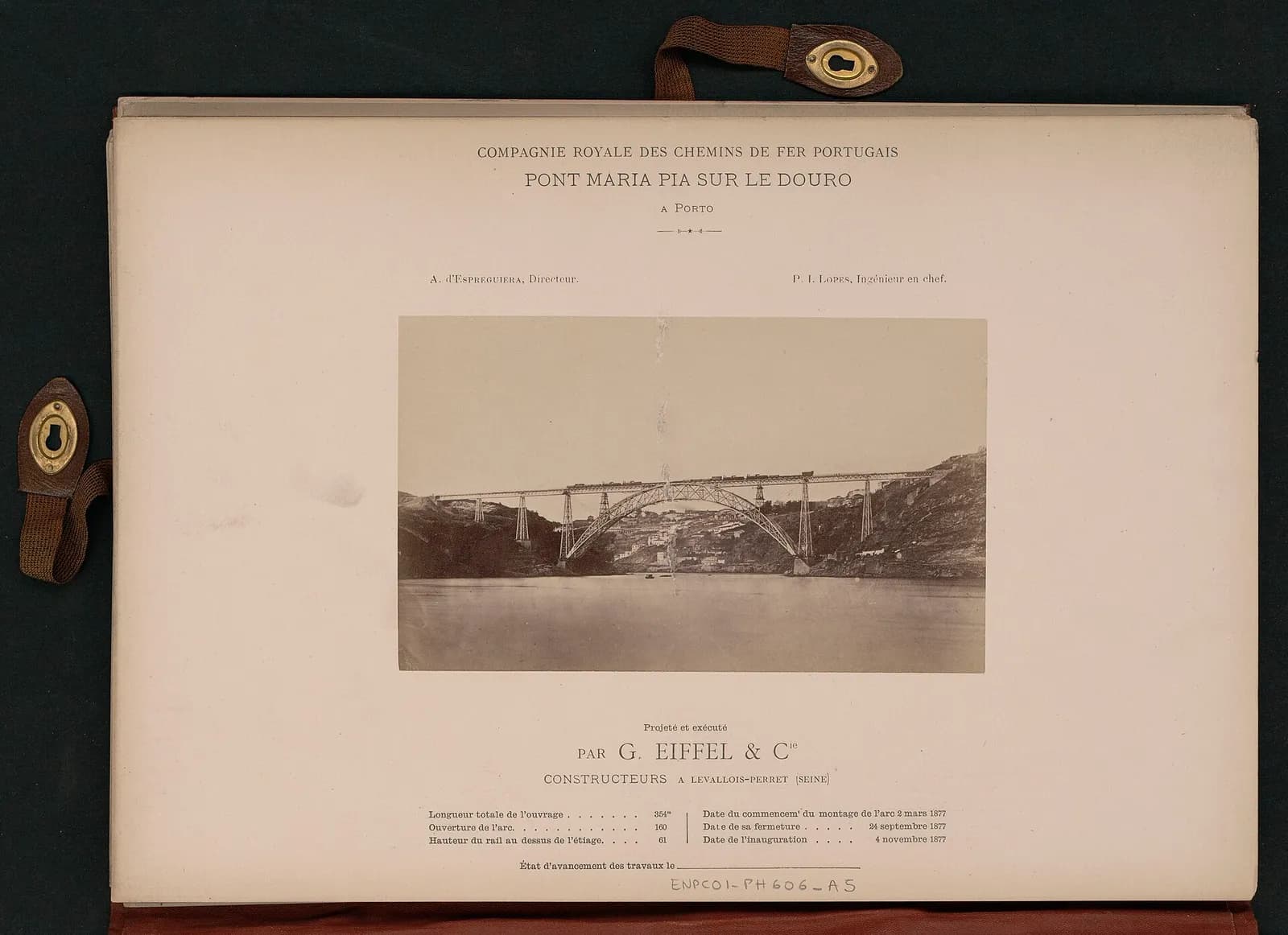
The iron came up the river by boat. At the tip of each half, a timber crane hanging from a cable strung across the gorge between two 10-metre trestles lifted the pieces into place. Riveters followed on a hanging platform. The two halves met on 24 September 1877, according to the printed mount of a photograph album of the bridge made that year. A note in the company's archives, quoted in the Gazeta dos Caminhos de Ferro in 1956, puts the closing of the arch at ten past three on the afternoon of 28 October instead; the sources do not explain the difference. The piers on the arch went up next, and on 28 October the deck was run into its final position.
About 150 workers built the bridge in 22 months. Just before the deck was finished, Adelaide Lopes, the chief engineer's wife, insisted on being the first person to cross. On her husband's arm she walked over the unfinished deck, with no railings and the river 60 metres below, crossed the last gap along a bare girder, and then walked back, so that nobody coming from the Lisbon side could claim to have been first.
26 February 1875
Law clears the way
Tax exemption; bridges for a single track.
1 May 1875
Tenders due
Four builders submit designs.
22 June 1875
Contract awarded
To G. Eiffel et Cie (IP's date).
5 January 1876
Work begins
2 March 1877
Arch erection starts
From both banks at once.
24 September 1877
Arch closed
28 October 1877
Deck in final position
31 October to 2 November 1877
Load tests
4 November 1877
Inauguration
King Luís I and Queen Maria Pia cross on the royal train.
5 November 1877
First regular Lisbon to Porto train
Load tests and a royal name
A commission of three Portuguese engineers tested the bridge from 31 October to 2 November. For the static tests it used two trains, each pulled by two 61-tonne Sharp engines from the Minho and Douro lines, then the heaviest in the country, with eight loaded wagons. They parked them on the whole arch, on each half in turn and on the centre. The crown sagged by no more than 20 millimetres. A goods train of 358 tonnes then crossed at 22 km/h and a lighter train at 31 km/h, the most the curves at either end allowed. Seyrig's own account, as summarised by Coste and Godart, instead gives a 355-tonne train at 31 km/h.
The commission's report said the arch was much stiffer than the bridge at St Louis on the Mississippi, the only one it thought comparable. IP and the American Society of Civil Engineers both describe the 160-metre span as the longest iron arch in the world when it opened.
While it was being built, the bridge was known as the “D. Fernando”. On the day of the inauguration it took the name of Queen Maria Pia of Savoy, the wife of Luís I. The company's board had asked her permission on 3 November, and on 15 November it recorded that, in all the company's acts, the Douro bridge would henceforth be called the “Ponte Maria Pia”.
Lisbon to Porto, and the making of a name
On 5 November 1877 the first regular train ran through from Lisbon to Porto, and the last section of the Northern Line, from Gaia to Campanhã station in eastern Porto, was open. For the first time the capital and the second city were joined by rail without a change at the river, and the main line could meet the state's Minho and Douro lines on the north bank.
It was expensive. Pedro Inácio Lopes's account of the cost of finishing the line puts the bridge at 1,413,577 francs out of about 2.54 million for the whole section, which works out at roughly 752,000 francs per kilometre. Manuel de Azeredo, a Porto engineering professor who wrote a history of the city's bridges, gives 965,000 francs for the bridge. The sources do not say what each figure includes.
| Measure | Figure | Source |
|---|---|---|
| Arch span between hinges | 160 m | All sources |
| Rise of the arch | 37.5 m to the underside; 42.6 m measured on the centre line | Seyrig via IESF; Gazeta; IP |
| Length of deck | 354 m; 352.875 m between abutment faces | Eiffel album, IP; Gazeta, Azeredo |
| Height of rails above the river | 61 m; 61.2 m; 62.4 m from low water | Album, IP; Azeredo; Gazeta |
| Weight of iron | 1,450 t (arch 750 t); about 1,500 t; 1,600 t (arch 640 t) | Seyrig via IESF; IP; Gazeta, Azeredo |
| Work finished | 21, 28, 30 or 31 October 1877 | IESF; Gazeta and AFGC; CP and Gazeta; Azeredo |
| Cost of the bridge | 965,000 francs; 1,413,577 francs | Azeredo; Lopes in the Gazeta |
Differences in length and height come from where each source measured. The finishing dates mix the end of the ironwork, the placing of the deck and the end of all work.
The American Society of Civil Engineers credits the bridge with establishing Eiffel as an important bridge designer. At the Paris Universal Exhibition of 1878 his firm won a grand prize for civil engineering for it. In June 1879 the French Minister of Public Works asked for the Garabit viaduct over the Truyère, a two-hinged arch of the same type spanning 165 metres, to be given to Eiffel without a tender. His decision gave the reason: it was Eiffel's Douro bridge that had given the state's engineers the idea for the new route.
Heavier engines and a bottleneck
For two decades every locomotive the company owned crossed the bridge without any speed limit, even as engines grew heavier. In 1891 and again in 1897 the government sent engineers to inspect it, because people in Porto feared that fumes from a nearby carbon disulphide works were eating the iron. A rumour spread that rotten rivets were raining from the bridge.
| Early locomotives | By about 1899 | Increase | |
|---|---|---|---|
| Load per axle | 12 t | 16.5 t | about 38 per cent |
| Total weight | 48 t | 69 t | about 44 per cent |
Weights as given by Frederico de Quadros Abragão in the Gazeta dos Caminhos de Ferro (1956); the percentage increases are calculated from them.
By 1899 some deck parts showed signs of fatigue. The company called in Maurice Koechlin, of Eiffel's works at Levallois-Perret, and on his advice replaced the deck floor and stringers and strengthened the cross-beams in 1899 and 1900. Its own ironworks at Ovar, set up to look after the bridge, replaced diagonals between 1901 and 1906 without stopping the trains. From then on the heaviest engines were kept off the bridge and speeds were cut, and further repairs followed in 1922 to 1926 and in 1951.
Restrictions kept the bridge safe but made it a choke point on the main line. In February 1981 the Council of Ministers called a new double-track bridge a priority that could not be put off. The old bridge, it said, was the only rail link to Porto and the north, and its single track and age limited loads, speeds, capacity and journey times. Strengthening it would not cure that and would spoil a monument that had to be preserved.
The replacement, the São João bridge designed by Edgar Cardoso, was built about 180 metres upstream: a double-track concrete frame with a central span of 250 metres between two piers founded in the river close to each bank. It opened on 24 June 1991, Porto's feast day of São João. That day the Maria Pia carried its last trains, after almost 114 years in service.
A monument without a use
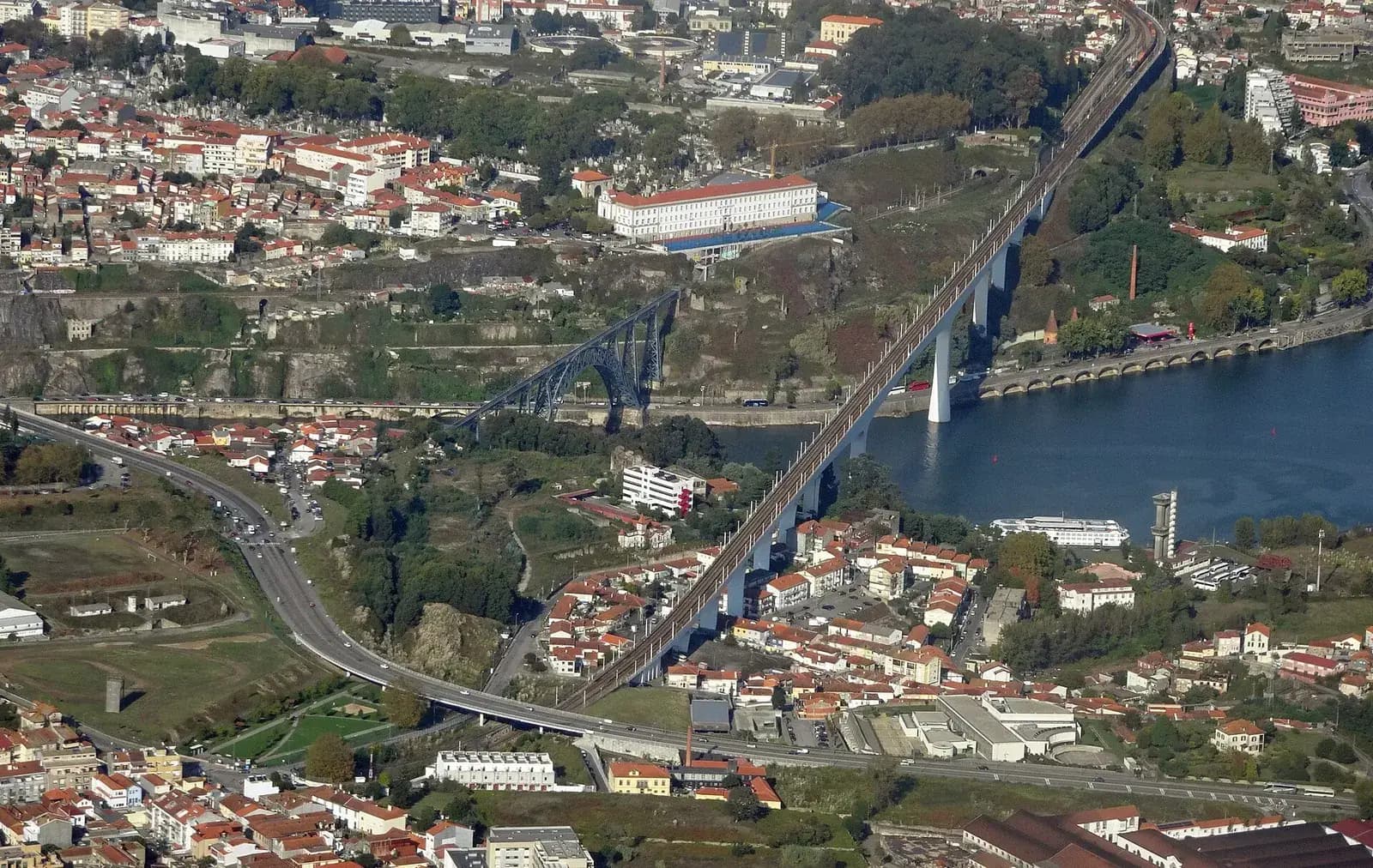
The bridge had already been honoured. A decree of 26 February 1982 classified it as a national monument; the government's 1981 resolution had already described it as declared a monument in 1976, and the sources do not explain the earlier date. In 1990 the American Society of Civil Engineers named it an International Historic Civil Engineering Landmark. IP, which owns it, says it carries out regular inspections and preventive maintenance.
Finding it a new job has proved harder. In 2004 a protocol was signed with the Porto and Gaia councils to turn it into a cycle path, at an estimated €1.5 million, but it was never carried out. In 2007 Refer, the state rail infrastructure company of the time, marked the bridge's 130th birthday by announcing €2 million to repaint it. In 2013 two architects even proposed moving it to a city block in Porto.
In March 2023 four Socialist MPs from Porto asked the government whether IP would reopen the bridge to walkers and cyclists. IP had said it would study that use with the two councils once Porto had converted the old Alfândega railway branch nearby for walking and cycling. Nineteen years after the cycle-path protocol, nothing had been built.
Its design lives on downstream. The Ponte Luís I, opened in 1886, is also an iron arch hinged at both ends, and was designed by the same man, Seyrig.
FAQs
Did Gustave Eiffel design the Maria Pia bridge?
His firm, G. Eiffel et Cie, won the contract and built it, and Eiffel directed the project and attended the inauguration. Its arch is credited largely to his partner Théophile Seyrig: the firm's own 1878 notice said Seyrig and Henri de Dion did the design and calculations.
Was the Maria Pia the longest arch bridge in the world?
Its 160-metre span was the longest iron arch in the world when it opened in 1877, according to Infraestruturas de Portugal and the American Society of Civil Engineers. Eiffel's own Garabit viaduct in France, finished in 1884, spans 165 metres.
Why did trains stop using the Maria Pia bridge?
It had a single track and, after strengthening around 1900, carried trains under weight and speed limits. In 1981 the government called it a bottleneck for loads, speeds and capacity. Its replacement, the double-track São João bridge, opened on 24 June 1991.
Can you walk across the Maria Pia bridge?
No. It has been closed since 1991. Plans to make it a cycle and footpath, including a protocol signed in 2004, have not been carried out. You can see it from the riverside road on the Porto bank and from trains on the São João bridge.
Is the Maria Pia the same as the Ponte Luís I?
No. The Maria Pia is the railway bridge of 1877, upstream. The Ponte Luís I, opened in 1886, is the two-deck bridge near Porto's old centre, built by a Belgian firm to Seyrig's design. Both are iron arches hinged at both ends.
On the timeline
Open the timelineNearby moments from regeneration and the last kings (1851–1910).
António Egas Moniz is born in Avanca, near Estarreja. Neurologist, foreign minister and head of Portugal's delegation to the Paris Peace Conference, he pioneered cerebral angiography and the prefrontal leucotomy, which brought him Portugal's first Nobel Prize, in 1949.
French President Patrice de MacMahon, asked to arbitrate between Portugal and Britain, awards the whole of Delagoa Bay — today's Maputo Bay — to Portugal. The ruling secured the future capital of Mozambique for the Portuguese, and the city still remembers it: a local beer is called '2M', after the marshal.
The Caixa Geral de Depósitos is created by law in Lisbon, at first to safeguard the deposits that courts and public bodies were required to lodge. Wholly owned by the state ever since, it grew into the country's largest bank and a fixture of every Portuguese high street.
The Maria Pia bridge, 1877
The Dona Maria Pia railway bridge over the Douro between Porto and Vila Nova de Gaia is inaugurated. Built by Gustave Eiffel's Paris firm, its wrought-iron crescent arch, 160 metres across, was then the longest iron arch in the world; it carried trains until 1991 and is a National Monument.
Birth in Guarda of Carolina Beatriz Ângelo, Portugal's first woman surgeon. In 1911, as a widow and 'head of household', she won a court case that let her become the first woman to vote in Portugal — prompting the Republic to rewrite the electoral law in 1913 to bar women explicitly.
Lisbon marks the tercentenary of Camões's death with a great 'cortejo cívico' through its streets, organised by a commission of the Portuguese press and echoed by processions in towns across the country. The first large civic commemoration of its kind in Portugal turns 10 June into a national symbol and lays the foundations of today's Dia de Portugal.
Birth in Porto of naval officer José Carvalho Araújo (two Navy sources say 1880). In October 1918, commanding the small patrol boat 'Augusto de Castilho', he fought the German submarine U-139 for nearly two hours so that the steamer 'São Miguel', carrying 206 passengers from Madeira to the Azores, could escape. He died in the fight, and his ship was sunk.
Coming up in history
All long reads 6 November 1919Sophia de Mello Breyner Andresen, poet of the sea, born in Porto in 1919
 7 November 1933A Canção de Lisboa: the 1933 talkie that made Lisbon laugh
 8 November 1822Pirajá, 8 November 1822: the battle for Salvador da Bahia
 9 November 1975“O povo é sereno”: smoke over the Terreiro do Paço, 9 November 1975
14 sources
Archives, scholarship and reporting this article was checked against.
- 1
Gazeta dos Caminhos de Ferro, n.º 1652 (16 October 1956): centenary issue of the Portuguese railwaysGazeta dos Caminhos de Ferro, digitised by the Hemeroteca Municipal de Lisboa
- 2
Gustave Eiffel constructeur de grands arcs métalliques: du pont Maria Pia au viaduc de Garabit (Jean-François Coste and Bruno Godart)Ingénieurs et Scientifiques de France (IESF), Comité Génie Civil et Bâtiment, October 2023
- 3
Ponte Maria PiaInfraestruturas de Portugal
- 4
Ponte Maria Pia: uma ponte de Eiffel… e de Seyrig (José Manuel Lopes Cordeiro)Universidade do Minho, published by ocomboio.net, 2009
- 5
A Ponte Maria Pia: inaugurada a 4 de novembro de 1877CP, Comboios de Portugal
- 6
Resolução do Conselho de Ministros n.º 28/81 (new double-track railway bridge over the Douro)Diário da República, I série, n.º 41, 18 February 1981, p. 439
- 7
As Pontes do Porto (Manuel de Azeredo, 1997–1999)Faculdade de Engenharia da Universidade do Porto (U.Porto web archive)
- 8
Le pont Maria Pia sur le Douro à Porto, précurseur du viaduc de Garabit (Bruno Godart)Association Française de Génie Civil, presentation of 17 October 2024
- 9
- 10
Compagnie Royale des Chemins de Fer Portugais: Pont Maria Pia sur le Douro à Porto (photograph album page, 1877)École nationale des ponts et chaussées collection, digitised by the Bibliothèque nationale de France (Gallica), via Wikimedia Commons
- 11
Ponte Maria Pia BridgeAmerican Society of Civil Engineers, Historic Civil Engineering Landmarks
- 12
- 13
- 14Deputados do PS questionam Governo sobre reabertura da Ponte Maria Pia no PortoObservador (Lusa), 17 March 2023

Image credits
- The Maria Pia bridge from the riverside in November 2024. The arch spans 160 metres between its hinges; the concrete Ponte do Infante of 2003 crosses the Douro behind it. Joseolgon, CC BY 4.0, via Wikimedia Commons.
- The works on 30 September 1876. On both banks the iron piers are up and the deck girders have been pushed out over them; the arch has not yet been started. Attributed to Karl Emil Biel, Public domain, via Wikimedia Commons.
- The two halves of the arch reaching across the Douro on 15 August 1877, each held by cables from the top of its main pier. They met about six weeks later. Attributed to Karl Emil Biel, Public domain, via Wikimedia Commons.
- A page from a photograph album of the bridge, 1877, headed with the name of the Companhia Real and showing the finished structure with a train on the deck. The mount credits G. Eiffel et Cie with the design and construction and gives a length of 354 metres, an arch of 160 metres, rails 61 metres above low water, and the dates the arch was begun and closed. Unknown author, Public domain, via Wikimedia Commons.
- The Maria Pia bridge (left) and its replacement, the São João bridge of 1991 (right), seen from the air in October 2019. Ion Tichy, CC BY-SA 4.0, via Wikimedia Commons.