

Olivença and Article 105: Portugal at the Congress of Vienna, 1815
With its court in Rio de Janeiro, Portugal sent three envoys to the peace congress that remade Europe. They came home with a slave-trade treaty Britain wanted and a pledge from the other powers to work for the return of Olivença, a border town Spain had taken. Spain acceded in 1817 but never gave it back.
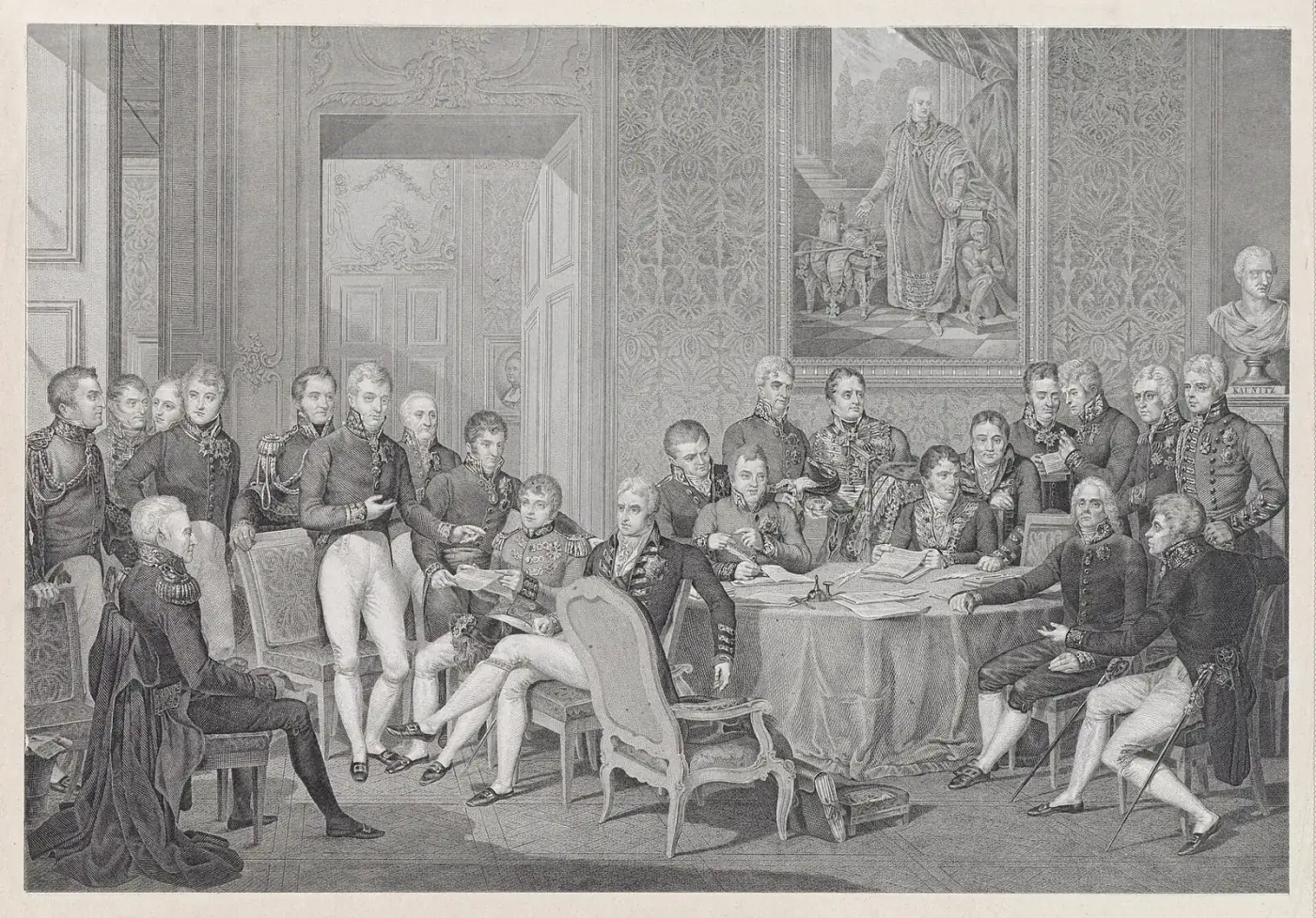
At a glance
- The Final Act of the Congress of Vienna is dated 9 June 1815, the day the envoys initialled it; some had left Vienna before the fair copy was ready. It bears the names of Austria, France, Britain, Portugal, Prussia, Russia and Sweden; Spain's envoy, the Marquis of Labrador, refused to sign.
- Portugal was represented by three plenipotentiaries: the Count of Palmela, António de Saldanha da Gama and Joaquim Lobo da Silveira. The Prince Regent, the future João VI, was in Rio de Janeiro, where the court had moved in 1808.
- In Article 105 the powers recognised “the justice” of Portugal's claim to Olivença, ceded to Spain at Badajoz in 1801, and promised to work by conciliation for its return as soon as possible.
- In January 1815, at Vienna, Portugal also signed two agreements with Britain: a ban on Portuguese slave trading north of the Equator, and £300,000 in compensation for Portuguese slave ships seized by the Royal Navy.
- Spain acceded to the Final Act on 7 May 1817 but never returned Olivença. Portugal has never recognised Spanish sovereignty over the town, and the border there has never been marked.
One signature missing
The great treaty was dated Friday 9 June 1815, though not everyone stayed to sign it. The plenipotentiaries initialled the Final Act of the Congress of Vienna, the peace conference that redrew the map of Europe after Napoleon's defeat, that day; the fair copy took longer, and some of them had left the city before it was ready. Under the last of its 121 articles the powers had six months to ratify. Portugal was given a year, “or sooner if possible”, because its sovereign lived on the other side of the Atlantic.
Three Portuguese names went on the document: the Count of Palmela, António de Saldanha da Gama and Dom Joaquim Lobo da Silveira. One space stayed empty. Pedro Gómez Labrador, envoy of the King of Spain, refused to sign, because the great powers had ignored his demands for the Bourbon princes of Italy.
Europe was at war again as the diplomats finished, because Napoleon had escaped from Elba and taken back power in France. Deep in the Final Act, under the heading “Affairs of Portugal”, sat a promise that mattered more in Lisbon than anywhere else. Article 105 dealt with a walled town by the Guadiana that Spain had taken fourteen years before.
A kingdom without its court
Olivença had been Portuguese since the Treaty of Alcañices of 1297. In 1801, after the short War of the Oranges, in which Spain overran several towns in the Alentejo, the Treaty of Badajoz gave the others back but kept Olivença and its district. That war and treaty have their own article on Lisboeta.
Six years later a French army, with Spanish troops alongside it, invaded Portugal and the royal family sailed for Brazil. From early 1808 the court sat in Rio de Janeiro, and Prince João governed the empire from there as Prince Regent. In Lisbon a council of regency governed in his name. That flight has its own article.
On 1 May 1808, in a manifesto from Rio breaking with France, the Prince Regent declared “null and of no force” the treaties Napoleon had forced on him, “particularly those of Badajoz and Madrid of 1801”. Portugal's claim to Olivença has rested since then on that repudiation and on Spain's part in the invasion of 1807, which Lisbon regards as a breach of the Badajoz treaty.
When peace came in 1814, the court's distance became a diplomatic problem. Late that year there were real preparations for the prince to return to Lisbon, pushed by the British, but Rio held out. The distance showed even in the treaty texts: the Final Act would give Portugal twice as long as anyone else to ratify it.
The first peace settlement had already gone badly. In its treaty with France of 30 May 1814, signed in Paris, a Portuguese envoy agreed to hand back French Guiana, which Portugal then held, on terms the Prince Regent refused to ratify. Vienna had to repair that too.
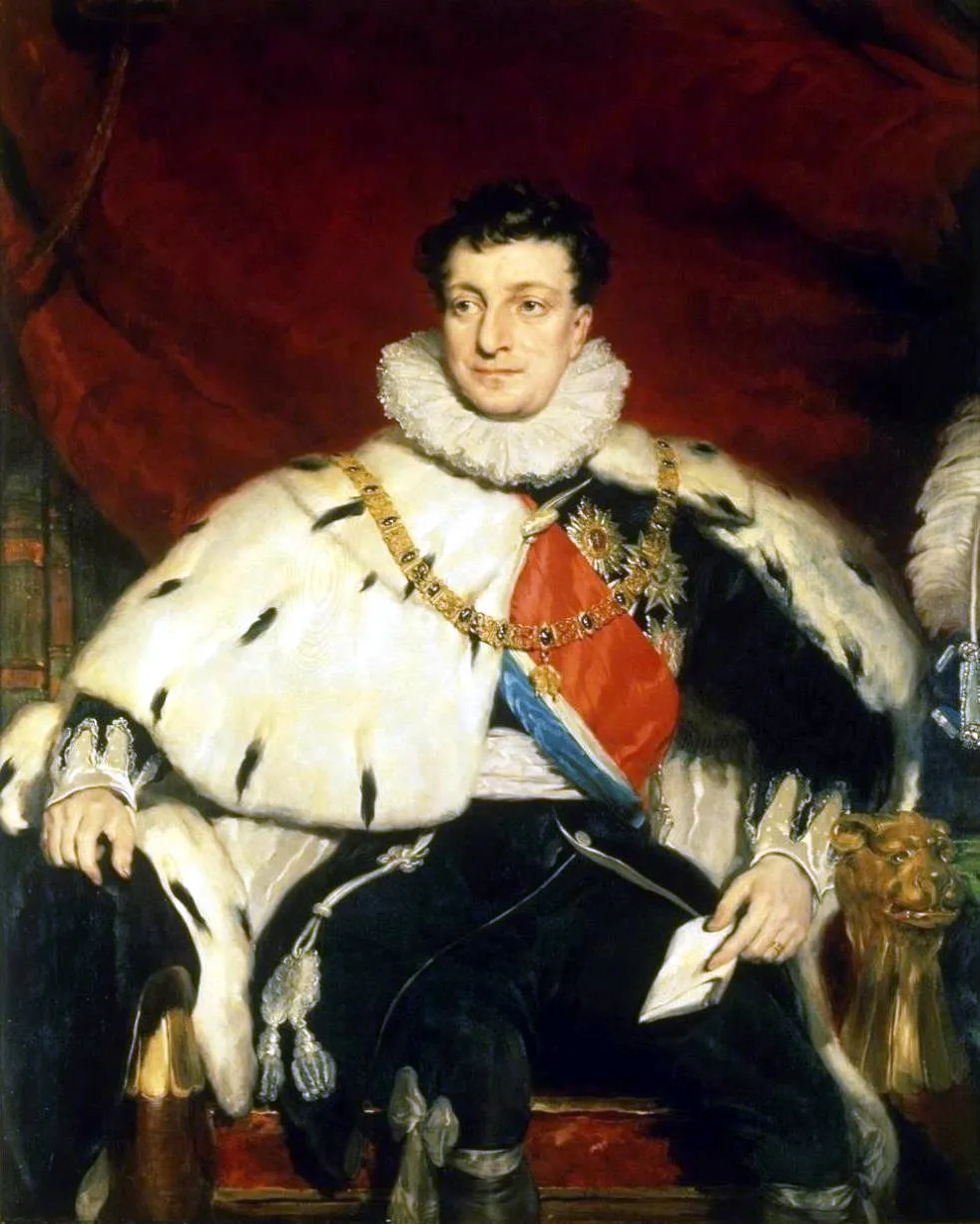
Palmela's delegation
The head of the mission, Dom Pedro de Sousa Holstein, was born in Turin in 1781, the son of a Portuguese diplomat, and grew up across Europe: Denmark, Italy, Germany, England and France, as well as Portugal. He had been made Count of Palmela and would later be marquis and duke. In the negotiations of these years, the historian Bruna Belchior writes, he had to deal with Olivença, Portugal's intervention on the River Plate and British pressure to end the slave trade.
His two colleagues, Saldanha da Gama and Lobo da Silveira, signed with him as plenipotentiaries “to the Congress of Vienna”. Historians disagree about whose interests Palmela served. Valentim Alexandre has argued that while the court in Rio cared most about Brazil, Palmela put Portuguese questions first, such as the return of Olivença and Lisbon's exposure to Spain. Belchior reads his letters as more mixed, loyal above all to the monarchy.
The price of British friendship
Britain had abolished its own Atlantic slave trade in 1807 and came to Vienna determined to make other countries follow. Portugal, whose ships carried enslaved Africans to Brazil, was a prime target. Palmela and Labrador argued that only the four colonial powers had any business discussing the trade. Castlereagh, the British foreign secretary, insisted it concerned all humanity, and the declaration went ahead in the name of all eight powers.
On Saturday 21 January 1815 Palmela, Saldanha and Lobo signed a convention with Castlereagh. Britain would pay £300,000 in London to settle all claims for Portuguese ships taken by British cruisers before 1 June 1814 on the charge of illegal slave trading. The next day they signed the treaty Britain really wanted.
“it shall be forbidden to each and every subject of the Crown of Portugal to buy slaves, or to traffic in them, on any part of the coast of Africa to the north of the Equator, under any pretext or in any manner whatsoever”
South of the line, the trade to Portugal's own possessions went on, and Britain promised not to hinder it. The treaty also declared void the Anglo-Portuguese treaty of alliance of 1810, “founded on temporary circumstances, which have happily ceased to exist”, while confirming the old alliances, and Britain gave up the payments still owed on a £600,000 loan raised in London for Portugal in 1809. Both sides promised a later treaty to fix the date when the whole trade would end.
Palmela had bargained hard. According to the historian Leslie Bethell, as summarised by Felipe Alamino, Britain first wanted total abolition within five years. Palmela said that was too little time for so large an economic change; eight years was then discussed, before both sides settled on the ban north of the Equator. Alamino calls that a success for Portuguese diplomacy, because it left the trade south of the Equator open.
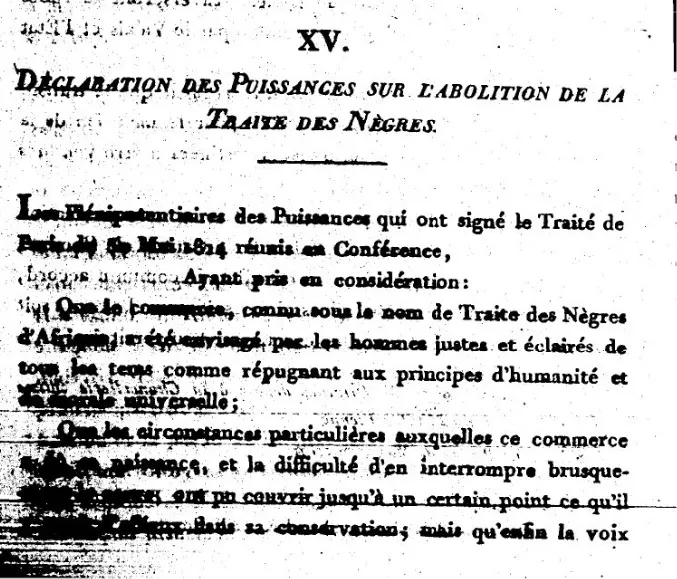
On 8 February the eight powers declared the trade “repugnant to the principles of humanity and universal morality”, and the text was annexed to the Final Act. It set no date; each power could choose its own moment to abolish. Enforcement against Portugal came with an additional convention on 28 July 1817, which let British and Portuguese warships stop and search each other's merchant ships and send suspected slavers to courts set up for the purpose.
Days from signing: the deadline to ratify, and the time actually taken
days after signing
Lisboeta's day counts from the dates in the texts; each bar counts days from the date the treaty was signed. The three deadline bars are the time the texts allowed: five months for the treaty of 22 January (to 22 June 1815; the convention of 21 January had the same five months), and under Article 121 of the Final Act six months (to 9 December 1815), or a year for Portugal (to 9 June 1816). The other two bars are the time actually taken: the Prince Regent ratified the January treaty in Rio on 8 June 1815 (the convention, 138 days after signing), and Spain, which had refused to sign, acceded to the Final Act on 7 May 1817.
Show the data
| Days after signing | |
|---|---|
| Treaty of 22 Jan 1815: deadline | 151 |
| Treaty of 22 Jan 1815: ratified in Rio | 137 |
| Final Act: deadline, other powers | 183 |
| Final Act: deadline, Portugal | 366 |
| Final Act: Spain accedes | 698 |
Article 105
Olivença was, on Valentim Alexandre's reading, one of the questions Palmela thought most urgent, and the Final Act gave it an article of its own, the first of three under “Affairs of Portugal”.
“The Powers, recognising the justice of the claims made by His Royal Highness the Prince Regent of Portugal and Brazil to the town of Olivenza and the other territories ceded to Spain by the Treaty of Badajoz of 1801, and regarding the restitution of these places as one of the measures fit to secure between the two kingdoms of the Peninsula that complete and stable good harmony whose preservation in every part of Europe has been the constant aim of their arrangements, formally undertake to use, by means of conciliation, their most effective efforts so that the retrocession of the said territories in favour of Portugal is carried out; and the Powers recognise, as far as depends on each of them, that this arrangement must take place as soon as possible.”
The powers recognised that Portugal was in the right and pledged their “most effective efforts”, but only through conciliation. The article set no deadline and no penalty. Nothing in the article obliged anyone to make Spain give the town back.
The next two articles settled the Guiana dispute. Article 106 cancelled the clause of the 1814 treaty that the Prince Regent had refused to ratify. In Article 107 he undertook to give French Guiana back to Louis XVIII as far as the Oyapock river, the boundary Portugal had always read into the Treaty of Utrecht, at a date to be fixed later.
| Question | What was signed | What happened |
|---|---|---|
| Olivença | Final Act, Article 105 (9 June 1815) | Powers back the claim; Spain accedes in 1817 but keeps the town |
| French Guiana | Final Act, Articles 106 and 107 | Portugal agrees to return it to France up to the Oyapock, date left to a later convention |
| Seized slave ships | Convention of 21 January 1815 | Britain to pay £300,000 for ships taken before 1 June 1814 |
| Slave trade | Treaty of 22 January 1815 | Trade banned north of the Equator; a mutual right of search follows in 1817 |
| Alliance and debt | Treaty of 22 January 1815, Articles III and V | 1810 alliance cancelled; remaining payments on the 1809 loan waived |
| Brazil's status | Law of 16 December 1815 | Brazil raised to a kingdom in a United Kingdom with Portugal and the Algarves |
The articles also named the Prince Regent “of Portugal and Brazil”, and of “the Kingdom of Portugal and that of Brazil”, six months before Brazil legally became a kingdom.
The idea of raising the colony to a kingdom without separating it from Portugal is usually credited to Talleyrand, the French foreign minister, who is said to have suggested it to the Portuguese envoys. The historian José Luís Cardoso writes that Palmela and António de Araújo de Azevedo had put the case to Talleyrand, who, by what Cardoso calls the historiography of petty diplomatic intrigue, was quick to claim the idea as his own.
“the rank and political category which, by the said attributes, ought to belong to them, and in which my said dominions were already considered by the Plenipotentiaries of the Powers that formed the Congress of Vienna, both in the Treaty of Alliance concluded on 8 April of this year and in the final treaty of the same Congress”
The town that stayed Spanish
Spain held out for almost two years and acceded to the Final Act on 7 May 1817. Portuguese accounts, including the Lusa news agency's, often say Spain thereby recognised Portuguese sovereignty over the town; Spain's view, as the head of Extremadura's regional government put it in 2024, is that Olivença has been Spanish since 1801. No handover followed.
By then the two crowns had a new quarrel. Portuguese and Brazilian troops had invaded the Banda Oriental, today's Uruguay, and taken Montevideo, and the dispute over Olivença became tangled with the frontiers east of the River Uruguay. Lisbon pressed its claim often in the first half of the nineteenth century, with Palmela its leading champion until his death in 1850.
Meanwhile Spain made the town its own. The new authorities banned teaching in Portuguese, imposed Spanish weights, measures and money, and Hispanicised surnames. After the sale of church and common lands in the 1850s, much of the land passed to settlers from Castile, La Rioja and the province of Badajoz. That, the historian Carlos Píriz writes, consolidated a Spanish identity in the area, though many families went on speaking Portuguese at home.
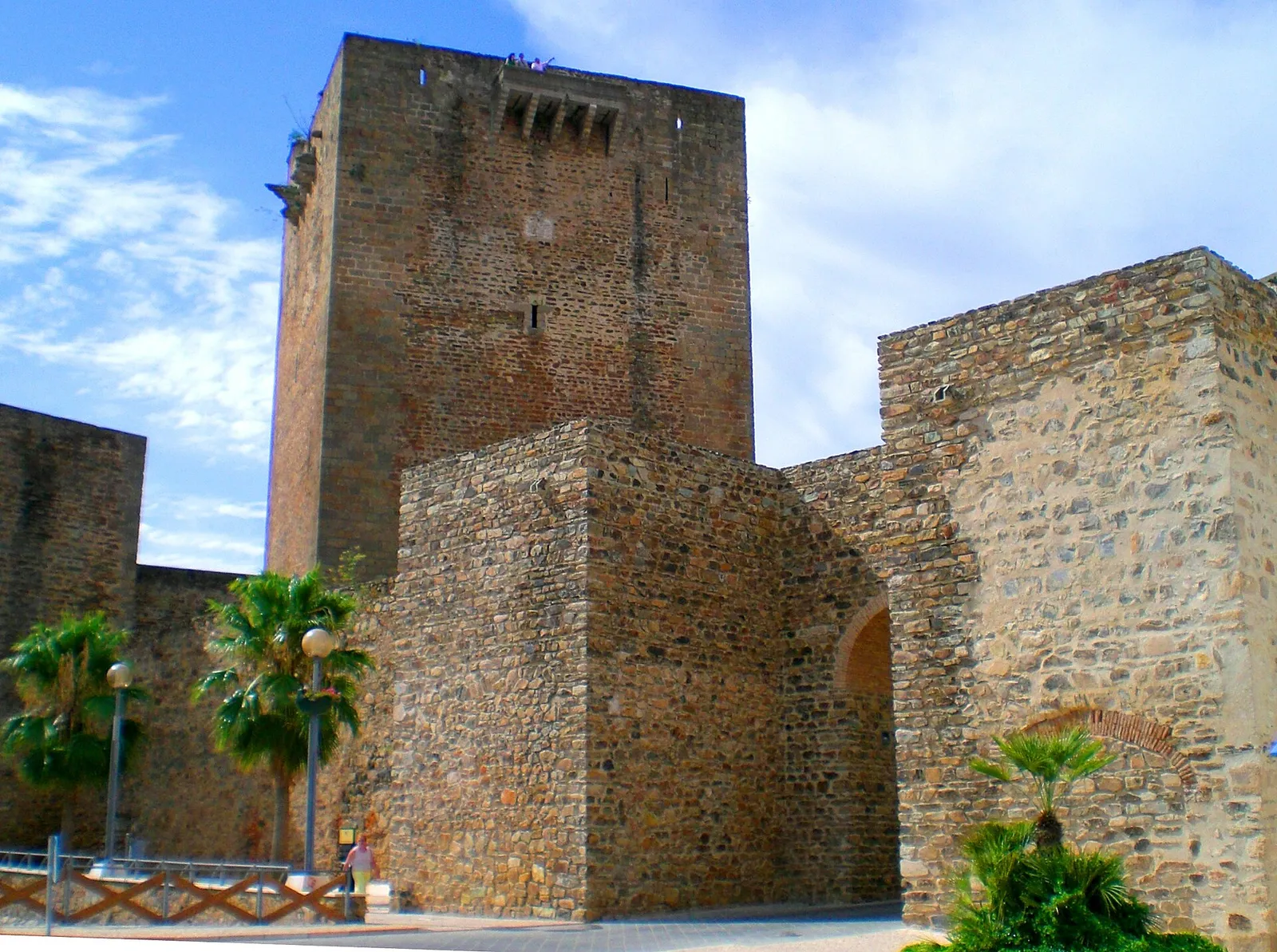
The border itself was left open. Joint commissions marked the frontier from the north in the Treaty of Lisbon of 1864 and stopped when they reached Olivença. In 1926 the two military dictatorships resumed the work from the confluence of the Cuncos with the Guadiana down to the sea, deliberately leaving the stretch north to the Caia, along Olivença's district, undefined.
6 June 1801
Treaty of Badajoz
Portugal cedes Olivença and its district to Spain.
9 June 1815
Final Act of Vienna
Article 105 backs Portugal's claim; Spain refuses to sign.
7 May 1817
Spain accedes
Spain accepts the Final Act but keeps the town.
1864
Treaty of Lisbon
The border commissions stop at Olivença.
1919
Paris peace conference
Portugal sounds out Britain about raising the claim, then drops it.
1926
Border agreement
The line is marked from the Cuncos to the sea, leaving the Olivença stretch open.
1936 to 1938
Sociedade Pró-Olivença
A campaign group is founded and publicly registered.
1944
Grupo dos Amigos de Olivença
Founded in Lisbon; registered the next year.
November 2000
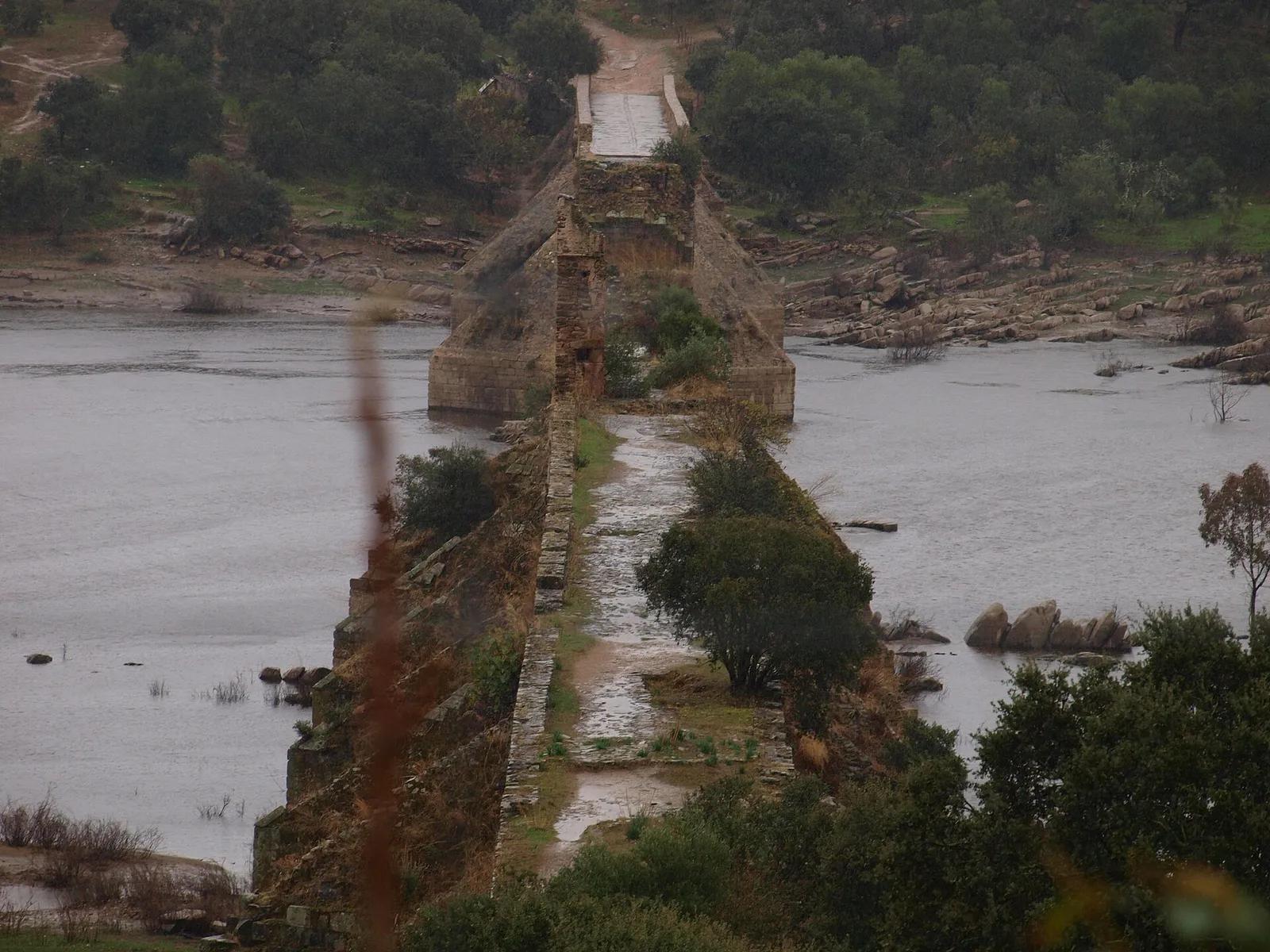
New Ajuda bridge
A new road bridge from Elvas opens beside the ruined one.
September 2024
Nuno Melo
Portugal's defence minister says Olivença is Portuguese.
The claim then passed from diplomats to nationalists. After the First World War the Portuguese press called Olivença “the Portuguese Alsace”, and the government sounded out the British foreign secretary, Arthur Balfour, about raising it at the peace conference in Paris; London's silence ended that. A Sociedade Pró-Olivença was founded in 1936 and the Grupo dos Amigos de Olivença in 1944, to the irritation of both Salazar and Franco, who in 1939 had signed a treaty to respect each other's borders.
After the 1974 revolution the group kept up the pressure. In 1981 its president, Admiral José Baptista Pinheiro de Azevedo, a former prime minister, made headlines on both sides of the border by saying Portugal was obliged to mobilise its armed forces over Olivença; the next year he explained that the occupation would be peaceful. Píriz reads the statements as bids for attention before the next presidential election.
Why it still matters
Portugal has never recognised Spanish sovereignty over Olivença. The official view, in Il Post's summary, is that the town is Portuguese by right and Spanish in fact. Governments rarely say so aloud. In 2003 the foreign minister, António Martins da Cruz, called the question frozen.
On 13 September 2024 the defence minister, Nuno Melo, said it anyway, after a cavalry ceremony at Estremoz. “By treaty”, he added, Olivença should be handed to the Portuguese state. He later wrote that this was a personal view that did not bind the government, then told parliament in October that his position was the state's own, unchanged for 209 years, under the monarchy, the First Republic, the Estado Novo and today.
“Olivença is Portuguese, naturally, and it is no provocation at all.”
Spain's answer came within days. The central government's delegate in Extremadura, José Luis Quintana, said the town was clearly Spanish, though it kept its Portuguese origins. The regional president, María Guardiola, said Extremadura would go on defending that Olivença is Spanish. The town's mayor, Manuel José González Andrade, called the remarks out of place and said speeches that divide people across borders belong to past centuries.
Olivença has about 12,000 inhabitants, and in recent years many have taken Portuguese nationality alongside their Spanish one. Estimates differ. Spain's government delegate, Quintana, said in September 2024 that more than 1,000 people in the town held both nationalities; Carlos Luna, who campaigns for the Portuguese claim, put the number of Oliventinos with Portuguese nationality at more than 3,000 by March that year.
The rest of Portugal's Vienna business is long settled. The Kingdom of Brazil that the congress anticipated broke away in 1822, and the trade south of the Equator carried on after 1815; the end of slavery in the empire has its own article. Only Olivença is still open. Melo's “209 years” count back to 1815, and Lusa's reports on his remarks recalled that Spain had subscribed to the Vienna settlement in 1817.
FAQs
What does Article 105 of the Final Act of Vienna say?
Signed on 9 June 1815, it says the powers recognise the justice of Portugal's claim to Olivenza and the other territories ceded to Spain by the Treaty of Badajoz of 1801. They undertook to use their most effective efforts, by conciliation, to have them returned to Portugal as soon as possible. It set no deadline and no sanction.
Did Spain sign the Final Act of the Congress of Vienna?
Not in 1815. Spain's envoy, the Marquis of Labrador, refused to sign on 9 June 1815, mainly because the powers ignored Spanish demands for the Bourbon princes of Italy. Spain acceded on 7 May 1817 but never returned Olivença.
Who represented Portugal at the Congress of Vienna?
Three plenipotentiaries of the Prince Regent João, who was living in Rio de Janeiro: Pedro de Sousa Holstein, Count of Palmela, who led the mission; António de Saldanha da Gama; and Dom Joaquim Lobo da Silveira. All three signed the Final Act and the two slave-trade agreements with Britain of January 1815.
Does Portugal still claim Olivença?
Portugal has never recognised Spanish sovereignty, and the border along Olivença's district has never been marked. Governments seldom raise the issue, but in 2024 the defence minister, Nuno Melo, said Olivença is Portuguese and told parliament this had been the state's position for 209 years. Spain regards the town as Spanish.
On the timeline
Open the timelineNearby moments from invasions, brazil and the liberal wars (1807–1851).
In thick fog and driving rain on the Côa river, Wellington's Anglo-Portuguese army defeats General Reynier's corps at the Battle of Sabugal. Within days Masséna's exhausted army was back in Spain, ending the third French invasion of Portugal apart from the besieged garrison at Almeida.
At the Battle of Salamanca, Wellington's allied army of about 48,000 routs Marshal Marmont's French Army of Portugal in an afternoon and evening of attacks, taking some 7,000 prisoners. Portuguese brigades — by now seasoned veterans of the Peninsular War — play a central role and suffer 2,037 casualties, and the victory opens the road to Madrid, which Wellington enters on 12 August.
At the Battle of Vitoria, in northern Spain, the Marquis of Wellington routs the army of King Joseph Bonaparte. The Anglo-Portuguese-Spanish victory effectively ends French rule in Spain and opens the road to the invasion of France, with Portuguese brigades, over a third of Wellington's Anglo-Portuguese army, leading the attack in the centre.
Portugal at the Congress of Vienna
The Final Act of the Congress of Vienna is dated this day and initialled by the envoys of seven of the eight powers behind the 1814 Peace of Paris, Portugal among them; Spain refuses to sign. Article 105 recognises the justice of Portugal's claim to Olivença, ceded under the Treaty of Badajoz of 1801, and the powers undertake to seek its return by conciliation, though Madrid would never return it.
With the royal court still in Rio de Janeiro after fleeing Napoleon, Prince Regent João raises Brazil from colony to kingdom, creating the United Kingdom of Portugal, Brazil and the Algarves. For a few years Rio was effectively the capital of the Portuguese world — until the 1820 revolution in Porto demanded the king's return and Brazil declared independence in 1822.
Queen Maria I dies aged 81 at the Carmo convent in Rio de Janeiro, where the court had fled from Napoleon. Portugal's first undisputed queen regnant is succeeded by her son João VI; her remains are carried back to Lisbon in 1821 and laid to rest in the Estrela Basilica in 1822.
Two years after the death of Queen Maria I, João VI is acclaimed King of the United Kingdom of Portugal, Brazil and the Algarves in Rio de Janeiro, home of the court since 1808. A temporary triumphal arch, a Greek temple and an obelisk, put up for days of festivities, marked Rio's new role as a royal capital.
Coming up in history
All long reads 11 June 1557The death of João III, 11 June 1557: a king who outlived all his children
 13 June 1231Saint Anthony of Lisbon: the friar who died outside Padua, 13 June 1231
 14 June 1908Fernão de Ornelas, the young mayor who rebuilt Funchal
 15 June 1970Almada Negreiros, the rebel of Orpheu, dies in Lisbon: 15 June 1970
18 sources
Archives, scholarship and reporting this article was checked against.
- 1
Wiener Congreß-Acte vom 9. Juni 1815 (Final Act of the Congress of Vienna, German text)Liechtensteinisches Landesarchiv, e-archiv.li
- 2
Traité de Vienne (1815), articles 105 à 107Wikisource (transcription of the French text of the Final Act)
- 3
Carta de Lei de 8 de Junho de 1815: ratifica o tratado assinado em Vienna a 22 de Janeiro deste anno para abolição do trafico de escravos ao Norte do Equador (publicação original)Câmara dos Deputados (Brazil), Legislação Informatizada, from the Coleção de Leis do Império do Brasil, 1815
- 4
- 5
O Congresso de Viena, o tráfico de escravos e as consequências para Portugal e Brasil (Felipe Nicolau Pimentel Alamino)Revista da Faculdade de Direito da Universidade de São Paulo, vol. 112 (2017)
- 6
El incordio ibérico: Oliven(z/ç)a, el lobby ultranacionalista portugués y la frontera irredenta (c. 1936–1968) (Carlos Píriz)Rubrica Contemporanea, vol. XI, no. 22 (2022), Universitat Autònoma de Barcelona
- 7
Pedro Gómez Labrador, Marquis of Labradorerc-secure-db, Utrecht University
- 8Nuno Melo diz que a sua posição sobre Olivença é a do Estado e de “vários governos”Diário de Notícias, 29 October 2024
- 9
A Revolução Liberal de 1820 (José Luís Cardoso)CTT Correios de Portugal, 2020 (bilingual edition, preview)
- 10
- 11
La disputa territoriale tra Spagna e Portogallo che va avanti dal 1815Il Post, 16 September 2024
- 12
Collecção dos tratados, convenções, contratos e actos publicos celebrados entre a coroa de Portugal e as mais potencias, vol. IV (José Ferreira Borges de Castro)Imprensa Nacional, Lisbon, 1856 (Internet Archive scan, University of Toronto copy)
- 13
Entre dois reinos: Conde de Palmela e a diplomacia luso-brasileira (Bruna Coutinho Gonçalves Belchior)ANPUH, XXV Simpósio Nacional de História, Fortaleza, 2009
- 14
Constituição e evolução do Estado brasileiro (Dalmo de Abreu Dallari)Revista da Faculdade de Direito, Universidade de São Paulo
- 15Alcaide de Olivença defende que os discursos de confronto são de séculos passadosRTP Notícias (Lusa), September 2024
- 16Madrid defende Olivença espanhola e promoção da sua singularidadeDiário de Notícias (Lusa), 16 September 2024
- 17Ir onde Saramago não quis ir (ao Portugal que não quis conhecer) (Carlos Luna, opinion)Observador, 27 August 2024
- 18
Image credits
- The envoys of the eight powers that had signed the Peace of Paris, Portugal among them, in conference at Vienna: a lithograph by Bernhard Dondorf of Frankfurt, made between 1833 and 1872, after Jean-Baptiste Isabey's picture of the congress. Rijksmuseum, CC0, via Wikimedia Commons.
- Pedro de Sousa Holstein, Count of Palmela at the time of the congress, painted by Thomas Lawrence some years later in a peer's ermine robes, when he had become a marquis. Thomas Lawrence, Public domain, via Wikimedia Commons.
- Annex XV of the official Vienna edition of the Final Act: the Declaration of the Powers on the abolition of the slave trade, agreed by the envoys of the eight powers on 8 February 1815. Bibliothèque nationale de France, CC0, via Wikimedia Commons.
- The keep and walls of Olivença's castle in 2007. The town, south of Badajoz, has been governed by Spain since 1801. Alfons024, Public domain, via Wikimedia Commons.
- The ruined Ajuda bridge over the Guadiana, seen from the Elvas side in 2010. It carried the road between Elvas and Olivença until it was destroyed in 1709 and was never rebuilt. Adriao, CC BY 3.0, via Wikimedia Commons.