

Camões dies in Lisbon: the poet whose death became Portugal's day
The soldier who wrote Portugal's national epic died in Lisbon, by tradition on 10 June 1580, as the kingdom slid towards Spanish rule. The tercentenary of his death in 1880 made the date a national symbol, and since 1978 it has been the Day of Portugal.
At a glance
- Luís Vaz de Camões, author of Os Lusíadas, died in Lisbon in 1580; 10 June is the date fixed in the nineteenth century from a pension document, and some scholars think he died in 1579.
- Born around 1524 or 1525, he fought in Ceuta, where he lost his right eye, was jailed for a street brawl in 1552 and spent 17 years in the East, from 1553 to 1570.
- Os Lusíadas, an epic of 1,102 stanzas in ten cantos on Vasco da Gama's voyage to India, was printed in Lisbon in 1572; the same year the king granted him a pension of 15,000 réis a year.
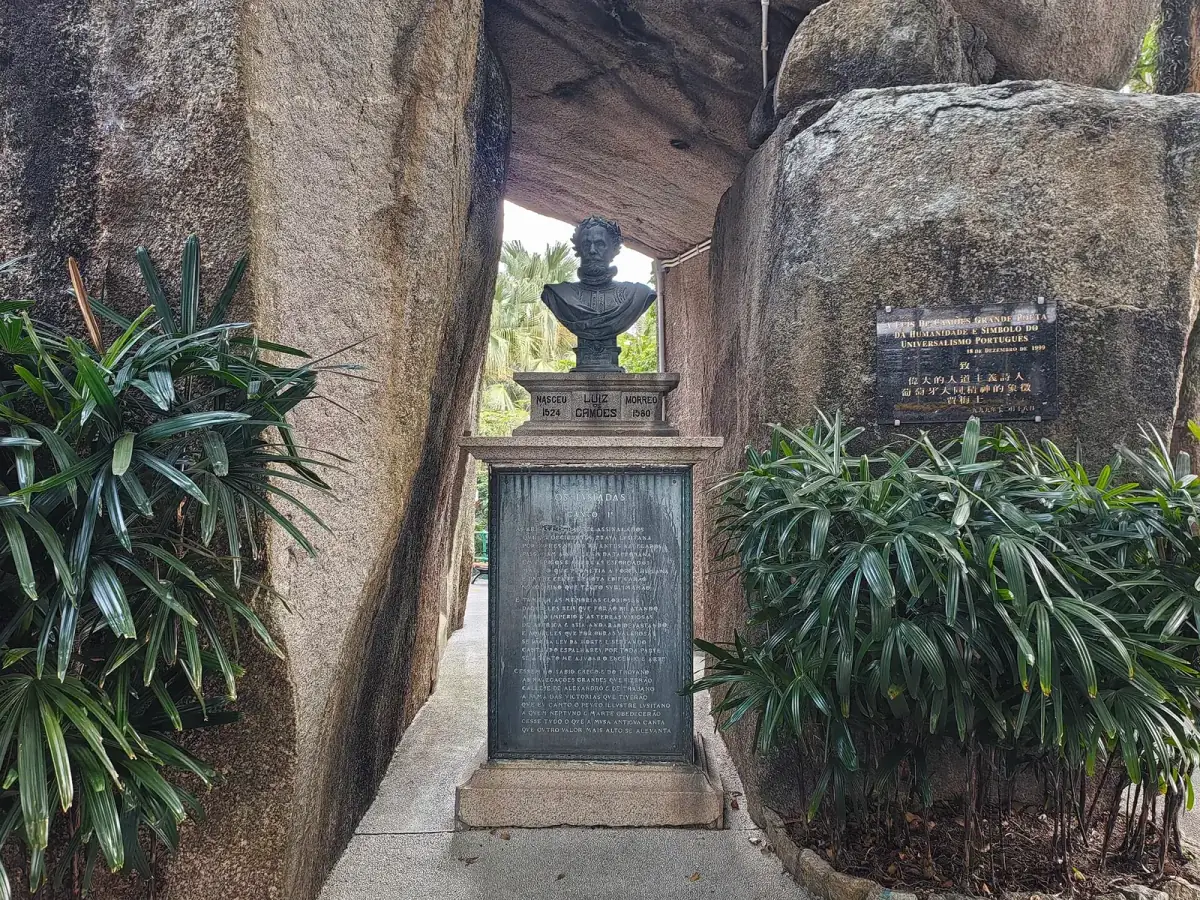
- His years in Macau are thinly documented: the grotto where he is said to have written appears in print only in 1817, and the Chinese girl said to have drowned in his shipwreck is doubtful; the wreck itself he describes in the poem.
- The 1880 tercentenary of his death was Portugal's first great civic commemoration; 10 June became Lisbon's holiday in 1911, a national holiday in 1929 and, since 1978, the Day of Portugal, of Camões and of the Portuguese Communities.
A burial paid for by charity
Luís de Camões was buried in a plain grave in the church of the convent of Santa Ana, in Lisbon. A charitable body, the Companhia dos Cortesãos, paid for the funeral. A friend had a line cut on the stone: here lies Luís de Camões, prince of the poets of his time, who lived poor and wretchedly, and so died.
He was about 55. The date of his death usually given, 10 June 1580, was settled only in the nineteenth century, from a single archive document, and some scholars think he died in 1579.
That June Lisbon had no king. Cardinal Henrique, the old man who had inherited the crown when his great-nephew Sebastião vanished in Morocco, had died at the end of January without naming an heir. Philip II of Spain was gathering an army under the Duke of Alba to take the throne he claimed through his mother.
On 19 June, nine days after the traditional date of the poet's death, the Prior of Crato, António, had himself proclaimed king at Santarém. At the end of June Alba's army crossed the border, and on 25 August it routed António's troops at Alcântara, outside Lisbon. The following year the Cortes, the assembly of the kingdom, acclaimed Philip king of Portugal at Tomar.
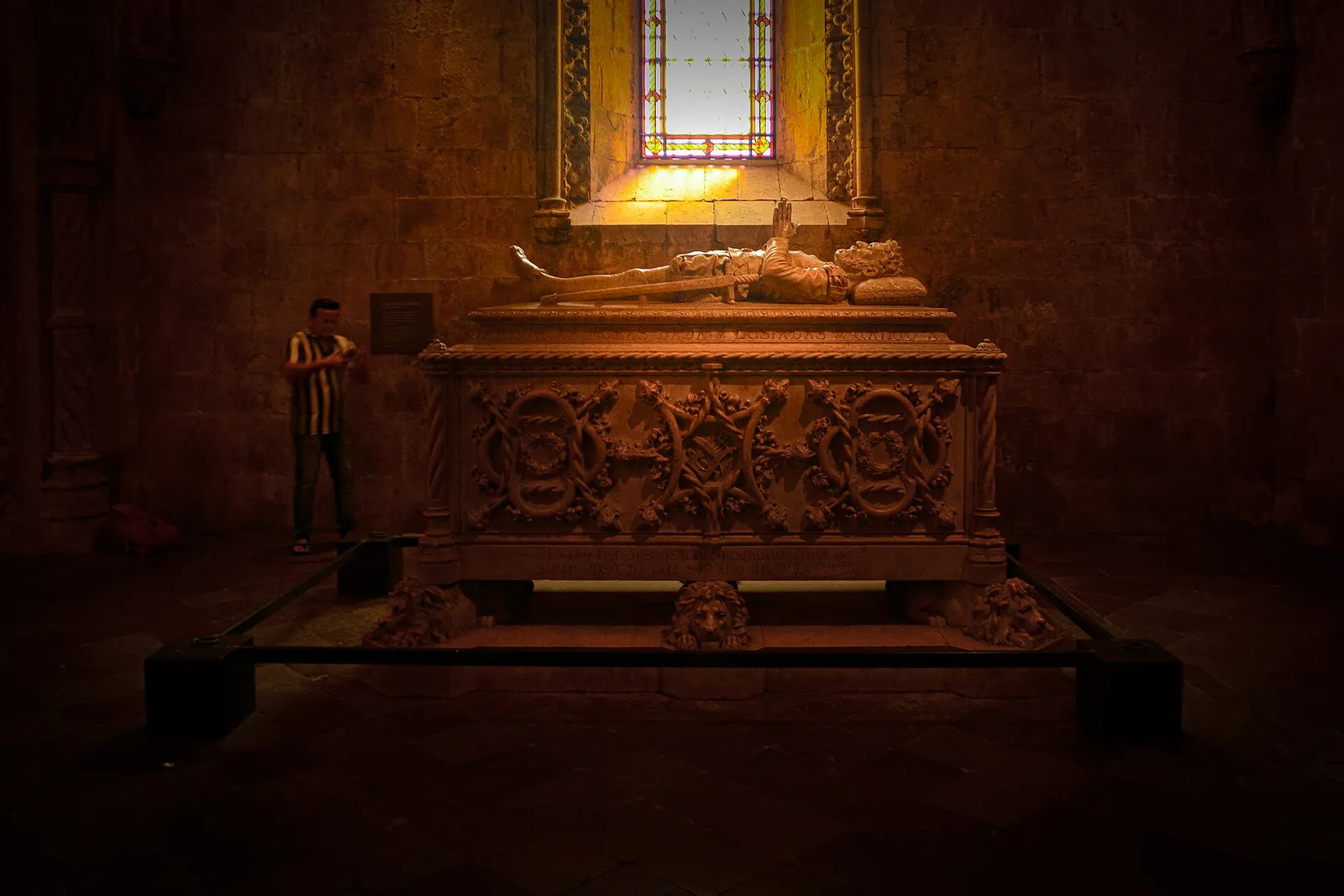
Camões was the author of Os Lusíadas, the epic of the Portuguese voyages to India. Three hundred years after his death his remains, or bones taken to be his, were carried to the Jerónimos Monastery, and the day of his death became Portugal's national day.
What you need to know first
Camões lived at the height of the Portuguese empire in Asia. In 1498 Vasco da Gama had reached India by sea, and Portuguese forts and trading posts followed along the coasts of Africa and Asia, from Goa to Malacca. Men of the impoverished lesser nobility, like Camões, looked to service at arms for a living, and for many that meant the East.
Most of what is said about him comes from his own poems, from a few archive documents published by the Viscount of Juromenha in 1860, and from friends and early biographers who wrote after his death. George Monteiro, writing for an encyclopedia of early modern Europe, calls the facts of his life sparse and often impossible to pin down.
That gap was filled by legend. The Romantics of the nineteenth century, above all Almeida Garrett in his poem Camões of 1825, made him the exiled genius, unlucky in love and left to die in want by an ungrateful country.
Soldier, brawler, exile
He was born around 1524 or 1525, probably in Lisbon, though nobody knows where for certain, to Simão Vaz de Camões and Ana de Sá. The family belonged to the poorer nobility. His father's brother, Dom Bento de Camões, was prior of the monastery of Santa Cruz in Coimbra and chancellor of the university.
No register shows him at the university or any college. Marnoto argues that he studied at Santa Cruz all the same: its library was the only one in Portugal that held some of the texts he used, and his uncle ran the place. His poems show a command of Latin, the classics, and the Italian and Spanish poets of his century.
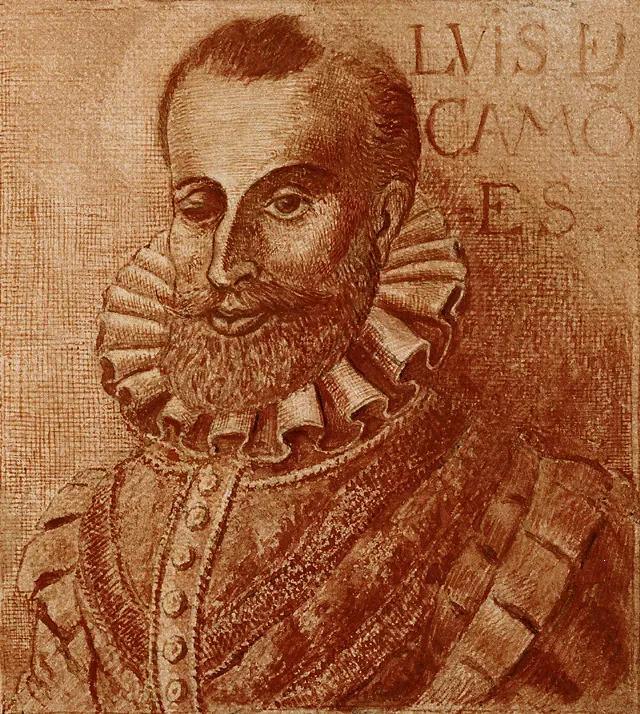
In the late 1540s he served as a soldier in Ceuta, the Portuguese fortress on the Moroccan side of the Strait of Gibraltar, and lost his right eye in a fight with the Moors. Older accounts link his absence from Lisbon to a love affair at court, a story reference works treat as legend.
The best-documented episode of his life is a brawl. On 16 June 1552, the feast of Corpus Christi, two masked men baited Gonçalo Borges, keeper of King João III's harness, as he rode along the Rua de Santo Antão in Lisbon. Camões recognised them as friends, joined in and cut Borges on the neck.
He spent about nine months in the Tronco, the city jail. A royal letter of pardon dated 7 March 1553 records that Borges forgave him and that he paid 4,000 réis for pious works, and notes that he was about to leave for India. Marnoto reads that as a choice, not a sentence of exile. One scholar has suggested the pardon may concern a namesake.
He sailed that spring and reached Goa in September 1553. Before the year was out he was on a punitive expedition against a ruler on the Malabar coast, and in 1554 he went with a fleet towards the Red Sea. He stayed in the East for 17 years.
Macau, the grotto and the shipwreck
The middle of his Asian years is where documents give out. The usual account says that in the later 1550s he was appointed provedor dos defuntos, the officer who looked after the goods of Portuguese who died or went missing in the East, and was sent to Macau, on the coast of China; biographers disagree on the years. On the way back he was shipwrecked near the mouth of the Mekong, in what is now Vietnam.
For the wreck there is the poet's own word. In the tenth canto of Os Lusíadas the sea goddess Tethys, showing Vasco da Gama a globe of the world, stops at the Mekong to say that this river will one day receive the poem itself.
“This river will receive, calm and gentle, in its lap the cantos that come wet from the sad and wretched shipwreck, escaped from stormy shoals, from hunger and great dangers, when the unjust command is carried out on him whose sounding lyre will be more famous than fortunate.”
The unjust command is usually read as an order for his arrest; one Gale reference entry says he was accused of maladministration and jailed in Goa in 1561. The picture of him swimming ashore with the manuscript held above the water is, in Monteiro's word, legendary.
The only near-contemporary witness is his friend the chronicler Diogo do Couto. A manuscript version of Couto's eighth Década, found in Porto in 1917, says that all on board were saved naked, that Camões escaped with his Lusíadas, and that a very beautiful Chinese girl he had with him drowned. It adds that he mourned her in sonnets such as Alma minha gentil, my gentle soul, and that she is the Dinamene of his poems.
Eduardo Ribeiro points out that Dinamene appears in poems Camões wrote before the wreck and suspects the link was added later. The historian Luís de Albuquerque wrote that nothing indicates Dinamene drowned in the shipwreck.
Back in Goa, his first poem to appear in print was an ode to the viceroy, the Count of Redondo, at the front of Garcia de Orta's Colóquios dos Simples e Drogas, a treatise on the medicinal plants of the East printed in Goa in 1563. Orta was probably a close friend.
The way home and Os Lusíadas
In 1567 he left Goa with his friend Pedro Barreto, the new governor of Mozambique, and was stranded there. Couto, sailing home in 1569, found him on Mozambique Island so poor that he ate at his friends' expense. The friends collected clothes for him, and that winter, Couto wrote, he finished polishing the Lusíadas for the press.
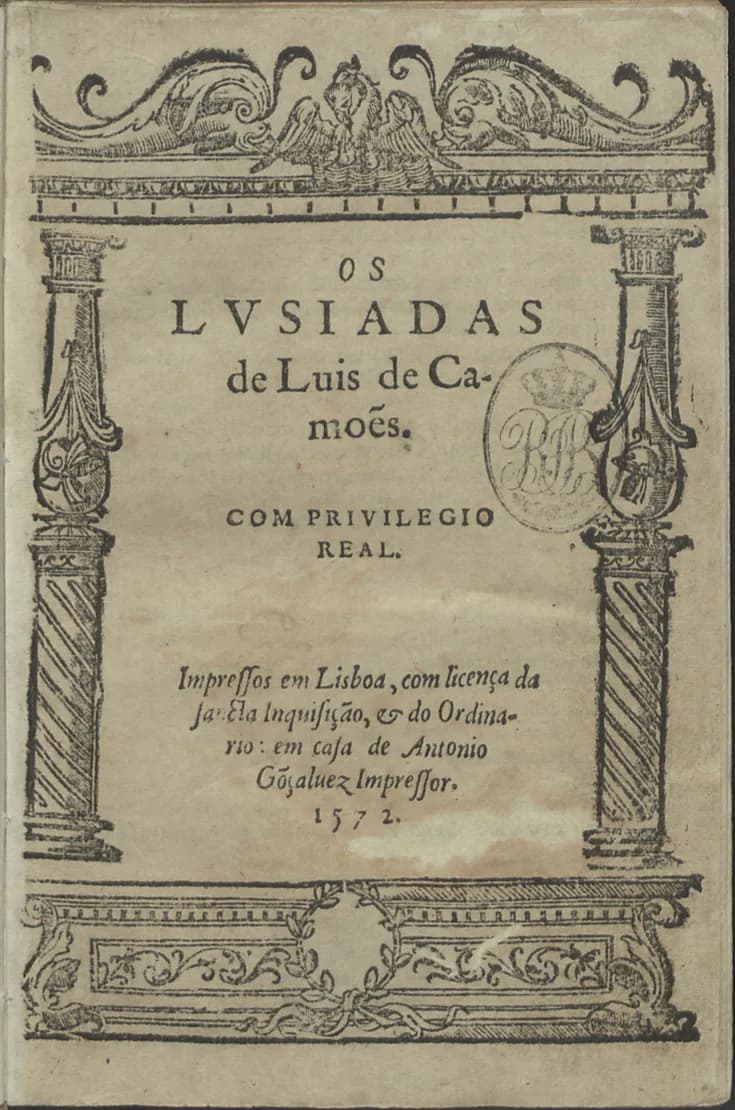
They left in November 1569 on the Santa Clara and reached Cascais in April 1570. On 24 September 1571 King Sebastião granted him a privilege to print the poem for ten years. Os Lusíadas came out in Lisbon in 1572 from the press of António Gonçalves, with the licence of the Inquisition printed on the title page.
The Lusiads are the Portuguese, whom the poem calls Lusitanians. It tells Vasco da Gama's voyage of 1497 to 1499, and on the way, through speeches and prophecies, the whole history of Portugal from its founding to the poet's own time, with the gods of Olympus quarrelling over the fleet.
“The arms and the famous men who, from the western shore of Lusitania, through seas never sailed before, passed even beyond Taprobana.”
- Printed
- Lisbon, 1572, by António Gonçalves
- Cantos
- 10
- Stanzas
- 1,102 of eight lines
- Lines
- 8,816
- Rhyme
- ABABABCC (ottava rima)
- Dedicated to
- King Sebastião, then 18
Stanzas in each canto of Os Lusíadas
stanzas
Counted from the numbered stanzas of the Project Gutenberg text. The tenth canto, with the prophecy of the empire, Tethys's globe of the world and the poet's own shipwreck, is the longest; the third holds Inês de Castro and the battle of Salado.
Show the data
| Stanzas | |
|---|---|
| I | 106 |
| II | 113 |
| III | 143 |
| IV | 104 |
| V | 100 |
| VI | 99 |
| VII | 87 |
| VIII | 99 |
| IX | 95 |
| X | 156 |
The poem opens with a long address to the 18-year-old king, the hope of Christendom, and closes with the poet urging him to new conquests in Africa. Six years later Sebastião led his army to destruction at Alcácer Quibir in Morocco.
A reward followed. On 28 July 1572 the king granted Camões a pension of 15,000 réis a year, backdated to 12 March, for his service in India and not only for the poem. It was paid late and irregularly but in full, and after his death Philip II ordered it paid to his mother, Ana de Sá, who outlived him.
A date fixed three centuries later
His last years were spent in sickness and want, by the usual account. Tradition has a slave named Jau, brought from the East, begging from door to door at night, without his master knowing, so that there would be bread the next day; Marnoto thinks it too risky to say whether the slave ever existed. Couto, his friend, wrote that he died in pure poverty.
Only one document gives the day. The date of 10 June 1580 was settled in the nineteenth century from the researches of the Viscount of Juromenha in the Torre do Tombo, the national archive, among the papers of the pension. Maria Isabel João, a historian at the Universidade Aberta, points out that the only record there giving the date is his mother's petition for the pension, made some years after his death.
Specialists, she writes, are divided on the day and even the year. In an earlier essay she noted that the year may in fact have been 1579, a year before the loss of independence with which Portuguese memory came to link it. Either way he was in his mid-fifties.
The grave at Santa Ana did not survive: the earthquake of 1755 destroyed it, and when the tercentenary came the bones exhumed there could only be described, in João's words, as the remains attributed to Camões.
c. 1524-25
Born, probably in Lisbon
Late 1540s
Soldier in Ceuta; loses his right eye
16 June 1552
Wounds Gonçalo Borges in a brawl; jailed in the Tronco
7 March 1553
Royal pardon; sails for India
Reaches Goa in September.
1553-54
Expeditions to the Malabar coast and towards the Red Sea
c. 1556-60
Post as provedor of the dead; shipwreck near the Mekong
Dates uncertain.
1563
First poem in print, in Garcia de Orta's Colóquios, Goa
1567-69
Stranded on Mozambique Island; Couto finds him
April 1570
Lands at Cascais on the Santa Clara
1572
Os Lusíadas printed; pension of 15,000 réis granted
4 August 1578
Sebastião killed at Alcácer Quibir
10 June 1580
Dies in Lisbon (traditional date)
Some scholars argue for 1579.
How 10 June became Portugal's day
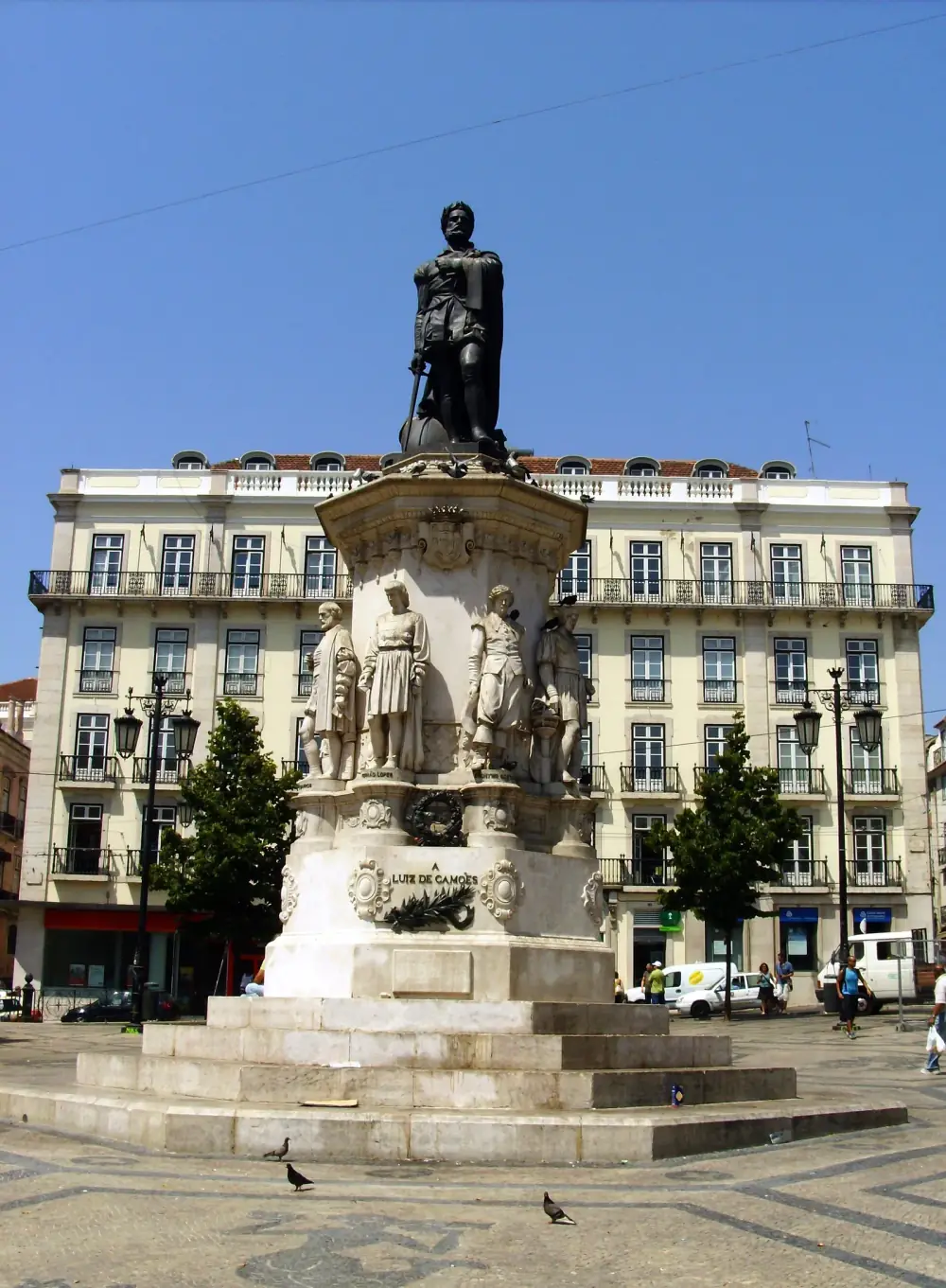
The cult began with the Romantics. In 1867 a statue of Camões by the sculptor Vítor Bastos went up in the square between the Chiado and the Bairro Alto that now bears his name; apart from the equestrian King José in the Terreiro do Paço, it was the first statue raised in a public square in Lisbon.
In 1880 came the tercentenary of his death. João calls it the first great civic commemoration held in Portugal, on the model of those in other European countries and in the spirit of positivism, the creed of science and progress then fashionable among reformers. A large commission of the Portuguese press organised it, and cities and towns across the country held processions and festivities, something new at the time.
The prime movers were republicans, among them the writer Teófilo Braga, with the liberal wing of the monarchists. A decree of 27 April 1880, carried on the motion of a Progressive deputy, made the day one of national gala and a holiday in public offices. King Luís and the court took part, João writes, reluctantly.
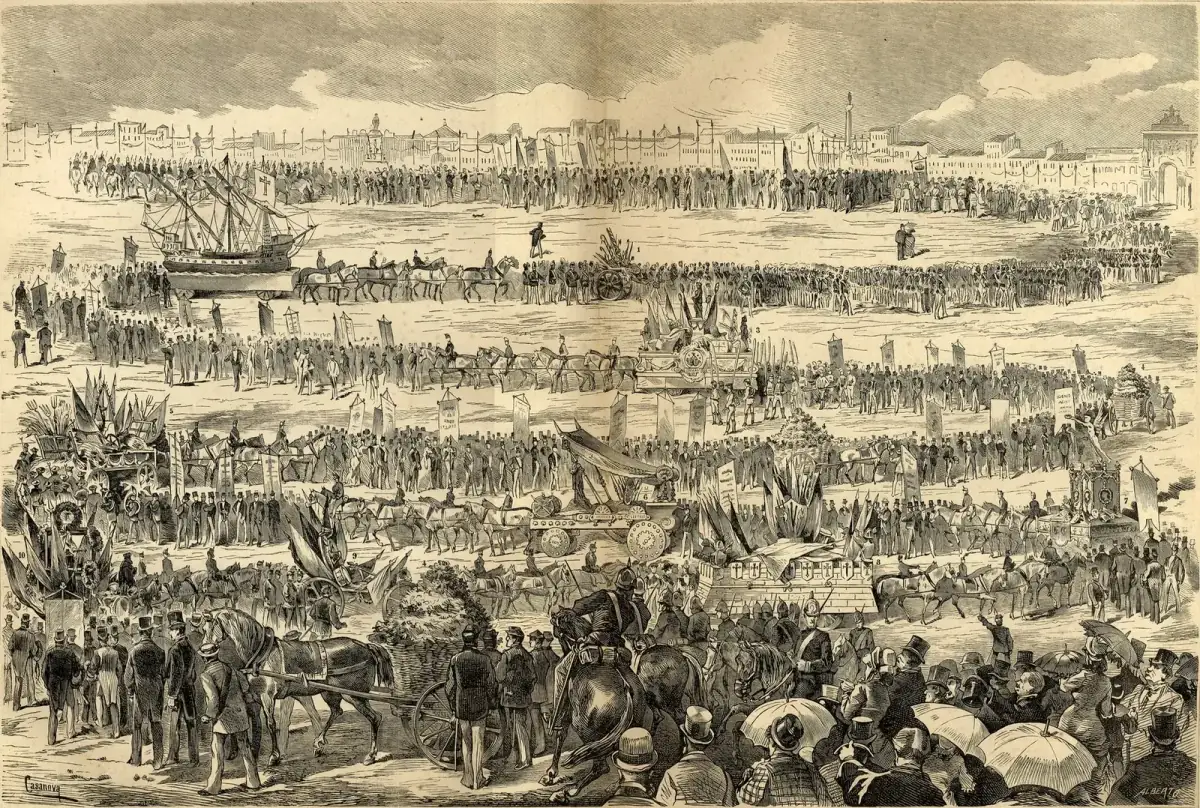
Two rituals marked the celebrations. The remains attributed to Camões and to Vasco da Gama were carried to the Jerónimos Monastery in Belém, which became a national pantheon. And a civic procession of town councils and associations, with banners, traditional dress and allegorical floats, crossed the capital to lay wreaths at the foot of the statue. There were cheap editions of the poems and lectures in schools and barracks.
The Republic, proclaimed in 1910, claimed the poet as its own. In 1911 Lisbon's council moved its municipal holiday to 10 June, three days before the city's own saint, Anthony; a columnist complained of incredible confusion and called Camões Lisbon's new saint. In 1924, the fourth centenary of his birth, the Senate voted to make the Festa de Portugal on 10 June a national occasion, and the decree was published in 1925. Only a revision of the holiday calendar in 1929 made it a public holiday.
The Estado Novo, the dictatorship of António de Oliveira Salazar and his successor Marcelo Caetano, kept the day but changed its tone. In 1924 the press had called the celebrations the Festa da Raça, the festival of the race, and according to Diário de Notícias the regime billed the day from 1944 as the day of Portugal, of Camões and of the Race. A decree of 4 January 1952 fixed its official name as the Dia de Portugal.
During the colonial wars in Africa 10 June became the day soldiers were decorated, usually in the Praça do Comércio.
After the revolution of 25 April 1974 part of the radical left saw the day as a relic of the old regime. The first elected president, Ramalho Eanes, chose to keep it with a new meaning. Decree-Law 80/77 of 4 March 1977 dedicated the Day of Camões also to the Portuguese communities abroad, honouring the emigrants scattered across the world.
After complaints, among them from emigrants, that it should not stop being the Dia de Portugal, Decree-Law 39-B/78 of 2 March 1978 made it the Day of Portugal again, dedicated to Portugal, to Camões and to the communities, and repealed the 1977 decree.
1867
Statue of Camões unveiled in Lisbon
10 June 1880
Tercentenary of his death
Remains attributed to him moved to the Jerónimos.
10 June 1911
First municipal holiday in Lisbon
1924-25
Festa de Portugal declared national
1929
Added to the calendar of public holidays
1952
Decree names it the Dia de Portugal
1960s-1973
Military decorations for the colonial wars
4 March 1977
Day of Camões and of the Portuguese Communities
First ceremonies in Guarda that June.
2 March 1978
Renamed Day of Portugal, of Camões and of the Portuguese Communities
Why it still matters
Each 10 June the President of the Republic leads the official ceremonies in a town chosen for that year, and since 1977 embassies and emigrant associations have held their own celebrations abroad. The first official ceremonies, in Guarda in 1977, heard the poet Jorge de Sena, who lived in the United States. Marcelo Rebelo de Sousa took the ceremonies to Paris in 2016 and to Rio de Janeiro and São Paulo in 2017.
João notes how unusual this is. Most countries mark their independence, their unification or their constitution; Portugal marks the death of a poet, on a date that is itself uncertain. The poet's meaning has shifted with each regime, from republican saint to herald of empire to patron of the emigrants.
His name is also on the Prémio Camões, a prize for writers in Portuguese awarded every year since 1989.
FAQs
When and where did Luís de Camões die?
He died in Lisbon, traditionally on 10 June 1580, and was buried in the church of Santa Ana. The date was fixed in the nineteenth century by the Viscount of Juromenha from his mother's later petition for his pension; some scholars argue that he died in 1579.
Why is 10 June Portugal's national day?
Because it is the traditional date of Camões's death. The tercentenary of 1880 made the date a national symbol; Lisbon made it a municipal holiday in 1911, the Republic declared it a national festival in 1924-25, it became a public holiday in 1929, and since 1978 it has been the Day of Portugal, of Camões and of the Portuguese Communities.
Did Camões really save Os Lusíadas from a shipwreck?
He says so himself, in Canto X, stanza 128, describing the poem coming wet from a wreck at the Mekong, and his friend Diogo do Couto wrote that he escaped with his Lusíadas. The picture of him swimming with the manuscript held high is later embroidery.
Was Camões ever in Macau?
Probably, though the evidence is thin. A draft of Couto's eighth Década says he went to China as provedor of the dead, which biographers take to mean Macau. The story that he wrote in the grotto there first appears in print in 1817.
Where is Camões buried?
His original grave at Santa Ana was lost after the 1755 earthquake. In 1880 remains attributed to him were moved to the Jerónimos Monastery in Belém, where his tomb by Costa Mota stands beside Vasco da Gama's.
On the timeline
Open the timelineNearby moments from the age of discoveries (1415–1580).
King Sebastião is killed at the Battle of Alcácer Quibir in Morocco, the 'Battle of the Three Kings', and much of the Portuguese nobility is killed or captured. The disaster triggered a succession crisis that led to Spanish rule over Portugal from 1580 and gave rise to the myth of Sebastianism.
Pedro Nunes, royal cosmographer and one of Europe's foremost mathematicians, dies in Coimbra. Inventor of the nonius and pioneer of the loxodrome, he placed Portuguese navigation on a scientific footing.
Cardinal-King Henrique dies at Almeirim on his 68th birthday without naming an heir. His death opens the way for Philip II of Spain to claim the throne, beginning sixty years of Iberian Union.
The death of Camões
Death of Luís Vaz de Camões in Lisbon, by tradition on this day and in poverty. The author of 'Os Lusíadas' — the epic that crystallised Portugal's Age of Discoveries — dies only months before the kingdom passes to Philip II of Spain, beginning sixty years of Iberian Union. The date is now Portugal's National Day: Dia de Portugal, de Camões e das Comunidades Portuguesas.
Coming up in history
All long reads 13 June 1231Saint Anthony of Lisbon: the friar who died outside Padua, 13 June 1231
 14 June 1908Fernão de Ornelas, the young mayor who rebuilt Funchal
 15 June 1970Almada Negreiros, the rebel of Orpheu, dies in Lisbon: 15 June 1970
 16 June 1808Olhão rises against Napoleon and sails a fishing boat to Brazil, 1808
22 sources
Archives, scholarship and reporting this article was checked against.
- 1
The Invention of the Dia de Portugal (Maria Isabel João)Portuguese Studies, vol. 31, no. 1 (2015), pp. 64-83, Modern Humanities Research Association (open-access copy, Universidade Aberta repository)
- 2
- 3
Camões poeta e viajante (Rita Marnoto)Convergência Lusíada, Rio de Janeiro, special issue (2025), pp. 39-50
- 4
Camões, Luís Vaz de (George Monteiro), with related entriesEurope, 1450 to 1789: Encyclopedia of the Early Modern World (Gale), on Encyclopedia.com
- 5
Camões e a moça china (Eduardo Ribeiro)Fénix, Universidade de Aveiro, 2021
- 6
Memórias literárias de Camões em Macau (Sara Augusto)Moderna Språk, vol. 119, no. 2 (2025), pp. 258-270
- 7
Os Lusíadas (Luís de Camões, 1572)Project Gutenberg
- 8
Os Lusiadas / de Luis de Camões, Lisboa, em casa de Antonio Gõçaluez, 1572Biblioteca Nacional de Portugal, Biblioteca Nacional Digital
- 9
Luís Vaz de Camões: biografia; Símbolo nacional português (V centenário do nascimento, June 2024)Biblioteca Municipal de Coimbra, adapted from Porto Editora's Infopédia
- 10
Nascimento do Cardeal D. HenriqueArquivo Nacional Torre do Tombo
- 11
Um rei indesejado: notas sobre a trajetória política de D. Antônio, Prior do Crato (Jacqueline Hermann)Revista Brasileira de História, vol. 30, no. 59, 2010, pp. 141-166
- 12O dia em que Portugal perdeu a última batalha pela independênciaObservador
- 13
Commemorations, festivals: Portuguese (Daniel Melo)Encyclopedia of Romantic Nationalism in Europe, ed. Joep Leerssen, Study Platform on Interlocking Nationalisms, University of Amsterdam (2022)
- 14
Portuguese EmpireWorld History Encyclopedia
- 15
Da Asia de Diogo de Couto, Década VIII (chapter 28)Regia Officina Typografica, Lisbon, 1786 (digitised by the Internet Archive)
- 16
O Desejado e o Encoberto: potências de movimento de um mito andarilho (Marcio Honorio de Godoy)Revista USP, no. 82, Universidade de São Paulo, 2009
- 1710 de Junho: sabe quando foram as primeiras comemorações?Diário de Notícias, 10 June 2017
- 18A operação salvar o 10 de Junho: como o dia nacional sobreviveu à revolução e ao espetro do Dia da Raça (Adelaide Cabral)Diário de Notícias, 10 June 2026
- 19
Decreto-Lei n.º 80/77, de 4 de MarçoDiário da República
- 20
- 21
Burghard Baltrusch, “Sobre o poético e o político em Jorge de Sena”, Santa Barbara Portuguese Studies, vol. 7University of California, Santa Barbara, Department of Spanish and Portuguese
- 22
Tomb of Luís de Camões (Costa Mota)Mosteiro dos Jerónimos (DGPC), on Google Arts & Culture
Image credits
- The tomb of Luís de Camões by the sculptor Costa Mota in the lower choir of the Jerónimos Monastery church in Belém, photographed in 2019. The remains attributed to the poet were brought to the monastery in 1880. ProtoplasmaKid, CC BY-SA 4.0, via Wikimedia Commons.
- Red-chalk portrait of Camões after the painter Fernão Gomes, who is said to have drawn him in the 1570s. The original is lost; this is a later copy, and its history is uncertain. Fernão Gomes, Public domain, via Wikimedia Commons.
- The Camões Grotto in Macau in 2026: a bust of the poet among granite boulders, with the opening stanzas of Os Lusíadas on the pedestal. The story that he wrote the poem here first appears in print in 1817. Yumeto, CC BY-SA 4.0, via Wikimedia Commons.
- Title page of Os Lusíadas, printed in Lisbon by António Gonçalves with royal privilege and the licence of the Inquisition, dated 1572. Two editions bear that date. Unknown author, Public domain, via Wikimedia Commons.
- The civic procession in Lisbon for the tercentenary of Camões's death in June 1880, with its allegorical floats, in an engraving by Casanova published in the magazine O Ocidente on 1 July 1880. Casanova, Public domain, via Wikimedia Commons.
- The monument to Camões by Vítor Bastos, unveiled in 1867, in the Praça Luís de Camões in Lisbon, photographed in 2008. Marble figures of Portuguese writers stand around the pedestal. Carlos Luis M C da Cruz, Public domain, via Wikimedia Commons.