

Saint Anthony of Lisbon: the friar who died outside Padua, 13 June 1231
He was born beside Lisbon's cathedral, studied in Coimbra, joined the Franciscans after five friars were killed in Morocco and died outside Padua at about 36. Within a year he was a saint, and Lisbon still keeps his feast as its municipal holiday.
At a glance
- Saint Anthony, known abroad as Anthony of Padua, was born in Lisbon in the 1190s and baptised Fernando; tradition gives 15 August 1195, and the name Fernando Martins de Bulhões comes from later writers.
- He became a canon regular at São Vicente de Fora in Lisbon and then at Santa Cruz in Coimbra, before joining the new Franciscan order in 1220 and taking the name António.
- After illness ended his mission in Morocco, he became the Franciscans' first teacher of theology and a famous preacher in Italy and southern France.
- He died at Arcella, on the edge of Padua, on Friday 13 June 1231, aged about 36. Pope Gregory IX canonised him at Spoleto on 30 May 1232, 352 days later.
- 13 June is Lisbon's municipal holiday. On 12 June couples marry in the Casamentos de Santo António, and that night the city's neighbourhoods parade down the Avenida in the marchas populares.
A cart on the road to Padua
At midday on 13 June 1231, a Friday, the friars at Camposampiero sat down to eat. Brother Anthony left the walnut tree where, by the earliest account, he had a shelter among the branches, joined them at table and collapsed into their arms. He whispered that he wanted to die in Padua, in the small friary by the church of Santa Maria that he loved.
Camposampiero was the country estate of Count Tiso, a local lord who backed the friars. Anthony had gone there in May, exhausted by a Lent of preaching to the crowds of Padua. The Assidua, the first Life of Anthony, says Tiso built him a cell of woven mats among the walnut's branches with his own hands. A Franciscan writing in the Padua friars' magazine thinks it more likely that Anthony, ill and heavily built, simply rested in its shade.
The friars laid him on an ox cart and set off. He never reached the city. At Arcella, on the outskirts, they stopped at a house of Poor Clares, the order of Franciscan nuns, and carried him inside. A priest anointed him. He sang a hymn to the Virgin, O gloriosa Domina, and the friars saw him gazing at something. They asked what it was.
“I see my Lord.”
He died that evening. The friars tried to keep the news quiet for fear that someone would steal the body, but children were soon running through Padua's streets crying that the saint was dead. He was about 36. He had been born Fernando, in Lisbon, at the other end of Christian Europe.
A boy from beside the cathedral
Almost everything known about his early life comes from the Assidua, written by an anonymous Franciscan soon after his death and the source the later legends grew from. Its author wrote about Lisbon from hearsay (“I have been told that there is a certain city in the kingdom of Portugal”), placing it “at the extreme limits of the world” and repeating the belief that Ulysses had founded it.
“Within its walls there stands a church of admirable size built to the honor of the glorious Virgin Mary. In this church rests the precious body of the blessed martyr Vincent, guarded with all honor and worthy of every veneration. The fortunate parents of Anthony owned at the west side of this district a house worthy of their social condition, its entrance being close to the threshold of the church.”
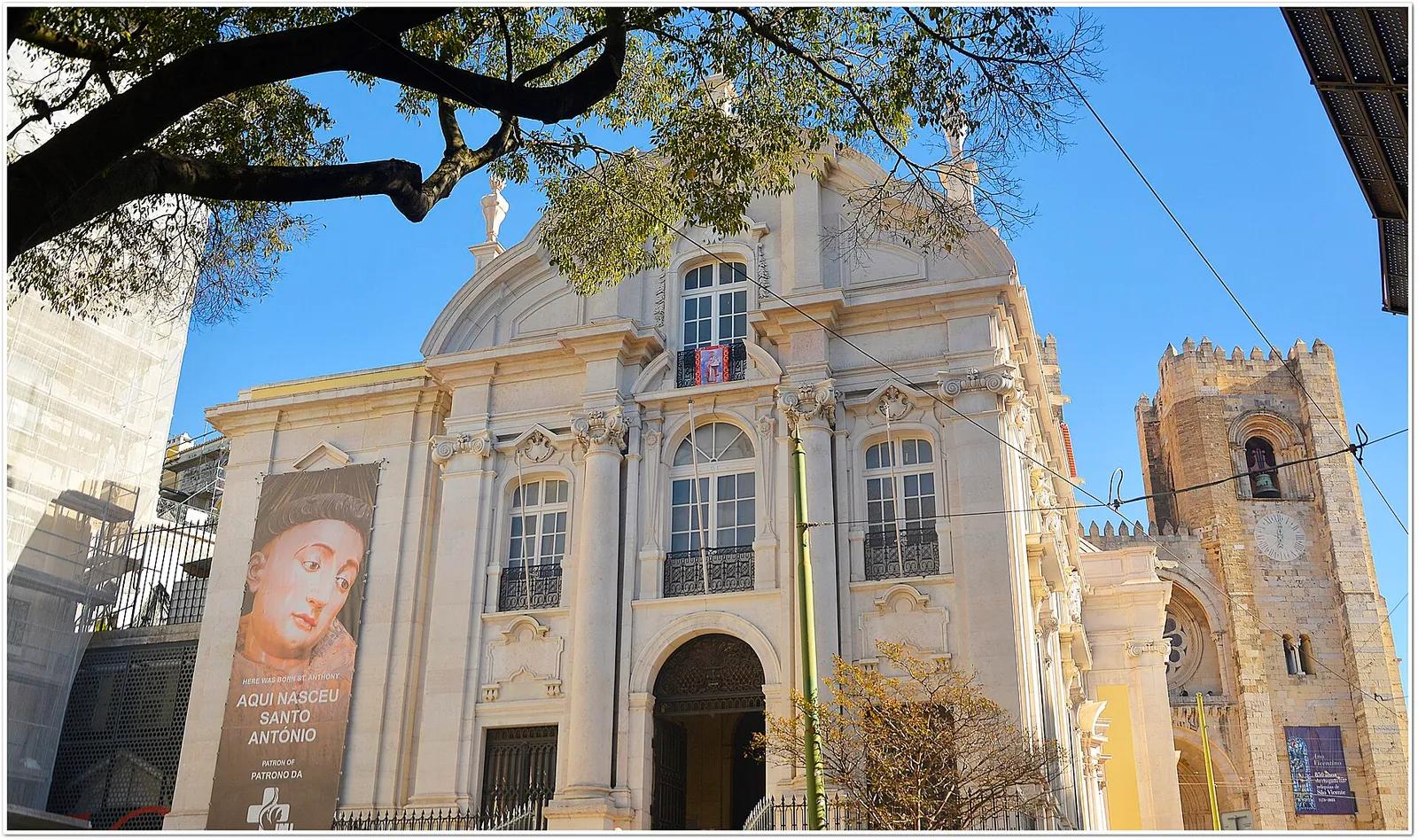
The church was Lisbon's cathedral, the Sé. Lisbon had been taken from its Muslim rulers by Afonso Henriques, Portugal's first king, with the help of crusaders in 1147. In 1173 the relics of Saint Vincent of Saragossa, an early Spanish martyr, were brought to the city, and they ended up in the cathedral. So the boy grew up next door to its most important shrine, in a frontier city that had been in Christian hands for only about half a century when he was born.
His parents, the Assidua says, were young and well off. They had him baptised Fernando and sent him to the cathedral school to learn the scriptures. The text names neither of them and gives no date of birth. Tradition fixes it on 15 August 1195, which roughly fits the age of 36 his biographers gave at his death; others have argued for 1190 or 1191.
| Question | Assidua, the first Life | Later tradition |
|---|---|---|
| Name | Fernando, at baptism | Fernando Martins de Bulhões, or Fernando de Bulhões |
| Parents | Young, of good standing; not named | Martim (Martin) de Bulhões, said by fifteenth-century writers to descend from Godfrey de Bouillon, and Teresa Taveira; one later tradition calls her Maria |
| Birth date | Not given | 15 August 1195, the date most scholars now accept; some have argued for 1190 or 1191 |
| Birthplace | A house beside the cathedral, west of it | The site of the church of Santo António, Rua das Pedras Negras |
| Schooling | The cathedral school | The same |
The Catholic Encyclopedia of 1907 calls the genealogy “uncertain” and keeps only what the Assidua says. The Messenger of Saint Anthony, the Padua friars' magazine, gives the parents as Martin and Maria from later sources.
A canon at São Vicente and Santa Cruz
At about fifteen, around 1210, Fernando left home for the monastery of São Vicente, just outside the city walls. Afonso Henriques had dedicated a church to Saint Vincent there, beyond the wall the Moors had defended. Its community were canons regular, priests who lived together under the Rule of Saint Augustine, and the order was known for its learning.
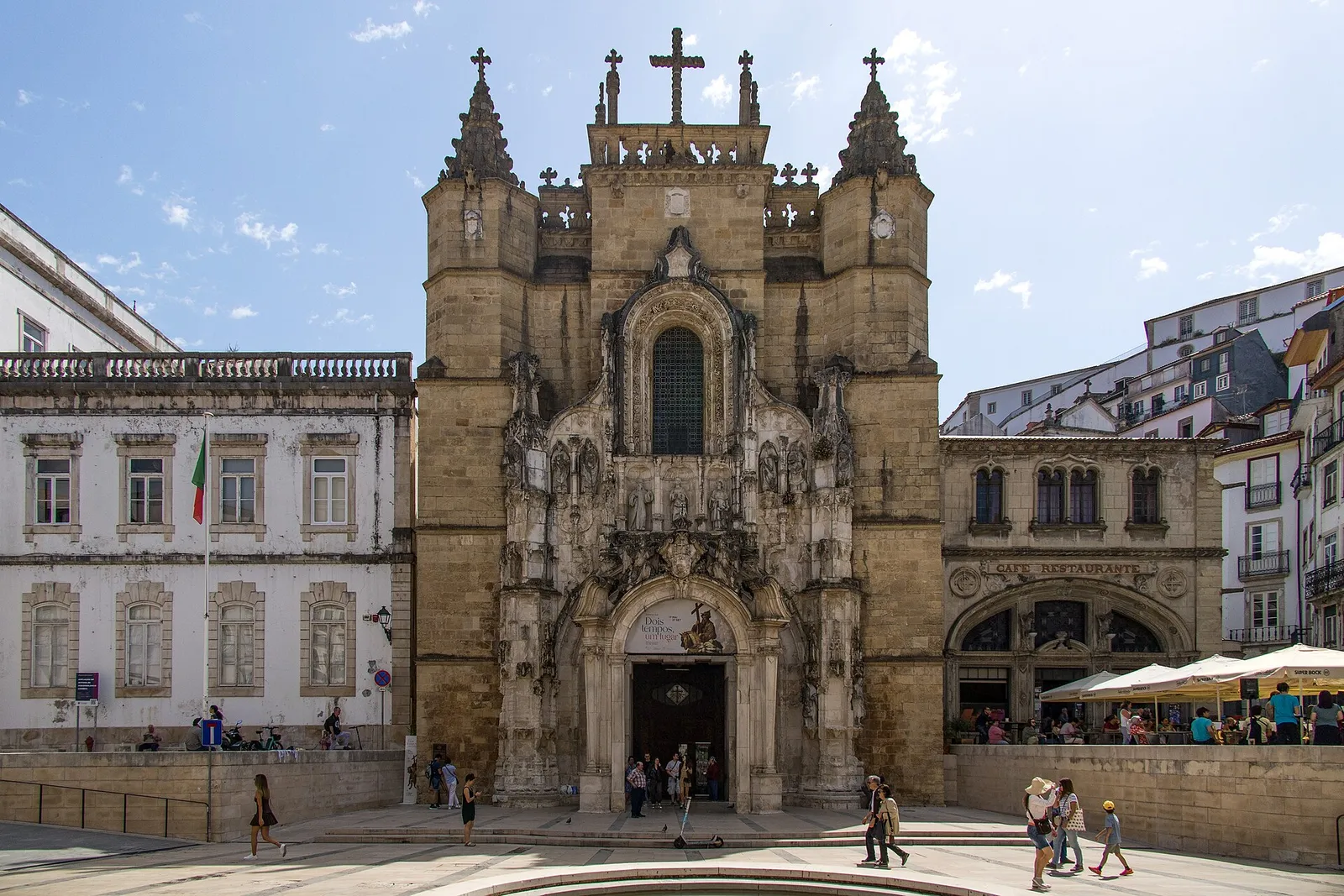
São Vicente was too close to home. Friends and relatives kept visiting, with gifts and gossip, and after about two years he asked to be moved. His superiors sent him to the monastery of Santa Cruz in Coimbra, founded by canons in 1131 on land given by Afonso Henriques. He stayed eight years, studying scripture and the Church Fathers, and was ordained a priest.
Five friars killed in Morocco
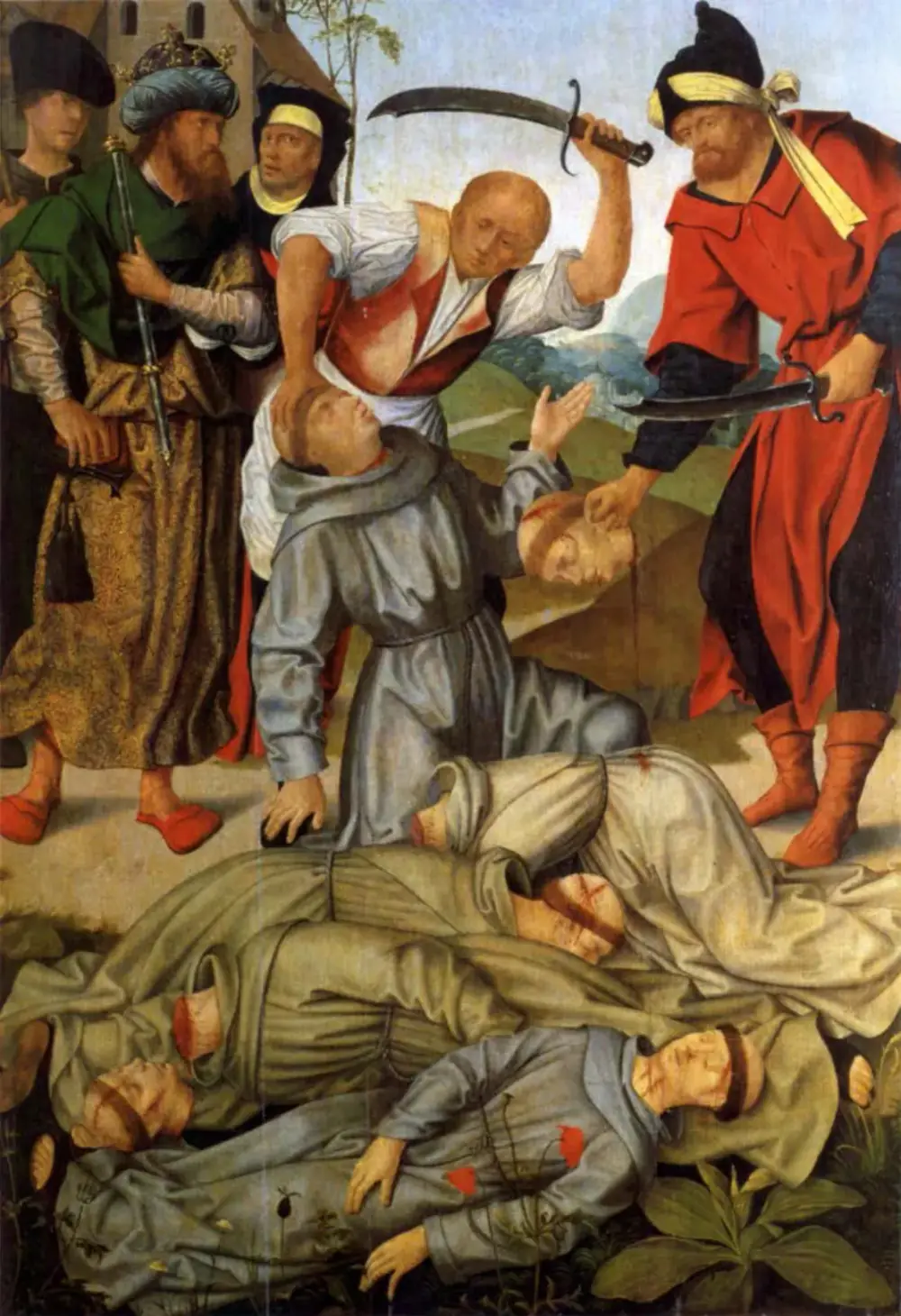
After his ordination Santa Cruz put Fernando in charge of guests, and in 1219 he met five Franciscan friars on their way to preach to the Muslims of Morocco. On 16 January 1220 they were put to death there. Their remains were brought back to Portugal and laid in the church of Santa Cruz.
Fernando wanted the same death. Friars from the little Franciscan hermitage at Olivais, outside Coimbra, came to Santa Cruz to beg, and he told them his plan. With his superiors' leave he took their habit, at Santa Cruz itself, and a new name, António, after Anthony the hermit of the Egyptian desert, to whom the hermitage was dedicated.
He sailed for Morocco before the year was out and fell ill as soon as he landed. The illness lasted the winter, and in the spring of 1221 he took ship for home. A storm drove the ship onto the coast of Sicily instead. There Franciscans from Messina told him of a general chapter, a gathering of the whole order, at Assisi at Pentecost, 30 May 1221, and he made his way north to it. He met Francis there.
Nobody knew who he was. He said nothing of his studies, and when the chapter ended a provincial superior, Brother Graziano, sent him to the hermitage of Montepaolo near Forlì to say Mass for the lay brothers. He cooked, cleaned and prayed there.
Preacher, teacher, provincial
The change came at an ordination of Franciscan and Dominican friars at Forlì, probably in 1222. No one had been chosen to preach, the Dominicans all declined, and Graziano ordered the quiet Portuguese to say whatever came to him. Anthony began hesitantly and then spoke with a command of scripture that astonished the room. From then on he was sent to preach.
Francis feared that study could smother prayer, but he allowed this friar to teach. A short letter attributed to him, dated to about 1224, gave the permission on one condition.
“To Brother Anthony, my bishop, Brother Francis sends his greetings. It is my pleasure that thou teach theology to the brethren, provided, however, that as the Rule prescribes, the spirit of prayer and devotion may not be extinguished.”
He taught friars at Bologna, then at Montpellier and Toulouse in southern France, where the Church was fighting the Cathars, a dualist movement it called heretical. He was guardian of the friary at Le Puy and from 1226 custos, a regional superior, in the Limousin. After Francis died in October 1226 he went back to Italy and was made minister provincial, head of the friars across northern Italy, from about 1227 to 1230.
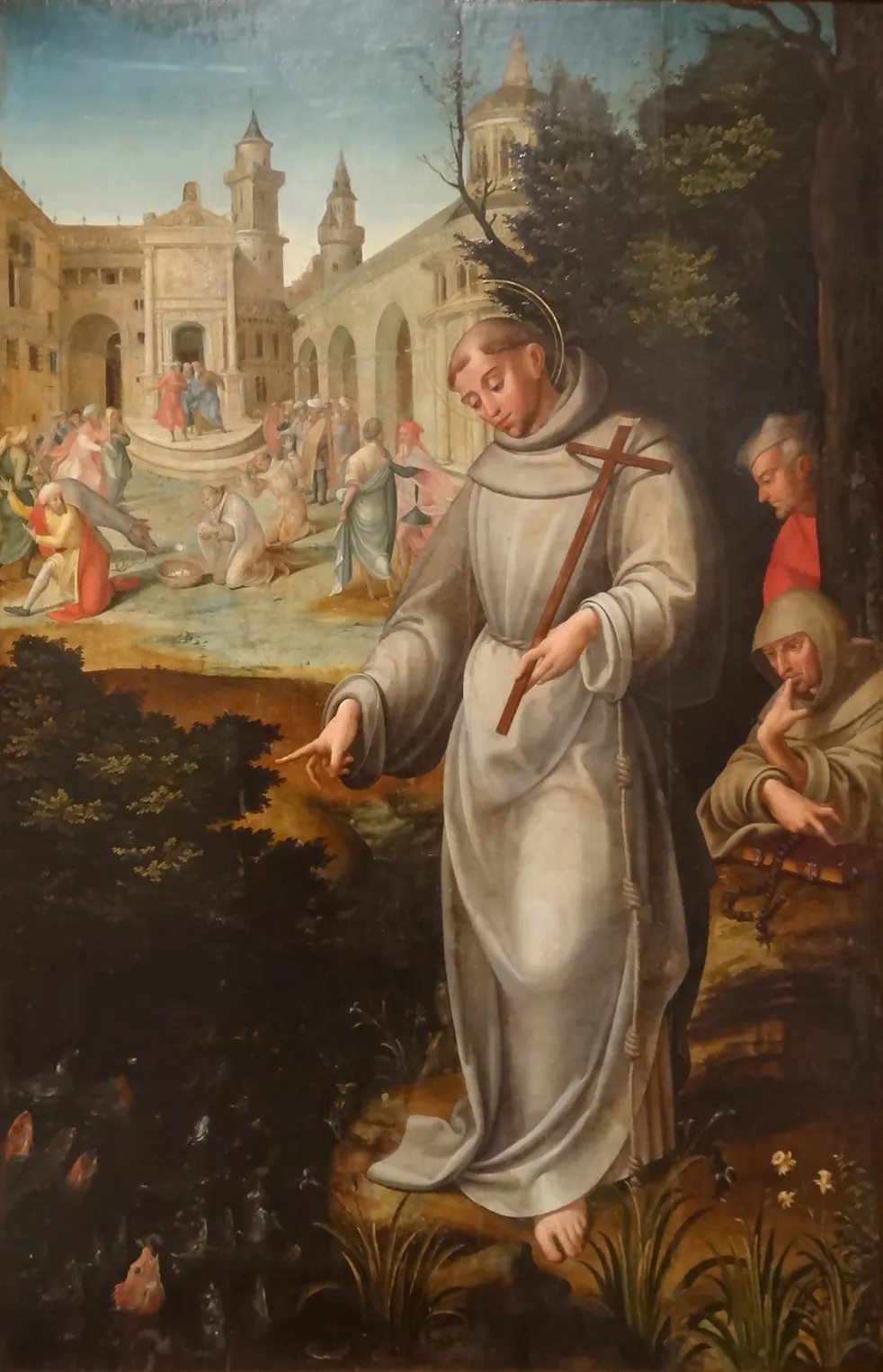
Preaching was what made him famous. Pope Gregory IX heard him and called him the “Ark of the Covenant”, a living store of scripture. Stories of miracles followed him: a horse that knelt before the consecrated host, a pulpit that collapsed without hurting anyone, and above all the sermon to the fish. The 1907 Catholic Encyclopedia placed that one on the bank of the River Brenta, near Padua; Portuguese tradition, followed by António Vieira, sets it at Rimini.
His real subject was money and violence. In Padua, where he stayed at the friary of Santa Maria Mater Domini in 1229-1230 and again in 1230-1231, he preached through Lent 1231 against feuds, usury and greed. On 15 March, eight days before Easter, the city passed a law in favour of debtors who could not pay. The 1907 Catholic Encyclopedia credits his efforts for it.
He also wrote. Two cycles of model sermons, for Sundays and for saints' days, were meant for friars learning to preach, and they survive. The 1907 Catholic Encyclopedia says his Lent crowds often numbered 30,000 and more, a figure no one can now check.
c. 1190-1195
Born in Lisbon
Baptised Fernando; tradition gives 15 August 1195.
c. 1210
Enters São Vicente de Fora
Canons regular of Saint Augustine, outside Lisbon's walls.
c. 1212
Moves to Santa Cruz, Coimbra
Eight years of study; ordained priest.
16 January 1220
Five friars killed in Morocco
Their relics are brought to Santa Cruz.
1220
Becomes a Franciscan
Takes the habit and the name António; sails for Morocco and falls ill.
Spring 1221
Storm drives his ship to Sicily
30 May 1221
General chapter at Assisi
Meets Francis; sent to the hermitage of Montepaolo.
c. 1222
Sermon at Forlì
Begins his career as a preacher.
c. 1224-1227
Teaching and preaching in Italy and France
Bologna, Montpellier, Toulouse, Le Puy, Limoges.
c. 1227-1230
Minister provincial in northern Italy
Lent 1231
Lent preaching in Padua
Padua's debtor law of 15 March.
13 June 1231
Dies at Arcella
30 May 1232
Canonised at Spoleto
16 January 1946
Declared a Doctor of the Church
A saint in 352 days
The friars buried him in Padua, in the little church of Santa Maria Mater Domini. On Gregory IX's orders the Bishop of Padua opened an inquiry into the miracles reported through his intercession, and accounts of them filled the second part of the Assidua and, later, a separate book of miracles.
The miracles persuaded Gregory IX. At Spoleto, on the feast of Pentecost, 30 May 1232, he added Anthony to the calendar of saints, writing in the bull of canonisation that he had known him personally. It had been 352 days since his death.
Months from death to canonisation, six thirteenth-century saints
months
Our calculation from the dates of death and canonisation in the Catholic Encyclopedia (1907-1911), counting days in the Julian calendar and dividing by 30.44. Anthony: 13 June 1231 to 30 May 1232, 352 days. Peter of Verona: 6 April 1252 to 25 March 1253, 353 days. Francis: 3 October 1226 to 16 July 1228. Clare: 11 August 1253 to 26 September 1255. Elizabeth: 17 November 1231 to Pentecost 1235 (27 May by our reckoning; the encyclopedia says 28 May). Dominic: 6 August 1221 to the signing of the bull, 13 July 1234. Sources differ on some of these dates: the Dominican friars date Peter of Verona's canonisation to 9 March 1253, 337 days (11.1 months) after his death.
Show the data
| Months | |
|---|---|
| Anthony (1232) | 11.6 |
| Peter of Verona (1253) | 11.6 |
| Francis of Assisi (1228) | 21.4 |
| Clare of Assisi (1255) | 25.5 |
| Elizabeth of Hungary (1235) | 42.3 |
| Dominic (1234) | 155.2 |
That was fast even by the standards of the time. Francis, the order's founder, waited almost two years, and Dominic, founder of the rival order of preachers, nearly thirteen. Of the saints in the chart, only Peter of Verona, a Dominican inquisitor murdered in 1252, was canonised as quickly: after about eleven months, or a fortnight less than Anthony if the Dominicans' own date is right.
Padua built him a church to match. His remains were moved into the new basilica in 1263, in the presence of Bonaventure, the minister general of the Franciscans. When the tomb was opened, according to the traditional account, the body had turned to dust but the tongue was whole and red.
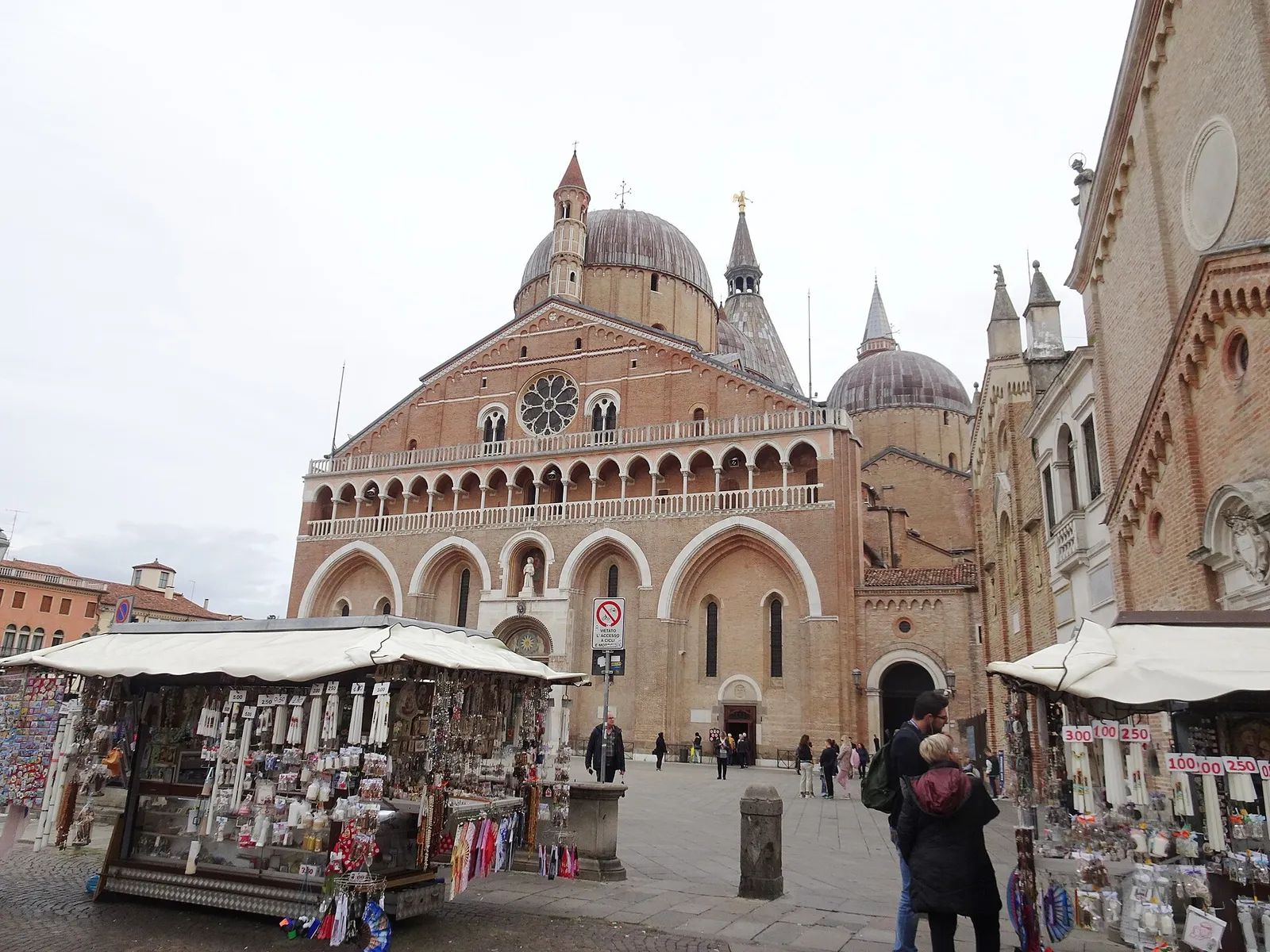
Seven centuries later the Church gave him one more title. On 16 January 1946, the feast of the five Franciscan martyrs of Morocco, Pius XII declared him a Doctor of the Church, a teacher for the whole Church, with the name Doctor Evangelicus because his sermons drew so constantly on the Gospels. The letter opened with both his cities.
“Rejoice, happy Lusitania; O happy Padua, be glad.”
- Born
- Lisbon, c. 1190-1195 (traditionally 15 August 1195)
- Baptismal name
- Fernando
- Died
- Arcella, Padua, Friday 13 June 1231, aged about 36
- Canonised
- 30 May 1232, Spoleto, by Gregory IX
- Buried
- Basilica of Saint Anthony, Padua
- Doctor of the Church
- 16 January 1946, Pius XII
- Feast day
- 13 June
Lisbon claims its saint
For centuries most of Europe called him Anthony of Padua and assumed he was Italian. The historian Paula Almeida Mendes notes that Spanish writers took him up before Portuguese ones did, with Lives printed in Salamanca, Seville and Mexico between 1588 and 1605. Portuguese writers answered with Lives that put Lisbon in the title, such as the Santo Antonio de Lisboa printed by Pedro Craesbeeck in Lisbon in 1610.
Portugal had few saints of its own. Leaving aside the early martyrs, Mendes counts only four canonised Portuguese saints by 1690: Teotónio, Anthony, Queen Isabel, canonised in 1625, and João de Deus, canonised in 1690.
After the revolt of 1640 that ended sixty years of rule by the kings of Spain, he became a patriotic saint as well. A writer of 1643 claimed that on the day João IV was acclaimed, the crucifix carried in procession freed an arm at the doors of the saint's church to send Anthony off to defend the Alentejo. Sermons, poems and paintings of the Restoration War cast him as the kingdom's protector.
In Lisbon itself the church of Santo António stands over the house where, by tradition, he was born. King João II had a chapel built there in the fifteenth century; the present church dates from 1767, after the earthquake, and its crypt keeps a fragment of his bone authenticated by a papal bull. By the seventeenth century the archdiocese of Lisbon already marked the vigil of his feast on 12 June.
Sardines, marchas and brides
Today 13 June is Lisbon's municipal holiday, and has been since 1953. The festivities fill the whole of June, with decorated streets, stalls and grilled sardines in the old neighbourhoods, and pots of basil, manjericos, given as presents. The high point is the night of the 12th.
Sardines and basil have no link to the saint. Observador's explainer points out that both belong to the June festivals in general, for Saint John and Saint Peter too: sardines are in season from the spring, and basil grows well in early summer.
The marchas populares, the costumed parades of the neighbourhoods, are younger than they look. The first were staged in 1932 by Leitão de Barros, at the request of Campos Figueira, director of the Parque Mayer theatre district, and Campo de Ourique won; accounts differ on how many neighbourhoods took part. The city council took them over in 1934. After the revolution of 1974 they lapsed; they came back in 1980, and a jury and prizes returned in 1981.
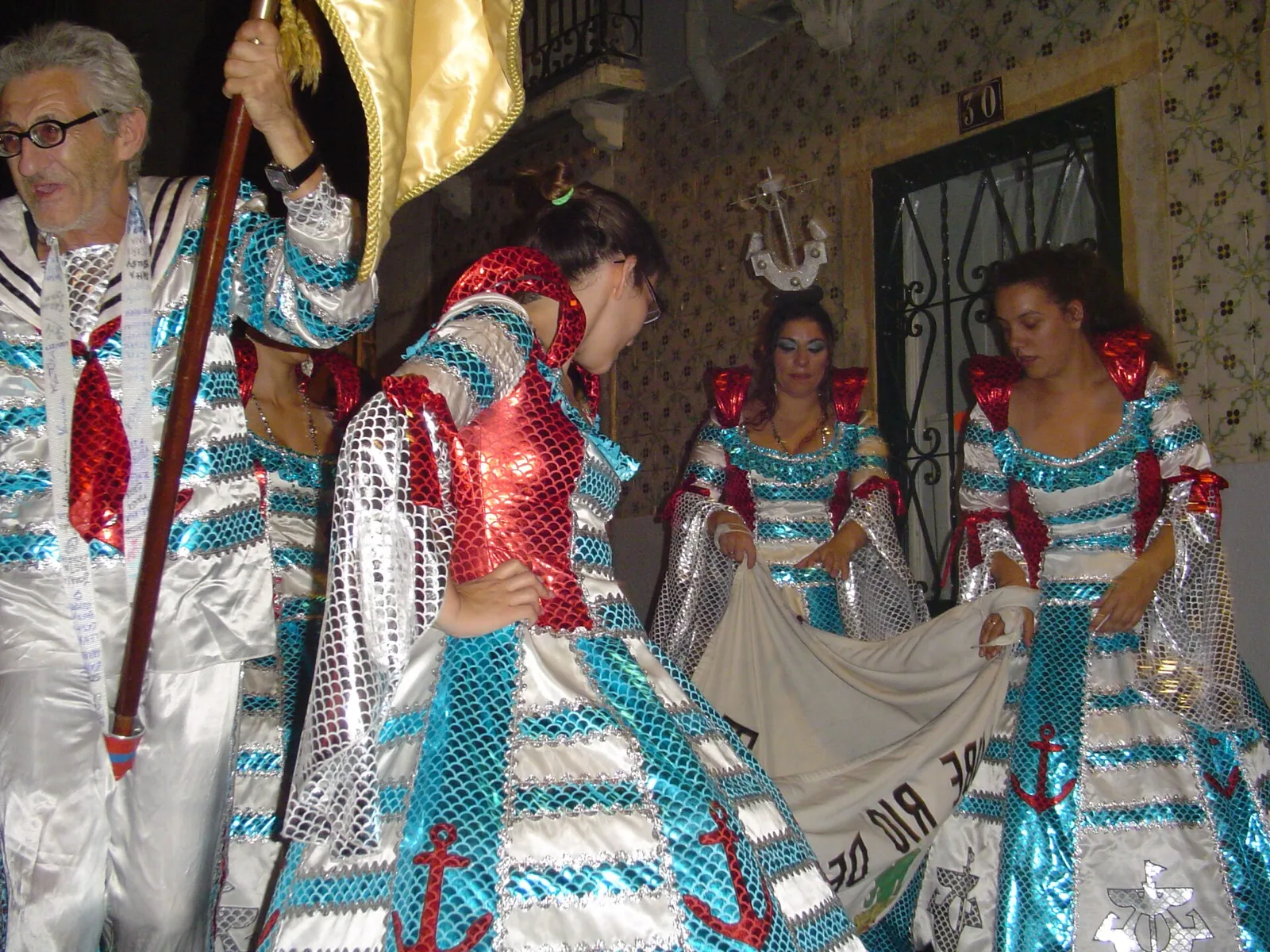
Anthony's reputation as a matchmaker rests on a story with many versions: he is said to have slipped a dowry to a poor girl so that she could marry. Lisbon turned it into a civic ritual. In 1958 the evening paper Diário Popular, taking up an idea of the councillor Augusto Pinto, organised the first “Noivas de Santo António”, Saint Anthony's brides, to marry together at the saint's church on 13 June. Lusa and Time Out count 26 couples; the city's cultural company EGEAC says 36. The magazine NiT dates the first edition to 1959.
The weddings stopped after the revolution of April 1974. The city council revived them in 1997 as the Casamentos de Santo António and added civil ceremonies. In the 2026 edition, the 28th, 16 couples aged 27 to 51 were chosen from 41 applications, to marry on 12 June at the Sé or in the city hall before joining the parade.
| Before the edition of | Religious weddings | Civil weddings | Total |
|---|---|---|---|
| 2025 | 285 | 130 | 415 |
| 2026 | 296 | 135 | 431 |
Running totals published by EGEAC in May 2025 and May 2026. The 2025 edition added 11 religious and 5 civil weddings, the 16 couples chosen that year.
On the afternoon of the 13th the saint's procession leaves his church at 5 pm and winds through Alfama, collecting the images of other saints from the churches on its way.
Why he still matters
Anthony spent his adult life in Coimbra, Italy and France, and his tomb is in Padua. Lisbon's claim on him is as old as the first account of his life, which begins with the house beside the Sé, and since 1953 the city has kept his feast, 13 June, as its municipal holiday.
On 13 June 1654, at São Luís do Maranhão in Brazil, the Lisbon-born Jesuit António Vieira preached the sermon in which Anthony's fish became a satire on the colonists who enslaved the Indigenous people.
FAQs
Was Saint Anthony of Padua Portuguese?
Yes. He was born in Lisbon in the 1190s, baptised Fernando, and lived in Lisbon and Coimbra as an Augustinian canon until 1220. He became a Franciscan, spent the last decade of his life in Italy and France, and died near Padua, which is why most of the world calls him Anthony of Padua.
When and where did Saint Anthony die?
On Friday 13 June 1231, at the house of the Poor Clares at Arcella, on the outskirts of Padua. He had fallen ill at Camposampiero and asked to be taken to Padua, but died on the way, aged about 36.
How quickly was Saint Anthony canonised?
Pope Gregory IX canonised him at Spoleto on 30 May 1232, 352 days after his death. Francis of Assisi had waited almost two years. Peter of Verona, canonised in March 1253 about eleven months after his murder, was about as quick, and by some dates slightly quicker.
Why is 13 June a holiday in Lisbon?
It is Saint Anthony's feast day and Lisbon's municipal holiday, observed since 1953. The festivities peak on 12 June, with the Casamentos de Santo António weddings by day and the marchas populares on the Avenida at night, and the saint's procession goes through Alfama on the 13th.
Why is Saint Anthony called a matchmaker?
A popular story, told in many versions, says he secretly gave a dowry to a poor girl so she could marry. Lisbon first held group weddings in his name in 1958, sponsored by the newspaper Diário Popular; they stopped in 1974, and the city council revived them in 1997.
On the timeline
Open the timelineNearby moments from from county to kingdom (1096–1249).
Battle of Las Navas de Tolosa. The combined armies of Castile, Aragon and Navarre crush the Almohad Caliph al-Nasir on a plain in the Sierra Morena. Afonso II, ill and at war with his sisters and León, sends no royal army, but Portuguese knights and many foot soldiers fight as volunteers, as Rodrigo of Toledo and Lucas of Tuy note; the victory tips the Iberian balance decisively against the Almohads.
King Afonso II of Portugal, ill and not yet 30, has his will drawn up in Coimbra. Written in Galician-Portuguese rather than Latin and made in 13 copies, of which two are known (in Lisbon and Toledo), it is the oldest dated royal document in Portuguese and a landmark in the history of the written language.
King Afonso II of Portugal dies, aged 37. Known as 'the Fat' (o Gordo), he issued the kingdom's first general laws at an assembly in Coimbra in 1211, often counted as the first Cortes (parliament).
Saint Anthony of Lisbon
Death of Saint Anthony of Padua at Arcella, on the outskirts of Padua, after he fell ill at Camposampiero and asked to be carried to the city. Born in Lisbon in the 1190s and baptised Fernando (later tradition adds the surname Martins de Bulhões), he is canonised 352 days after his death, one of the swiftest canonisations of the Middle Ages, and is Lisbon's best-loved saint: his feast day, 13 June, is the city's municipal holiday.
Sancho II dies in exile in Toledo. The king who had taken much of the Alentejo and Algarve from the Moors was declared unfit to rule by Pope Innocent IV and lost a civil war to his brother, the future Afonso III. Legend says the alcaide of Coimbra, Martim de Freitas, refused to surrender his castle until he had seen the dead king in Toledo with his own eyes.
Coming up in history
All long reads 15 June 1970Almada Negreiros, the rebel of Orpheu, dies in Lisbon: 15 June 1970
 16 June 1808Olhão rises against Napoleon and sails a fishing boat to Brazil, 1808
 17 June 1665Montes Claros, 1665: the last great battle of Portugal's Restoration War
 18 June 1946Goa Revolution Day: Lohia and Menezes defy the ban in Margão, 1946
37 sources
Archives, scholarship and reporting this article was checked against.
- 1
What's in a Name? (Andreas Alkofer, OFM Conv.)Messenger of Saint Anthony, April 2023
- 2
St. Anthony of Padua (Niccolò Dal-Gal)The Catholic Encyclopedia, vol. 1 (1907), New Advent edition
- 3
1231 His deathBasilica of Saint Anthony, Padua (Pontifical Basilica website)
- 4
General Audience, 10 February 2010: Saint Anthony of Padua (Benedict XVI)Holy See (vatican.va)
- 5
- 6
Do Portugal medieval à Primeira Idade Global: rumos da devoção a Santo António de Lisboa (Paula Almeida Mendes)eHumanista 48 (2021), pp. 247-264, CITCEM, Universidade do Porto
- 7Tudo o que precisa de saber sobre o Santo António (Sara Otto Coelho)Observador, 12 June 2014
- 8
Noivado assumido, casamento decidido: Casamentos de Santo António 2026 (press release)EGEAC, Lisbon City Council, May 2026
- 9
- 10
Anthony's PathMessenger of Saint Anthony
- 11
- 12
- 13
Há 850 anos, São Vicente chegou a Lisboa: um roteiro pelo mito (Álvaro Filho and Tomás Delfim)Mensagem de Lisboa
- 14Quem é o padroeiro de Lisboa: o popular Santo António ou o discreto São Vicente? (Ana Meireles)Diário de Notícias, 11 June 2023
- 15
Procissão de Santo AntónioVisit Lisboa (Turismo de Lisboa)
- 16
- 17
Vita Prima exhibition: St Anthony in PortugalMuseu Nacional Soares dos Reis, June 2023
- 18
O Mosteiro de Santa Cruz de Coimbra: uma história arquitetónica (Rui Lobo), in Projetos para o Mosteiro de Santa Cruz de Coimbra e área envolventeDepartamento de Arquitetura, Universidade de Coimbra, 2022
- 19
- 20
- 21
- 22
- 23
- 24
- 25
- 26
- 27
- 28
St. Peter MartyrDominican Friars, Province of St Joseph
- 29
- 30
- 31
Santos Populares: lá vai Lisboa de outros temposTime Out Lisboa, 8 June 2021
- 32Casamentos de Santo António voltam a unir 16 casais de Lisboa (Lusa)Observador, 12 June 2022
- 33
- 34
Aí vêm os noivos: já são conhecidos os 16 casais de Santo António deste anoNiT, 12 May 2025
- 35
- 36
A escravidão nos sermões do Padre Antonio Vieira (Alcir Pécora)Estudos Avançados, vol. 33, no. 97, Universidade de São Paulo, 2019
- 37
Guião de Trabalho Autónomo n.º 12, Português 11.º ano: o Sermão de Santo António (as repreensões)Direção-Geral da Educação, Ministério da Educação
Image credits
- The church of Santo António in Lisbon, begun in 1767 after the earthquake of 1755, on the spot tradition gives for the saint's birthplace, with a tower of the cathedral on the right. The banner reads “Aqui nasceu Santo António”, here Saint Anthony was born. Photographed in November 2023. Miguel Ángel García from Ólvega, España, CC BY 2.0, via Wikimedia Commons.
- The church of the monastery of Santa Cruz in Coimbra, where Fernando lived from about 1212 to 1220. The carved front dates from the rebuilding ordered by King Manuel I in the early sixteenth century. Photographed in May 2026. Alexkom000, CC BY 4.0, via Wikimedia Commons.
- The killing of the five Franciscan friars in Morocco in January 1220, painted around 1508 by the workshop of Francisco Henriques, nearly three centuries later. Now in the Museu Nacional de Arte Antiga, Lisbon. Francisco Henriques, Public domain, via Wikimedia Commons.
- Saint Anthony preaching to the fish, painted by the Portuguese artist Garcia Fernandes between 1535 and 1540. Now in the Museu Nacional de Arte Antiga, Lisbon. Garcia Fernandes, Public domain, via Wikimedia Commons.
- The Basilica of Saint Anthony in Padua, where his remains were moved in 1263. Photographed in September 2022. Palickap, CC BY-SA 4.0, via Wikimedia Commons.
- Members of a Lisbon marcha in sailor-themed costumes, photographed in a street of the city on 20 June 2009. Béria Lima de Rodríguez, CC BY-SA 3.0, via Wikimedia Commons.