

Earthquake, wave and fire: the destruction of Lisbon, 1 November 1755
On All Saints' morning the ground under one of Europe's richest capitals shook for several minutes. The river came next, then fire. The rebuilding gave Lisbon its grid of streets, and the disaster set off an argument that ran across Europe.
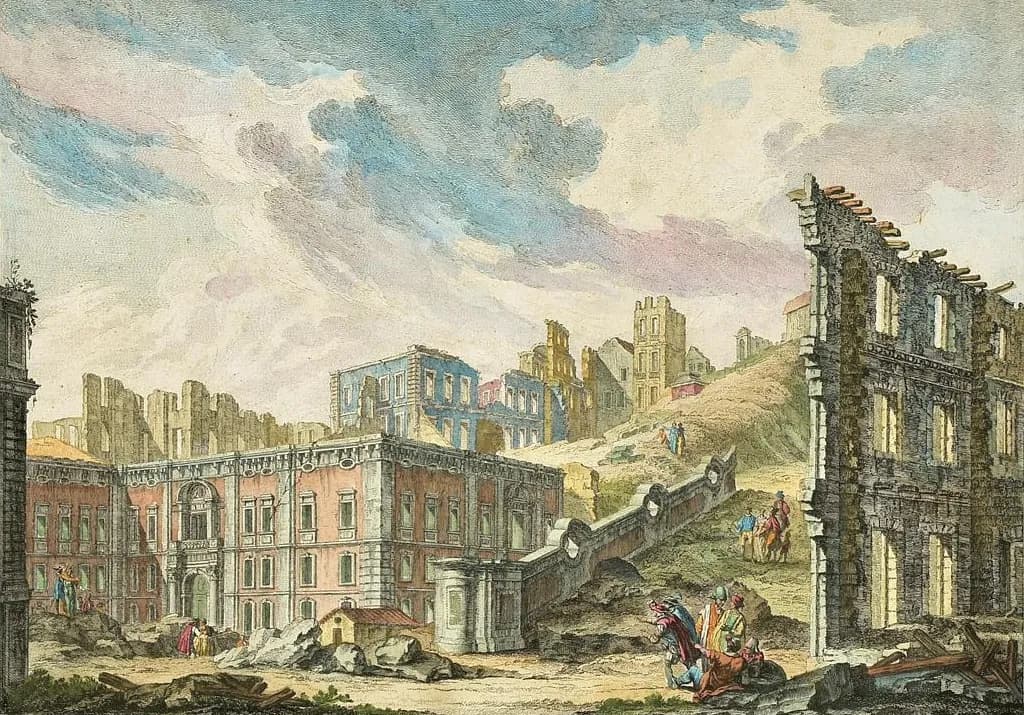
At a glance
- At about 9.40 on the morning of 1 November 1755, All Saints' Day, a great earthquake struck Lisbon while many people were at Mass. Contemporary times range from 9.30 to 9.50.
- A tsunami followed within the hour, washing about 250 metres into the lower town; fires then burned for days. Lagos, Albufeira and the coasts of Spain and Morocco were also hit.
- Nobody counted the dead. Contemporary figures for Lisbon run from Pombal's 6,000 to 8,000 to the papal nuncio's 40,000; later estimates range from about 10,000 to 40,000.
- King José I's minister Sebastião José de Carvalho e Melo, later Marquis of Pombal, ran the emergency and the rebuilding: the grid of the Baixa, with its standard façades and timber-framed walls, dates from his plan of 1758.
- The disaster set Voltaire, Rousseau and Kant arguing, and Pombal's printed questionnaire of 1756 to every parish is counted among the first modern seismological surveys.
All Saints' morning
The weather was calm and clear. Miguel Tibério Pedegache, a Lisbon army officer of Swiss descent and a man of the Enlightenment, noted the barometer at 27 inches 7 lines and Réaumur's thermometer at 14 degrees. Then, at nine o'clock and forty minutes in the morning, “shook the earth with three impulses”.
It was Saturday 1 November 1755, All Saints' Day, and many churches were full of people at Mass. The first shock lasted, by one witness's count, six or seven minutes. Joaquim José Moreira de Mendonça, who published a history of earthquakes in 1758, felt two distinct tremors inside it. Two more strong, shorter shocks followed and brought down much of what was still standing.
Along the river the next danger came from the water. The Tagus drew back, uncovering a riverbed nobody had seen before, and then the sea came in.
“The sea made three major incursions against the land, in addition to other minor ones, destroying many buildings and sweeping away many people swallowed up in its waters.”
By nightfall a column of smoke stood over the centre of the city. Fires had broken out in the palace of the Marquis of Louriçal, in the church of São Domingos and near the Royal Palace and the Customs House, and for four more days they burned through rubble and bodies alike.
A rich capital on a fault line
Lisbon in 1755 was the capital of a seaborne empire and one of the richest cities in Europe, with about 250,000 inhabitants. It had forty parishes and sixty-five convents.
The king, José I, had been acclaimed on 7 September 1750. On the riverfront stood his Ribeira Palace, with a royal library of about 70,000 volumes, beside the warehouses of the Casa da Índia, which handled the trade with Asia. A new opera house had just opened, and a new Patriarchal church, the seat of Lisbon's patriarch, had just been built.
Earthquakes were not new. Pedegache pointed to earlier great shocks in Portugal in 1309 and 1531, and wondered whether they came back at regular intervals. What nobody in 1755 knew was where they came from: the 1755 shock started offshore, south-west of Portugal, and geologists still argue over which fault broke.
The day, hour by hour
c. 9.30 to 9.50
The first shock
Recorded times vary: 9.30 in the Torre do Tombo's account, 9.40 by Pedegache and 9.50 in Kant's reckoning, checked against the time felt in Madrid. The ground shakes for six or seven minutes.
Minutes later
Two more strong shocks
Shorter but violent, they bring down damaged buildings that are still standing.
c. 10.10 to 10.40
The tsunami
The river withdraws, then the sea makes three major surges into the lower town, about 45 minutes to an hour after the first shock by different modern accounts.
Early afternoon
The ground rumbles again
Survivors wander among the ruins and the dead in a haze of dust and ash.
Nightfall
Fire takes hold
Smoke rises from the palace of the Marquis of Louriçal, São Domingos church and the streets near the Royal Palace and Customs House.
2 November
A crisis command meets
Within 24 hours the king's emergency structure, under Carvalho e Melo, begins to act.
2 to 5 November
The fire burns on
Four days of fire reduce rubble and bodies to ash.
About 8 November
Fires out, ground still shaking
A week on, the fires are out but small tremors continue, and go on for more than six months.
In the Tagus the water rose and fell three times in a few minutes, climbing by one account some fifteen English feet above the highest spring tides. Witnesses saw it flood the Customs House, the Terreiro, the great square by the palace, and the São Paulo quarter. Studies of these descriptions conclude that the sea ran about 250 metres into the lower town, held back in part by the old city wall built by King Fernando.
The wave reached far beyond Lisbon. Reports describe waves of 10 to 15 metres at Cape St Vincent and along the Gulf of Cádiz. At Albufeira, in the Algarve, the parish priest wrote that the sea took the whole quarter of Santa Ana, seven streets, leaving no sign of the houses. In Funchal, on Madeira, the water rose fifteen feet above the high-water mark about an hour and a half after the shock. The tsunami was seen along North Atlantic coasts and in Central and South America.
The shaking was felt in North Africa and as far as the Canary Islands, Madeira and the Azores. Kant, working from newspaper reports, found that the waters had been disturbed almost at once from Åbo in Finland to the West Indies, with few coasts spared.
The city that was lost
Moreira de Mendonça judged that more than two-thirds of the city was left uninhabitable. The Ribeira Palace, the new opera house and the new Patriarchal church collapsed completely. The royal library vanished, and so did the goods stored in the Casa da Índia. At least twenty palaces of the high nobility were destroyed, with their paintings, libraries, furniture, silver and jewels.
The churches suffered worst, because so many people were inside them. Of the sixty-five convents in the city only eleven stayed standing, and Lisbon's six main hospitals, partly destroyed, had to be emptied. So did the court gaols.
What became of Lisbon's 40 parish churches
parish churches
Of the city's 40 parishes, 16 churches collapsed or burned, 19 were reduced to ruins and the other 5 were damaged. Figures from the art historian José-Augusto França, as quoted by Ana Cristina Araújo.
Show the data
| Parish churches | |
|---|---|
| Collapsed or burned | 16 |
| Reduced to ruins | 19 |
| Damaged | 5 |
Some things survived by luck. The royal archive, the Torre do Tombo, was kept in a tower of São Jorge Castle. The tower fell, but the fire never reached it. Its keeper, the military engineer Manuel da Maia, had a wooden hut built on the castle's parade ground for the papers saved from the rubble and set about listing what was left. The royal family was unhurt: on the morning of the earthquake they were at their country houses at Belém. The court moved to a wooden palace at Ajuda, the Real Barraca, and stayed there until 1794.
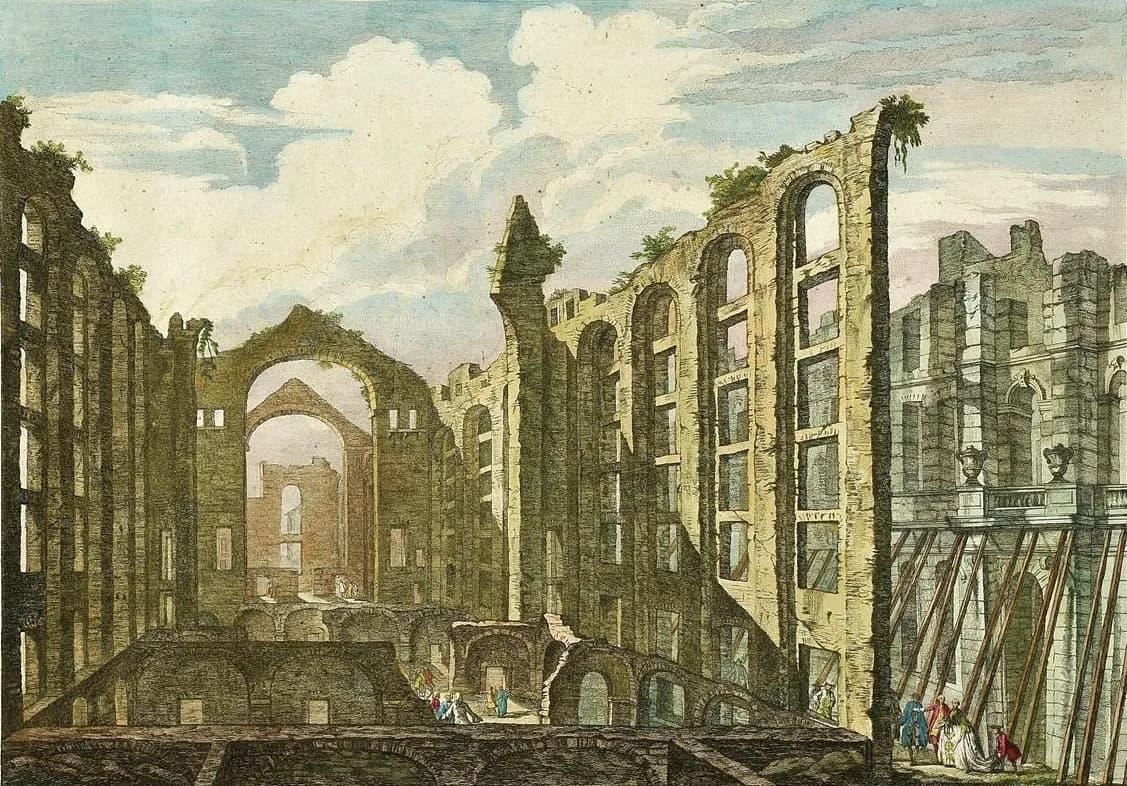
How many died
Nobody counted the dead, and the numbers have been argued over ever since. Bodies were buried under rubble, burned in the fires or carried off by the river. Thousands were taken out by barge, weighted and dropped into the sea beyond the bar of the Tagus, with no funeral rites.
Contemporary figures varied widely. Pombal, keen to stop alarm, told the colonial governors that 6,000 to 8,000 people had died. The papal nuncio, the pope's ambassador, told Rome about 40,000. Voltaire's poem spoke of a hundred thousand.
| Estimate | Who | When | Notes |
|---|---|---|---|
| 6,000 to 8,000 | Carvalho e Melo (Pombal), to the colonial governors | Soon after | Kept low on purpose, to calm alarm |
| At least 18,000 | Lisbon street talk, reported by Father António do Sacramento | 1756 | A year after the disaster |
| About 40,000 | The Apostolic Nuncio, reporting to Rome | Soon after | Contemporary |
| 100,000 | Voltaire, Poème sur le désastre de Lisbonne | 1756 | A poem, not a count |
| About 10,000 | Grégory Quenet, historian | 2007 | The geographer Fernando Rebelo thought this too low |
| About 40,000 | Ernest Zebrowski, Perils of a Restless Planet | 1997 | 30,000 in the earthquake and 10,000 in the tsunami |
| About 25,000 | Ana Cristina Araújo, historian | 2021 | About a tenth of a city of some 250,000 |
| Close to 900 | M. A. Baptista and colleagues | 1998 | Deaths from the tsunami alone |
Other published figures: NOAA gives about 30,000, noting that some estimates double that, and EARTH Magazine 70,000. The deaths in the Algarve, Spain and Morocco come on top of Lisbon's.
The gap between 10,000 and 40,000 has not closed. Even the tsunami's share is disputed: Zebrowski's 10,000 is more than ten times the estimate of the Portuguese tsunami specialists. What is not in doubt is the scale of the loss. Álvaro Pereira, an economic historian, puts the direct cost of the disaster at 32 to 48 per cent of Portugal's GDP.
Pombal takes charge
The king at once set up a crisis command under Carvalho e Melo, and within 24 hours it was at work. The Duke of Lafões took charge of justice, the Marquis of Marialva of military matters and the Marquis of Alegrete, president of the city's Senate, of food supplies and clearing the streets. The city council and the army were told to put all their men and materials at its disposal.
Prices, wages and rents were frozen at their pre-earthquake levels, and fish and grain were sold under the eye of city officials to stop hoarding. Ships in the harbour were searched for loot and made to unload timber and food. Soldiers guarded the roads into Lisbon, and looters caught in the ruins were tried summarily and hanged on gallows set up around the city.
Survivors camped outside the city, then were made to come back. About 9,000 wooden shacks went up in six months, many in Belém, Alcântara and the new parish of Santa Isabel, where some 25,000 people were living by 1756, many of them in shacks. To pay for rebuilding, a 4 per cent duty was added to imports from 1756, Brazil was told to contribute 1,200 contos (1.2 billion réis) over thirty years, and a papal brief of 25 August 1756 diverted a third of parish church revenues to rebuilding churches.
The emergency made Carvalho e Melo's career. In the next few years he had members of the high nobility, accused of an attempt on the king's life in 1758, sentenced to death, and expelled the Jesuits in 1759, and his propagandists presented the earthquake as the start of a new era of progress.
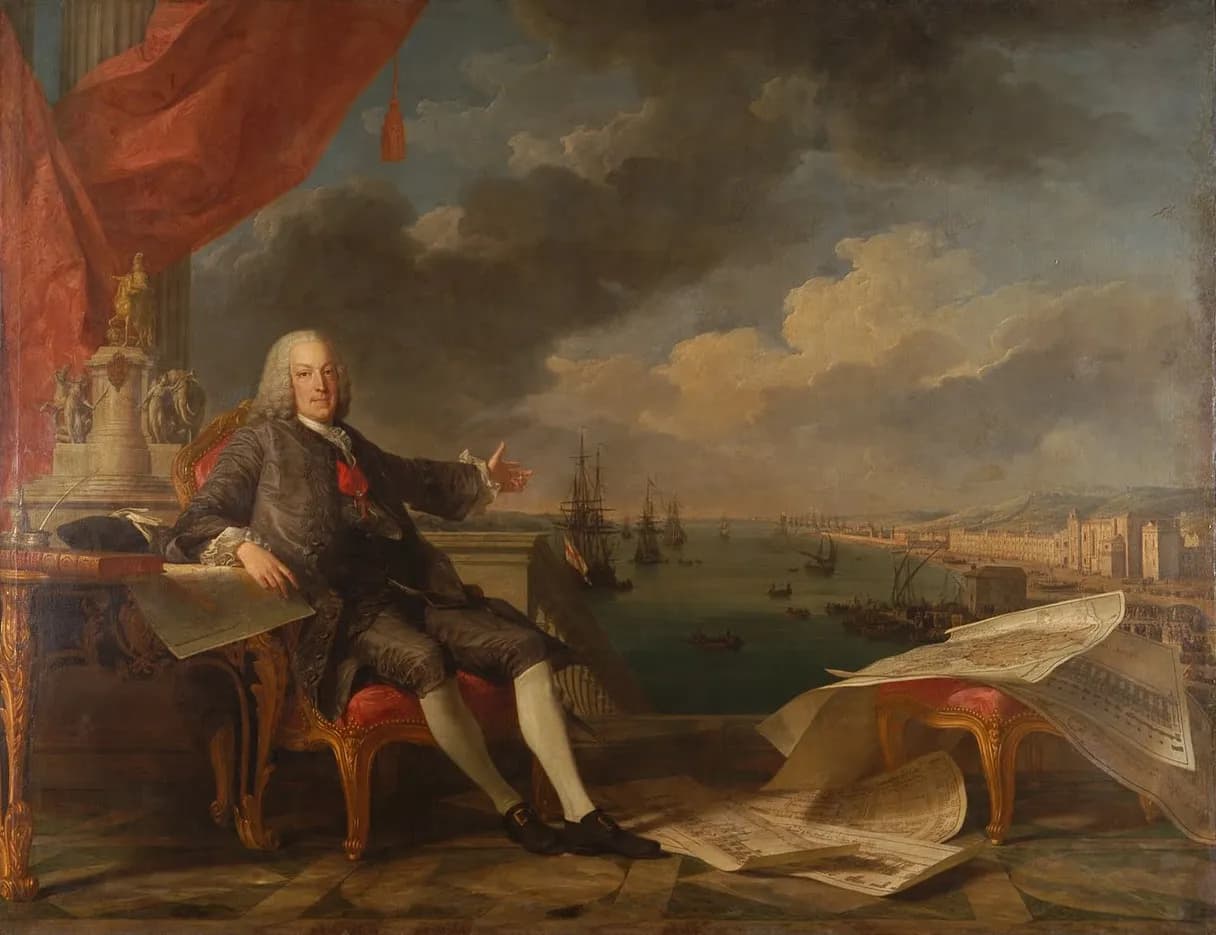
Rebuilding the Baixa
A month after the disaster, on 4 December 1755, Manuel da Maia, an elderly and experienced military engineer, sent the Duke of Lafões the first part of a dissertation on rebuilding Lisbon. He set out five options: rebuild the city as it was; rebuild it with straighter, wider streets; do that but allow only two-storey houses; level the ruins and draw a completely new plan; or abandon the old city and build a new Lisbon at Belém, which he preferred.
The government chose to rebuild the Baixa, the flat lower town between the hills, from scratch. In the second part of his dissertation Maia laid down the rules: the new streets should be wide, and no building should be taller than its street. The third part is dated 31 March 1756.
“with competent liberty, both in their width and in the height of the buildings, which could never exceed the width of the streets”
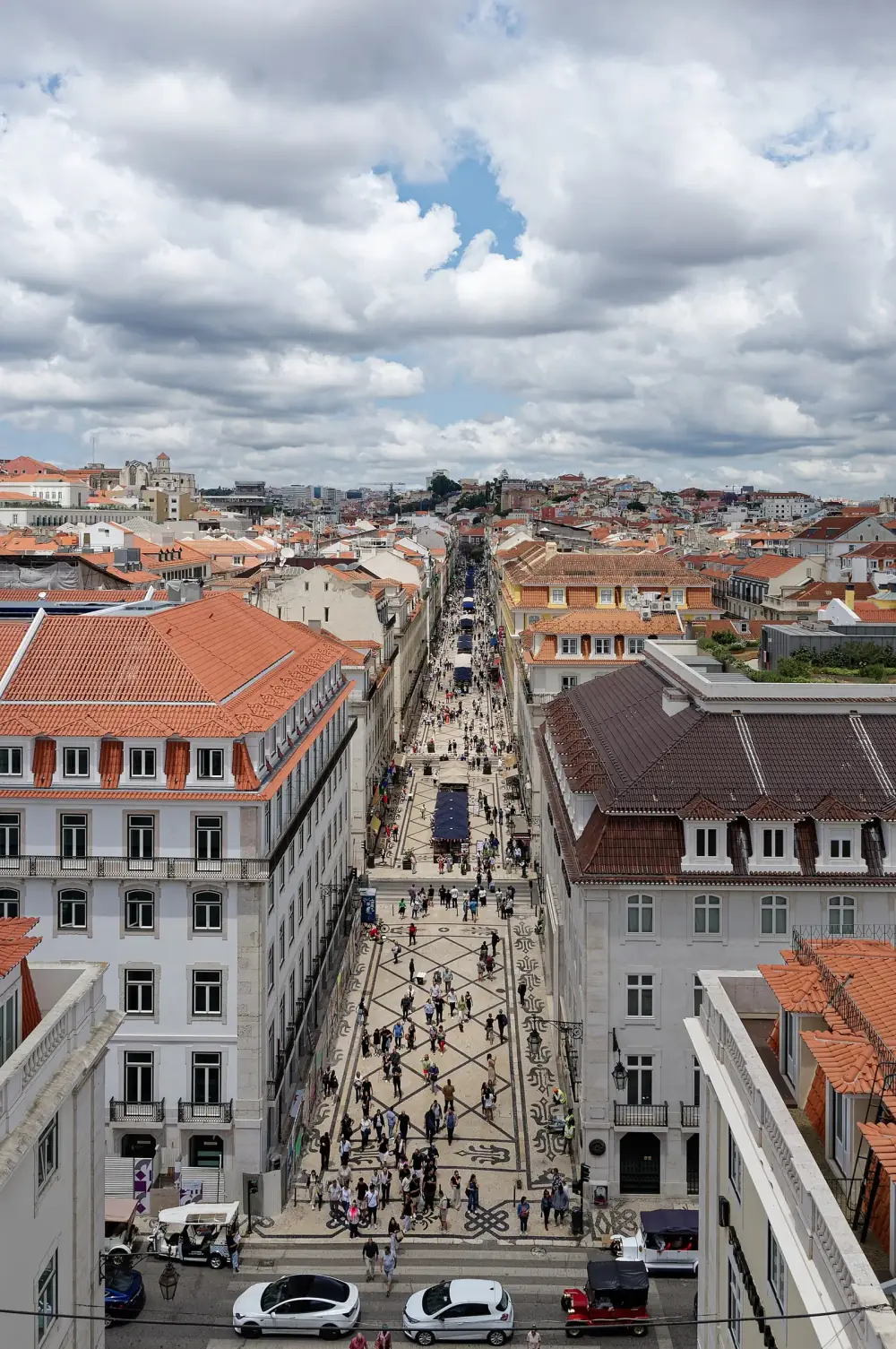
Three teams of engineers drew plans. The one adopted was by Eugénio dos Santos, architect of the works of the Ribeira Palace and the city Senate, approved and refined by the engineer Carlos Mardel. Dated 1758, it levelled the ground over the rubble and laid out a grid of straight streets between two great squares: the Rossio inland and the new Praça do Comércio on the river. The Senate, the Stock Exchange, the Arsenal and the royal courts were planned inside the grid.
The buildings were standardised: the same heights, the same windows and doors, with parts made in advance and assembled on site. Inside the walls went a timber framework, the gaiola or “cage”, meant to give the buildings elasticity and strength when the ground shook. Pombal signed many of the façade drawings himself, and the district is still called the Baixa Pombalina.
Work formally began after a law of 12 May 1758 set out owners' rights and gave each plot five years to be rebuilt, a deadline that was not kept. In the middle of the Praça do Comércio the government set up an equestrian statue of José I, with Pombal's portrait on the pedestal.
Europe argues about God and nature
News travelled slowly. Voltaire, in Geneva, may only have heard of the disaster by letter on 23 November. The Gazeta de Lisboa gave it a few lines. Abroad, newspapers filled the gap with survivors' letters, some real and some invented, and with prints by artists who had never seen Lisbon and drew houses like their own.
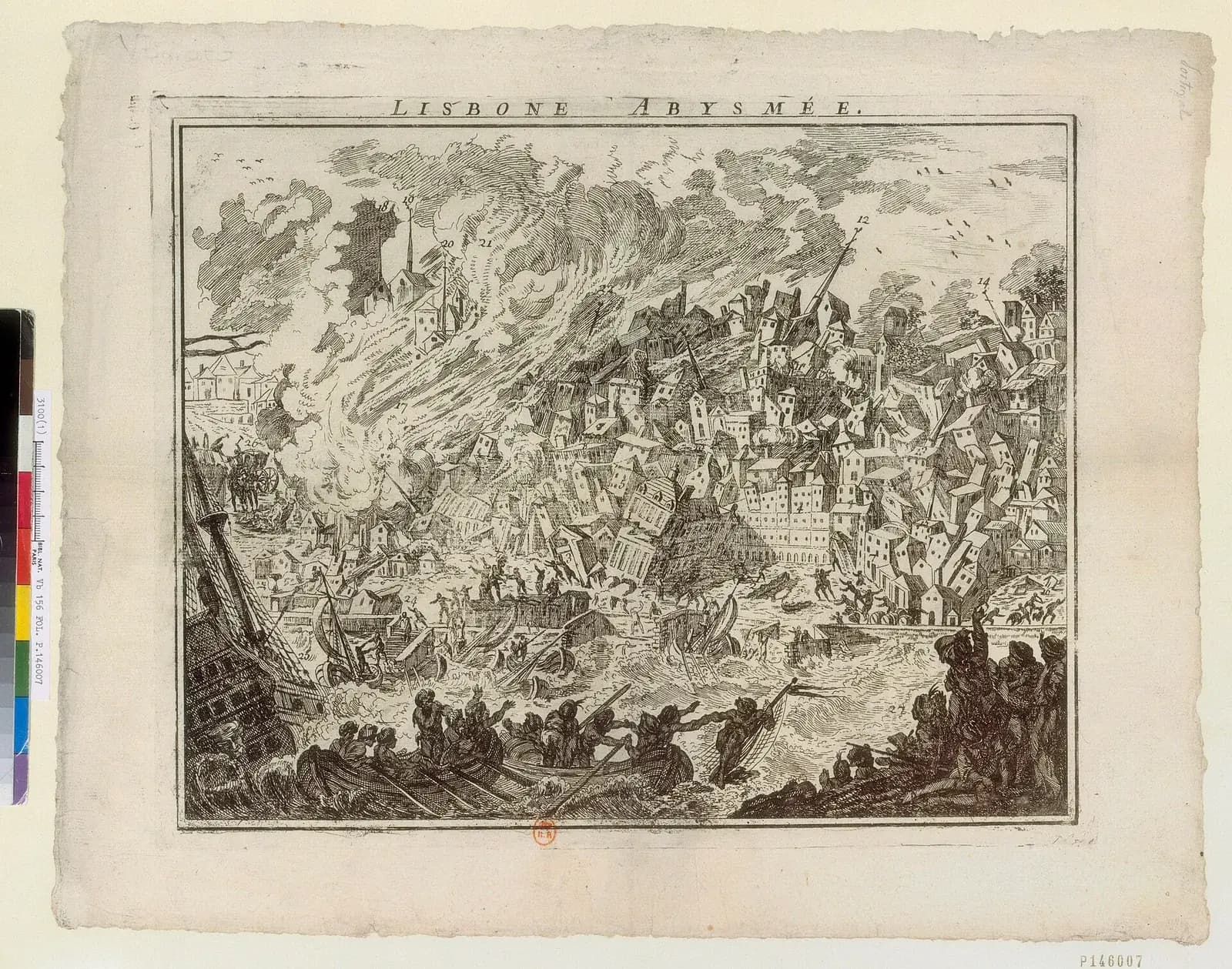
Many preachers, Protestant and Catholic, said the earthquake was God's punishment. In London the Methodist John Wesley published Serious Thoughts Occasioned by the Late Earthquake at Lisbon in 1755, and it went through several editions before the end of the century.
Voltaire disagreed in verse. His Poem on the Lisbon Disaster of 1756 attacked the optimism of Leibniz and Alexander Pope, summed up in the phrase “all is well”. As Rousseau later put their case, God had chosen, of all possible arrangements of the world, the one with the least evil and the most good.
“Did Lisbon, which is no more, have more vices than London, than Paris, sunk in their pleasures? Lisbon is swallowed up, and in Paris they dance.”
Jean-Jacques Rousseau answered the poem in a letter of 18 August 1756. Most of our physical ills, he argued, are our own work, and Lisbon was no exception. In 1759 Voltaire published Candide, a satire that recalls the Lisbon earthquake and mocks the idea that a battle, an auto-da-fé (the Inquisition's public sentencing of heretics) or an earthquake could be part of God's plan.
“Without leaving your subject of Lisbon, admit, for example, that nature had not gathered twenty thousand houses of six or seven storeys there, and that if the inhabitants of that great city had been spread out more evenly and housed more lightly, the damage would have been much less, and perhaps none at all.”
The German philosopher Immanuel Kant published three short works on the earthquake in 1756. He explained it as a natural event: heated matter spreading through passages under the earth until it met sulphur, oil or pitch and caught fire. The theory was wrong, but he looked for causes in nature and refused to search the movements of the earth for God's purposes.
“Great events that concern the fate of all men rightly arouse that laudable curiosity which wakes at everything extraordinary and asks after its causes.”
Thirteen questions and the birth of seismology
In 1756 Pombal's government sent a printed questionnaire of thirteen questions to the parish priests of every diocese in Portugal. Advised by Pedegache, the physician António Ribeiro Sanches and the astronomer Joaquim Soares de Barros, it asked about what could be observed, not about omens. Spain ran a damage survey too, but a simpler one.
- Question 1
- At what time did the earthquake begin on 1 November and how long did it last?
- Question 2
- Was the shock greater from one direction than another, and did more buildings fall to one side?
- Question 5
- What happened to the sea, to fountains and to rivers?
- On the sea
- Did it fall or rise first, how far above normal did it rise, and how many times?
- On cracks
- Did fissures open in the ground, and what was noticed about them?
- On memory
- Have there been other earthquakes in living memory, and what damage did they do?
The replies are kept in the Torre do Tombo, and Francisco Luís Pereira de Sousa compiled and studied them between 1919 and 1932. Elsewhere scientists went to work on the same event. Kant checked the times reported from Lisbon against Madrid, allowing for the difference in longitude. The Cambridge fellow John Michell built a long paper for the Royal Society around the Lisbon shock.
Reports of what people felt and saw, known as macroseismic data, are still the main evidence for the earthquake's size. In 2020 the seismologist João Fonseca, of the University of Lisbon's Instituto Superior Técnico, used 1,206 such data points from Portugal, Spain and Morocco to estimate the earthquake's size, and arrived at a much lower figure than his predecessors.
| Estimate | Who | Method |
|---|---|---|
| 8¾ to 9 | Beno Gutenberg and Charles Richter, 1949 | Tentative, from how far away it was felt (about 2,500 km) |
| 8.5 to 8.7 | Several studies before 2020 | Size of the areas of equal shaking |
| Mw 8.5 ± 0.3 | Solares and Arroyo, 2004 | Re-evaluation of the macroseismic field |
| Mw 7.7 ± 0.5 | João Fonseca, 2020 | 1,206 macroseismic data points, with a modern ground-motion model |
Mw is moment magnitude, the scale seismologists use for large earthquakes. Fonseca suggests a complex rupture, partly onshore or close to shore, and links the size of the tsunami to a rupture at the base of the sediment wedge under the Gulf of Cádiz.
Where the earthquake started is still debated. The geologist António Ribeiro ruled out the much-cited Gorringe Bank, because its fault has been inactive for about five million years. He argued that the Marquês de Pombal thrust, about 100 kilometres south-west of Cape St Vincent, was at 55 kilometres too short to produce the shock alone, and that the Horseshoe fault beside it was the most plausible partner.
What you can still see
The Carmo church, on the hill facing São Jorge Castle, was founded in 1389 by Nuno Álvares Pereira, constable of the kingdom and one of Portugal's medieval heroes, who chose it for his grave. The earthquake badly damaged it and the fire that followed destroyed almost everything inside. Rebuilding in neo-Gothic style began in 1756 and stopped for good in 1834, when the religious orders were abolished. In the mid-nineteenth century the roofless nave was left open to the sky as a memorial to 1755.
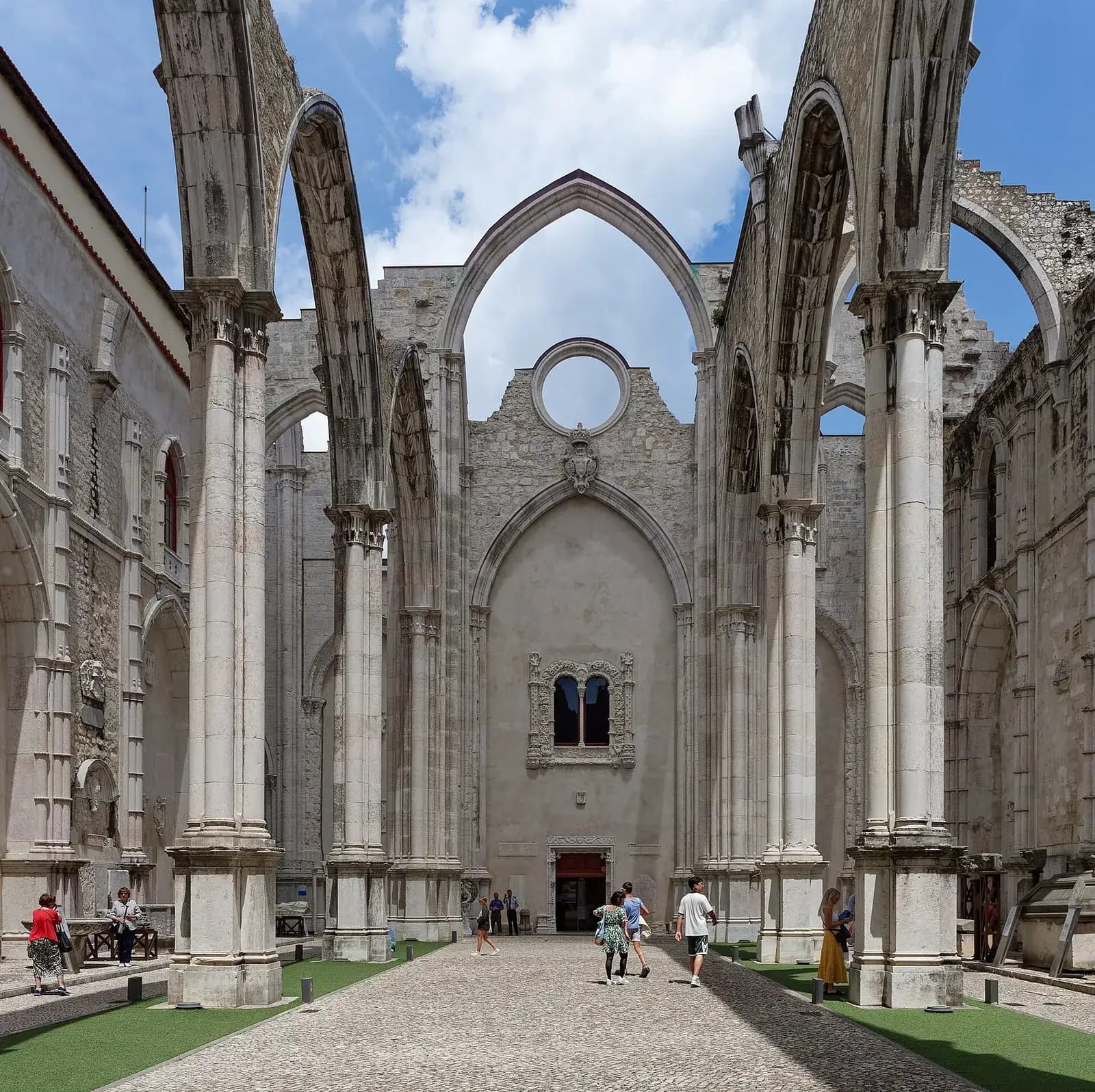
Below it lies Pombal's city. The grid of the Baixa still runs from the Rossio to the river, and José I still rides in the middle of the Praça do Comércio. The triumphal arch at the end of Rua Augusta is crowned by statues of Glory, Genius and Valour, with figures from Portuguese history, Pombal among them, below; since 2013 visitors can climb to the top.
FAQs
What time did the 1755 Lisbon earthquake happen?
On the morning of Saturday 1 November 1755, All Saints' Day. The most cited time, from the eyewitness Miguel Tibério Pedegache, is 9.40 am; the Torre do Tombo archive gives 9.30 and Kant calculated 9.50. The first shock lasted several minutes and was followed by two more.
How many people died in the Lisbon earthquake?
Nobody knows. Contemporary figures ranged from Pombal's 6,000 to 8,000 to the papal nuncio's 40,000. Modern estimates for Lisbon run from about 10,000 to about 40,000; Portuguese tsunami specialists put close to 900 of those deaths down to the tsunami alone. More died in the Algarve, Spain and Morocco.
How strong was the 1755 earthquake?
There were no instruments, so its size is estimated from damage and eyewitness reports. Estimates have long been around magnitude 8.5 to 9, but a 2020 study by João Fonseca, using 1,206 data points, gave a moment magnitude of 7.7 ± 0.5.
Who rebuilt Lisbon after the earthquake?
King José I's minister Sebastião José de Carvalho e Melo, later Marquis of Pombal, directed the rebuilding. The engineer Manuel da Maia set the rules, and the plan for the Baixa, with its grid of streets between the Rossio and the Praça do Comércio, was drawn by Eugénio dos Santos and Carlos Mardel in 1758.
Where can you see traces of the 1755 earthquake in Lisbon?
The roofless Carmo church, now the Carmo Archaeological Museum, was left as a ruin in memory of 1755. The Baixa's grid, the Praça do Comércio with its statue of José I and the Rua Augusta arch are all part of the city built afterwards.
On the timeline
Open the timelineNearby moments from earthquake and enlightenment (1750–1807).
The Lisbon earthquake of 1755
At about 9.40 on the morning of All Saints' Day, with many people at Mass, a massive earthquake devastates Lisbon. Roughly 45 minutes to an hour later a tsunami surges up the Tagus into the lower town, and fires burn for days; modern estimates of the dead in Lisbon alone run from about 10,000 to 40,000.
By royal charter, King José I and his minister Sebastião José de Carvalho e Melo, the future Marquês de Pombal, create the Companhia Geral da Agricultura das Vinhas do Alto Douro to control the port wine trade. Its granite boundary stones, the 'marcos pombalinos', went on to mark out what is considered the world's oldest demarcated wine region.
Gomes Freire de Andrade is born in Vienna, son of Portugal's ambassador to the Austrian court. A soldier of fortune who fought for Catherine the Great against the Turks and marched into Russia with Napoleon, he was hanged in 1817 as the alleged leader of a liberal plot against the British-dominated regency; Lisbon's Campo dos Mártires da Pátria honours the conspirators.
King José I survives an assassination attempt when horsemen ambush his carriage outside Lisbon, wounding him in the arm and shoulder; the affair leads to the trial and brutal execution of the Távora family, strengthens the hand of the future Marquês de Pombal and paves the way for the expulsion of the Jesuits a year later.
Coming up in history
All long reads 3 November 1910The Republic legalises divorce: Portugal's law of 3 November 1910
 4 November 1877The Maria Pia bridge: Eiffel's iron arch that took the railway into Porto
 5 November 1966The Hotel da Penina, Henry Cotton and the making of the Algarve, 1966
 6 November 1919Sophia de Mello Breyner Andresen, poet of the sea, born in Porto in 1919
17 sources
Archives, scholarship and reporting this article was checked against.
- 1
The 1755 Lisbon Earthquake: The Catastrophe and the ReconstructionAna Cristina Araújo (University of Coimbra), Storicamente 17 (2021), peer reviewed
- 2
Revision of the Portuguese catalog of tsunamisM. A. Baptista and J. M. Miranda, Natural Hazards and Earth System Sciences 9 (2009), 25–42
- 3
A Reassessment of the Magnitude of the 1755 Lisbon EarthquakeJoão F. B. D. Fonseca, Bulletin of the Seismological Society of America 110 (2020), 1–17
- 4
O terramoto de 1755 analisado 250 anos depois em colóquio multidisciplinarFernando Rebelo, Territorium 15 (2008), Riscos, Associação Portuguesa de Riscos, Prevenção e Segurança
- 5
The Opportunity of a Disaster: The Economic Impact of the 1755 Lisbon EarthquakeÁlvaro S. Pereira, The Journal of Economic History 69 (2009), 466–499
- 6
O Terramoto de 1755, a Torre do Tombo e Manuel da MaiaArquivo Nacional Torre do Tombo
- 7
Poème sur le désastre de Lisbonne (Œuvres complètes, Garnier, 1877, vol. 9, pp. 470–479)Voltaire, via Wikisource
- 8
Geschichte und Naturbeschreibung der merkwürdigsten Vorfälle des Erdbebens, welches an dem Ende des 1755sten Jahres einen großen Theil der Erde erschüttert hat (1756)Immanuel Kant, Akademie-Ausgabe vol. 1, pp. 429–461, via Korpora (Universität Duisburg-Essen)
- 9
- 10
Benchmarks: November 1, 1755: Earthquake destroys LisbonLucas Joel, EARTH Magazine (American Geosciences Institute), 23 October 2015
- 11
Tsunami Historical Series: Lisbon – 1755NOAA Science On a Sphere
- 12
- 13
- 14
- 15
- 16
Museu Arqueológico do Carmo: história do edifício e do museuAssociação dos Arqueólogos Portugueses
- 17
Arco da Rua AugustaVisit Lisboa (Turismo de Lisboa)
Image credits
- The ruins of the Patriarchal Square after the earthquake, engraved in Paris in 1757 by Jacques Philippe Le Bas from drawings sent from Lisbon by M. Paris and Miguel Tibério Pedegache. Jacques Philippe Le Bas, Public domain, via Wikimedia Commons.
- The ruins of the opera house, which had opened shortly before the earthquake, in Le Bas's engraving of 1757. Jacques Philippe Le Bas, Public domain, via Wikimedia Commons.
- Carvalho e Melo, by then Count of Oeiras and later Marquis of Pombal, painted in 1766 by Louis-Michel van Loo and Claude Joseph Vernet. He gestures towards a harbour full of ships, with plans spread at his feet. The painting belongs to Oeiras City Hall. Louis-Michel van Loo / Joseph Vernet, Public domain, via Wikimedia Commons.
- Rua Augusta, the central street of the Pombaline grid, seen in 2025 from the top of the arch on the Praça do Comércio and looking north towards the Rossio. Jakub Hałun, CC BY 4.0, via Wikimedia Commons.
- Lisbone abysmée (Lisbon swallowed up), a French print of 1755. Its tumbling city of steep northern roofs looks nothing like Lisbon; compare Le Bas's engravings, drawn from sketches made on the spot. Unknown author, Public domain, via Wikimedia Commons.
- The roofless nave of the Carmo church in 2025. The pillars and arches date from the rebuilding begun after 1755 and abandoned in 1834. Jakub Hałun, CC BY 4.0, via Wikimedia Commons.