

The Campo Maior powder explosion of 1732
Before dawn on 16 September 1732, lightning struck the great tower of Campo Maior's castle, packed with some 84 tonnes of gunpowder. The blast flattened most of an Alentejo border town and left a death toll that is still argued over.
At a glance
- Between three and four in the morning of 16 September 1732, lightning struck the great tower of the castle of Campo Maior, a fortress town on Portugal's border with Spain, which was used as the garrison's powder magazine.
- The tower held 5,743 arrobas of gunpowder, about 84 tonnes, with grenades and charged bombs. It blew up from its foundations and rained stone on the houses below.
- The governor counted 836 of the town's 1,076 houses down, 256 dead and more than 2,000 hurt. Other early accounts give 200 or more dead; the popular figure of 800 has no contemporary support.
- King João V sent surgeons and ordered the fortress rebuilt. The keep was never replaced, and the town was rebuilt around a new civic square and new churches, among them São João Baptista, which the municipality dates to 1747.
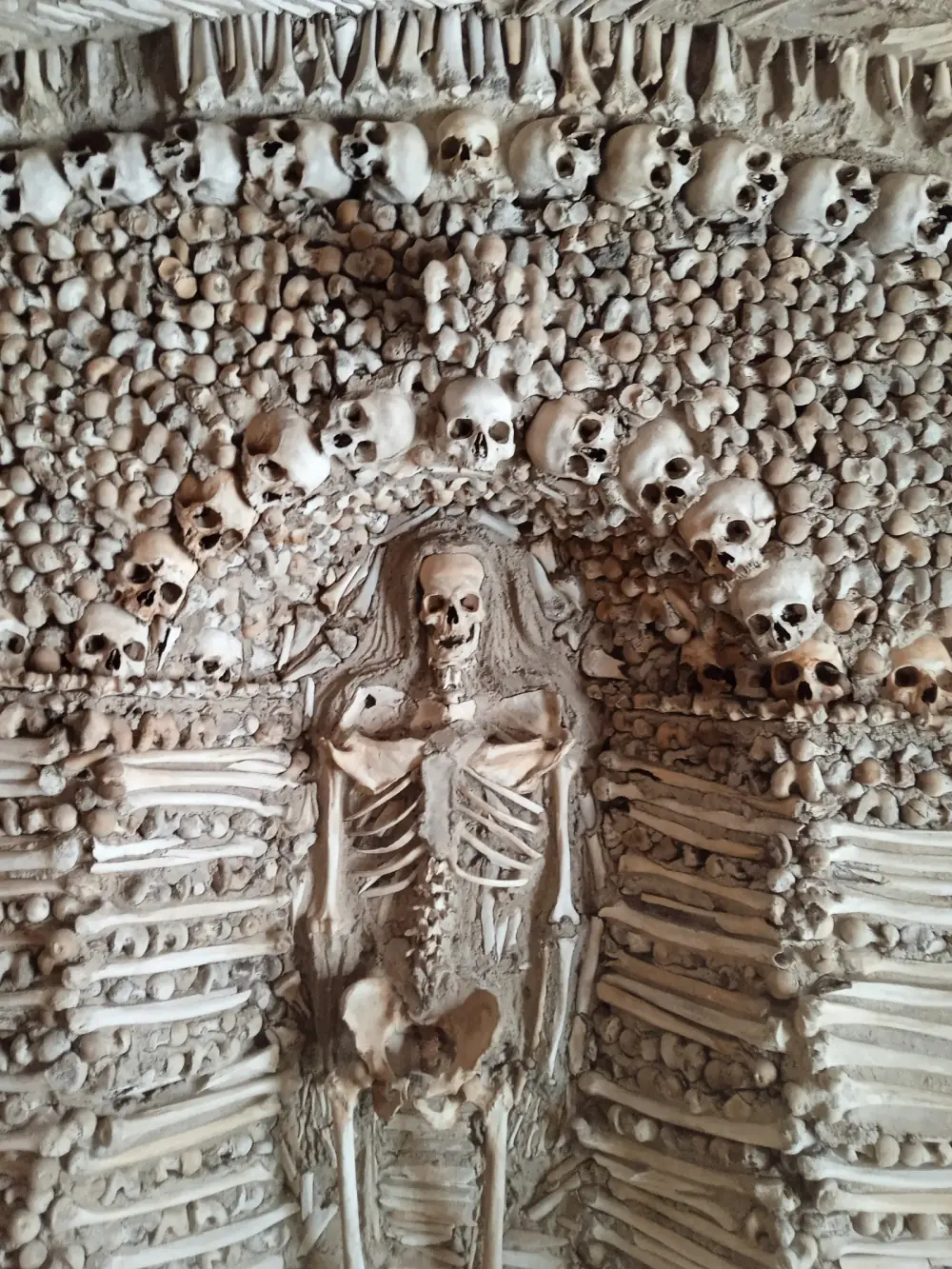
- The Capela dos Ossos, lined with human bones around 1766, is linked to the disaster by tradition, but study during its restoration found no sign that the bones belong to the blast's victims.
Three in the morning on the frontier
On the night of Monday 15 September 1732 a terrible storm of thunder and lightning broke over Campo Maior and, in the words of the report printed in Madrid, emptied itself on the town. Campo Maior was a walled garrison town on the Alentejo plain, close to the Spanish border.
Between three and four the next morning a bolt hit the great tower of the castle, on the hill at the top of the town. The tower was the garrison's powder store. It held 5,743 arrobas and 6 arráteis of gunpowder, with a quantity of grenades and charged bombs.
The powder went up at once.
The blast tore the tower out down to its foundations. It shook the four smaller towers of the castle so hard that only one was left standing, and that one damaged, by the Lisbon chronicle of 1744; the Madrid report says all four fell. In an undamaged corner, fifty barrels of powder survived. Had they caught as well, both accounts say, not one house in the town would have been left standing.
The tower went up into the air in pieces, and the pieces came down on the houses, burying the people inside. Some lived because their roofs came off whole and fell against the walls, leaving a pocket of space underneath; a few were dug out alive the next day.
“It was a great pity to see those who were brought out alive, for some were missing their arms, others their legs, and all were very badly hurt.”
A powder town on the border
Campo Maior had been Portuguese since 1297, when Castile ceded it, with Olivença and Ouguela, in the Treaty of Alcañices. It watched one of the main invasion routes into Portugal.
After Portugal broke away from sixty years of rule by the Spanish kings in 1640, the medieval walls were no longer enough. In 1645 work began on a ring of bastions, the angled earth-and-stone defences of modern artillery warfare, laid out under the engineer João Cosmander and then Nicolau de Langres. It was finished only in the late seventeenth century, under Pedro II.
By the municipality's reckoning, in the second half of the seventeenth century one in four people living in Campo Maior was a soldier. It was the main base of the Dutch mercenaries sent to the Alentejo and, after Elvas, the most important military centre in the province.
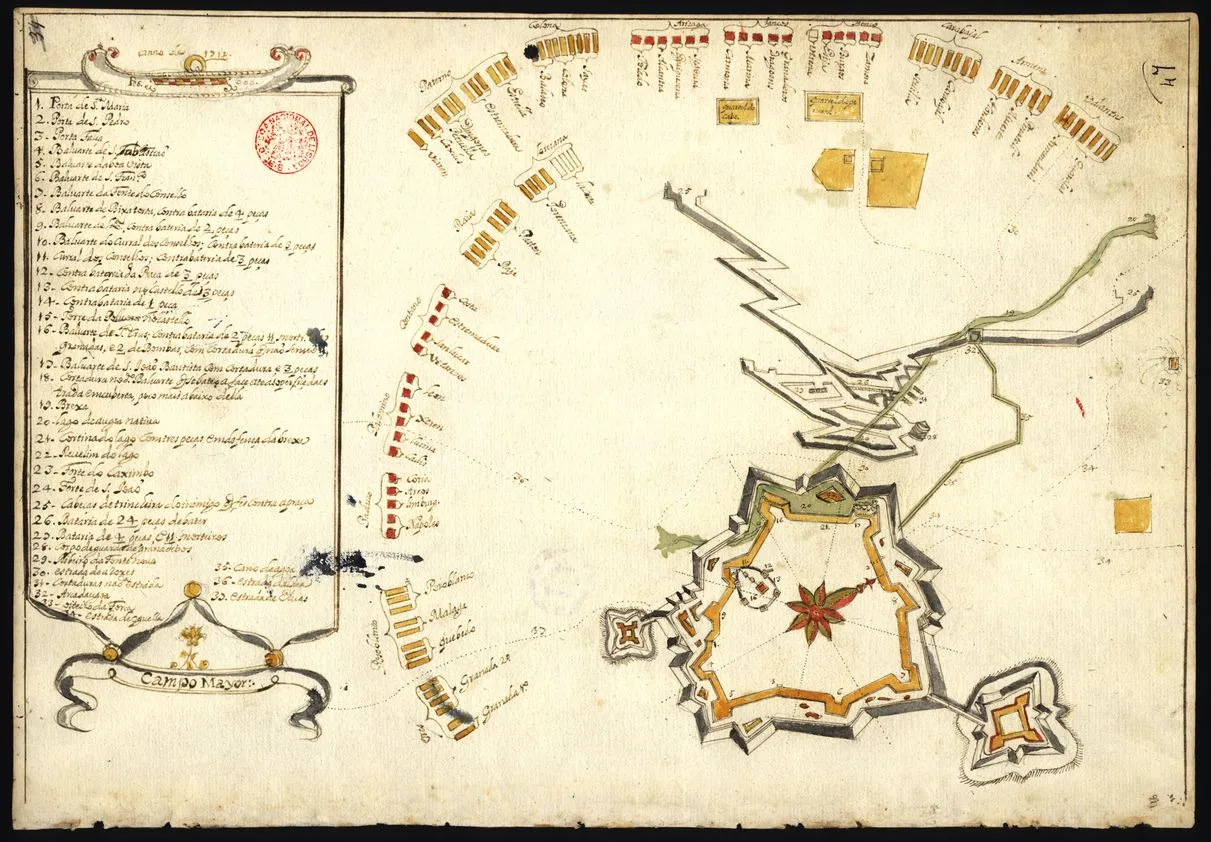
In 1712, late in the War of the Spanish Succession, a Spanish army under the Marquis de Bay besieged the town for 36 days by the municipality's count, opened a breach in the Cavaleiro bastion on 24 October, and lost so many men in the assault that it gave up. The governor who held the town, Estêvão da Gama de Moura e Azevedo, in post from 1705 to 1741, wrote that only a few houses and the church of São João Baptista were damaged. Twenty years later he would count the dead of 1732.
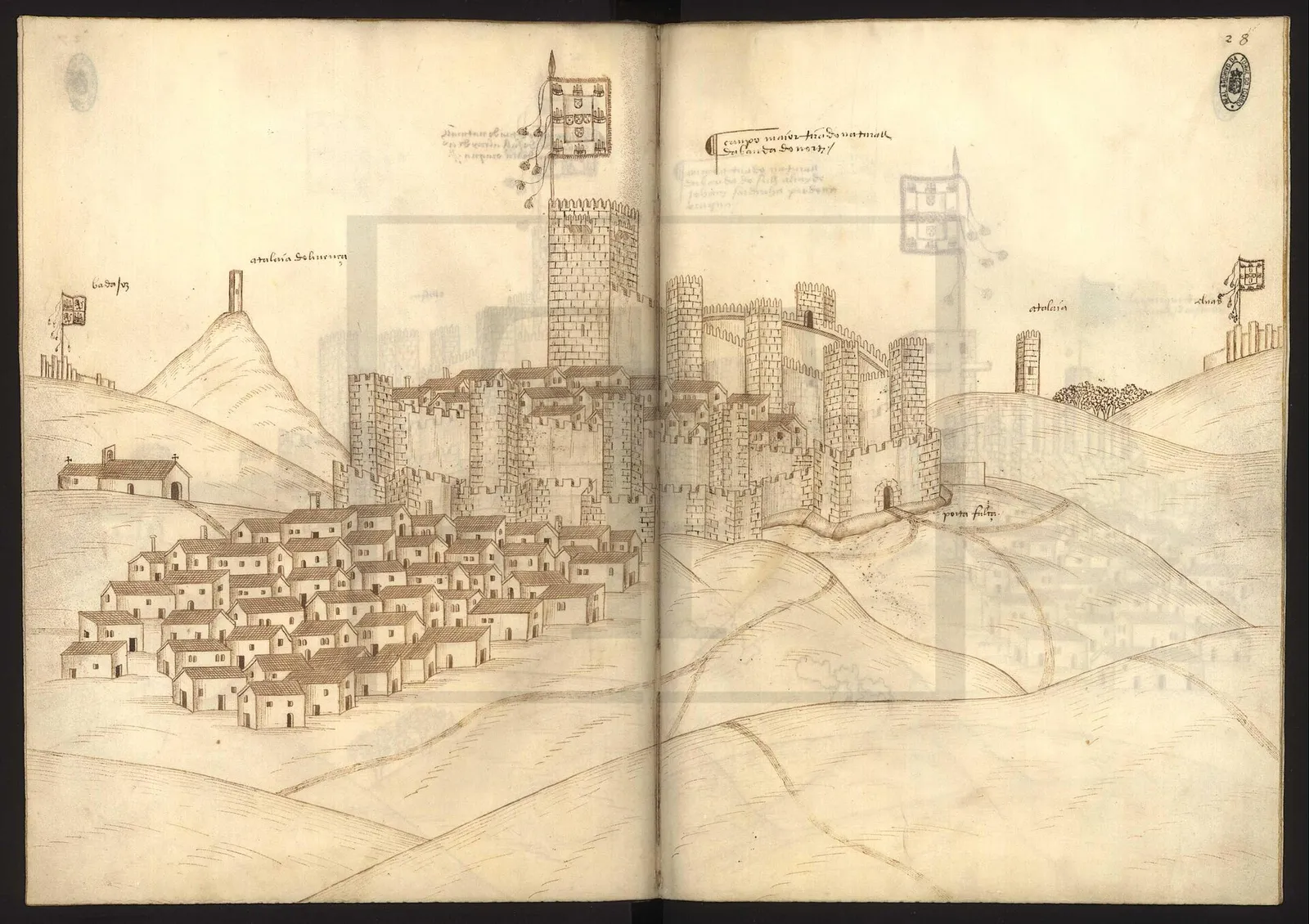
Up on the hill, the castle's tall medieval keep, a great tower rising above a ring of smaller ones, had become the garrison's magazine. It held the gunpowder, grenades and bombs at the highest point of a town of more than a thousand houses.
The keep had long been the symbol of royal power in the town. Its ground floor held the jail, and the old public buildings and the first parish church, Santa Clara, stood close by. By the sixteenth century the town had spread far beyond the medieval walls, and a new parish church was built in the lower town.
What the powder did
- Date
- Tuesday 16 September 1732, between 3 and 4 am
- Place
- Great tower of the castle of Campo Maior, Alto Alentejo
- Cause
- Lightning during a thunderstorm that began the night before
- Powder
- 5,743 arrobas and 6 arráteis, about 84 tonnes, plus grenades and charged bombs
- Houses
- 823 or 836 destroyed, depending on the account, of 1,076
- Dead
- 200 to 316 in early and local records; 256 by the governor's count
An arroba was an old Portuguese weight of 32 arráteis, or 14.688 kilograms. The powder in the tower therefore weighed about 84,360 kilograms. The municipality's history of the town rounds it to 6,000 arrobas, which would be about 88 tonnes.
The town's charitable and religious buildings were hit hard. The convent and hospital of the Brothers of São João de Deus were wrecked, and a priest of the order was found dead. At the Franciscan convent, three friars praying in the choir were killed and the rest of the community injured. The blast took off the front of the parish church and ruined the hospital of the Misericórdia, the town's charitable brotherhood.
Some found signs of grace in the wreckage. In the Misericórdia hospital, the Madrid report noted, the image of São João Baptista, the town's patron saint, came through unharmed, and one could piously believe that by his intercession the tower beside his chapel had been spared. By 19 September, it added, 200 bodies had been taken from the ruins, not counting those still under them. The streets were impassable, and the houses were heaps of stone.
Counting the dead
Nobody agrees how many people died, and the numbers have grown with time. The earliest figure is the 200 bodies recovered by 19 September, in letters written three days after the blast. The count most often cited is the governor's.
“At the roar of the powder and the tower, 836 houses fell at the same time, of the 1,076 that made up this town, and the others were left without roofs, and none without damage. 256 people died, great and small; more than two thousand were wounded.”
| Source | Written | Dead | Injured | Houses destroyed |
|---|---|---|---|---|
| Letters from Campo Maior, printed in the Gaceta de Madrid | 19 September 1732 | 200 bodies recovered, more still in the ruins | Not counted | Not counted; the houses were heaps of stone |
| Estêvão da Gama, governor of the town | Before his death in 1741 | 256 | More than 2,000 | 836 of 1,076; the rest unroofed |
| Anno Historico, Lisbon | 1744 | More than 200 | 302, plus more than 2,000 treated in nearby towns | 823 |
| Local records, cited by the municipality | Cited today | 316 | About 2,000 | Half the town |
| Popular tradition about the Capela dos Ossos | Repeated in 2020 | 800 | Not given | Not given |
On the governor's figures, 836 of 1,076 houses is 78 per cent, more than the “two-thirds” often quoted. The municipality's history page says the explosion and fire carried off about two-thirds of the population, but gives no count. The 800 figure comes from the belief, now rejected, that the chapel's bones are those of the blast's victims.
The injured were the larger number. The 1744 chronicle counted 302 wounded in the town itself and more than 2,000 who went to be treated in the towns around. Some were crippled, others had lost arms or legs, and all, it noted, were poor.
Help from Elvas, Lisbon and Spain
Help came first from Elvas, the big fortress city to the south. The cathedral chapter sent two canons with a hundred gold coins, medicines for the wounded and food for the poor. The Capuchin friars of Elvas came to hear the confessions of the dying; the Dominicans sent 740 loaves, twelve sheep and a load of wine; the Jesuits sent two loads of olive oil and some money. The other towns and villages around, the Madrid report said, joined in with great charity and zeal.
The governor asked for men from the Count of Alva, Governor of Arms of the Alentejo, the province's military commander. The count set out from Vila Viçosa with men and a large number of gold coins to share among the poor at the king's expense. The help also came from across the border. The Spanish town of Alburquerque sent one of its aldermen to offer the people of Campo Maior a place to live, and the Captain General at Badajoz offered the count the stores of his own fortress.
In Lisbon, João V sent surgeons in all haste with supplies for the sick, ordered the whole province to help the town and, in the same breath, ordered its fortifications renewed. The news travelled as far as Madrid, where the Gaceta printed it on 14 October.
Night of 15 to 16 September 1732
Thunderstorm over Campo Maior
16 September, 3 to 4 am
Lightning hits the great tower; the magazine explodes
17 September
Some survivors are found alive under the fallen roofs
19 September
Letters from Campo Maior report 200 bodies recovered
By 25 September
In Lisbon, the king sends surgeons and orders relief and new fortifications
14 October 1732
The Gaceta de Madrid prints the report
1742
First known plan of the town after the disaster, with the keep gone
1744
The Anno Historico records the disaster under 16 September
1747
The date the municipality gives for the new church of São João Baptista
About 1766
The Capela dos Ossos is built beside the parish church
A castle without a keep
João V gave the job of rebuilding the castle to the military engineer Manuel de Azevedo Fortes. He did not put the medieval castle back as it was. The ruins became a smaller, more practical fortress. Of the new castle's six rectangular towers, two survive, built into trapezoid walls with a wall-walk and battlements; seven turrets remain from the old town wall around it.
The great tower was never rebuilt.
The first known plan of Campo Maior after the disaster, drawn in 1742, shows a town with a different skyline: the castle without its keep, and its Manueline battlements rebuilt. New ammunition stores went up inside the old medieval enclosure, with barracks, a guardhouse and stables against the outside of its walls.
A second military quarter grew up elsewhere in the town, beside the Cavaleiro bastion, where the 1712 breach had been opened. Infantry barracks went up there, and so did the military hospital of São João de Deus, the order whose house had been wrecked in 1732.
The town changed shape too. Before 1732 the town's powers had met in the Praça Velha, the old square in the upper town. In the rebuilding, the political centre moved down beside the main street and the parish church, round what is now the Praça da República, leaving the hilltop to the army.
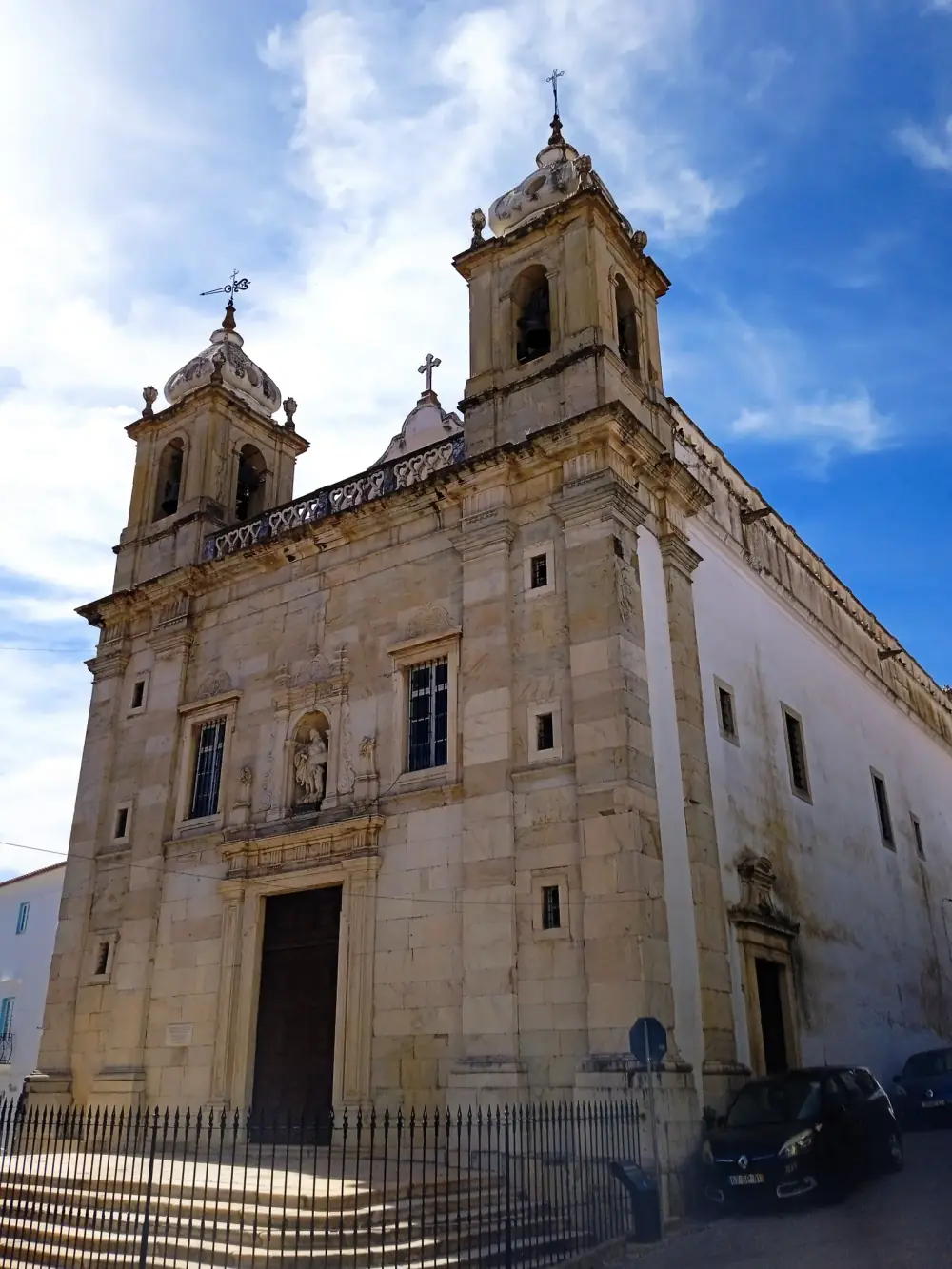
The churches were rebuilt as well. The old church of São João Baptista, from the sixteenth century, had been ruined by the explosion. A new one was raised on its remains to a design by the architect Sebastião Soares, octagonal, with two towers and an interior of two-coloured marble. The municipality dates it to 1747 and credits its foundation to João V.
The chapel of bones
Against the parish church of Nossa Senhora da Expectação, built between 1570 and 1646, stands a small baroque chapel whose interior is lined with human skulls and bones. Little is known about how it was built. The municipality thinks the Confraria das Almas, a lay brotherhood devoted to the souls of the dead, had it made around 1766.
It follows the model of the much better-known Capela dos Ossos at the church of São Francisco in Évora, and the municipality says it is the largest in Portugal after Évora's. In February 2020 the mayor, João Muacho, announced a €231,000 restoration, agreed with the parish that owns it, after decades in which nobody had touched the building.
Paper flowers for the patron saint
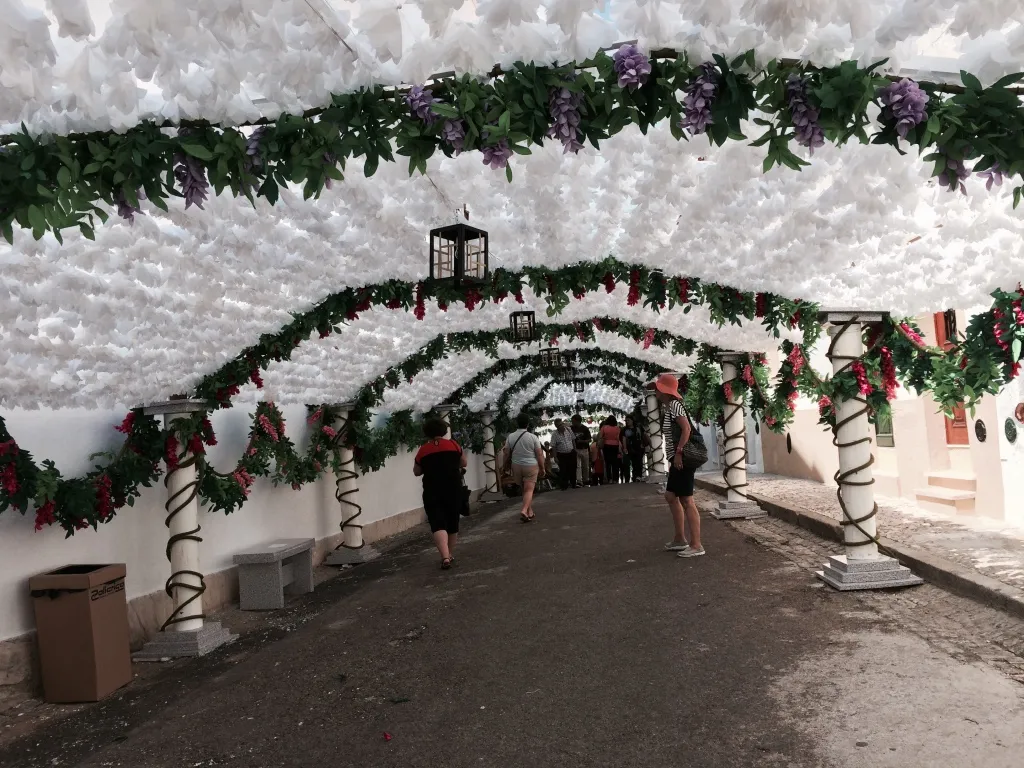
The town rebuilt after 1732 is better known today for paper flowers. In the Festas do Povo, the People's Festival, residents spend months making paper flowers and then, in a single night, roof their streets with them. Each street chooses a cabeça de rua, a kind of team captain, to lead the work.
The festival has no fixed calendar. It happens, people say, when the people want it. The team that prepared its UNESCO bid traced it to the cult of São João Baptista, the patron saint. An Observador feature of 2026 says the saint's feast was held on 28 October, the day the town was freed from the 1712 siege, and that local shopkeepers, craftsmen and workers organised the festivities in 1893, decorated the streets with greenery, lights and the first paper ornaments the next year, and gave them the name Festas do Povo in 1922.
In 2015 some 4,000 to 5,000 residents took part, using about 30 tonnes of paper, wire, wood and card. On 15 December 2021 UNESCO inscribed the festival as Intangible Cultural Heritage of Humanity. It returned from 8 to 16 August 2026, the first edition since 2015, with 101 decorated streets.
Why it still matters
Nothing is left of the medieval town that stood inside the old enclosure around the castle. What replaced it after 1732 was organised around a new civic square, rebuilt churches and new military stores on the hill, and much of old Campo Maior dates from those years.
In the castle, now part of the interpretation centre for the bastioned fortifications, a room called the Sala do Silêncio, the Room of Silence, remembers the victims. The governor's 256 is the count of the man in charge on the spot; the 800 often repeated has no source from the time.
FAQs
What caused the Campo Maior explosion of 1732?
Lightning. During a thunderstorm in the early hours of 16 September 1732, a bolt hit the great tower of the castle of Campo Maior, which was used as a powder magazine. It held 5,743 arrobas of gunpowder, about 84 tonnes, with grenades and bombs, and the whole store exploded.
How many people died in the Campo Maior explosion?
The governor of the town, Estêvão da Gama, counted 256 dead and more than 2,000 injured. Letters written three days later reported 200 bodies recovered, with more still under the ruins, and the municipality today cites local records giving 316. The figure of about 800, linked to the Capela dos Ossos, has no contemporary support.
Are the bones in Campo Maior's Capela dos Ossos from the explosion?
Probably not. Tradition says so, but study during the chapel's restoration found no signs of violent injury on the bones. The municipality thinks they came from the parish churchyard, which was redesigned when the town was rebuilt after 1732, and the chapel itself dates from around 1766.
How much of Campo Maior was destroyed in 1732?
By the governor's count, 836 of the town's 1,076 houses collapsed and the rest lost their roofs; a Lisbon chronicle of 1744 gives 823 houses demolished. The castle keep was blown away and never rebuilt, and churches, convents and hospitals were badly damaged.
Are the Festas do Povo connected to the 1732 explosion?
Not directly. The paper-flower festival grew out of the feasts of the town's patron saint, São João Baptista, which one 2026 account links to the end of the 1712 siege, and took its present name in 1922. It is held only when the townspeople decide to, most recently in August 2026, and UNESCO listed it in 2021.
On the timeline
Open the timelineNearby moments from restoration and the gold of brazil (1640–1750).
Death at the Convent of the Conception in Beja of Sister Mariana Alcoforado, 83, the nun long named as the author of the 'Letters of a Portuguese Nun', five anguished love letters to a French officer published in Paris in 1669. Most scholars now credit them to the French courtier Guilleragues, though some still defend her authorship.
On his forty-first birthday, João V attends the consecration of the basilica of the Palace-Convent of Mafra, begun in 1717 in fulfilment of a vow he had made for children; the ceremonies lasted eight days. The vast building was paid for with gold from Brazil.
Birth in Coimbra of Joaquim Machado de Castro, Portugal's leading sculptor of the 18th century. His masterpiece, the equestrian statue of King José I, cast in brass in a single pour and unveiled on 6 June 1775, still presides over the rebuilt Praça do Comércio — the symbolic centrepiece of Pombal's Lisbon after the earthquake.
The Campo Maior explosion (1732)
In the early hours, lightning strikes the castle keep of Campo Maior in the Alentejo, used as a powder magazine holding 5,743 arrobas (about 84 tonnes) of gunpowder. By the governor's count the blast kills 256 people and brings down 836 of the town's 1,076 houses.
Diogo Inácio de Pina Manique is born in Lisbon. As Intendant-General of Police under Queen Maria I he introduced public street lighting and modern policing to Lisbon and founded the Casa Pia in 1780 to educate orphaned and abandoned children.
Maria Francisca, the future Maria I, is born in Lisbon. She became Portugal's first undisputed queen regnant in 1777, but after a mental collapse in 1792 (George III's doctor, Francis Willis, was summoned from England to treat her) her son João governed in her name, becoming formal regent in 1799.
The playwright António José da Silva, known as 'o Judeu', is sentenced as a relapsed Judaiser at an auto-da-fé in Lisbon's São Domingos church, then garrotted and his body burned. Born in Rio de Janeiro, he wrote comic operas for puppets that were staged with great success at the Bairro Alto theatre.
Coming up in history
All long reads
17 sources
Archives, scholarship and reporting this article was checked against.
- 1
Lisboa 25 de Septiembre de 1732, Gaceta de Madrid no. 41, 14 October 1732, pp. 175–176Agencia Estatal Boletín Oficial del Estado, Gazeta historical collection (BOE-A-1732-328)
- 2
Anno historico, diario portuguez, noticia abreviada de pessoas grandes, e cousas notaveis de Portugal, vol. III (Francisco de Santa Maria; Lourenço Justiniano da Anunciação)Officina de Domingos Gonsalves, Lisbon, 1744 (Internet Archive scan, University of Toronto copy)
- 3
Cidade de pólvora em tempos de guerra e de paz: estratégia urbana e arquitectónica para Campo Maior (João Mário Coelho Espada Catarrunas, integrated master's dissertation in architecture)Faculdade de Ciências e Tecnologia, Universidade de Coimbra, 2015
- 4
Capela dos OssosMunicípio de Campo Maior
- 5
Requalificação da Fortificação Abaluartada de Campo Maior: soluções técnicas de reabilitação (Alexandra Margarida Pinheiro Rodrigues, master's dissertation in civil engineering)Universidade da Beira Interior, 2021
- 6
- 7
- 8
arrobaDicionário Priberam da Língua Portuguesa
- 9
Campo Maior vai reabilitar Capela dos OssosDiário do Alentejo, 15 February 2020
- 10
- 11
- 12Festas do Povo de Campo Maior classificadas pela UNESCO como Património Cultural Imaterial (Lusa)Diário de Notícias, 15 December 2021
- 13
Onze anos de silêncio, uma noite para florir: como Campo Maior plantou o maior jardim de papel do mundo24notícias (SAPO), August 2026
- 14Festas do Povo em Campo MaiorObservador, 2026 (first published in DDD, the magazine of Delta Cafés)
- 15Flores de papel de Campo Maior na UNESCO e “no sangue” do povo raiano (Lusa)Diário de Notícias, 11 December 2021
- 16
Completam-se hoje os 289 anos da explosão do paiol da pólvora instalado na Torre de Menagem do Castelo de Campo Maior (Augusta Serrano)Rádio Campanário, 16 September 2021
- 17
Image credits
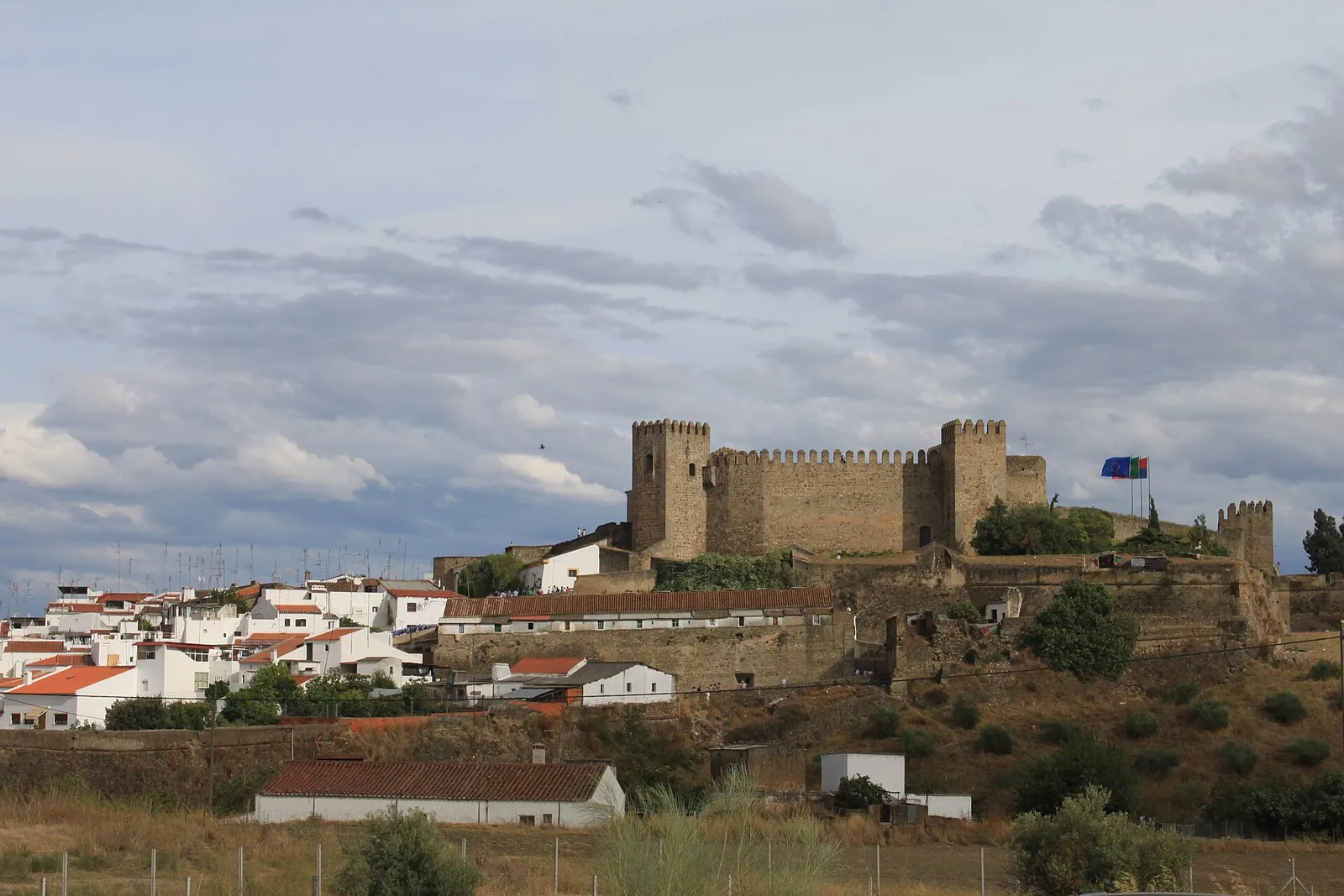
- The castle of Campo Maior above the town in 2011. The tall keep that held the powder in 1732 was never rebuilt; the walls and towers seen here are what was restored afterwards. Pmvandrade, CC BY-SA 4.0, via Wikimedia Commons.
- Plan of the Spanish siege of Campo Maior in 1712, from a manuscript book of plans of Portugal and Castile compiled between 1699 and 1743. The zigzag lines are the besiegers' trenches; the ring of bastions built after 1645 encloses the town. João Tomás Correia, Public domain, via Wikimedia Commons.
- Campo Maior from the north, drawn by Duarte de Armas for King Manuel I's Livro das Fortalezas, the book of border fortresses, around 1509 to 1510. The tall square tower flying the royal banner is the keep, the “great tower” that held the powder in 1732. Duarte de Armas, CC BY-SA 3.0, via Wikimedia Commons.
- The church of São João Baptista, dated to 1747 and built on the remains of the sixteenth-century church that the explosion destroyed. Kani, CC0, via Wikimedia Commons.
- A skeleton in a niche of the Capela dos Ossos, photographed in 2026. The chapel was lined with bones around 1766; tradition says they belong to the victims of 1732, but the restoration found no evidence of it. Kani, CC0, via Wikimedia Commons.
- A street decorated with paper flowers for the Festas do Povo on 22 August 2015, the last edition before 2026. Rui Beja, CC BY-SA 4.0, via Wikimedia Commons.