

Josefa de Óbidos: the woman who ran a painter's business in Baroque Portugal
Born in Seville and trained in her father's workshop, Josefa de Ayala painted cakes, lambs and saints in a walled town north of Lisbon, signed her own contracts and lent money at interest. Three centuries of critics patronised her. Museums are now buying her.
At a glance
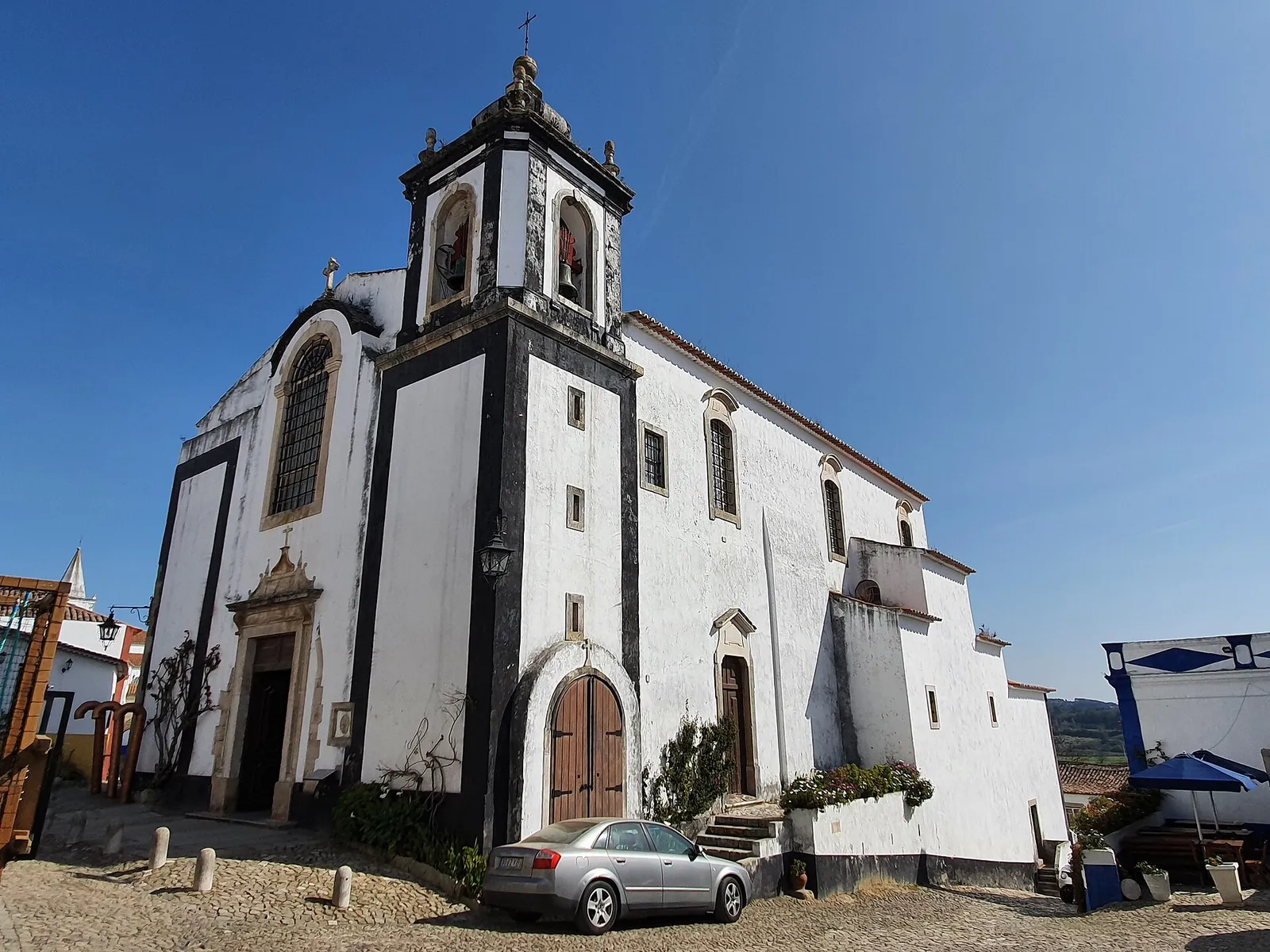
- Josefa de Óbidos died in Óbidos on Saturday 22 July 1684, aged 54, and was buried in the church of São Pedro, across the street from her house.
- She was baptised Josefa de Ayala in Seville on 20 February 1630, the daughter of the Portuguese painter Baltazar Gomes Figueira, and grew up in Óbidos from 1636.
- She trained in her father's workshop, made her first known engraving at 16 and painted small oils on copper, still lifes and altarpieces for convents across central Portugal.
- As a donzela emancipada, an unmarried woman freed by her father to act for herself, she signed contracts, bought land and mills and lent money at interest.
- About 150 works are attributed to her. The Louvre, Norway's National Museum and the Meadows Museum in Dallas have acquired paintings by her since 2016.
A Saturday in Óbidos, July 1684
On 13 June 1684 Josefa de Ayala, a painter of 54 who lived in the walled town of Óbidos, made her will. It described her as a virgin who had never married and who had been emancipated with her parents' consent. Thirty-nine days later, on Saturday 22 July 1684, she died.
It was the feast day of Mary Magdalene, one of the saints Josefa painted most often: as a penitent lit by a single oil lamp, as one of the brides of Christ at the top of her first large altarpiece, and comforted by angels in a small copper that now hangs in the Louvre.
She died rich. Her home was a large house on the Rua Direita, opposite the church of São Pedro, which she shared with her servants and, later, her orphaned nieces. The inventory drawn up after her death is full of velvet and oriental silk clothes, lace, gloves, silver and gold embroidery and a good deal of jewellery. She also owned farmland and mills.
She was buried across the street, in São Pedro. The art historian Julia K. Dabbs notes that she was laid out in the habit of a Poor Clare, a sign that she may have been a lay member of the Franciscan order. She had kept working almost to the end: one of her pictures of the Christ Child is dated 1684.
Josefa de Óbidos, as she is known, worked in a trade that was almost entirely male. The Museu Nacional de Arte Antiga (MNAA), Portugal's national museum of old art, calls her the only professional woman painter of her time in Portugal, with her own workshop and important commissions. About 150 works are attributed to her: still lifes of cakes and cherries, altarpieces for convents, and small, jewel-like pictures of the Christ Child and the Lamb of God.
For three centuries critics mostly treated her as a curiosity. Since 2016 the Louvre, Norway's National Museum and a museum in Dallas have added her to their walls.
A soldier-painter's daughter from Seville
Her father, Baltazar Gomes Figueira, was a soldier from Óbidos, born in 1604. In the mid-1620s, during the war between Spain and England, he joined a Portuguese contingent sent to help defend Cádiz. Joaquim Oliveira Caetano, the MNAA's curator of painting, dates this to 1624; the museum's 2015 exhibition material says 1625.
A few years later he was living in Seville, where he met Juan Ortiz de Ayala, an ensign with a taste for painting. At the end of 1629 Baltazar married his daughter, Catalina, probably in a hurry.
Their first child, Josefa, was baptised in the church of San Vicente on 20 February 1630. Her godfather was Francisco de Herrera the Elder, the leading painter in Seville, with whom Baltazar may already have been training. The baptismal record calls Baltazar a painter, but he received his licence from the city's examiners only on 13 June 1631, when they described him as a young man of 27 “of good body with straight teeth”.
Seville did not go well for him. He was arrested for debt in 1633, and the next year a wealthy Portuguese merchant in the city had to stand guarantor for new debts. In 1634 Baltazar took his wife and two small daughters, Josefa and Luísa, back to Portugal. They lived first in Peniche, on the coast, where his brother, the merchant António Gomes Figueira, helped him to his first church commissions. In 1636 they settled for good in a house on the Rua Nova in Óbidos.
- Baptised
- 20 February 1630, church of San Vicente, Seville
- Died
- Saturday 22 July 1684, Óbidos, aged 54
- Father
- Baltazar Gomes Figueira (1604–1674), painter, born in Óbidos
- Mother
- Catalina de Ayala, daughter of the ensign Juan Ortiz de Ayala (Caetano gives her surnames as Camacho de Cabrera y Romero)
- Godfather
- Francisco de Herrera the Elder, painter of Seville
- Signature
- “Josepha”, often “Josepha em Óbidos”, with a date
- Works
- About 150 attributed
Apprentice in her father's workshop
Baltazar brought two things back from Seville that made his name in a small town far from Lisbon. One was a large collection of prints, which father and daughter copied and adapted all their lives. The other was the still life, a genre hardly known in Portugal before him, composed and lit in the Sevillian manner of Juan Sánchez Cotán, with food and objects set out on a dark ledge.
Josefa learned in his studio. In 1644 Baltazar was hired to paint a large altarpiece for the church of the Augustinians in Coimbra, and she went with him, lodging at the convent of Santa Ana. There, at 16, she made her first known work, an engraving of Saint Catherine. In 1653 she engraved a figure of Wisdom for the university's new statutes, printed in 1654. The university paid her father, a sign that she worked inside the family business.
Her earliest dated paintings, from 1647, are small oils on copper. One, a Mystic Marriage of Saint Catherine in the MNAA in Lisbon, follows a composition by Titian that she knew from an engraving. Another Mystic Marriage on copper, also dated 1647, was bought by Norway's National Museum in Oslo in 2022.
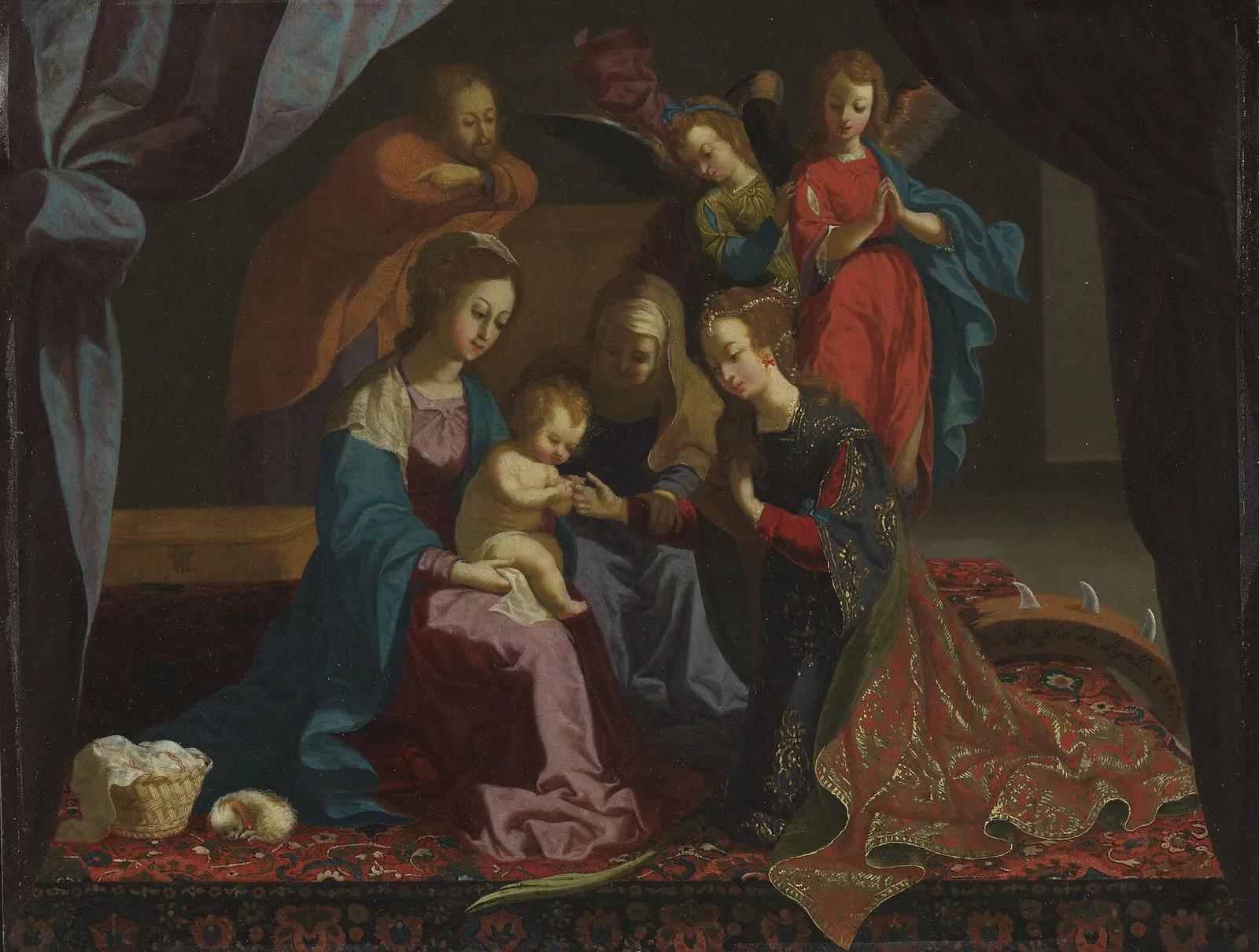
For the next 15 years almost everything known by her is in this format: small coppers for private devotion, painted with a miniaturist's care for jewels, lace and the sheen of fabric. A Virgin and Child of 1657 in the MNAA is a good example. A Penitent Magdalene in Coimbra still has a note on the back about copper plates bought by her father.
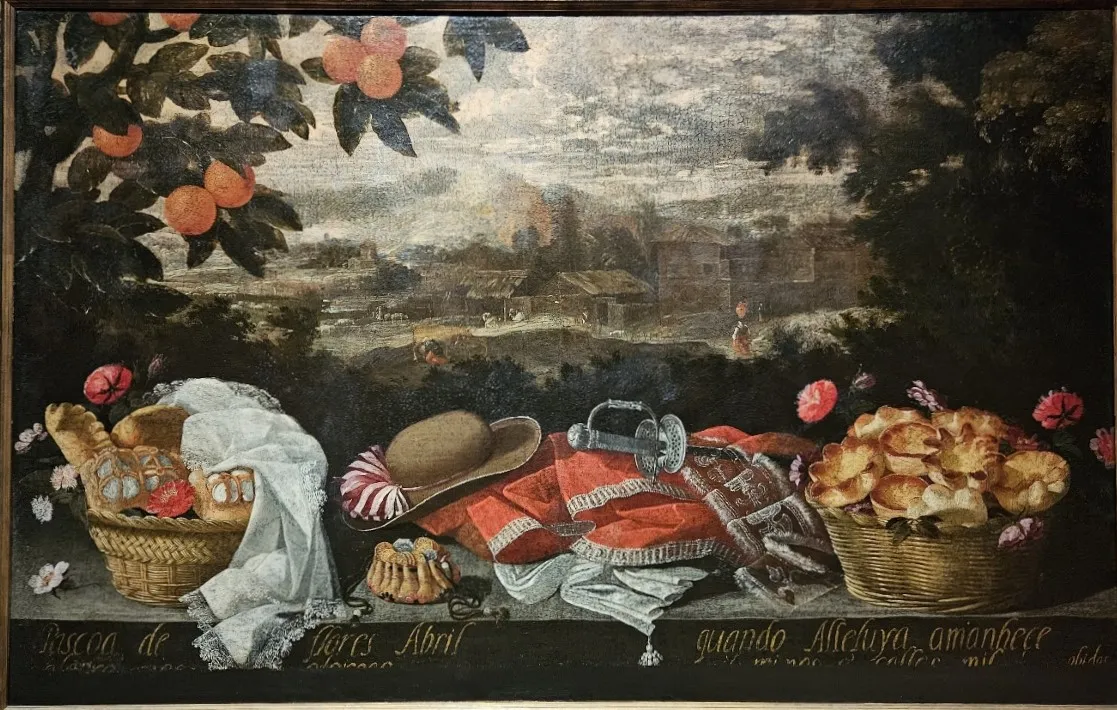
The workshop explains how the Óbidos still lifes were made. The family kept a stock of small model pictures of fruit baskets, trays of sweets, flower vases, glass and pottery, and recombined them on larger canvases. Baskets of cherries, plates of cheese, bowls of cakes and baskets of Easter bread turn up again and again. In 1668 father and daughter probably painted together a series of the months of the year, now scattered.
“She did not understand perspective well, and diminished colour.”
It was a fair point. Her figures tend to fill the picture against plain dark grounds, clouds or curtains, a way round the deep spaces she found hard. Her strength was objects, and the cloth, lace and jewels she plainly loved to paint.
Altarpieces, contracts and an emancipated maiden
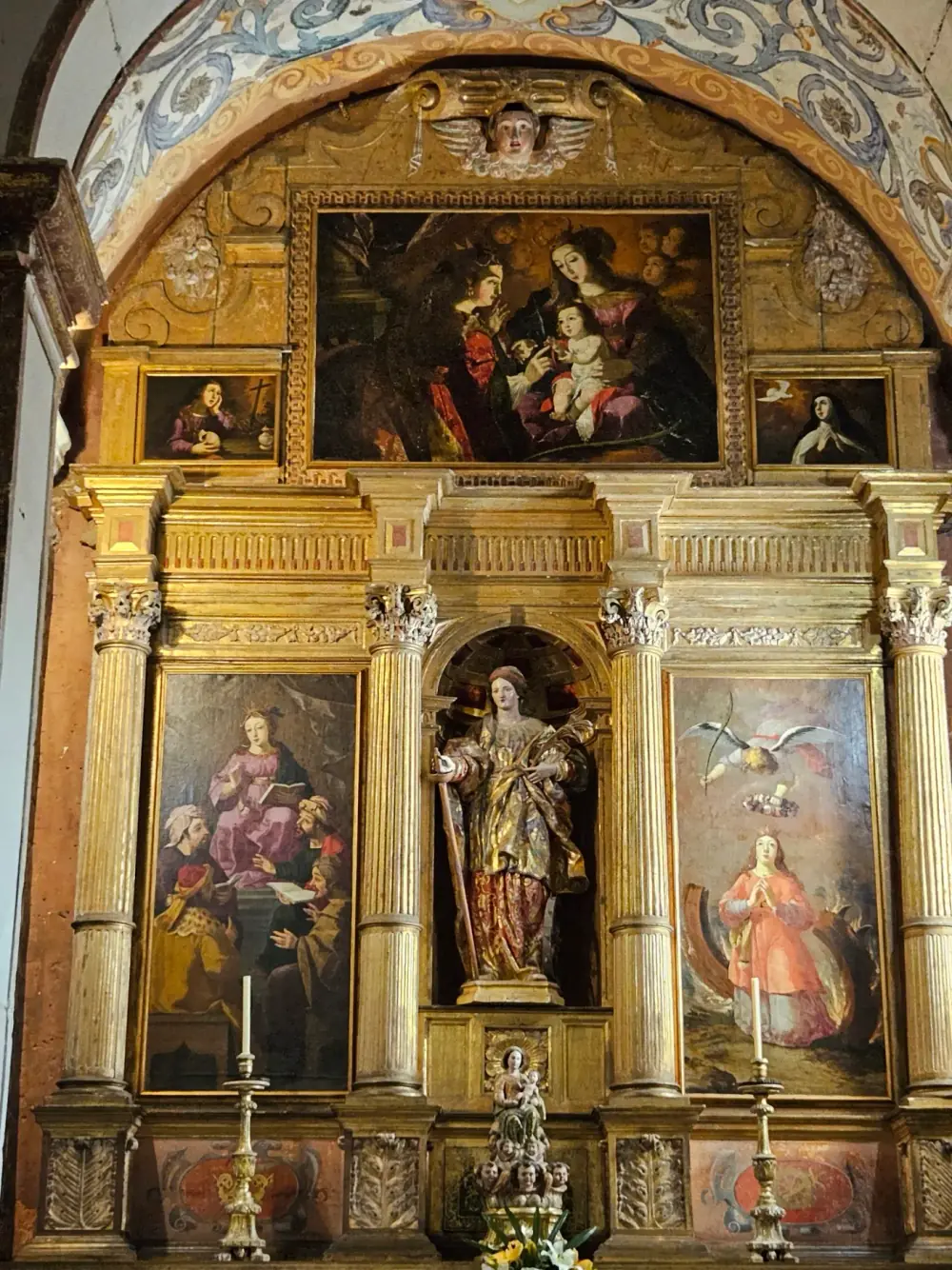
The turning point came in 1661, when Josefa painted the altarpiece of Saint Catherine for the church of Santa Maria in Óbidos. It is still there in its gilded carving. Side panels show the saint arguing with the scholars of Alexandria and the wheel meant to torture her breaking apart. At the top is a large Mystic Marriage, flanked by small busts of Mary Magdalene and Saint Teresa of Ávila.
Big commissions needed notarial contracts, and in seventeenth-century Portugal a woman could not sign one without the consent of a guardian, normally her father or a brother. Widows were the exception. The other way out was emancipation, by which a father gave his daughter legal independence, putting her in much the same position as a widow. Josefa appears in the documents as a donzela emancipada, an emancipated maiden.
Nobody knows exactly when. Caetano places it in the early 1660s, because her altarpiece work and her property deals start then. The MNAA's 2015 press release says she was about 30, the Meadows Museum in Dallas says 29, and the Diário de Notícias reported in 2016 that her father emancipated her at 30. Carmen Ripollés, in the first monograph on her in English, puts it in her mid-thirties, which would mean the mid-1660s.
Freedom to sign was also freedom to trade. Josefa bought freehold and leased land, lent money at interest and bought up property and debts. The war with Spain had brought very high inflation, and peasants were short of cash, so high-interest loans made her and other members of her family rich quickly. She came to own farmland, mills and the large house on the Rua Direita.
Her family scattered around her. Her sister Antónia married the painter José Pereira da Costa in 1659, and Basília married and moved to Cadaval. Both brothers took religious vows; António, who also painted, became a Cistercian monk at Alcobaça. Luísa, the sickly sister she had been close to since childhood, died on 1 January 1664.
| Year | Work | For |
|---|---|---|
| 1661 | Altarpiece of Saint Catherine | Church of Santa Maria, Óbidos (still in place) |
| 1664 | Holy Family | Carmelite convent of São José, Buçaco |
| 1669 | Adoration of the Shepherds | Convent of Santa Madalena, Alcobaça (now in the MNAA) |
| 1672 | Large cycle of paintings of Saint Teresa of Ávila | Carmelite convent, Cascais |
| 1673 | Vision of Saint John of the Cross | Carmelite college, Figueiró dos Vinhos |
| 1676 | Virgin and Child with Saint Anthony | Now in the Museu do Patriarcado, Lisbon |
| 1679 | Main altarpiece | Misericórdia, Peniche |
Undated commissions in the same list include Saints Justa and Rufina for the church of Columbeira, three canvases for São Brás da Dagorda, a Last Judgment for the Cistercian monastery of Cós and an altarpiece for the Hieronymite nuns of Vale Benfeito. The list prints the Patriarcado painting's date as 1576, a misprint: later in the essay Caetano dates it 1676. An altarpiece of the Holy Family in Egypt, printed as 1574 and not dated elsewhere, is left out.
Her most distant clients were all Carmelite houses, of the order reformed by Saint Teresa of Ávila: Buçaco, Figueiró dos Vinhos and Cascais. Teresa had argued that nuns should be able to keep their convents going by their own work, and Caetano suggests that this was a point Josefa would have noticed.
Cakes, lambs and the Christ Child
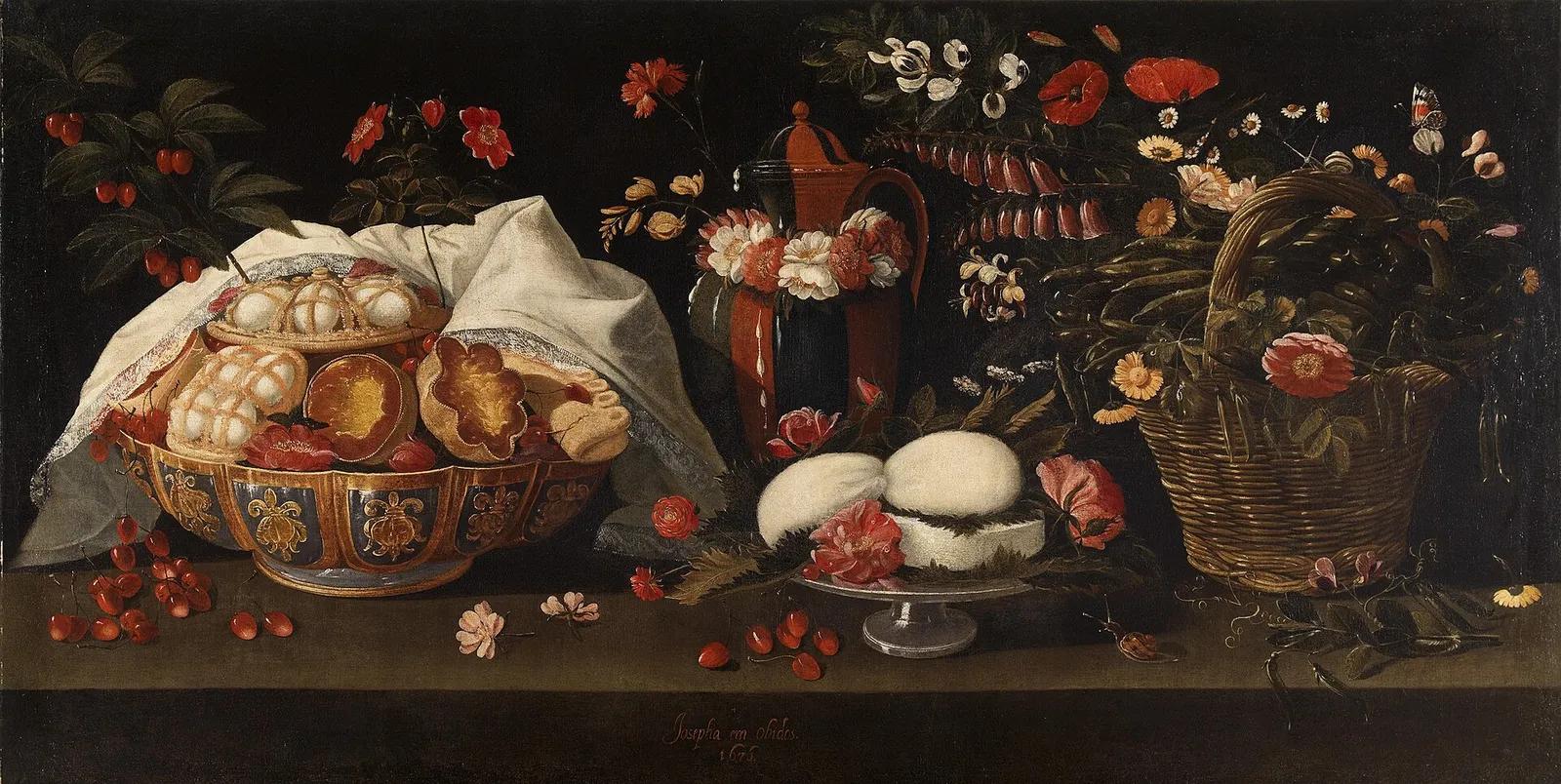
Baltazar died in 1674. In the decade that followed Josefa went back to small pictures on copper and to still lifes. The only still lifes she signed and dated herself belong to the 1670s, after his death, among them the canvas of 1676 at the top of this page.
They were more than displays of Óbidos sweets. When the Meadows Museum bought a still life of about 1680 in 2024, it pointed to fruit with biblical meanings: the melon, onions and cucumbers that fed the Israelites in the wilderness, the apple of Genesis and the grapes of the Eucharist, set among cherries, figs and flowers, with small insects crawling over them. Such meanings were widely known: in 1622 the friar Isidoro Barreira had published in Lisbon a treatise on the meanings of plants, flowers and fruit that stayed popular all century.
Her late religious pictures work the same way. She painted the Lamb of God again and again, its legs bound, lying on a ledge like a still-life object, and the Christ Child dressed in lace or as a pilgrim, framed by painted cartouches or wreaths of flowers. Such images could worry the clergy: the synodal constitutions of Évora of 1633 had forbidden pictures of the Christ Child “dressed in unholy attire”. There was a market for them all the same.
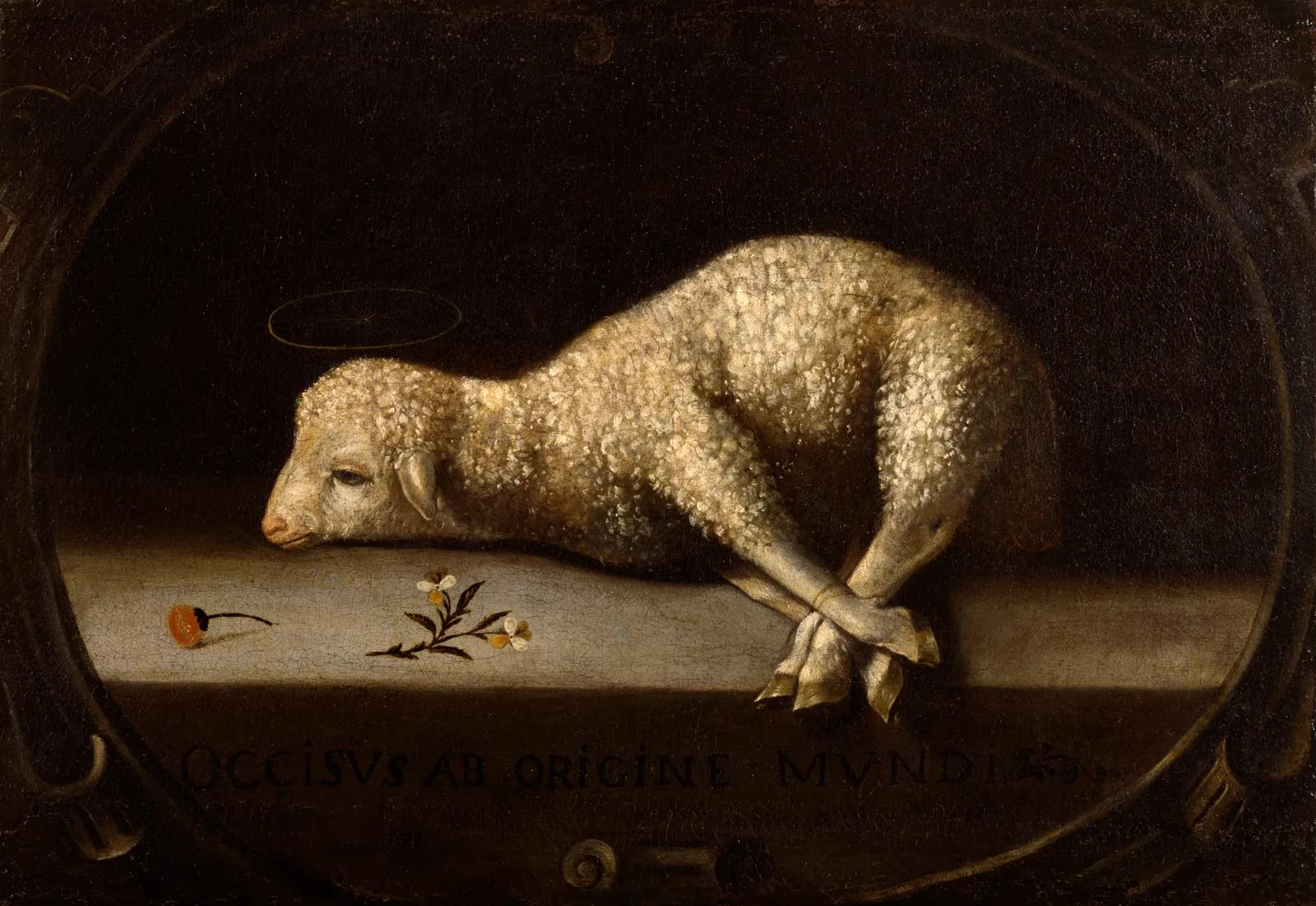
Critics later called this sweetness feminine and provincial. Caetano answers that Murillo and Carlo Dolci, two of her best-known male contemporaries, drew the same charge. Following the art historian Barbara von Barghahn, he points out that the “sweetness of God” was a devotional idea revived in the seventeenth century under the influence of Saint Teresa, whose writings shaped much of Josefa's late imagery.
“The greater part of the day and night, Dona Josefa spent learning from books, being most inclined especially to spiritual and devout works.”
From curiosity to the Louvre
Her reputation was bound up with her sex from the start. A little over 50 years after her death she was one of the famous Portuguese women profiled in Damião de Froes Perym's Theatro Heroino of 1736.
The MNAA gave her a first exhibition in 1949. The writer Miguel Torga went on 30 May and wrote in his diary that “this lady makes lace with brushes”, in Caetano's translation. In 1971, introducing a show in Óbidos that hung her work beside contemporary artists, Manuel Rio-Carvalho could still talk of “boys depicted like cakes”.
Serious study began in 1991, when the art historian Vítor Serrão curated a large exhibition, Josefa de Óbidos e o Tempo Barroco, at the Galeria de Pintura do Rei D. Luís in Lisbon. In 1997 the National Museum of Women in the Arts in Washington showed 47 of her paintings, the first exhibition about her in the United States.
In 2015 the MNAA gathered most of her known work in a show of more than 130 pieces, with loans from the Prado and the Escorial, and set out to replace the myth of a pious provincial with an emancipated, cultured woman.
1696
Félix da Costa Meesen faults her perspective
1736
Profiled among famous Portuguese women in Theatro Heroino
1949
First exhibition, at the MNAA in Lisbon
Miguel Torga dismisses her in his diary.
1971
Exhibition in Óbidos with contemporary artists
1991
Vítor Serrão's exhibition, Josefa de Óbidos e o Tempo Barroco
1997
47 paintings shown at the National Museum of Women in the Arts, Washington
16 May 2015
Josefa de Óbidos e a Invenção do Barroco Português opens at the MNAA
24 November 2016
Her Magdalene goes on show at the Louvre
2025
Carmen Ripollés publishes the first monograph on her in English
3 July 2026
Conference on her work at the National Gallery, London
Why she matters now
The art market found her at the same time as the scholars. Since 2015 three paintings by her have sold at auction for $200,000 or more each (the lowest, in 2016, was a hammer price of $200,000, or $250,000 with the buyer's premium), and three museums outside Portugal have acquired her work.
| Sale or purchase | Work | Price | Where it went |
|---|---|---|---|
| Sotheby's, New York, early 2015 | Penitent Magdalene comforted by angels, copper | $269,000 (€238,615) | Bought by the Paris dealer Philippe Mendes; given to the Louvre, on show from 24 November 2016 |
| Sotheby's, New York, 28 January 2016 | Holy Family with Saint John the Baptist, Saint Elizabeth and angels, copper, 1678 | $250,000 with buyer's premium (hammer price $200,000) | Museu da Misericórdia do Porto |
| Plückbaum, Bonn, 31 May to 1 June 2019 | Reading the Fate of the Christ Child, copper, 1667 | €220,000 (opening bid €25,000) | Now with the Jaime Eguiguren gallery, which showed it at the MNAA in September 2019; an agent for the Portuguese state tried to buy it |
| Bought from the Rafael Valls gallery, 2022 | Mystic Marriage of Saint Catherine, copper, 1647 | Not published | Nasjonalmuseet, Oslo |
| Announced 30 July 2024 | Still life, about 1680 | Not published | Meadows Museum, Dallas |
Prices as reported by Lusa in ECO (2016), Observador (2016) and Sábado (2019). The Holy Family is dated 1678 in the Lisbon press and 1679 by Caetano. Philippe Mendes appears as Filipe Mendes in some Portuguese reports.
When the Magdalene went up in the Louvre in November 2016 it hung beside a still life of 1645 by her father. The curator, Guillaume Kientz, said it was only the third Portuguese painting on show in the museum and that no other French public collection owned a work by her.
Portugal has not always kept up. The MNAA, which holds 15 of her works, the largest collection anywhere, stayed out of the 2016 New York sale; its deputy director said it already had good coppers from every phase of her career. In 2019 an agent acting for the state's heritage directorate tried to buy the 1667 copper in Bonn and failed.
Discoveries continue. In July 2025 Vanessa Henriques Antunes, a conservator at the state's José de Figueiredo laboratory, announced that while cleaning a badly damaged Christ Child at rest from the Palácio Nacional de Mafra she had found the signature “Josepha”, almost invisible to the eye, on the 30 per cent of the paint that survives. It confirmed an attribution Vítor Serrão had made earlier.
Unlike most Portuguese painters of her day, Caetano notes, she signed and dated many of her pictures, often with the words “Josepha em Óbidos”, Josefa in Óbidos. Born in Seville, she chose to be known by the small town where she lived and worked for nearly 50 years. Even so, signed pieces are rare enough that Sérgio Gorjão, director of the Mafra palace, said in 2025 the new signature put the Christ Child into “a very limited list of signed pieces” (translated from Portuguese).
FAQs
Why is she called Josefa de Óbidos if she was born in Seville?
Her baptismal name was Josefa de Ayala, after her mother's family. Her father brought the family back to Portugal in 1634 and settled in Óbidos, his home town, in 1636. She lived there for the rest of her life and often signed her paintings “Josepha em Óbidos”, partly, according to Carmen Ripollés, to set herself apart from her father.
Was Josefa de Óbidos a nun?
No. As a girl she lodged for a time at the convent of Santa Ana in Coimbra, where her father was working, and she was deeply devout, but she never took vows or married. As an emancipated maiden she lived independently in Óbidos with servants and nieces, signed contracts and ran a lending and property business.
How many paintings did Josefa de Óbidos make?
About 150 works are attributed to her, mostly still lifes and religious paintings, from tiny oils on copper to large altarpieces. Many are signed and dated. The Museu Nacional de Arte Antiga in Lisbon has 15, the largest single collection.
Who was Baltazar Gomes Figueira?
Josefa's father (1604–1674), a soldier from Óbidos who became a painter in Seville and introduced the Spanish-style still life to Portugal. He ran the family workshop in Óbidos, where Josefa trained and worked with him. A still life of his from 1645 hangs in the Louvre.
Where can I see Josefa de Óbidos's paintings?
In Portugal: the church of Santa Maria in Óbidos, the Museu Nacional de Arte Antiga in Lisbon, the parish church of Cascais and the national museum in Évora. Abroad: the Louvre in Paris, the Walters Art Museum in Baltimore, the National Museum in Oslo and the Meadows Museum in Dallas.
On the timeline
Open the timelineNearby moments from restoration and the gold of brazil (1640–1750).
Spain formally recognises Portuguese independence through the Treaty of Lisbon, ending the 28-year Portuguese Restoration War.
The Esnoga, the Portuguese Synagogue of Amsterdam, is inaugurated with great ceremony. It was built by a Sephardic community largely descended from Jews who had fled Portugal and its Inquisition, and it is still in use today, lit by candlelight during services.
Jesuit missionary Jerónimo Lobo dies in Lisbon. He had spent years in Ethiopia and in 1629 visited the source of the Blue Nile; an abridged English version of his account, 'A Voyage to Abyssinia' (1735), was the first book published by Samuel Johnson.
Death of Josefa de Óbidos
Death in Óbidos of Josefa de Óbidos, the Seville-born painter whom Lisbon's national museum of old art calls the only professional woman painter of her time in Portugal. Over nearly four decades she produced some 150 surviving works — still lifes, devotional paintings and church altarpieces — many of them signed and dated, often “Josepha em Óbidos”.
Zumbi, the last leader of the Quilombo dos Palmares — the largest community of escaped slaves in Portuguese Brazil, which held out in the hills of what is now Alagoas for most of the century — is ambushed and killed by colonial forces. Brazil marks the date as its Day of Black Consciousness.
An Omani army lays siege to Fort Jesus, Portugal's stronghold at Mombasa in today's Kenya. The siege lasts 33 months; hunger and disease kill thousands of defenders and refugees, and the fort's fall in December 1698 all but ends Portuguese power on the Swahili coast north of Mozambique.
Portugal and England sign the Methuen Treaty in Lisbon. Portugal lifts its ban on English woollen cloth, while Portuguese wine is to pay a third less duty in England than French wine. It helped make port Britain's wine, though critics blamed it for ruining Portugal's own textile industry.
Coming up in history
All long reads 24 July 18751875: the French president's ruling that kept Delagoa Bay Portuguese
 25 July 1139The Battle of Ourique, 1139: a raid, a victory and a miracle
 26 July 1582The Battle of Ponta Delgada, 26 July 1582: the Azores fight for Dom António
 27 July 1970The death of Salazar, 27 July 1970: the dictator who was never formally told
20 sources
Archives, scholarship and reporting this article was checked against.
- 1
Reading the Fate of the Christ Child: New Masterpiece by Josefa de Ayala (1630-1684) (Joaquim Oliveira Caetano)Jaime Eguiguren Art & Antiques, 2019
- 2
Meadows Museum announces acquisition of two paintings by Baroque-era women artistsMeadows Museum, Southern Methodist University, Dallas, 30 July 2024
- 3
de Ayala, Josefa (1630–1684) (Kendall W. Brown)Women in World History: A Biographical Encyclopedia (Gale), via Encyclopedia.com
- 4
The Sacred and the Profane: Josefa de Obidos of Portugal (1630-1684)National Museum of Women in the Arts, Washington DC (exhibition, 1997)
- 5Museu de Arte Antiga faz exposição sobre Josefa de Óbidos com 130 obrasObservador, 8 May 2015
- 6Josefa de Óbidos já está no Louvre (Lusa)ECO, 24 November 2016
- 7
Josefa de Óbidos (Carmen Ripollés)Getty Publications
- 8
Josefa de Óbidos: biography and worksThe Art Story
- 9
Josefa de Óbidos e a Invenção do Barroco Português (press release)Museu Nacional de Arte Antiga, Lisbon, May 2015
- 10
Apostle of the Apostles (Arthur Roche, on the feast of Saint Mary Magdalene)Congregation for Divine Worship and the Discipline of the Sacraments, Holy See, 2016
- 11
The painter who became a baroque star in Portugal (David Gelber, review of Carmen Ripollés, Josefa de Óbidos)Apollo, 21 October 2025
- 12
Josefa de Óbidos, The Mystic Marriage of Saint Catharine, 1647 (NMK.2022.0171)Nasjonalmuseet for kunst, arkitektur og design, Oslo
- 13
A short story of 1st December (José Miguel Sardica)Universidade Católica Portuguesa
- 14
“O Menino Jesus Salvador do Mundo” de Josefa de Óbidos (Obras de Referência da Cultura Portuguesa)Centro Nacional de Cultura, e-cultura
- 15
Josefa d'ÓbidosÓbidos Turismo, Município de Óbidos
- 16Filho de português licita Josefa de Óbidos por PortugalDiário de Notícias, 28 January 2016
- 17
Conference: Josefa de Óbidos, painter of the Portuguese Baroque (National Gallery, London, 3 July 2026)ARTES, Iberian and Latin American Visual Culture Group
- 18Quadro de Josefa de Óbidos leiloado em Nova Iorque fica em Portugal (Lusa)Observador, 29 January 2016
- 19
Pintura inédita de Josefa de Óbidos vendida por 220 mil euros na Alemanha (Lusa)Sábado, 1 June 2019
- 20Descoberta assinatura de Josefa d'Óbidos em pintura do Palácio Nacional de Mafra (Lusa)RTP Notícias, 25 July 2025
Image credits
- Still life with flowers, sweets and cherries, signed “Josepha em Obidos” and dated 1676, two years after her father's death. It belongs to the municipality of Santarém. Josefa de Óbidos, Public domain, via Wikimedia Commons.
- The Mystic Marriage of Saint Catherine, oil on copper, 27.8 by 36.3 centimetres, dated 1647, when Josefa was about 17. Norway's National Museum bought it in 2022. Josefa de Óbidos, Public domain, via Wikimedia Commons.
- April, from the series of the months of 1668 attributed to Baltazar Gomes Figueira and Josefa. The verse along the ledge calls April the “Easter of flowers”; the baskets hold breads and pastries. Museu Nacional de Arte Antiga, Lisbon, photographed in 2024. GualdimG, CC BY-SA 4.0, via Wikimedia Commons.
- The altarpiece of Saint Catherine in the church of Santa Maria, Óbidos, with Josefa's canvases of 1661 still in their original setting. Photographed in 2023. GualdimG, CC BY-SA 4.0, via Wikimedia Commons.
- The Sacrificial Lamb, painted between about 1670 and 1684. The inscription, Occisus ab origine mundi, calls Christ the lamb slain from the foundation of the world. Henry Walters bought it in Rome in 1902; it is now in the Walters Art Museum, Baltimore. Josefa de Óbidos, Public domain, via Wikimedia Commons.
- The church of São Pedro in Óbidos, where Josefa was buried in 1684. Her house stood across the street on the Rua Direita. Photographed in 2022. GualdimG, CC BY-SA 4.0, via Wikimedia Commons.