

The Battle of Ourique, 1139: a raid, a victory and a miracle
Twelfth-century annals give the battle a few lines. Later writers added an acclamation on the field, a vision of Christ and the five shields of Portugal's arms.
At a glance
- On 25 July 1139, the feast of Saint James, Afonso Henriques, then ruler of the County of Portugal, defeated a Muslim army led by a man the Christian annals call Esmar, at a place they name Oric, Ouric or Aulic.
- The twelfth-century annals give the battle a few lines. One longer copy, which Herculano thought a later hand had embroidered, adds that the Portuguese, camped on a height, held out from morning to evening until picked knights charged and the enemy fled. Herculano found no Arabic chronicle that mentions it.
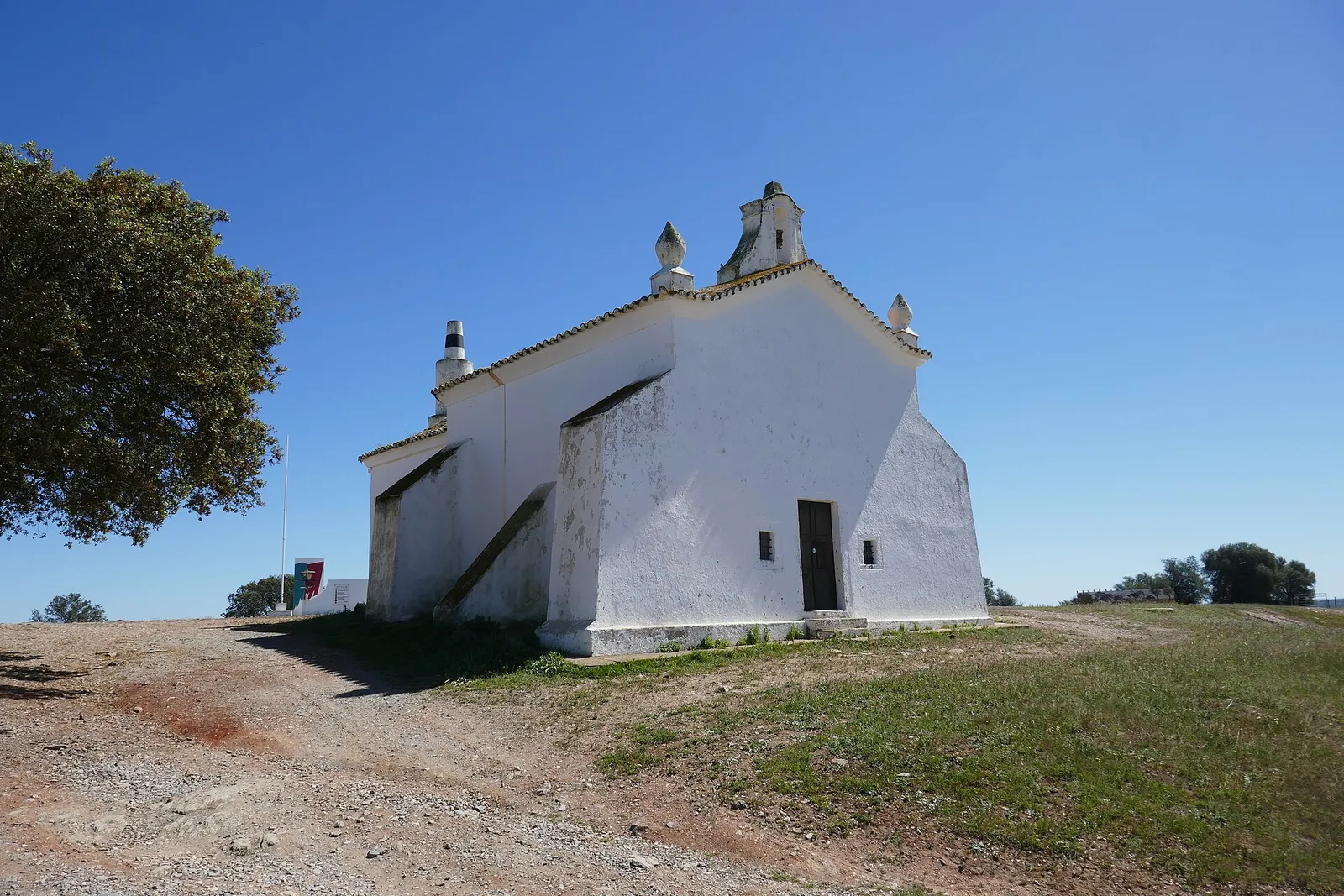
- Tradition puts the battlefield near Castro Verde in the Baixo Alentejo, a march of more than 250 kilometres through enemy territory. Other sites have been proposed, near Santarém, Leiria and Penela, and none can be proved.
- The story of Christ appearing to Afonso before the battle first appears in the Crónica de 1419. A supposed sworn statement by the king, printed at the end of the sixteenth century, was a forgery.
- Herculano found no document of 1139 that calls Afonso king, and José Mattoso dates the royal title in his charters to 1140. The earliest dated example Herculano found is a grant of 10 April 1140, after the encounter with Alfonso VII at Valdevez.
A hill on Saint James's day
In late July 1139, a small Christian army from Coimbra was camped on a hilltop, by the usual reading far inside Muslim territory, its tents pitched on the summit. Around it gathered a much larger force. From morning until evening, one version of the annals says, the Muslims tried to break into the camp.
Then a band of picked knights rode out, drove the attackers away from the tents and cut them down. Their leader, whom the Christians called King Esmar, saw that the Portuguese would rather win or die than run, and fled. A kinsman of his, Omar Atagor, was taken prisoner. Among the dead the victors found women who had fought, the chronicler wrote, “in the manner of the Amazons”.
The commander on the hill was Afonso Henriques, about thirty years old, who had ruled the County of Portugal since 1128. The day was 25 July, the feast of Saint James, the apostle venerated at Santiago de Compostela. A twelfth-century life of a Coimbra saint credits the victory to divine help and to Saint James's patronage.
That is close to everything the earliest sources say about the battle of Ourique, and the camp, the charge and the prisoner come from a single copy that Herculano thought a later hand had embroidered. Within four centuries the battle had become the moment God chose Portugal: Christ crucified appearing to him in the sky, the prince raised as king on the field, and five blue shields set on his arms in memory of five defeated kings.
A prince on the frontier
In 1139 Portugal was not yet a kingdom. It was a county reaching from the river Minho to the frontier south of Coimbra, held in theory from the king of León and Castile. Afonso had seized it from his mother, Teresa, and her Galician allies at the battle of São Mamede in 1128, and he had since moved his base south to Coimbra, the frontier city facing Muslim al-Andalus.
The frontier had been hard on the Portuguese. In December 1135 Afonso began building a castle at Leiria to stop raids on the fields of Coimbra, and the annals record a “misfortune” for the Christians at Tomar in 1137. His relations with his cousin Alfonso VII, who called himself emperor of Spain, swung between war and uneasy truce.
In 1139 the moment was good. Alfonso VII was besieging the Muslim fortress of Oreja, and the Almoravid commanders in Spain had failed to draw him away from it. Herculano found a knight's grant of 18 May 1139 that provided for his death “in the king's army”, a sign that men were gathering, and a grant of July in which the prince himself called the campaign a fossado.
What the twelfth century wrote
Herculano listed five short Latin texts as the only legitimate sources for the battle: three sets of annals, a saint's life and a witness's statement in a church lawsuit. They date by the Spanish Era, which runs 38 years ahead of the Christian calendar, so Era 1177 is 1139.
“On the eighth day before the Kalends of August, on the feast of Saint James the apostle, in the eleventh year of his reign, the same king Dom Afonso fought a great battle with a king of the Saracens named Esmar, in the place called Aulic.”
| Text | Written | Name of the place | What it adds |
|---|---|---|---|
| Chronicon Lamecense (Lamego annals) | Copied in 1262 from an older, probably twelfth-century, text | Oric | A battle between pagans and Christians; the pagan king, “Examare” in the Latin, escaped by flight |
| Chronicon Conimbricense (Coimbra annals) | Twelfth or early thirteenth century | Ouric | A lis magna, a “great fight”; “Esmar” defeated and fled |
| Life of Saint Theotonius | Twelfth century, by a disciple of the saint | Haulich | Five pagan kings with countless men from both sides of the sea; victory with divine help and Saint James's patronage |
| Chronica Gothorum (Annals of the Goths) | Twelfth century | Aulic, “then the heart of the land of the Saracens” | Women warriors among the dead; in a longer copy, the camp on a height, the knights' charge and the prisoner Omar Atagor |
| Inquiry in the Braga–Toledo primacy dispute | Not dated by Herculano | Aurich | A witness dates his age by “the time of the battle of Aurich” |
As listed and dated by Herculano in note XVI of his História de Portugal. Herculano trusted the shorter copies of the Chronica Gothorum from Alcobaça and Santa Cruz; the longer copy, once owned by André de Resende, he thought had been embroidered by a later hand.
The five kings come from the Life of Saint Theotonius, the first prior of Santa Cruz in Coimbra, written by a monk who had known him. Herculano warned against reading too much into it: Christian chroniclers gave the title of king to any Muslim chief, and governors of districts and commanders of castles were often promoted to “kings” in Latin annals.
Who Esmar was is unknown; the Lamego annals spell the name Examare, and Galvão and Camões later wrote Ismar. Herculano suggested the name was a corruption of Omar or Ismael and pointed out that it appears in no Arabic history; neither does a prisoner called Omar Atagor, though the longer copy of the Chronica Gothorum makes him a relative of Esmar and of the Almoravid ruler Ali. RTP's history service suggests the Muslim army may have been led by the governor of Santarém.
- Date
- 25 July 1139 (Era 1177), feast of Saint James
- Christian leader
- Afonso Henriques, prince of the Portuguese
- Muslim leader
- “Esmar”, not identified in Arabic sources
- Place
- Oric, Ouric, Aulic or Haulich; traditionally near Castro Verde
- Outcome
- Portuguese victory; no town taken
- Royal title
- In his charters from 1140; earliest dated example found by Herculano, 10 April 1140
The disputed battlefield
The annals name the place but give no landmark except the Chronica Gothorum's “heart of the land of the Saracens”. Herculano placed it near the castle the Arabs called Orik, in the rolling country south of Beja, where the plains rise towards the hills of the Algarve. A tradition already recorded in the fourteenth century, Mattoso noted, put the battle in the Alentejo, and a fifteenth-century compilation of notes from Santa Cruz in Coimbra sets it “beyond Castro Verde”.
The difficulty is distance. In his biography of Afonso Henriques, Mattoso put the question plainly: how could the prince cross more than 250 kilometres of enemy country without being intercepted? Herculano had noted that Afonso was still issuing grants in his own lands in early July, which leaves about twenty days to march south and fight.
Mattoso's answer was that such deep raids were not unheard of. The Almoravids kept their best troops in the frontier fortresses, and inland towns had small garrisons that shut themselves behind their walls when raiders came. The fourteenth-century tradition points to the Alentejo, he added, and there is no comparable tradition for any place north of the Tagus.
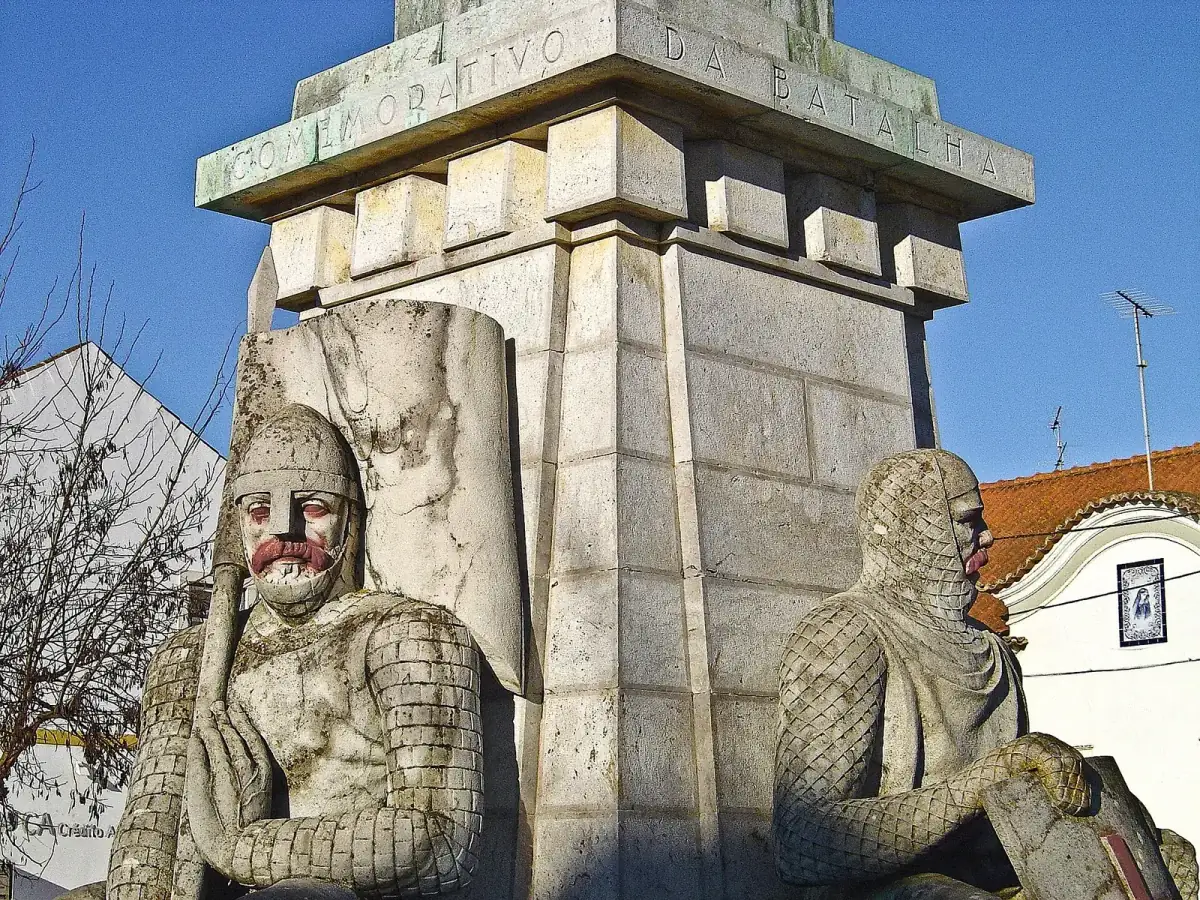
Others have looked closer to Coimbra. General Vitoriano José César argued for Vila Chã de Ourique, near Cartaxo in today's district of Santarém; Santarém itself was still a Muslim town in 1139. The parish raised a monument to the battle in 1932. The parish itself was called Casal de Ouro when it was created in 1907 and took its present name only in 1926.
| Place | Region | Proposed or defended by |
|---|---|---|
| Ourique and Castro Verde (São Pedro das Cabeças) | Baixo Alentejo | Fourteenth-century tradition; Herculano; Mattoso |
| Vila Chã de Ourique | Cartaxo, Ribatejo | General Vitoriano José César; according to the parish, also David Lopes |
| Campo de Ourique at Cortes | Near Leiria | José Saraiva, according to the parish; a 2016 review of a book by Jorge de Alarcão asks whether it was near Leiria |
| Lisbon | Estremadura | Borges de Figueiredo, according to the parish |
| Penela | South of Coimbra | Named among the candidates by the mayor of Ourique in 2009 |
Several places in Portugal are called Ourique. The arabist David Lopes derived the name from a Gothic personal name, Auricus; the Spanish arabist Eduardo Saavedra said he had never found it in Arabic documents.
The archaeologist Jorge de Alarcão reopened the question in a book called Ourique: o lugar controverso, “the disputed place”; a review of it in 2016 was titled “Was the battle of Ourique near Leiria?”. The quarrel is also local. In 2009, when Vila Chã staged a re-enactment on 25 July, the mayor of Ourique told the Diário de Notícias that the battle “was here, in the Alentejo”.
From a raid to a miracle
Herculano observed that no writer of the time outside Portugal, Christian or Muslim, mentions Ourique, not even Rodrigo of Toledo, who in the thirteenth century wrote a chapter on the Portuguese king's famous battles. In his view this showed that in the first half of that century the victory did not yet carry the weight later given to it.
In Portugal its weight grew. In the twelfth century writers counted Afonso's reign from São Mamede in 1128; by the fourteenth century Ourique had taken over as the founding moment. José Mattoso explained the shift in 1978: once national feeling sharpened in the war of independence of 1385, a battle between Christendom and Islam suited a sacred story far better than São Mamede.
Twelfth century
The annals
A battle on Saint James's day against Esmar; the Life of Saint Theotonius adds five pagan kings.
1316–1330
Order of Santiago
Articles sent to the pope say Afonso was taken as king by his nobles at Ourique: the oldest mention Herculano found.
Soon after 1340
Fourth Short Chronicle of Santa Cruz
After Ourique he called himself king and took the five quinas as his arms.
1344
Crónica Geral de Espanha
Treats Ourique as the most significant event in Portugal's origins, tied to the royal title.
1419
Crónica de Portugal de 1419
First account of Christ appearing to Afonso, announced by a hermit.
1505
Duarte Galvão
His chronicle for King Manuel I spreads the full legend, set at Cabeças de Rei near Castro Verde.
1572
Os Lusíadas
Camões puts the vision, the acclamation and the shields into the national epic.
Late 1590s
The “oath”
A sworn statement by the king, said to be just found at Alcobaça, is printed by Pedro de Mariz.
1632
Monarquia Lusitana
António Brandão makes Ourique the true cradle of the nation.
1846–1850
Herculano
His História de Portugal leaves out the miracle, and the clergy attack him.
The acclamation came first. Articles that the Portuguese branch of the Order of Santiago sent to the pope under its master Pero Escacho, between 1316 and 1330, say that Afonso “was raised to king by his nobles and other communities in the field of Ourique”. Herculano, who found the text, offered it to the “friends of traditions”, since it was written almost two centuries after the event.
The miracle came later. The Crónica de Portugal de 1419, which some scholars attribute to Fernão Lopes, is the first text known to describe it. On the eve of battle a hermit tells Afonso that when he hears the bell of the hermitage he should go out of his tent, and Christ will appear to him in the sky. He hears it, goes out and sees Christ on the cross.
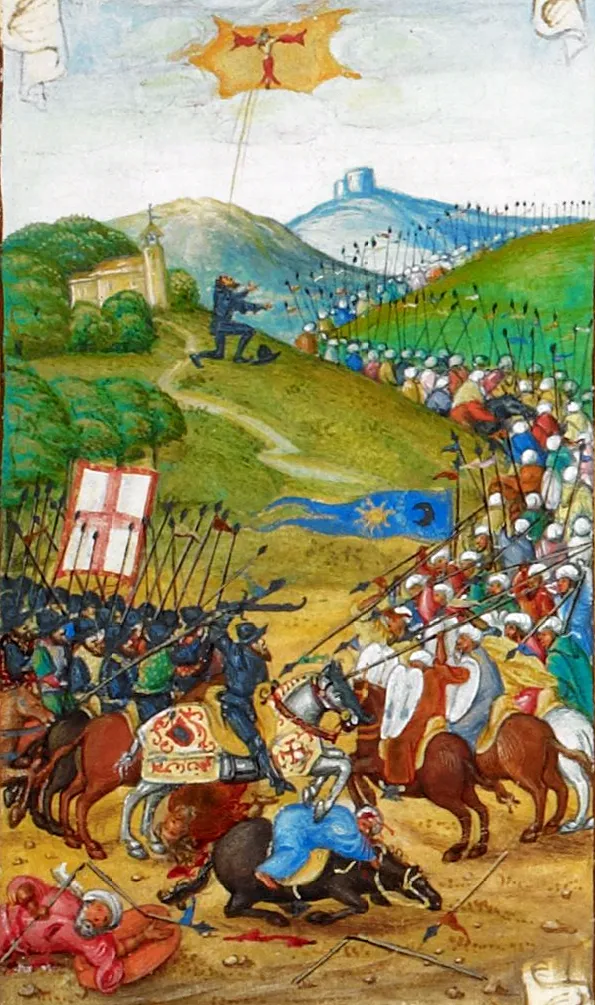
Duarte Galvão's chronicle of the king, written for Manuel I in 1505, gave the legend its classic form. He sets the hermitage at a place “now called Cabeças de Rei, next to Castro Verde”, and has Christ promise that Portugal will always be preserved as a kingdom. In the morning the nobles beg Afonso to let them make him king; he refuses, then gives in, and the army shouts its acclamation before a blow is struck.
“Royal, royal, for King Dom Afonso Henriques of Portugal!”
Galvão was precise about things no earlier source mentions. He gives Afonso four divisions totalling 10,000 foot and 1,000 horse, names their captains, and puts the Muslims at “little less than a hundred to one” in twelve divisions with four kings besides Ismar. The fighting, in his version, lasted until midday in great heat and dust. Tradition, Herculano wrote, eventually raised the number of the defeated to 400,000.
Afonso's army at Ourique, according to Duarte Galvão
men
- Foot soldiers
- Horsemen
Galvão's figures, written in 1505, more than 360 years after the battle, add up to 10,000 foot and 1,000 horse, as he says. No twelfth-century source gives any numbers; the longer copy of the Chronica Gothorum says only that Afonso was there with “few of his men”.
Show the data
| Foot soldiers | Horsemen | |
|---|---|---|
| Vanguard (Afonso) | 3,000 | 300 |
| Rearguard | 3,000 | 300 |
| Left (Mem Moniz) | 2,000 | 200 |
| Right (Martim Moniz) | 2,000 | 200 |
Camões took all this into Os Lusíadas in 1572: the camp on the field of Ourique, five Moorish kings led by Ismar, warrior women, Christ on the cross at dawn and the army crying “Royal, royal, for Afonso, high King of Portugal”.
A forged oath and five blue shields
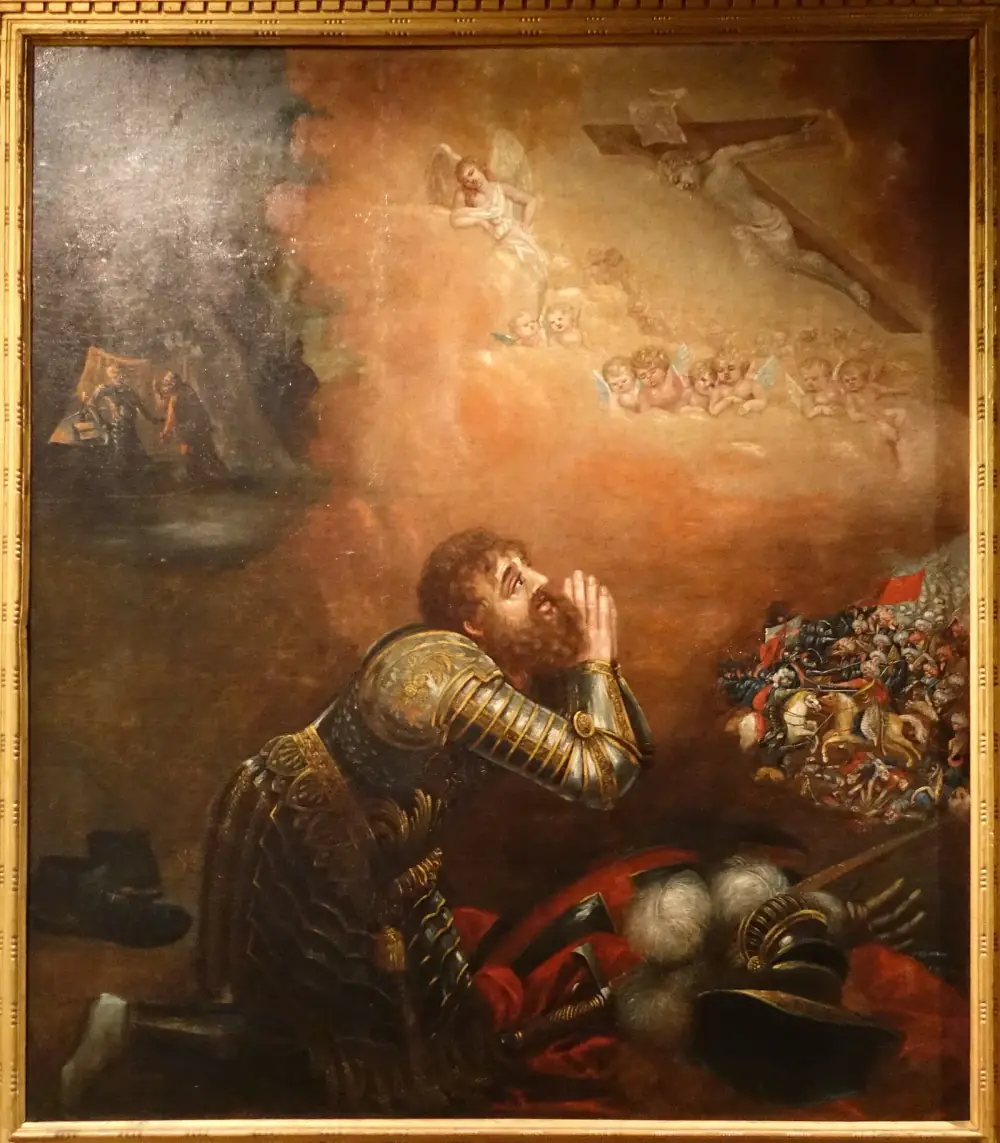
At the end of the sixteenth century the miracle acquired a document. In the second edition of his Diálogos de Vária História, Pedro de Mariz announced that the Cistercian monks of Alcobaça had just found in their archive a Latin text: a statement made by Afonso himself in Coimbra, years after the battle, before bishops and the whole court, swearing that Christ had appeared to him. Mariz printed it in Latin and Portuguese.
Bernardo de Brito, an Alcobaça monk and royal chronicler, built it into his Crónica de Cister, and the oath added a new element: a dream in which the hermit visits the sleeping prince before the vision. In 1632 Brito's successor António Brandão retold it in the Monarquia Lusitana, and after 1640, when Portugal broke away from Spain, Ourique became a central part of how the restored kingdom saw itself.
“I wish to found in you and in your descendants an empire for myself, through which my name will be made known among the most foreign nations.”
“It rests on a document so badly forged that the least instructed student of diplomatics would reject it as false at first sight.”
Herculano added that the original could be inspected in the national archive in Lisbon, and dismissed the Cortes of Lamego, the supposed founding assembly that also cited Ourique as the basis of Afonso's acclamation, as the invention of a sixteenth-century forger. Lima, a historian of the legend, calls the oath forged documentary proof made to legitimise the miracle.
The legend also explained Portugal's arms. In the Fourth Short Chronicle of Santa Cruz, written soon after 1340, Afonso takes “the five quinas” as his arms after Ourique. In the 1419 chronicle and in Galvão, he places a blue cross over his white shield and divides it into five small shields for the five kings he had beaten.
King by 1140
The documents are thinner than the legend but clear enough. When he wrote his note on the royal title, Herculano knew of no charter of Afonso's own between July 1139 and June 1140, and two private deeds of 19 August and 1 October 1139 still call him infante, the title of a king's child. He concluded that the title of king came in 1140, after Valdevez.
At Valdevez, in the Minho, Alfonso VII invaded with the armies of Castile and Galicia. The Chronica Gothorum describes no pitched battle: knights rode out from both camps to joust, the Portuguese took several of the emperor's nobles prisoner, and the emperor sent for the archbishop of Braga to make peace.
After finishing the note, Herculano received a copy of a grant from inside that gap, the first in the Liber Fidei cartulary of Braga in which Afonso calls himself king, “egregius rex”, the illustrious king. It is dated 10 April 1140, and among its witnesses is Fernando Furtado, the emperor's half-brother, who had been taken prisoner at Valdevez, so the encounter came before that date.
People had been calling him king for some time. A Latin chronicle of Alfonso VII says that after Teresa died in 1130 the Portuguese called her son king, “as he afterwards was”. Mattoso allowed that his knights may have acclaimed him on the field at Ourique, raising him on a shield as was the custom in Navarre, and again in the triumphal procession into Coimbra; from about 1140 his chancery uses the title.
Recognition took longer. After a meeting with Alfonso VII at Zamora in 1143, relations with León became peaceful, and the pope recognised Afonso's royal title only in 1179, six years before his death.
Why Ourique still matters
For four centuries Ourique was the founding story of Portugal. When Alexandre Herculano left the miracle out of his História de Portugal in 1846, clergy attacked him, and in 1850 the dispute broke out into what became known as the Ourique controversy. A pamphlet of 1851 set out to refute his view that Ourique was a mere raid that Arab historians did not record.
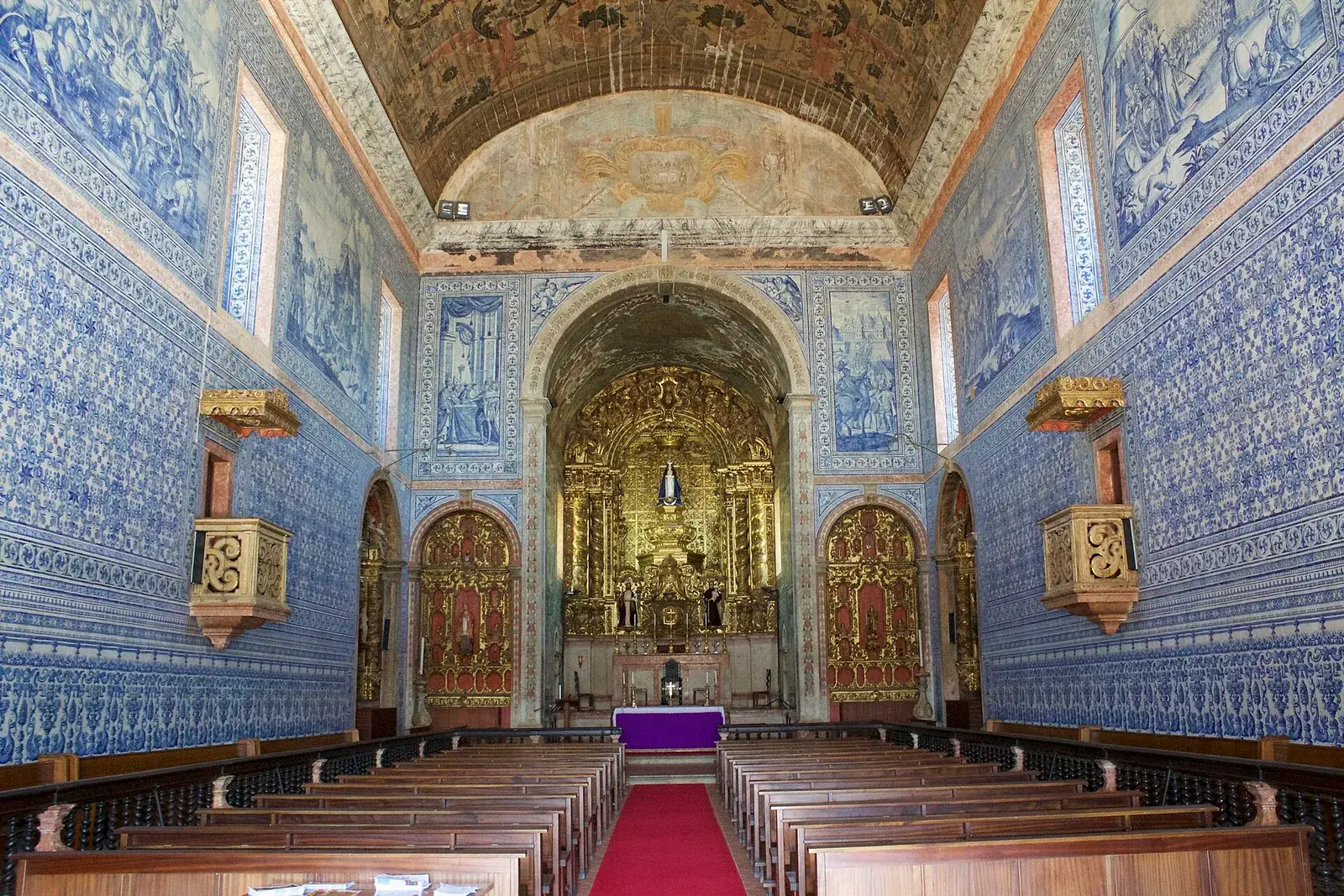
The battle is still the pride of the southern Alentejo. Castro Verde marks the anniversary every July at São Pedro das Cabeças, which the council calls a reference in Portuguese historiography as the site of the battle, and Ourique has a roundabout monument to the victory over the five Moorish kings. In 2021 the parish of Castro Verde put out to tender a €310,000 restoration of the basilica's painted ceiling of the miracle, 85 per cent funded by the EU.
The legend's most visible trace is the five blue shields at the centre of Portugal's arms, which appear on the national flag. The chroniclers explained them by the five defeated kings; the forged oath has Afonso adopt them in honour of the cross and the five wounds of Christ. Both readings date from centuries after 1139.
FAQs
When and where was the battle of Ourique?
On 25 July 1139, the feast of Saint James, according to Latin annals written in the twelfth century. They call the place Oric, Ouric or Aulic. A tradition recorded by the fourteenth century places it in the Alentejo, and later ones near Castro Verde and Ourique in the Baixo Alentejo, but other sites have been proposed near Santarém, Leiria and Penela.
Did Christ appear to Afonso Henriques at Ourique?
No source from the twelfth, thirteenth or fourteenth century says so. The apparition first appears in the Crónica de Portugal de 1419, and the king's sworn statement that seemed to confirm it, printed at the end of the sixteenth century, was a forgery. Herculano left the miracle out of his history in 1846.
Was Afonso Henriques crowned king at Ourique?
Not as far as documents show. Two deeds of August and October 1139 still call him infante, his charters use the royal title from 1140, and the earliest dated example Herculano found is of 10 April 1140. His men may have acclaimed him on the field, but the oldest text that says so was written between 1316 and 1330. The pope recognised him as king in 1179.
Who was King Esmar, and were there really five Moorish kings?
Esmar is the name the Christian annals give the Muslim commander; he cannot be identified in Arabic sources, which do not mention the battle. The five kings come from a twelfth-century life of Saint Theotonius, but Christian writers of the time called any Muslim governor or castle commander a king.
What do the five shields on the Portuguese flag have to do with Ourique?
According to the legend, Afonso put five blue shields on his arms for the five kings he beat at Ourique, with coins recalling the thirty pieces of silver paid to Judas. A chronicle written soon after 1340 first links the five quinas to Ourique, and the 1419 chronicle explains them by the five kings. The coins appear in Duarte Galvão's chronicle of 1505, and Camões repeated the story.
On the timeline
Open the timelineNearby moments from from county to kingdom (1096–1249).
Battle of São Mamede, near Guimarães. Afonso Henriques defeats the army of his mother Teresa and her Galician ally Fernão Peres de Trava and takes control of the County of Portugal. Since the nineteenth century the battle has been widely seen as the founding act of the future Kingdom of Portugal.
The Battle of Ourique
Battle of Ourique. On the feast day of Saint James, Afonso Henriques's army defeats a larger Muslim force under a commander the chronicles call 'Esmar', at a place tradition puts near Castro Verde in the Baixo Alentejo, though the site is disputed. Later tradition says his knights acclaimed him king on the field; his own charters first use the royal title in 1140.
By the Treaty of Zamora, Alfonso VII of León and Castile recognises his cousin Afonso Henriques as king, with the papal legate Cardinal Guido de Vico as mediator. The date is traditionally taken as the birth of the independent Kingdom of Portugal.
Afonso Henriques takes Muslim Santarém in a surprise attack before dawn: about 25 of his men climb the walls on two ladders and raise his banner, and a gate is broken open for the rest. The prize opens the road to Lisbon, which he captures that October.
The Siege of Lisbon begins. King Afonso I, having struck a deal with Northern European crusaders bound for the Second Crusade, opens the assault on the great Almoravid city on the Tagus. After almost four months the city falls on 25 October, becoming the future capital of the Kingdom of Portugal.
Coming up in history
All long reads 27 July 1970The death of Salazar, 27 July 1970: the dictator who was never formally told
 28 July 1723Mariana Alcoforado, the nun of Beja and the Portuguese Letters
 29 July 1180Fuas Roupinho and the sea fight off Cape Espichel, 1180
 30 July 1950Guilhermina Suggia, the cellist from Porto, dies at home: 30 July 1950
21 sources
Archives, scholarship and reporting this article was checked against.
- 1
Portugaliae Monumenta Historica: Scriptores, vol. I (Lisbon, Academia das Ciências, 1856): Chronicon Conimbricense, Chronica Gothorum and De expugnatione ScalabisInternet Archive (scan of the 1856 edition)
- 2
- 3
Chronica de El-Rei D. Affonso Henriques (Duarte Galvão), Bibliotheca de Classicos Portuguezes, vol. LI, Lisbon, 1906Project Gutenberg, from Biblioteca Nacional de Portugal scans
- 4
O milagre de Ourique ou um mito nacional de sobrevivência (Luís Carmelo)Universidade Autónoma de Lisboa; Biblioteca On-line de Ciências da Comunicação (BOCC), Universidade da Beira Interior
- 5
Imagens e figuras de um rei sonhador: representações do milagre de Ourique e do juramento de Afonso Henriques no século XVII (Luís Filipe Silvério Lima)História (São Paulo), vol. 26, no. 2 (2007), pp. 311-339 (Redalyc)
- 6Ourique e Vila Chã disputam local de batalhaDiário de Notícias, 25 July 2009
- 7
Entre Oriente e Ocidente. Contactos de Portugal com o mundo nas origens da nacionalidade (José Mattoso), in No tempo de D. Afonso Henriques: reflexões sobre o primeiro século português, ed. Mário Jorge BarrocaCITCEM, Faculdade de Letras da Universidade do Porto (repositório Ler Letras)
- 8
A Batalha de OuriqueRTP Ensina
- 9
- 10
- 11
A batalha de Ourique e a construção da identidade portuguesa: de Fernão Lopes a Luís de Camões (Rodrigo Franco da Costa)Medievalis, vol. 5 (1), 2014, Universidade Federal do Rio de Janeiro
- 12
Monumento alusivo à Batalha de OuriqueMunicípio do Cartaxo
- 13
História da freguesiaJunta de Freguesia de Vila Chã de Ourique
- 14
Recensão: Jorge de Alarcão, Do Douro ao Mondego de Afonso Magno a Almançor (José d'Encarnação)Revista Portuguesa de História, t. LI (2020), pp. 267-271, Universidade de Coimbra
- 15
S. Mamede, «a primeira tarde portuguesa» (Filipe Alves Moreira)Super Interessante, special issue “Portugal, nação independente há 900 anos” (2025), pp. 33-41; Repositório Aberto, Universidade Aberta
- 16Portugal, desde 1128 (Florentino Cardoso)Observador, opinion, 27 February 2025 (Portugal 900 Anos series, Sociedade Histórica da Independência de Portugal)
- 17
Falácias do “destino crístico”: o mito de Ourique (1139) e as respostas anticlericais de Alexandre Herculano (Eduardo Soczek Mendes)Desassossego, vol. 16, no. 31 (2024), Universidade de São Paulo
- 18
- 19Furtado sino de ermida junto ao sítio da Batalha de Ourique em Castro VerdeDiário de Notícias / Lusa, 10 August 2022
- 20Obras de 310 mil euros para restaurar teto pintado da Basílica de Castro VerdeObservador / Lusa, 22 January 2021
- 21
Castro Verde: TransAlentejo walking routeTurismo do Alentejo
Image credits
- The chapel of São Pedro das Cabeças, on a hill a little over five kilometres from Castro Verde, in 2023. Tradition places the battle of Ourique around it, and the town council marks the anniversary there every July. Wilrooij, CC BY-SA 4.0, via Wikimedia Commons.
- The monument to the battle of Ourique in Vila Chã de Ourique, Cartaxo, inaugurated in 1932, photographed in 2007. The parish claims the battle was fought on its land. Vitor Oliveira from Torres Vedras, PORTUGAL, CC BY-SA 2.0, via Wikimedia Commons.
- The vision and the battle in one picture: a miniature attributed to António de Holanda in the Genealogy of the Kings of Portugal, made in Lisbon between 1530 and 1534 and now in the British Library. António de Holanda, Public domain, via Wikimedia Commons.
- Afonso Henriques kneeling before the vision of Christ, painted by Frei Manuel dos Reis in 1665, a generation after Portugal regained its independence. Museu de Alberto Sampaio, Guimarães. Friar Manuel dos Reis, Public domain, via Wikimedia Commons.
- The Basílica Real in Castro Verde in 2017. Its tile panels depict the battle, and its eighteenth-century painted wooden ceiling shows the miracle of Ourique. Patrick Nouhailler from Genève, Suisse, CC BY-SA 2.0, via Wikimedia Commons.