

Fuas Roupinho and the sea fight off Cape Espichel, 1180
Portuguese tradition counts it as the kingdom's first naval victory and dates it to July 1180, on the 15th or the 29th. The story comes from chronicles written centuries later, an Arabic annal tells a harsher one, and the commander is best remembered for a miracle.
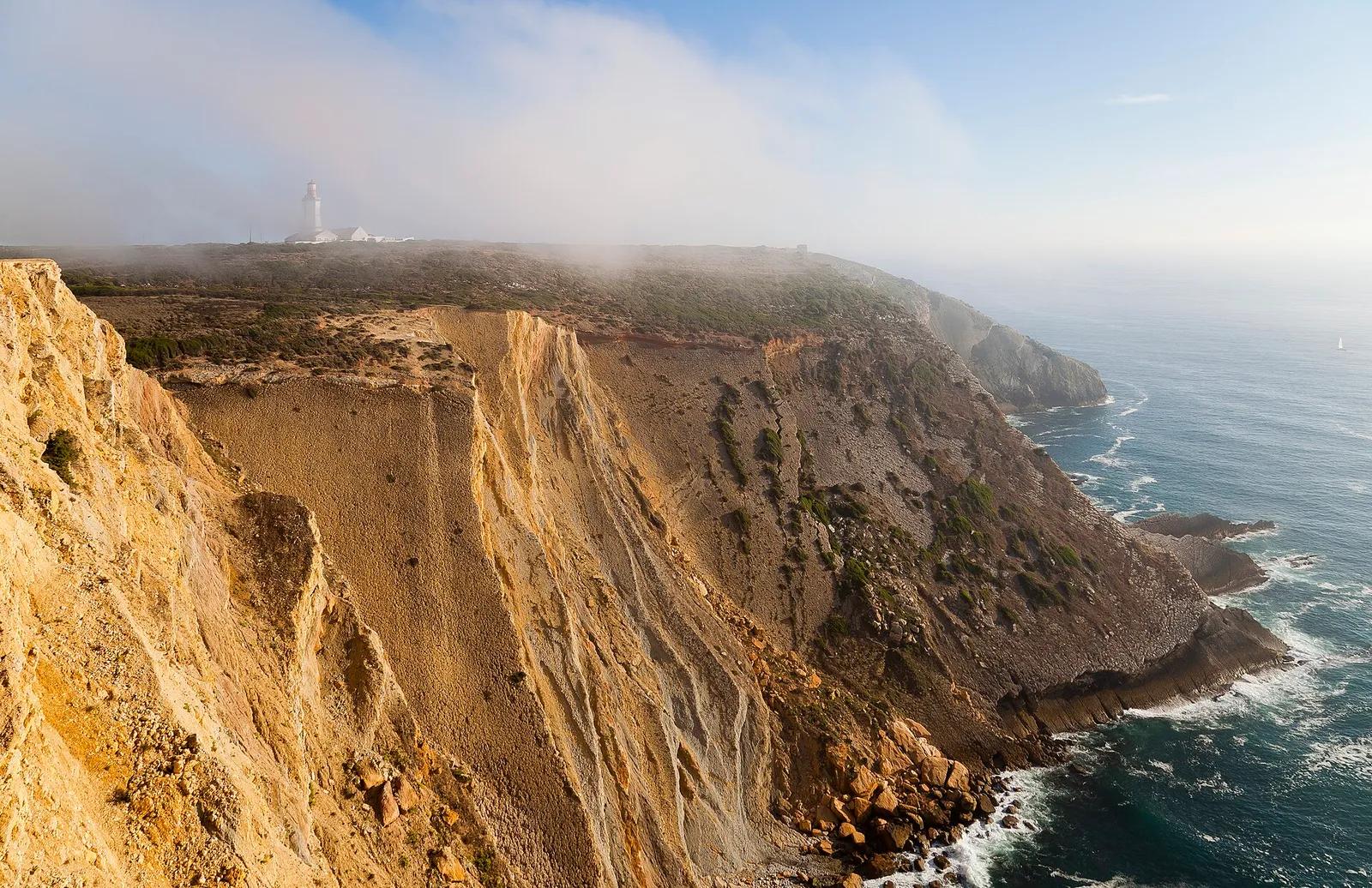
At a glance
- Portuguese tradition dates the kingdom's first naval victory to July 1180, when galleys armed in Lisbon took an Almohad squadron off Cape Espichel, south of the city.
- The day is uncertain: Duarte Galvão's chronicle of about 1505 gives 15 July 1180, and Frei António Brandão's Monarquia Lusitana of 1632 gives 29 July.
- The chronicles name the commander as Dom Fuas Roupinho, but no document written in his lifetime mentions him.
- An Arabic annal of the early fourteenth century records an Almohad admiral captured and several galleys taken in June 1180, and the Lisbon fleet crushed near Silves on 31 May 1181, with 20 ships taken.
- Fuas is best known from the Nazaré legend, printed in 1609, in which the Virgin stops his horse at a cliff edge as he chases a stag.
Rounding the cape
In the early summer of 1180, the people of Lisbon wrote to King Afonso Henriques in Coimbra. Nine Moorish galleys were at sea off their coast, making war on it, and they asked him to put a stop to it. The king sent a knight, Dom Fuas Roupinho, to Lisbon with letters ordering the city and the royal officials to arm galleys and give him command of them.
When the ships were ready, Fuas sailed south towards Cape Espichel. News had come that the enemy galleys were working the waters off the river of Setúbal. The Moors, for their part, had heard that a fleet was being armed against them and were sailing north to find it.
“And on rounding the Cape they caught sight of the fleet of the Christians, and without more delay they went to grapple with one another, fighting very hard, and it pleased Our Lord that the Moors were routed and all their galleys taken.”
Galvão, who wrote his chronicle for King Manuel I about 1505, dates this to 15 July 1180. Frei António Brandão, a Cistercian monk of Alcobaça and royal chronicler, retold it in 1632 and gave a different day: the fleets met “a little beyond Cape Espichel on the 29th day of the month of July of the year 1180”.
Brandão added details of his own. The Portuguese, he wrote, had little experience of war at sea, but the enemy lost heart when their flagship struck and their captain-general was killed, and every galley surrendered. Fuas entered Lisbon in triumph. Brandão called it the first naval victory the Portuguese had won and compared it to Rome's first sea victory over Carthage. He also admitted that the histories gave no numbers for the ships or men on either side.
- Date
- 1180; 15 July in Galvão (about 1505), 29 July in Brandão (1632)
- Place
- Off Cape Espichel, south of Lisbon, as the Moorish galleys rounded the headland
- Portuguese side
- Galleys armed in Lisbon on the king's order, led in the chronicles by Dom Fuas Roupinho
- Enemy
- Almohad galleys, nine of them in Galvão; Brandão gives no number
- Result
- All the enemy galleys taken; Brandão adds that their commander was killed
- Contemporary record
- None. The Latin annals that cover these years say nothing of a fight at sea
A young kingdom at war with an empire
By 1180 Afonso Henriques had ruled Portugal for half a century and was an old man. Pope Alexander III had confirmed his title of king only the year before, in 1179. The nineteenth-century historian Alexandre Herculano thought the fighting in the south was by then led by his son and heir, Sancho.
The enemy was the Almohad empire, a dynasty based in Morocco that also ruled Muslim Spain, al-Andalus, from Seville. In 1178 Sancho raided as far as Seville and sacked Triana, its suburb across the river. Herculano judged the raid reckless: it could gain no land, and it invited revenge.
The revenge came by land and sea. In October 1179 an Almohad army led by a son of the caliph besieged Abrantes on the Tagus and withdrew on the fourth day; the Coimbra annals claim the defenders lost only nine men. In 1180 the Almohads surprised Coruche, pulled down its castle and carried all its people into captivity.
At sea, Herculano followed the Arab historian Ibn Khaldun: in 1179 an Almohad fleet under Ghanim ibn Mardanish rounded Cape St Vincent and entered the Tagus, and Herculano supposed it plundered the country around Lisbon. The Portuguese records, he noted, are completely silent about it. An older Arabic annal, the al-Bayan al-Mughrib, says Ghanim commanded the squadron of Ceuta and that the Portuguese answered his raid by attacking the island of Saltes, on the Andalusian coast.
The story the chronicles tell
The earliest known account of Fuas Roupinho's deeds is in the Chronicle of Portugal of 1419, written at the court of the new Avis dynasty for Prince Duarte, son of King João I. Nobody knows where its author found the story. He gives exact dates, and at one point admits that he found nothing written about a raid, which suggests he was working from a written source. Galvão's chronicle follows the same story closely.
It begins on land. A Moorish king called Gani (Guami in Galvão), lord of the country “where Cáceres and Valença now are”, meaning Valencia de Alcántara rather than the Spanish city, crossed the Tagus with his brother and marched on Porto de Mós, the castle Fuas held. Fuas left a garrison inside and hid with his men on the hills above. He sent to Alcanede and Santarém for help. While the Moors attacked the castle all day, he made his men wait.
Before dawn they fell on the sleeping camp. The ground between the river and the castle was narrow, and the Moors were cut down in the confusion. Gani and his brother were taken, and Fuas led them with 50 of the best prisoners to the king at Coimbra. The 1419 chronicle dates this to 22 May 1180; Galvão has 20 May.
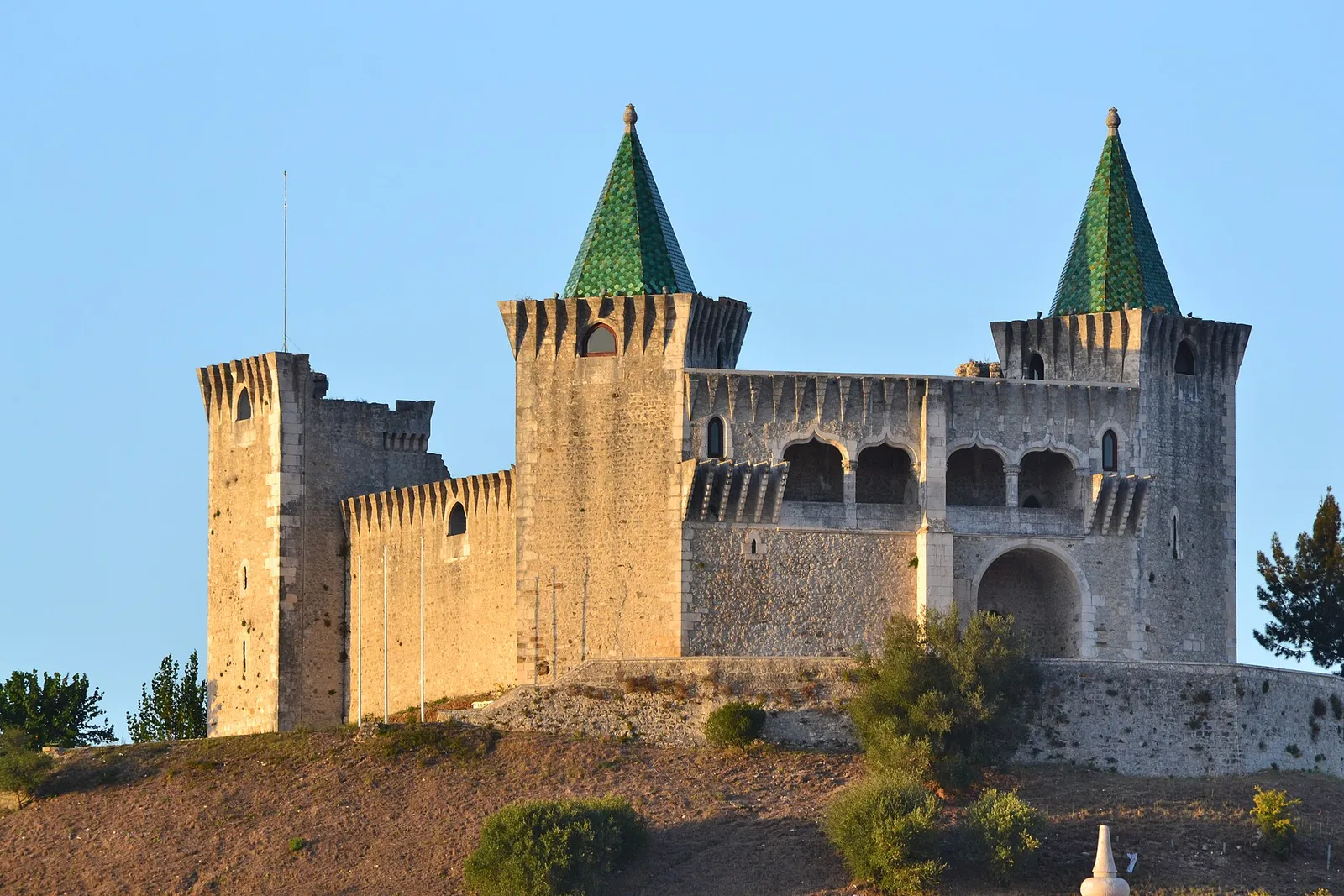
The victory at sea followed in July. Back in Lisbon, Fuas wrote to the king that the city and the country around were eager to take to the galleys and carry the war to the Moors, and the king agreed. The new fleet ran down the coast of the Algarve, though the chronicler found nothing worth telling about what it did there.
Then Fuas and his captains decided to strike at Ceuta, the Almohad port on the African side of the Strait of Gibraltar. They found warships in its harbour and took them, along with other large vessels, stayed two days off the city and sailed home with their prizes.
A few days later they went back. This time the Moors were ready, having gathered 54 galleys from the African coast and from Spain. Fuas, who knew nothing of this, sailed into the Strait, the strong current carried his galleys onto the enemy fleet, and there was nothing to do but fight. The Portuguese were overwhelmed and Fuas was killed. Galvão dates his death to 17 October 1180.
20 or 22 May 1180
Porto de Mós
Fuas surprises the camp of the Moorish king Gani at dawn and takes him and his brother to Coimbra.
15 or 29 July 1180
Cape Espichel
A fleet armed in Lisbon meets the Moorish galleys as they round the cape and takes them all.
After July 1180
The Algarve and Ceuta
A second cruise down the Algarve coast, then a raid on the harbour of Ceuta; ships taken, two days off the city.
17 October 1180
Defeat in the Strait
Returning to Ceuta, the fleet meets 54 galleys; the Portuguese are routed and Fuas is killed. Brandão moves this to 1182.
Tiago João Queimada e Silva, who has studied these chapters, points out how unusual they are. They are the only ones in the reign of Afonso Henriques, apart from those on the king's son, that take the spotlight away from the king. They have none of the holy-war language found everywhere else in that part of the chronicle, and Fuas wins at Porto de Mós by cunning rather than by faith.
Two dates for one battle
The two dates for the battle come from two traditions. Silva reports that the 1419 chronicle places it in July of the Era 1218, and Galvão, who follows that chronicle, gives 15 July. Brandão gives 29 July and credits it to “our histories” without naming them. Neither date can be checked against a source from 1180: the Latin annals kept at Coimbra record the siege of Abrantes and the loss of Coruche but say nothing of a battle at sea.
Brandão changed more than the day. He found it hard to believe that one summer had room for so many expeditions, and he had read a document, printed by Bernardo de Brito in the second part of the Monarquia Lusitana, that showed Fuas still alive in 1182. So he moved the final defeat off Ceuta to 1182. He also gave numbers: the Portuguese fleet had 21 galleys, and 11 were captured or sunk while the rest got back to Lisbon.
When Ignacio da Costa Quintella compiled his annals of the Portuguese navy for the Academy of Sciences in 1839, the only naval actions he could find in the reign of Afonso Henriques were Fuas Roupinho's three battles. He did not choose between the dates.
“On the 15th or 29th of July (on this the writers differ) the two squadrons attacked each other, and the galleys of the one nation and the other boarding each other valiantly, according to the method of that time, all those of the Moors were taken and brought to Lisbon, with the death of their admiral, on whose name the same writers differ.”
| Account | Written | Capture of Gani (Ghanim) | Cape Espichel | Final defeat |
|---|---|---|---|---|
| Chronicle of Portugal of 1419 (as summarised by Silva) | 1419 | 22 May 1180, at Porto de Mós | July 1180 | 17 October 1180, in the Strait; Fuas killed |
| Duarte Galvão, Crónica de D. Afonso Henriques | About 1505 | 20 May 1180, at Porto de Mós | 15 July 1180; nine galleys taken | 17 October 1180, against 54 galleys; Fuas killed |
| Frei António Brandão, Monarquia Lusitana, part III | 1632 | 1180, at Porto de Mós | 29 July 1180; all galleys taken, admiral killed | 1182 off Ceuta; 11 of 21 galleys lost; Fuas killed |
| Ignacio da Costa Quintella, Annaes da Marinha | 1839 | Not covered | 15 or 29 July 1180; all galleys taken, admiral killed | 17 October 1182 off Ceuta; 11 of 21 galleys lost; Fuas killed |
| Ibn Idhari, al-Bayan al-Mughrib (as read by Silva) | Early fourteenth century | Mid-June 1180, with his brother, in a heavy defeat; several galleys taken | Not mentioned | 31 May 1181 near Silves, where Ghanim had been taken; 20 ships taken; no commander named |
The 1419 chronicle dates by the Spanish Era, which runs 38 years ahead (Era 1218 is AD 1180); Galvão and Brandão give the Christian year. The Arabic dates are Islamic: mid-Muharram 576 fell around 11 June 1180, and 15 Muharram 577 was 31 May 1181. Silva pairs the Arabic capture of Ghanim with the chronicle's Porto de Mós.
The view from al-Andalus
Modern historians have pieced the war at sea together from the Portuguese chronicle and an Arabic one, the al-Bayan al-Mughrib, written by Ibn Idhari of Marrakesh in the early fourteenth century. Its account is short but dated, and it does not flatter the Portuguese.
According to Ibn Idhari, the Christians had been raiding by land and sea. In mid-Muharram of the year 576, about the middle of June 1180, Ghanim ibn Mardanish, the admiral of Ceuta, and his brother Abu-l-Ula were captured in a heavy defeat, and the Christians seized several galleys. The annal also tells how the brothers were later ransomed.
Then came the reply. On 31 May 1181 the squadron of Ceuta, under Abd Allah ibn Jami while Ghanim was still a prisoner, and the squadron of Seville sailed for the waters off Silves. There they met the Lisbon fleet, at the same place where Ghanim had been taken, and crushed it: 1,800 captives and 20 ships fell to them, with rich spoil. Herculano, using Ibn Khaldun, tells the same story of twenty ships taken, dating it to late 1180 or early 1181.
The two traditions overlap. The chronicle's Moorish king Gani can only be Ghanim ibn Mardanish, Silva notes, although Ghanim was an admiral, not a king of Cáceres, and the chronicle has him captured on land at Porto de Mós. Both sides record Christian raids, the capture of Ghanim and a final defeat that destroyed the Lisbon fleet. Maria João Branco, Sancho I's biographer, dates that defeat to 1181, puts the fleet at about 40 ships and has 20 of them sunk.
Where the last battle was fought is less clear. The chronicles place it in the Strait of Gibraltar. Christophe Picard, a French historian of the Muslim Atlantic, has suggested Cape St Vincent, and the Spanish Arabist Ambrosio Huici Miranda suggested Cape Espichel itself.
The Espichel victory has no clear match. Silva pairs Ibn Idhari's capture of Ghanim in mid-June 1180 with the chronicle's capture of Gani at Porto de Mós, dated 22 May, and none of the points the two texts share is a fight off Espichel. What the Arabic annal never gives is the name of the Christian commander.
A commander without documents
No document written in his lifetime names him. Historians usually call him the alcaide, or castle commander, of Porto de Mós, but he appears in none of the town's documents from his time. Given how close to the king and to the Lisbon council the chronicle places him, Silva finds his absence from the royal documents of the day puzzling.
Several historians have identified him with Fernão Gonçalves Churrichão, nicknamed Farroupim, a name close to Roupinho. Silva rejects this: Churrichão appears in three documents of 1271 kept at Ourense Cathedral in Galicia, nearly a century too late. The only twelfth-century Fuas he knows of, pointed out to him by the historian Leontina Ventura, is a man named in the will of Pedro Forjaz of Coimbra in 1156, and nothing links the two beyond the uncommon name.
Nineteenth-century critics were harsher. The introduction to the genealogies in the Portugaliae Monumenta Historica, the edition of medieval sources that Alexandre Herculano launched for the Academy of Sciences in 1856, counts the stories of Fuas among the inventions of the forgers of the late sixteenth and early seventeenth centuries, and names “the Britos” among those impostors. The 1419 chronicle, however, was written nearly two centuries before any of them.
“All the inventions of these makers of hoaxes, such as the instrument of the Apparition, the Cortes of Lamego, the council of Braga under Pancratianus, the correspondence between Saint Bernard and Afonso Henriques, the stories of Fuas Roupinho, of the monk Felino or of the Moorish girl Saluquia, etc., clash so badly with the phrasing, idiom and style of the genuine records … that they move one to laughter.”
Recent scholarship is kinder. Because the chronicle and the Arabic annal agree on so much, Silva concludes that the admiral can reasonably be treated as a real person, the leader of a Lisbon fleet at the time the young kingdom was learning what war at sea could win it. Two things stop him going further: Fuas's absence from the documents, and the unknown source behind the 1419 chronicle.
The stag and the Virgin of Nazaré
Fuas Roupinho is better known from a different story. In 1609 Frei Bernardo de Brito printed, in the second part of the same Monarquia Lusitana that Brandão continued, a document telling of a miracle on the cliffs at Nazaré. The historian Luís Krus thought the tales of the admiral had been worked up at the Cistercian monastery of Alcobaça and ended in this legend. Silva doubts it: a monastic writer, he argues, would hardly have left out the holy-war language that the Fuas chapters lack.
Brandão summarised Brito's document in 1632. Fuas rode out hunting one misty morning along the coast where the church of Our Lady of Nazareth now stands and followed a stag to the point of a rock. From the north the ground runs level, but there it drops sheer into the sea. On the brink he called on the Virgin, and his horse stood still on the edge of the rock, where its marks could still be seen in the stone.
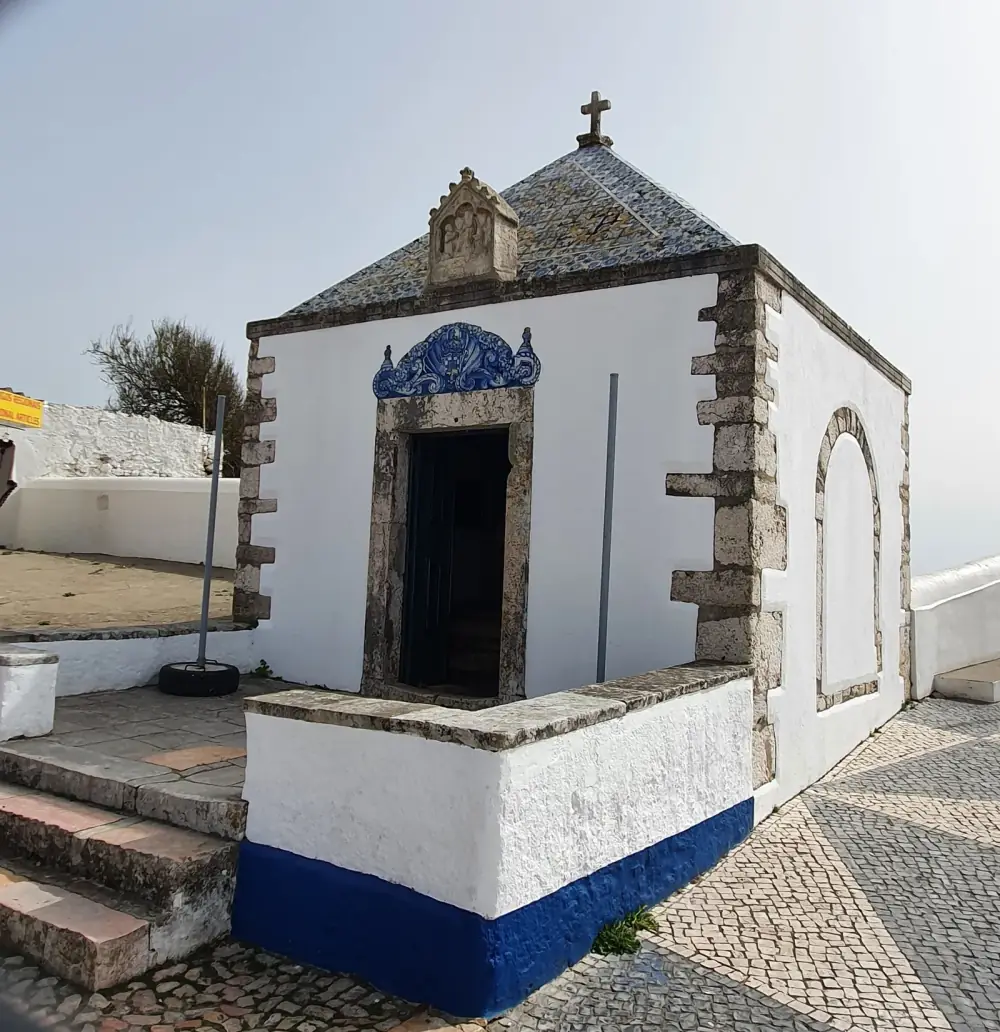
Fuas dismounted, honoured an image of the Virgin kept in a cave there and built over it the hermitage that came to be called da Memória, the chapel of the Remembrance. A larger church was later founded nearby. By Brandão's day it was one of the most visited shrines in Spain, the name then used for the whole peninsula.
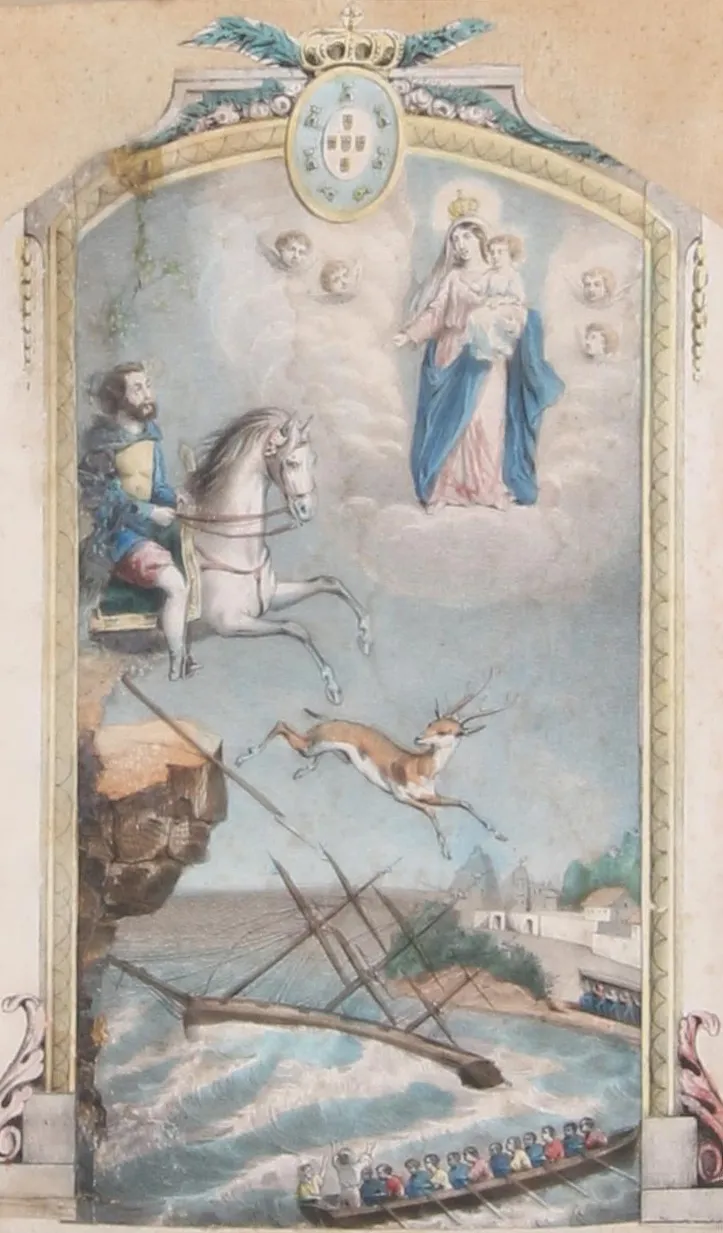
The legend as Nazaré tells it today is dated to dawn on 14 September 1182. Fuas, hunting on a coast wrapped in fog, lost his companions as he chased the stag, recognised the cave of the Virgin as he reached the cliff top, and cried out “Senhora, valei-me!”, “Lady, help me!”. The horse dug its hooves into the rock above the void.
Oral versions add more. In one collected in Nazaré in 2008, the storyteller said that some make the stag the Devil in disguise and others a plain stag, and pointed to a hollow in the rock as the mark left by the horse's hind hooves. He ended: “Of course, it is a legend.”
Brito's document mattered beyond Nazaré. It was the evidence Brandão used to keep Fuas alive until 1182 and move his death off Ceuta to that year, so a doubtful charter reshaped the chronology of the naval war too. Quintella followed Brandão's 1182 two centuries later.
Why the admiral outlived the doubts
The war at sea did not end the Almohad threat. In 1184 the Almohad caliph came north in person and besieged Santarém for five weeks, and Afonso Henriques died the following year. A Lisbon fleet had been built, had won and had been destroyed within about two years.
Silva suggests why the story lasted. The 1419 chronicle was written a few years after King João I took Ceuta, on 21 August 1415, and he argues that Fuas's raids on the same port gave Portuguese war in North Africa a precedent reaching back to the twelfth century. They are also the first time a Portuguese chronicle moves the war against the Moors onto the sea.
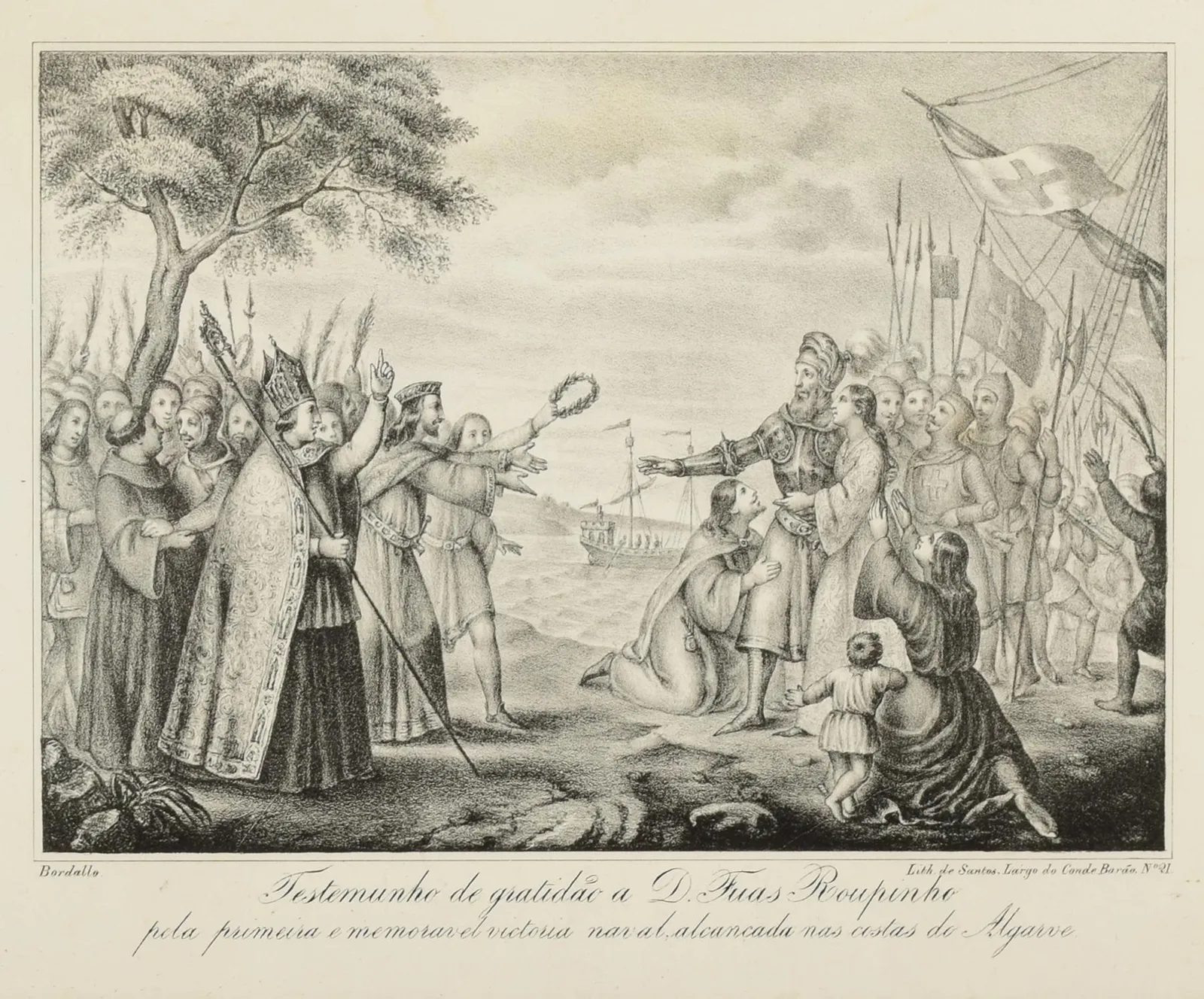
Later historians of the navy started where Brandão had. Quintella's annals of 1839 begin the navy's fighting record with Fuas's three battles, and the military historian Luís Miguel Duarte dates the first steps towards a Portuguese war fleet to the reign of Afonso Henriques. Whether the fight off Cape Espichel took place on 15 or 29 July cannot now be settled. The Arabic annal does confirm that in June 1180 the Christians defeated the Almohads, took several of their galleys and captured the admiral of Ceuta.
FAQs
When was the battle of Cape Espichel?
The chronicles place it in July 1180, but the day differs. Duarte Galvão's chronicle of about 1505 gives 15 July; Frei António Brandão's Monarquia Lusitana of 1632 gives 29 July. In 1839 the naval historian Quintella simply wrote 15 or 29 July. No source from 1180 itself mentions the battle. An Arabic annal records a Christian victory around the middle of June 1180, in which an Almohad admiral was captured and several galleys taken, but the historian Tiago João Queimada e Silva matches it with the chronicles' capture of the Moorish king Gani at Porto de Mós, not with Espichel.
Was it really Portugal's first naval battle?
That is the tradition. Brandão called it the first naval victory the Portuguese had won, and in 1839 Quintella found no other naval action in the reign of Afonso Henriques besides Fuas Roupinho's battles. It was not the first fighting at sea, however. An Arabic annal records Portuguese raids by sea in 1179 and early 1180, including an attack on the island of Saltes, and an Almohad fleet entered the Tagus in 1179.
Was Fuas Roupinho a real person?
Possibly. No document from his lifetime names him, and nineteenth-century critics treated his stories as forgeries. But the chronicle of 1419 agrees in many points with an Arabic annal about a Lisbon fleet in 1180 and 1181, and the historian Tiago João Queimada e Silva concludes that he can reasonably be treated as the historical leader of that fleet.
How did Fuas Roupinho die?
According to the chronicles, he was killed when a Portuguese fleet returning to raid Ceuta met 54 Almohad galleys in the Strait of Gibraltar. Galvão dates this to 17 October 1180; Brandão moved it to 1182. The Arabic annal of Ibn Idhari records the Lisbon fleet destroyed near Silves on 31 May 1181, with 20 ships taken, but does not name its commander.
What is the legend of Nazaré?
In the legend, Fuas Roupinho was hunting on a foggy morning, traditionally 14 September 1182, when he chased a stag to the edge of the cliff at Nazaré. He called on the Virgin, whose image was kept in a cave there, and his horse stopped on the brink. In thanks he built the Ermida da Memória over the cave. Historians cite the document Frei Bernardo de Brito printed in 1609; the nineteenth-century editors of the Portugaliae Monumenta Historica counted the stories of Fuas among the inventions of forgers such as “the Britos”.
On the timeline
Open the timelineNearby moments from from county to kingdom (1096–1249).
Afonso Henriques takes Muslim Santarém in a surprise attack before dawn: about 25 of his men climb the walls on two ladders and raise his banner, and a gate is broken open for the rest. The prize opens the road to Lisbon, which he captures that October.
The Siege of Lisbon begins. King Afonso I, having struck a deal with Northern European crusaders bound for the Second Crusade, opens the assault on the great Almoravid city on the Tagus. After almost four months the city falls on 25 October, becoming the future capital of the Kingdom of Portugal.
After a siege of about four months, Afonso Henriques and his crusader allies enter Lisbon, whose starving Muslim defenders had agreed to surrender. The capture was the main success of the Second Crusade, and Sintra and Palmela soon surrendered too.
Fuas Roupinho at Cape Espichel
By tradition, Portugal's first naval victory. Off Cape Espichel, galleys armed in Lisbon for King Afonso Henriques and led, the chronicles say, by Dom Fuas Roupinho, rout an Almohad squadron and take every galley. The day is disputed: Brandão (1632) gives 29 July, Galvão's chronicle (c. 1505) 15 July.
Death in Coimbra of Afonso Henriques, the first King of Portugal, who had ruled for more than half a century, first as prince of the County of Portugal and from about 1140 as king. He is buried in the Monastery of Santa Cruz in Coimbra; in July 2006 a scientific plan to open his tomb and study his remains was halted at the last minute by the state heritage institute, and the culture minister refused it in 2007.
Birth, probably in Coimbra, of Afonso III, the king who completed Portugal's share of the Reconquista by taking Faro in 1249 and fixed the Guadiana border with Castile in 1267. Under him Lisbon gradually became the court's main seat, though the king kept travelling.
King Sancho I of Portugal dies in Coimbra. Remembered as 'the Populator' (o Povoador) for resettling the frontier, he granted charters to towns such as Guarda (1199) and briefly took Silves from the Almohads in 1189.
Coming up in history
All long reads



12 sources
Archives, scholarship and reporting this article was checked against.
- 1
Os feitos de D. Fuas Roupinho na Crónica de 1419 (Tiago João Queimada e Silva)Revista Portuguesa de História, vol. 43 (2012); open copy in the University of Turku repository (UTUPub)
- 2
Chronica de El-Rei D. Affonso Henriques (Duarte Galvão), Bibliotheca de Classicos Portuguezes, vol. LI, Lisbon, 1906Project Gutenberg, from Biblioteca Nacional de Portugal scans
- 3
Terceira parte da Monarchia Lusitana (Frei António Brandão), book XI, chapters 30, 31 and 33Mosteiro de São Bernardo, Lisbon, 1632 (Internet Archive)
- 4
- 5
- 6
- 7
Herculano, Alexandre (Lisbon, 1810 - Azóia de Baixo, Santarém, 1877) (Arthur Alfaix Assis)Dicionário de Historiadores Portugueses, Biblioteca Nacional de Portugal
- 8Nazaré, a vila azulObservador (Observador Lab feature made with the support of Mercedes-Benz), 26 September 2022
- 9
A lenda de Dom Fuas Roupinho (APL 2445)Arquivo Português de Lendas, Centro de Estudos Ataíde Oliveira, Universidade do Algarve
- 10
Ceuta (Maria Dávila)Encyclopaedia of Portuguese Expansion (EVE), CHAM, NOVA FCSH
- 11
Revive: aberto concurso para concessão do Santuário do Cabo EspichelGoverno de Portugal, 18 May 2021
- 12
Santuário de Nª Srª do CaboVisit Lisboa (Turismo de Lisboa)
Image credits
- Cape Espichel, south of Lisbon, in August 2012. The chronicles put the sea fight of 1180 just off this headland, as the Moorish galleys rounded it. Diego Delso, CC BY-SA 3.0, via Wikimedia Commons.
- The castle of Porto de Mós in 2011. The chronicles make Fuas Roupinho its commander in 1180; the green-tiled spires and arcaded gallery seen today come from much later rebuilding. Celia Ascenso, CC BY-SA 3.0, via Wikimedia Commons.
- The Miracle of Nazaré in a hand-coloured nineteenth-century lithograph by an unknown artist: Fuas's horse halts at the cliff edge as the stag leaps. Below, a wrecked ship and a crowded boat ride a heavy sea. Unknown author, Public domain, via Wikimedia Commons.
- “Testimony of gratitude to D. Fuas Roupinho for the first and memorable naval victory won off the coasts of the Algarve”: a nineteenth-century lithograph signed Bordallo and printed by the Santos lithographic works in Lisbon. Its caption moves the victory to the Algarve. Bordallo, Lith. de Santos, Public domain, via Wikimedia Commons.
- The Ermida da Memória on the Sítio at Nazaré in October 2022, the chapel that tradition says Fuas Roupinho built over the Virgin's cave after the miracle of 1182. GualdimG, CC BY-SA 4.0, via Wikimedia Commons.