

The Esnoga: Amsterdam's Portuguese Synagogue, 1675
Descendants of Jews baptised by force in Portugal, many from families that had fled its Inquisition, built the largest synagogue of their day in Amsterdam. They opened it on a Friday evening in August 1675, by the light of more than 800 candles.
At a glance
- The Esnoga, Amsterdam's Portuguese Synagogue, was inaugurated on Friday 2 August 1675 (10 Av 5435), at the start of the Sabbath after the fast of Tisha B'Av, with eight days of services and sermons.
- It was built by Kahal Kadosh Talmud Torah, a congregation formed in 1639 largely by former New Christians: Jews of Portuguese descent whose families had been baptised by force in 1497 and hunted by the Inquisition.
- Elias Bouman, a non-Jewish master mason, designed it. Building began on 17 April 1671, stalled in the war year of 1672 and cost 162,469 guilders by the time the accounts were closed in March 1676.
- The congregation spoke Portuguese and kept its records in it. Sermons switched to Dutch around 1845, but some announcements in the synagogue are still made in Portuguese.
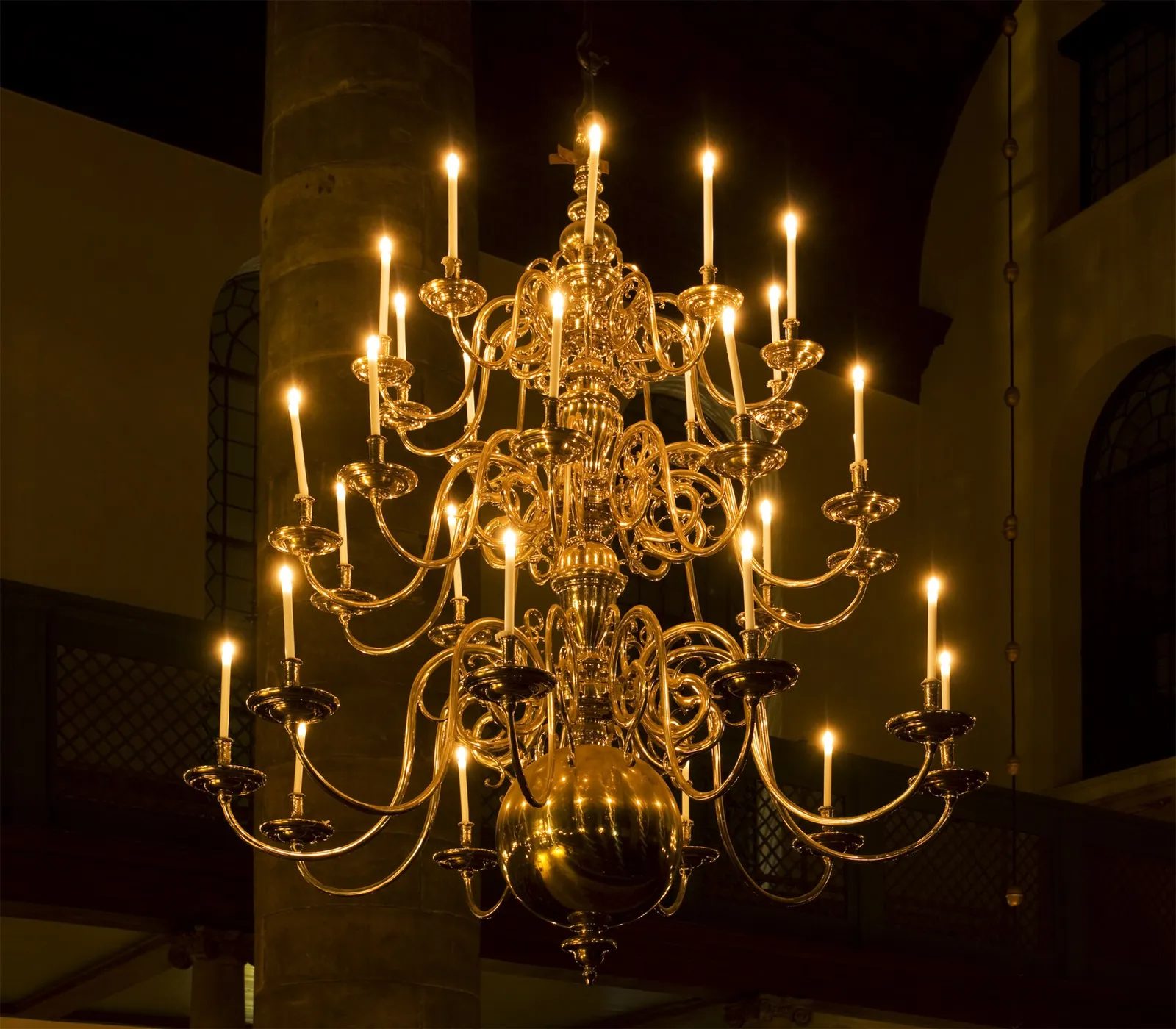
- The building survived the Nazi occupation almost untouched and has no electric light: it is still lit by about 1,000 candles, over a floor strewn with sand.
Eight hundred candles on a Friday evening
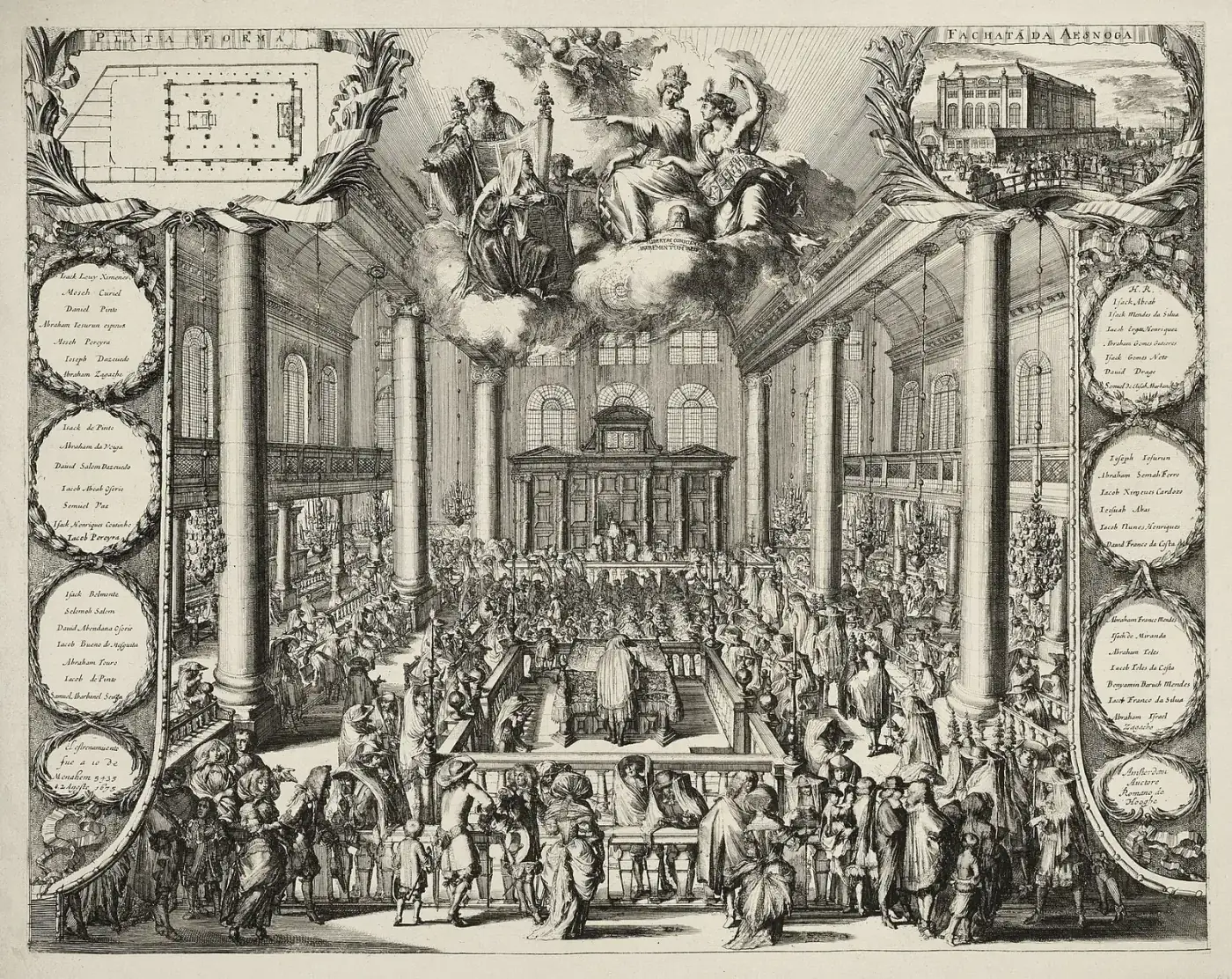
Towards five in the afternoon of Friday 2 August 1675, a crowd in their best clothes gathered at a new building on the eastern edge of Amsterdam. Inside, more than 800 candles were burning in brass chandeliers. The burgomasters and aldermen of the city were among the guests. The Sabbath was about to begin, and the Portuguese Jews of Amsterdam were opening what was then the largest synagogue in the world.
The Torah scrolls came in from the board's new meeting room, across the courtyard and through a side door. At the head of the procession walked the chief rabbi, Isaac Aboab da Fonseca, about 70 years old, who had been born Simão da Fonseca, to a New Christian family, in Castro Daire, near Viseu. The boards of two of the congregation's societies followed, then the elders, each led by a man with a burning candle or torch. They carried the scrolls, in silver and gold brocade, three times around the hall.
The senior cantor, Jozef Cohen Faro, said the blessing for new beginnings on behalf of the congregation. His colleague Imanuel Abenatar Mello recited the prayer for the government and the city council. Then, while psalms were sung, the scrolls were placed in the great ark of Brazilian rosewood, and the first Sabbath service began.
The day was chosen with care. The day before had been Tisha B'Av, the fast that mourns the destruction of the Temple in Jerusalem, and the Sabbath that followed was Shabbat Nachamu, named after the first word of Isaiah 40: “Comfort, comfort ye my people.” Writing about a century later, the community's historian David Franco Mendes said the guests radiated “an inexpressible joy, but accompanied by a sense of gravity”.
“with a solemnity appropriate to our state of exile”
The Portuguese Nation of Amsterdam
The people in the hall called themselves Portuguese, although many had never seen Portugal. In 1496 King Manuel I ordered Portugal's Jews to convert or leave, and in 1497 he had them baptised by force instead, because he could not afford to lose them. Their descendants, the New Christians, lived as Catholics in public while some kept Jewish customs at home.
Amsterdam drew them from the 1590s. The Dutch Republic, at war with Spain, offered freedom of conscience and a booming trade, and after 1580 Portugal itself was ruled by the king of Spain. Merchants who returned to Judaism often kept two names: a Jewish one for the synagogue and a Portuguese one for business in Portugal and elsewhere. They could not become citizens or join most guilds, but they did not have to live in a separate district or wear a sign of their religion.
Three congregations were founded between about 1602 and 1618: Beth Jacob, Neve Shalom and Beth Israel. In 1639 they merged as Kahal Kadosh Talmud Torah, the Holy Congregation of the Study of the Law, which worshipped in an enlarged house synagogue on the Houtgracht. The young Baruch Spinoza was banned by that congregation in 1656, a story told in another article.
Sephardic Jews in Amsterdam, 1610 to 1675
people (estimates)
Estimates given by David Cohen Paraira and Jos Smit in Vlaardingerbroek (ed.), 2013. Nobody took a census, and other historians count higher: Carsten Wilke puts the community at about 4,500 at its peak in the second half of the century, as cited by Cláudia Duarte.
Show the data
| Estimated Sephardim in Amsterdam | |
|---|---|
| 1610 | 350 |
| 1630 | 900 |
| 1650 | 1,400 |
| 1675 | 2,500 |
The community grew fast after 1650. Jews who had settled in Recife under Dutch rule came back when Portugal retook northeast Brazil in 1654; Aboab da Fonseca, who had been their rabbi there since the early 1640s, was one of them. Spain's worsening economy drew more New Christian merchants and bankers north, among them the De Pinto, Lopes Suasso and Pereira families. Between 1641 and 1671 the number of Jewish account holders at the Amsterdam exchange bank rose from 89 to 265.
Building bigger than the Ashkenazim
By 1670 the old synagogue was too small, and the Ashkenazi Jews, poorer newcomers from Central Europe, were finishing a large new synagogue of their own across the canal. It opened in March 1671. The Portuguese, who then considered themselves the senior community, would not be outdone. In 1670 they bought a large plot near the old Sint Antoniespoort, on new land of the city's latest expansion.
On 23 November 1670 Aboab da Fonseca preached a sermon asking the congregation to pay for a new building, and members pledged some 40,000 guilders. On 26 January 1671 the board chose a design by Elias Bouman, a non-Jewish master mason then about 35, who had built the Ashkenazi synagogue with the carpenter Gillis van der Veen. On 17 April 1671 four leading members, among them Mozes Curiel and two De Pintos, laid the first stones, paying 2,310 guilders between them for the honour.
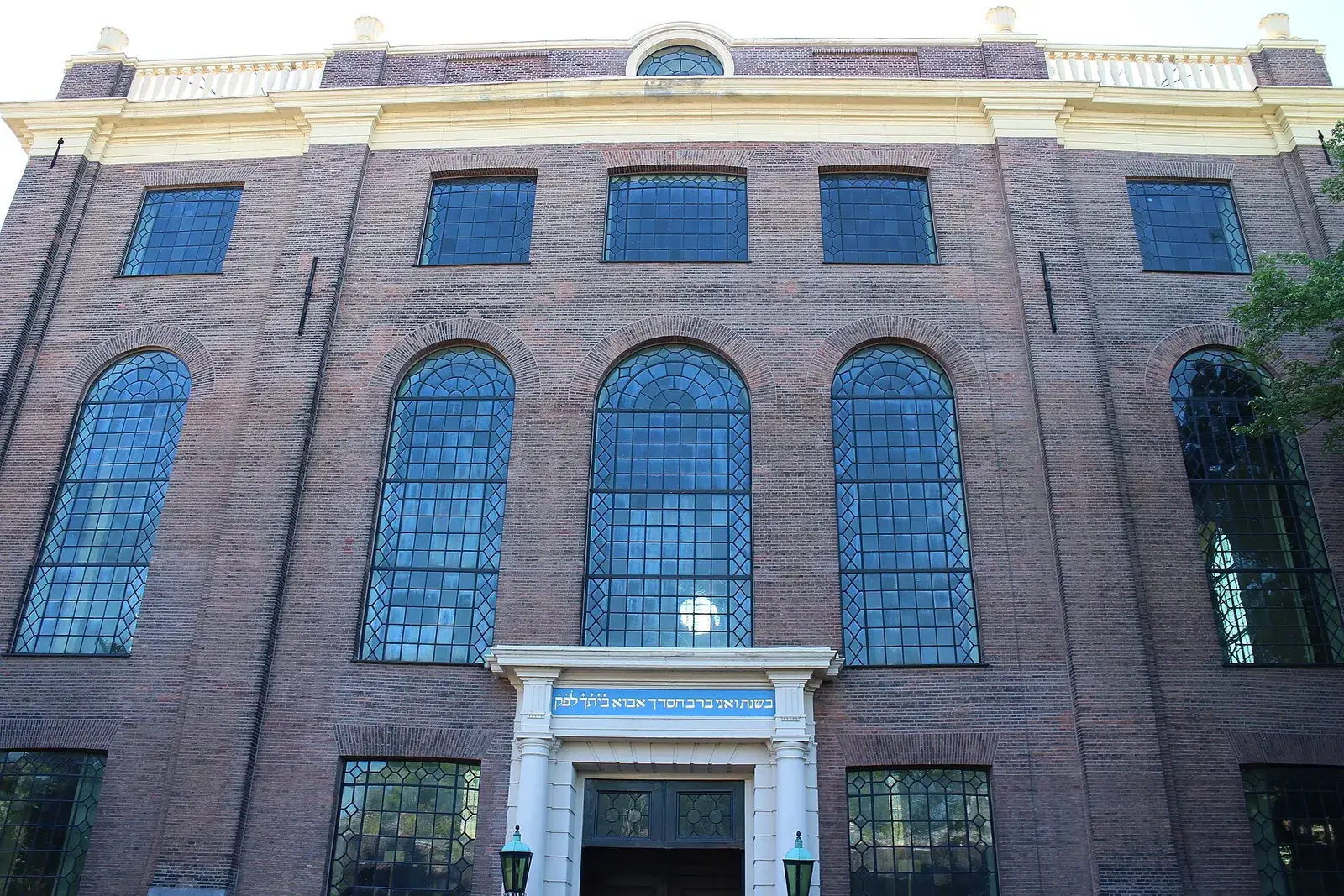
Amsterdam stands on peat. To carry the brick hall, about 3,000 timber piles were driven through more than twelve metres of soft ground to the sand below. The board expected the work to take about a year, and the Hebrew inscription over the door, from Psalm 5:8, “But as for me, I will come into Thy house in the multitude of Thy mercy”, also gives a date: the letters of the word for “Thy house” add up to 432, which stands for the Jewish year 5432, or 1672.
1672 turned out to be the Rampjaar, the disaster year, when France, England and two German bishoprics attacked the Republic. Building in Amsterdam almost stopped. On 1 August 1674 a heavy storm damaged the unfinished synagogue, and the board and Bouman went to arbitration over extra work. The contracts for the low wings around the courtyard were only awarded in 1674, the year peace was made with England.
23 November 1670
Aboab da Fonseca's sermon raises pledges of some 40,000 guilders
26 January 1671
The board chooses Elias Bouman's design
March 1671
The Ashkenazi Great Synagogue opens across the canal
17 April 1671
Four members lay the first stones
1672
War with France and England; work almost stops
1 August 1674
A storm damages the building
October 1674
The pope suspends the Portuguese Inquisition's trials
2 August 1675
Inauguration, the start of eight days of celebrations and sermons
26 March 1676
Accounts closed at 162,469 guilders
- Architect
- Elias Bouman (1635 to 1686), master mason
- Built
- 1671 to 1675
- Size
- 130 by 100 feet (36.8 by 28.3 metres)
- Height
- Central nave almost 20 metres
- Foundations
- About 3,000 timber piles
- Light
- 72 windows and about 1,000 candles; no electric light
- Ark
- Brazilian rosewood (jacaranda) over an oak core, given by Mozes Curiel
A bill in guilders
The congregation's accounts survive well enough to follow the money. The payments to Bouman up to 1675, for his design, his work and the materials he bought, came to about 9 per cent of the final bill.
| Item | Amount | When |
|---|---|---|
| Pledges after Aboab da Fonseca's sermon | Some 40,000 guilders | November 1670 |
| Paid by four members to lay the first stones | 2,310 guilders | April 1671 |
| Payments to Elias Bouman for design, building and materials | 14,581 guilders 10 stuivers | 1671 to 1675 |
| Total cost of construction when the accounts were closed | 162,469 guilders 10 stuivers | 26 March 1676 |
| Extra paid to Bouman after arbitration | 3,484 guilders 6 stuivers | 1676 |
| Gilt leather hangings, not in the total | 448 guilders | Not stated |
Figures from Vlaardingerbroek (ed.), 2013. With the two extras the bill comes to 166,401 guilders 16 stuivers (20 stuivers made a guilder). The book gives the extra payment as 3,484 guilders 6 stuivers in two places and 3,486 guilders 6 stuivers in a third. The Posen Library gives the cost as more than 186,000 florins, a figure we could not reconcile with the accounts.
Eight days of sermons, in Portuguese
The celebrations lasted eight days, in imitation of the dedication of Solomon's Temple. After the opening service, a scholar of the congregation preached each day, seven sermons in all, beginning with Aboab da Fonseca on the Sabbath. One of the preachers, Eliyau Lopes, explained the word Esnoga as a joining of the Hebrew esh, fire, and noga, light.
The longest sermon came from a young man, Isaac Vellozino, who was 21 or 22. The honour of opening the new ark went to Mozes Curiel, a member of the board who had given the rosewood. Known outside the synagogue as Jerónimo Nunes da Costa, he was the agent of the king of Portugal and held the Dutch monopoly on importing the wood.
The sermons were printed that same year by David de Castro Tartas as Sermoes que pregaraõ os Doctos Ingenios do K.K. de Talmud Torah, desta Cidade de Amsterdam, in Portuguese. Tartas had lost a brother to the Portuguese Inquisition. Isaac de Castro Tartas, son of New Christians who had left Portugal, went to Dutch Recife and then to Portuguese Bahia, where he was arrested in 1644. He was tried in Lisbon and burned alive there on 15 December 1647.
“these [celebrations] were more like holidays with liberty in the Temple than festivities of captivity in a Synagogue”
Curiel probably also hired the Dutch etcher Romeyn de Hooghe to record the opening. His large print shows the crowded hall under an allegory: the Maid of Amsterdam and the United Provinces on one side, the Synagogue with the tablets of the Law and the high priest Aaron on the other, and the Latin motto Libertas conscientiae incrementum reipublicae, which the 2013 monograph renders as “freedom of worship is the mainspring of the Republic”. A few copies are said to have been printed on silk as gifts for the building committee.
“On the Amstel and the IJ; this temple consecrated to God / Fears no conscience – no coercion, torture or death.”
A congregation that wrote in Portuguese
Portuguese was the congregation's everyday spoken language. Spanish was the language of its scholarship, poetry and many of its prayer books and Bible translations. The rabbis at first allowed Portuguese in the service, to help former New Christians who had never learned Hebrew, and returned to Hebrew alone once most members had learned it.
The archive of the congregation, now in the Amsterdam City Archives, runs from 1614 to 1943, fills about 60 metres of shelving and is written in Dutch, Portuguese and Spanish. Many of its volumes carry Portuguese titles: the Livro de pregoens, a register of announcements made in the synagogue; the Copiador de cartas, copies of letters sent; the Livro da caixa, the cash book. It also holds the papers of the Santa Companhia de Dotar Órfãs e Donzelas, a brotherhood founded in 1615 to give dowries to orphans and young women.
In the nineteenth century King William I promoted the use of Dutch for minutes and sermons. By about 1845 Portuguese had fallen out of everyday use at the synagogue and out of its sermons, surviving in announcements and in the prayer for the royal family and the city. The congregation says that announcements on ordinary, non-religious matters are still made in Portuguese, although the foreword to the 2013 monograph says Portuguese “is no longer heard”. Members still call their synagogue the Esnoga or Snoge and themselves snogeiros.
In the same complex is the library of Ets Haim, the congregation's seminary, founded in 1616. It holds about 560 manuscripts and 30,000 printed works and was added to UNESCO's Memory of the World Register in 2003.
Amsterdam's Portuguese congregation was the mother community of the western Sephardic world, and its synagogue's plan, with the reading platform and the ark facing each other on the same axis, was a model for Bevis Marks in London (1701), Mikvé Israel in Willemstad, Curaçao (1732), and the synagogue of Paramaribo, Suriname (1737).
Decline, occupation and survival
The golden age did not last. In the eighteenth century bankruptcies and the decline of Sephardic trade left many Portuguese Jews poor; by 1795, 54 per cent of the congregation's members relied on charity or public assistance. The synagogue's centenary in 1775 passed without celebration. Its bicentenary in 1875 was marked with lavish festivities, and two marble memorial stones were set beside the ark.
In 1939, fearing war, the Dutch government paid to fireproof the building, and the congregation formed a fire patrol of about 40 men. In the winter of 1941 to 1942 the SS officer F. H. aus der Fünten looked at the Esnoga as a possible deportation centre, but it had too many windows to black out; the nearby Hollandse Schouwburg theatre was used instead. Services went on until 26 May 1943, and then in secret in a member's flat.
Most of the congregation was deported and murdered.
The congregation's own figures are 3,700 dead out of 4,300 Portuguese Jews; the 2013 monograph speaks of more than 5,000 members in 1940, of whom fewer than 1,000 survived. Guarded by its fire patrol, the building came through almost undamaged, with its scrolls still in the ark. Its brass chandeliers survived too, at a time when copper had to be handed in for the war industry.
On 9 May 1945, four days after the liberation of the Netherlands, Jewish survivors gathered for a special service in the Esnoga, almost the only synagogue in Amsterdam to come through the war intact. The 2013 monograph calls it the survivors' first meeting after the liberation. Before the war the central nave had been reserved for Portuguese Jews, with Ashkenazim seated in the aisles; the war ended that distinction.
The Esnoga today
The congregation has about 630 members in some 250 families, and holds services in the Esnoga on the Sabbath, on Sunday mornings and on holidays, and in a second synagogue in Amstelveen. Since 2009 the Jewish Museum has managed the building and its collections.
Two Portuguese presidents have visited the Esnoga on state visits to the Netherlands. On 10 December 2024 Marcelo Rebelo de Sousa toured it with King Willem-Alexander. Speaking to reporters in Portuguese, he called the visit a historic homage and a way of paying “a historic debt of Portugal”. The synagogue, he said, was “a Portuguese achievement”, built by Portuguese who had come to Amsterdam. He was following Mário Soares, who, he recalled, had gone there on a state visit in October 1989 and apologised for the Inquisition.
The 350th anniversary was marked on Sunday 7 September 2025 with a service and a procession of the Torah scrolls. The king attended and was welcomed at the synagogue by the mayor of Amsterdam, Femke Halsema. Portugal's ambassador, Clara Nunes dos Santos, was among the guests.
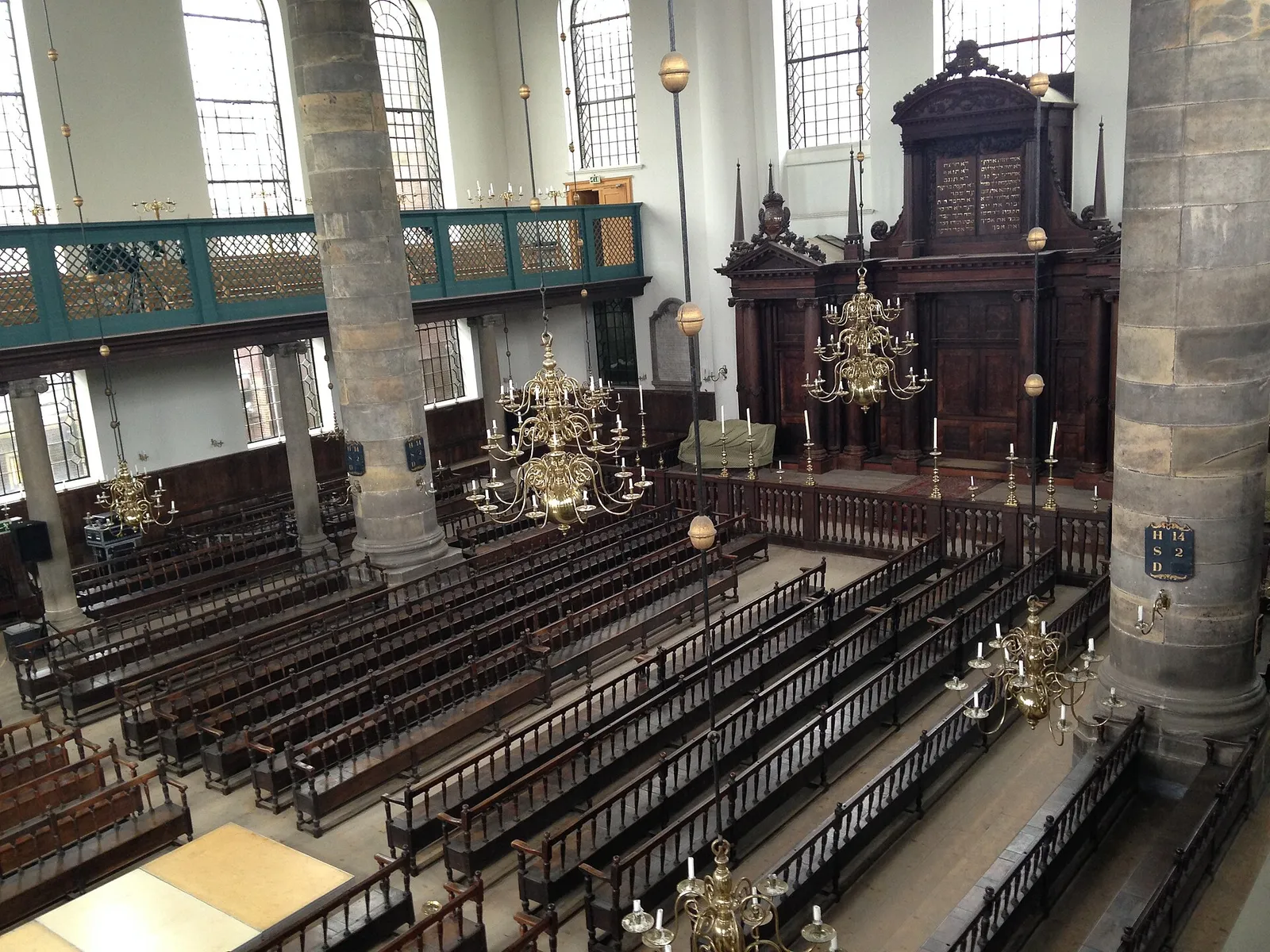
The building was restored in 1954 to 1959, in 1991 to 1993 and again in 2010 to 2011, but little has changed inside. There is no electric light and no central heating. On the floor, sand still muffles the sound of footsteps, and the hundreds of candles in the chandeliers are lit for services. Every year, on Shabbat Nachamu, the congregation holds a service in memory of the inauguration.
FAQs
When was the Portuguese Synagogue in Amsterdam inaugurated?
On Friday 2 August 1675, 10 Av 5435 in the Jewish calendar, at the start of the Sabbath after Tisha B'Av. The celebrations went on for eight days, with seven sermons on the days that followed.
Why is it called the Portuguese Synagogue?
It was built by Kahal Kadosh Talmud Torah, a congregation founded in 1639 mostly by former New Christians of Portuguese descent who had returned to Judaism in Amsterdam. They called themselves the Portuguese Nation and used Portuguese as their everyday language.
Who designed the Esnoga?
Elias Bouman, an Amsterdam master mason who had also built the Ashkenazi synagogue across the canal. The board chose his design on 26 January 1671; older attributions to Daniel Stalpaert were dropped after the board's resolution was published in 1934.
Is the Portuguese Synagogue still used?
Yes. The Portuguese Jewish congregation, about 630 members, holds services there on the Sabbath and holidays, lit only by candles. Tourists can visit on other days with a Jewish Cultural Quarter ticket.
Why does the Esnoga have no electric light?
The interior has been kept as it was in the seventeenth century. Since 1675 it has had no electric light or heating, and it is lit by about 1,000 candles in brass chandeliers.
On the timeline
Open the timelineNearby moments from restoration and the gold of brazil (1640–1750).
At the Battle of Ambuíla in northern Angola, a Portuguese force from Luanda under Luís Lopes de Sequeira defeats the army of the Kingdom of Kongo. King António I is killed and beheaded, and the once-powerful kingdom slides into civil war.
Queen Luísa de Gusmão (born Luisa de Guzmán), widow of João IV, dies in Lisbon. Credited, perhaps apocryphally, with urging her husband to take the crown in 1640 because it was better to be queen for a day than duchess for life, she later ruled as regent and helped secure the Bragança dynasty.
Spain formally recognises Portuguese independence through the Treaty of Lisbon, ending the 28-year Portuguese Restoration War.
Amsterdam's Portuguese Synagogue
The Esnoga, the Portuguese Synagogue of Amsterdam, is inaugurated with great ceremony. It was built by a Sephardic community largely descended from Jews who had fled Portugal and its Inquisition, and it is still in use today, lit by candlelight during services.
Jesuit missionary Jerónimo Lobo dies in Lisbon. He had spent years in Ethiopia and in 1629 visited the source of the Blue Nile; an abridged English version of his account, 'A Voyage to Abyssinia' (1735), was the first book published by Samuel Johnson.
Death in Óbidos of Josefa de Óbidos, the Seville-born painter whom Lisbon's national museum of old art calls the only professional woman painter of her time in Portugal. Over nearly four decades she produced some 150 surviving works — still lifes, devotional paintings and church altarpieces — many of them signed and dated, often “Josepha em Óbidos”.
Zumbi, the last leader of the Quilombo dos Palmares — the largest community of escaped slaves in Portuguese Brazil, which held out in the hills of what is now Alagoas for most of the century — is ambushed and killed by colonial forces. Brazil marks the date as its Day of Black Consciousness.
Coming up in history
All long reads
18 sources
Archives, scholarship and reporting this article was checked against.
- 1
The Portuguese Synagogue in Amsterdam (Pieter Vlaardingerbroek, ed., with David Cohen Paraira, Jos Smit, Mirjam Knotter and others)WBooks and the Cultural Heritage Agency of the Netherlands (Rijksdienst voor het Cultureel Erfgoed), 2013
- 2
History of the communityPortugees-Israëlietische Gemeente Amsterdam
- 3
The Dedication of the Esnoga, the Great Synagogue of Amsterdam (David de Castro Tartas, 1675; translated by Ronnie Perelis)The Posen Library of Jewish Culture and Civilization
- 4
Archief van de Portugees-Israëlietische Gemeente (inventory of archive 334)Stadsarchief Amsterdam
- 5
Aboab da Fonseca, IsaacEncyclopaedia Judaica, via Encyclopedia.com
- 6Ida à Sinagoga Portuguesa foi homenagem histórica - Marcelo (Lusa, 10 December 2024)RTP Notícias
- 7
Notas sobre a Inquisição portuguesa: história e historiografiaGrayce Mayre Bonfim Souza, Politeia: História e Sociedade (Uesb), v. 20, n. 1, 2021
- 8
Judeus portugueses em Amesterdão no século XVII: fluxos de emigração e níveis de integração (Cláudia Sofia Nunes Duarte, In Omni Tempore, 2019)Faculdade de Letras da Universidade do Porto
- 9
The Esnoga (Portuguese Synagogue) in Amsterdam, Romeyn de Hooghe, 1675The Posen Library of Jewish Culture and Civilization
- 10
- 11
- 12
Roteiro da Inquisição em Lisboa: uma possibilidade cultural?João Miguel Cabral Borges Capela, master's dissertation, Iscte – Instituto Universitário de Lisboa, 2021
- 13
Archief van de Portugees-Israëlietische Gemeente (Amsterdam City Archives, 334)Western Sephardic Diaspora Roadmap, DHLab, NOVA FCSH (Universidade Nova de Lisboa)
- 14
- 15
- 16
- 17
Koning Willem-Alexander bij jubileumviering Portugese Synagoge (ANP, 7 September 2025)Nieuws.nl
- 18
Portuguese SynagogueJewish Cultural Quarter (Joods Cultureel Kwartier), Amsterdam
Image credits
- The inauguration of the Esnoga on 2 August 1675, in Romeyn de Hooghe's etching. The medallions name the congregation's leaders and the building committee; the insets show the plan and the front of the synagogue. Hooghe, Romeyn de (1645-1708), Public domain, via Wikimedia Commons.
- The main entrance of the Esnoga in 2018. The Hebrew line over the door is Psalm 5:8; read as numbers, the word for “Thy house” gives the year 1672, when the building was meant to open. Suicasmo, CC BY-SA 4.0, via Wikimedia Commons.
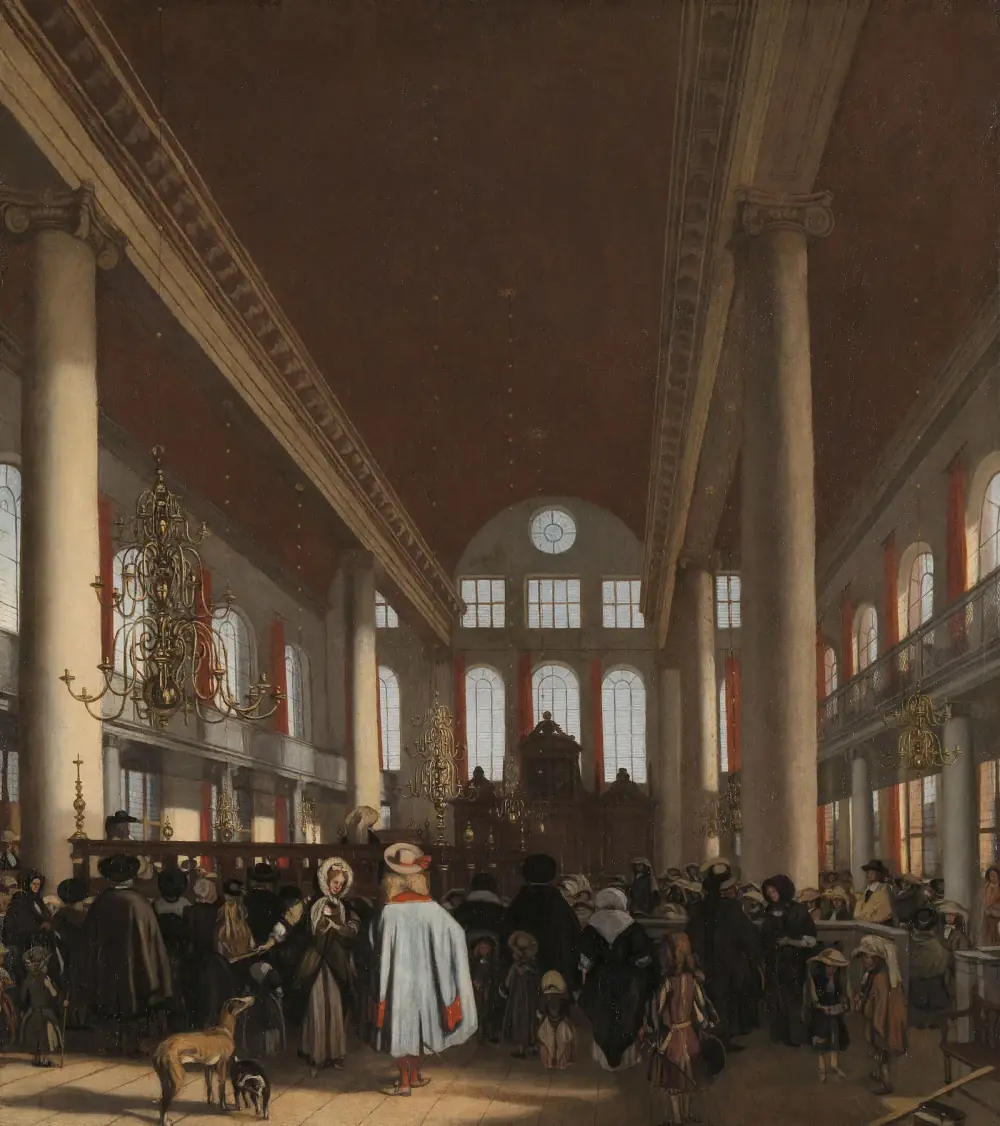
- Emanuel de Witte's painting of the Esnoga during a service, made around 1680, a few years after the opening. Visitors, children and dogs fill the foreground; the rosewood ark stands at the far end. Emanuel de Witte, CC0, via Wikimedia Commons.
- The interior in 2015, seen from a gallery: rows of benches, the rosewood ark at the far end and brass chandeliers still fitted with candles. Chajm Guski from Germany, CC BY-SA 2.0, via Wikimedia Commons.
- One of the Esnoga's brass chandeliers lit with candles, photographed in 2009. The building has never had electric light. Massimo Catarinella, CC BY-SA 3.0, via Wikimedia Commons.