

The Battle of Ponta Delgada, 26 July 1582: the Azores fight for Dom António
Catherine de' Medici sent a fleet of some sixty ships to win the Azores for the Portuguese pretender Dom António. Off São Miguel, the flagship of Philip II's admiral boarded the French commander's ship, and the prisoners were put to death as pirates.
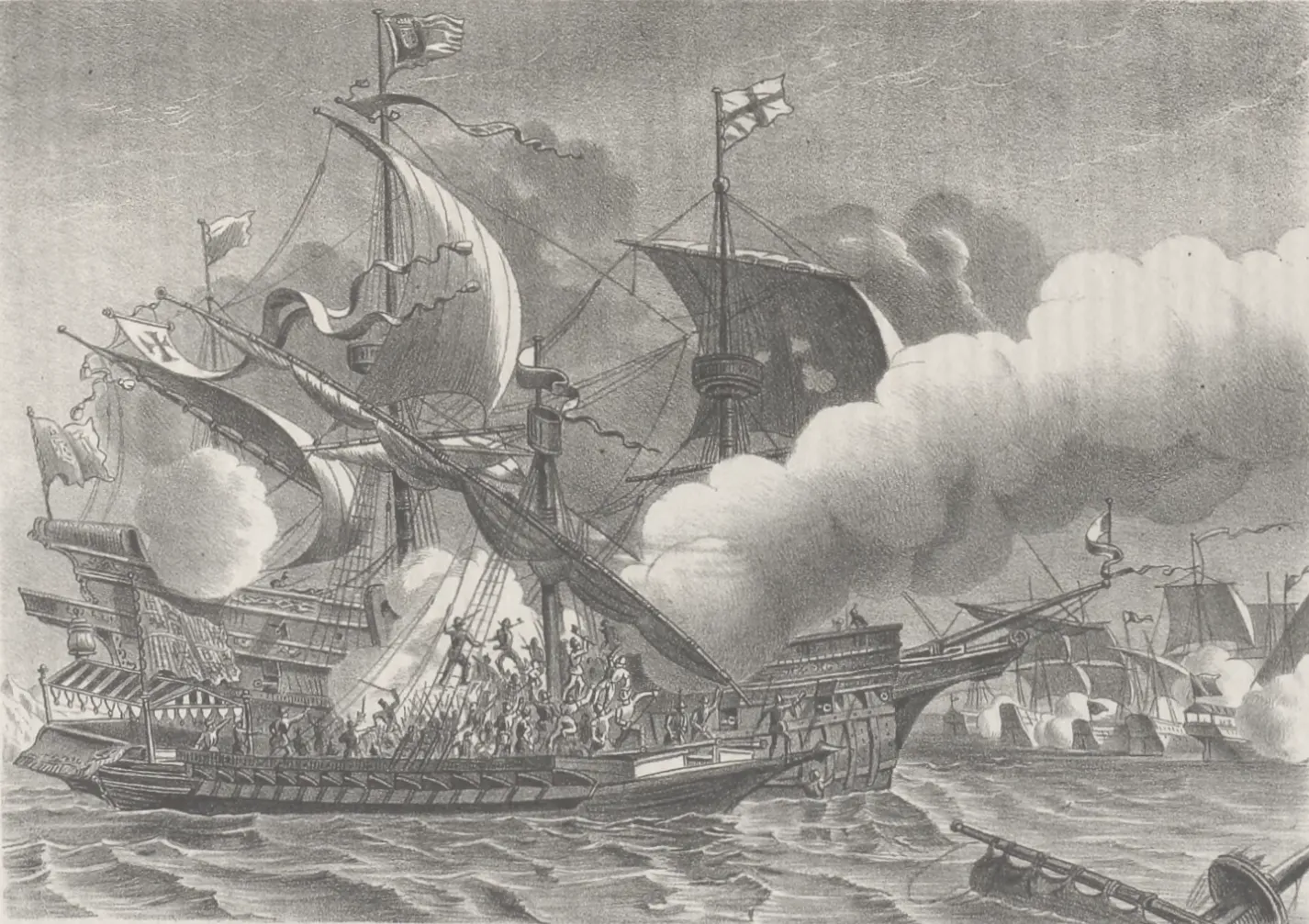
At a glance
- On Thursday 26 July 1582, south of São Miguel in the Azores, a fleet sent by Philip II under Álvaro de Bazán, Marquis of Santa Cruz, beat a larger French fleet sent to win the islands for Dom António, Prior of Crato.
- Estimates of the French fleet run from 58 to 73 sail. Santa Cruz had about 27 fighting ships and some 5,500 soldiers; 20 more ships were still on their way from Cádiz.
- The French commander, the Florentine Filippo Strozzi, was mortally wounded when his flagship was boarded. Accounts differ on whether he died of his wounds or was stabbed and thrown overboard.
- France and Spain were officially at peace, so the prisoners were tried as pirates. Twenty-eight lords, 52 gentlemen and 313 soldiers and sailors were sentenced to death. Sailors were hanged from the yardarms and the nobles executed on a scaffold at Vila Franca do Campo; the sources do not say separately what became of the soldiers.
- Terceira held out for António for another year. Santa Cruz landed there before dawn on 26 or 27 July 1583 (the sources differ by a day), and by early August every island had submitted to Philip.
St Anne's day, eighteen miles off São Miguel
Early on 26 July 1582, St Anne's day, Filippo Strozzi went from ship to ship to draw up his fleet. His captains had muttered that the big hulk carrying his flag was too slow and would hang back, so he moved to one of the fastest sailers in the fleet, a light ship of about 200 tons. Every captain had signed his order of battle the day before: every ship was to board an enemy.
The two fleets were about eighteen miles from São Miguel, the largest island of the Azores, with a north-north-westerly wind behind the French. For four days they had circled each other between São Miguel and Santa Maria. Soon after midday the French bore down in good order, the flagships leading, on a Spanish fleet packed tight to meet them.
On the other side, Álvaro de Bazán, Marquis of Santa Cruz, gave the only order of his that the Spanish accounts of the day record: close up the ships. One of his two big galleons, the San Mateo, had fallen a little behind. Strozzi steered straight for her.
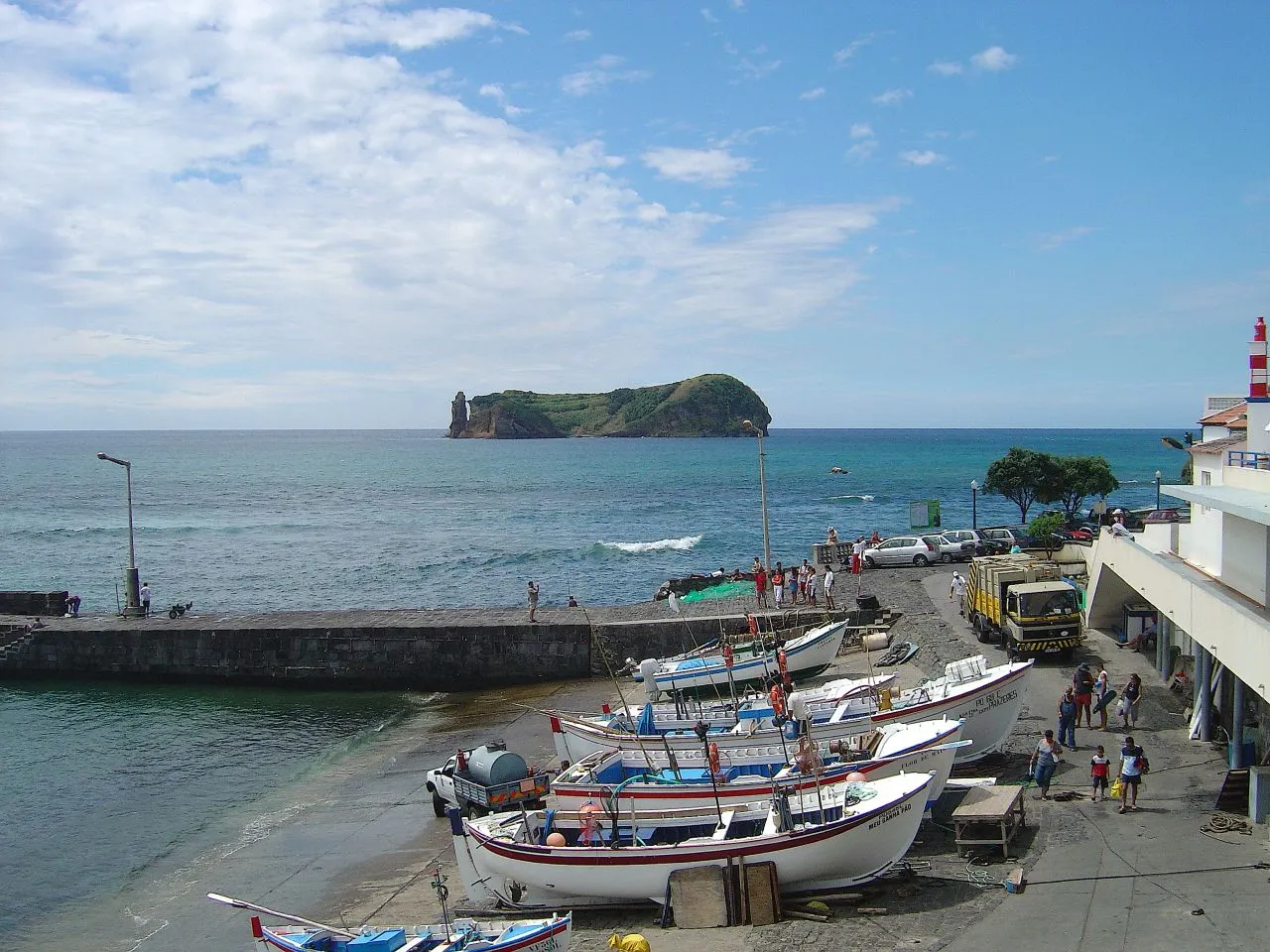
Five hours later Strozzi was a dying prisoner, his flagship taken, and the rest of his fleet was scattering. Spanish writers came to call the fight the battle of the island of São Miguel or of Terceira; Portuguese historians often call it the battle of Vila Franca do Campo, after the town where the Spanish fleet anchored. In English it is often the Battle of Ponta Delgada.
A crown and nine islands
Portugal had lost its king in 1578, when Sebastião died without children at Alcácer Quibir in Morocco. His great-uncle, Cardinal Henrique, reigned for a year and a half and died in January 1580 without naming an heir. The strongest claimant was Philip II of Spain, grandson of King Manuel I through his mother. His rival António, Prior of Crato, was also Manuel's grandson, through Manuel's son Luís, but he had been born out of wedlock.
António had himself proclaimed king at Santarém on 19 June 1580. Philip's army under the Duke of Alba crossed the border at the end of June and beat António's men at Alcântara, outside Lisbon, on 25 August. António, wounded, escaped through the north and was never caught. In April 1581 the Cortes, Portugal's assembly of the estates, acclaimed Philip king at Tomar.
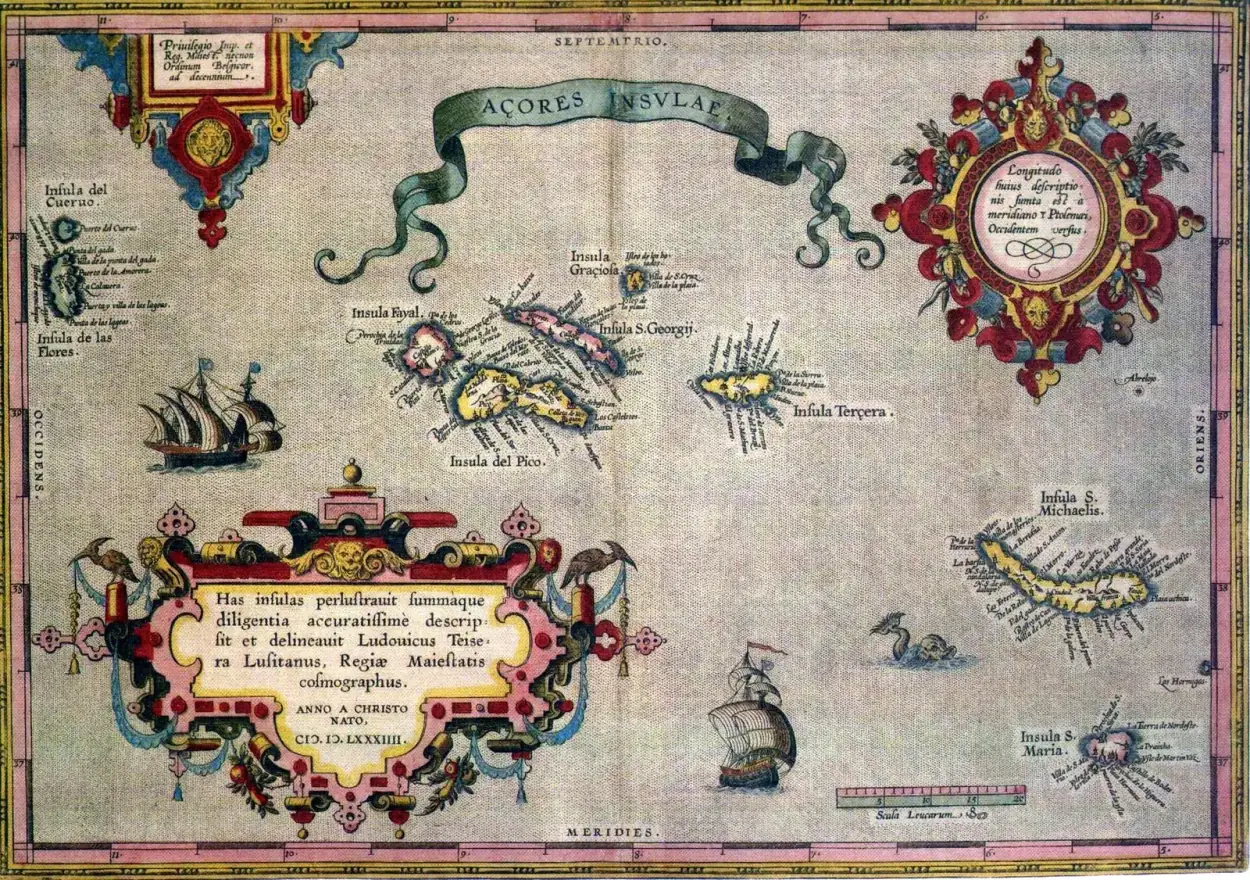
The Azores did not all follow. São Miguel accepted Philip as soon as the news of Alcântara arrived, and so did Santa Maria. Terceira, whose town of Angra was the capital of the archipelago, and the western islands stayed loyal to António. Their governor, Ciprião de Figueiredo, answered Philip's offer of pardon with a prayer that God would restore Portugal to its beloved king, Dom António.
Philip's first attempt failed. In July 1581 Pedro de Valdés, sent with a small squadron to shepherd the treasure fleets, tried on his own initiative to take Terceira and landed his men in the bay of Salga. The islanders drove them off, by island tradition and La Roncière's account with the help of herds of wild cattle loosed on the Spanish, and the failed landing cost Valdés 300 or more casualties.
The queen mother's fleet
António found his patron in France. Catherine de' Medici, mother of King Henri III, had a claim of her own to the Portuguese throne, and she gave it up in his favour for a price. According to La Roncière, who worked from her letters, the two agreed that once António was restored she would have Brazil. Her written plan, approved by the king on 3 May 1582, was for Strozzi to take Madeira, secure the Azores and then sail on to Brazil.
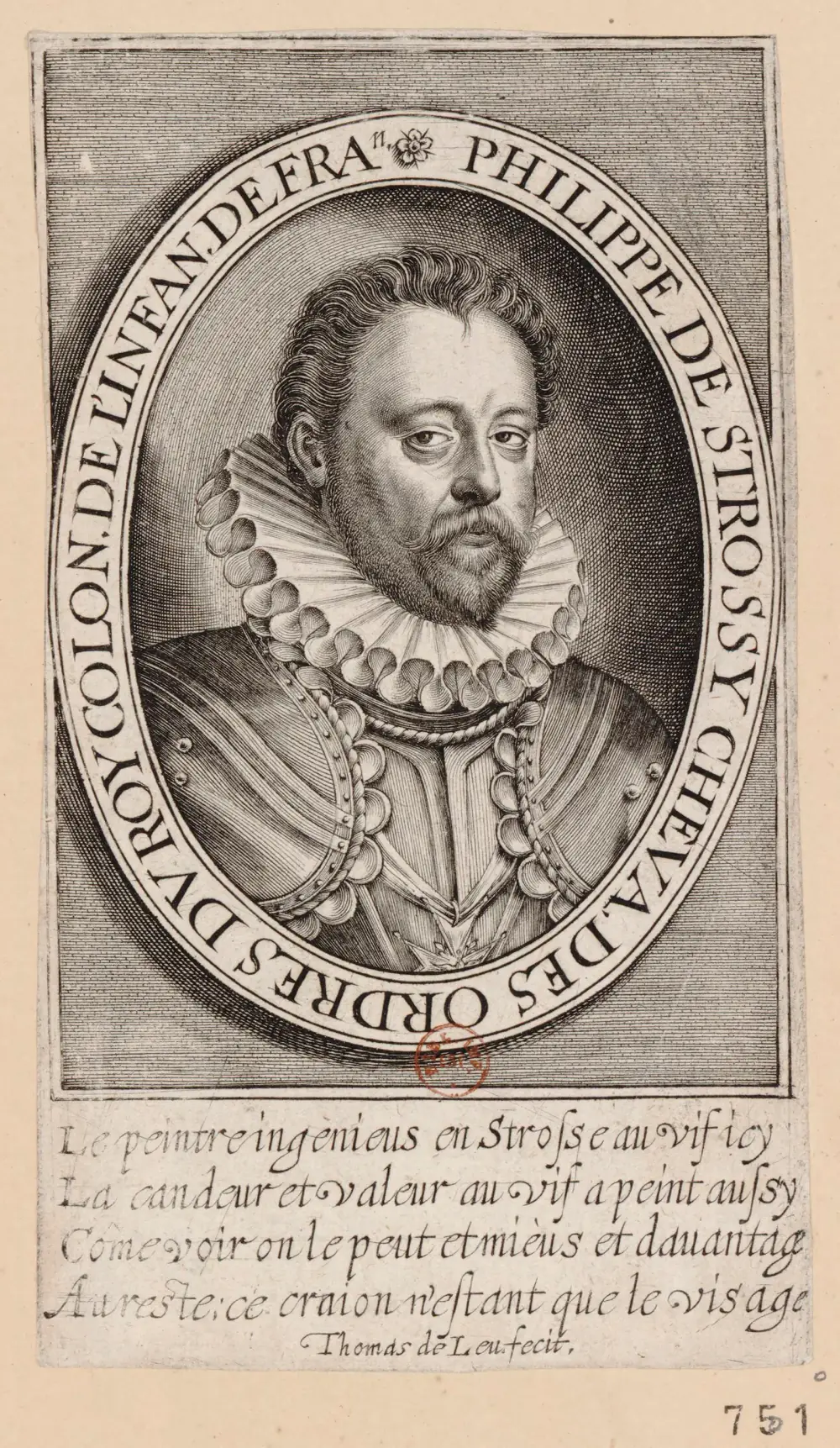
Filippo Strozzi, whom La Roncière calls the queen's cousin, was born in Venice in 1541 into the Florentine Strozzi family and was brought up at the French court. He had fought in the wars of religion, at Moncontour and the siege of La Rochelle, and rose to colonel general of the French infantry. In 1581 he was made to give up that post, reluctantly and for 50,000 écus, according to La Roncière; Catherine, who wanted him to lead the expedition, had a hand in it. He had never been a seaman.
France and Spain were at peace, and the charters for the hired ships spoke only of protecting merchants and chasing pirates. Nobody was fooled. At Belle-Île, off Brittany, António reviewed a fleet of 64 sail carrying 55 companies of troops, about 5,000 men, many of them gentlemen volunteers. In mid-June it sailed. An advance squadron had already probed São Miguel in May and been turned away.
Philip had already decided what to do with such men. His instructions to Santa Cruz of 13 January 1582 told him to seek out and destroy any fleet sent from France or England, and laid down that French and English prisoners, subjects of kings with whom he was at peace, were to be treated as pirates and executed if they were of age.
Two fleets off São Miguel
Strozzi's ships anchored off São Miguel on 15 or 16 July, after a month at sea. His troops routed the island's Spanish companies and plundered the countryside, but the garrison of the fort at Ponta Delgada, some 500 men, refused António's summons to surrender. Then the French captured a dispatch boat and learned that Santa Cruz was coming.
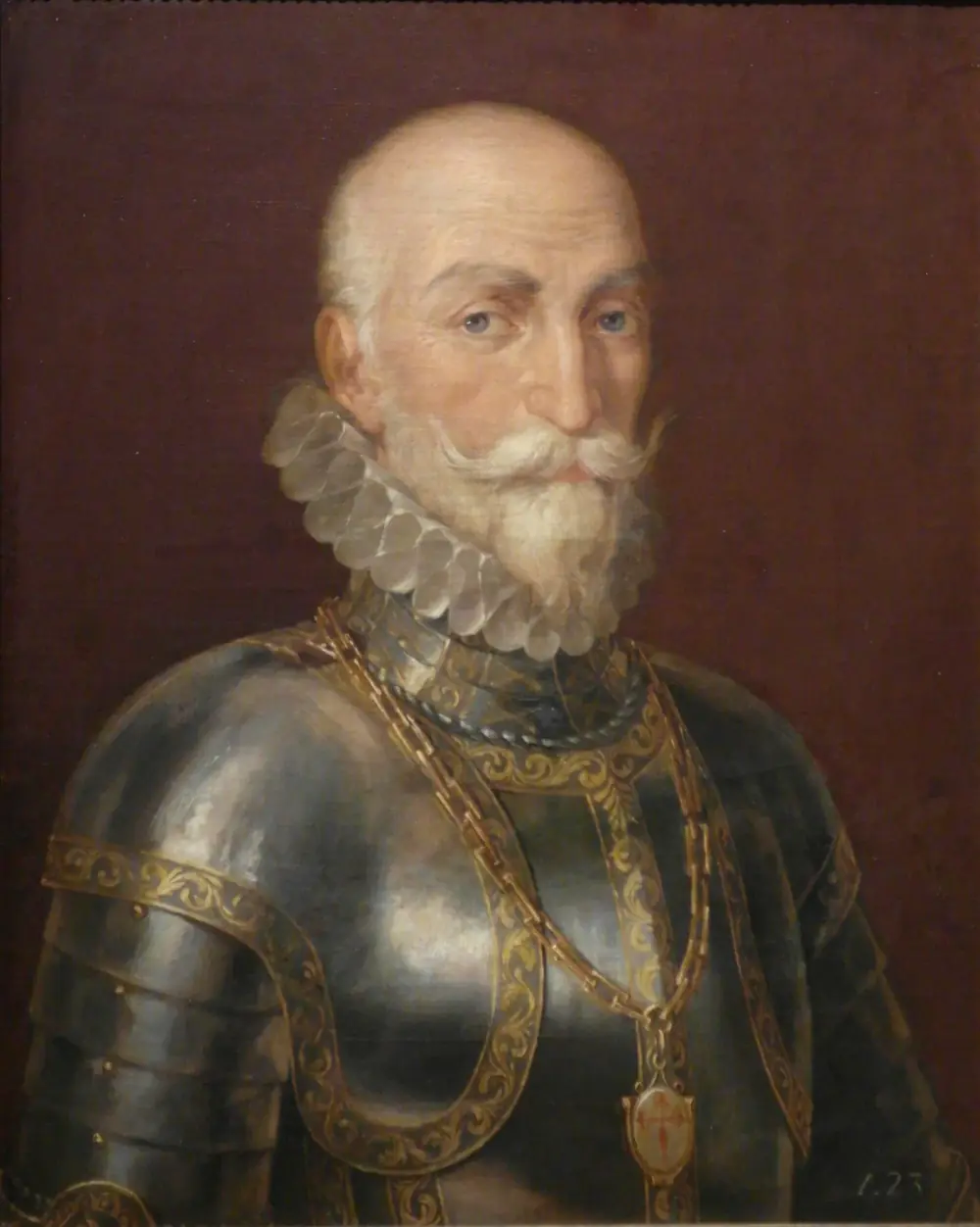
Santa Cruz had left Lisbon on 10 July before his fleet was complete, because news of Strozzi's departure had reached the court. His flagship, the San Martín, was a Portuguese galleon of 1,200 tons that his own men had captured in Lisbon in 1580, when she served António. The San Mateo, another Portuguese galleon, carried the veteran infantry commander Lope de Figueroa. Westerly gales off the Algarve sent back the twelve galleys of Francisco de Benavides and delayed the twenty ships of Juan Martínez de Recalde from Cádiz.
When the fleets sighted each other off Vila Franca do Campo on 22 July, Strozzi re-embarked his troops. Asked why he was leaving the ground he had won, he gave the answer La Roncière found in the French accounts.
“Let us first beat the enemy fleet. It has thirty-one ships, ours seventy-three. If we win, we shall be masters not only of Portugal and its islands but of all the fleets of the Indies, of Calicut and of Peru.”
| Figure | Source | |
|---|---|---|
| French ships | 64 sail at Belle-Île; 73 by Strozzi's count | La Roncière, from French papers |
| French ships | 58 sail, 28 of them large | Juan del Castillo, captain of the Ponta Delgada fort, to Santa Cruz |
| French ships | 60, large and small | Gaspar Frutuoso, eyewitness on São Miguel |
| French troops | about 5,000 (55 companies) | La Roncière |
| French troops | 6,000 | Castillo's letter |
| French troops | 8,000 | Frutuoso |
| Santa Cruz's fighting ships | 27, plus scouting boats | Rodríguez Garat, from Santa Cruz's report |
| Santa Cruz's soldiers | about 5,500 | Santa Cruz's report, via Rodríguez Garat |
| Spanish dead | 224 | Casualty return in Frutuoso; Rodríguez Garat |
| Spanish wounded | 513 to 550 | Frutuoso (513); Rodríguez Garat (550); La Roncière gives 777 killed or wounded, which with 224 dead implies 553 |
| French dead | about 1,200, besides many wounded | Frutuoso |
| French killed and wounded | about double the Spanish 777 | La Roncière |
| French ships lost | 4 to 10 | La Roncière (4 taken or burned); Rodríguez Garat (10 large ships) |
Every count of an enemy fleet in this period was liable to inflation; Rodríguez Garat suggests up to a third of the French ships may have been small craft of little fighting value. Frutuoso's itemised list of Spanish wounded, as printed, adds up to 493, not the 513 he gives as the total; neither source explains the gap.
Strozzi had the wind, the numbers and faster ships, so the choice of when to fight was his. Santa Cruz kept his fleet in a tight defensive mass with the four strongest ships on the side facing the enemy, waiting for Recalde. On 23 July the French tried three times to get round his rear. On the 24th they came within cannon shot of the San Martín and San Mateo, exchanged broadsides and drew off.
That night the mainmast of Cristóbal de Eraso's big nao, the Jesús María, gave way, and Santa Cruz took her in tow, which slowed the whole fleet. Two hulks carrying German soldiers lost touch in the dark and did not come back until after the battle. On the French side, captains refused Strozzi's orders to keep in contact. The night before the battle, Dom António left for Terceira to await the outcome there.
Five hours of boarding
Strozzi grappled the San Mateo on one side and his second in command, the Count of Brissac, on the other, while three more French ships came at her bow and stern. The galleon was set on fire five times. Her captain was killed, and by the end she had 40 dead and 74 wounded. Lope de Figueroa later wrote that for two hours the rest of the fleet could not reach him, because it lay downwind.
Help came from the Basque naos behind him. The Juana boarded Strozzi's ship from her free side and the María did the same to Brissac's, losing 45 men, more than any other ship in the fleet. Then Miguel de Oquendo brought his Concepción round.
“Seeing that she was in great danger, and that if they took her they would rout us all, I freed myself as best I could and turned back to help her, and arrived at a moment of the very greatest need, and wedged my ship between the said galleon and the enemy's vice-flagship with every sail set, so that the two galleons drew apart, and the San Mateo got free of her danger, and not a little glad.”
Oquendo's men boarded Brissac's ship and took her colours, but Brissac held out in his cabin until other French captains rescued him, and he escaped the battle. The French say that most of their fleet never closed with the enemy. By their count only about fifteen ships were in line, some twenty had slipped away, and one squadron commander pulled back without firing a shot.
Strozzi's ship, reinforced with 300 fresh men, finally broke away from the San Mateo. She was a few hundred paces clear when the San Martín, which had turned back on the enemy, ran alongside her, and the nao Catalina boarded from the other side. Musketeers fired down from the galleon's poop and tops onto the small French deck. After an hour Strozzi, his thigh smashed, was taken, and the battle was over.
Spanish dead by ship, 26 July 1582
dead
Dead on each ship of Santa Cruz's fleet, 224 in all, from the casualty list in Gaspar Frutuoso's account as printed by Iglesias Almeida (2012). Rodríguez Garat (2023) gives the same figures for the San Martín, San Mateo, María and Concepción.
Show the data
| Dead | |
|---|---|
| María | 45 |
| San Mateo | 40 |
| San Vicente | 27 |
| Concepción (Oquendo) | 17 |
| San Martín (flagship) | 15 |
| San Antonio y Buen Viaje | 15 |
| Juana | 13 |
| Catalina | 13 |
| Buenaventura | 6 |
| Misericordia | 6 |
| Santa María de Icíar | 5 |
| Peña de Francia | 2 |
| Other ships | 20 |
The casualty list shows where the fighting was. The two galleons and the four naos that boarded beside them, the María, Juana, Concepción and Catalina, account for 143 of the 224 Spanish dead. Not one of Santa Cruz's ships was lost, though several were badly damaged, and he told the king on 4 August that his fleet was battered, with many dead and wounded, and out of powder and match.
Pirates, not prisoners of war
António's constable, the Count of Vimioso, had sailed with Strozzi and was mortally wounded on his deck. Before he died, the day after the battle by La Roncière's account or two days after by Rodríguez Garat's, he told Santa Cruz what he knew of French plans: a new squadron of 30 hulks carrying German and other regiments was to land near Vigo or at Lagos and, with some 40 English ships, try to win back Portugal for António.
The other prisoners were treated as Philip had ordered. After four days in captivity, La Roncière writes, without food, water or dressings for their wounds, they were sentenced to death as pirates and disturbers of the peace by the fleet's auditor general, Martín de Aranda. Only the pilots and boys under seventeen were spared. The list of the condemned counted 28 lords, 52 gentlemen and 313 soldiers and sailors.
French sailors were hanged from the yardarms of the Spanish ships; La Roncière does not say separately how the soldiers died. The noblemen were put to death on a scaffold set up in Vila Franca do Campo, by garrotte according to La Roncière. Among them were captains, a ship's commander, the expedition's chief physician and a young man who asked leave to write to his mother first. The chaplain went last.
When Philip asked Henri III how he had allowed such a fleet to sail in peacetime, the French king answered, according to Frutuoso, that he had known nothing of it and that its men could be treated as corsairs. In private Henri raged against Spanish cruelty, but he could not go to war over it. Meanwhile the bishop received Santa Cruz under a canopy at the parish church of Vila Franca, and a Te Deum was sung for the victory.
Terceira holds out for a year
Recalde's ships reached the Azores on 9 August, two weeks too late for the battle. Santa Cruz still had no galleys and none of the flat-bottomed landing boats built for the assault, and his Cádiz ships were full of sick men. He left 1,500 soldiers on São Miguel, cruised west of the islands to meet the treasure fleets and was back in Lisbon on 15 September. Philip, who had urged him to attack Terceira at once, was pleased with the victory and disappointed by the rest.
About twenty French ships and 2,000 men had reached Terceira after the battle. Brissac sailed for France. Dom António sent a small force against the Cape Verde islands, which failed, and in October he went back to France himself.
Santa Cruz returned the next summer with everything he had lacked. La Roncière counts 97 vessels and 12,835 men, galleys among them. On 23 July 1583 he offered a pardon to the Portuguese of Terceira and safe passage to the foreigners; the forts of Angra answered with gunfire. Before dawn on 26 July by Rodríguez Garat's account, or 27 July by La Roncière's, the galleys towed 4,000 to 4,500 men in landing boats to the cove of Mós, between Angra and Praia, which was held by only a few companies.
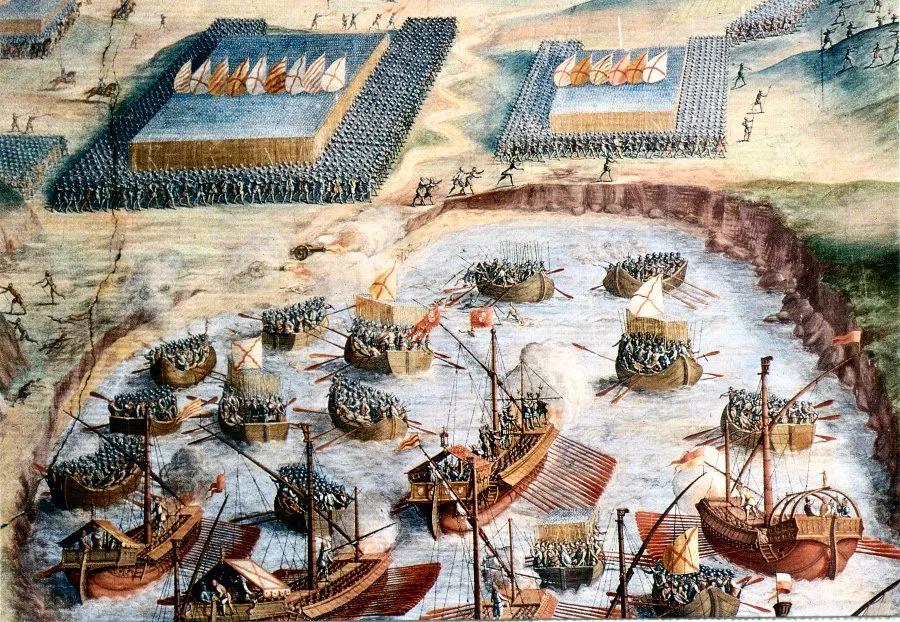
The French under Aymar de Chaste counter-attacked and fought until nightfall, and the landing cost about 70 dead and 300 wounded. But Spanish galleys took Angra without a fight, and the Portuguese militia scattered. Chaste capitulated on 2 or 3 August in return for passage home for his men. The other islands submitted, Faial only after a fight. By 1583 the island's governor was Manuel da Silva, Count of Torres Vedras; he was beheaded with a few others, and Angra was sacked for three days.
4 August 1578
King Sebastião killed at Alcácer Quibir
January 1580
Cardinal-King Henrique dies without an heir
19 June 1580
António proclaimed king at Santarém
25 August 1580
Alba's army beats António at Alcântara
April 1581
The Cortes at Tomar acclaim Philip II as Philip I of Portugal
July 1581
Valdés's landing at Salga on Terceira is driven off
13 January 1582
Philip's instructions to Santa Cruz
Mid-June 1582
Strozzi's fleet sails from Belle-Île
10 July 1582
Santa Cruz sails from Lisbon
15-16 July 1582
French troops land on São Miguel
22 July 1582
The fleets sight each other off Vila Franca do Campo
26 July 1582
Battle off São Miguel; Strozzi's flagship taken
Late July 1582
Prisoners sentenced to death as pirates
15 September 1582
Santa Cruz back in Lisbon
October 1582
António returns to France
26 or 27 July 1583
Santa Cruz lands at Mós on Terceira
2 or 3 August 1583
The French on Terceira capitulate
1595
António dies in Paris
Why it still matters
The battle settled who would hold the Atlantic crossroads. With the Azores in Philip's hands, the treasure fleets from America and the India ships could call there in safety, and the islands stayed under Philip's rule. For France, La Roncière wrote, the defeat laid bare how weak its navy was: it had no ships able to face the great galleons.
Naval historians also look at it as a fight between ocean-going sailing ships, fought mostly with guns but decided by boarding. Rodríguez Garat calls it the first great naval battle in the Atlantic of the modern age, and argues that the Azores campaign planted in Santa Cruz's mind the idea of an invasion of England. In Garat's view Santa Cruz would have been the right man to lead it, had illness and a distrustful king allowed; he died in 1588.
Dom António never gave up. He settled in England in 1585, sailed with the failed English expedition to Lisbon in 1589 and died poor in Paris in 1595. One of his followers on the 1582 expedition, João de Castro, lost faith in him in 1583, turned to Sebastianism, the belief that King Sebastião had survived and would return, and wrote the first life of Sebastião that set out to explain his survival.
FAQs
Why is it called both the Battle of Ponta Delgada and the Battle of Vila Franca do Campo?
The fight took place at sea, some eighteen miles south of São Miguel. The French had landed near Ponta Delgada, the island's main town, while the Spanish fleet anchored at Vila Franca do Campo, where it returned after the battle. Spanish writers have also called it the battle of the island of São Miguel, or of Terceira.
Were France and Spain at war in 1582?
No. The two crowns were officially at peace, and the French fleet sailed under António's flag with private charters. That is why Philip ordered the French and English prisoners to be treated as pirates, and why Henri III said he had known nothing of the expedition.
What happened to Filippo Strozzi?
He was badly wounded when the San Martín and the Catalina boarded his flagship, and he died a prisoner aboard the San Martín soon afterwards. Spanish and Portuguese accounts say he died of his wounds; French accounts say a soldier stabbed him and Santa Cruz had him thrown into the sea.
Did the battle end the resistance in the Azores?
Not at once. Terceira and the western islands held out for António, with French reinforcements, until Santa Cruz landed on Terceira before dawn on 26 or 27 July 1583 (the sources differ by a day). The French there capitulated on 2 or 3 August 1583, and the remaining islands then submitted.
On the timeline
Open the timelineNearby moments from the iberian union (1580–1640).
Spanish forces under the Duke of Alba defeat Dom António, Prior of Crato, at the Battle of Alcântara on the outskirts of Lisbon, crushing Portuguese resistance to Philip II; Alba's troops occupied the capital in the days that followed, opening the way to sixty years of Iberian Union.
At Tomar's Convent of Christ, the three estates acclaim Philip II of Spain as Filipe I of Portugal and he swears to keep their laws. At the Cortes that follow he grants 25 chapters keeping Portugal's coinage and offices in Portuguese hands. The 'dual monarchy' would last sixty years, until the Restoration of 1 December 1640.
At the Battle of Salga on Terceira, in the Azores, islanders loyal to Dom António, Prior of Crato, beat off a Spanish landing led by Pedro de Valdés, who attacked on his own initiative rather than on Philip II's orders. Island tradition says stampeding cattle helped rout his men. Terceira holds out for Dom António for two more years.
Battle of Ponta Delgada, 1582
In the Battle of Ponta Delgada, fought at sea south of São Miguel in the Azores, Philip II's fleet under Álvaro de Bazán, Marquis of Santa Cruz, defeats a larger French fleet under Filippo Strozzi sent to back Dom António, Prior of Crato, in his claim to the Portuguese throne. Strozzi dies a prisoner; Terceira, the last island holding out for António, falls a year later.
Portugal adopts the Gregorian calendar by a law signed by Philip I: Thursday 4 October is followed directly by Friday 15 October, and the ten days in between never take place in the country's calendar.
Around this date the Spanish Armada, which included Portuguese-built galleons taken over during the Iberian Union, begins to leave Lisbon for England, putting to sea from off Cascais on 30 May. Lists give it some 130 to 150 ships. The fleet would be scattered in the Channel and wrecked off Scotland and Ireland.
Birth of Manuel de Faria e Sousa, the historian and poet who spent most of his life in Madrid writing Portugal's history in Spanish. His vast commentary on Camões's 'Os Lusíadas' (1639) drew the Inquisition's suspicion and was banned in Lisbon in 1640.
Coming up in history
All long reads
7 sources
Archives, scholarship and reporting this article was checked against.
- 1
«En la Tercera el francés» (Juan Rodríguez Garat)Revista de Historia Naval 162 (2023), pp. 11-54, Instituto de Historia y Cultura Naval, Spanish Navy
- 2
Histoire de la marine française, vol. IV: En quête d'un empire colonial (Charles de La Roncière), pp. 173-199Plon-Nourrit, Paris, 1910 (Internet Archive scan)
- 3
- 4
Um rei indesejado: notas sobre a trajetória política de D. Antônio, Prior do Crato (Jacqueline Hermann)Revista Brasileira de História, vol. 30, no. 59, 2010, pp. 141-166
- 5
Strozzi, Filippo (Guido Almagià)Enciclopedia Italiana, Istituto della Enciclopedia Italiana Treccani, 1936
- 6
Sala de Batallas (Nerea Senra Alonso)Universidad Complutense de Madrid, Proyecto de innovación docente El Escorial
- 7
Documento do Mês – Julho: Lei de adoção do calendário gregorianoArquivo Nacional Torre do Tombo, 1 July 2011
Image credits
- The naval battle off the Azores in July 1582, as imagined almost three centuries later in a lithograph for Rafael del Castillo's illustrated History of Spain (Barcelona, 1875). The fighting on 26 July was decided by boarding, but no oared galley like the one drawn here took part: Santa Cruz's galleys had been driven back by storms. Josep Serra i Porsón, Public domain, via Wikimedia Commons.
- The Azores as surveyed by the Portuguese royal cosmographer Luís Teixeira, printed in Abraham Ortelius's atlas in 1584, two years after the battle. The fight took place south of São Miguel (Insula S. Michaelis, lower right); Terceira (Insula Terçera) is in the centre. Abraham Ortelius, Public domain, via Wikimedia Commons.
- Filippo Strozzi, “Philippe de Strossy”, colonel of the French infantry and knight of the king's orders, in an engraving by Thomas de Leu. Bibliothèque nationale de France. Thomas de Leu, Public domain, via Wikimedia Commons.
- Álvaro de Bazán, first Marquis of Santa Cruz (1526-1588), veteran of Lepanto, in an 1828 copy by Rafael Tegeo, also spelt Tejeo, of an older anonymous portrait kept by his descendants, now in the Museo Naval in Madrid. Rafael Tejeo, Public domain, via Wikimedia Commons.
- The harbour of Vila Franca do Campo on the south coast of São Miguel, with its islet offshore, in 2005. Santa Cruz's fleet was anchoring here when the French fleet was sighted on 22 July 1582, and the French noblemen were executed in the town after the battle. Vitor Oliveira from Torres Vedras, PORTUGAL, CC BY 2.0, via Wikimedia Commons.
- Spanish infantry landing on Terceira in July 1583, a detail of the fresco by Niccolò Granello, one of the Genoese painters Philip II engaged in 1584 to decorate the Hall of Battles at the Escorial. Niccolò Granello, Public domain, via Wikimedia Commons.