

Tomar, 16 April 1581: Philip II of Spain swears to rule as a Portuguese king
After a disputed succession and a short war, the most powerful king in Europe knelt in a Portuguese convent and swore to keep Portugal's laws. The promises he made at Tomar shaped sixty years of shared kings.
At a glance
- On the afternoon of Sunday 16 April 1581, in the Convent of Christ at Tomar, the three estates of Portugal acclaimed Philip II of Spain as their king, Filipe I, and he swore to keep their laws, customs and privileges.
- Philip's claim came through his mother, a daughter of King Manuel I. He won the crown after Cardinal-King Henrique died without an heir in 1580 and the Duke of Alba's army beat the rival claimant, António, Prior of Crato, at Alcântara.
- The Cortes formally opened on 20 April and swore in Philip's son Diogo as heir on 23 April. The notaries' record mentions a gold sceptre but no crown.
- At Tomar Philip accepted 25 chapters first offered in 1580: Portugal would keep its own laws, Cortes, coinage and officials, and its trade with India and Guinea. He confirmed them in writing on 15 November 1582.
- The union of crowns lasted until 1 December 1640. Philip deferred the promise of Portuguese-only garrisons from the start and in 1592 reversed another, on free trade across the land border.
A Sunday afternoon at the Convent of Christ
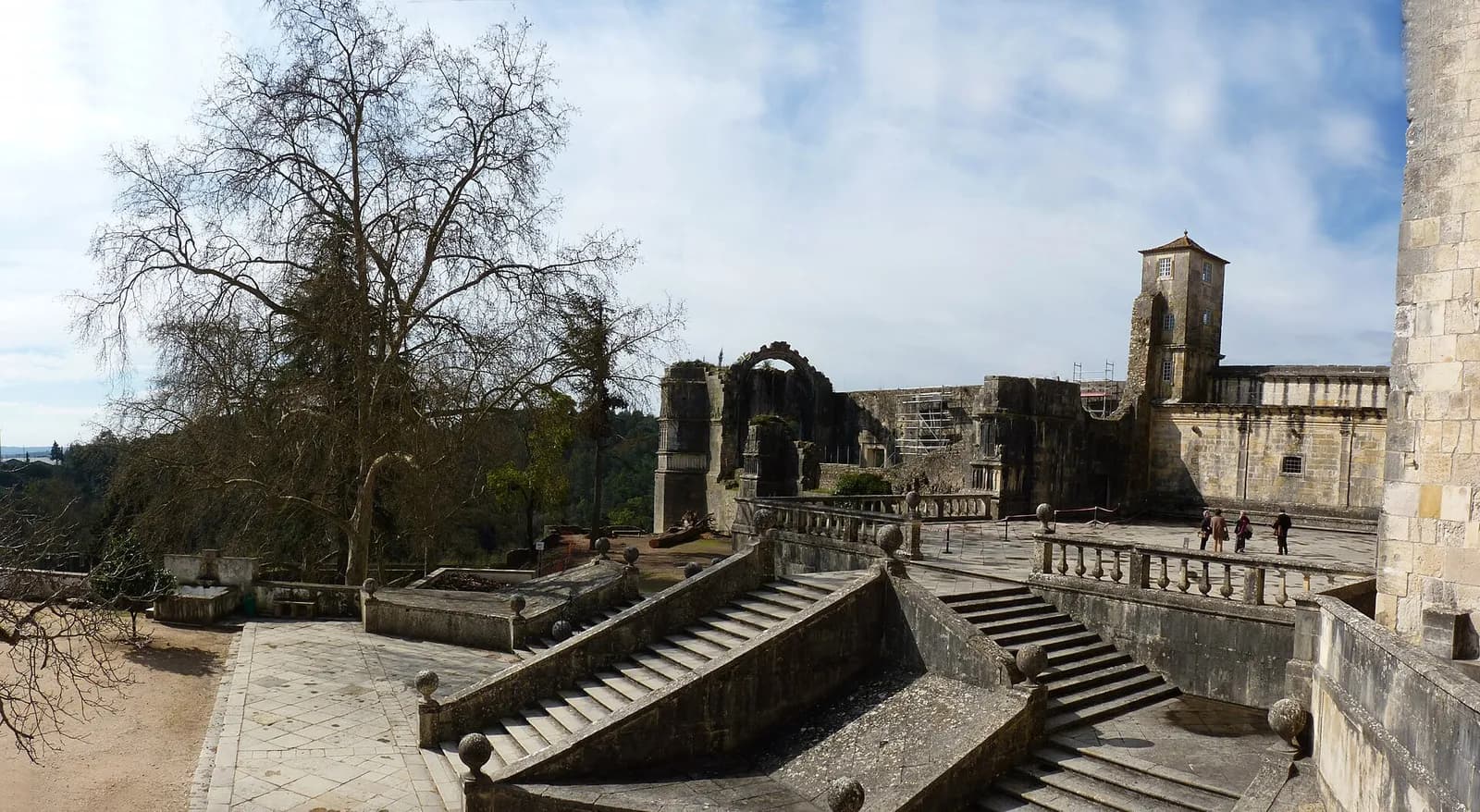
On the afternoon of Sunday 16 April 1581 a high, carpeted stage stood in the Cistern courtyard of the Convent of Christ at Tomar, the head house of the Order of Christ, and the walls around it were hung with rich tapestries. Bishops and the representatives of Portugal's towns were already in their places when the king came out of his lodgings in the same convent. He wore a long robe of brocade and the collar of the Order of the Golden Fleece.
Ahead of him walked João, Duke of Bragança, Constable of the kingdom, holding the sword of state upright, and the standard-bearer Jorge de Meneses with the royal banner still furled. Heralds and mace-bearers went in front. Minstrels, shawms, trumpets and kettledrums struck up as he entered, and on the stage he sat down and took a gold sceptre from his chamberlain.
The king was Philip II of Spain. That afternoon he became Filipe I of Portugal. The Bishop of Leiria, António Pinheiro, made a speech setting out his right to the throne, and Damião de Aguiar, one of Lisbon's two representatives, answered for the kingdom. Then Philip knelt before an open missal with a cross laid on it, put his right hand on the book, held the sceptre in his left and repeated the oath that his secretary, Miguel de Moura, read out to him.
“We swear and promise, with the grace of Our Lord, to rule and govern you well and rightly, and to administer justice to you in full, as far as human frailty permits, and to keep your good customs, privileges, graces, favours, liberties and franchises, which were given, granted and confirmed to you by the past kings our predecessors.”
The Duke of Bragança swore first, his right hand on the cross and missal, and kissed the king's hand. As he finished, the standard-bearer unfurled the banner. The other nobles followed, then the prelates, the royal councillors, the lords of lands and the castle governors, and then the representatives of the towns, so many that the notaries filled pages with their names. When the king had accepted their oaths, Portugal King of Arms, the senior herald, called out “Hear ye” three times, and the standard-bearer cried “Real, real, real” for King Philip.
Every step followed, in the notaries' words, the custom and ceremonies used by the kings of Portugal. That was the point. Philip had taken Portugal with an army, and at Tomar he had himself raised as the lawful heir of its old kings.
A kingdom without an heir
The crisis began in Morocco. On 4 August 1578 King Sebastião was killed at the battle of Alcácer Quibir, leaving no children, and much of the Portuguese nobility was taken prisoner. The crown passed to his great-uncle, Cardinal Henrique, an elderly churchman with no heir of his own, who had to settle a succession that could not wait.
Several descendants of King Manuel I came forward. The strongest were Philip, whose mother was Manuel's daughter Isabel; Catarina, Duchess of Bragança, daughter of Manuel's son Duarte and Henrique's favourite; and António, Prior of Crato, son of Manuel's son Luís. António was the only claimant descended through the male line, but he was illegitimate, and Henrique declared him so.
| Claimant | Descent from Manuel I | Position |
|---|---|---|
| Philip II, King of Spain | Son of Manuel's daughter Isabel | Had long courted the Portuguese nobility |
| Catarina, Duchess of Bragança | Daughter of Manuel's son Duarte | Henrique's preferred heir, without the nobility's support |
| António, Prior of Crato | Son of Manuel's son Luís | Only male-line claimant, but illegitimate |
| Emanuel Philibert, Duke of Savoy | Son of Manuel's daughter Beatriz | Outside contender |
| Ranuccio Farnese, of Parma | Great-grandson, through his mother, the infanta Maria | Outside contender |
| Catherine de' Medici, Queen Mother of France | None: a remote link to Afonso III, who died in 1279 | Outside contender |
From Jacqueline Hermann's study of António's career.
Philip worked on the Portuguese for two years. His envoys in Lisbon, among them Cristóvão de Moura, courted the higher nobility and clergy and tried to talk António out of his claim. Francisco Ribeiro da Silva, a historian at the University of Porto, found that even the representatives of Lisbon's guilds took Castilian gold from the ambassador Rodrigo Vázquez de Arce.
Philip's ambassadors, led by the Duke of Osuna, also put guarantees on the table: a memorial of 25 chapters on how Portugal would be governed under him, offered first to the Lisbon city council and then at the Cortes that Henrique called to Almeirim in January 1580 to settle the succession. The old king died on 30 or 31 January (sources differ) without naming an heir, and a board of governors took over. Osuna signed the memorial at Almeirim on 20 March, but at the time it came to nothing.
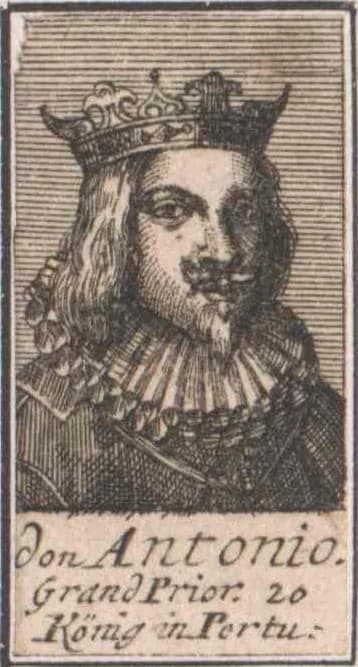
On 19 June 1580 António had himself proclaimed king at Santarém. Philip answered with an army under the Duke of Alba, which crossed the border at the end of June and on 25 August routed António's hastily raised force at Alcântara, outside Lisbon. António, wounded, escaped through the north of the country and went abroad. His cause held out in the Azores until 1583, and he died in Paris in 1595.
Philip himself entered Portugal at Elvas on 5 December 1580. Lisbon was in no state to receive him. The city had been sacked when António's troops abandoned it and attacked again when Alba's arrived, and plague was spreading through its streets.
Why Tomar
The plague decided where the Cortes would meet. Philip and the Duke of Alba weighed Évora, Abrantes, Elvas and Tomar, and the king chose Tomar, according to the art historian Milton Pedro Dias Pacheco. Its convent, the head house of the Order of Christ, could lodge a king and his court. Philip stayed there for almost seventy days and began governing from it.
Philip left little to chance. He forbade the towns to send supporters of the Prior of Crato as their procuradores. Before the Cortes met he also published a general pardon for those who had been “induced, deceived or compelled” to disturb the peace. It did not extend to the Prior himself, whom Philip pursued without mercy.
Three ceremonies in eight days
The ceremony of 16 April was the acclamation, the levantamento, in which the estates raised Philip as their king and he swore to keep their laws. The Cortes proper opened four days later. On the afternoon of Thursday 20 April the king, sceptre in hand, sat under a canopy worked with gold and silver in the chapter house of the Knights of Christ. There were no minstrels this time, the notaries noted, because it was not the custom.
The Bishop of Leiria spoke again. He compared the Cortes to the councils of the Church, hoped the Holy Spirit would assist them and reminded the estates of the king's pardon. Damião de Aguiar thanked Philip in the name of all three estates. Then Lisbon's other representative, Rodrigo de Meneses, climbed the dais and handed the king a paper with some chapters of Cortes, and the session ended.
On Sunday 23 April, St George's day, the three estates met again in the same room to swear allegiance to Philip's heir, his son Diogo. The king accepted the oaths in the prince's name. The commons later asked for Diogo to be brought up in Portugal; Philip replied that the boy's mother had died and he was too young to be parted from his sisters.
- Acclamation and oath
- Sunday 16 April 1581, afternoon
- Formal opening of the Cortes
- Thursday 20 April 1581, chapter house of the Knights of Christ
- Oath to the heir, Prince Diogo
- Sunday 23 April 1581
- Place
- Convent of Christ, Tomar
- Recorded by
- The notaries Lopo Soares and Valério Lopes
- Promises confirmed in writing
- Letters patent signed in Lisbon, 15 November 1582
4 August 1578
Sebastião killed at Alcácer Quibir
Cardinal Henrique becomes king.
January 1580
Henrique's Cortes meet at Almeirim
30 or 31 January 1580
Henrique dies without naming an heir
A board of governors takes over.
20 March 1580
Osuna signs the 25 chapters at Almeirim
19 June 1580
António proclaimed king at Santarém
25 August 1580
Alba defeats António at Alcântara
5 December 1580
Philip enters Portugal at Elvas
16 April 1581
Acclamation and royal oath at Tomar
20 April 1581
Formal opening session of the Cortes
23 April 1581
Prince Diogo sworn as heir
29 June 1581
Philip's state entry into Lisbon
15 November 1582
Letters patent confirm the promises of Tomar
30 January 1583
After Diogo's death, Prince Philip is sworn heir in Lisbon
28 March 1583
Philip back in Madrid
The promises of Tomar
Each of the three estates asked for Osuna's offer back. In the third of their chapters the commons asked Philip to grant the Duke of Osuna's chapters and to swear to them in the form of the letter King Manuel I had given in 1499, when his son Miguel was heir to Castile and Aragon as well as Portugal. Philip agreed. When the chapters were turned down in 1580, he added, he had minded it more for the harm he foresaw for the kingdom than for himself.
The chapters, sometimes called the Statute of Tomar, described a union of crowns, not of kingdoms. Portugal would keep its laws and customs. Cortes dealing with Portugal would meet only in Portugal. Offices, from governor down, would go to Portuguese, unless the king sent a son, brother, uncle or nephew to govern. Church posts and the trade with India and Guinea would stay in Portuguese hands, and gold and silver would be coined with Portugal's arms alone.
| Chapter | Promise | What happened |
|---|---|---|
| I | Keep all Portugal's rights, customs, privileges and liberties | Sworn at Tomar on 16 April 1581 |
| II | Cortes on matters touching Portugal to meet only in Portugal | Confirmed in 1582 |
| III | Viceroy or governors to be Portuguese, or the king's son, brother, uncle or nephew | Confirmed in 1582 |
| IV to VI | All offices of justice, finance, local government, the royal household, sea and land, and the fortress garrisons, to go to Portuguese | Confirmed, except the garrisons, deferred “for a better and more convenient occasion” |
| VII | Trade with India and Guinea unchanged; its ships and officers Portuguese | Confirmed in 1582 |
| VIII | Gold and silver coined only with Portugal's arms | Confirmed in 1582 |
| IX | Bishoprics, abbeys, the Inquisitor-General and the military orders' commanderies to Portuguese | Confirmed in 1582 |
| XV | A Council of Portugal, all Portuguese, to travel with the king, its business done in Portuguese | Council set up in 1581 or 1582; sat in Madrid from 1583 |
| XXI | Customs posts on the land border with Castile (the “dry ports”) to be opened | Granted, then reversed in 1592 |
| XXV | The king to live in Portugal as much as he could, or leave the prince there | Soon proved impractical |
Chapter numbers as printed in the letters patent of 15 November 1582. The fate of each promise is from Francisco Ribeiro da Silva and the BRASILHIS dictionary.
The estates also presented their own chapters, as at every Cortes. The commons began by asking Philip, a widower, to marry in Portugal, and the estates asked him to abolish the town militias and the royal stud farms. The commons' fourth chapter put the heart of the matter plainly.
“Although Your Majesty inherited these kingdoms and lordships of Portugal, they are not for that reason joined to those of Castile; you inherited them principally and in their own right. So we remind and ask Your Majesty that these kingdoms should always remain whole and by themselves, and be ruled and governed in everything by their own laws, ordinances, rights and customs, as has been done until now, when they had kings of these kingdoms only.”
Philip replied that all this was already contained in the 25 graces. Chapter XXIII carried a sum of money: 300,000 cruzados to ransom the captives still held in Morocco, to stock up grain, and to fight the plague in Lisbon.
Chapter XXIII: how the 300,000 cruzados were to be spent
cruzados
The ransom money was to be spent through the Misericórdia of Lisbon, half of it on freeing poor noblemen and commoners. The grain stores were to be set up where the Lisbon city council directed, and the plague money handed out by the archbishop and the city council.
Show the data
| Cruzados | |
|---|---|
| Ransoming captives | 120,000 |
| Grain stores | 150,000 |
| Plague relief in Lisbon | 30,000 |
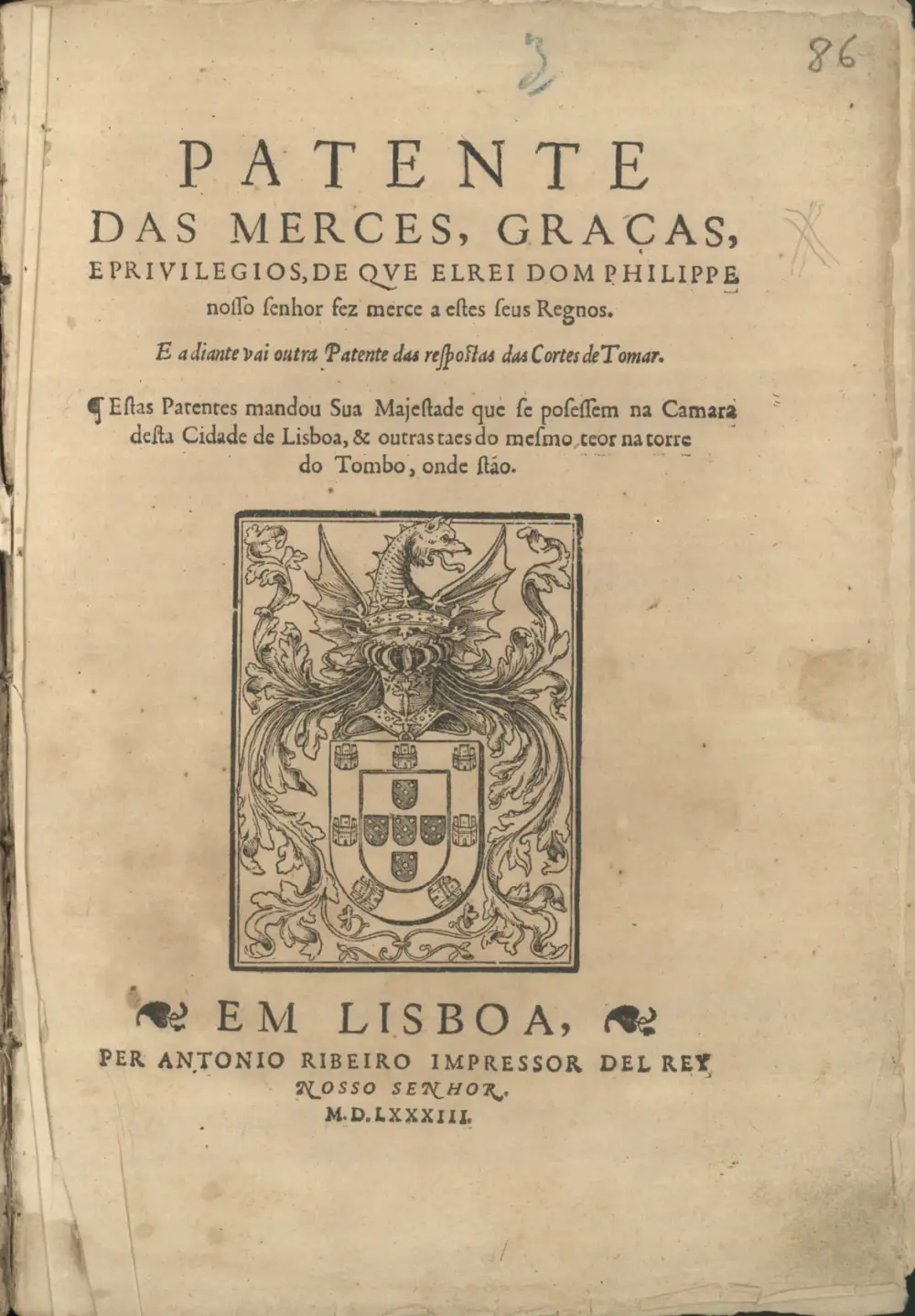
The promises were put in writing only on 15 November 1582, in two letters patent signed in Lisbon: one carried the 25 chapters, the other the king's answers to each estate. Philip bound his successors as well. Any king who broke them, the letter says, should be “cursed with the curse of Our Lord”.
One chapter he would not carry out. The sixth promised that the soldiers garrisoning Portugal's fortresses would be Portuguese. Philip wrote that nothing would please him more, but that for the quiet of his kingdoms he would defer it to “a better and more convenient occasion”. Castilian and German troops stayed, and complaints about soldiers billeted in Portuguese homes appear in the commons' chapters.
How the union worked
Philip left Tomar in May and made his state entry into Lisbon on 29 June 1581. He lived in Portugal for about 25 months in all and had the royal palace on the Lisbon riverfront rebuilt. At the end of 1582 news came that Diogo had died, so the Cortes met in the palace on 30 January 1583 to swear in his son Philip, the future Philip III of Spain. In February the king set out for Castile, and he was back in Madrid on 28 March.
After that Portugal was governed from a distance. The Council of Portugal, the body of Portuguese councillors promised in chapter XV, sat in Madrid from 1583 and handled appointments, grants, bishoprics and overseas governments. In Lisbon a viceroy of royal blood or a board of governors ruled in the king's name, and Portugal's overseas possessions stayed separate from Castile's.
Philip's government was busy. A law reforming the courts was issued on 27 July 1582, the same day as the rules that moved an appeal court, the Casa do Cível, from Lisbon to Porto as the Relação do Porto. A commission began revising the kingdom's laws in 1582; the new code, the Ordenações Filipinas, was finished in 1595 and published in 1603, after Philip's death.
Some promises bent. In 1592 Philip restored the customs posts on the land border, arguing that free passage helped merchants more than ordinary buyers, and there were riots in Porto and Braga. The same year a new duty of 3 per cent on goods passing through Portuguese ports, the consulado, began paying for a coastal fleet against corsairs. Portugal now shared Spain's enemies: by one contemporary count, the English took 28 India ships between 1580 and 1594.
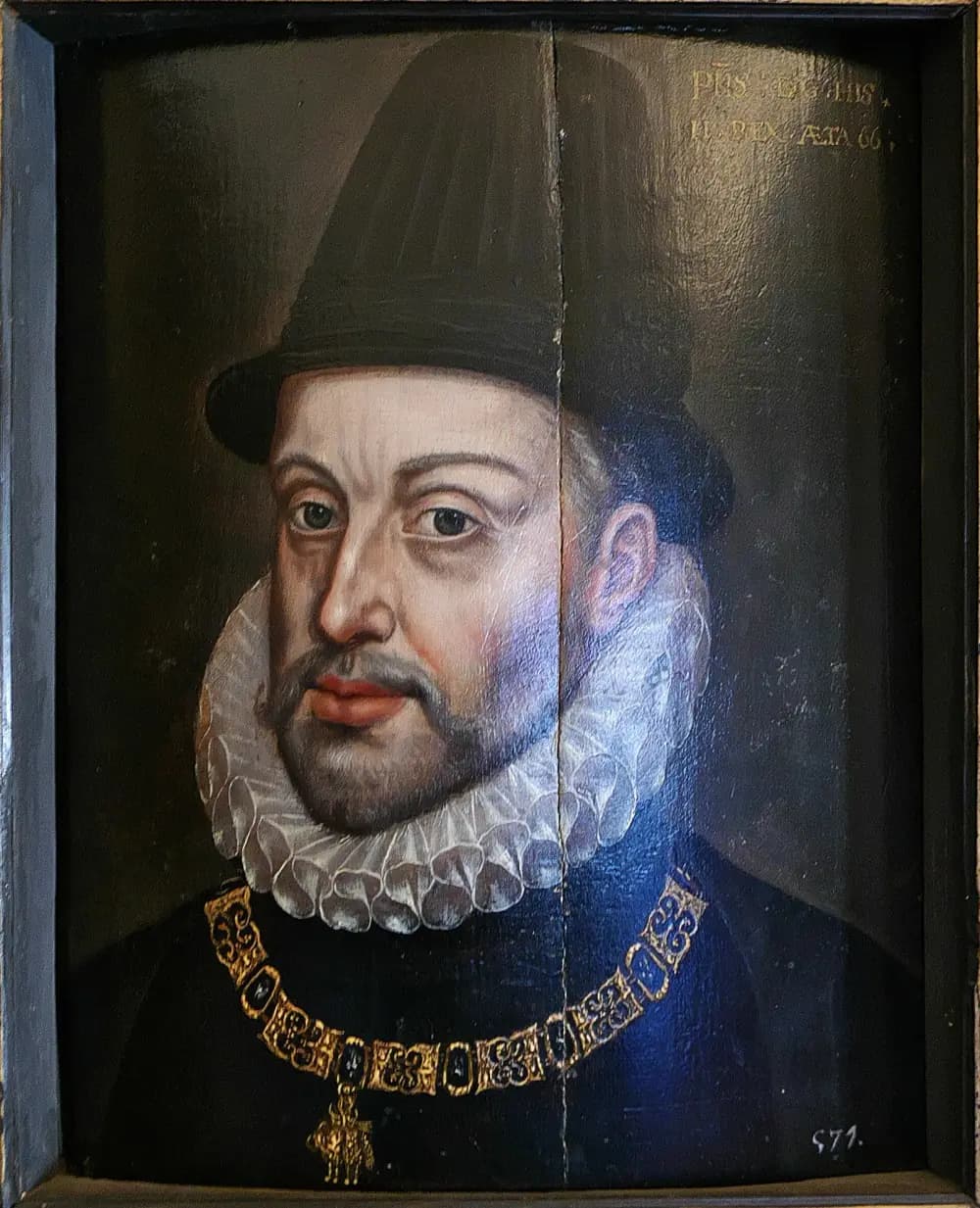
Historians still weigh the balance differently. Joaquim Veríssimo Serrão accused Philip of failing to keep part of the promises of 1581; A. H. de Oliveira Marques called his administration excellent. Ribeiro da Silva compares the chapters to an unwritten constitution, which Philip did not fully respect and his successors broke much further.
Much depended on how 1580 was told. Fernando Bouza, of the Complutense University of Madrid, shows that Portuguese who wanted their country to stay a kingdom insisted that Philip had inherited it, because only an inheritance protected the privileges of Tomar; a conquered country could be treated as a province. A later book, the Arte de Furtar (The Art of Stealing), puts all three versions in Philip's mouth: “I inherited it, I bought it, I conquered it.”
Under Philip's grandson, Philip IV, and his chief minister, the Count-Duke of Olivares, Madrid's rule grew more centralising, until on 1 December 1640 a group of nobles in Lisbon ended the union and the Duke of Bragança became King João IV.
Why it still matters
Because of the promises of Tomar, the Iberian Union was a union of crowns. For sixty years under Habsburg kings, Portugal kept its own laws, coinage, courts, councils and officials, and its empire was run separately from Spain's.
The law code begun under Philip lasted longest. João IV kept the Ordenações Filipinas in force after 1640, and they remained in force in Portugal until the coming of liberalism in the nineteenth century. In Brazil they were finally repealed only in 1917.
The period's reputation has changed too. In the nineteenth century Portuguese writers described the sixty years as a long night of submission. Ribeiro da Silva writes that no one can seriously hold so dark a view today, and that the three Philips should not be judged as if they were one king.
FAQs
Was Philip II crowned king of Portugal at Tomar?
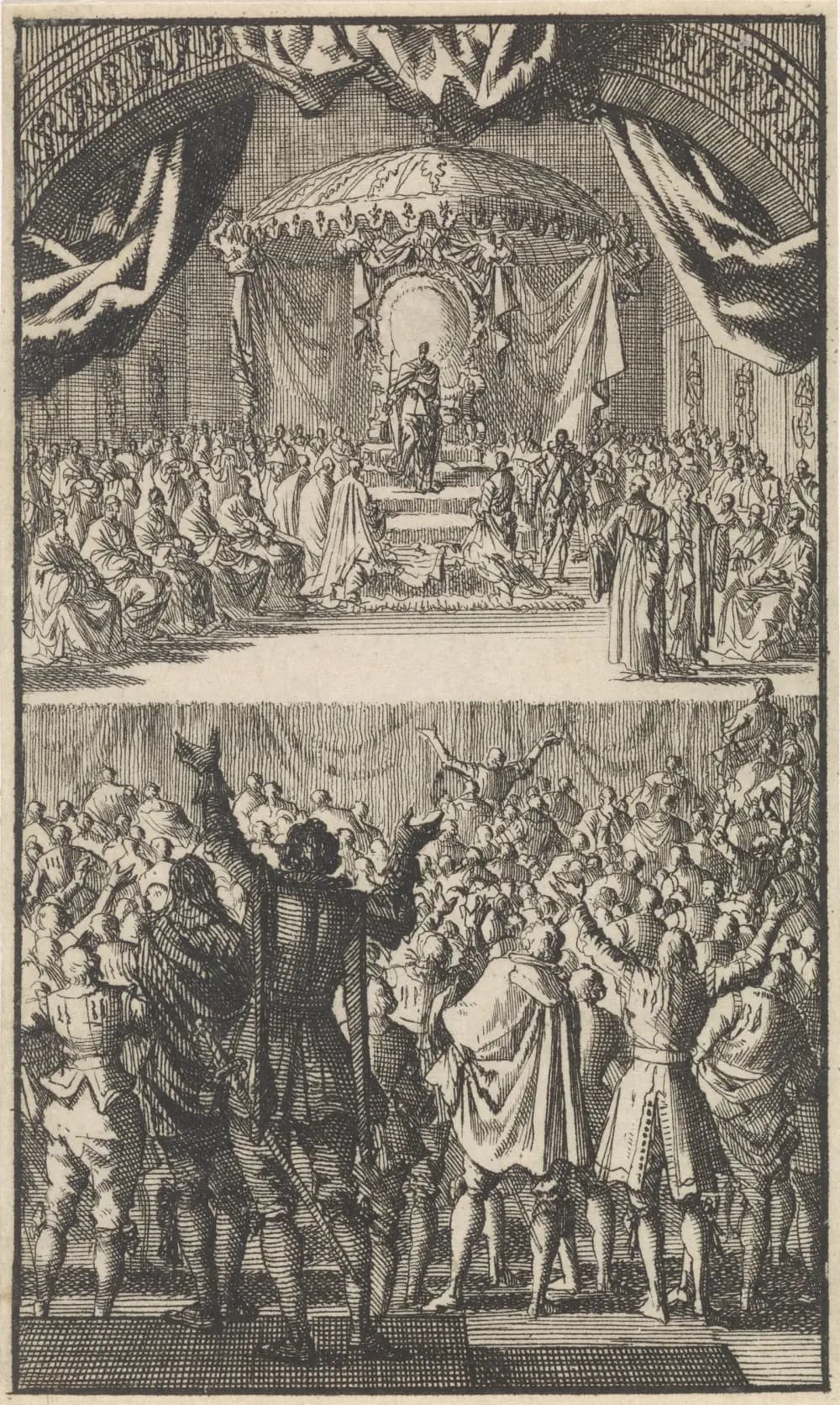
No. On the afternoon of Sunday 16 April 1581 he was acclaimed by the three estates and swore the customary royal oath, holding a gold sceptre. The notaries' record mentions no crown. Prints that show a coronation, like Jan Luyken's of 1699, were made long afterwards.
When did the Cortes of Tomar open?
The acclamation and royal oath took place on Sunday 16 April 1581, and the formal opening session, the Auto das Cortes, followed in the chapter house on Thursday 20 April. The estates swore allegiance to the heir, Prince Diogo, on Sunday 23 April.
What were the 25 chapters of Tomar?
A list of guarantees first drawn up by Philip's ambassadors and signed by the Duke of Osuna at Almeirim on 20 March 1580. They promised that Portugal would keep its laws, hold its Cortes at home, keep its offices, church posts, coinage and overseas trade in Portuguese hands and be advised by a Portuguese council. Philip granted them at Tomar and confirmed them by letters patent on 15 November 1582.
Did Philip II keep the promises of Tomar?
Mostly in form, not entirely. He deferred the promise of Portuguese-only garrisons from the start, restored the customs posts on the land border in 1592, and could not live in Portugal or leave his heir there as chapter XXV promised. His successors went much further, which fed the revolt of 1640.
Why were the Cortes held at Tomar and not in Lisbon?
Lisbon had been sacked during the war of 1580 and was suffering from plague. Philip considered Évora, Abrantes and Elvas as well, and chose Tomar, where the Convent of Christ could house the king and his court.
On the timeline
Open the timelineNearby moments from the iberian union (1580–1640).
Spanish forces under the Duke of Alba defeat Dom António, Prior of Crato, at the Battle of Alcântara on the outskirts of Lisbon, crushing Portuguese resistance to Philip II; Alba's troops occupied the capital in the days that followed, opening the way to sixty years of Iberian Union.
The Cortes of Tomar, 1581
At Tomar's Convent of Christ, the three estates acclaim Philip II of Spain as Filipe I of Portugal and he swears to keep their laws. At the Cortes that follow he grants 25 chapters keeping Portugal's coinage and offices in Portuguese hands. The 'dual monarchy' would last sixty years, until the Restoration of 1 December 1640.
At the Battle of Salga on Terceira, in the Azores, islanders loyal to Dom António, Prior of Crato, defeat a Spanish landing force sent by Philip II — famously by stampeding a herd of cattle into the invaders' ranks. The victory keeps the island holding out for Dom António for two more years.
In the Battle of Ponta Delgada, fought off Vila Franca do Campo on São Miguel in the Azores, the Spanish fleet of Álvaro de Bazán, Marquis of Santa Cruz, destroys a French fleet under Filippo Strozzi sent to back Dom António, Prior of Crato, in his claim to the Portuguese throne. Strozzi is killed, dooming the last Azorean resistance to Philip II.
Portugal adopts the Gregorian calendar by a law signed by Philip I: Thursday 4 October is followed directly by Friday 15 October, and the ten days in between never take place in the country's calendar.
Coming up in history
All long reads 18 April 1842Antero de Quental, the Azorean poet who told Portugal why it had declined
 19 April 1506The Lisbon Massacre: three days of killing in April 1506
 20 April 1911Portugal's Law of Separation: how the Republic broke with the Church in 1911
 21 April 1985Senna's first Formula One win, in the Estoril rain, 1985
11 sources
Archives, scholarship and reporting this article was checked against.
- 1
Instrumentos e escrituras dos autos seguintes: Auto do levantamento e juramento d'el-Rei nosso senhor; Auto das Cortes de Tomar; Auto do juramento do Príncipe Dom Diogo; Auto do juramento do Príncipe Dom Filipe ([Lisbon]: António Ribeiro, [1584])Biblioteca Nacional de Portugal, Biblioteca Nacional Digital
- 2
- 3
Filipe II e Portugal (Francisco Ribeiro da Silva)Faculdade de Letras da Universidade do Porto; first published as the introduction to Filipe II de Espanha, Rei de Portugal, Zamora, Fundação Rei Afonso Henriques, 2000
- 4
The Royal Journey of Succession to Portugal of King D. Filipe I of Portugal and the architectonic renovation of the palatine residences: the case of the Royal Palace of Lisbon (Milton Pedro Dias Pacheco)Anales de Historia del Arte 30 (2020), pp. 301-323, Universidad Complutense de Madrid
- 5
Um rei indesejado: notas sobre a trajetória política de D. Antônio, Prior do Crato (Jacqueline Hermann)Revista Brasileira de História, vol. 30, no. 59, 2010, pp. 141-166
- 6
La herencia portuguesa de Baltasar Carlos de Austria: el Directorio de António Brandão para la educación del heredero de la monarquía católica (Fernando J. Bouza Álvarez)Cuadernos de Historia Moderna 9 (1988), Universidad Complutense de Madrid
- 7
Council of Portugal (Sergio Moreta Pedraz)BRASILHIS Dictionary, Universidad de Salamanca
- 8
Revisitar a Batalha de Alcácer Quibir (Luís Filipe Guerreiro da Costa e Sousa)e-Stratégica, no. 1, 2017, pp. 111-159 (via Dialnet)
- 9O dia em que Portugal perdeu a última batalha pela independênciaObservador
- 10
A short story of 1st December (José Miguel Sardica)Universidade Católica Portuguesa
- 11
Convento de CristoMuseus e Monumentos de Portugal
Image credits
- The terraces of the Convent of Christ at Tomar, head house of the Order of Christ, in 2011. Philip II lodged in the convent for almost seventy days in 1581, and the Cortes that accepted him as king met there. Duca696, CC BY-SA 3.0, via Wikimedia Commons.
- António, Prior of Crato, in a small German engraving captioned as Portugal's 20th king. His supporters proclaimed him king at Santarém on 19 June 1580; Philip's army defeated him at Alcântara two months later. Austrian National Library. Unknown author, Public domain, via Wikimedia Commons.
- Jan Luyken etched this scene in Amsterdam in 1699 for a Dutch life of Philip II; the Rijksmuseum catalogues it as “Philip II is crowned king of Portugal, 1581”. The notaries who were there describe an acclamation, with a sceptre, a sword of state and a royal banner, but no crown. Rijksmuseum, CC0, via Wikimedia Commons.
- Title page of the letters patent that put the promises of Tomar in writing, printed in Lisbon by António Ribeiro in 1583. The note under the title says that the originals were kept in the Lisbon city chamber and in the Torre do Tombo, the royal archive. Antonio Ribeiro impressor del Rey Nosso Senhor, Public domain, via Wikimedia Commons.
- Philip II at 66, as the inscription says, painted on panel by Juan Pantoja de la Cruz, at the monastery of El Escorial near Madrid. The golden ram on his chain is the badge of the Order of the Golden Fleece, whose collar he wore at Tomar. Jl FilpoC, CC BY-SA 4.0, via Wikimedia Commons.