

The Cardinal of Portugal and his Florence chapel, 1459
Captured on his father's last battlefield at 15, Jaime of Portugal was a cardinal at 22 and dead at 25. The chapel built for him at San Miniato al Monte brought together the best artists in Florence.
At a glance
- Jaime of Portugal, a grandson of King João I, died in Florence on 27 August 1459, aged 25 years, 11 months and 10 days by his epitaph.
- His father, the former regent Pedro, Duke of Coimbra, was killed at Alfarrobeira in 1449; Jaime, then 15, was taken prisoner on the battlefield.
- Taken in by his aunt Isabel, Duchess of Burgundy, he reached Bruges in January 1450; her money and letters made him administrator of the see of Lisbon at 19 and a cardinal at 22.
- He fell ill on a papal mission at the time of the Congress of Mantua and died in Florence that August, asking to be buried at San Miniato al Monte.
- His chapel there, designed by Antonio Manetti, holds a tomb by the Rossellino brothers, a vault by Luca della Robbia and paintings by Baldovinetti; the Pollaiuolo altarpiece is now in the Uffizi.
A death in Florence
In the summer of 1459 a young man lay dying in a borrowed room in Florence. The Cambini, a family firm of Florentine merchant bankers, had fitted it out for him inside the palace they had bought the year before from the Calimala, one of the city's great guilds. He was Jaime of Portugal, cardinal of the Roman Church and archbishop of Lisbon, and he was 25.
He had been ill for at least four years. The Florentine bookseller Vespasiano da Bisticci, who talked to the people round his bed, wrote that a vein had burst in his chest. His own physician, maestro Fernando, worked beside two of the best-known doctors in the city, Paolo dal Pozzo Toscanelli and Ugolino da Pisa. A stay at the baths had done little good.
One doctor, Vespasiano says, proposed a remedy that the cardinal found monstrous: that he sleep with a girl. Jaime had vowed as a boy to stay chaste. He rebuked the man, forbade him to enter his room again, and spent his last weeks in confession, Mass and communion. On 6 August he made his will.
He died on Monday 27 August 1459.
Florence gave him the funeral honours the republic reserved for churchmen. His body lay in state in the square in front of Santa Maria Novella, a Mass was said in the cathedral, and the city spent 807 lire, 16 soldi and 7 denari on the ceremonies. Then he was carried up to San Miniato al Monte, the hilltop church of the Olivetan monks, where his will asked for a chapel of his own.
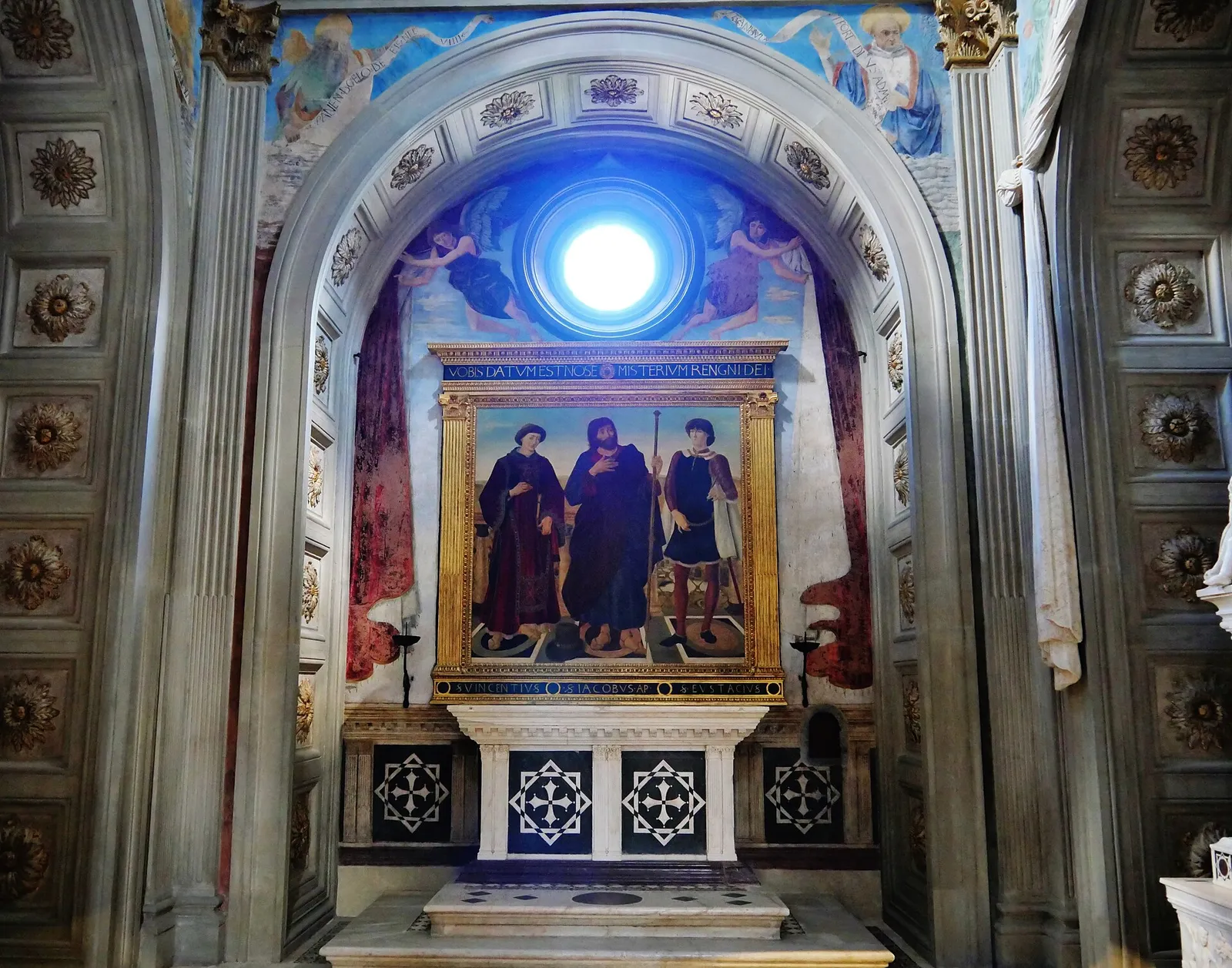
That chapel took 14 years to finish. His aunt in Burgundy paid for most of it, and it brought together a pupil of Brunelleschi, the Rossellino brothers, Luca della Robbia, the Pollaiuolo brothers and Alesso Baldovinetti. Almost all of it is still where they put it; only the altarpiece is a copy.
A prince of the house of Avis
Jaime was born on 17 September 1433, a date historians work back from his epitaph, which says he lived 25 years, 11 months and 10 days. His grandparents were King João I, founder of the Avis dynasty, and Philippa of Lancaster. His father was their son Pedro, Duke of Coimbra, and his mother, Isabel of Urgell, came from the royal house of Aragon, whose arms he later quartered with Portugal's on his seals.
Pedro was a traveller and a reader. He had toured Europe between 1425 and 1428, translated Cicero's De officiis into Portuguese and, with the friar João Verba, turned Seneca's treatise on benefits into the Livro da Virtuosa Benfeitoria. For most of the 1440s he governed Portugal as regent for his nephew Afonso V, who had become king at six in 1438, and he married his daughter Isabel to the boy.
Jaime grew up in that household with two brothers, Pedro and João, and four sisters. He had the best tutors his father could find, above all Álvaro Afonso, a lawyer in civil and canon law who would stay at his side for the rest of his life, and he learned Latin and law. Vespasiano says he decided early to remain a virgin, avoided women's company and hated dancing, music and singing.
- Born
- 17 September 1433 (worked back from the epitaph)
- Parents
- Pedro, Duke of Coimbra, regent for most of the 1440s, and Isabel of Urgell
- Grandparents
- João I of Portugal and Philippa of Lancaster
- Aunt and patron
- Isabel of Portugal, Duchess of Burgundy
- Highest offices
- Archbishop of Lisbon (administrator from 1453); cardinal deacon of Sant'Eustachio from 1456
- Died
- Florence, 27 August 1459, aged 25
- Buried
- San Miniato al Monte, Florence; moved into his finished chapel in 1466
Taken prisoner at Alfarrobeira
Afonso V took power for himself in 1447 or 1448 and, pushed by Pedro's enemies at court, turned on the uncle who had raised him. The chronicler Rui de Pina says that in a stand-off with the Duke of Bragança Pedro gave his vanguard to Jaime and the Count of Abranches, and that when Pedro's army left Coimbra in May 1449, Jaime led the troops out a night ahead of his father. A knight, Luís Gomes da Grã, carried his banner.
On 20 May the king's much larger army caught them by the Alfarrobeira stream near Alverca, north of Lisbon. The fight was short. Pedro was killed, Luís Gomes da Grã died with many of the duke's men, and Jaime, aged 15, was taken prisoner; later Portuguese accounts say he was found under a heap of bodies. His elder brother Pedro had already fled to Castile. Some accounts put João at the battle too, but Manuel Ramos, who studied the speeches of the Burgundian envoy, says Jaime was the only son on the field.
“Of his sons we saw Dom Jaime taken prisoner at once and made ready for the executioner's blade, and Dom Pedro, the eldest, fled and banished in Castile, begging alms of those he had once favoured.”
The victors treated the dead regent as a traitor. His body was left unburied, his property and his children's was confiscated without trial, and the children were declared infamous, barred from holding goods or honours. According to the Burgundian envoy's speeches, some courtiers asked the king to execute Jaime and Pedro's leading supporters. Afonso, who was 17, refused.
The news reached Burgundy a month later. Pedro's sister Isabel, Duchess of Burgundy and wife of Duke Philip the Good, sent the cleric Jean Jouffroy to Portugal on 11 August 1449 to demand an apology, a royal burial for her brother at Batalha and the release of his children. Jouffroy's Latin speeches, delivered mostly at Évora that December, did not win back the family's lands.
How Jaime got out of Portugal is less clear. Rui de Pina and the historians Alain Marchandisse, Christophe Masson and Monique Sommé credit the embassy with his release. Ramos tells it differently: Jouffroy, who probably reached Portugal in October, passed on Isabel's offer of shelter, and by late November, before his first public audience, Jaime, his brother João and their sister Beatriz had left the country, short of money and fearing for their safety, by way of Castile.
An exile at the court of Burgundy
By Saturday 10 January 1450 Jaime was in Bruges. The household roll for that day names him beside his aunt and his cousin Charles, the future Charles the Bold, who was his own age. The Burgundian chronicler Olivier de La Marche wrote that he came with a large company of knights and gentlemen, all of them fugitives from Portugal, and that the duke received him with honour.
His aunt's household paid his way. In September 1450 her clerks entered his allowance at 108 sous a day, plus 60 for his table, although he held no office. The only officer at court paid as much was the duke's first chamberlain, and the auditors complained. In March 1451 Philip turned the allowance into a pension of 3,832 and a half francs a year. Isabel also bought him a house in Bruges, and was still paying for it in 1452, after he had left.
His future had been decided: the Church. On 26 March 1451 he left Bruges for Rome with a Burgundian embassy sent to discuss the duke's crusade plans with Pope Nicholas V, and he settled to study canon law at Perugia. There he spent each Lent with the Olivetan monks of Monte Morcino outside the town, eating in their refectory, sleeping in his clothes and going to church at every hour.
A career bought in Burgundy
Isabel's money and letters moved him up fast. At about 18 he was made a protonotary apostolic, a senior papal notary: Nicholas V was under pressure from the duke to give him a cardinal's hat at once, and the title was a way of making him wait. Then came the provostship of Saint-Pierre in Lille, in 1452, and five weeks as administrator of the rich bishopric of Arras, which then passed to Jean Jouffroy, the envoy of 1449.
Jaime took Jouffroy's deanery of Vergy in exchange and, on 30 April 1453, the administration of the archdiocese of Lisbon. Lisbon paid only half as much as Arras, but La Marche called it the greatest benefice in Portugal. The choice made a point: Pedro de Noronha, archbishop until his death in 1452, had been one of his father's bitterest enemies.
He never set foot in Lisbon. The cathedral chapter governed the see, and from 1456 his old tutor Álvaro Afonso, now bishop of Silves in the Algarve, managed it for him, while a papal licence let him live in Rome and keep the revenues. As archbishop he was one of the three prelates told to enforce Romanus Pontifex, the bull of 8 January 1455 that confirmed Portugal's monopoly of conquest along the African coast.
| Date | Office | Notes |
|---|---|---|
| c. 1451–52 | Protonotary apostolic | At about 18, according to Vespasiano |
| 31 July 1452 | Provost of Saint-Pierre, Lille | Took possession; elected after letters from the duke, the duchess and their son |
| 23 March 1453 | Administrator of Arras | Worth 12,000 florins a year; held for about five weeks |
| 30 April 1453 | Administrator of Lisbon; dean of Vergy | Lisbon worth 6,000 florins; full archbishop only from April 1459 |
| 20 February 1456 | Cardinal deacon of Sant'Eustachio | Secret consistory; announced 17 September, red hat 2 December |
| 18 June 1457 | Bishop of Paphos, Cyprus | Never visited |
| By 1459 | Abbeys and priories | Saint-Ghislain, Cherlieu, the Dunes, houses in the dioceses of Braga and Porto, São Vicente de Fora in Lisbon |
Ramos gives 2 December 1457 for the red hat; Marchandisse, Masson and Sommé, citing the Vatican registers, give 1456. They also say he was to become archbishop in his own right in April 1459, at 26, the age canon law required, but by his epitaph he was then 25.
On 20 February 1456 Pope Callixtus III named him cardinal deacon of Sant'Eustachio, a church in Rome, in a secret consistory. Only two others were promoted, both the pope's nephews: Luis Juan de Milà and Rodrigo Borgia, the future Alexander VI. The humanist Enea Silvio Piccolomini, who had been promised a hat himself, remarked that the three together were barely the usual age of one cardinal. Jaime was 22.
Piccolomini became Pope Pius II in August 1458 and wrote that Jaime had voted for him; in the first ballot Jaime had four votes of his own. They soon quarrelled. When Pius jailed Bernardo Roverio, a protégé of Callixtus who had been slandering his dead patron, Jaime demanded his release and refused to leave until he got it. By Pius's account he told the young man that royal blood gave him no right to insult the Vicar of Christ, and sent him away. Jaime went home furious, wept, apologised a few days later and still won Roverio's release.
The benefices kept coming. In June 1457 he was given the bishopric of Paphos in Cyprus, where his brother João had married the heiress to the throne; João died in Cyprus later that year, poisoned according to rumour. Burgundian pressure added abbeys in Flanders, Hainaut and Burgundy, and a disputed one at Châtillon-sur-Seine was still in court when he died.
The road to Mantua
Pius II had called the princes of Christendom to a congress at Mantua in 1459 to plan a crusade against the Ottomans, who had taken Constantinople in 1453. He gave Jaime a mission to the Empire, whose ruler, Frederick III, was married to Jaime's first cousin Leonor of Portugal. The Uffizi, which now owns his altarpiece, describes him as dying on his way to Mantua.
He got no further than Tuscany. After organising the journey in Florence he joined the pope on the road north, but he was too ill to go on. He left the papal party at Siena, stayed there from April to the end of June, and then went back to Florence, which he loved for its Olivetan monastery of San Miniato and its ties to Portuguese money. Florentine firms still held money of his father's that the republic, pleading the needs of war, refused to release to his heirs.
August 1458
Pius II elected
Jaime gets four votes in the first ballot.
Early 1459
Papal mission to the Empire
He prepares the journey in Florence and joins the pope's progress towards Mantua.
April to late June 1459
Ill at Siena
He leaves the papal party and stays behind.
Summer 1459
Florence
A room in the Cambini palace; his doctors include Toscanelli.
6 August 1459
Will
Burial at San Miniato al Monte, a chapel with a daily Mass, his goods to his household and the poor.
27 August 1459
Death
Funeral at Santa Maria Novella and the cathedral, burial at San Miniato.
14 September 1459
An epitaph
Pierfilippo Pandolfini asks the humanist Bartolomeo Platina to write one.
His will had little to give. Vespasiano reckoned his books, clothes and household goods at under 3,000 florins, while his debts came to 8,000 ducats, 3,800 florins of it owed to the Medici bank. Pius named two cardinals and two bishops, Álvaro Afonso among them, to settle them.
A chapel paid for from Burgundy
Without money of his own, the chapel fell to his executor. Álvaro Afonso put in funds he held in Portugal and raised a large sum from the Duchess of Burgundy, and two of his brothers, both clerics, oversaw the works. The bishop also endowed it with 40 florins a year from the rent of a house, payable to the monks only on days when they said at least two Masses there.
The design is credited to Antonio Manetti, a follower of Filippo Brunelleschi: a small square room off the nave with a vault, windows and an arch on each side, framed in the grey Florentine stone called pietra serena. In 1461 Álvaro commissioned the tomb from Antonio Rossellino, who worked on it with his brother Bernardo, and the cardinal's body was moved into the chapel in 1466.
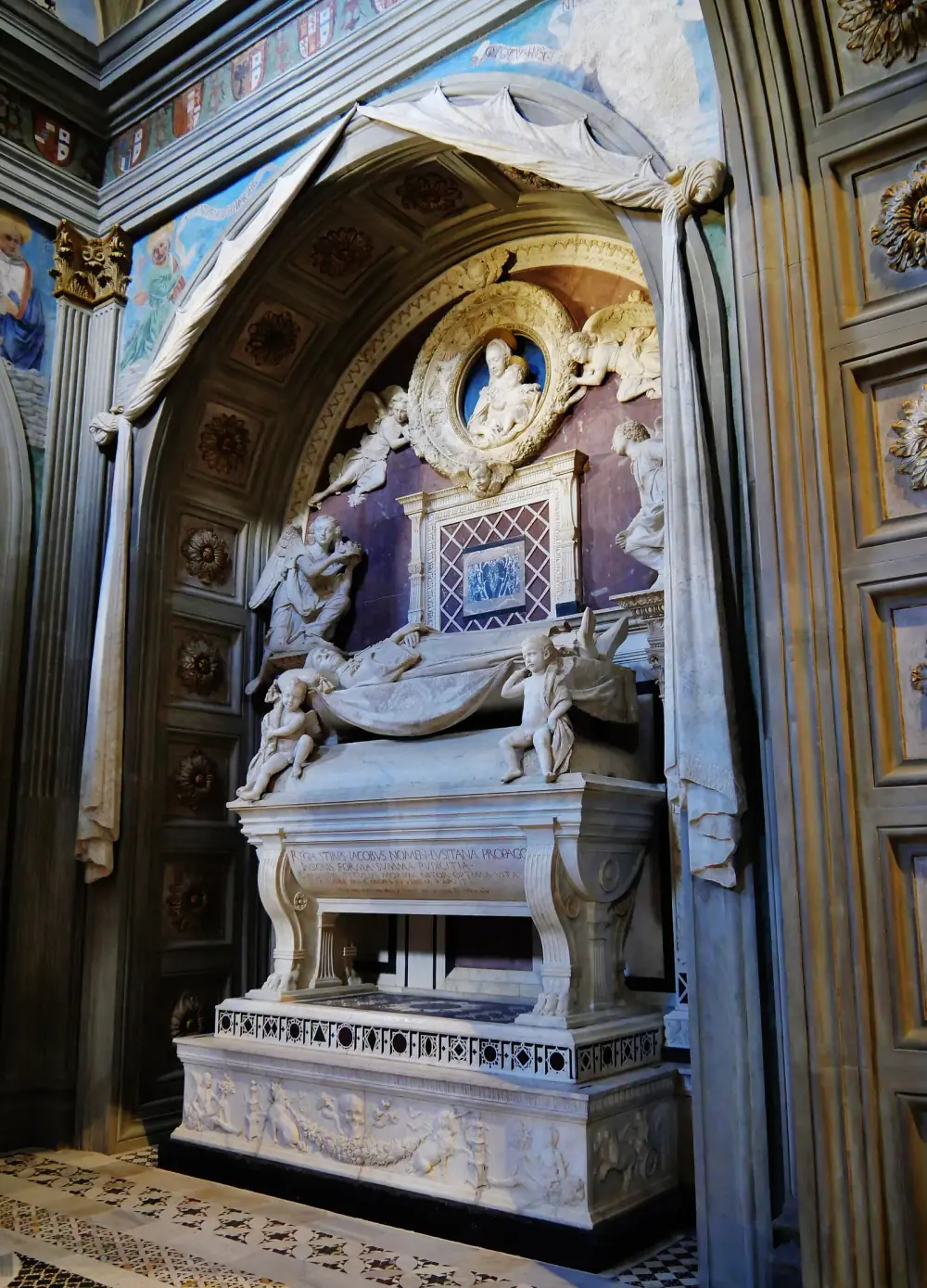
The effigy lies on a sarcophagus modelled, Vasari noticed, on an ancient porphyry one that stood in Rome's Piazza della Rotonda, in front of the Pantheon. One angel holds a crown for his chastity and another a palm for his victory over the world, and above them a roundel of the Virgin and Child sits under a marble curtain drawn back against the grey stone. Restorers found traces of the original paint and gilding on the marble.
“On the tomb which is now in San Miniato the hands were modelled from his own, the face is an excellent likeness because it was taken immediately after death.”
Luca della Robbia covered the vault in glazed terracotta: a dove of the Holy Spirit in the centre and, around it, roundels of the four cardinal virtues, Temperance, Prudence, Justice and Fortitude, set in scale-like tiles that shrink towards the middle. Fortitude's shield carries the cardinal's arms, Portugal quartered with Aragon.
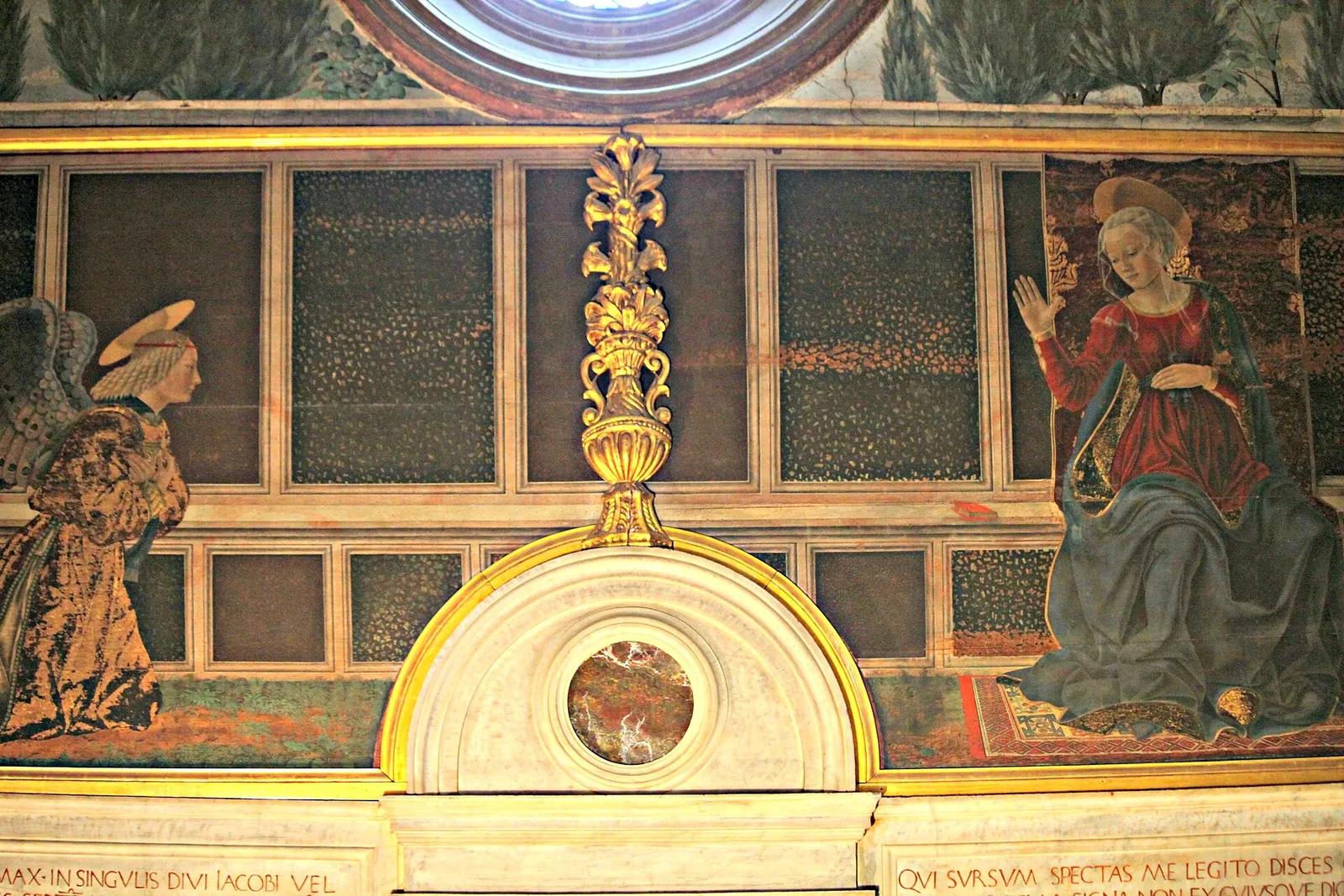
Facing the tomb, in a matching niche, is a marble bishop's throne, and above it Alesso Baldovinetti's painted Annunciation. Baldovinetti was given the paintings in 1466 and declared himself paid in full, with a last three florins, in 1473. By 1907 his Evangelists and Doctors of the Church in the spandrels had lost their strongest colours, because he painted them on dry plaster with thick tempera, and the Prophets below were almost gone.
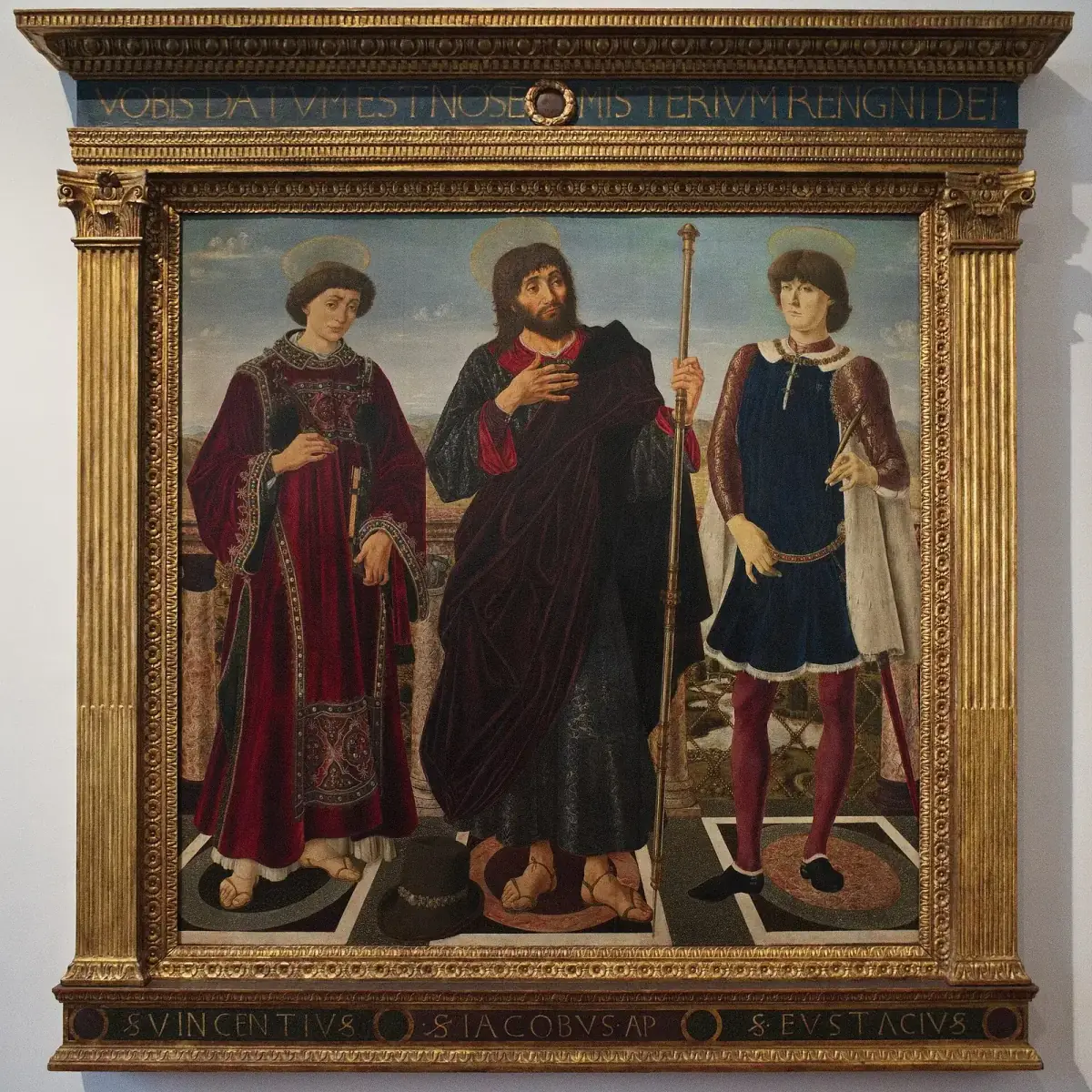
On the altar stood an oil painting by the brothers Antonio and Piero del Pollaiuolo, made in 1466–68: Saint Vincent, patron of Lisbon; Saint James, the cardinal's name saint; and Saint Eustace, for his titular church in Rome. They are the same three saints, with the Virgin and Child, that Jaime had engraved on his cardinal's seal. The panel went to the Uffizi in 1800 or in 1866, depending on the account, and a copy has stood on the altar since the 1930s.
| Artist | Work | Dates | Where it is |
|---|---|---|---|
| Antonio Manetti | Design of the chapel | After 1459 | The chapel itself |
| Antonio and Bernardo Rossellino | Tomb of the cardinal; bishop's throne | 1461–c. 1466 | In place |
| Luca della Robbia | Glazed terracotta vault: Holy Spirit and cardinal virtues | After 1459 | In place |
| Antonio and Piero del Pollaiuolo | Altarpiece of Saints Vincent, James and Eustace | 1466–1468 | Uffizi (copy in the chapel) |
| Alesso Baldovinetti | Annunciation panel; Evangelists, Doctors and Prophets | 1466–1473 | In place |
| Bartolomeo Platina | Epitaph | Asked for in September 1459 | On the tomb |
The sources used here give no contract dates for Manetti or for Luca della Robbia. Rossellino's last payment for the tomb was in February 1466; he made the throne in the months after. The cardinal's body was moved into the chapel in 1466.
Getting the record straight
Vespasiano's life is a portrait of a saint, and later Portuguese writers have repeated it: the chaste prince who preferred to die rather than be defiled, a motto some attached to him. Marchandisse, Masson and Sommé read the Burgundian accounts and the papal registers and find a more ordinary prelate as well, one who quarrelled with a pope, fought monks in Flanders for their abbey and left 8,000 ducats of debt.
Why it still matters
Antonio Piccolomini, Duke of Amalfi and nephew of Pius II, liked the tomb and the chapel so much, Vasari says, that he had Rossellino make a near copy in Naples for his wife. The art historian Evelyn Londi argued in 1907 that Domenico Ghirlandaio remembered Baldovinetti's saints and prophets when he painted the chapel of Santa Fina at San Gimignano, a room of much the same shape.
The chapel was restored over three years and unveiled again on 28 July 2021, with money from the charity Friends of Florence, under the direction of Maria Maugeri for the state heritage office. The cleaning brought back surfaces by all of its artists.
In Portugal Jaime left fewer traces. He held the see of Lisbon for six years without seeing it, and he barely knew the Portuguese court. The Panels of Saint Vincent, the great altarpiece of Afonso V's reign in Lisbon's national museum, have been read as a gallery of his family. One recent identification finds his father, his eldest brother, his aunt Isabel and his grandfather's other sons there, but not Jaime; the writer Belard da Fonseca saw him in the saint himself.
His aunt could buy him a career that ran from Lille to Cyprus, and his brother and sister married into the royal house of Cyprus and the Burgundian nobility. The Porto historian André Moutinho Rodrigues counts him as one of only four men who can strictly be called cardinals of Portugal in the fifteenth century.
FAQs
Who was the Cardinal of Portugal?
Jaime of Portugal (1433–1459), son of the regent Pedro, Duke of Coimbra, and grandson of King João I. He was captured at Alfarrobeira in 1449, taken into exile in Burgundy by his aunt the duchess, made administrator of the archdiocese of Lisbon in 1453 and a cardinal in 1456, and died in Florence on 27 August 1459.
Why is a Portuguese cardinal buried in Florence?
He fell ill on a papal mission at the time of the Congress of Mantua, stayed at Siena and then Florence, and died there. In his will of 6 August 1459 he asked to be buried at San Miniato al Monte, a church of the Olivetan monks he was devoted to, in a chapel with a daily Mass.
Who made the tomb of the Cardinal of Portugal?
Antonio Rossellino, with his brother Bernardo. The bishop of Silves, Álvaro Afonso, commissioned it in 1461 and the last payment was made in February 1466. Vespasiano says the hands were modelled from the cardinal's own and the face from a cast taken after death.
Where is the Pollaiuolo altarpiece now?
In the Uffizi in Florence. The gallery says it was taken there from San Miniato in 1800; another account dates its purchase to 1866. It shows Saints Vincent, James and Eustace and was painted by Antonio and Piero del Pollaiuolo in 1466–68. A copy hangs in the chapel.
Did Jaime ever go to Lisbon as archbishop?
No. After 1449 he never returned to Portugal. The cathedral chapter and then his former tutor Álvaro Afonso, bishop of Silves, ran the archdiocese while a papal licence let him live in Rome and keep its revenues.
On the timeline
Open the timelineNearby moments from the age of discoveries (1415–1580).
At Lagos in the Algarve, 235 captives seized on the coast of present-day Mauritania by six caravels licensed by Prince Henry the Navigator are divided into five lots, some to be sold on: the first large landing of African captives recorded in Portugal.
Pope Nicholas V issues the bull 'Romanus Pontifex', granting the Portuguese crown exclusive rights to conquest, trade and navigation along the African coast south of Cape Bojador and sanctioning the enslavement of non-Christians — a papal charter for Portugal's overseas expansion.
Birth of King João II ('The Perfect Prince') in Lisbon. He would become one of Portugal's most important monarchs, sponsoring Bartolomeu Dias's voyage around the Cape of Good Hope and negotiating the Treaty of Tordesillas.
The Cardinal of Portugal
Cardinal Jaime of Portugal, a grandson of King João I and archbishop of Lisbon, dies in Florence aged 25, after falling ill on the pope's journey towards the Congress of Mantua. His funerary chapel at San Miniato al Monte, with a tomb by the Rossellino brothers and decoration by Luca della Robbia and the Pollaiuolo brothers, is one of the great monuments of the Florentine Renaissance.
Infante Henrique — Prince Henry the Navigator — dies at his Vila do Infante near Sagres, aged 66. Patron of the voyages down the African coast that opened the Age of Discovery, he lies in the Founder's Chapel of the Monastery of Batalha.
By tradition, Portuguese navigators Pêro Escobar and João de Santarém sight the island of Príncipe in the Gulf of Guinea on 17 January, the feast of Santo Antão. The date rests on the saints' calendar rather than a surviving record: historians place the first Portuguese arrival only somewhere between 1471 and 1480, and give the island's first name as Santo António. It was later renamed Ilha do Príncipe in honour of the heir to the Portuguese throne.
Isabel of Portugal, Duchess of Burgundy, dies at Aire-sur-la-Lys aged 74. The only surviving daughter of João I and Philippa of Lancaster, she governed the Burgundian Low Countries in her husband's absence, negotiated trade deals with England and was the mother of Charles the Bold.
Coming up in history
All long reads
14 sources
Archives, scholarship and reporting this article was checked against.
- 1
Jacques de Coïmbre (1433-1459), un cardinal lusitano-bourguignon (Alain Marchandisse, Christophe Masson and Monique Sommé)In Évêques et cardinaux princiers et curiaux (xive-début xvie siècle), Brepols, 2017 (ORBi, Université de Liège)
- 2
The Vespasiano Memoirs: Lives of Illustrious Men of the XVth Century (Vespasiano da Bisticci, translated by William George and Emily Waters)George Routledge & Sons, London, 1926 (Internet Archive)
- 3
O impacto de Alfarrobeira nas relações com o ducado da Borgonha (Manuel Ramos)História. Revista da FLUP, IV série, vol. 5 (2015), Universidade do Porto
- 4
Chronica de El-Rei D. Affonso V, vol. II (Rui de Pina, ed. Gabriel Pereira, 1902)Project Gutenberg
- 5
Restaurata la Cappella del Cardinale del Portogallo in San Miniato al Monte, capolavoro del Rinascimento fiorentinoFinestre sull'Arte, 4 August 2021
- 6
Saints Vincent, James the Great and Eustace (Antonio and Piero del Pollaiolo, 1466-1468)Gallerie degli Uffizi, Florence
- 7
- 8
D. Afonso V (b. 1432-r. 1438-1481) (João Paulo Oliveira e Costa)Encyclopaedia of Portuguese Expansion (EVE), CHAM, NOVA FCSH, 2009
- 9
- 10
- 11
- 12
Compiuto in basilica il restauro della cappella del Cardinale del PortogalloAbbazia di San Miniato al Monte, 2021
- 13
- 14
Image credits
- The altar wall of the chapel of the Cardinal of Portugal at San Miniato al Monte, with the copy of the Pollaiuolo altarpiece of Saints Vincent, James and Eustace that replaced the original in the 1930s. Photographed in 2023. Zairon, CC BY 4.0, via Wikimedia Commons.
- The tomb of Cardinal Jaime by Antonio Rossellino, with his brother Bernardo, finished in 1466. The Latin inscription on the sarcophagus begins Regia stirps, Iacobus nomen, Lusitana propago: of royal stock, his name James, a scion of Portugal. Zairon, CC BY 4.0, via Wikimedia Commons.
- Alesso Baldovinetti's Annunciation, painted after 1466 above the marble bishop's throne that faces the tomb. Mongolo1984, CC BY-SA 3.0, via Wikimedia Commons.
- The original altarpiece by Antonio and Piero del Pollaiuolo, 1466–68: Saint Vincent, Saint James and Saint Eustace, as labelled on the frame. It now hangs in the Uffizi. Armin Kleiner, CC BY-SA 4.0, via Wikimedia Commons.