

9 February 2026 – 15 February 2026
Storm chaos hits Portugal as leaders spar over aid, appointments and tax relief
Severe storms triggered widespread damage, from an A1 viaduct collapse and Costa da Caparica evacuations to 377 Civil Protection incidents, over 100,000 insurance claims, and power cuts still affecting 26,000 customers. Marcelo urged talks on a national disaster fund as eligibility for state weather aid drew scrutiny over tax-debt exclusions. Politics also heated up with Seguro’s record presidential win and a PS summons over a nurse’s renewable-energy appointment, while 651,000 taxpayers gained IMI exemptions.
Marcelo calls for national disaster fund talks
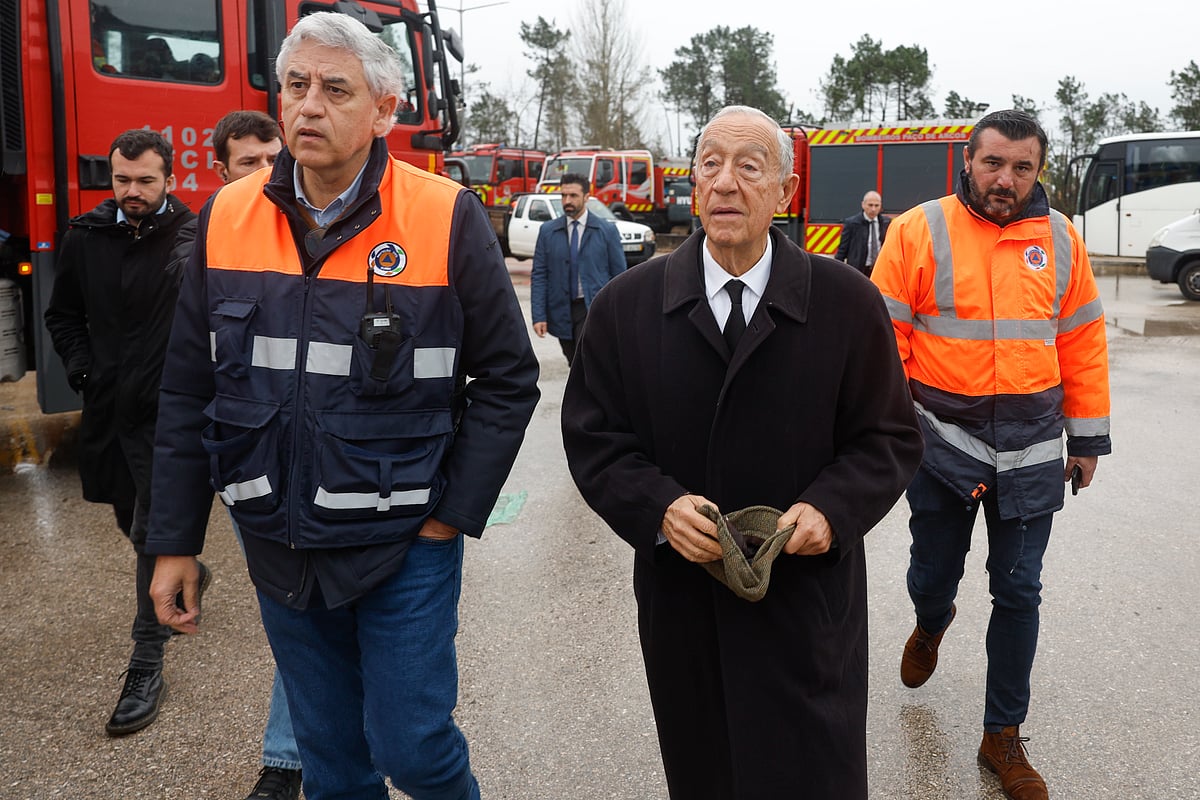
President of the Republic Marcelo Rebelo de Sousa urged starting discussions on a national disaster fund during a visit to flood-hit Alcácer do Sal, saying Portugal lacks a dedicated fund while other countries and the EU have one. He praised local leaders and volunteers, and said worsening storms make planning for collective responses sensible. Residents in flood-prone areas should monitor any proposed fund for details on eligibility and compensation mechanisms.
Update: Marcelo presses government during flood tour
Multiple outlets report the president used a visit to Alcácer do Sal to press the Government and propose a new disaster fund, saying Portugal should follow EU peers that already have such mechanisms. Observador and ECO noted the visit praised local officials and volunteers while also pushing for formal talks on how a fund would work.
A permanent disaster fund is a government reserve set aside to pay for emergency relief, repairs and reconstruction after natural catastrophes so money is available quickly rather than through ad‑hoc budget measures. Portugal’s government has proposed creating such a fund after recent storms to speed help to affected families and municipalities and to reduce reliance on one-off emergency allocations. Residents, insurers and local councils should follow the legislation because it will change how and when compensation and repair money is released.
The President of the Republic (Presidente da República) is Portugal’s elected head of state, chosen by popular vote for a five-year term. The president signs or can veto laws, formally appoints the prime minister, and may dissolve parliament and call elections — powers that matter during events like the 2026 presidential run-off.

- Role: Portugal's President (2016–2026)
- Party: Independent (formerly Social Democratic Party, PSD)
Electoral Mandate and Democratic Consensus:
Marcelo Rebelo de Sousa was elected President of Portugal on January 24, 2016, winning 52.0% of the vote in the first round—a decisive victory in a fragmented field. He campaigned as an independent, positioning himself as a unifying figure after years of austerity from Portugal's 2011–14 bailout, promising to repair political divisions and restore national confidence. His campaign emphasized moderation and cross-party consensus, a departure from his decades-long association with the center-right Social Democratic Party (PSD). Upon taking office on March 9, 2016, he suspended his party membership for the duration of his presidency.
His 2021 re-election proved extraordinary: Rebelo de Sousa secured 60.7% of the vote—the third-highest margin in Portuguese presidential electoral history since the 1974 Carnation Revolution. Historically, he became the first candidate ever to win in all 308 municipalities and the vast majority of parishes, ranging from 51.3% in Beja District to 72.16% in Madeira. This unprecedented sweep reflected his broad appeal across social, geographic, and ideological divides.
Constitutional Role and Crisis Leadership:
Portugal operates as a semi-presidential system where the president, while largely ceremonial, exercises meaningful influence over national security, foreign policy, and military affairs as Supreme Commander of the Armed Forces. Rebelo de Sousa leveraged this authority during Portugal's response to the COVID-19 pandemic. In March 2020, he requested parliamentary authorization for a state of emergency—the first nationwide declaration in 46 years of democratic history—to contain the crisis. He voluntarily quarantined after potential COVID-19 exposure in March 2020, and later tested positive in January 2021 while remaining asymptomatic. His measured handling of the pandemic, balancing public health with institutional continuity, contributed to his landslide 2021 re-election.
Diplomatic Engagement and International Presence:
Rebelo de Sousa has conducted extensive state visits representing Portugal's interests across diverse regions: the Vatican, Spain, Mozambique, Morocco, Brazil, Switzerland, Cuba, the United Kingdom, Greece, the United States, and Angola. A notable diplomatic highlight occurred in 2019 when he joined President Emmanuel Macron at the Bastille Day military parade in Paris, representing European military cooperation and the European Intervention Initiative. These engagements positioned Portugal as an active participant in global affairs, particularly regarding colonial history and Atlantic security partnerships.
Colonial Legacy and Historical Accountability:
During his presidency, Rebelo de Sousa has publicly supported making restitution and acknowledging abuses committed during Portugal's colonial history and the country's role in the Atlantic slave trade. This position marked a significant policy shift, as Portugal historically avoided confronting its imperial past compared to other European powers. His stance reflected evolving attitudes within Portuguese society toward historical accountability.
Controversies and Public Criticism:
Rebelo de Sousa's presidency has not been without controversy. In 2023, allegations emerged that he had intervened to expedite treatment for Brazilian twins with Zolgensma, an expensive rare disease medication, raising questions about presidential influence and potential corruption. These claims implicated his son and generated criticism across Portuguese political and media sectors. Additionally, in April 2024, Rebelo de Sousa made controversial remarks comparing the speed of Prime Ministers António Costa and Luís Montenegro using orientalist language that drew public rebuke. In August 2025, he called U.S. President Donald Trump a "Russian asset" at a PSD event, demonstrating his willingness to make provocative foreign policy statements.
Constitutional Constraints and Legacy:
Under Portugal's constitution, Rebelo de Sousa is barred from running for a third consecutive term, meaning his presidency concludes with elections scheduled for January 18, 2026. His decade-long tenure has established him as one of Portugal's most popular recent heads of state, characterized by broad consensus-building and institutional stability. Whether future presidents can replicate his cross-party appeal remains an open question for Portuguese democracy as it enters a new era.
State weather aid blocked for those with tax debts
CNN Portugal reports the government will only grant state support (apoios do Estado) to victims of bad weather if they do not have outstanding tax debts. The rule ties access to emergency financial help to tax compliance and has already prompted criticism from opposition figures who say it could exclude emigrants and vulnerable households. Those affected by storm damage or seeking assistance should check eligibility rules and their tax standing before applying.
Update: President: People with tax debts shouldn't be penalised
During a visit to Alcácer do Sal, the President of the Republic, Marcelo Rebelo de Sousa, said losses from the storms will run to “some thousands of millions” and argued that people without insurance and those with tax debts should not be penalised when state aid is considered. His comments contrast with the government's existing condition tying some emergency support to having no outstanding tax debts and add political pressure, but there is no sign the eligibility rule has been changed.
Update: President repeats: don't penalise tax debts
CNN Portugal reports the president restated his position in Alcácer do Sal, saying estimated storm losses run to “some thousands of millions” and repeating that uninsured or indebted people should not be excluded from state help; there is still no formal change to the government's eligibility condition.
Tax debt is any unpaid tax liability owed to Portugal's tax authority (Autoridade Tributária e Aduaneira), including income tax, VAT and other charges. Under the recent rules mentioned in the story, people with outstanding tax debt can be blocked from receiving state disaster aid, so residents should check their tax status or obtain a debt‑clearance document before applying for public support.
State aid (apoios do Estado) are emergency supports the central government can provide after events like severe weather, floods or storms; they may include direct cash payments, repair grants, tax relief or temporary housing help. Municipalities and civil-protection bodies usually handle applications and set deadlines, and applicants typically need ID (citizen card or NIF), proof of ownership or damage and any required receipts — residents and property owners should check their local council for precise rules.
The West region (Oeste) is the coastal agricultural area north of Lisbon that supplies large quantities of fruits, vegetables and other agri-food products to national supermarkets. Heavy damage to farms and packing operations there can reduce local supply and push prices up in the weeks or months after severe weather, so buyers and food businesses often watch developments in this region.
João Rodrigues dos Santos is the head of the Mission Structure for the Recovery of Affected Areas, the office handling reconstruction after recent disasters; he reported that 34,000 applications were made for the €10,000 support for home repairs in the Centre, Lisbon and Tagus Valley. Residents with damaged property or family in those regions should note the scale of demand and the likely pace of processing for the payment.
- Role: Portugal's President (2016–2026)
- Party: Independent (formerly Social Democratic Party, PSD)
Electoral Mandate and Democratic Consensus:
Marcelo Rebelo de Sousa was elected President of Portugal on January 24, 2016, winning 52.0% of the vote in the first round—a decisive victory in a fragmented field. He campaigned as an independent, positioning himself as a unifying figure after years of austerity from Portugal's 2011–14 bailout, promising to repair political divisions and restore national confidence. His campaign emphasized moderation and cross-party consensus, a departure from his decades-long association with the center-right Social Democratic Party (PSD). Upon taking office on March 9, 2016, he suspended his party membership for the duration of his presidency.
His 2021 re-election proved extraordinary: Rebelo de Sousa secured 60.7% of the vote—the third-highest margin in Portuguese presidential electoral history since the 1974 Carnation Revolution. Historically, he became the first candidate ever to win in all 308 municipalities and the vast majority of parishes, ranging from 51.3% in Beja District to 72.16% in Madeira. This unprecedented sweep reflected his broad appeal across social, geographic, and ideological divides.
Constitutional Role and Crisis Leadership:
Portugal operates as a semi-presidential system where the president, while largely ceremonial, exercises meaningful influence over national security, foreign policy, and military affairs as Supreme Commander of the Armed Forces. Rebelo de Sousa leveraged this authority during Portugal's response to the COVID-19 pandemic. In March 2020, he requested parliamentary authorization for a state of emergency—the first nationwide declaration in 46 years of democratic history—to contain the crisis. He voluntarily quarantined after potential COVID-19 exposure in March 2020, and later tested positive in January 2021 while remaining asymptomatic. His measured handling of the pandemic, balancing public health with institutional continuity, contributed to his landslide 2021 re-election.
Diplomatic Engagement and International Presence:
Rebelo de Sousa has conducted extensive state visits representing Portugal's interests across diverse regions: the Vatican, Spain, Mozambique, Morocco, Brazil, Switzerland, Cuba, the United Kingdom, Greece, the United States, and Angola. A notable diplomatic highlight occurred in 2019 when he joined President Emmanuel Macron at the Bastille Day military parade in Paris, representing European military cooperation and the European Intervention Initiative. These engagements positioned Portugal as an active participant in global affairs, particularly regarding colonial history and Atlantic security partnerships.
Colonial Legacy and Historical Accountability:
During his presidency, Rebelo de Sousa has publicly supported making restitution and acknowledging abuses committed during Portugal's colonial history and the country's role in the Atlantic slave trade. This position marked a significant policy shift, as Portugal historically avoided confronting its imperial past compared to other European powers. His stance reflected evolving attitudes within Portuguese society toward historical accountability.
Controversies and Public Criticism:
Rebelo de Sousa's presidency has not been without controversy. In 2023, allegations emerged that he had intervened to expedite treatment for Brazilian twins with Zolgensma, an expensive rare disease medication, raising questions about presidential influence and potential corruption. These claims implicated his son and generated criticism across Portuguese political and media sectors. Additionally, in April 2024, Rebelo de Sousa made controversial remarks comparing the speed of Prime Ministers António Costa and Luís Montenegro using orientalist language that drew public rebuke. In August 2025, he called U.S. President Donald Trump a "Russian asset" at a PSD event, demonstrating his willingness to make provocative foreign policy statements.
Constitutional Constraints and Legacy:
Under Portugal's constitution, Rebelo de Sousa is barred from running for a third consecutive term, meaning his presidency concludes with elections scheduled for January 18, 2026. His decade-long tenure has established him as one of Portugal's most popular recent heads of state, characterized by broad consensus-building and institutional stability. Whether future presidents can replicate his cross-party appeal remains an open question for Portuguese democracy as it enters a new era.

Socialist Party (PS)
- Leader: José Luís Carneiro (since June 2025)
- Ideology: Center-left, Social democracy, pro-Europeanism
Portugal's other traditional major party suffered a historic collapse in the 2025 election, dropping from 78 to 58 seats and falling to third place for the first time in democratic history. The party was led by Pedro Nuno Santos from January 2024 until his resignation following the May 2025 defeat. José Luís Carneiro, a 53-year-old former Minister of Internal Administration known for his moderate positioning within the party, was elected unopposed as the new Secretary-General with 95% of votes in June 2025. The Socialist Party governed Portugal from 2015 to 2024, including an absolute majority from 2022 to 2024 under António Costa, who resigned in November 2023 amid a corruption investigation. The PS previously led the innovative "Geringonça" (contraption) coalition government from 2015-2019, a minority government supported by the Left Bloc and Portuguese Communist Party that reversed austerity measures and presided over economic recovery.
The €10,000 reconstruction grant is a one‑off emergency payment announced to help households and businesses in storm‑damaged areas pay for urgent repairs and immediate rebuilding. Eligibility, application rules and deadlines are set by the national government and the affected municipalities, so people with damaged property or interrupted businesses should check local municipal notices or civil protection updates for how to apply.
The Linha do Oeste (West Line) is a regional rail route on Portugal’s west coast that links towns north of the Lisbon metro area and carries both local passenger services and some freight. It is part of the national infrastructure managed by Infraestruturas de Portugal with passenger trains run by Comboios de Portugal (CP), and it was cited in a Feb 14, 2026 Público piece as an example of underinvestment and service cuts that affect commuters and regional mobility.
The President of the Republic (Presidente da República) is Portugal’s elected head of state, chosen by popular vote for a five-year term. The president signs or can veto laws, formally appoints the prime minister, and may dissolve parliament and call elections — powers that matter during events like the 2026 presidential run-off.
Power outages fall to 26,000 customers
E-Redes reported that electricity cuts tied to the Kristin depression have fallen to about 26,000 customers on mainland Portugal, with roughly 16,000 still blacked out in the most affected areas. Operators say around 5,000 customers had supply restored during the day as crews prioritised the hardest-hit zones. Those without power should follow local restoration updates from E-Redes and check contingency plans for heating and medical equipment.
Update: Conflicting outlet counts show 26k–31k outages
RTP and Expresso give a current figure of about 26,000 customers without power, with roughly 16,000 in the worst-hit zones and about 5,000 restorations during the day, while Correio da Manhã reported up to 31,000 earlier — a range reporters attribute to different update times and local reporting. Expect numbers to change as crews finish repairs.

E‑Redes is the company that operates much of Portugal’s electricity distribution network, responsible for local power lines, transformer substations and restoring outages. Its commitment to install nine new substations and reinforce the network is a direct technical response to recurring blackouts in parts of the Lisbon Metropolitan Area and should improve local supply reliability for residents and businesses.
A Depressão Kristin (a named low-pressure system or storm) is another storm affecting Portugal around early February 2026, associated with heavy rainfall and strong winds. It can disrupt tourism and transport—especially around holiday periods—so those with travel plans should monitor official forecasts and local advisories.

Insurers get 100,000+ weather claims
The Portuguese Insurance Association (APS) said more than 100,000 claims have been filed after the recent bad weather, with about half reported in the last week. APS added that roughly 75% of cases have already seen initial assessment, advance payments or partial/total settlements, while others await documentation. Policyholders seeking payouts should contact their insurer promptly and check what documentation is needed for fast processing.
Update: APS says half of claims filed in recent week
Dinheiro Vivo and Observador report APS data showing just over 100,000 claims were filed (with about 50% lodged in the most recent week) and that roughly 75% of cases have received some assessment, advance payment or settlement; outstanding files are mainly waiting for paperwork.
The Portuguese Insurance Association (Associação Portuguesa de Seguradores) is the industry trade body that represents insurers in Portugal, collects sector data and speaks with government and the media after major events. On 14 February 2026 it reported more than 100,000 claims from recent bad weather (about half reported in the previous week); policyholders should contact their insurer promptly and check their cover and claims process.
PS to summon secretary over nurse's renewable appointment
The Socialist Party (Partido Socialista or PS) has asked to summon the Secretary of State for Energy to the Assembly of the Republic (Assembleia da República) after a nurse, Fábio Teixeira, was appointed to coordinate a renewable-energy mission structure. PS has raised doubts about the appointee's qualifications and said the environment minister was reportedly not informed. Those following public appointments and transparency issues in energy policy should watch parliamentary scheduling and any official explanations.
Update: PS seeks ban on misleading health-card adverts
Correio da Manhã, Observador and Público report the PS wants a legal prohibition on advertising that presents discount “health cards” (cartões de saúde) as full “planos de saúde” or "seguros de saúde*. The outlets list the common services involved — consultations, medicine delivery, ambulance transport and phone clinical advice — as the kinds of offers PS says must not be marketed as equivalent to insurance.
Update: PS cites Jean Barroca, seeks EMER president resignation
Multiple outlets report the PS has formally asked for Secretary of State for Energy Jean Barroca to appear before the parliamentary committee and has called for the president of the renewable mission body (EMER) to explain the appointment and step down; MPs say the Environment Minister was reportedly not informed about the choice of Fábio Teixeira.
Socialist Party (PS)
- Leader: José Luís Carneiro (since June 2025)
- Ideology: Center-left, Social democracy, pro-Europeanism
Portugal's other traditional major party suffered a historic collapse in the 2025 election, dropping from 78 to 58 seats and falling to third place for the first time in democratic history. The party was led by Pedro Nuno Santos from January 2024 until his resignation following the May 2025 defeat. José Luís Carneiro, a 53-year-old former Minister of Internal Administration known for his moderate positioning within the party, was elected unopposed as the new Secretary-General with 95% of votes in June 2025. The Socialist Party governed Portugal from 2015 to 2024, including an absolute majority from 2022 to 2024 under António Costa, who resigned in November 2023 amid a corruption investigation. The PS previously led the innovative "Geringonça" (contraption) coalition government from 2015-2019, a minority government supported by the Left Bloc and Portuguese Communist Party that reversed austerity measures and presided over economic recovery.
Fábio Teixeira is a nurse who was briefly appointed coordinator of the Mission Structure for Renewable Energies and resigned four days after the appointment was published; the Environment Minister said she learned about the appointment through the press and did not agree with it. The episode is relevant to those watching government appointments and transparency because it led to a rapid reversal and public scrutiny.
The Assembly of the Republic (Assembleia da República) is Portugal’s unicameral parliament of 230 deputies elected for four‑year terms; it makes laws, approves the budget and oversees the government. It approved the law strengthening penalties and rules for train drivers on 19 December 2025, demonstrating how parliamentary decisions directly change safety and labour rules that affect public services.
Jean Barroca appeared in the Expresso da Meia‑Noite podcast as one of four commentators discussing how recent storms affected the presidential campaign. For residents and voters, his remarks are part of mainstream media coverage that can influence public understanding of storm damage, emergency measures and any disruptions to campaign events or local services.

Nearly 651,000 taxpayers exempt from IMI
The Ministry of Finance said nearly 651,000 taxpayers were exempt from paying IMI (Municipal Property Tax) in 2024 due to low incomes or low property valuations, covering roughly 2.06 million rural properties and 617,000 urban properties. The ministry attributed low rural values to lack of reassessment and many smallholdings, especially in the North and Centre. Property owners and those buying rural homes should check local IMI rules and valuation practices when budgeting for costs.
Update: Ministry gives exact figure and regional breakdown
Diário de Notícias gives the precise tally as 650,907 taxpayers exempt in 2024, covering 2,059,105 rural properties and 616,980 urban properties; the Ministry repeated that low rural valuations reflect missing reassessments and many smallholdings, mainly in the North and Centre.
The municipal property tax (Imposto Municipal sobre Imóveis), known as IMI, is an annual tax on property ownership calculated from the property’s taxable value, with the exact rate set by each municipality. For expats who own property, IMI is a recurring local cost that can vary by location and is often central to policy discussions about housing affordability.
Civil Protection logged 377 storm-related incidents
Proteção Civil recorded 377 occurrences linked to the adverse weather by 18:00, the agency said. The tally covers rescues, floods and other emergency responses across the mainland as teams continue to manage local risks. Those in affected areas should follow municipal guidance and Proteção Civil updates for road closures and safety instructions.
Update: Lusa confirms 377 incidents at 18:00
Lusa's reporting on 14 February confirmed the Proteção Civil total of 377 occurrences as of 18:00, covering a mix of rescues, flood response and other weather-related incidents across the mainland.
Civil protection (Proteção Civil) is the national system that coordinates prevention, response and recovery for disasters and emergencies in Portugal; the Autoridade Nacional de Emergência e Proteção Civil (ANEPC) oversees planning, warnings and coordination with fire brigades, police and municipal services. In weather events—such as snow or road closures around Serra da Estrela—Proteção Civil issues safety advisories, may close access routes and coordinates rescue and relief efforts, so people in affected areas should follow official guidance and call 112 for emergencies.
Emergency associations argue that a single command structure in the Civil Protection law would centralise decision‑making during major incidents, reducing confusion between municipal, regional and national responders and improving the speed and efficiency of operations. They say this clearer hierarchy would help volunteers and professional services coordinate on the front line, which is why they want that change included before the health framework law is finalised.