

Montenegro's repeated recipe
Former Prime Minister Passos Coelho has issued a stern warning to Luis Montenegro regarding the urgent need for structural reforms, signaling his intent to present a new transformative agenda for Portugal.
publico.pt

Latest news and stories about political analysis in finance in Portugal for expats and residents.
Former Prime Minister Passos Coelho has issued a stern warning to Luis Montenegro regarding the urgent need for structural reforms, signaling his intent to present a new transformative agenda for Portugal.
The rejection of the government's labour package highlights the power of popular struggle over institutional politics, as political tensions between Chega and the PSD led to a last-minute collapse of the agreement.

The PCP leader is not disappointed with Seguro because expectations “were not high”, believes that Chega is “the can opener for the politics” of Montenegro, and reveals that his boss gave him a raise above inflation.

It is not by accusing opponents of fascism, nor by denouncing only the scandals of others while protecting one's own, that the growth of the extremes is halted.

The political 'rentrée'—the start of the new cycle—has arrived, but rather than presenting new agendas, the government and opposition are stuck in a cycle of managing existing issues. While the government focuses on past promises and fiscal caution ahead of the 2027 Budget, the Socialist Party (PS) remains reactive, focusing on criticism rather than offering a clear alternative. Meanwhile, Chega is attempting to position itself by setting specific demands for the budget, highlighting the ongoing struggle between parties to define their political identity beyond mere administrative competence.

Political grocery shopping is what we witnessed at the PSD and PS summer political kick-offs. With one referencing Cavaco Silva and the other Guterres, both seem to have very little to say to the country. Montenegro exhausted his speech with a long-winded account of his recent activities, ignoring essentials like Health, Housing, and Justice. He also raised the issue of 'modern censorship'—a strange claim, as Montenegro should know that independent journalism is not meant to be a propaganda arm for the Government. If the Executive cannot communicate effectively, it should change its press advisors. Independent journalism exists to scrutinise, which includes highlighting government failures, lack of ethics, and errors. Montenegro's reliance on statistics, much like António Costa before him, fails to address the reality of citizens struggling to find affordable housing. He has lost his reformist momentum. Meanwhile, José Luís Carneiro suffers from the same malaise, failing to offer a national vision beyond referencing 1995. Both parties are stuck in petty political squabbles, failing to address the urgent needs of the Portuguese people: a slow justice system, inaccessible housing, a struggling health service, and the brain drain of young talent. The country needs long-term vision and the inclusion of the best minds to solve these national constraints, not just political posturing.


The headline discusses the perception that the Portuguese economic and political system is heavily influenced by cronyism.

Ana Gomes advocates for PS support of the AD with a return in future elections. Duarte Pacheco views a grand coalition as a mistake that would empower Chega. Meanwhile, Rui Gomes da Silva says the PS is waiting for the government to wear down.

Mariana Leitão argues that Portugal suffers from an overabundance of announced reforms rather than a shortage.
The country does not need institutions whose decisions are seen as the victory of one side of the barricade. Editorial by Marta Moitinho Oliveira
Although he is not a member of the Socialist Party, he still retains a great deal of respect and sympathy within the party. Editorial by Helena Pereira.
The strategies of the PSD and Chega are fundamentally the same: both consist of pinning the other to the PS. To what end?
It failed in the economy, in health, and in housing. The exhaustion is evident and no communication strategy can save this government. Montenegro played on both sides and lost on both. He undermined his relationship with the centre and became dependent on those who are not trustworthy. The unanimity surrounding the comparison between the PS and Chega at this congress only reveals a detachment even from his own voters.
In the current context, it is impossible to reform anything without an effective understanding on the right.

Luís Aguiar-Conraria responds to a listener concerned about the situation of the parties to the left of the PS. He also addresses a likely provocation regarding politicians who do not read.
Passos's coherence, much like his aura, is only sustained from outside of power. If he were in Montenegro's position, he would either have to abandon reformist liberalism or abandon power.

It is unlikely that Passos Coelho and Ventura will be partners because they want to occupy the same political space. They are adversaries who speak to each other while sizing one another up. This is the brief story of three politicians.
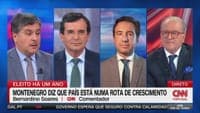
CNN Portugal commentator Bernardino Soares analyses the state of the reforms of Luís Montenegro's Government, on the anniversary of the re-elected Executive.
The author argues that simply presenting facts and exposing the failures of populism is insufficient to counter its rise. The text posits that populism thrives on real grievances—such as economic precariousness and a sense of abandonment—which mainstream centre-left parties, like the Portuguese Socialist Party (PS), have failed to address due to internal stagnation, clientelism, and a lack of genuine renewal. To regain credibility, the centre-left must undergo a structural transformation, prioritising merit and concrete policy solutions—such as large-scale public housing and job-creating climate initiatives—over political routine. Ultimately, the author concludes that political parties must earn the right to be heard by first reforming their own internal practices.
There is an important difference between failing to grasp reality and distorting it. The former is a mistake, while the latter involves intent and strategy. 'The country is better off, and so are the Portuguese,' the Prime Minister told us in his assessment of two years of government. It is not a naive statement.

José Luis Carneiro faces a daunting task in leading the Socialist Party (PS) as it struggles with the legacy of the António Costa era and the financial scandals of the José Sócrates period. The party is currently weakened, lacking representation from key sectors of society and suffering from internal divisions. The author argues that Carneiro must focus on national interests rather than just party politics, suggesting that the current government's perceived apathy under Montenegro provides an opening for the PS. However, the author criticizes Carneiro's current proposals on housing and healthcare as lacking substance, urging him to move beyond ideological rhetoric and embrace structural reforms, such as state-led housing construction and public-private partnerships in health. Ultimately, the author contends that Carneiro's success depends on his ability to bring in new talent and present bold, concrete solutions to the country's problems.

This column examines the 'reforms' proposed by former Prime Ministers Cavaco Silva and Passos Coelho. While acknowledging Cavaco's contributions to tax reform and infrastructure, the author argues he failed to prepare Portugal for the post-Cold War economy, leading to a lack of industrial integration. Passos is criticised for his austerity measures, which the author claims focused on labour market deregulation rather than structural reform. The piece concludes that both leaders failed to foster long-term economic innovation, leaving Portugal reliant on tourism and low wages.
CNN Portugal commentator Rui Calafate analyses how the Government managed the approval of the nationality law and the agreement between the PSD and Chega.

Mário Centeno was already sidelined and left - was it a logical decision or a political move by the current governor? Álvaro Santos Pereira bets on common sense, but not everyone buys the calm version of this story.
It is necessary to turn the page on unproductive trench warfare and discourse centered on an empty moral superiority.

Pedro Passos Coelho wants reforms – and pushes the government into the arms of Chega.

Cavaco Silva published an opinion piece in Expresso in which, like Passos Coelho, he advises the government to show “reformist firmness”. In this episode of Expresso da Manhã, Paulo Baldaia talks with David Dinis.

The election of António José Seguro to the Presidency of the Republic is the first factor to consider. Seguro's understanding widens the room for manoeuvre for the main opposition parties. Analysis by David Santiago.

The Liberal Initiative (IL) supported the adventure in Iran, accused the left of collaborationism, and is now exploiting its predictable effects. War serves moral simplism; inflation serves fiscal populism. Just as Chega will take advantage of a migration crisis, should one occur. They support the cause and ride the consequence. There is no coherence or responsibility. There is political opportunism.