

Cape Verde becomes independent: Praia, 5 July 1975
In a small stadium in Praia, after years of drought, the Portuguese flag came down over islands Portugal had settled in 1462. The party that took over had fought its war on the African mainland and promised to join the two countries into one.
At a glance
- On Saturday 5 July 1975 a National Assembly elected on 30 June proclaimed the Republic of Cape Verde in Praia, ending Portuguese rule over islands that Portugal had begun to settle in 1462.
- The same day the Assembly elected Aristides Pereira, secretary-general of the PAIGC, as President and Pedro Pires as Prime Minister.
- The PAIGC, founded by Amílcar Cabral, had fought for the independence of Guinea and Cape Verde together; its war was fought in Guinea, and Cabral was killed in 1973.
- In the only election before independence, on 30 June 1975, each constituency had a single list of PAIGC candidates. By Lisboeta's count of the published constituency results, about 87 per cent of registered electors voted and 95.6 per cent of ballots were valid votes for the list.
- The planned union with Guinea-Bissau ended with the coup in Bissau of 14 November 1980, and in January 1981 the party in Cape Verde became the PAICV. Multi-party elections followed in 1991.
Two flags at the Várzea
José Silva Pinto, sent by the Diário de Notícias, counted about 4,000 people under “a merciless sun” at the Estádio da Várzea, a modest stadium in Praia, the capital, on the island of Santiago. Over the ground hung a large portrait of Amílcar Cabral with the words “Cabral ca mori”, Creole for “Cabral did not die”, and the crowd chanted his name as “hero of the people”.
The man most celebrated that Saturday, 5 July 1975, was dead. Cabral, the founder of the party that now took power, had been shot in Conakry two and a half years earlier. Silva Pinto saw grave ceremony and carefree carnival at the same time: a Portuguese ship fired salutes, and four military aircraft flew over the stadium and dropped flowers.
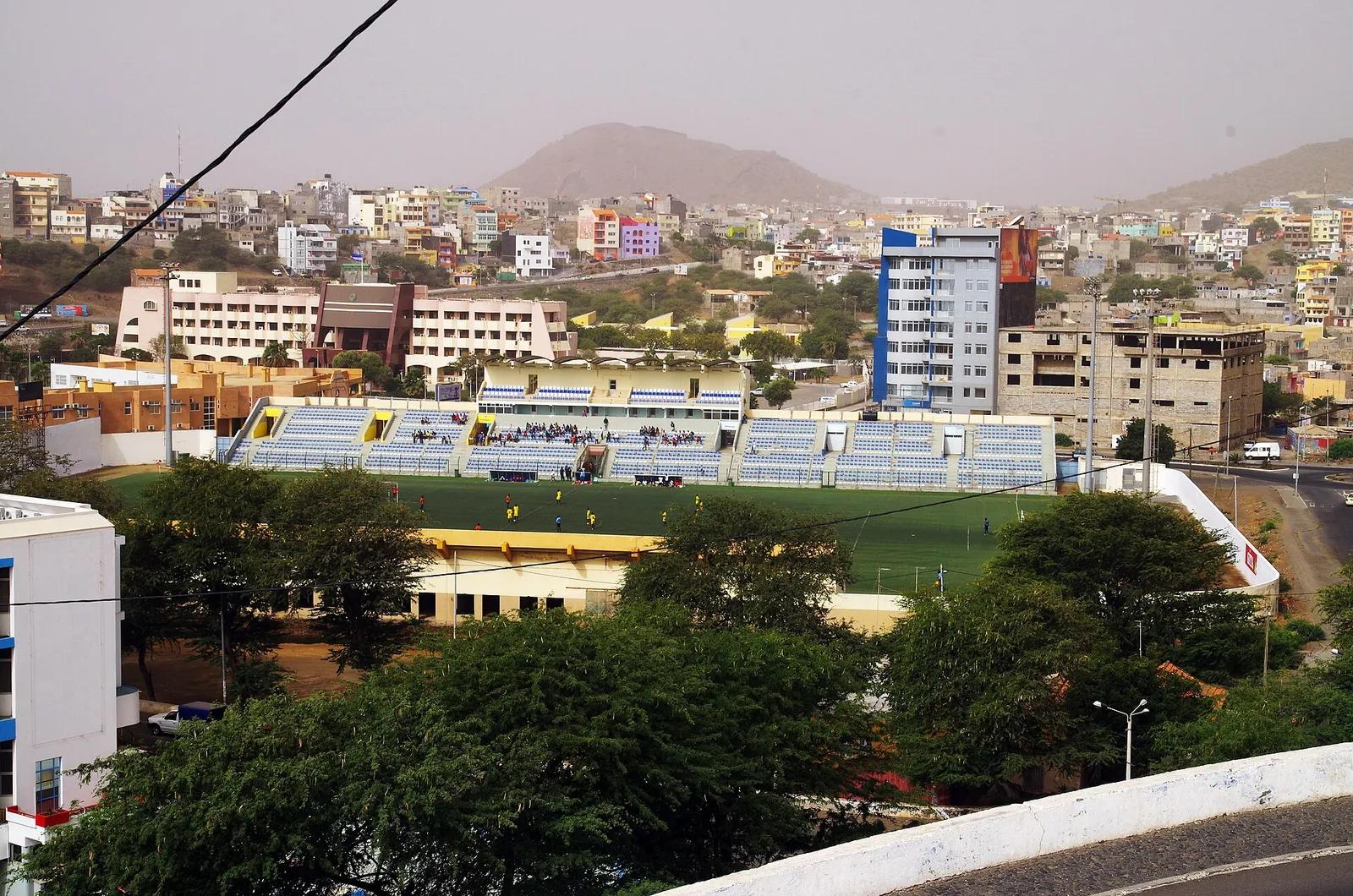
The Portuguese Prime Minister, Vasco Gonçalves, watched Abílio Duarte, the president of the new National Assembly, sign the document that made the transfer official. The last Portuguese High Commissioner, Commodore Vicente Almeida d'Eça, had cabled the day's programme to Lisbon, from a radio message by the PAIGC's secretary-general at midnight to the raising of the Portuguese flag one last time at eight.
The transfer of sovereignty was set for 11.20 at the stadium. The Portuguese flag would be lowered and handed to a representative of the President of Portugal, and the flag of Cape Verde raised to the new anthem.
“People of Cape Verde: today, 5 July 1975, in your name, the National Assembly of Cape Verde solemnly proclaims the Republic of Cape Verde as an independent and sovereign nation.”
- Date
- Saturday 5 July 1975
- Place
- Estádio da Várzea and the National Assembly, Praia, island of Santiago
- Transfer of sovereignty
- Scheduled for 11.20, after the Portuguese flag was raised at 8.00
- Crowd at the stadium
- About 4,000, according to the DN's reporter
- Head of state
- Aristides Pereira, elected by the Assembly the same day
- Prime Minister
- Pedro Pires
- For Portugal
- Prime Minister Vasco Gonçalves
Islands without people
Cape Verde is a group of ten islands and five islets in the Atlantic, off the west coast of Africa. Nobody lived there when Portuguese ships arrived around 1460. Settlement began on Santiago in 1462, at Ribeira Grande in the south and Alcatrazes in the east; Alcatrazes was abandoned about fifty years later because the land was too dry.
The Crown wanted Santiago as an island trading post for the Guinea coast, the African mainland from the headland of Cape Verde, in today's Senegal, down to Sierra Leone. A royal charter of 12 June 1466 gave settlers the right to trade there. As the island was farmed, more and more enslaved Africans were brought in, and a society of masters and slaves grew up, out of which came a third group, the “sons of the land”, black and mixed-race islanders born in Cape Verde.
Ribeira Grande became a city and the seat of a bishop in 1533. For about a century and a half it was a port in the trade that linked Europe, Africa and the Americas, above all in enslaved people. At the end of the sixteenth century the city had about 500 vizinhos, free citizens who owned property, and an estimated 5,000 slaves. Cape Verdean Creole, the islands' own language, was born of this mixing of Africans and Europeans.
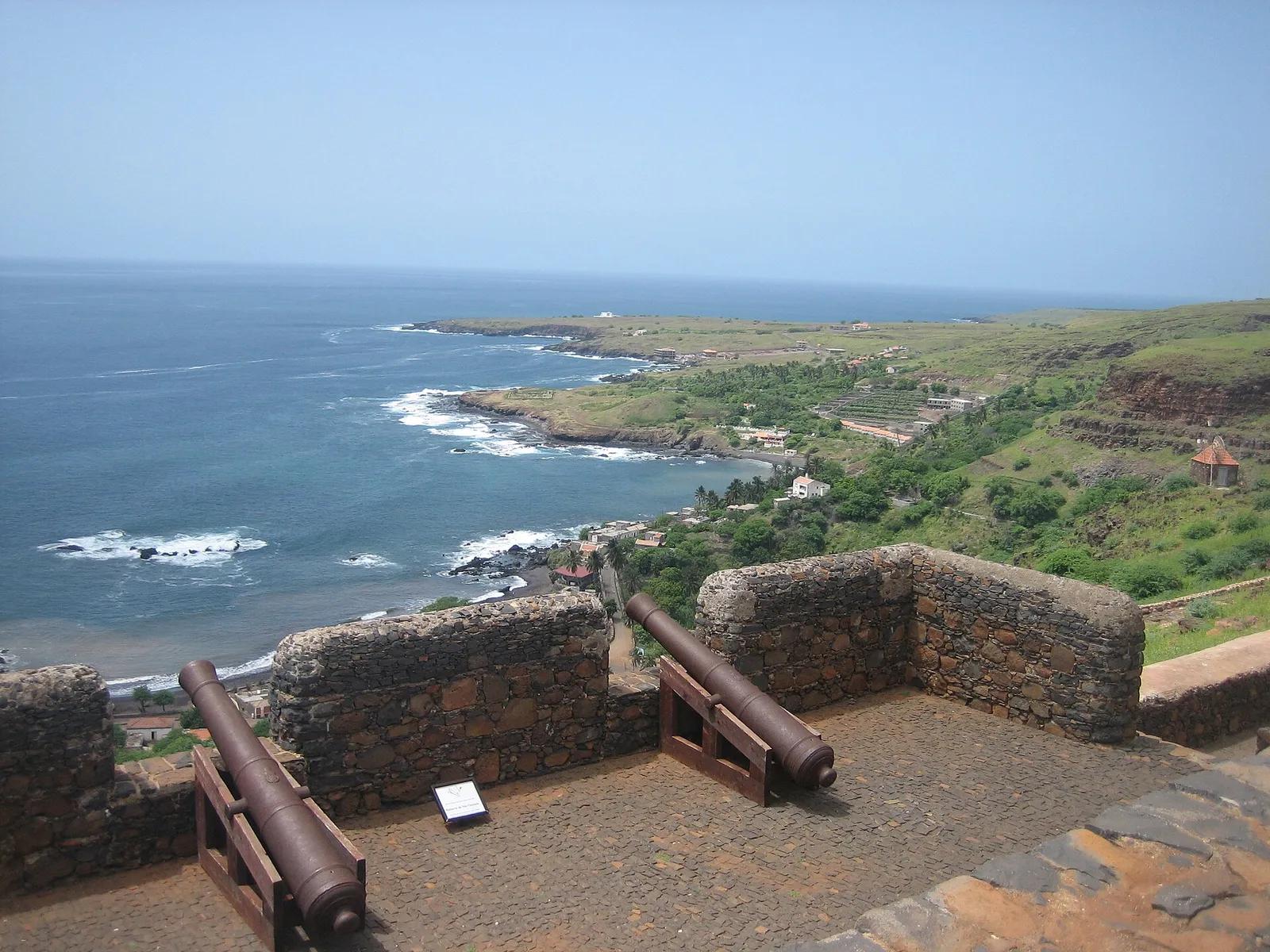
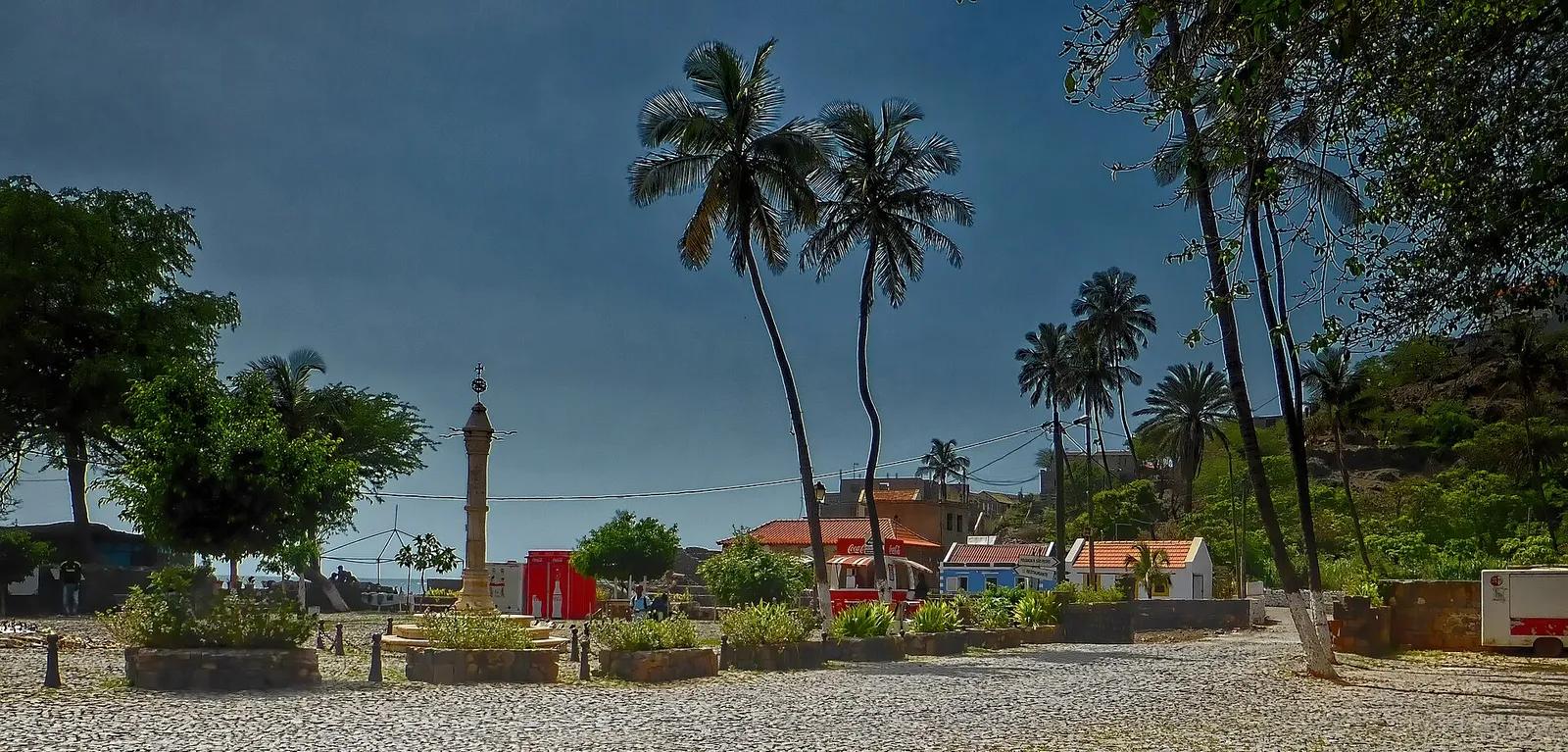
Ribeira Grande declined when the conditions that had created it changed, and it is now called Cidade Velha, the Old City. Portugal ended slavery in stages: a decree of 1869, told in our article on abolition, turned every slave left in the empire into a liberto, bound to serve until 1878.
Drought, hunger and the ships
When the rains failed, people starved. In 1730 the eleven parishes of the archipelago held about 25,000 people; by 1775, after years of drought, the population had fallen to a third. An estimated 82,000 people died of hunger between 1900 and 1947, and the historian António Carreira reckoned that in the worst phases famine killed 17.6 to 22.4 per cent of the population counted at the census.
The famine of 1947 was the last with a great number of victims. In that year, Carreira found, about 128,000 of some 160,000 Cape Verdeans were listed as needy. Death by hunger became one of the main subjects of Cape Verdean fiction.
The other answer was to leave. In the nineteenth century, seamen from Brava, the smallest inhabited island, signed on with the whaling and deep-sea fishing fleets of southern New England, and many settled in New Bedford, Fall River and Providence. Cape Verdean dockers later bought old whaling ships to run a packet trade of goods, mail and passengers between the islands and the United States. Early Cape Verdeans in America were often simply called “Bravas”.
Poorer islanders went south instead, as contract labourers on the coffee and cocoa plantations of São Tomé and Príncipe, another Portuguese colony in the Gulf of Guinea. A decree published in São Tomé in February 1903 organised the recruitment, and in the 1930s a migration company was set up to represent the planters and secure workers. The contracts ran from about 1900 to 1970, and Cape Verdeans still remember them as “forced emigration”.
“Until now you have been the free worker of America: from now on you will be a kind of contract labourer of São Tomé.”
From the 1960s a third route led to Lisbon, where building firms recruited Cape Verdean labourers; that story is told in our article on the film-maker Pedro Costa. The islands also held the Estado Novo's prison camp at Tarrafal, on Santiago, which has its own article too.
Cabral's party for two countries
Amílcar Cabral was born in Bafatá, in Portuguese Guinea, on 12 September 1924 and went to live in Cape Verde as a child. He studied at the liceu, the secondary school, on São Vicente, then won a scholarship in 1945 to the Instituto Superior de Agronomia in Lisbon, where he met the future leaders of the Angolan and Mozambican independence movements. In the summer of 1949 he ran a cultural programme on the radio in Praia until the colonial authorities banned it.
The party Cabral founded in Bissau, which dates itself to 19 September 1956 (some historians and RTP Ensina place the founding in 1959), began as the African Party for Independence, the PAI, and took the name African Party for the Independence of Guinea and Cape Verde, the PAIGC, in October 1960. Unity of the two colonies, linked by history and by the many educated Cape Verdeans who worked in Portugal's colonial service in Guinea, was one of the ideas behind it.
Aristides Pereira, born on the island of Boa Vista in 1923 and a son of a priest, worked in the public service in Guinea and was one of the founders.
The war was fought on the mainland. From 1963 the PAIGC waged a guerrilla war in Guinea, told in our article on its first attack, and Cape Verdeans fought in it, outside their own islands. The proclamation of 1975 would say they had also been ready to take up arms in Cape Verde if that had proved the only way. In April 1971 Cabral used a visit to Stockholm to denounce famine in Cape Verde and asked the United Nations for help.
On 20 January 1973 Cabral was shot dead in Conakry by men from his own party. Pereira became secretary-general. In September 1973 the PAIGC proclaimed the independence of Guinea-Bissau, whose constitution already spoke of union with Cape Verde, but the islands were still a Portuguese colony when the dictatorship in Lisbon fell.
From Algiers to Praia
The Carnation Revolution of 25 April 1974, the military coup that ended the Estado Novo, opened talks with the PAIGC. On 26 August 1974 in Algiers the two sides agreed on the independence of Guinea-Bissau, and Portugal added a promise about the islands.
“The Portuguese delegation, in the name of the Portuguese Government, reaffirms the right of the people of the Cape Verde islands to self-determination and independence and guarantees the realisation of this right, in accordance with the relevant resolutions of the United Nations, also taking into account the will expressed by the Organisation of African Unity.”
The PAIGC had worked on the islands in secret. Its proclamation of 1975 would credit it with inspiring strikes and protests against the colonial order; its critics say it had few supporters there when the dictatorship fell. It also had rivals: the Union of the People of the Cape Verde Islands (UPICV) and the Cape Verde Democratic Union (UDC).
In December 1974, according to José Veiga, who later served in the PAIGC government and broke with it, PAIGC supporters attacked the Rádio Barlavento station and locked up the leaders of both parties to keep them out of the coming government.
Portugal negotiated with the PAIGC alone. On 17 December 1974 the Council of State gave Cape Verde an Organic Statute, and the next day President Costa Gomes appointed Almeida d'Eça High Commissioner. An agreement between the Portuguese government and the PAIGC set the timetable for decolonisation; it is dated 18 December in the decree that put it into effect and 19 December in Lusa's accounts.
The statute provided for a Transitional Government of the High Commissioner and five ministers. Four took office on 30 December: an army officer, Major José Manuel Vaz Barroco, at Internal Administration, and three PAIGC men, Carlos Reis, Amaro da Luz and Manuel Faustino.
Decree-Law 203-A/75 of 15 April 1975 fixed the election of a constituent National Assembly for 30 June and independence for 5 July. It gave the vote to Cape Verdeans aged 17 or over and let emigrants who kept close ties to the islands vote by post. Instead of the d'Hondt proportional method used for Portugal's own constituent election, the most-voted list took every seat in its constituency.
The preamble promised the “free democratic play” of every current of opinion; in the event only one list stood in each constituency, made up of PAIGC candidates. Aristides Pereira headed it in Praia and Pedro Pires in Santa Catarina.
The Electoral Commission published the results, constituency by constituency, on 4 July. Added up by Lisboeta, they give 121,724 registered electors and 105,503 voters, a turnout of 86.7 per cent. The total is approximate: the registration figure for Bela Vista, in Mindelo, is hard to read in the scan, and the likeliest reading, 2,651, is lower than the 2,683 votes recorded there. Raised to 2,683, it leaves turnout unchanged at 86.7 per cent.
The PAIGC lists received 100,835 votes, 95.6 per cent of those cast, and 4,668 ballots were counted as null. Turnout was lowest on Brava, at 56 per cent, and the list did worst on Maio, with 77 per cent of the votes cast.
The election of 30 June 1975, by island
%
- Turnout (voters as % of registered electors)
- Votes for the PAIGC list (% of voters)
Islands ordered by number of registered electors, from 56,122 on Santiago to 1,485 on Maio. Percentages calculated by Lisboeta from the figures for the 24 constituencies in the Electoral Commission's official results of 4 July 1975, grouped by island. The registered total for Bela Vista, in Mindelo, is hard to read in the scan; read as 2,651, which is fewer than the 2,683 voters recorded there, it makes the archipelago total 121,724.
Show the data
| Turnout (voters as % of registered electors) | Votes for the PAIGC list (% of voters) | |
|---|---|---|
| Santiago | 87.8 | 95.4 |
| São Vicente | 87.7 | 97.4 |
| Santo Antão | 89 | 95.6 |
| Fogo | 86.4 | 96.9 |
| São Nicolau | 84.1 | 92.5 |
| Brava | 55.9 | 99.1 |
| Sal | 89.6 | 97.3 |
| Boa Vista | 83.4 | 89.8 |
| Maio | 88.9 | 76.9 |
25 April 1974
Carnation Revolution in Lisbon
26 August 1974
Algiers declaration: Portugal recognises Cape Verde's right to independence
10 September 1974
Portugal recognises Guinea-Bissau
17 December 1974
Organic Statute of the State of Cape Verde (Law 13/74)
18 December 1974
Almeida d'Eça appointed High Commissioner
18 or 19 December 1974
Agreement between Portugal and the PAIGC
30 December 1974
Transitional Government takes office
15 April 1975
Decree-Law 203-A/75 sets the election and independence dates
30 June 1975
Election of the National Assembly
5 July 1975
Independence; Pereira elected President, Pires Prime Minister
The first government
The Assembly met in Praia on 5 July and adopted a Law on the Political Organisation of the State to serve until a constitution was written. Its first article named the PAIGC as the leading political force in society. The Assembly elected Abílio Duarte as its president, Aristides Pereira as President of the Republic and, on Pereira's proposal, Pedro Pires as Prime Minister. Portuguese laws stayed in force wherever they did not conflict with the new order.
| Office | Holder |
|---|---|
| President of the Republic | Aristides Maria Pereira, secretary-general of the PAIGC |
| Prime Minister | Pedro Verona Pires, head of the PAIGC's National Commission for Cape Verde |
| Foreign Affairs | Abílio Duarte, also president of the National Assembly |
| Defence and National Security | Silvino Manuel da Luz |
| Economy | Osvaldo Lopes da Silva |
| Education, Culture, Youth and Sport | Carlos Reis |
| Finance | Amaro da Luz |
| Health and Social Affairs | Manuel Faustino |
| Agriculture and Water | Sérgio Centeio |
| Transport and Communications | Herculano Vieira |
| Public Works | Silvino Lima |
| Justice | David Hopffer Almada |
| Secretary of State for Foreign Affairs | Corsino Tolentino |
The Assembly elected the President and the Prime Minister; the President appointed the ministers on the Prime Minister's proposal. Carlos Reis, Amaro da Luz and Manuel Faustino had been ministers in the Transitional Government since 30 December 1974. Every member except the Justice minister is described in the Boletim Oficial as a member of a PAIGC body.
At the same sitting the Assembly gave Cabral the title of Founder of the Nation, created a medal in his name and made his birthday, 12 September, the national day. Ten days before, the PAIGC's leadership had asked governments and international bodies for money, food and technical aid for islands left, after nearly ten years of continuous drought, under a real threat of famine.
Two bodies, one heart
Independence was meant as a first step. After an extended meeting in Bissau on 24 and 25 June 1975, the PAIGC's Superior Council of the Struggle declared that the Cape Verdean Assembly would decide on union with Guinea-Bissau, and proposed a Council of Unity, formed by commissions of both parliaments, to draft a constitution for an association of the two states. The law the Assembly passed on 5 July mandated its constitutional commission to sit on that council.
“And the day is not far off when the two sister nations, joined in a fraternal union, two bodies and one heart, will make up the fine reality that the best son of our people, Amílcar Cabral, dreamed of and had enshrined in our Party's Major Programme.”
The new flag looked like Guinea-Bissau's, with two ears of maize and a shell added. In Praia Pereira said the union would be “original” and respect the particular character of each country. Guinea-Bissau's parliament had already approved it; the Cape Verdean side had yet to decide, and the plan met resistance. The DN's correspondent in Bissau reported that the city had emptied of political and technical cadres and of the petty bourgeoisie, who had left by boat and plane for Praia.
Guinea-Bissau's President was Luís Cabral, Amílcar's half-brother, born in Bissau but schooled in Cape Verde. On 14 November 1980 the man he had made Prime Minister in 1978, João Bernardo “Nino” Vieira, overthrew him in a coup known in Bissau as the Readjustment Movement. Its point, as the Diário de Notícias put it when Luís Cabral died in 2009, was that Guineans, and not the educated mixed-race Cape Verdeans Guinea had inherited from colonial rule, would run the country.
Pereira broke with Vieira. The PAIGC's Cape Verdean members met in congress from 16 to 20 January 1981 and recognised that the coup had ended the PAIGC as a party of two nations. They turned it into the African Party for the Independence of Cape Verde, the PAICV, which claimed the whole legacy of Cabral. On 12 February the Assembly revised the constitution of 1980 to match, removing several articles and naming the PAICV the leading force of society and the state.
“The change in the institutional order that occurred in Guinea-Bissau on 14 November 1980 in fact brought about the end of the existence of the African Party for the Independence of Guinea and Cape Verde as a binational political organisation.”
From one party to many
Pereira was President for 16 years, and for 15 of them Cape Verde had a single party. Critics who once served the regime, such as José Veiga, have described persecution of opponents. By Veiga's account the government first used torture in 1977, against young people in Mindelo who had put up leaflets about the arrogance of power, and in August 1981 it crushed protests against land reform on Santo Antão, calling them “enemy actions”.
The single-party state ended in 1990, when the opposition Movement for Democracy (MpD) was founded. Pereira governed until the first free elections, in 1991, and was succeeded by António Mascarenhas Monteiro. In 1992 the new democracy replaced the 1975 flag with today's blue flag with a red and white stripe and ten stars.
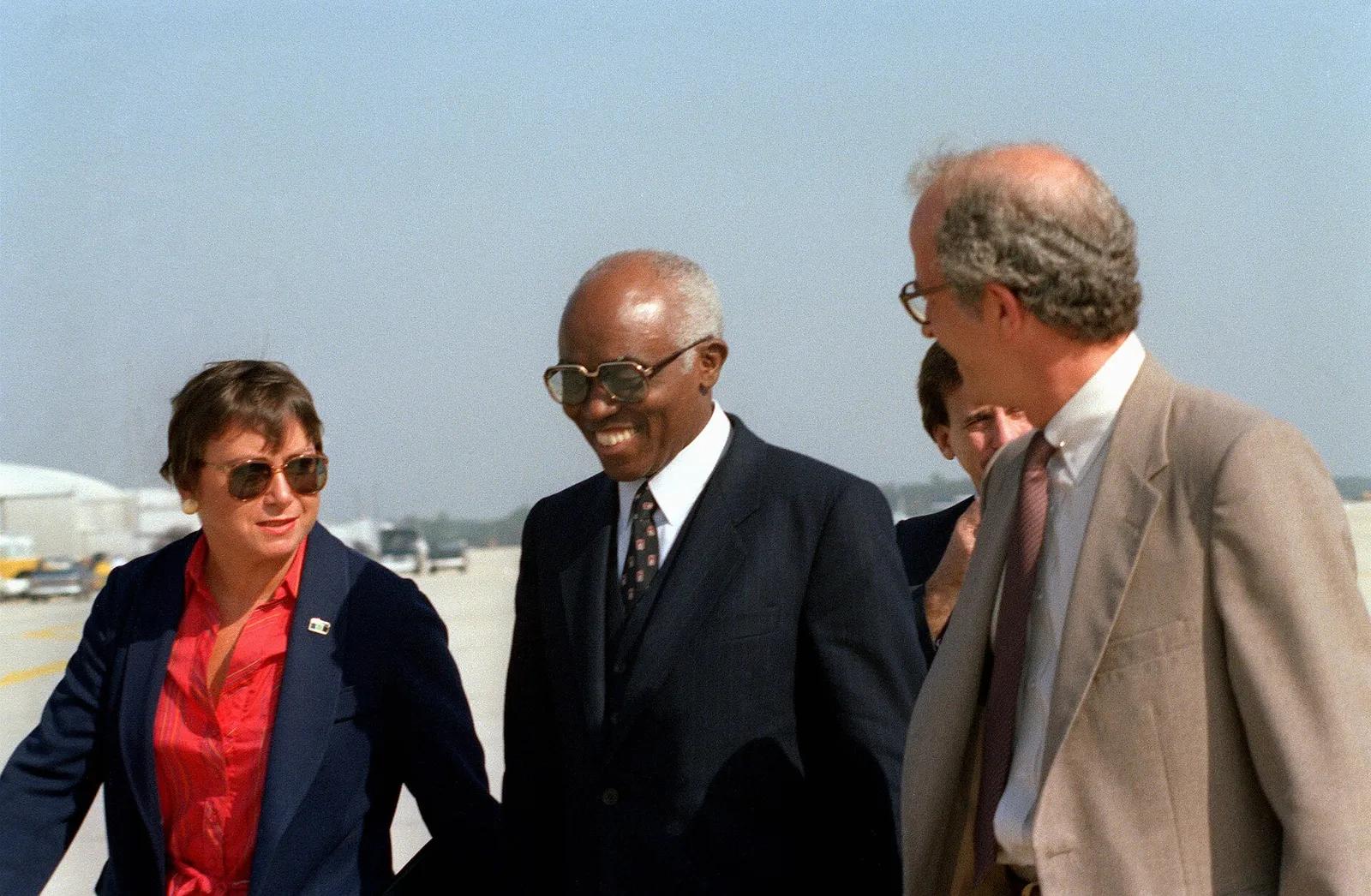
Pereira died in the university hospital at Coimbra on 22 September 2011, aged 87, after an operation on a broken hip.
Why it still matters
Cape Verde and Guinea-Bissau, born of one party, went separate ways. Fifty years on, the Diário de Notícias described Cape Verde as one of Africa's few established democracies, with the best human development score among the Portuguese-speaking African countries, though still far behind the rich world.
Portugal's President, Marcelo Rebelo de Sousa, was in Praia for the 50th anniversary on 5 July 2025 and called cooperation between the two countries “unstoppable”. He counted more than 20,000 Portuguese living on the islands and more than 50,000 Cape Verdeans in Portugal, and reckoned he had visited about 20 times in ten years.
Most Cape Verdeans in Portugal live in and around Lisbon, the result of migrations that began in the 1960s and grew after independence. A decree of 24 June 1975 made most of them foreigners: people born in the African colonies lost Portuguese nationality unless they descended from people born in Portugal or had lived there for more than five years by 25 April 1974.
FAQs
When did Cape Verde become independent?
On 5 July 1975. The National Assembly elected on 30 June proclaimed the Republic of Cape Verde in Praia, and Portugal transferred sovereignty at a ceremony at the Estádio da Várzea the same day. Cape Verde had been Portuguese since settlement began in 1462.
Who was the first President of Cape Verde?
Aristides Pereira, born on Boa Vista in 1923, a founder of the PAIGC and its secretary-general after Amílcar Cabral's death. The National Assembly elected him on 5 July 1975. He governed until the first multi-party elections in 1991 and died in Coimbra in 2011.
Was there a war of independence in Cape Verde?
Not on the islands. The PAIGC fought a guerrilla war in Guinea-Bissau from 1963, and Cape Verdeans fought in it, but Cape Verde itself became independent through negotiation after the Carnation Revolution of 1974, an agreement with the PAIGC in December 1974 and an election in June 1975.
Why did Cape Verde and Guinea-Bissau not unite?
Union was the PAIGC's aim, and a Council of Unity was planned in 1975. But on 14 November 1980 João Bernardo Vieira overthrew Guinea-Bissau's President Luís Cabral, and the Cape Verdeans in the party broke away and formed the PAICV in January 1981.
How many people voted in Cape Verde's independence election?
Adding up the official results for the 24 constituencies gives 105,503 voters out of 121,724 registered electors on 30 June 1975, a turnout of about 87 per cent; one registration figure is hard to read in the scan, so the electorate total is approximate. The single PAIGC list received 100,835 votes, 95.6 per cent of those cast; the rest were counted as null.
On the timeline
Open the timelineNearby moments from revolution and democracy (1974–1986).
The workers' committee of the Lisbon daily 'República', led by its print workers, ousts the Socialist-leaning editors and takes over the paper. The 'República Affair' that followed led the Socialists to quit the provisional government in July.
Portugal's Constituent Assembly — 250 deputies chosen on 25 April 1975 in the country's first free elections with universal suffrage — holds its opening session in São Bento. Given ninety days to write a new constitution, it needs ten tumultuous months of revolution; the Constitution it approves on 2 April 1976 is still in force.
Mozambique becomes independent from Portugal after nearly five centuries of Portuguese presence and a decade of liberation war. At midnight in the Machava stadium, outside Lourenço Marques (renamed Maputo in 1976), FRELIMO's leader Samora Machel proclaims the People's Republic of Mozambique and becomes its first president.
Cape Verde's independence
Cape Verde becomes independent from Portugal after more than five hundred years of Portuguese presence. In Praia the new National Assembly proclaims the republic and elects Aristides Pereira of the PAIGC as its first President, another chapter in the decolonisation that followed the Carnation Revolution.
São Tomé and Príncipe becomes independent from Portugal after five centuries of colonial rule, with Manuel Pinto da Costa of the MLSTP sworn in as the new republic's first President.
Portugal's Sixth Provisional Government, led by the naval officer José Pinheiro de Azevedo, is sworn in. The last of the provisional governments after the 1974 revolution, it stays in office until July 1976.
Mário Soares and Álvaro Cunhal face each other on RTP in a debate lasting 3 hours, 40 minutes and 52 seconds, moderated by Joaquim Letria and José Carlos Megre. Cunhal's repeated 'Olhe que não, olhe que não' ('Look, it isn't so') passed into Portuguese folklore, and the clash is still remembered as the longest and most famous political debate on Portuguese television.
Coming up in history
All long reads 7 July 1923Guerra Junqueiro, the poet who mocked God and king, dies in Lisbon
 8 July 1832The landing at Mindelo: Dom Pedro's 7,500 come ashore, 8 July 1832
 9 July 1955Alves dos Reis and the banknote fraud that shook Portugal in 1925
 10 July 2016Éder's goal in Saint-Denis: Portugal win Euro 2016, 10 July 2016
29 sources
Archives, scholarship and reporting this article was checked against.
- 1
Boletim Oficial da República de Cabo Verde, no. 1, 5 July 1975Imprensa Nacional de Cabo Verde (Boletim Oficial archive, INCV)
- 2
- 3
- 4
- 5
O primeiro centro urbano colonial nos trópicos: Ribeira Grande (Cabo Verde), séculos XV-XVII (Maria Emília Madeira Santos and Iva Cabral)Anais de História de Além-Mar VII (2006), CHAM, Universidade NOVA de Lisboa
- 6O dia em que os cabo-verdianos se esqueceram da prolongada seca (César Avó)Diário de Notícias, 5 July 2025
- 7
Discursos e representações: death by famine in Cape Verdean literature (Margarida Fernandes)Via Atlântica 10 (2006), Universidade de São Paulo
- 8
Texto da declaração Portugal-PAIGC (Algiers, 26 August 1974) and Declaração sobre a independência da República da Guiné-Bissau (10 September 1974)Textos Históricos da Revolução, ed. Orlando Neves, reproduced by the Marxists Internet Archive
- 9O telegrama com que há 50 anos Cabo Verde informou Portugal das cerimóniasRTP Notícias / Lusa, July 2025
- 10
From Port to Port: The Cape Verdean Connection (Miguel Youngs)EnCompass, Rhode Island Historical Society
- 11Descobertos vestígios de casas mais antigas de Cabo Verde onde funcionou capitaniaRTP Notícias / Lusa
- 12
Sítio Histórico Cidade Velha, Património MundialInstituto do Património Cultural de Cabo Verde
- 13
Decree of 25 February 1869 abolishing the state of slavery in all territories of the Portuguese monarchy, with its preamble (Diário do Governo no. 45, 27 February 1869)Faculdade de Direito, Universidade Nova de Lisboa (reproduction)
- 14
- 15
Musicalidades das cabo-verdianas nas roças de São Tomé e Príncipe (Carla Indira Carvalho Semedo)Revista Estudos Feministas 24 (3), Universidade Federal de Santa Catarina, 2016
- 16
Os cabo-verdianos em Portugal: processo de consolidação, estratégias individuais e acção colectiva (Ana Paula Beja Horta and Jorge Macaísta Malheiros)Instituto de Estudos Estratégicos e Internacionais (IEEI)
- 17
- 18
Amílcar Lopes CabralMuseu do Aljube Resistência e Liberdade
- 19
- 20O homem que Nino Vieira derrubouDiário de Notícias, 31 May 2009
- 21
Aristides Pereira, o primeiro Presidente de Cabo VerdeRTP Ensina
- 22
- 23Morreu o primeiro presidente de Cabo VerdeCorreio da Manhã / Lusa, 22 September 2011
- 24
Review of José Tomaz Wahnon C. Veiga, A “Democracia” Nacional Revolucionária: o projecto totalitário do PAIGC/PAICV, Cabo Verde 1975-1990 (Jan Klíma)Modern Africa: Politics, History and Society 10 (2), 2022
- 25
- 26
- 27
Marcelo em Cabo Verde nos 50 anos da transferência de soberaniaNotícias ao Minuto / Lusa, 3 December 2024
- 28
- 29PR considera “imparável” cooperação entre Portugal e Cabo VerdeRTP Notícias / Lusa, 5 July 2025
Image credits
- The square of the pillory at Cidade Velha, the old Ribeira Grande on Santiago, in 2014. The town, founded soon after settlers arrived in 1462, was the islands' first seat of power and a hub of the Atlantic slave trade; the pillory dates from the early sixteenth century. Reino Baptista, CC BY-SA 4.0, via Wikimedia Commons.
- The Estádio da Várzea in Praia, seen from the monument to the navigator Diogo Gomes in February 2015. Portugal handed over sovereignty here on 5 July 1975. Balou46, CC BY-SA 4.0, via Wikimedia Commons.
- The view from the Fortress of São Filipe, built in 1587 above Ribeira Grande, now Cidade Velha, in 2006. The town in the valley below was the islands' first city and slave port. Erik Kristensen, CC BY 2.0, via Wikimedia Commons.
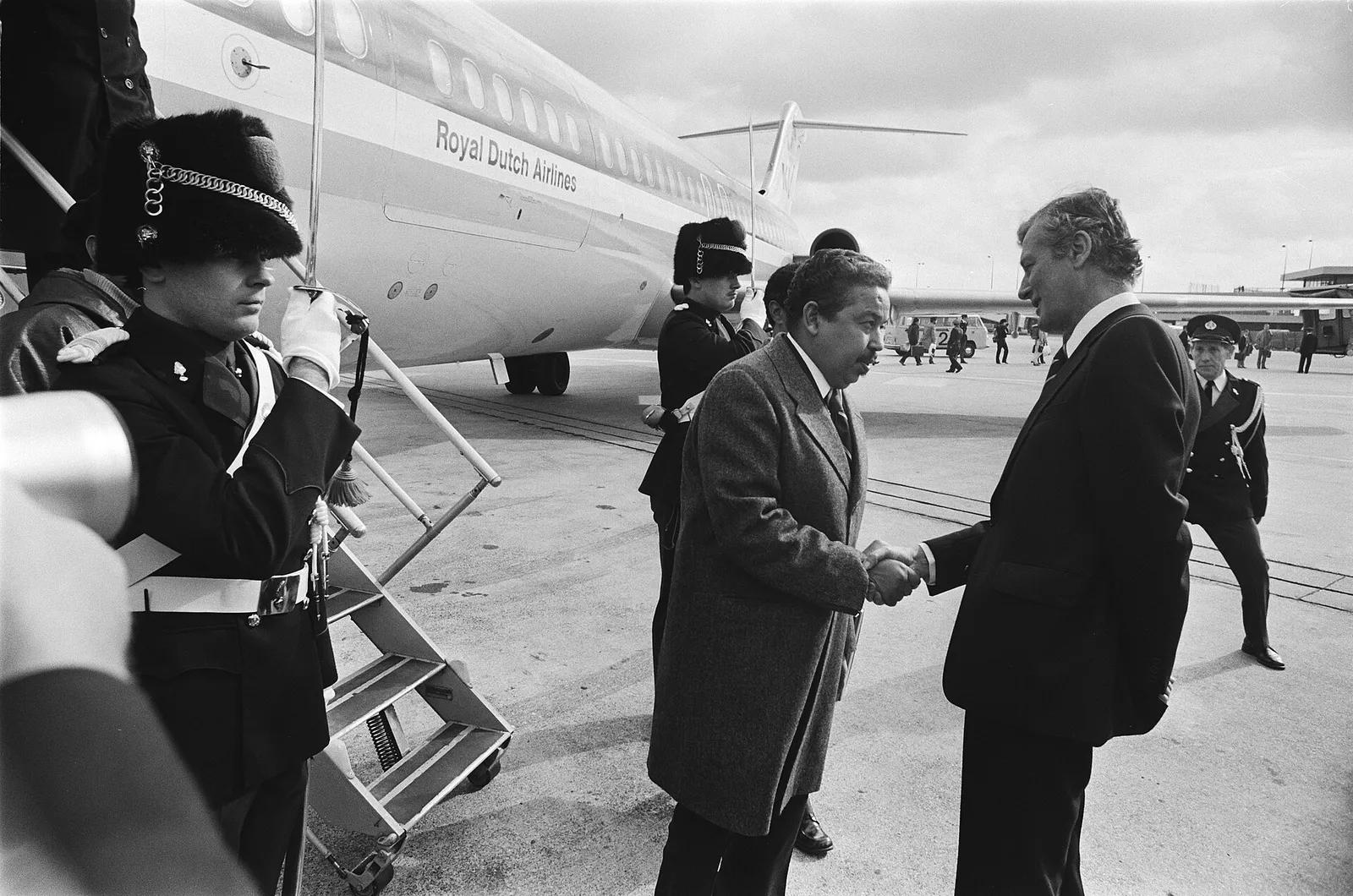
- Cape Verde's Prime Minister, Pedro Pires, in the grey overcoat, is met by the Dutch minister De Koning on arriving in the Netherlands on 29 March 1978. Koen Suyk / Anefo, CC0, via Wikimedia Commons.
- President Aristides Pereira leaves Andrews Air Force Base, Maryland, at the end of a state visit to the United States on 4 October 1983. SSGT Maria Briestline, Public domain, via Wikimedia Commons.